Name: I.D.Rubasinghe
Index Number: 12001228
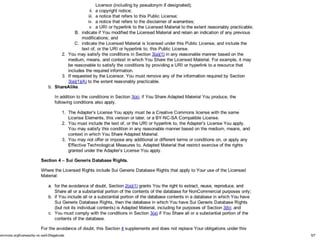
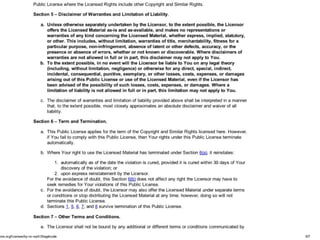
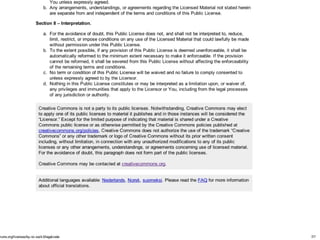
( Including the CC Licence in 7 slides in landscape mode of it’s all pages )
•Q1Q1
•What Is GNU GPL ?
•Different Versions Of GNU GPL
•GNU LGPL
•MsPL
•Comparison And Contrast
•Business Models That Can Be Explained
•Q2
•Combining License Types
•Similar Practical Cases
•Q3Q3
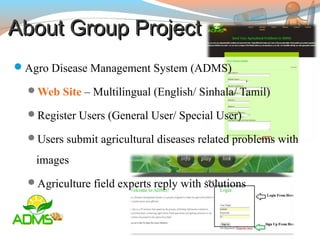
•About Group Project
•CC License
•Why Add CC License To Web Site ?
•Attributions And Why Are They ?
What is GNU GeneralWhat is GNU General
Public License (GPL) ?Public License (GPL) ?
• A free, copy-left license for software and other kinds of
works
• Is intended to guarantee your freedom to share and change all
versions of a program to make sure it remains free software
for all its users
Developers that use the GNU GPL protect your rights with
TWO steps:
(1) Assert copyright on the software
(2) Offer you this license giving you legal permission to copy,
distribute and/or modify it
What is GNU General Public License (GPL) ?What is GNU General Public License (GPL) ?
contd...contd...
What is GNU General Public License (GPL) ?What is GNU General Public License (GPL) ?
contd...contd...
You have the freedom to distribute copies of free software
(and charge for them if you wish), that you receive source
code or can get it if you want it, that you can change the
software or use pieces of it in new free programs
You have certain responsibilities if you distribute copies of
the software, or if you modify it: responsibilities to respect
the freedom of others
What is GNU General Public License (GPL) ?What is GNU General Public License (GPL) ?
contd...contd...
Different Versions Of GNUDifferent Versions Of GNU
GPLGPL
Version 1 - GPLv1
Released on 25 February 1989
The first problem was that distributors may publish binary files only-
executable, but not readable or modifiable by humans
To prevent this, GPLv1 said that any vendor distributing binaries must
also make the human-readable source code available under the same
licensing terms
The second problem was the distributors might add additional restrictions
 To prevent this, GPLv1 said that modified versions, as a whole, had to
be distributed under the terms in GPLv1 (sections 2b and 4 of the
license)
Different Versions Of GNU GPL contd...Different Versions Of GNU GPL contd...
Version 2 - GPLv2
Released in June 1991
According to Richard Stallman, the major change in GPLv2 was the
"liberty or death" clause
This section says that if somebody has restrictions imposed that prevent him
or her from distributing GPL-covered software in a way that respects other
users' freedom, he or she cannot distribute it at all. The hope is, that this will
make it less tempting for companies to use patent threats to require a fee from
the free software developers
When version 2 of the GPL (GPLv2) was released therefore, a second
license - the Library General Public License was introduced at the same
time and numbered with version 2 to show that both were complementary
Different Versions Of GNU GPLDifferent Versions Of GNU GPL contd...contd...
Version 3 - GPLv3
Released by FSF on 29 June 2007 - Written by Richard Stallman
According to Stallman, the most important changes are in relation to :
Software Patents
Free Software License Compatibility
Definition Of "Source Code"
Hardware Restrictions On Software Modification ("Tivoization")
Other changes relate to internationalization, how license violations are
handled, and how additional permissions can be granted by the copyright
holder
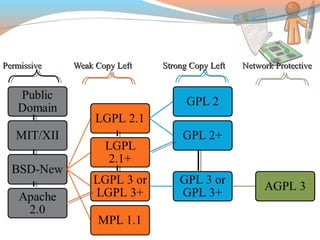
PermissivePermissive Weak Copy LeftWeak Copy Left Strong Copy LeftStrong Copy Left Network ProtectiveNetwork Protective
GNU Lesser GeneralGNU Lesser General
Public License (LGPL)Public License (LGPL)
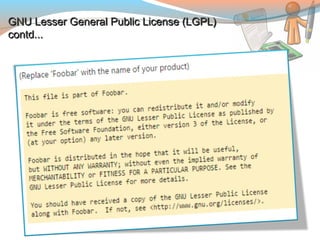
This accompanies some open source software that details
how the software and its accompany source code can be
freely copied, distributed and modified
The author of this license asks that you only use this
license if you are licensing functionality already commonly
available
A LGPL is used to license free software so that it can be
incorporated into both free software and proprietary
software, and is often referred to as the weaker sibling of
GNU Lesser General Public License (LGPL)GNU Lesser General Public License (LGPL)
contd...contd...
Provides copyright protection: True
Can be used in commercial applications: True
Bug fixes / extensions must be released to the public
domain: True
Provides an explicit patent license: False
Can be used in proprietary (closed source) applications: True
Is a viral licence: True
GNU Lesser General Public License (LGPL)GNU Lesser General Public License (LGPL)
contd...contd...
Microsoft PublicMicrosoft Public
License (MsPL)License (MsPL)
Used by Microsoft
This license governs use of the accompanying software
If you use the software, you accept this license
If you do not accept the license, do not use the software
Does not grant permission to the contributor’s name, logo
or trademark
Incompatible with GPL
Microsoft Public License (MsPL) contd...Microsoft Public License (MsPL) contd...
Provides copyright protection: True
Can be used in commercial applications: True
Bug fixes / extensions must be released to the public
domain: False
Provides an explicit patent license: True
Can be used in proprietary (closed source)
applications: True
Is a viral licence: False
Comparison And ContrastComparison And Contrast
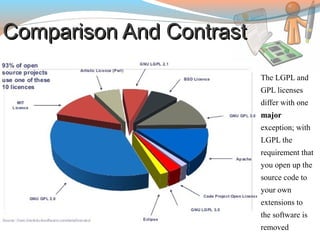
 The LGPL and
GPL licenses
differ with one
major
exception; with
LGPL the
requirement that
you open up the
source code to
your own
extensions to
the software is
removed
Comparison And Contrast contd...Comparison And Contrast contd...
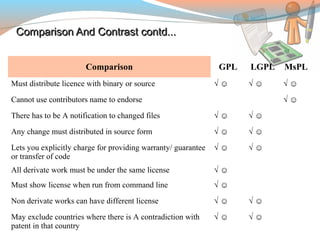
Comparison GPL LGPL MsPL
Must distribute licence with binary or source √ ☺ √ ☺ √ ☺
Cannot use contributors name to endorse √ ☺
There has to be A notification to changed files √ ☺ √ ☺
Any change must distributed in source form √ ☺ √ ☺
Lets you explicitly charge for providing warranty/ guarantee
or transfer of code
√ ☺ √ ☺
All derivate work must be under the same license √ ☺
Must show license when run from command line √ ☺
Non derivate works can have different license √ ☺ √ ☺
May exclude countries where there is A contradiction with
patent in that country
√ ☺ √ ☺
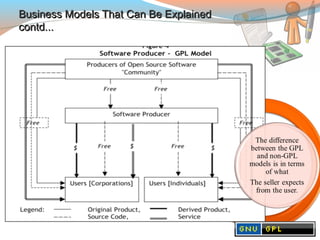
Business Models ThatBusiness Models That
Can Be ExplainedCan Be Explained
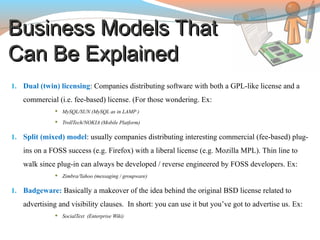
1. Dual (twin) licensing: Companies distributing software with both a GPL-like license and a
commercial (i.e. fee-based) license. (For those wondering. Ex:
 MySQL/SUN (MySQL as in LAMP )
 TrollTech/NOKIA (Mobile Platform)
1. Split (mixed) model: usually companies distributing interesting commercial (fee-based) plug-
ins on a FOSS success (e.g. Firefox) with a liberal license (e.g. Mozilla MPL). Thin line to
walk since plug-in can always be developed / reverse engineered by FOSS developers. Ex:
 Zimbra/Yahoo (messaging / groupware)
1. Badgeware: Basically a makeover of the idea behind the original BSD license related to
advertising and visibility clauses. In short: you can use it but you’ve got to advertise us. Ex:
 SocialText  (Enterprise Wiki) 
Business Models That Can Be ExplainedBusiness Models That Can Be Explained
contd...contd...
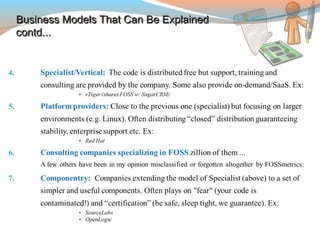
Business Models That Can Be Explained contd...Business Models That Can Be Explained contd...
8. Search engines: How to find the right source code and its license? And yes, Google is here too and
also a few VC-backed companies thinking in the worst case they can always turn into FOSS
management companies. Ex:
 Google code search (Labs) 
8.    Community/Resources: The traditional repositories but also various and large forums/discussion
boards. Ex:
 SourceForge/SourceForge Inc.
 The Code Project
10. FOSS management/Compliance: The idea here is really to play on people’s fear that their
proprietary software might have been contaminated by a GNU-like license. Hence products and
services geared towards cleansing, identification and Open Source compliance enforcement.
8. Black Duck the leader
Obviously "Free" in "Free Open Source developer" does mean "Free" as in 
"Free beer"!
Business Models That Can Be ExplainedBusiness Models That Can Be Explained
contd...contd...
Business Models That Can Be Explained contd...Business Models That Can Be Explained contd...
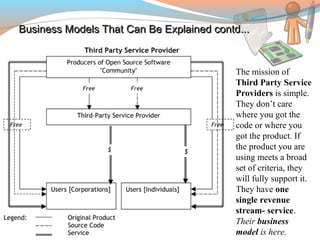
The mission of
Third Party Service 
Providers is simple.
They don’t care
where you got the
code or where you
got the product. If
the product you are
using meets a broad
set of criteria, they
will fully support it.
They have one 
single revenue 
stream- service.
Their business
model is here. 
Business Models That Can Be Explained contd...Business Models That Can Be Explained contd...
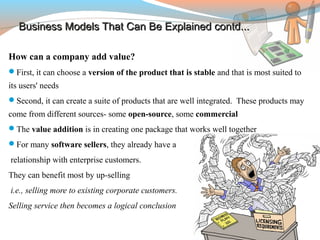
How can a company add value?
First, it can choose a version of the product that is stable and that is most suited to
its users' needs
Second, it can create a suite of products that are well integrated. These products may
come from different sources- some open-source, some commercial
The value addition is in creating one package that works well together
For many software sellers, they already have a
relationship with enterprise customers.
They can benefit most by up-selling
i.e., selling more to existing corporate customers. 
Selling service then becomes a logical conclusion
Combining License Types
Many of the most common free software licenses, such as the:
 original MIT/X license
BSD licenses (in the 3-clause and 2-clause forms, though not the
original 4-clause form)
MPL 2.0
LGPL
are "GPL-compatible". 
That is, their code can be combined with a program under the GPL without
conflict (the new combination would have the GPL applied to 
the whole).
When it comes to copy-left software licenses, they are not inherently GPL-
compatible, even the GPLv2 is, by itself, not compatible with GPLv3
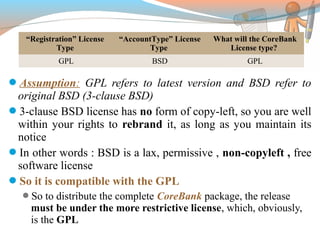
“Registration” License 
Type 
“AccountType” License 
Type 
What will the CoreBank 
License type? 
GPL LGPL GPL
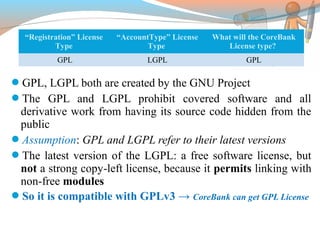
GPL, LGPL both are created by the GNU Project
The GPL and LGPL prohibit covered software and all
derivative work from having its source code hidden from the
public
Assumption: GPL and LGPL refer to their latest versions
The latest version of the LGPL: a free software license, but
not a strong copy-left license, because it permits linking with
non-free modules
So it is compatible with GPLv3 → CoreBank can get GPL License
GPL + LGPL contd...GPL + LGPL contd...
Problems
A side-effect of the strong copy-left terms of the GPL is
that even many free and open source software projects are
prohibited from using GPLed libraries
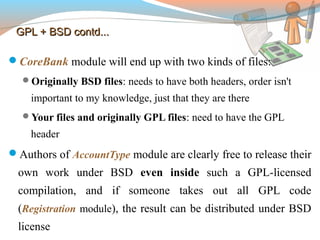
“Registration” License
Type
“AccountType” License
Type
What will the CoreBank
License type?
GPL BSD GPL
Assumption: GPL refers to latest version and BSD refer to
original BSD (3-clause BSD)
3-clause BSD license has no form of copy-left, so you are well
within your rights to rebrand it, as long as you maintain its
notice
In other words : BSD is a lax, permissive , non-copyleft , free
software license
So it is compatible with the GPL
So to distribute the complete CoreBank package, the release
must be under the more restrictive license, which, obviously,
is the GPL
GPL + BSD contd...GPL + BSD contd...
CoreBank module will end up with two kinds of files:
Originally BSD files: needs to have both headers, order isn't
important to my knowledge, just that they are there
Your files and originally GPL files: need to have the GPL
header
Authors of AccountType module are clearly free to release their
own work under BSD even inside such a GPL-licensed
compilation, and if someone takes out all GPL code
(Registration module), the result can be distributed under BSD
license
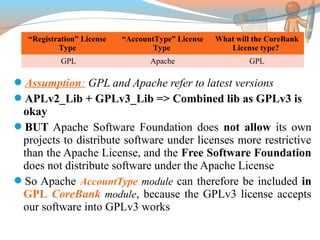
“Registration” License
Type
“AccountType” License
Type
What will the CoreBank
License type?
GPL Apache GPL
Assumption: GPL and Apache refer to latest versions
APLv2_Lib + GPLv3_Lib => Combined lib as GPLv3 is
okay
BUT Apache Software Foundation does not allow its own
projects to distribute software under licenses more restrictive
than the Apache License, and the Free Software Foundation
does not distribute software under the Apache License
So Apache AccountType module can therefore be included in
GPL CoreBank module, because the GPLv3 license accepts
our software into GPLv3 works
GPL + Apache contd...GPL + Apache contd...
Problems
However, GPLv3 modules cannot be included in
Apache projects. The licenses are compatible in one
direction only
“Registration” License
Type
“AccountType” License
Type
What will the CoreBank
License type?
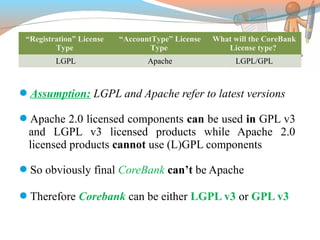
LGPL Apache LGPL/GPL
Assumption: LGPL and Apache refer to latest versions
Apache 2.0 licensed components can be used in GPL v3
and LGPL v3 licensed products while Apache 2.0
licensed products cannot use (L)GPL components
So obviously final CoreBank can’t be Apache
Therefore Corebank can be either LGPL v3 or GPL v3
LGPL + Apache contd...LGPL + Apache contd...
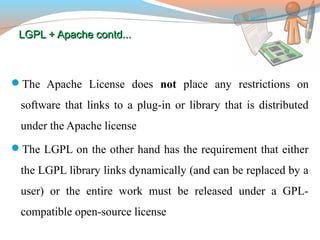
The Apache License does not place any restrictions on
software that links to a plug-in or library that is distributed
under the Apache license
The LGPL on the other hand has the requirement that either
the LGPL library links dynamically (and can be replaced by a
user) or the entire work must be released under a GPL-
compatible open-source license
“Registration” License
Type
“AccountType” License
Type
What will the CoreBank
License type?
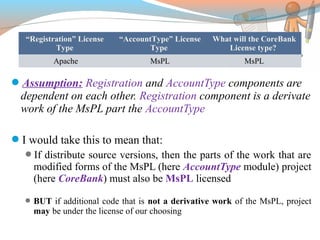
Apache MsPL MsPL
Assumption: Registration and AccountType components are
dependent on each other. Registration component is a derivate
work of the MsPL part the AccountType
I would take this to mean that:
If distribute source versions, then the parts of the work that are
modified forms of the MsPL (here AccountType module) project
(here CoreBank) must also be MsPL licensed
BUT if additional code that is not a derivative work of the MsPL, project
may be under the license of our choosing
Apache + MsPL contd...Apache + MsPL contd...
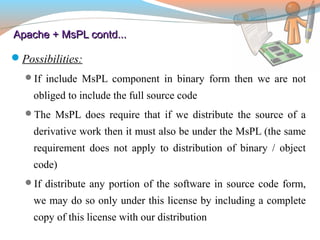
Possibilities:
If include MsPL component in binary form then we are not
obliged to include the full source code
The MsPL does require that if we distribute the source of a
derivative work then it must also be under the MsPL (the same
requirement does not apply to distribution of binary / object
code)
If distribute any portion of the software in source code form,
we may do so only under this license by including a complete
copy of this license with our distribution
Similar Practical CasesSimilar Practical Cases
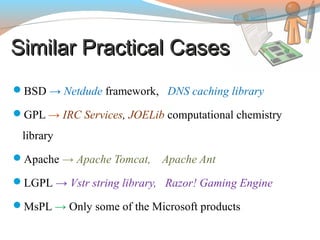
BSD → Netdude framework, DNS caching library
GPL → IRC Services, JOELib computational chemistry
library
Apache → Apache Tomcat, Apache Ant
LGPL → Vstr string library, Razor! Gaming Engine
MsPL → Only some of the Microsoft products
About Group ProjectAbout Group Project
Agro Disease Management System (ADMS)
Web Site – Multilingual (English/ Sinhala/ Tamil)
Register Users (General User/ Special User)
Users submit agricultural diseases related problems with
images
Agriculture field experts reply with solutions
Why add CC License toWhy add CC License to
Website ?Website ?
Anyone on the Internet can find our website
But what if someone wants to download content, reuse
images, or copy documents we have published online ?
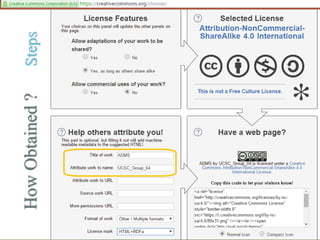
By adding a Creative Commons license, can encourage
others to reuse, remix, and redistribute our content
Can professionally share our work with the world !
Attribution - NonCommercialAttribution - NonCommercial
-ShareAlike 4.0 International-ShareAlike 4.0 International
(CC BY-NC-SA 4.0)(CC BY-NC-SA 4.0)
Why this ?
Because the ATTRIBUTIONSATTRIBUTIONS of this license
well satisfy the needs / requirements of the selected
project
What are
they ?
We’ll see
Cont...
ATTRIBUTIONSATTRIBUTIONS andand
Why are they ?Why are they ?Attribution 
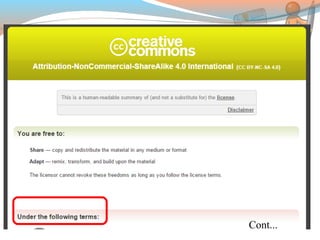
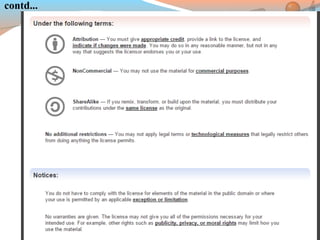
To Let others remix, tweak and build upon our web site. I let to
do so because this project is a non-profit social work by itself to
ease the famers’ agriculture problems solving. So if anyone can
improve this it’s great.
NonCommercial 
To let them know that their new works must also acknowledge us 
and be non-commercial, otherwise it will break the quality and
social value of our work. contd...
ATTRIBUTIONSATTRIBUTIONS and Why are they ? contd...and Why are they ? contd...
ShareAlike 
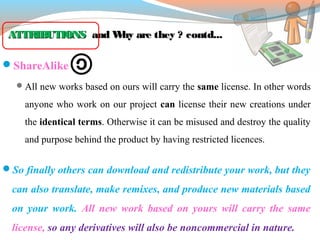
All new works based on ours will carry the same license. In other words
anyone who work on our project can license their new creations under
the identical terms. Otherwise it can be misused and destroy the quality
and purpose behind the product by having restricted licences.
So finally others can download and redistribute your work, but they
can also translate, make remixes, and produce new materials based
on your work. All new work based on yours will carry the same
license, so any derivatives will also be noncommercial in nature.
contd...
CC LicenseCC License
GNU GPL, LGPL, Apache licence Types and Differences

GNU GPL, LGPL, Apache licence Types and Differences

  • 1.
    Name: I.D.Rubasinghe Index Number:12001228 ( Including the CC Licence in 7 slides in landscape mode of it’s all pages )
  • 2.
    •Q1Q1 •What Is GNUGPL ? •Different Versions Of GNU GPL •GNU LGPL •MsPL •Comparison And Contrast •Business Models That Can Be Explained •Q2 •Combining License Types •Similar Practical Cases •Q3Q3 •About Group Project •CC License •Why Add CC License To Web Site ? •Attributions And Why Are They ?
  • 3.
    What is GNUGeneralWhat is GNU General Public License (GPL) ?Public License (GPL) ? • A free, copy-left license for software and other kinds of works • Is intended to guarantee your freedom to share and change all versions of a program to make sure it remains free software for all its users
  • 4.
    Developers that usethe GNU GPL protect your rights with TWO steps: (1) Assert copyright on the software (2) Offer you this license giving you legal permission to copy, distribute and/or modify it What is GNU General Public License (GPL) ?What is GNU General Public License (GPL) ? contd...contd...
  • 5.
    What is GNUGeneral Public License (GPL) ?What is GNU General Public License (GPL) ? contd...contd... You have the freedom to distribute copies of free software (and charge for them if you wish), that you receive source code or can get it if you want it, that you can change the software or use pieces of it in new free programs You have certain responsibilities if you distribute copies of the software, or if you modify it: responsibilities to respect the freedom of others
  • 6.
    What is GNUGeneral Public License (GPL) ?What is GNU General Public License (GPL) ? contd...contd...
  • 7.
    Different Versions OfGNUDifferent Versions Of GNU GPLGPL Version 1 - GPLv1 Released on 25 February 1989 The first problem was that distributors may publish binary files only- executable, but not readable or modifiable by humans To prevent this, GPLv1 said that any vendor distributing binaries must also make the human-readable source code available under the same licensing terms The second problem was the distributors might add additional restrictions  To prevent this, GPLv1 said that modified versions, as a whole, had to be distributed under the terms in GPLv1 (sections 2b and 4 of the license)
  • 8.
    Different Versions OfGNU GPL contd...Different Versions Of GNU GPL contd... Version 2 - GPLv2 Released in June 1991 According to Richard Stallman, the major change in GPLv2 was the "liberty or death" clause This section says that if somebody has restrictions imposed that prevent him or her from distributing GPL-covered software in a way that respects other users' freedom, he or she cannot distribute it at all. The hope is, that this will make it less tempting for companies to use patent threats to require a fee from the free software developers When version 2 of the GPL (GPLv2) was released therefore, a second license - the Library General Public License was introduced at the same time and numbered with version 2 to show that both were complementary
  • 9.
    Different Versions OfGNU GPLDifferent Versions Of GNU GPL contd...contd... Version 3 - GPLv3 Released by FSF on 29 June 2007 - Written by Richard Stallman According to Stallman, the most important changes are in relation to : Software Patents Free Software License Compatibility Definition Of "Source Code" Hardware Restrictions On Software Modification ("Tivoization") Other changes relate to internationalization, how license violations are handled, and how additional permissions can be granted by the copyright holder
  • 10.
    PermissivePermissive Weak CopyLeftWeak Copy Left Strong Copy LeftStrong Copy Left Network ProtectiveNetwork Protective
  • 11.
    GNU Lesser GeneralGNULesser General Public License (LGPL)Public License (LGPL) This accompanies some open source software that details how the software and its accompany source code can be freely copied, distributed and modified The author of this license asks that you only use this license if you are licensing functionality already commonly available A LGPL is used to license free software so that it can be incorporated into both free software and proprietary software, and is often referred to as the weaker sibling of
  • 12.
    GNU Lesser GeneralPublic License (LGPL)GNU Lesser General Public License (LGPL) contd...contd... Provides copyright protection: True Can be used in commercial applications: True Bug fixes / extensions must be released to the public domain: True Provides an explicit patent license: False Can be used in proprietary (closed source) applications: True Is a viral licence: True
  • 13.
    GNU Lesser GeneralPublic License (LGPL)GNU Lesser General Public License (LGPL) contd...contd...
  • 14.
    Microsoft PublicMicrosoft Public License(MsPL)License (MsPL) Used by Microsoft This license governs use of the accompanying software If you use the software, you accept this license If you do not accept the license, do not use the software Does not grant permission to the contributor’s name, logo or trademark Incompatible with GPL
  • 15.
    Microsoft Public License(MsPL) contd...Microsoft Public License (MsPL) contd... Provides copyright protection: True Can be used in commercial applications: True Bug fixes / extensions must be released to the public domain: False Provides an explicit patent license: True Can be used in proprietary (closed source) applications: True Is a viral licence: False
  • 16.
    Comparison And ContrastComparisonAnd Contrast  The LGPL and GPL licenses differ with one major exception; with LGPL the requirement that you open up the source code to your own extensions to the software is removed
  • 17.
    Comparison And Contrastcontd...Comparison And Contrast contd... Comparison GPL LGPL MsPL Must distribute licence with binary or source √ ☺ √ ☺ √ ☺ Cannot use contributors name to endorse √ ☺ There has to be A notification to changed files √ ☺ √ ☺ Any change must distributed in source form √ ☺ √ ☺ Lets you explicitly charge for providing warranty/ guarantee or transfer of code √ ☺ √ ☺ All derivate work must be under the same license √ ☺ Must show license when run from command line √ ☺ Non derivate works can have different license √ ☺ √ ☺ May exclude countries where there is A contradiction with patent in that country √ ☺ √ ☺
  • 19.
    Business Models ThatBusinessModels That Can Be ExplainedCan Be Explained 1. Dual (twin) licensing: Companies distributing software with both a GPL-like license and a commercial (i.e. fee-based) license. (For those wondering. Ex:  MySQL/SUN (MySQL as in LAMP )  TrollTech/NOKIA (Mobile Platform) 1. Split (mixed) model: usually companies distributing interesting commercial (fee-based) plug- ins on a FOSS success (e.g. Firefox) with a liberal license (e.g. Mozilla MPL). Thin line to walk since plug-in can always be developed / reverse engineered by FOSS developers. Ex:  Zimbra/Yahoo (messaging / groupware) 1. Badgeware: Basically a makeover of the idea behind the original BSD license related to advertising and visibility clauses. In short: you can use it but you’ve got to advertise us. Ex:  SocialText  (Enterprise Wiki) 
  • 20.
    Business Models ThatCan Be ExplainedBusiness Models That Can Be Explained contd...contd...
  • 21.
    Business Models ThatCan Be Explained contd...Business Models That Can Be Explained contd... 8. Search engines: How to find the right source code and its license? And yes, Google is here too and also a few VC-backed companies thinking in the worst case they can always turn into FOSS management companies. Ex:  Google code search (Labs)  8.    Community/Resources: The traditional repositories but also various and large forums/discussion boards. Ex:  SourceForge/SourceForge Inc.  The Code Project 10. FOSS management/Compliance: The idea here is really to play on people’s fear that their proprietary software might have been contaminated by a GNU-like license. Hence products and services geared towards cleansing, identification and Open Source compliance enforcement. 8. Black Duck the leader Obviously "Free" in "Free Open Source developer" does mean "Free" as in  "Free beer"!
  • 22.
    Business Models ThatCan Be ExplainedBusiness Models That Can Be Explained contd...contd...
  • 23.
    Business Models ThatCan Be Explained contd...Business Models That Can Be Explained contd... The mission of Third Party Service  Providers is simple. They don’t care where you got the code or where you got the product. If the product you are using meets a broad set of criteria, they will fully support it. They have one  single revenue  stream- service. Their business model is here. 
  • 24.
    Business Models ThatCan Be Explained contd...Business Models That Can Be Explained contd... How can a company add value? First, it can choose a version of the product that is stable and that is most suited to its users' needs Second, it can create a suite of products that are well integrated. These products may come from different sources- some open-source, some commercial The value addition is in creating one package that works well together For many software sellers, they already have a relationship with enterprise customers. They can benefit most by up-selling i.e., selling more to existing corporate customers.  Selling service then becomes a logical conclusion
  • 25.
  • 26.
    Many of themost common free software licenses, such as the:  original MIT/X license BSD licenses (in the 3-clause and 2-clause forms, though not the original 4-clause form) MPL 2.0 LGPL are "GPL-compatible".  That is, their code can be combined with a program under the GPL without conflict (the new combination would have the GPL applied to  the whole). When it comes to copy-left software licenses, they are not inherently GPL- compatible, even the GPLv2 is, by itself, not compatible with GPLv3
  • 27.
    “Registration” License  Type  “AccountType” License  Type  What will the CoreBank  License type?  GPL LGPL GPL GPL,LGPL both are created by the GNU Project The GPL and LGPL prohibit covered software and all derivative work from having its source code hidden from the public Assumption: GPL and LGPL refer to their latest versions The latest version of the LGPL: a free software license, but not a strong copy-left license, because it permits linking with non-free modules So it is compatible with GPLv3 → CoreBank can get GPL License
  • 28.
    GPL + LGPLcontd...GPL + LGPL contd... Problems A side-effect of the strong copy-left terms of the GPL is that even many free and open source software projects are prohibited from using GPLed libraries
  • 29.
    “Registration” License Type “AccountType” License Type Whatwill the CoreBank License type? GPL BSD GPL Assumption: GPL refers to latest version and BSD refer to original BSD (3-clause BSD) 3-clause BSD license has no form of copy-left, so you are well within your rights to rebrand it, as long as you maintain its notice In other words : BSD is a lax, permissive , non-copyleft , free software license So it is compatible with the GPL So to distribute the complete CoreBank package, the release must be under the more restrictive license, which, obviously, is the GPL
  • 30.
    GPL + BSDcontd...GPL + BSD contd... CoreBank module will end up with two kinds of files: Originally BSD files: needs to have both headers, order isn't important to my knowledge, just that they are there Your files and originally GPL files: need to have the GPL header Authors of AccountType module are clearly free to release their own work under BSD even inside such a GPL-licensed compilation, and if someone takes out all GPL code (Registration module), the result can be distributed under BSD license
  • 31.
    “Registration” License Type “AccountType” License Type Whatwill the CoreBank License type? GPL Apache GPL Assumption: GPL and Apache refer to latest versions APLv2_Lib + GPLv3_Lib => Combined lib as GPLv3 is okay BUT Apache Software Foundation does not allow its own projects to distribute software under licenses more restrictive than the Apache License, and the Free Software Foundation does not distribute software under the Apache License So Apache AccountType module can therefore be included in GPL CoreBank module, because the GPLv3 license accepts our software into GPLv3 works
  • 32.
    GPL + Apachecontd...GPL + Apache contd... Problems However, GPLv3 modules cannot be included in Apache projects. The licenses are compatible in one direction only
  • 33.
    “Registration” License Type “AccountType” License Type Whatwill the CoreBank License type? LGPL Apache LGPL/GPL Assumption: LGPL and Apache refer to latest versions Apache 2.0 licensed components can be used in GPL v3 and LGPL v3 licensed products while Apache 2.0 licensed products cannot use (L)GPL components So obviously final CoreBank can’t be Apache Therefore Corebank can be either LGPL v3 or GPL v3
  • 34.
    LGPL + Apachecontd...LGPL + Apache contd... The Apache License does not place any restrictions on software that links to a plug-in or library that is distributed under the Apache license The LGPL on the other hand has the requirement that either the LGPL library links dynamically (and can be replaced by a user) or the entire work must be released under a GPL- compatible open-source license
  • 35.
    “Registration” License Type “AccountType” License Type Whatwill the CoreBank License type? Apache MsPL MsPL Assumption: Registration and AccountType components are dependent on each other. Registration component is a derivate work of the MsPL part the AccountType I would take this to mean that: If distribute source versions, then the parts of the work that are modified forms of the MsPL (here AccountType module) project (here CoreBank) must also be MsPL licensed BUT if additional code that is not a derivative work of the MsPL, project may be under the license of our choosing
  • 36.
    Apache + MsPLcontd...Apache + MsPL contd... Possibilities: If include MsPL component in binary form then we are not obliged to include the full source code The MsPL does require that if we distribute the source of a derivative work then it must also be under the MsPL (the same requirement does not apply to distribution of binary / object code) If distribute any portion of the software in source code form, we may do so only under this license by including a complete copy of this license with our distribution
  • 37.
    Similar Practical CasesSimilarPractical Cases BSD → Netdude framework, DNS caching library GPL → IRC Services, JOELib computational chemistry library Apache → Apache Tomcat, Apache Ant LGPL → Vstr string library, Razor! Gaming Engine MsPL → Only some of the Microsoft products
  • 39.
    About Group ProjectAboutGroup Project Agro Disease Management System (ADMS) Web Site – Multilingual (English/ Sinhala/ Tamil) Register Users (General User/ Special User) Users submit agricultural diseases related problems with images Agriculture field experts reply with solutions
  • 41.
    Why add CCLicense toWhy add CC License to Website ?Website ? Anyone on the Internet can find our website But what if someone wants to download content, reuse images, or copy documents we have published online ? By adding a Creative Commons license, can encourage others to reuse, remix, and redistribute our content Can professionally share our work with the world !
  • 43.
    Attribution - NonCommercialAttribution- NonCommercial -ShareAlike 4.0 International-ShareAlike 4.0 International (CC BY-NC-SA 4.0)(CC BY-NC-SA 4.0) Why this ? Because the ATTRIBUTIONSATTRIBUTIONS of this license well satisfy the needs / requirements of the selected project What are they ? We’ll see
  • 44.
  • 45.
    ATTRIBUTIONSATTRIBUTIONS andand Why arethey ?Why are they ?Attribution  To Let others remix, tweak and build upon our web site. I let to do so because this project is a non-profit social work by itself to ease the famers’ agriculture problems solving. So if anyone can improve this it’s great. NonCommercial  To let them know that their new works must also acknowledge us  and be non-commercial, otherwise it will break the quality and social value of our work. contd...
  • 46.
    ATTRIBUTIONSATTRIBUTIONS and Whyare they ? contd...and Why are they ? contd... ShareAlike  All new works based on ours will carry the same license. In other words anyone who work on our project can license their new creations under the identical terms. Otherwise it can be misused and destroy the quality and purpose behind the product by having restricted licences. So finally others can download and redistribute your work, but they can also translate, make remixes, and produce new materials based on your work. All new work based on yours will carry the same license, so any derivatives will also be noncommercial in nature.
  • 47.
  • 48.

Editor's Notes

  • #10 Free Software Foundation (FSF)
  • #12 A derivative of the GPL that was intended to allow non-GPL code to work with, and call GPL code.
  • #15 Compiled derived code can be distributed, for both commercial and non-commercial use. If the source code is to be redistributed then a complete copy of this license must be included in the redistribution.
  • #27 However, most software released under GPLv2 allows you to use the terms of later versions of the GPL as well but some have exception clauses that allow combining them with software that is under different licenses or license versions.
  • #28 Please note that LGPLv3 is not compatible with GPLv2 by itself. However, most software released under GPLv2 allows you to use the terms of later versions of the GPL as well. When this is the case, you can use the code under GPLv3 to make the desired combination. That’s why the assumption is made here above.
  • #30 If you pull out the BSD bits, those may be distributed under the BSD license. However if someone goes and modifies the BSD bits, the modifications may happen to be only GPL licensed. When a combined work including both GPL and BSD content is distributed under the GPL, the entire work is considered a GPL licensed work For simplicity, it is probably best to release the entire thing under GPL.
  • #32 The Free Software Foundation considers the Apache License, Version 2.0 to be a free software license, compatible with version 3 of the GPL. No, you may not distribute the combined daemon using GPLv2 and APLv2 licensed material.FSF explicitly calls out that combination as not allowable for public distribution.
  • #34 using the ordinary GPL for a library makes it available only for free programs.  LGPL permits use of the library in proprietary programs if libraries were modified then CoreBank must release under the LGPLv3 (or GPLv3) license
  • #35 The LGPL is ineligible primarily due to the restrictions it places on larger works, violating the third license criterion. Therefore, LGPL-licensed works must not be included in Apache products.
  • #36 For Resolver One, which includes (amongst other things) IronPython, we install a 'Licenses' directory along with the application and put the licenses in there. Our about dialog also mentions the open-source components we use and their licenses.