Open Source Licensing John A. Lewis Chief Software Architect Unicon, Inc. 3 March 2009 © Copyright Unicon, Inc., 2009.  Some rights reserved.  This work is licensed under a Creative Commons Attribution-Noncommercial-Share Alike 3.0 United States License. To view a copy of this license, visit  http://creativecommons.org/licenses/by-nc-sa/3.0/us/
Agenda What Is Open Source? History of Free Software / Open Source Open Source Licensing Considerations Major Open Source Licenses Recommendations
What Is Open Source?
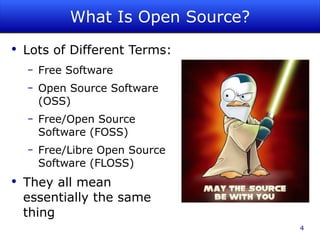
What Is Open Source? Lots of Different Terms: Free Software Open Source Software (OSS) Free/Open Source Software (FOSS) Free/Libre Open Source Software (FLOSS) They all mean essentially the same thing
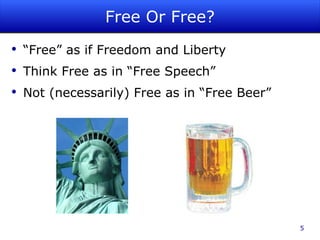
Free Or Free? “Free” as if Freedom and Liberty Think Free as in “Free Speech” Not (necessarily) Free as in “Free Beer”
Major Organizations Free Software Foundation www.fsf.org Grew out of GNU community Promoters of GNU Public License (GPL) Approves Licenses as “Free Software” Open Source Initiative www.opensource.org Grew out of disagreements with GNU/FSF Less dogmatic / more practical Approves Licenses as “Open Source”
Free Software Definition (FSF) Essential “Freedoms” of Free Software: 0: Free to Run Anyone for any purpose 1: Free to Study Access to see and modify source code 2: Free to Redistribute Share binaries and source code 3: Free to Improve Make it better for the whole community
Open Source Definition (OSI) 1. Free Redistribution 2. Source Code  3. Derived Works  4. Integrity of The Author's Source Code  5. No Discrimination Against Persons or Groups  6. No Discrimination Against Fields of Endeavor  7. Distribution of License  8. License Must Not Be Specific to a Product  9. License Must Not Restrict Other Software  10. License Must Be Technology-Neutral
History of Free Software / Open Source
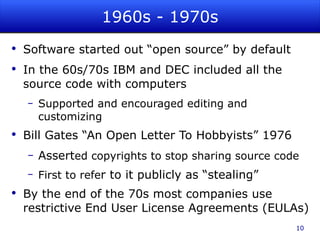
1960s - 1970s Software started out “open source” by default In the 60s/70s IBM and DEC included all the source code with computers Supported and encouraged editing and customizing Bill Gates “An Open Letter To Hobbyists” 1976 Assert ed copyrights to stop sharing source code First to refe r to it publicly as “stealing” By the end of the 70s most companies use restrictive End User License Agreements (EULAs)
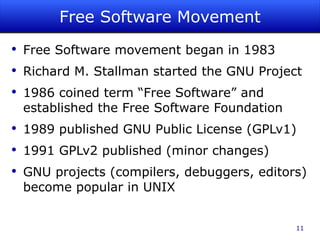
Free Software Movement Free Software movement began in 1983 Richard M. Stallman started the GNU Project 1986 coined term “Free Software” and established the Free Software Foundation 1989 published GNU Public License (GPLv1) 1991 GPLv2 published (minor changes) GNU projects (compilers, debuggers, editors) become popular in UNIX
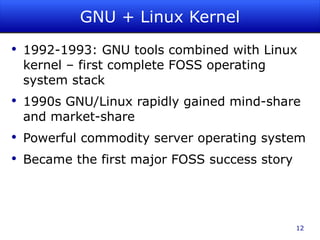
GNU + Linux Kernel 1992-1993: GNU tools combined with Linux kernel – first complete FOSS operating system stack 1990s GNU/Linux rapidly gained mind-share and market-share Powerful commodity server operating system Became the first major FOSS success story
Internet & LAMP FOSS powered Internet boom & Dot-Com era LAMP Stack Linux operating system Apache web server MySQL database engine Perl or PHP as the scripting language Powerful, simple, stable, and free platform developing and running dynamic web applications
Apache Apache is mostly widely used web server in the world since late 90s Apache Software Foundation formed in 1999 (uses/promotes the Apache License) Now hosts a huge ecosystem of community open source software projects
Open Source Movement 1997 Eric S. Raymond published “The Cathedral and The Bazaar” - explores the ethos of free software and its developers Raymond and others looking to apply free software to commercial software Strong ideology of FSF unattractive to businesses Pragmatic approach focused on open source code Raymond coined the term “Open Source” Founded the Open Source Initiative to promote it Stallman and FSF disagreed strongly, but are allies in fight against proprietary software
Netscape & Mozilla Netscape released its web browser as free software in 1998 Mozilla project becomes major player 2003 the Mozilla Foundation was formed Firefox web browser and Thunderbird email client gain serious popularity Significant market share, second only to Microsoft's embedded equivalents
Pervasive Open Source By 2000s viable open source alternatives for all desktop / server infrastructure software Powered by the Internet and distributed cooperative development Last five years: open source penetrates last major area: Enterprise Applications Major areas all have at least one major open source project – frequently backed by a commercial company offering services Open source business models – VC funding exceeds $200 million in Q1 of 2008
Expanding Beyond Software Concepts of Free Software / Open Source spilling over into other areas Creative Commons is leading voice http://www.creativecommons.org/ Licenses suitable for literature, photography, music, film, video, etc.
Open Source Licensing Considerations
Copyrights All FOSS licenses based in Copyright law Decisions used to focus on extremes: Complete enforcement (“all rights reserved”) Contribute to public domain (“no rights reserved”) Open Source is “some right reserved” Publisher of open source retains copyright Copyright holder can do whatever they want Do not have to follow terms of their own license Only those who receive software under the license are bound by it
Managing Contributor Copyrights Important to understand the copyright ownership of all source code Project with multiple contributing people/organizations may have multiple copyright holders Cannot tell by looking at the license Choice for handling copyrights (Intellectual Property Policy) is separate from License
Copyright Assignment Maintain complete central control over IP Require contributors to assign copyrights to a central organization Could be legal entity created for the explicit purpose of holding project IP Can be joint assignment or sole assignment w/ broad grant-back copyright license Include a patent license to avoid interference with contributed code May seem extreme / can discourage contribution Used by Sun for its open source projects
Broad Copyright License Require contributors to give broad copyright license to central entity Include the right to sub-license and redistribute – broader than project license Also has patent license Project can redistribute the source code under its FOSS license without any issues Nice compromise, less extreme Used by Apache Software Foundation for all of its projects
Use Project FOSS License Simplest policy is to accept contributions under the project license Largely the default – used on many projects Used by the Linux kernel project Major potential problem: Cannot distribute under a different license without explicit permission from every copyright holder Two year effort by Mozilla project to relicense code from 450 contributors
“Copyleft” Requiring software freedom for  derivative works based on  free software There is no requirement for copyleft in “Free Software” or “Open Source” – Copyleft is a separate concern Two key dimensions: when the copyleft requirements are triggered (usually redistribution) How far the copyleft requirements reach (e.g. source files, compiled together, dynamic linking)
GPL Compatibility GPL is most important FOSS license First to embody Free Software and Copyleft 70% of FOSS projects use the GPL Key copyleft provision: Combined works that include GPL must be relicensed under GPL If other software cannot be licensed under the GPL then they are incompatible and cannot be combined
Major Open Source Licenses
GNU Public License (GPL) Best starting point – clearly FOSS leader and obviously GPL compatible Strong copyleft that defines “derivative work” as anything that runs in the scope of the process (including dynamic linking) Lesser GNU Public License (LGPL) has weaker copyleft that applies only to source code compiled together into binary (e.g. libraries) Affero GNU Public License (AGPL) has extended definition to trigger copyleft on network usage (e.g. web sites)
Apache License Comprehensive open source license – covers many of the same areas as the GPL No copyleft provisions (does require preservation of copyrights and disclaimers) Compatible with GPLv3, but not w/ GPLv2 2nd most popular FOSS license Used by projects that want comprehensive license without copyleft
New BSD License Very simple, permissive, non-copyleft (only 220 words long) Basic redistribution requirements Must preserve the copyright and disclaimer Forbid endorsement use of copyright holder name Similar variants: Simplified BSD License, MIT License Easy to read and understand Doesn't address patents or trademarks Lacks language legal advisers prefer
Mozilla Public License (MPL) Compromise between GPL and BSD licenses Weaker copyleft than LGPL (applies to individual source code files only) Incompatible with the GPL (due to minor but complex restrictions) Popular derivatives: Common Development and Distribution License (CDDL) : used by Sun, minor changes only Common Public Attribution License (CPAL) : requires “attribution” of original developer – usually large logo / splash screen (“Badgeware”)
Recommendations
Pick The Right License Use an existing, major license Choose the one that best fits your needs Avoid “License Proliferation” Unless you have a really compelling reason to go another way, choose one of these: Apache: no Copyleft LGPL: weak Copyleft GPL: strong Copyleft AGPL: strong Copyleft that covers SaaS
Copyright Management Establish intellectual property policy for handling outside contributions Include Contributor License Agreement Preserve right to relicense Use an existing CLA Sun CLA for joint copyright assignment Apache CLA for broad licensing
Clear & Complete Implementation Clearly list license on web page for downloads In every binary and source distribution: “ readme” file explains licensing of distribution copy of all relevant license files copy of all required notices for original works and other works being redistributed Comment header with copyright, license, and disclaimer in every source code file (licenses usually provide templates) Ensure headers are maintained and audited Document contributor policy on website and provide the CLA for download
Questions & Answers John A. Lewis Chief Software Architect Unicon, Inc. [email_address] www.unicon.net

Open Source Licensing

  • 1.
    Open Source LicensingJohn A. Lewis Chief Software Architect Unicon, Inc. 3 March 2009 © Copyright Unicon, Inc., 2009. Some rights reserved. This work is licensed under a Creative Commons Attribution-Noncommercial-Share Alike 3.0 United States License. To view a copy of this license, visit http://creativecommons.org/licenses/by-nc-sa/3.0/us/
  • 2.
    Agenda What IsOpen Source? History of Free Software / Open Source Open Source Licensing Considerations Major Open Source Licenses Recommendations
  • 3.
    What Is OpenSource?
  • 4.
    What Is OpenSource? Lots of Different Terms: Free Software Open Source Software (OSS) Free/Open Source Software (FOSS) Free/Libre Open Source Software (FLOSS) They all mean essentially the same thing
  • 5.
    Free Or Free?“Free” as if Freedom and Liberty Think Free as in “Free Speech” Not (necessarily) Free as in “Free Beer”
  • 6.
    Major Organizations FreeSoftware Foundation www.fsf.org Grew out of GNU community Promoters of GNU Public License (GPL) Approves Licenses as “Free Software” Open Source Initiative www.opensource.org Grew out of disagreements with GNU/FSF Less dogmatic / more practical Approves Licenses as “Open Source”
  • 7.
    Free Software Definition(FSF) Essential “Freedoms” of Free Software: 0: Free to Run Anyone for any purpose 1: Free to Study Access to see and modify source code 2: Free to Redistribute Share binaries and source code 3: Free to Improve Make it better for the whole community
  • 8.
    Open Source Definition(OSI) 1. Free Redistribution 2. Source Code 3. Derived Works 4. Integrity of The Author's Source Code 5. No Discrimination Against Persons or Groups 6. No Discrimination Against Fields of Endeavor 7. Distribution of License 8. License Must Not Be Specific to a Product 9. License Must Not Restrict Other Software 10. License Must Be Technology-Neutral
  • 9.
    History of FreeSoftware / Open Source
  • 10.
    1960s - 1970sSoftware started out “open source” by default In the 60s/70s IBM and DEC included all the source code with computers Supported and encouraged editing and customizing Bill Gates “An Open Letter To Hobbyists” 1976 Assert ed copyrights to stop sharing source code First to refe r to it publicly as “stealing” By the end of the 70s most companies use restrictive End User License Agreements (EULAs)
  • 11.
    Free Software MovementFree Software movement began in 1983 Richard M. Stallman started the GNU Project 1986 coined term “Free Software” and established the Free Software Foundation 1989 published GNU Public License (GPLv1) 1991 GPLv2 published (minor changes) GNU projects (compilers, debuggers, editors) become popular in UNIX
  • 12.
    GNU + LinuxKernel 1992-1993: GNU tools combined with Linux kernel – first complete FOSS operating system stack 1990s GNU/Linux rapidly gained mind-share and market-share Powerful commodity server operating system Became the first major FOSS success story
  • 13.
    Internet & LAMPFOSS powered Internet boom & Dot-Com era LAMP Stack Linux operating system Apache web server MySQL database engine Perl or PHP as the scripting language Powerful, simple, stable, and free platform developing and running dynamic web applications
  • 14.
    Apache Apache ismostly widely used web server in the world since late 90s Apache Software Foundation formed in 1999 (uses/promotes the Apache License) Now hosts a huge ecosystem of community open source software projects
  • 15.
    Open Source Movement1997 Eric S. Raymond published “The Cathedral and The Bazaar” - explores the ethos of free software and its developers Raymond and others looking to apply free software to commercial software Strong ideology of FSF unattractive to businesses Pragmatic approach focused on open source code Raymond coined the term “Open Source” Founded the Open Source Initiative to promote it Stallman and FSF disagreed strongly, but are allies in fight against proprietary software
  • 16.
    Netscape & MozillaNetscape released its web browser as free software in 1998 Mozilla project becomes major player 2003 the Mozilla Foundation was formed Firefox web browser and Thunderbird email client gain serious popularity Significant market share, second only to Microsoft's embedded equivalents
  • 17.
    Pervasive Open SourceBy 2000s viable open source alternatives for all desktop / server infrastructure software Powered by the Internet and distributed cooperative development Last five years: open source penetrates last major area: Enterprise Applications Major areas all have at least one major open source project – frequently backed by a commercial company offering services Open source business models – VC funding exceeds $200 million in Q1 of 2008
  • 18.
    Expanding Beyond SoftwareConcepts of Free Software / Open Source spilling over into other areas Creative Commons is leading voice http://www.creativecommons.org/ Licenses suitable for literature, photography, music, film, video, etc.
  • 19.
    Open Source LicensingConsiderations
  • 20.
    Copyrights All FOSSlicenses based in Copyright law Decisions used to focus on extremes: Complete enforcement (“all rights reserved”) Contribute to public domain (“no rights reserved”) Open Source is “some right reserved” Publisher of open source retains copyright Copyright holder can do whatever they want Do not have to follow terms of their own license Only those who receive software under the license are bound by it
  • 21.
    Managing Contributor CopyrightsImportant to understand the copyright ownership of all source code Project with multiple contributing people/organizations may have multiple copyright holders Cannot tell by looking at the license Choice for handling copyrights (Intellectual Property Policy) is separate from License
  • 22.
    Copyright Assignment Maintaincomplete central control over IP Require contributors to assign copyrights to a central organization Could be legal entity created for the explicit purpose of holding project IP Can be joint assignment or sole assignment w/ broad grant-back copyright license Include a patent license to avoid interference with contributed code May seem extreme / can discourage contribution Used by Sun for its open source projects
  • 23.
    Broad Copyright LicenseRequire contributors to give broad copyright license to central entity Include the right to sub-license and redistribute – broader than project license Also has patent license Project can redistribute the source code under its FOSS license without any issues Nice compromise, less extreme Used by Apache Software Foundation for all of its projects
  • 24.
    Use Project FOSSLicense Simplest policy is to accept contributions under the project license Largely the default – used on many projects Used by the Linux kernel project Major potential problem: Cannot distribute under a different license without explicit permission from every copyright holder Two year effort by Mozilla project to relicense code from 450 contributors
  • 25.
    “Copyleft” Requiring softwarefreedom for derivative works based on free software There is no requirement for copyleft in “Free Software” or “Open Source” – Copyleft is a separate concern Two key dimensions: when the copyleft requirements are triggered (usually redistribution) How far the copyleft requirements reach (e.g. source files, compiled together, dynamic linking)
  • 26.
    GPL Compatibility GPLis most important FOSS license First to embody Free Software and Copyleft 70% of FOSS projects use the GPL Key copyleft provision: Combined works that include GPL must be relicensed under GPL If other software cannot be licensed under the GPL then they are incompatible and cannot be combined
  • 27.
  • 28.
    GNU Public License(GPL) Best starting point – clearly FOSS leader and obviously GPL compatible Strong copyleft that defines “derivative work” as anything that runs in the scope of the process (including dynamic linking) Lesser GNU Public License (LGPL) has weaker copyleft that applies only to source code compiled together into binary (e.g. libraries) Affero GNU Public License (AGPL) has extended definition to trigger copyleft on network usage (e.g. web sites)
  • 29.
    Apache License Comprehensiveopen source license – covers many of the same areas as the GPL No copyleft provisions (does require preservation of copyrights and disclaimers) Compatible with GPLv3, but not w/ GPLv2 2nd most popular FOSS license Used by projects that want comprehensive license without copyleft
  • 30.
    New BSD LicenseVery simple, permissive, non-copyleft (only 220 words long) Basic redistribution requirements Must preserve the copyright and disclaimer Forbid endorsement use of copyright holder name Similar variants: Simplified BSD License, MIT License Easy to read and understand Doesn't address patents or trademarks Lacks language legal advisers prefer
  • 31.
    Mozilla Public License(MPL) Compromise between GPL and BSD licenses Weaker copyleft than LGPL (applies to individual source code files only) Incompatible with the GPL (due to minor but complex restrictions) Popular derivatives: Common Development and Distribution License (CDDL) : used by Sun, minor changes only Common Public Attribution License (CPAL) : requires “attribution” of original developer – usually large logo / splash screen (“Badgeware”)
  • 32.
  • 33.
    Pick The RightLicense Use an existing, major license Choose the one that best fits your needs Avoid “License Proliferation” Unless you have a really compelling reason to go another way, choose one of these: Apache: no Copyleft LGPL: weak Copyleft GPL: strong Copyleft AGPL: strong Copyleft that covers SaaS
  • 34.
    Copyright Management Establishintellectual property policy for handling outside contributions Include Contributor License Agreement Preserve right to relicense Use an existing CLA Sun CLA for joint copyright assignment Apache CLA for broad licensing
  • 35.
    Clear & CompleteImplementation Clearly list license on web page for downloads In every binary and source distribution: “ readme” file explains licensing of distribution copy of all relevant license files copy of all required notices for original works and other works being redistributed Comment header with copyright, license, and disclaimer in every source code file (licenses usually provide templates) Ensure headers are maintained and audited Document contributor policy on website and provide the CLA for download
  • 36.
    Questions & AnswersJohn A. Lewis Chief Software Architect Unicon, Inc. [email_address] www.unicon.net