eLiberatica      Michael Widenius
                   MySQL founder
May 23, 2009   monty@openoceancapital.com
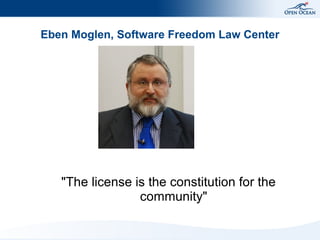
Eben Moglen, Software Freedom Law Center


   "The license is the constitution for the
                 community"
Key questions addressed

●   What is an Open Source License?
●   Why go Open Source?
●   How to choose a License?
●   What are the main popular Licenses in use, and what
     are their main differences?
●   How to develop high quality open source products
●   What kind of community creates high quality
     products?
What is an Open Source License?

...Is a Copyright License for Computer Software
...that makes the source code available
...for modification and redistribution
...free of charge


However:
●   It does NOT mean you can do what you want with the
    code
●   But you can use it freely as long as you follow the
    *Terms of the License*
Why go Open Source?
●   Spread the product more quickly (more users)
●   Get some part of the development done elsewhere (lower
     cost)
●   Get things more tested and get more bug reports (higher
     quality)
●   Possible to get development done in 'not business critical'
      directions (more useful product)


    The above means more market recognition, feedback,
      leads, business, partners and sell opportunities and a
      strong trademark.
    In general open source projects gets more feedback and
       better bug reports than closed source project.
Reasons for users to trust a open source vendor
 ●   Open source vendors are more trustworthy as they depend on
       trust to survive
 ●   No vendor lock in. Your investment in using the product is safe
       even if:
     >   Vendor goes out of business
     >   Vendor would surprisingly change business terms radically
     >   Vendor would stop supporting the version of the product you
           are using
     If above would happen to a popular product, someone would
        go away with the code and start maintain it themselves
 ●   Little risk for hidden trap doors as one can examine the product
        code
Benefits for developers using open source vendor

●   Easy to get access, look at and use the code
●   Freedom to examine and change any part of the code to
      satisfy your business reasons, fix bugs or port to other
      systems.
●   Freedom to find anyone to do the above
●   Freedom to use (read, build and change) the code and
      redistribute the code in an open source environment.
Why go Open Source?

    IF you can create a sustainable business model around
      Open Source, proprietary vendors will have hard to
      compete with you.


    It's nowadays increasingly harder to sell closed source
       solutions in a lot of business sectors.


    Nor surprisingly, it's hard to choose the right license for
     your software as it significantly impacts your strategy,
     i.e.
●   How you can co-operate with your user community
●   How you can build your business
How to choose an OS license?

●   Key Questions:

●   What is your business idea around the open source
     product?
●   What rights do you keep to your code when used,
     modified and potentially redistributed?
●   What kind of community do you want around the
     product?
How to choose an OS license?

    Do you want to allow others to:
●   do anything with your code?
●   use your code freely in any manner?
●change your code without giving you access to the
changes?
● include and redistribute your code together with commercial,
closed source code?
●   use your code together with other open source code?
● release their modifications to your code under a different
license?
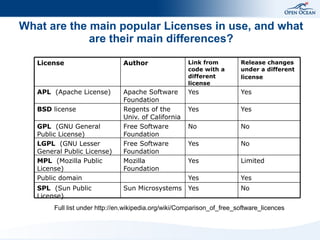
What are the main popular Licenses in use, and what
             are their main differences?

   License                      Author                 Link from         Release changes
                                                       code with a       under a different
                                                       different         license
                                                       license
   APL (Apache License)         Apache Software        Yes               Yes
                                Foundation
   BSD license                  Regents of the         Yes               Yes
                                Univ. of California
   GPL (GNU General             Free Software          No                No
   Public License)              Foundation
   LGPL (GNU Lesser             Free Software          Yes               No
   General Public License)      Foundation
   MPL (Mozilla Public          Mozilla                Yes               Limited
   License)                     Foundation
   Public domain                                       Yes               Yes
   SPL (Sun Public              Sun Microsystems Yes                     No
   License)
        Full list under http://en.wikipedia.org/wiki/Comparison_of_free_software_licences
The main open source licenses you need to consider
                (Very simple view)
●       Public domain
    >     Gives user freedom to do anything, including changing your copyright
             and claim they wrote it.
●       BSD/Apache
    >     Gives user freedom to full use, but needs to keep copyright in the source
             code.
●       LGPL
    >     Gives user freedom to use freely, but if they distribute it changed, they
             need to publish the changes under LGP
●       GPL
    >     Gives user freedom to use it freely, but if they distribute it, they need to
             publish changes and their code under GPL
●       AGPL (Optional addition to GPL V3)
    >    Free usage, but users needs to publish the code and the code connected
         to it.
Business models to use with open source

●   Open-Core Model - have an open-source core and sell
     closed-source features on top of it (e.g. SugarCRM)
●   Dual Licensing Model- one product/project that gets
     licensed with a viral, GPL-style license and a
     commercial closed-source license (e.g. MySQL)
●   Services Models - where you get to download a
      productized version of an open-source project and pay
      a fee for the support you get on it. You can normally
      also pay for training, features etc
Open Core

●   Probably most popular way nowadays for business trying
      to do open source first time
●   Is not an open source business model, because it uses
       closed components and most of the benefits open
       source developers expect from the product is gone:
    >   You can't change, modify, port or redistribute the code
    >   You are locked to one vendor
●   You may be able to create a small developer community
      around the product but mainly by people that doesn't
      need the extensions.
●   For community developers, the “worst” possible offer is
      open core or closed source that used under sub-
      scription and it stop working when subscription runs out.
So, How to decide on licensing?

    You need to provide the right balance of freedom:
●       Being too restrictive will harm Community growth
    >   Here you compete with companies like Microsoft
●       Being too permissive will harm Business growth
    >   Here you compete with projects like Wikipedia


    Going “All-In” on either, can be tough in the competitive
     market of today if you are not unique
    Try to create a business model, which enables you to
      grow a business,but is as free as possible to help you
      create a large Community
How to develop high quality open source products

    To create quality open source program, you need a
      community with many of the following characteristics:
●   A designated active leader or active leaders that have the
      respect from the community
●   A group of good Open Source Citizens
●   Active and passionate user and developer community around
      your product.
●   Having developers that is using the product daily in production
●   Having developers that need to extend the product for their
      own needs
●   An open development model (all email list, discussions
      architecture, plans, decisions should be open)
How to develop high quality open source products

    Needed community characteristics, part 2:
●   Clear guidelines for how things are done and will be done.
●   Clear license and business model
●   Good review process of patches that enforces quality
●   People with good "old time" coding style standards that actively
      teach others how to produce high quality code
●   Extensive documentation
●   Good open toolset for development (Sourceforge, Launchpad or
      own)
    Generally the quality of the product is defined by the
      technical leaders
How to develop high quality open source products

    You do this by:
●   Having a 'enlighten dictator' (Linus) or a small group of
     enlighted people that works good together
     (PostgreSQL)
●   Release early - release often, binaries + source
●   Aim that each release, including alpha, should be bug free
      enough to be usable in production by those that try it.
●   Be transparent with your plans and let users influence
      them
●   Be open about your bugs, and when they will be
      addressed
How to develop high quality open source products

    You do this by:
●   Listen to what your users want and either do it or help
      them do it themselves.
●   Understanding that people who write the code 'owns' the
     code
●   Don't expect the community to produce any code!
●   Keep your promises!


●   Recognize that the path for turning a user to a customer
     can be long, and don’t let short term monetary interest
     distract your long term winning strategy
How to develop high quality open source products
●   Ensure that that all the technical drivers are very active with
      the community.
●   Be open about your use of external code - Share the fame!
●   Provide quick feedback to providers (bug reports and fixes,
      code enhancements, ideas)
●   Help others in forums (around your code, and around related
     code you know)
●   Keep up a high ethical standard on the email lists/forums
●   Being a good Open Source Citizen will build trust in you and
      your product, and will pay off over time.
●   Building a supportive Community later in the game is
      extremely hard - You should start day 1
For potential entrepreneurs

Open Ocean - The first major investor in
 MySQL AB, is launching an initiative to invest
 into new technology startups and help them
 become successful
We can provide entrepreneurs Open Source
 technology insight, International business
 know-how and Funds


For further information, please contact:
monty@openoceancapital.com
The end

"Open Source licensing and software quality" by Monty Michael Widenius @ eLiberatica 2009

  • 1.
    eLiberatica Michael Widenius MySQL founder May 23, 2009 monty@openoceancapital.com
  • 2.
    Eben Moglen, SoftwareFreedom Law Center "The license is the constitution for the community"
  • 3.
    Key questions addressed ● What is an Open Source License? ● Why go Open Source? ● How to choose a License? ● What are the main popular Licenses in use, and what are their main differences? ● How to develop high quality open source products ● What kind of community creates high quality products?
  • 4.
    What is anOpen Source License? ...Is a Copyright License for Computer Software ...that makes the source code available ...for modification and redistribution ...free of charge However: ● It does NOT mean you can do what you want with the code ● But you can use it freely as long as you follow the *Terms of the License*
  • 5.
    Why go OpenSource? ● Spread the product more quickly (more users) ● Get some part of the development done elsewhere (lower cost) ● Get things more tested and get more bug reports (higher quality) ● Possible to get development done in 'not business critical' directions (more useful product) The above means more market recognition, feedback, leads, business, partners and sell opportunities and a strong trademark. In general open source projects gets more feedback and better bug reports than closed source project.
  • 6.
    Reasons for usersto trust a open source vendor ● Open source vendors are more trustworthy as they depend on trust to survive ● No vendor lock in. Your investment in using the product is safe even if: > Vendor goes out of business > Vendor would surprisingly change business terms radically > Vendor would stop supporting the version of the product you are using If above would happen to a popular product, someone would go away with the code and start maintain it themselves ● Little risk for hidden trap doors as one can examine the product code
  • 7.
    Benefits for developersusing open source vendor ● Easy to get access, look at and use the code ● Freedom to examine and change any part of the code to satisfy your business reasons, fix bugs or port to other systems. ● Freedom to find anyone to do the above ● Freedom to use (read, build and change) the code and redistribute the code in an open source environment.
  • 8.
    Why go OpenSource? IF you can create a sustainable business model around Open Source, proprietary vendors will have hard to compete with you. It's nowadays increasingly harder to sell closed source solutions in a lot of business sectors. Nor surprisingly, it's hard to choose the right license for your software as it significantly impacts your strategy, i.e. ● How you can co-operate with your user community ● How you can build your business
  • 9.
    How to choosean OS license? ● Key Questions: ● What is your business idea around the open source product? ● What rights do you keep to your code when used, modified and potentially redistributed? ● What kind of community do you want around the product?
  • 10.
    How to choosean OS license? Do you want to allow others to: ● do anything with your code? ● use your code freely in any manner? ●change your code without giving you access to the changes? ● include and redistribute your code together with commercial, closed source code? ● use your code together with other open source code? ● release their modifications to your code under a different license?
  • 11.
    What are themain popular Licenses in use, and what are their main differences? License Author Link from Release changes code with a under a different different license license APL (Apache License) Apache Software Yes Yes Foundation BSD license Regents of the Yes Yes Univ. of California GPL (GNU General Free Software No No Public License) Foundation LGPL (GNU Lesser Free Software Yes No General Public License) Foundation MPL (Mozilla Public Mozilla Yes Limited License) Foundation Public domain Yes Yes SPL (Sun Public Sun Microsystems Yes No License) Full list under http://en.wikipedia.org/wiki/Comparison_of_free_software_licences
  • 12.
    The main opensource licenses you need to consider (Very simple view) ● Public domain > Gives user freedom to do anything, including changing your copyright and claim they wrote it. ● BSD/Apache > Gives user freedom to full use, but needs to keep copyright in the source code. ● LGPL > Gives user freedom to use freely, but if they distribute it changed, they need to publish the changes under LGP ● GPL > Gives user freedom to use it freely, but if they distribute it, they need to publish changes and their code under GPL ● AGPL (Optional addition to GPL V3) > Free usage, but users needs to publish the code and the code connected to it.
  • 13.
    Business models touse with open source ● Open-Core Model - have an open-source core and sell closed-source features on top of it (e.g. SugarCRM) ● Dual Licensing Model- one product/project that gets licensed with a viral, GPL-style license and a commercial closed-source license (e.g. MySQL) ● Services Models - where you get to download a productized version of an open-source project and pay a fee for the support you get on it. You can normally also pay for training, features etc
  • 14.
    Open Core ● Probably most popular way nowadays for business trying to do open source first time ● Is not an open source business model, because it uses closed components and most of the benefits open source developers expect from the product is gone: > You can't change, modify, port or redistribute the code > You are locked to one vendor ● You may be able to create a small developer community around the product but mainly by people that doesn't need the extensions. ● For community developers, the “worst” possible offer is open core or closed source that used under sub- scription and it stop working when subscription runs out.
  • 15.
    So, How todecide on licensing? You need to provide the right balance of freedom: ● Being too restrictive will harm Community growth > Here you compete with companies like Microsoft ● Being too permissive will harm Business growth > Here you compete with projects like Wikipedia Going “All-In” on either, can be tough in the competitive market of today if you are not unique Try to create a business model, which enables you to grow a business,but is as free as possible to help you create a large Community
  • 16.
    How to develophigh quality open source products To create quality open source program, you need a community with many of the following characteristics: ● A designated active leader or active leaders that have the respect from the community ● A group of good Open Source Citizens ● Active and passionate user and developer community around your product. ● Having developers that is using the product daily in production ● Having developers that need to extend the product for their own needs ● An open development model (all email list, discussions architecture, plans, decisions should be open)
  • 17.
    How to develophigh quality open source products Needed community characteristics, part 2: ● Clear guidelines for how things are done and will be done. ● Clear license and business model ● Good review process of patches that enforces quality ● People with good "old time" coding style standards that actively teach others how to produce high quality code ● Extensive documentation ● Good open toolset for development (Sourceforge, Launchpad or own) Generally the quality of the product is defined by the technical leaders
  • 18.
    How to develophigh quality open source products You do this by: ● Having a 'enlighten dictator' (Linus) or a small group of enlighted people that works good together (PostgreSQL) ● Release early - release often, binaries + source ● Aim that each release, including alpha, should be bug free enough to be usable in production by those that try it. ● Be transparent with your plans and let users influence them ● Be open about your bugs, and when they will be addressed
  • 19.
    How to develophigh quality open source products You do this by: ● Listen to what your users want and either do it or help them do it themselves. ● Understanding that people who write the code 'owns' the code ● Don't expect the community to produce any code! ● Keep your promises! ● Recognize that the path for turning a user to a customer can be long, and don’t let short term monetary interest distract your long term winning strategy
  • 20.
    How to develophigh quality open source products ● Ensure that that all the technical drivers are very active with the community. ● Be open about your use of external code - Share the fame! ● Provide quick feedback to providers (bug reports and fixes, code enhancements, ideas) ● Help others in forums (around your code, and around related code you know) ● Keep up a high ethical standard on the email lists/forums ● Being a good Open Source Citizen will build trust in you and your product, and will pay off over time. ● Building a supportive Community later in the game is extremely hard - You should start day 1
  • 21.
    For potential entrepreneurs OpenOcean - The first major investor in MySQL AB, is launching an initiative to invest into new technology startups and help them become successful We can provide entrepreneurs Open Source technology insight, International business know-how and Funds For further information, please contact: monty@openoceancapital.com
  • 22.