
Open Source licenses
This presentation is distributed in the hope that it will be useful,
but WITHOUT ANY WARRANTY; without even the implied warranty of
MERCHANTABILITY or FITNESS FOR A PARTICULAR PURPOSE.
.NET BarCamp, 28.08.2013
Andrei Paleyes
Intro
What is open source license
A type of license for computer software and other
products that allows the source code, blueprint or
design to be used, modified and/or shared
under defined terms and conditions.
Why do?
• Collaboration
• Share results with community
• Get feedback
• Gain respect
• Protect author rights
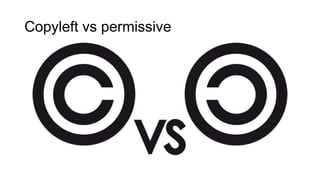
Copyleft vs permissive
Licenses
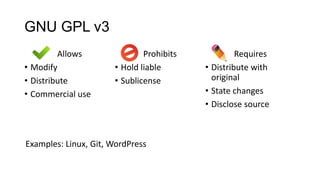
GNU GPL v3
Allows
• Modify
• Distribute
• Commercial use
Prohibits
• Hold liable
• Sublicense
Requires
• Distribute with
original
• State changes
• Disclose source
Examples: Linux, Git, WordPress
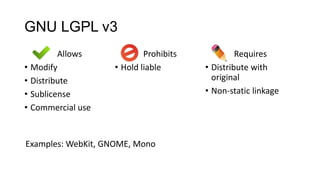
GNU LGPL v3
Allows
• Modify
• Distribute
• Sublicense
• Commercial use
Prohibits
• Hold liable
Requires
• Distribute with
original
• Non-static linkage
Examples: WebKit, GNOME, Mono
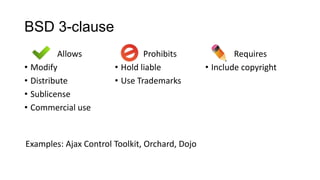
BSD 3-clause
Allows
• Modify
• Distribute
• Sublicense
• Commercial use
Prohibits
• Hold liable
• Use Trademarks
Requires
• Include copyright
Examples: Ajax Control Toolkit, Orchard, Dojo
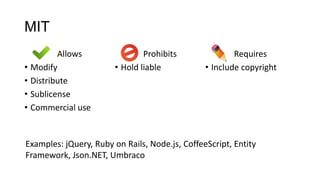
MIT
Allows
• Modify
• Distribute
• Sublicense
• Commercial use
Prohibits
• Hold liable
Requires
• Include copyright
Examples: jQuery, Ruby on Rails, Node.js, CoffeeScript, Entity
Framework, Json.NET, Umbraco
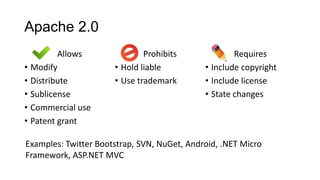
Apache 2.0
Allows
• Modify
• Distribute
• Sublicense
• Commercial use
• Patent grant
Prohibits
• Hold liable
• Use trademark
Requires
• Include copyright
• Include license
• State changes
Examples: Twitter Bootstrap, SVN, NuGet, Android, .NET Micro
Framework, ASP.NET MVC
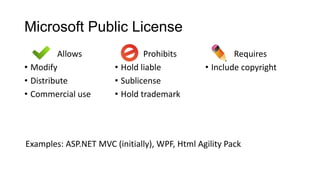
Microsoft Public License
Allows
• Modify
• Distribute
• Commercial use
Prohibits
• Hold liable
• Sublicense
• Hold trademark
Requires
• Include copyright
Examples: ASP.NET MVC (initially), WPF, Html Agility Pack
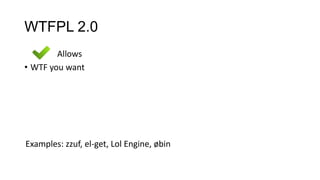
WTFPL 2.0
Allows
• WTF you want
Examples: zzuf, el-get, Lol Engine, øbin
Usage
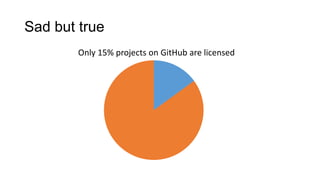
Sad but true
Only 15% projects on GitHub are licensed
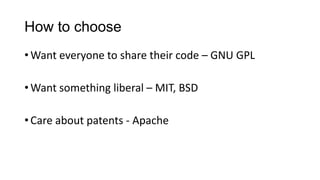
How to choose
•Want everyone to share their code – GNU GPL
•Want something liberal – MIT, BSD
•Care about patents - Apache
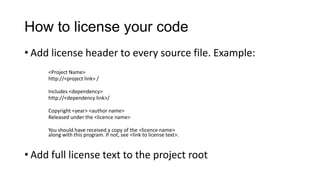
How to license your code
• Add license header to every source file. Example:
<Project Name>
http://<project link> /
Includes <dependency>
http://<dependency link>/
Copyright <year> <author name>
Released under the <licence name>
You should have received a copy of the <licence name>
along with this program. If not, see <link to license text>.
• Add full license text to the project root
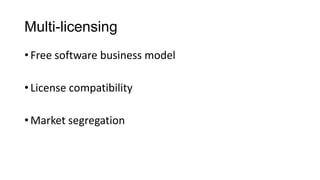
Multi-licensing
•Free software business model
•License compatibility
•Market segregation
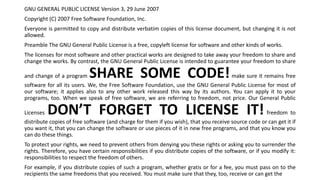
GNU GENERAL PUBLIC LICENSE Version 3, 29 June 2007
Copyright (C) 2007 Free Software Foundation, Inc.
Everyone is permitted to copy and distribute verbatim copies of this license document, but changing it is not
allowed.
Preamble The GNU General Public License is a free, copyleft license for software and other kinds of works.
The licenses for most software and other practical works are designed to take away your freedom to share and
change the works. By contrast, the GNU General Public License is intended to guarantee your freedom to share
and change of a program SHARE SOME CODE!make sure it remains free
software for all its users. We, the Free Software Foundation, use the GNU General Public License for most of
our software; it applies also to any other work released this way by its authors. You can apply it to your
programs, too. When we speak of free software, we are referring to freedom, not price. Our General Public
Licenses DON’T FORGET TO LICENSE IT! freedom to
distribute copies of free software (and charge for them if you wish), that you receive source code or can get it if
you want it, that you can change the software or use pieces of it in new free programs, and that you know you
can do these things.
To protect your rights, we need to prevent others from denying you these rights or asking you to surrender the
rights. Therefore, you have certain responsibilities if you distribute copies of the software, or if you modify it:
responsibilities to respect the freedom of others.
For example, if you distribute copies of such a program, whether gratis or for a fee, you must pass on to the
recipients the same freedoms that you received. You must make sure that they, too, receive or can get the

Open Source licenses

  • 1.
    Open Source licenses Thispresentation is distributed in the hope that it will be useful, but WITHOUT ANY WARRANTY; without even the implied warranty of MERCHANTABILITY or FITNESS FOR A PARTICULAR PURPOSE. .NET BarCamp, 28.08.2013 Andrei Paleyes
  • 2.
  • 3.
    What is opensource license A type of license for computer software and other products that allows the source code, blueprint or design to be used, modified and/or shared under defined terms and conditions.
  • 4.
    Why do? • Collaboration •Share results with community • Get feedback • Gain respect • Protect author rights
  • 5.
  • 6.
  • 7.
    GNU GPL v3 Allows •Modify • Distribute • Commercial use Prohibits • Hold liable • Sublicense Requires • Distribute with original • State changes • Disclose source Examples: Linux, Git, WordPress
  • 8.
    GNU LGPL v3 Allows •Modify • Distribute • Sublicense • Commercial use Prohibits • Hold liable Requires • Distribute with original • Non-static linkage Examples: WebKit, GNOME, Mono
  • 9.
    BSD 3-clause Allows • Modify •Distribute • Sublicense • Commercial use Prohibits • Hold liable • Use Trademarks Requires • Include copyright Examples: Ajax Control Toolkit, Orchard, Dojo
  • 10.
    MIT Allows • Modify • Distribute •Sublicense • Commercial use Prohibits • Hold liable Requires • Include copyright Examples: jQuery, Ruby on Rails, Node.js, CoffeeScript, Entity Framework, Json.NET, Umbraco
  • 11.
    Apache 2.0 Allows • Modify •Distribute • Sublicense • Commercial use • Patent grant Prohibits • Hold liable • Use trademark Requires • Include copyright • Include license • State changes Examples: Twitter Bootstrap, SVN, NuGet, Android, .NET Micro Framework, ASP.NET MVC
  • 12.
    Microsoft Public License Allows •Modify • Distribute • Commercial use Prohibits • Hold liable • Sublicense • Hold trademark Requires • Include copyright Examples: ASP.NET MVC (initially), WPF, Html Agility Pack
  • 13.
    WTFPL 2.0 Allows • WTFyou want Examples: zzuf, el-get, Lol Engine, øbin
  • 14.
  • 15.
    Sad but true Only15% projects on GitHub are licensed
  • 16.
    How to choose •Wanteveryone to share their code – GNU GPL •Want something liberal – MIT, BSD •Care about patents - Apache
  • 17.
    How to licenseyour code • Add license header to every source file. Example: <Project Name> http://<project link> / Includes <dependency> http://<dependency link>/ Copyright <year> <author name> Released under the <licence name> You should have received a copy of the <licence name> along with this program. If not, see <link to license text>. • Add full license text to the project root
  • 18.
    Multi-licensing •Free software businessmodel •License compatibility •Market segregation
  • 19.
    GNU GENERAL PUBLICLICENSE Version 3, 29 June 2007 Copyright (C) 2007 Free Software Foundation, Inc. Everyone is permitted to copy and distribute verbatim copies of this license document, but changing it is not allowed. Preamble The GNU General Public License is a free, copyleft license for software and other kinds of works. The licenses for most software and other practical works are designed to take away your freedom to share and change the works. By contrast, the GNU General Public License is intended to guarantee your freedom to share and change of a program SHARE SOME CODE!make sure it remains free software for all its users. We, the Free Software Foundation, use the GNU General Public License for most of our software; it applies also to any other work released this way by its authors. You can apply it to your programs, too. When we speak of free software, we are referring to freedom, not price. Our General Public Licenses DON’T FORGET TO LICENSE IT! freedom to distribute copies of free software (and charge for them if you wish), that you receive source code or can get it if you want it, that you can change the software or use pieces of it in new free programs, and that you know you can do these things. To protect your rights, we need to prevent others from denying you these rights or asking you to surrender the rights. Therefore, you have certain responsibilities if you distribute copies of the software, or if you modify it: responsibilities to respect the freedom of others. For example, if you distribute copies of such a program, whether gratis or for a fee, you must pass on to the recipients the same freedoms that you received. You must make sure that they, too, receive or can get the