Schizophrenia
By Kian Collis Zamanian
What is Schizophrenia?
Schizophrenia is a severe and chronic mental health disorder that affects a
person’s thoughts, behaviour and emotions. This illness can be characterized by
being a combination of various conditions, including hallucinations*, delusions**,
and disorganized thinking and speech.
*Hallucinations are the perception of unreal events, situations or circumstances.
**Delusions are holding false beliefs that contrast evidence and facts.
Important Parts of Brain Relating to Schizophrenia
The Prefrontal Cortex:
The Prefrontal cortex is a part of the frontal lobe in the forebrain that is responsible for regulating and stimulating cognitive functions.
Mesolimbic Pathways:
The Mesolimbic pathway transports dopamine from the VTA (Ventral Tegmental Area) in the midbrain to the Nucleus Accumbens in the
forebrain. It is responsible for regulating and controlling reward and motivation.
The Nucleus Accumbens:
The Nucleus Accumbens is the Ventral Medial part of the Striatum in the Basal Ganglia, it is responsible for reward and desire.
The Amygdala:
The Amygdala is a Ventral Telencephalic part of your brain that is responsible for processing emotions, linking emotions to various brain
functions, developing Implicit emotion related memories, and initiating instinctive decisions.
The Hypothalamus:
The Hypothalamus is responsible for the development of Explicit, Semantic and Episodic memories.
What Happens in the Brain of a Schizophrenic?
The Dopamine Hypothesis
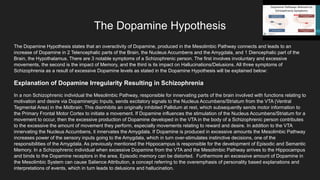
The Dopamine Hypothesis states that an overactivity of Dopamine, produced in the Mesolimbic Pathway connects and leads to an
increase of Dopamine in 2 Telencephalic parts of the Brain, the Nucleus Accumbens and the Amygdala, and 1 Diencephalic part of the
Brain, the Hypothalamus. There are 3 notable symptoms of a Schizophrenic person. The first involves involuntary and excessive
movements, the second is the impact of Memory, and the third is its impact on Hallucinations/Delusions. All three symptoms of
Schizophrenia as a result of excessive Dopamine levels as stated in the Dopamine Hypothesis will be explained below:
Explanation of Dopamine Irregularity Resulting in Schizophrenia
In a non Schizophrenic individual the Mesolimbic Pathway, responsible for innervating parts of the brain involved with functions relating to
motivation and desire via Dopaminergic Inputs, sends excitatory signals to the Nucleus Accumbens/Striatum from the VTA (Ventral
Tegmental Area) in the Midbrain. This disinhibits an originally inhibited Pallidum at rest, which subsequently sends motor information to
the Primary Frontal Motor Cortex to initiate a movement. If Dopamine influences the stimulation of the Nucleus Accumbens/Striatum for a
movement to occur, then the excessive production of Dopamine developed in the VTA in the body of a Schizophrenic person contributes
to the excessive the amount of movement they perform, especially movements relating to reward and desire. In addition to the VTA
innervating the Nucleus Accumbens, it innervates the Amygdala. If Dopamine is produced in excessive amounts the Mesolimbic Pathway
increases power of the sensory inputs going to the Amygdala, which in turn over-stimulates instinctive decisions, one of the
responsibilities of the Amygdala. As previously mentioned the Hippocampus is responsible for the development of Episodic and Semantic
Memory. In a Schizophrenic individual when excessive Dopamine from the VTA and the Mesolimbic Pathway arrives to the Hippocampus
and binds to the Dopamine receptors in the area, Episodic memory can be distorted. Furthermore an excessive amount of Dopamine in
the Mesolimbic System can cause Salience Attribution, a concept referring to the overemphasis of personality based explanations and
interpretations of events, which in turn leads to delusions and hallucination.
The Glutamate Hypothesis
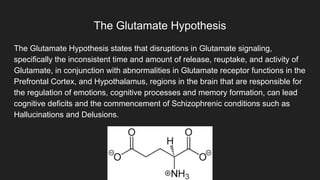
The Glutamate Hypothesis states that disruptions in Glutamate signaling,
specifically the inconsistent time and amount of release, reuptake, and activity of
Glutamate, in conjunction with abnormalities in Glutamate receptor functions in the
Prefrontal Cortex, and Hypothalamus, regions in the brain that are responsible for
the regulation of emotions, cognitive processes and memory formation, can lead
cognitive deficits and the commencement of Schizophrenic conditions such as
Hallucinations and Delusions.
External Causes of Schizophrenia
1. Prenatal and Birth Complications
2. Cannabis Use
3. Substance Abuse
4. Traumatic Experiences
5. Urban upbringing
These factors in addition to genetic neurodevelopmental factors contribute to
Schizophrenia.
What is the Treatment for Schizophrenia
Medication such as Sulpiride, Loxapine, and Remoxipride are designed to target
and block Dopamine Neuroreceptors in the Mesolimbic pathway, this helps reduce
Dopamine Signaling and reduces episodes of Hallucinations and Delusions. In
addition other medications Exservan, Rilutek, and Tiglutik, are designed to inhibit,
and regulate Glutamate to also reduce and decrease episodes of Hallucinations
and Delusions.
The Ways Peggy Mason’s Neuroscience Course improved
Understanding of Schizophrenia
● Learning about the Basal Ganglia, specifically about the Striatum and the Pallium assisted in the understanding
of the Direct pathway to performing movements, and how they are stimulated by Dopamine.
● Learning about the Diencephalon and Telencephalon helped concisely organize the Brain into simpler
components to more easily identify various pathways such as the Mesolimbic Pathway.
● Learning about the ways information is transmitted from one Neuron to another via neurotransmitters binding to
neuroreceptors that initiate Action Potentials of a subsequent Neuron, helped me understand how Dopamine
moves from from one neuron to another.
Note: Neurotransmitters are released from a Presynaptic Terminal of a Neuron due to an influx of Calcium ions that
rush into the its synapse, because of an Action Potential reaching the end of the Neuron. The Calcium in turn causes
the ventricles storing the Neurotransmitters to bind with the synaptic membrane of the Neuron then causing the
release of them to a Synaptic Cleft where they then bind to their corresponding Neuroreceptor of a subsequent
Neuron that causes the initiative of another Action Potential.
Citations
Brisch, Ralf, et al. “The Role of Dopamine in Schizophrenia from a Neurobiological and Evolutionary Perspective: Old Fashioned, but Still in Vogue.” Frontiers in Psychiatry, 19 May 2014, www.ncbi.nlm.nih.gov/pmc/articles/PMC4032934/.
“Dopamine Antagonists.” Dopamine Antagonists | DrugBank Online, go.drugbank.com/categories/DBCAT000603. Accessed 14 May 2023.
Hu, Wei, et al. “The Glutamate Hypothesis of Schizophrenia: Evidence from Human Brain Tissue Studies.” Annals of the New York Academy of Sciences, Mar. 2015, www.ncbi.nlm.nih.gov/pmc/articles/PMC4363164/.
Mei, Yu-Ying, et al. “Astrocytic Regulation of Glutamate Transmission in Schizophrenia.” Frontiers, 12 Oct. 2018,
www.frontiersin.org/articles/10.3389/fpsyt.2018.00544/full#:~:text=The%20%E2%80%9Cglutamate%20hypothesis%20of%20schizophrenia,cortex%20and%20hippocampus%20(1).
“Riluzole.” Uses, Interactions, Mechanism of Action | DrugBank Online, go.drugbank.com/drugs/DB00740. Accessed 14 May 2023.
Stilo, Simona A., and Robin M. Murray. “Non-Genetic Factors in Schizophrenia - Current Psychiatry Reports.” SpringerLink, 14 Sept. 2019,
link.springer.com/article/10.1007/s11920-019-1091-3#:~:text=Environmental%20risk%20factors%20such%20as,likelihood%20to%20develop%20the%20disorder.
“What Is Schizophrenia?” Psychiatry.Org - What Is Schizophrenia?, www.psychiatry.org/patients-families/schizophrenia/what-is-schizophrenia#:~:text=Schizophrenia%20is%20a%20chronic%20brain,thinking%20and%20lack%20of%20motivation.
Accessed 14 May 2023.
Functional Mechanisms of Episodic Memory Impairment in ... - Sage Journals, journals.sagepub.com/doi/10.1177/070674370705201103. Accessed 5 Oct. 2023.
Huber, Markus Karl, et al. “Delusion and Dopamine: Neuronal Insights in Psychotropic Drug Therapy.” SpringerLink, Springer International Publishing, 1 Jan. 1970,
link.springer.com/referenceworkentry/10.1007/978-3-319-56015-1_411-1#:~:text=Additional%20dopamine%20agonists%20trigger%20psychosis,the%20basis%20of%20delusional%20formation.
Serafini, Randal A, et al. “The Mesolimbic Dopamine System in Chronic Pain and Associated Affective Comorbidities.” Biological Psychiatry, U.S. National Library of Medicine, 1 Jan. 2020,
www.ncbi.nlm.nih.gov/pmc/articles/PMC6954000/#:~:text=The%20mesolimbic%20system%20is%20a,and%20nucleus%20accumbens%20(NAc).
Tessitore, Alessandro, et al. “Dopamine Modulates the Response of the Human Amygdala: A Study in Parkinson’s Disease.” The Journal of Neuroscience : The Official Journal of the Society for Neuroscience, U.S. National Library of Medicine, 15 Oct.
2002, www.ncbi.nlm.nih.gov/pmc/articles/PMC6757686/#:~:text=Moreover%2C%20Rosenkranz%20and%20Grace%20(1999,excitatory%20influence%20of%20sensory%20inputs.
Šimić, Goran, et al. “Understanding Emotions: Origins and Roles of the Amygdala.” Biomolecules, U.S. National Library of Medicine, 31 May 2021,
www.ncbi.nlm.nih.gov/pmc/articles/PMC8228195/#:~:text=The%20amygdala%20participates%20in%20the,of%20the%20fight%2Dor%2Dflight.
The End

Schizophrenia Presentation

  • 1.
  • 2.
    What is Schizophrenia? Schizophreniais a severe and chronic mental health disorder that affects a person’s thoughts, behaviour and emotions. This illness can be characterized by being a combination of various conditions, including hallucinations*, delusions**, and disorganized thinking and speech. *Hallucinations are the perception of unreal events, situations or circumstances. **Delusions are holding false beliefs that contrast evidence and facts.
  • 3.
    Important Parts ofBrain Relating to Schizophrenia The Prefrontal Cortex: The Prefrontal cortex is a part of the frontal lobe in the forebrain that is responsible for regulating and stimulating cognitive functions. Mesolimbic Pathways: The Mesolimbic pathway transports dopamine from the VTA (Ventral Tegmental Area) in the midbrain to the Nucleus Accumbens in the forebrain. It is responsible for regulating and controlling reward and motivation. The Nucleus Accumbens: The Nucleus Accumbens is the Ventral Medial part of the Striatum in the Basal Ganglia, it is responsible for reward and desire. The Amygdala: The Amygdala is a Ventral Telencephalic part of your brain that is responsible for processing emotions, linking emotions to various brain functions, developing Implicit emotion related memories, and initiating instinctive decisions. The Hypothalamus: The Hypothalamus is responsible for the development of Explicit, Semantic and Episodic memories.
  • 4.
    What Happens inthe Brain of a Schizophrenic?
  • 5.
    The Dopamine Hypothesis TheDopamine Hypothesis states that an overactivity of Dopamine, produced in the Mesolimbic Pathway connects and leads to an increase of Dopamine in 2 Telencephalic parts of the Brain, the Nucleus Accumbens and the Amygdala, and 1 Diencephalic part of the Brain, the Hypothalamus. There are 3 notable symptoms of a Schizophrenic person. The first involves involuntary and excessive movements, the second is the impact of Memory, and the third is its impact on Hallucinations/Delusions. All three symptoms of Schizophrenia as a result of excessive Dopamine levels as stated in the Dopamine Hypothesis will be explained below: Explanation of Dopamine Irregularity Resulting in Schizophrenia In a non Schizophrenic individual the Mesolimbic Pathway, responsible for innervating parts of the brain involved with functions relating to motivation and desire via Dopaminergic Inputs, sends excitatory signals to the Nucleus Accumbens/Striatum from the VTA (Ventral Tegmental Area) in the Midbrain. This disinhibits an originally inhibited Pallidum at rest, which subsequently sends motor information to the Primary Frontal Motor Cortex to initiate a movement. If Dopamine influences the stimulation of the Nucleus Accumbens/Striatum for a movement to occur, then the excessive production of Dopamine developed in the VTA in the body of a Schizophrenic person contributes to the excessive the amount of movement they perform, especially movements relating to reward and desire. In addition to the VTA innervating the Nucleus Accumbens, it innervates the Amygdala. If Dopamine is produced in excessive amounts the Mesolimbic Pathway increases power of the sensory inputs going to the Amygdala, which in turn over-stimulates instinctive decisions, one of the responsibilities of the Amygdala. As previously mentioned the Hippocampus is responsible for the development of Episodic and Semantic Memory. In a Schizophrenic individual when excessive Dopamine from the VTA and the Mesolimbic Pathway arrives to the Hippocampus and binds to the Dopamine receptors in the area, Episodic memory can be distorted. Furthermore an excessive amount of Dopamine in the Mesolimbic System can cause Salience Attribution, a concept referring to the overemphasis of personality based explanations and interpretations of events, which in turn leads to delusions and hallucination.
  • 6.
    The Glutamate Hypothesis TheGlutamate Hypothesis states that disruptions in Glutamate signaling, specifically the inconsistent time and amount of release, reuptake, and activity of Glutamate, in conjunction with abnormalities in Glutamate receptor functions in the Prefrontal Cortex, and Hypothalamus, regions in the brain that are responsible for the regulation of emotions, cognitive processes and memory formation, can lead cognitive deficits and the commencement of Schizophrenic conditions such as Hallucinations and Delusions.
  • 7.
    External Causes ofSchizophrenia 1. Prenatal and Birth Complications 2. Cannabis Use 3. Substance Abuse 4. Traumatic Experiences 5. Urban upbringing These factors in addition to genetic neurodevelopmental factors contribute to Schizophrenia.
  • 8.
    What is theTreatment for Schizophrenia Medication such as Sulpiride, Loxapine, and Remoxipride are designed to target and block Dopamine Neuroreceptors in the Mesolimbic pathway, this helps reduce Dopamine Signaling and reduces episodes of Hallucinations and Delusions. In addition other medications Exservan, Rilutek, and Tiglutik, are designed to inhibit, and regulate Glutamate to also reduce and decrease episodes of Hallucinations and Delusions.
  • 9.
    The Ways PeggyMason’s Neuroscience Course improved Understanding of Schizophrenia ● Learning about the Basal Ganglia, specifically about the Striatum and the Pallium assisted in the understanding of the Direct pathway to performing movements, and how they are stimulated by Dopamine. ● Learning about the Diencephalon and Telencephalon helped concisely organize the Brain into simpler components to more easily identify various pathways such as the Mesolimbic Pathway. ● Learning about the ways information is transmitted from one Neuron to another via neurotransmitters binding to neuroreceptors that initiate Action Potentials of a subsequent Neuron, helped me understand how Dopamine moves from from one neuron to another. Note: Neurotransmitters are released from a Presynaptic Terminal of a Neuron due to an influx of Calcium ions that rush into the its synapse, because of an Action Potential reaching the end of the Neuron. The Calcium in turn causes the ventricles storing the Neurotransmitters to bind with the synaptic membrane of the Neuron then causing the release of them to a Synaptic Cleft where they then bind to their corresponding Neuroreceptor of a subsequent Neuron that causes the initiative of another Action Potential.
  • 10.
    Citations Brisch, Ralf, etal. “The Role of Dopamine in Schizophrenia from a Neurobiological and Evolutionary Perspective: Old Fashioned, but Still in Vogue.” Frontiers in Psychiatry, 19 May 2014, www.ncbi.nlm.nih.gov/pmc/articles/PMC4032934/. “Dopamine Antagonists.” Dopamine Antagonists | DrugBank Online, go.drugbank.com/categories/DBCAT000603. Accessed 14 May 2023. Hu, Wei, et al. “The Glutamate Hypothesis of Schizophrenia: Evidence from Human Brain Tissue Studies.” Annals of the New York Academy of Sciences, Mar. 2015, www.ncbi.nlm.nih.gov/pmc/articles/PMC4363164/. Mei, Yu-Ying, et al. “Astrocytic Regulation of Glutamate Transmission in Schizophrenia.” Frontiers, 12 Oct. 2018, www.frontiersin.org/articles/10.3389/fpsyt.2018.00544/full#:~:text=The%20%E2%80%9Cglutamate%20hypothesis%20of%20schizophrenia,cortex%20and%20hippocampus%20(1). “Riluzole.” Uses, Interactions, Mechanism of Action | DrugBank Online, go.drugbank.com/drugs/DB00740. Accessed 14 May 2023. Stilo, Simona A., and Robin M. Murray. “Non-Genetic Factors in Schizophrenia - Current Psychiatry Reports.” SpringerLink, 14 Sept. 2019, link.springer.com/article/10.1007/s11920-019-1091-3#:~:text=Environmental%20risk%20factors%20such%20as,likelihood%20to%20develop%20the%20disorder. “What Is Schizophrenia?” Psychiatry.Org - What Is Schizophrenia?, www.psychiatry.org/patients-families/schizophrenia/what-is-schizophrenia#:~:text=Schizophrenia%20is%20a%20chronic%20brain,thinking%20and%20lack%20of%20motivation. Accessed 14 May 2023. Functional Mechanisms of Episodic Memory Impairment in ... - Sage Journals, journals.sagepub.com/doi/10.1177/070674370705201103. Accessed 5 Oct. 2023. Huber, Markus Karl, et al. “Delusion and Dopamine: Neuronal Insights in Psychotropic Drug Therapy.” SpringerLink, Springer International Publishing, 1 Jan. 1970, link.springer.com/referenceworkentry/10.1007/978-3-319-56015-1_411-1#:~:text=Additional%20dopamine%20agonists%20trigger%20psychosis,the%20basis%20of%20delusional%20formation. Serafini, Randal A, et al. “The Mesolimbic Dopamine System in Chronic Pain and Associated Affective Comorbidities.” Biological Psychiatry, U.S. National Library of Medicine, 1 Jan. 2020, www.ncbi.nlm.nih.gov/pmc/articles/PMC6954000/#:~:text=The%20mesolimbic%20system%20is%20a,and%20nucleus%20accumbens%20(NAc). Tessitore, Alessandro, et al. “Dopamine Modulates the Response of the Human Amygdala: A Study in Parkinson’s Disease.” The Journal of Neuroscience : The Official Journal of the Society for Neuroscience, U.S. National Library of Medicine, 15 Oct. 2002, www.ncbi.nlm.nih.gov/pmc/articles/PMC6757686/#:~:text=Moreover%2C%20Rosenkranz%20and%20Grace%20(1999,excitatory%20influence%20of%20sensory%20inputs. Šimić, Goran, et al. “Understanding Emotions: Origins and Roles of the Amygdala.” Biomolecules, U.S. National Library of Medicine, 31 May 2021, www.ncbi.nlm.nih.gov/pmc/articles/PMC8228195/#:~:text=The%20amygdala%20participates%20in%20the,of%20the%20fight%2Dor%2Dflight.
  • 11.