Glucose homeostasis
Dr Anand.Tiwari
Head of dept.ICU
Wanowrie Ruby hall
Emergency prespective
• When do you advise a blood sugar ?
• Brain is the biggest user of glucose
ALTERED MENTAL STATUS
Pinprick for BSL
• Altered glucose metabolism should
be considered in the
• differential diagnosis of all patients
with mental status changes,
• neurologic deficits, and severe
illness
Do not neglect the initial assessment of ABC
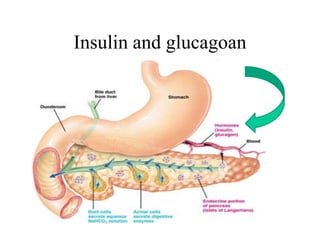
Insulin and glucagoan
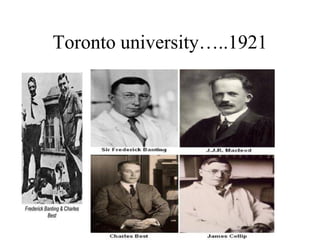
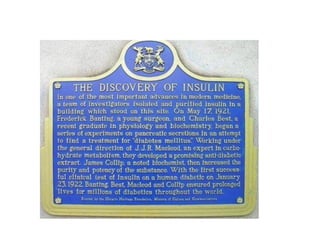
Toronto university…..1921
Insulin
• Hormone required to transfer glucose from
the blood to the tissues and the cell where it
can be used as fuel.
• Anabolic hormone
• Ant catabolic action
• Liver acts as a buffer
The Diabetic patient
• Diabetes is a medical condition when
persons pancreas will no longer produce an
adequate supply of insulin or when the
body loses ability to utilize insulin properly
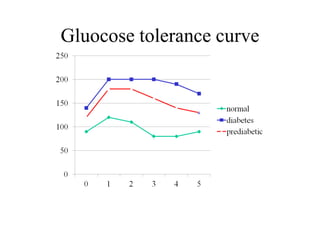
Gluocose tolerance curve
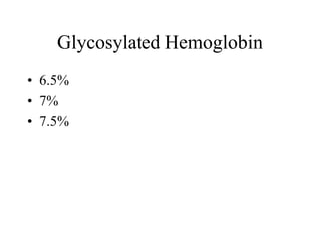
Glycosylated Hemoglobin
• 6.5%
• 7%
• 7.5%
Pathophysiology of Diabetic Emergencies
• type 1 diabetes (previously known as
juvenile onset,
• ketosis-prone, insulin-dependent, or
brittle diabetes) or
• type 2 diabetes (previously, adult-
onset, non-ketosis-prone,
• non-insulin-dependent, or obesity-
related diabetes
• T3Gestational
• SUGAR CONTROL IN DIABETICS
• DIET CONTROL
• INSULIN
• ORAL HYPOGYCEMIC DRUGS
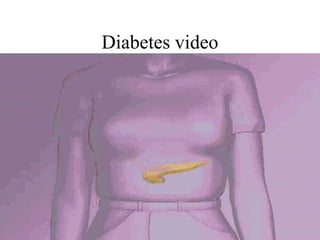
Diabetes video
Diabetic emergencies
• HYPERGLYCEMIA
• HYPOGLYCEMIA
• You receive a patient in ER who is
obtunded,what is your approach to the
patient /?????????????
Emergency care
• SAMPLE
• What did you last eat?
• Do you take diabetic medication?
• Have you taken your medication as
prescribed?
life-threatening disorders of glucose
metabolism.
• DKA
• HHNC
• hypoglycemia
Atherosclerosis
Infection
Retinopathy
Cataract
Hypertension
Ckd
Neuropathy
Foot
Stop and review
Q --HYPOGLYCEMIA IF LEFT
UNTREATED WILL RESULT IN
• A.-INSULIN COMA
• B-DIABETIC SHOCK
• C-DIBETIC COMA
• D-INSULIN SHOCK
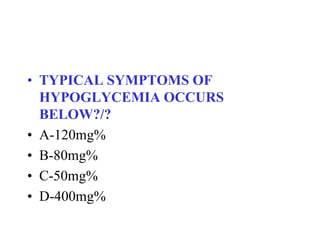
• TYPICAL SYMPTOMS OF
HYPOGLYCEMIA OCCURS
BELOW?/?
• A-120mg%
• B-80mg%
• C-50mg%
• D-400mg%
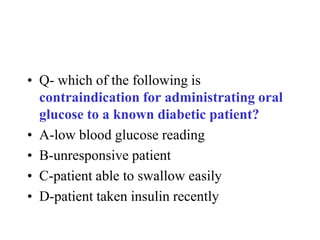
• Q- which of the following is
contraindication for administrating oral
glucose to a known diabetic patient?
• A-low blood glucose reading
• B-unresponsive patient
• C-patient able to swallow easily
• D-patient taken insulin recently
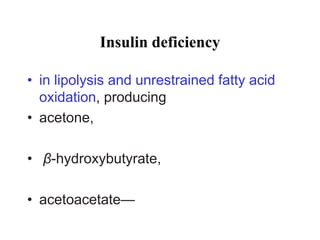
Insulin deficiency
• in lipolysis and unrestrained fatty acid
oxidation, producing
• acetone,
• β-hydroxybutyrate,
• acetoacetate—
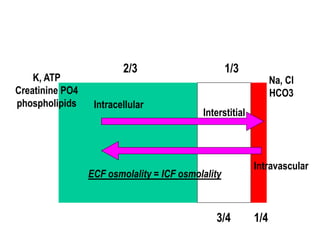
Intracellular
Interstitial
Intravascular
2/3 1/3
3/4 1/4
ECF osmolality = ICF osmolality
K, ATP
Creatinine PO4
phospholipids
Na, Cl
HCO3
Osmotic diuresis
• The glucose remains largely in the
extracellular
• space and shifts water osmotically from
the intracellular compartment.
• of the renal tubules for glucose has a
maximum of approximately 200 mg/min,
an osmotic diuresis occurs, with water lost in
• excess of salts.
DKA
• Hyperglycemic condition in which absence
of insulin causes the body to metabolize
other sources of energy such as fat .The
blood becomes acidic and condition may
result in fruity breath odor and altered
mental status
• (
Kussmaul respiration
• )
• Respiration that are both rapid and
deep seen in patient with extreme
hyperglycemia associated with the
fruity odor of acetone.
Enumerate medical causes of
•
• ACUTE ABDOMEN???
Diabetic ketoacidosis
• Dyspnea
• Normotension
• Hypo- and hyperthermia
• Nausea
• Tachycardia
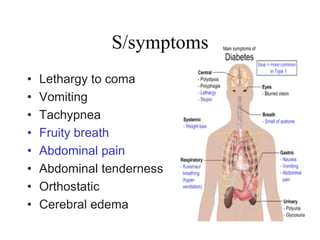
S/symptoms
• Lethargy to coma
• Vomiting
• Tachypnea
• Fruity breath
• Abdominal pain
• Abdominal tenderness
• Orthostatic
• Cerebral edema
Lab paradox
• nitroprusside reaction commonly used
to detect ketone bodies
• detects acetoacetate much better than
acetone and does
• not react with β-hydroxybutyrate at all.
Particularly in severe
• DKA, β-hydroxybutyrate is the
predominant ketone,
Laboratory findings
• 1. Serum glucose level >300 mg/dL
• 2. pH <7.35, pCO2 <40 mm Hg
• 3. Bicarbonate level below normal with an
elevated anion gap
• 4. Presence of ketones in the serum
What next
• CHECK ANION GAP
• Causes of raised anion gap
• MUDPIES
Differential diagnosis
• A. Differential diagnosis of ketosis-causing conditions
• 1. Alcoholic ketoacidosis occurs with heavy drinking
• and vomiting. It does not cause an elevated
• glucose.
• 2. Starvation ketosis occurs after 24 hours without
• food and is not usually confused with DKA because
• glucose and serum pH are normal.
Treatment of diabetic ketoacidosis
• Fluid resuscitation
• Which fluid???
• When to introduce 5% dex
Insulin
• loading dose consists of 0.1 U/kg IV
• . then infused at 0.1 U/kg per hour.
• glucose decline does not
• exceed 100 mg/dL per hour.
• 2. The insulin infusion rate may be decreased
when the bicarbonate level is greater than 20
mEq/L, the anion gap is less than 16 mEq/L, or the
glucose is <250 mg/dL.
Potassium
• deficit is between 300 and 500 mEq
• potassium replacement is 20 mEq/h, but
• hypokalemia
. All patients should receive potassium replacement,
• except for those with renal failure, no urine output,
• or an initial serum potassium level greater than 6.0
• mEq/L.
Sodium.
• . For every 100 mg/dL that glucose is
elevated, the sodium level should be
assumed to be higher than the measured
value by 1.6 mEq/L.
Other electrolytes
• Phosphate. Diabetic ketoacidosis depletes phosphate
• stores. Serum phosphate level should be
• checked after 4 hours of treatment. If it is below 1.5
• mg/dL, potassium phosphate should be added to the
• IV solution in place of KCl.
• F. Bicarbonate therapy is not required unless the
• arterial pH value is <7.0. For a pH of <7.0, add 50
• mEq of sodium bicarbonate to the first liter of IV fluid.
• G. Magnesium. The usual magnesium deficit is 2-3 gm.
• If the patient's magnesium level is less than 1.8
• mEq/L or if tetany is present, magnesium sulfate is
• given as 5g in 500 mL of 0.45% normal saline over 5
• hours.
Say no to soda bicarbonate??
• Therapy of DKA and HHNC requires
replacement of deficits of
• fluids, electrolytes, and insulin
Freezing point depression method
• Osmolarity (mOsm/L) = 2 × [sodium]
• + [glucose]/18 + [BUN]/2.8 +
[ethanol]/4.6
disastrous consequences of
aggressive
therapy
• —cerebral edema,
• pulmonary edema,
• hypoglycemia,
• hypokalemia, and
• hyperchloremic metabolic acidosis.
Why decompensation?
Search for Infection
BS control in acute illness
• Maintaining BS between 80-100 mg/dl
• Surgical ICU (Van den Berghe et al, 2001)
– In-hospital mortality 11 to 7%
– Reduction in severe infections, polyneuropathy and
organ failure
• Medical ICU (Van den Berghe et al, 2006)
– Prevent acute renal failure, accelerated weaning from
ventilator, reduced ICU and hospital stay
– Mortality reduced in people who stayed in icu for more
than 3 days
• Control population had BS control once BS > 215
mg/dl
Review questions
• All of the following pathways occur as diabetic
• ketoacidosis develops EXCEPT
• (A) hyperglycemia → glycosuria → dehydration
• and loss of electrolytes
• (B) hyperglycemia → cell dehydration → altered
• level of consciousness
• (C) insulin and glucagon deficiency → increased
• hepatic gluconeogenesis
• (D) lipolysis → ketosis → acidosis
• (E) muscle breakdown → azotemia →
• loss of sodium
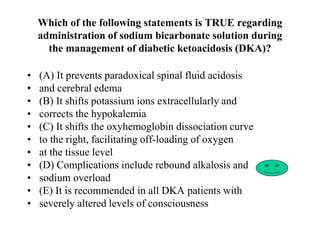
Which of the following statements is TRUE regarding
administration of sodium bicarbonate solution during
the management of diabetic ketoacidosis (DKA)?
• (A) It prevents paradoxical spinal fluid acidosis
• and cerebral edema
• (B) It shifts potassium ions extracellularly and
• corrects the hypokalemia
• (C) It shifts the oxyhemoglobin dissociation curve
• to the right, facilitating off-loading of oxygen
• at the tissue level
• (D) Complications include rebound alkalosis and
• sodium overload
• (E) It is recommended in all DKA patients with
• severely altered levels of consciousness
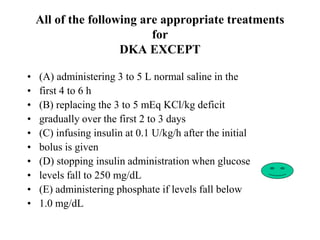
All of the following are appropriate treatments
for
DKA EXCEPT
• (A) administering 3 to 5 L normal saline in the
• first 4 to 6 h
• (B) replacing the 3 to 5 mEq KCl/kg deficit
• gradually over the first 2 to 3 days
• (C) infusing insulin at 0.1 U/kg/h after the initial
• bolus is given
• (D) stopping insulin administration when glucose
• levels fall to 250 mg/dL
• (E) administering phosphate if levels fall below
• 1.0 mg/dL
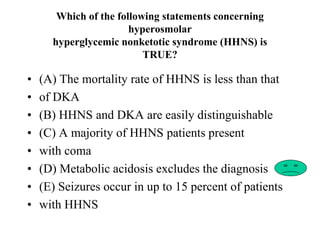
Which of the following statements concerning
hyperosmolar
hyperglycemic nonketotic syndrome (HHNS) is
TRUE?
• (A) The mortality rate of HHNS is less than that
• of DKA
• (B) HHNS and DKA are easily distinguishable
• (C) A majority of HHNS patients present
• with coma
• (D) Metabolic acidosis excludes the diagnosis
• (E) Seizures occur in up to 15 percent of patients
• with HHNS
• What is the MOST common cause of
hypoglycemia
• in patients presenting to the ED?
• (A) First time presentation of diabetes
• (B) Alcohol related
• (C) Oral hypoglycemics
• (D) Insulinoma
• (E) Liver failure
Which of the following statements
regarding hypoglycemia
is FALSE?
• (A) Counterregulatory hormones are released in a
• hypoglycemic state
• (B) Hypoglycemia causes both autonomic and neuroglycopenic
• symptoms
• (C) Hypoglycemic patients commonly present with
• altered levels of consciousness, lethargy, confusion,
• or agitation
• (D) Hypoglycemia is diagnosed when the blood
• glucose is less than 60 mg/dL
• (E) Glucagon is ineffective in the treatment of
• alcohol-induced hypoglycemia
• A patient presents to the ED and has the following
• laboratory values: sodium 139 mEq/L, potassium 4.1
• mEq/L, chloride 112 mEq/L, bicarbonate 15 mEq/L,
• blood urea nitrogen (BUN) 22, creatinine 1.5, and
glucose 180. All of the following could be the etiology of
• these laboratory findings EXCEPT
• (A) salicylates
• (B) renal tubular acidosis, type II
• (C) acute diarrhea
• (D) ureterosigmoidostomy
• (E) pancreatic fistula
• What is the calculated osmolarity for the patient in
• question 300?
• (A) 157 mOsm/L
• (B) 274 mOsm/L
• (C) 296 mOsm/L
• (D) 310 mOsm/L
• (E) 347 mOsm/L
• The etiologies of this patient’s normal AG
• (hyperchloremic) metabolic acidosis can be
remembered by a helpful mnemonic,
• HARDUP: H for hypoaldosteronism (Addison’s
disease), A for acetazolamide, R for renal
• tubular acidosis, D for diarrhea, U for
ureterosigmoidostomy, and P for pancreatic
fistula.

Glucose homeostasis

  • 1.
    Glucose homeostasis Dr Anand.Tiwari Headof dept.ICU Wanowrie Ruby hall
  • 2.
    Emergency prespective • Whendo you advise a blood sugar ?
  • 3.
    • Brain isthe biggest user of glucose ALTERED MENTAL STATUS
  • 4.
    Pinprick for BSL •Altered glucose metabolism should be considered in the • differential diagnosis of all patients with mental status changes, • neurologic deficits, and severe illness Do not neglect the initial assessment of ABC
  • 5.
  • 6.
  • 8.
    Insulin • Hormone requiredto transfer glucose from the blood to the tissues and the cell where it can be used as fuel. • Anabolic hormone • Ant catabolic action • Liver acts as a buffer
  • 9.
    The Diabetic patient •Diabetes is a medical condition when persons pancreas will no longer produce an adequate supply of insulin or when the body loses ability to utilize insulin properly
  • 10.
  • 11.
  • 12.
    Pathophysiology of DiabeticEmergencies • type 1 diabetes (previously known as juvenile onset, • ketosis-prone, insulin-dependent, or brittle diabetes) or • type 2 diabetes (previously, adult- onset, non-ketosis-prone, • non-insulin-dependent, or obesity- related diabetes • T3Gestational
  • 13.
    • SUGAR CONTROLIN DIABETICS • DIET CONTROL • INSULIN • ORAL HYPOGYCEMIC DRUGS
  • 14.
  • 15.
  • 16.
    • You receivea patient in ER who is obtunded,what is your approach to the patient /?????????????
  • 17.
    Emergency care • SAMPLE •What did you last eat? • Do you take diabetic medication? • Have you taken your medication as prescribed?
  • 18.
    life-threatening disorders ofglucose metabolism. • DKA • HHNC • hypoglycemia Atherosclerosis Infection Retinopathy Cataract Hypertension Ckd Neuropathy Foot
  • 19.
    Stop and review Q--HYPOGLYCEMIA IF LEFT UNTREATED WILL RESULT IN • A.-INSULIN COMA • B-DIABETIC SHOCK • C-DIBETIC COMA • D-INSULIN SHOCK
  • 20.
    • TYPICAL SYMPTOMSOF HYPOGLYCEMIA OCCURS BELOW?/? • A-120mg% • B-80mg% • C-50mg% • D-400mg%
  • 21.
    • Q- whichof the following is contraindication for administrating oral glucose to a known diabetic patient? • A-low blood glucose reading • B-unresponsive patient • C-patient able to swallow easily • D-patient taken insulin recently
  • 22.
    Insulin deficiency • inlipolysis and unrestrained fatty acid oxidation, producing • acetone, • β-hydroxybutyrate, • acetoacetate—
  • 23.
    Intracellular Interstitial Intravascular 2/3 1/3 3/4 1/4 ECFosmolality = ICF osmolality K, ATP Creatinine PO4 phospholipids Na, Cl HCO3
  • 24.
    Osmotic diuresis • Theglucose remains largely in the extracellular • space and shifts water osmotically from the intracellular compartment. • of the renal tubules for glucose has a maximum of approximately 200 mg/min, an osmotic diuresis occurs, with water lost in • excess of salts.
  • 25.
    DKA • Hyperglycemic conditionin which absence of insulin causes the body to metabolize other sources of energy such as fat .The blood becomes acidic and condition may result in fruity breath odor and altered mental status • (
  • 26.
    Kussmaul respiration • ) •Respiration that are both rapid and deep seen in patient with extreme hyperglycemia associated with the fruity odor of acetone.
  • 27.
    Enumerate medical causesof • • ACUTE ABDOMEN???
  • 28.
    Diabetic ketoacidosis • Dyspnea •Normotension • Hypo- and hyperthermia • Nausea • Tachycardia
  • 29.
    S/symptoms • Lethargy tocoma • Vomiting • Tachypnea • Fruity breath • Abdominal pain • Abdominal tenderness • Orthostatic • Cerebral edema
  • 30.
    Lab paradox • nitroprussidereaction commonly used to detect ketone bodies • detects acetoacetate much better than acetone and does • not react with β-hydroxybutyrate at all. Particularly in severe • DKA, β-hydroxybutyrate is the predominant ketone,
  • 31.
    Laboratory findings • 1.Serum glucose level >300 mg/dL • 2. pH <7.35, pCO2 <40 mm Hg • 3. Bicarbonate level below normal with an elevated anion gap • 4. Presence of ketones in the serum
  • 32.
    What next • CHECKANION GAP • Causes of raised anion gap • MUDPIES
  • 33.
    Differential diagnosis • A.Differential diagnosis of ketosis-causing conditions • 1. Alcoholic ketoacidosis occurs with heavy drinking • and vomiting. It does not cause an elevated • glucose. • 2. Starvation ketosis occurs after 24 hours without • food and is not usually confused with DKA because • glucose and serum pH are normal.
  • 34.
    Treatment of diabeticketoacidosis • Fluid resuscitation • Which fluid??? • When to introduce 5% dex
  • 35.
    Insulin • loading doseconsists of 0.1 U/kg IV • . then infused at 0.1 U/kg per hour. • glucose decline does not • exceed 100 mg/dL per hour. • 2. The insulin infusion rate may be decreased when the bicarbonate level is greater than 20 mEq/L, the anion gap is less than 16 mEq/L, or the glucose is <250 mg/dL.
  • 36.
    Potassium • deficit isbetween 300 and 500 mEq • potassium replacement is 20 mEq/h, but • hypokalemia . All patients should receive potassium replacement, • except for those with renal failure, no urine output, • or an initial serum potassium level greater than 6.0 • mEq/L.
  • 37.
    Sodium. • . Forevery 100 mg/dL that glucose is elevated, the sodium level should be assumed to be higher than the measured value by 1.6 mEq/L.
  • 38.
    Other electrolytes • Phosphate.Diabetic ketoacidosis depletes phosphate • stores. Serum phosphate level should be • checked after 4 hours of treatment. If it is below 1.5 • mg/dL, potassium phosphate should be added to the • IV solution in place of KCl. • F. Bicarbonate therapy is not required unless the • arterial pH value is <7.0. For a pH of <7.0, add 50 • mEq of sodium bicarbonate to the first liter of IV fluid. • G. Magnesium. The usual magnesium deficit is 2-3 gm. • If the patient's magnesium level is less than 1.8 • mEq/L or if tetany is present, magnesium sulfate is • given as 5g in 500 mL of 0.45% normal saline over 5 • hours.
  • 39.
    Say no tosoda bicarbonate?? • Therapy of DKA and HHNC requires replacement of deficits of • fluids, electrolytes, and insulin
  • 40.
    Freezing point depressionmethod • Osmolarity (mOsm/L) = 2 × [sodium] • + [glucose]/18 + [BUN]/2.8 + [ethanol]/4.6
  • 41.
    disastrous consequences of aggressive therapy •—cerebral edema, • pulmonary edema, • hypoglycemia, • hypokalemia, and • hyperchloremic metabolic acidosis.
  • 42.
  • 43.
    BS control inacute illness • Maintaining BS between 80-100 mg/dl • Surgical ICU (Van den Berghe et al, 2001) – In-hospital mortality 11 to 7% – Reduction in severe infections, polyneuropathy and organ failure • Medical ICU (Van den Berghe et al, 2006) – Prevent acute renal failure, accelerated weaning from ventilator, reduced ICU and hospital stay – Mortality reduced in people who stayed in icu for more than 3 days • Control population had BS control once BS > 215 mg/dl
  • 44.
    Review questions • Allof the following pathways occur as diabetic • ketoacidosis develops EXCEPT • (A) hyperglycemia → glycosuria → dehydration • and loss of electrolytes • (B) hyperglycemia → cell dehydration → altered • level of consciousness • (C) insulin and glucagon deficiency → increased • hepatic gluconeogenesis • (D) lipolysis → ketosis → acidosis • (E) muscle breakdown → azotemia → • loss of sodium
  • 45.
    Which of thefollowing statements is TRUE regarding administration of sodium bicarbonate solution during the management of diabetic ketoacidosis (DKA)? • (A) It prevents paradoxical spinal fluid acidosis • and cerebral edema • (B) It shifts potassium ions extracellularly and • corrects the hypokalemia • (C) It shifts the oxyhemoglobin dissociation curve • to the right, facilitating off-loading of oxygen • at the tissue level • (D) Complications include rebound alkalosis and • sodium overload • (E) It is recommended in all DKA patients with • severely altered levels of consciousness
  • 46.
    All of thefollowing are appropriate treatments for DKA EXCEPT • (A) administering 3 to 5 L normal saline in the • first 4 to 6 h • (B) replacing the 3 to 5 mEq KCl/kg deficit • gradually over the first 2 to 3 days • (C) infusing insulin at 0.1 U/kg/h after the initial • bolus is given • (D) stopping insulin administration when glucose • levels fall to 250 mg/dL • (E) administering phosphate if levels fall below • 1.0 mg/dL
  • 47.
    Which of thefollowing statements concerning hyperosmolar hyperglycemic nonketotic syndrome (HHNS) is TRUE? • (A) The mortality rate of HHNS is less than that • of DKA • (B) HHNS and DKA are easily distinguishable • (C) A majority of HHNS patients present • with coma • (D) Metabolic acidosis excludes the diagnosis • (E) Seizures occur in up to 15 percent of patients • with HHNS
  • 49.
    • What isthe MOST common cause of hypoglycemia • in patients presenting to the ED? • (A) First time presentation of diabetes • (B) Alcohol related • (C) Oral hypoglycemics • (D) Insulinoma • (E) Liver failure
  • 50.
    Which of thefollowing statements regarding hypoglycemia is FALSE? • (A) Counterregulatory hormones are released in a • hypoglycemic state • (B) Hypoglycemia causes both autonomic and neuroglycopenic • symptoms • (C) Hypoglycemic patients commonly present with • altered levels of consciousness, lethargy, confusion, • or agitation • (D) Hypoglycemia is diagnosed when the blood • glucose is less than 60 mg/dL • (E) Glucagon is ineffective in the treatment of • alcohol-induced hypoglycemia
  • 51.
    • A patientpresents to the ED and has the following • laboratory values: sodium 139 mEq/L, potassium 4.1 • mEq/L, chloride 112 mEq/L, bicarbonate 15 mEq/L, • blood urea nitrogen (BUN) 22, creatinine 1.5, and glucose 180. All of the following could be the etiology of • these laboratory findings EXCEPT • (A) salicylates • (B) renal tubular acidosis, type II • (C) acute diarrhea • (D) ureterosigmoidostomy • (E) pancreatic fistula
  • 52.
    • What isthe calculated osmolarity for the patient in • question 300? • (A) 157 mOsm/L • (B) 274 mOsm/L • (C) 296 mOsm/L • (D) 310 mOsm/L • (E) 347 mOsm/L
  • 53.
    • The etiologiesof this patient’s normal AG • (hyperchloremic) metabolic acidosis can be remembered by a helpful mnemonic, • HARDUP: H for hypoaldosteronism (Addison’s disease), A for acetazolamide, R for renal • tubular acidosis, D for diarrhea, U for ureterosigmoidostomy, and P for pancreatic fistula.