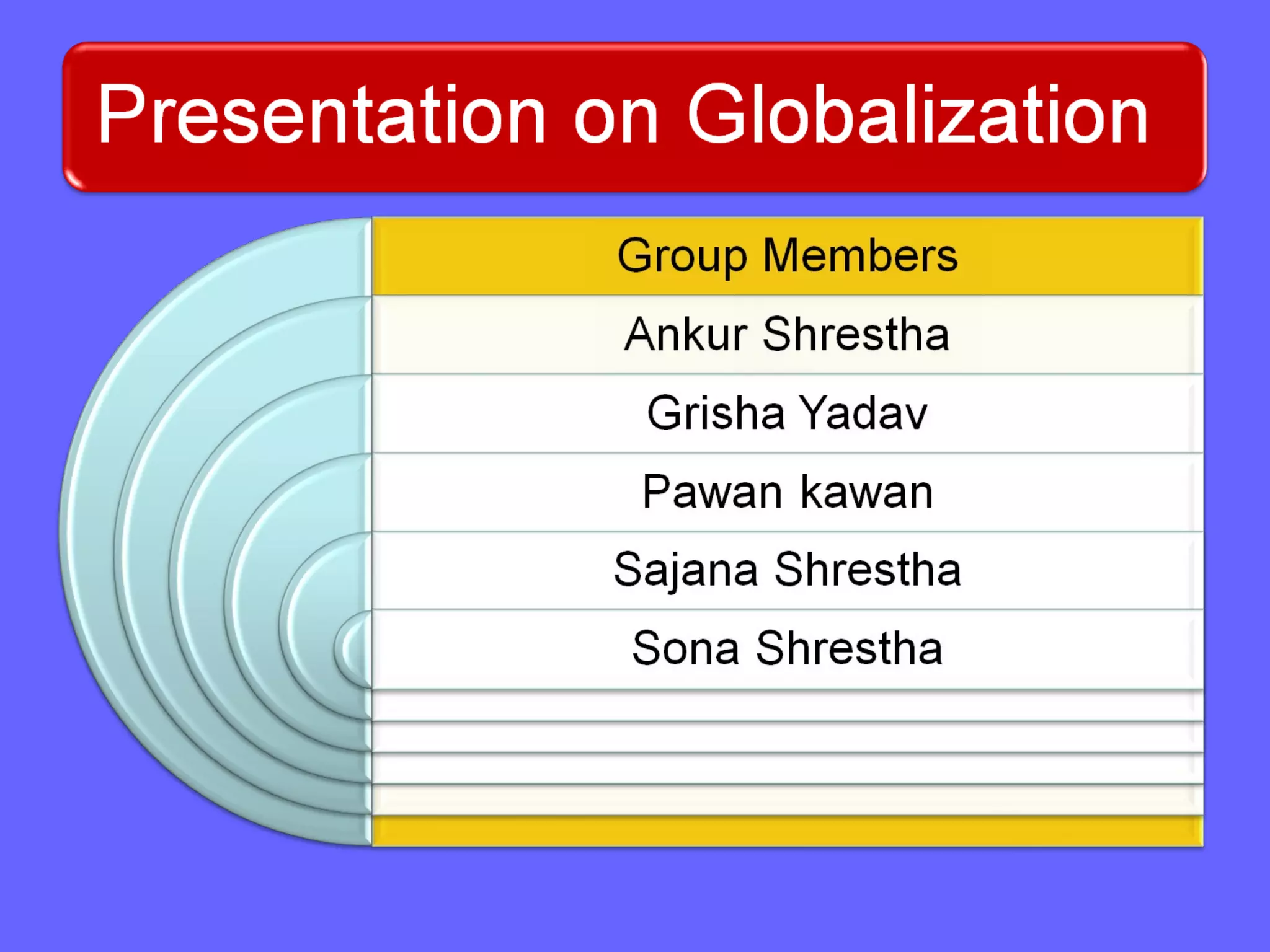

Globalizationrefers to the increasingly
global relationships of
culture, people, and
economic activity. It is
generally used to refer
to economic
globalization: the global
distribution of the
production of goods and
services, through
reduction of barriers to
international trade such
as tariffs, export fees,
and import quotas.
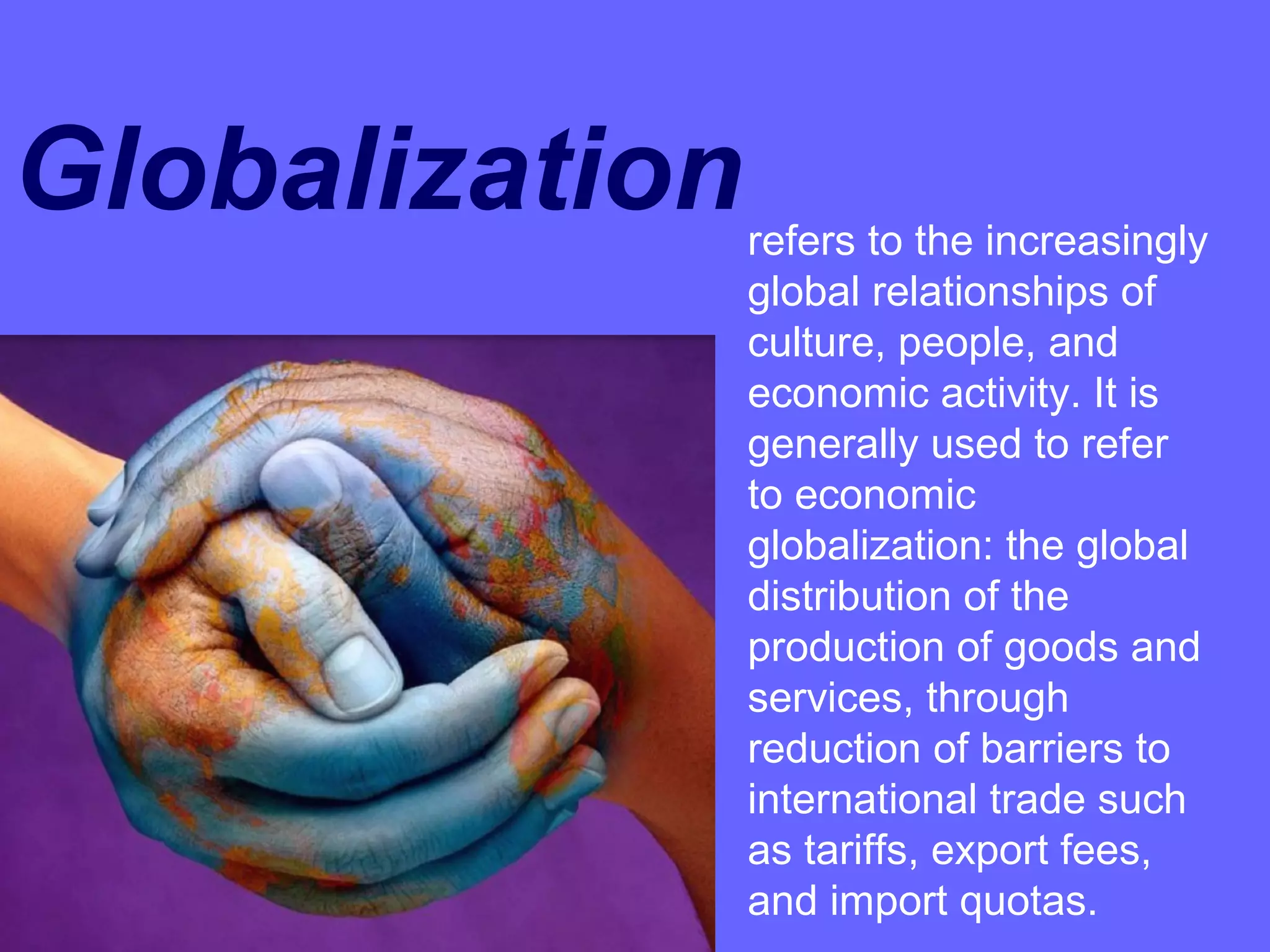
According to most
researchers, it is the
modern age which
led to the origin of
globalization.
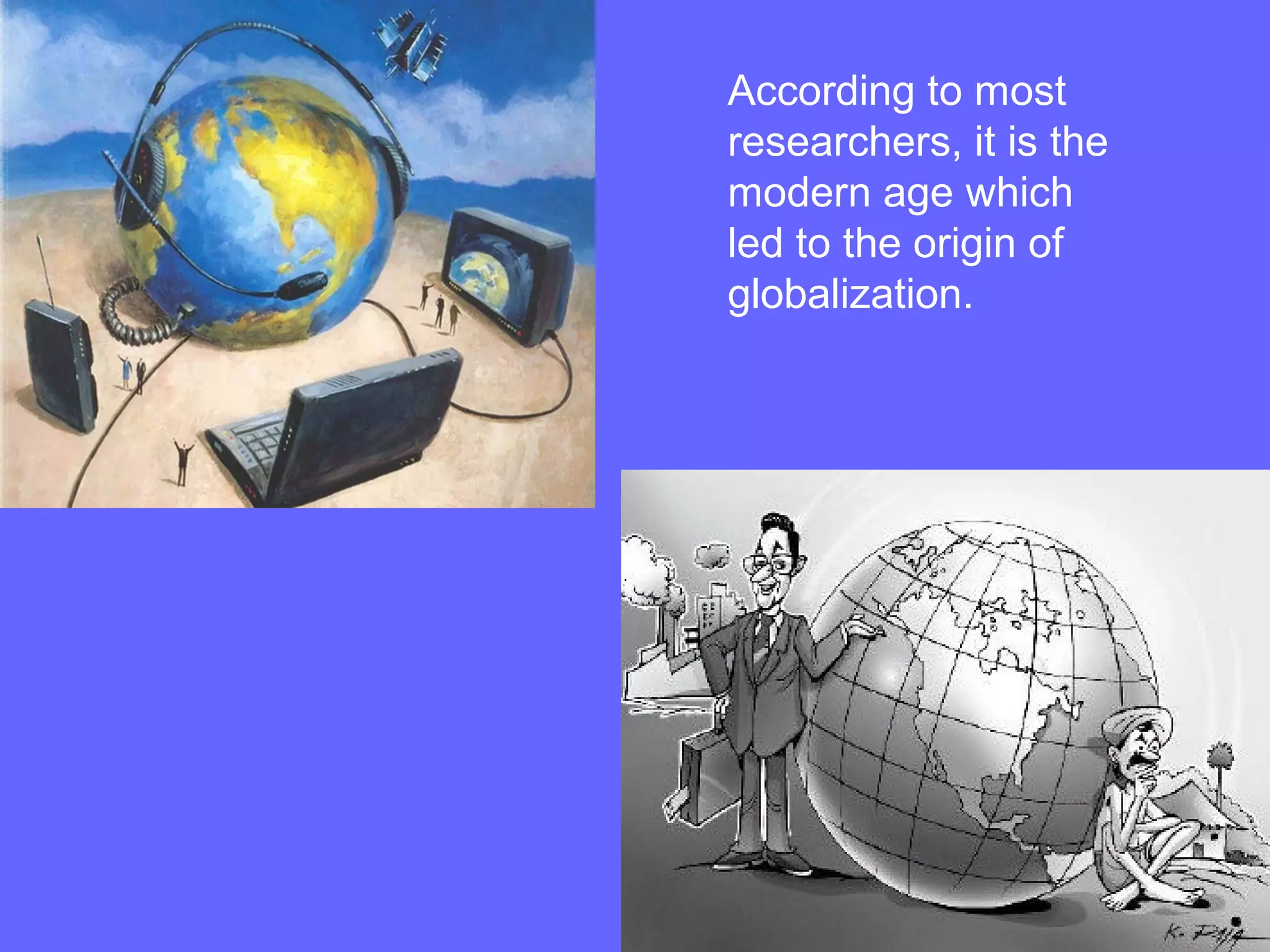
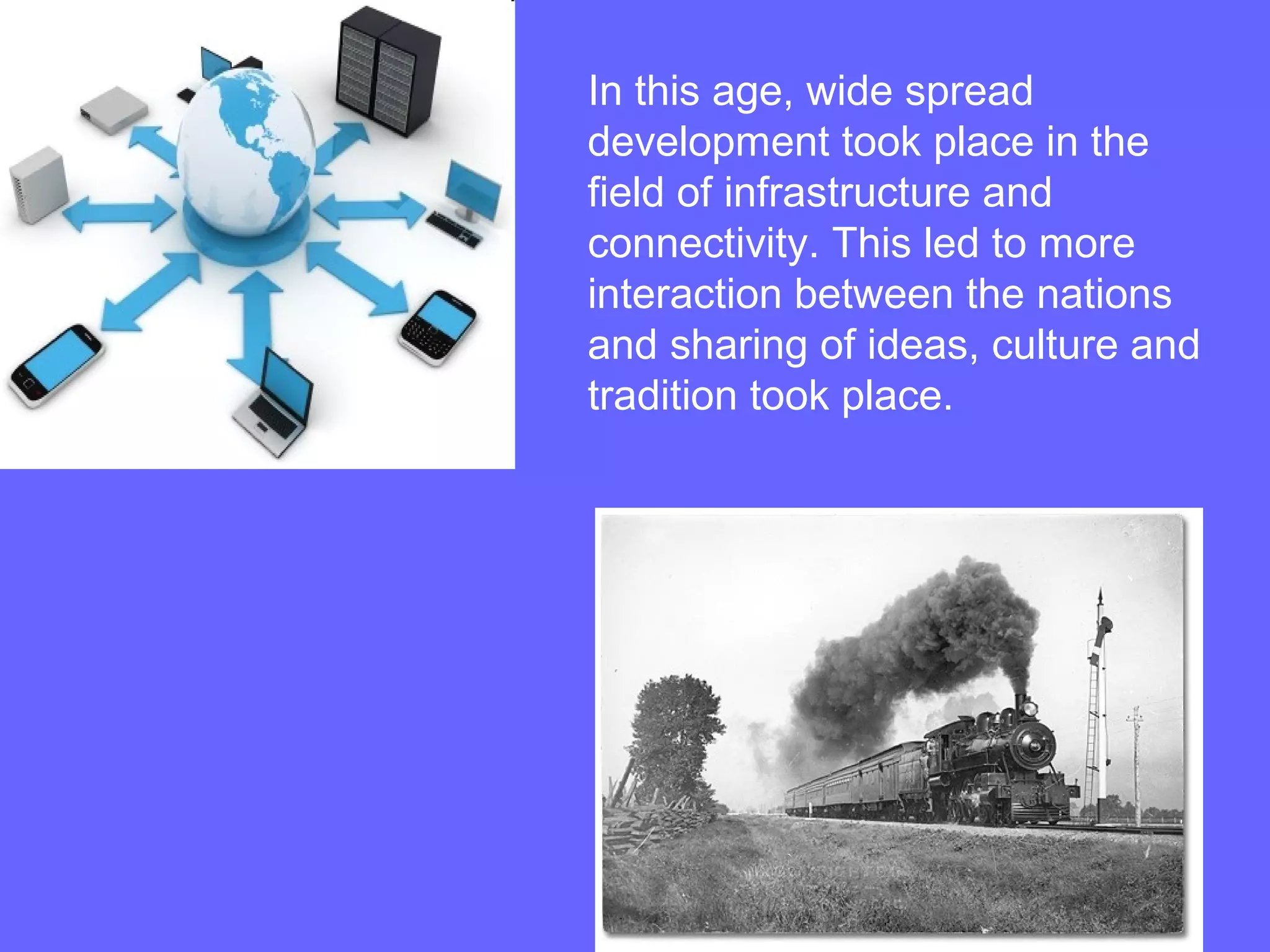
In this age, wide spread
development took place in the
field of infrastructure and
connectivity. This led to more
interaction between the nations
and sharing of ideas, culture and
tradition took place.
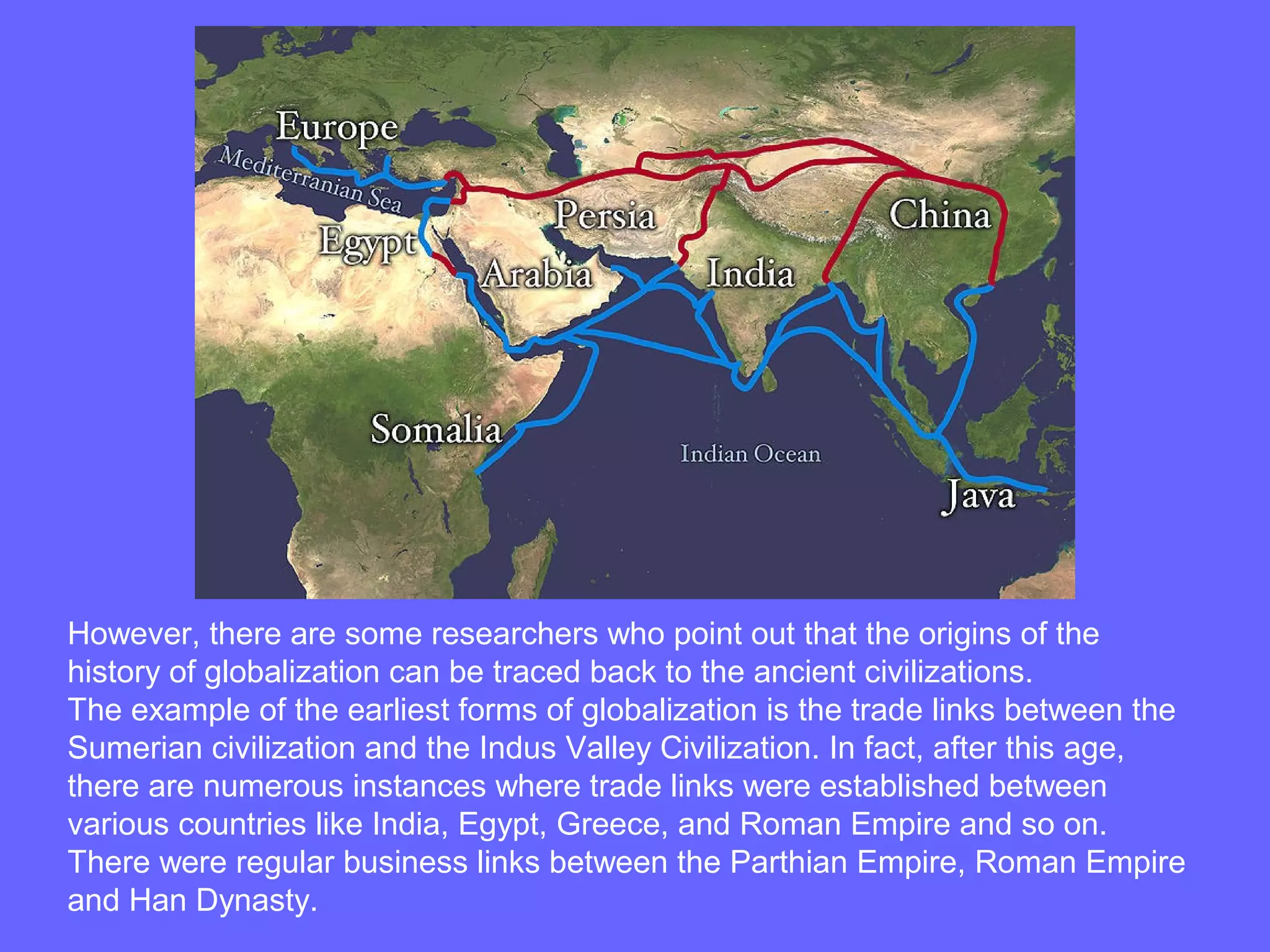
However, there are some researchers who point out that the origins of the
history of globalization can be traced back to the ancient civilizations.
The example of the earliest forms of globalization is the trade links between the
Sumerian civilization and the Indus Valley Civilization. In fact, after this age,
there are numerous instances where trade links were established between
various countries like India, Egypt, Greece, and Roman Empire and so on.
There were regular business links between the Parthian Empire, Roman Empire
and Han Dynasty.
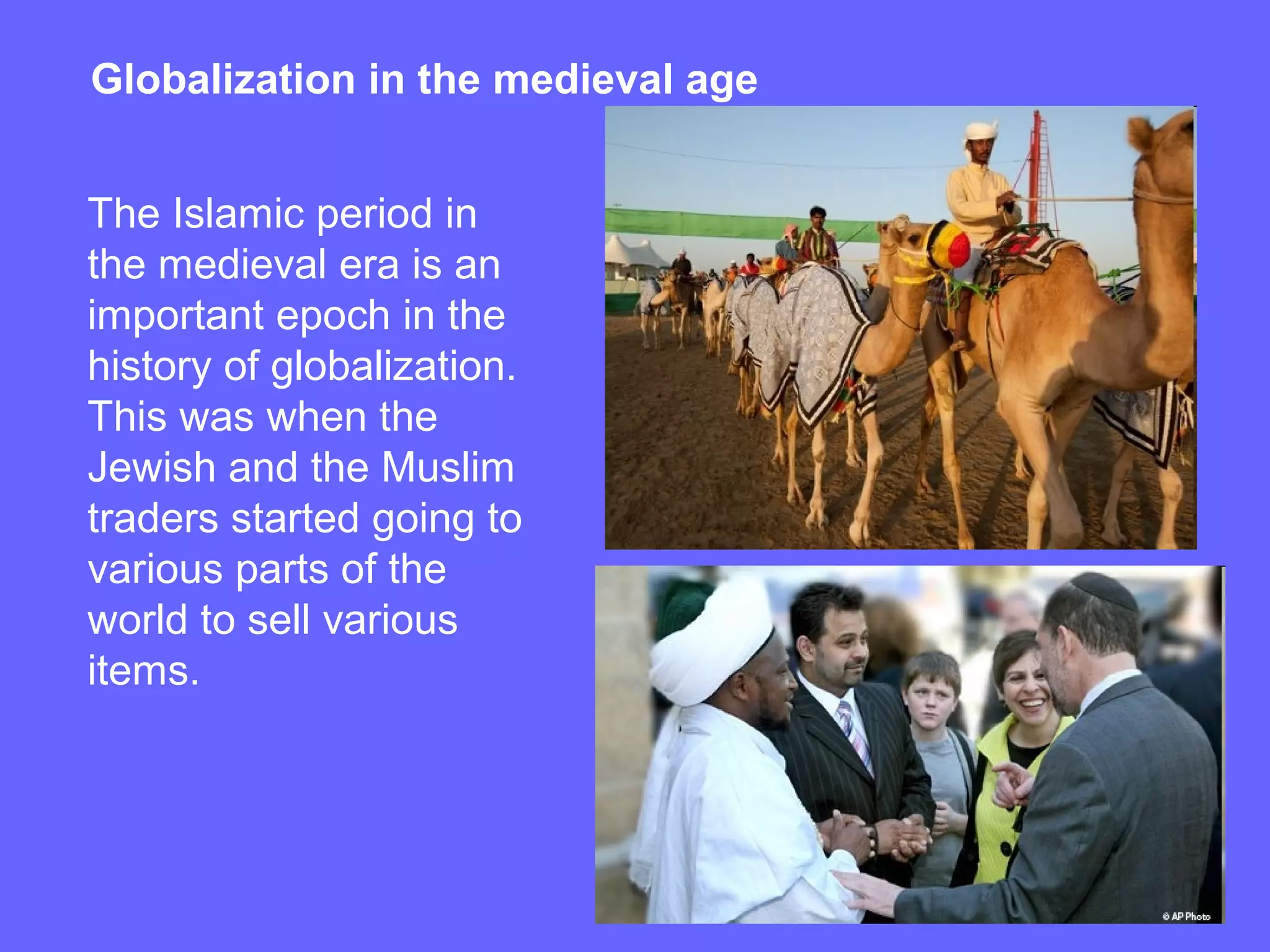
Globalization in the medieval age
The Islamic period in
the medieval era is an
important epoch in the
history of globalization.
This was when the
Jewish and the Muslim
traders started going to
various parts of the
world to sell various
items.
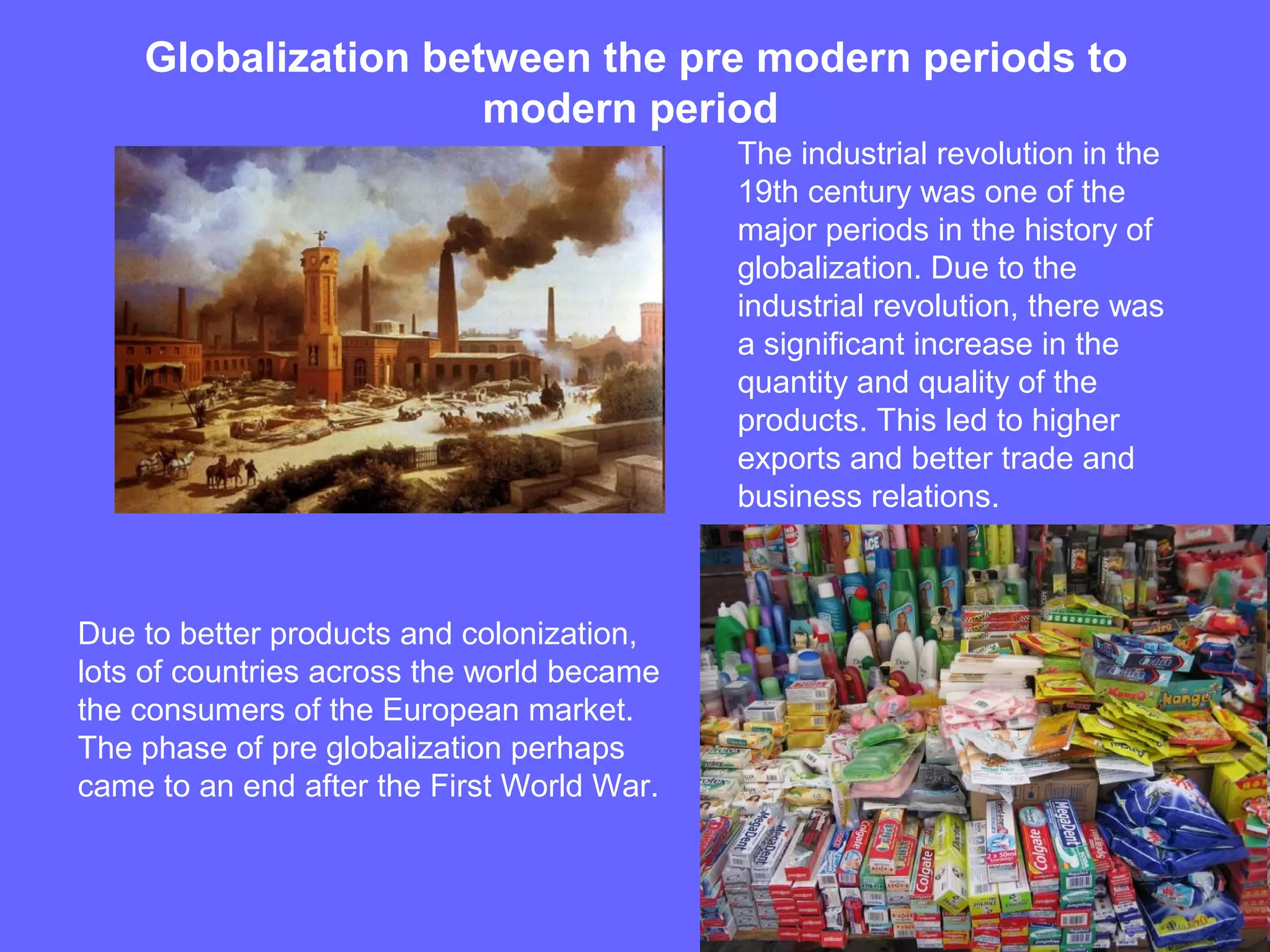
Globalization between the pre modern periods to
modern period
The industrial revolution in the
19th century was one of the
major periods in the history of
globalization. Due to the
industrial revolution, there was
a significant increase in the
quantity and quality of the
products. This led to higher
exports and better trade and
business relations.
Due to better products and colonization,
lots of countries across the world became
the consumers of the European market.
The phase of pre globalization perhaps
came to an end after the First World War.
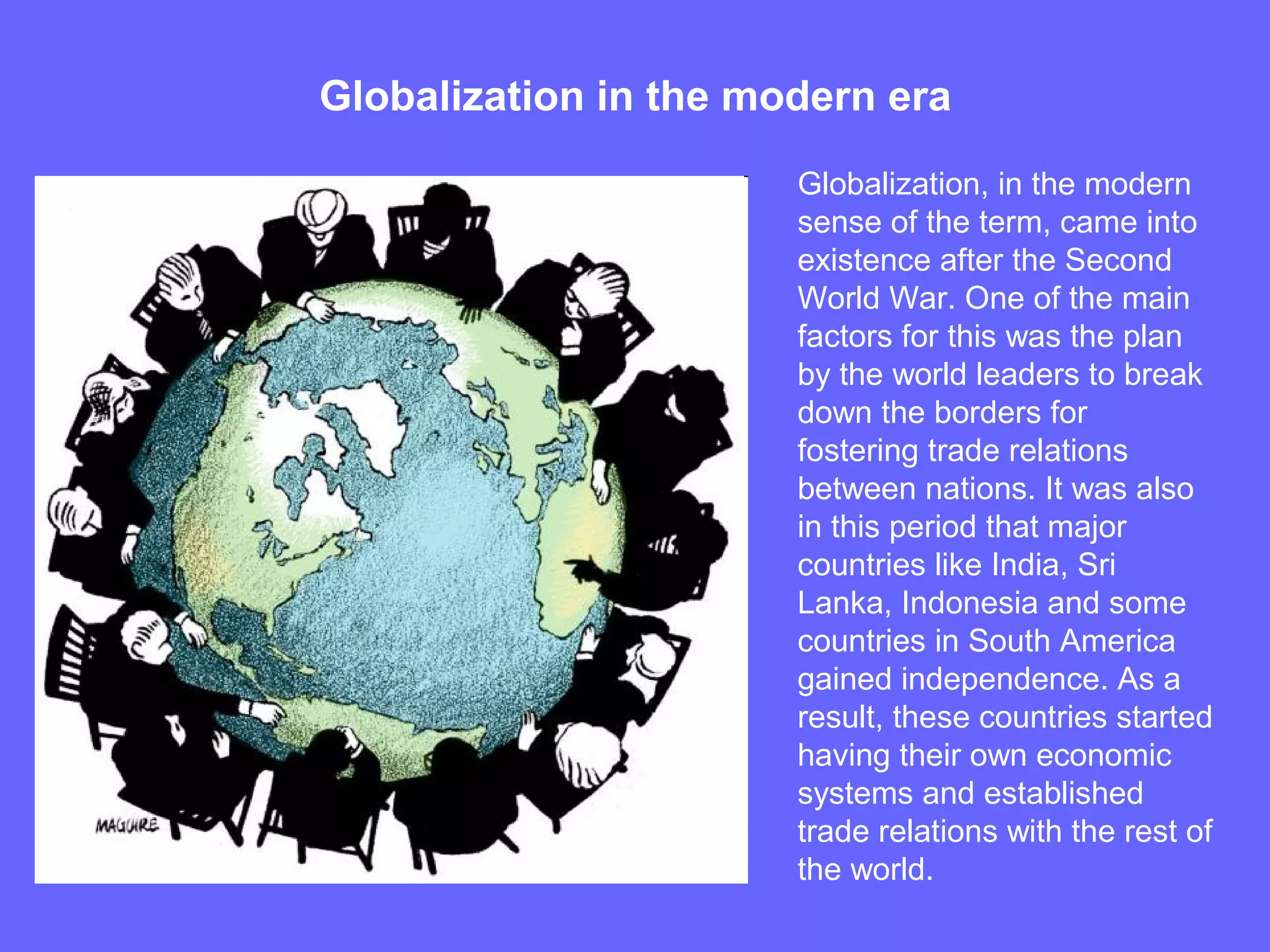
Globalization in the modern era
Globalization, in the modern
sense of the term, came into
existence after the Second
World War. One of the main
factors for this was the plan
by the world leaders to break
down the borders for
fostering trade relations
between nations. It was also
in this period that major
countries like India, Sri
Lanka, Indonesia and some
countries in South America
gained independence. As a
result, these countries started
having their own economic
systems and established
trade relations with the rest of
the world.
The establishment of
the United Nations
Organization (UNO)
was also a major step
in this regard.
Another milestone in
the history of
globalization is the
creation of the World
Trade Organization
which led to the growth
of a uniform platform to
settle trade and
commercial disputes.
• refers to the intensification and expansion of cultural flows
across the globe.
• Culture is a very broad concept and has many facets, but in
the discussion on globalization
• symbolic construction, articulation, and dissemination
• development of a global culture, the role of the media in
shaping our identities and desires, and the globalization of
languages.
• Merging or “watering down” of the world’s cultures e.g.
food, entertainment, language, etc.
• Heavily criticized as destructive of local culture
• e.g. The Simpsons is shown in over 200 countries in the
world.
• refers to the global environmental issues.
• includes population growth, access to food, worldwide
reduction in biodiversity, the gap between rich and
poor as well as between the global North and global
South, human-induced climate change, and global
environmental degradation.
• seeing the Earth as a single ecosystem rather than a
collection of separate ecological systems because so
many problems are global in nature
• e.g. International treaties to deal with environmental
issues like biodiversity, climate change or the ozone
layer, wildlife reserves that span several countries
• filled with a range of norms, claims,
beliefs, and narratives about the
phenomenon itself. According to Steger,
there are three main types of globalisms
• market globalism
• justice globalism
• and jihadist globalism. Steger defines
them as follows
• Interconnection of the world’s financial
systems e.g. stock markets
• More of a connection between large cities
than of nations
• Example: What happens in Asian markets
affects the North American markets.
• The formation of the World Trade Organization (WTO) and
the acceleration of import liberalization had started in 1995.
• It had further opened the economies of the developing
countries to the influx of foreign companies, foreign goods
and foreign service providers.
• The organization deals with regulation of trade between
participating countries.
• It provides a framework for negotiating and formalizing trade
agreements.
• Expanding free-trade concessions equally to all members.
• Establishing free global trade with fewer barriers.
• Making trade more predictable through established rules.
• Making trade more competitive by removing subsidies.
• It oversees the implementation, administration
and operation of the covered agreements.
• It provides a forum for negotiations and for
settling disputes.
• The WTO represents the rules-based regime of the
policy of economic globalization.
• The central operating principal of the WTO is that
commercial interests should succeed all others.
• Any obstacles in the path of operations and
expansion of global business enterprise must be
subordinated.
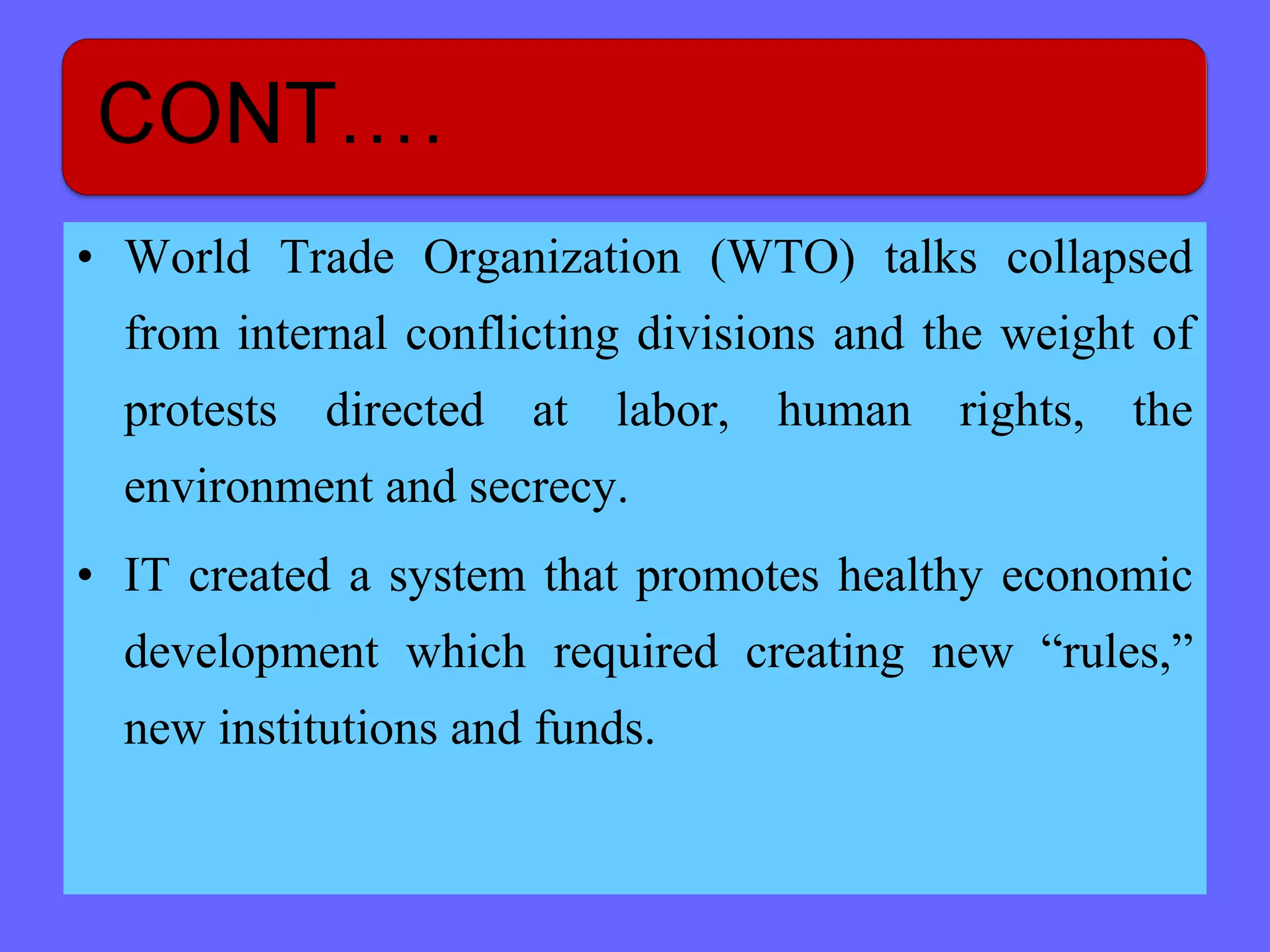
• World Trade Organization (WTO) talks collapsed
from internal conflicting divisions and the weight of
protests directed at labor, human rights, the
environment and secrecy.
• IT created a system that promotes healthy economic
development which required creating new “rules,”
new institutions and funds.
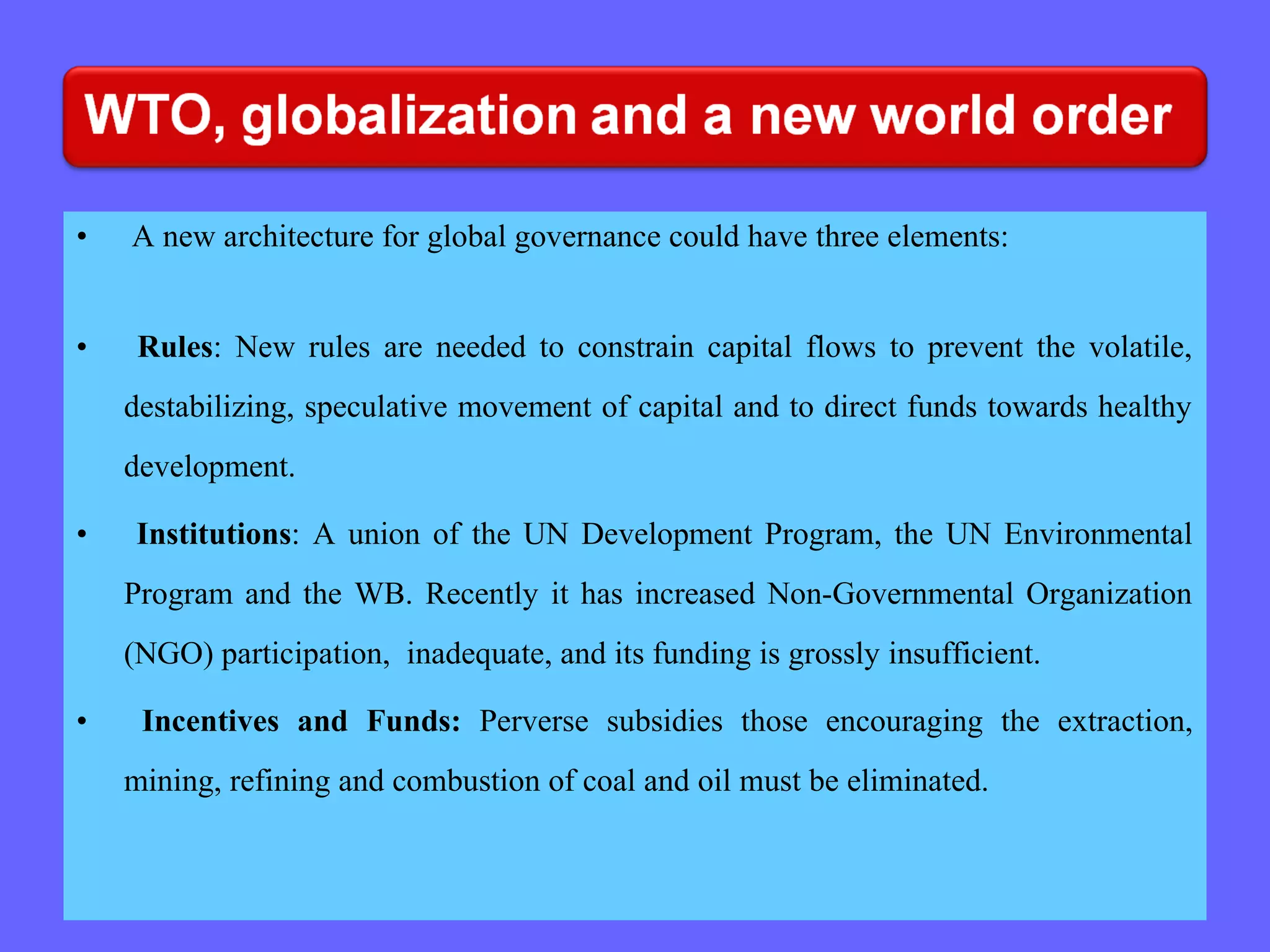
• A new architecture for global governance could have three elements:
• Rules: New rules are needed to constrain capital flows to prevent the volatile,
destabilizing, speculative movement of capital and to direct funds towards healthy
development.
• Institutions: A union of the UN Development Program, the UN Environmental
Program and the WB. Recently it has increased Non-Governmental Organization
(NGO) participation, inadequate, and its funding is grossly insufficient.
• Incentives and Funds: Perverse subsidies those encouraging the extraction,
mining, refining and combustion of coal and oil must be eliminated.
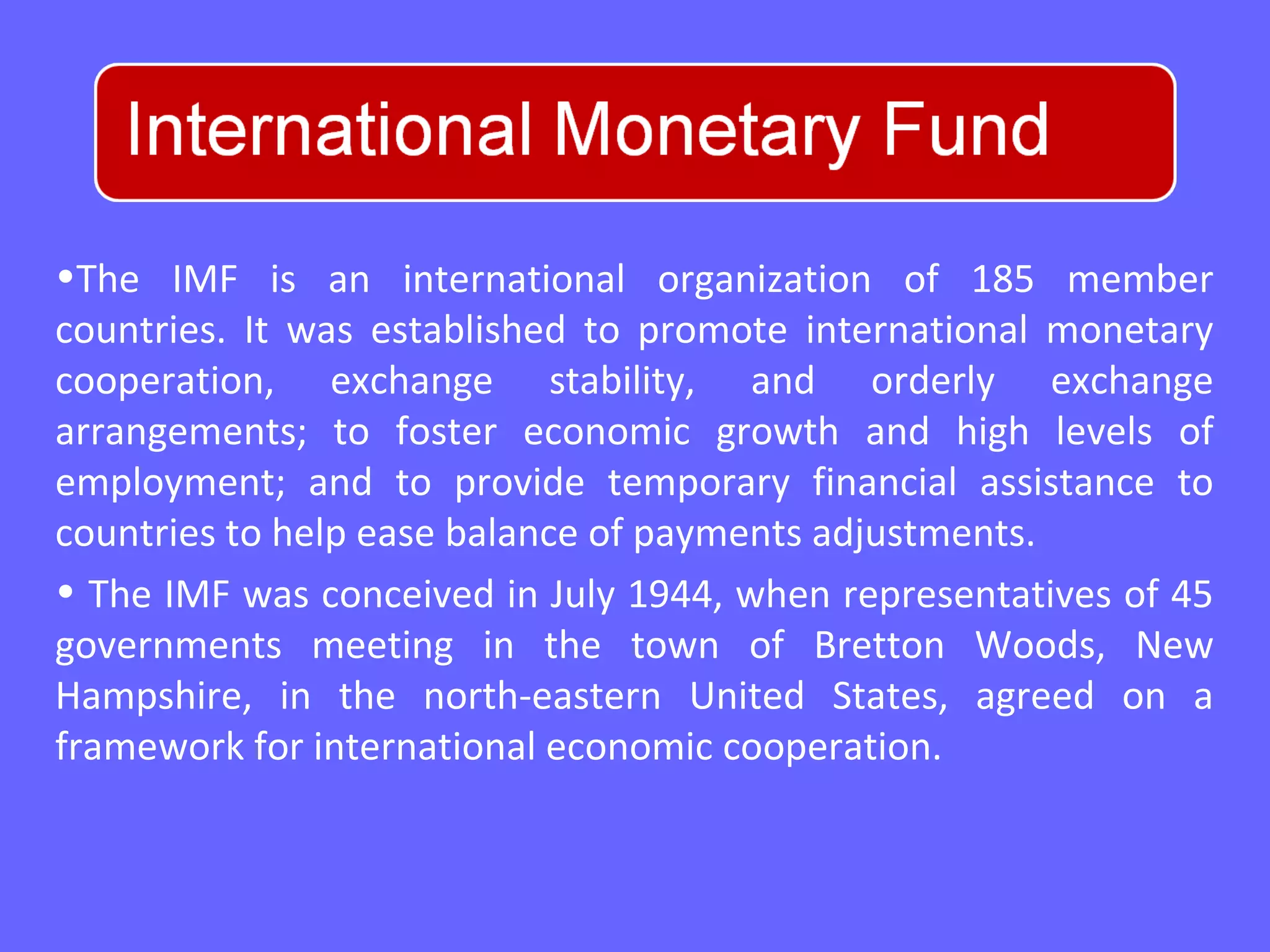
•The IMF is an international organization of 185 member
countries. It was established to promote international monetary
cooperation, exchange stability, and orderly exchange
arrangements; to foster economic growth and high levels of
employment; and to provide temporary financial assistance to
countries to help ease balance of payments adjustments.
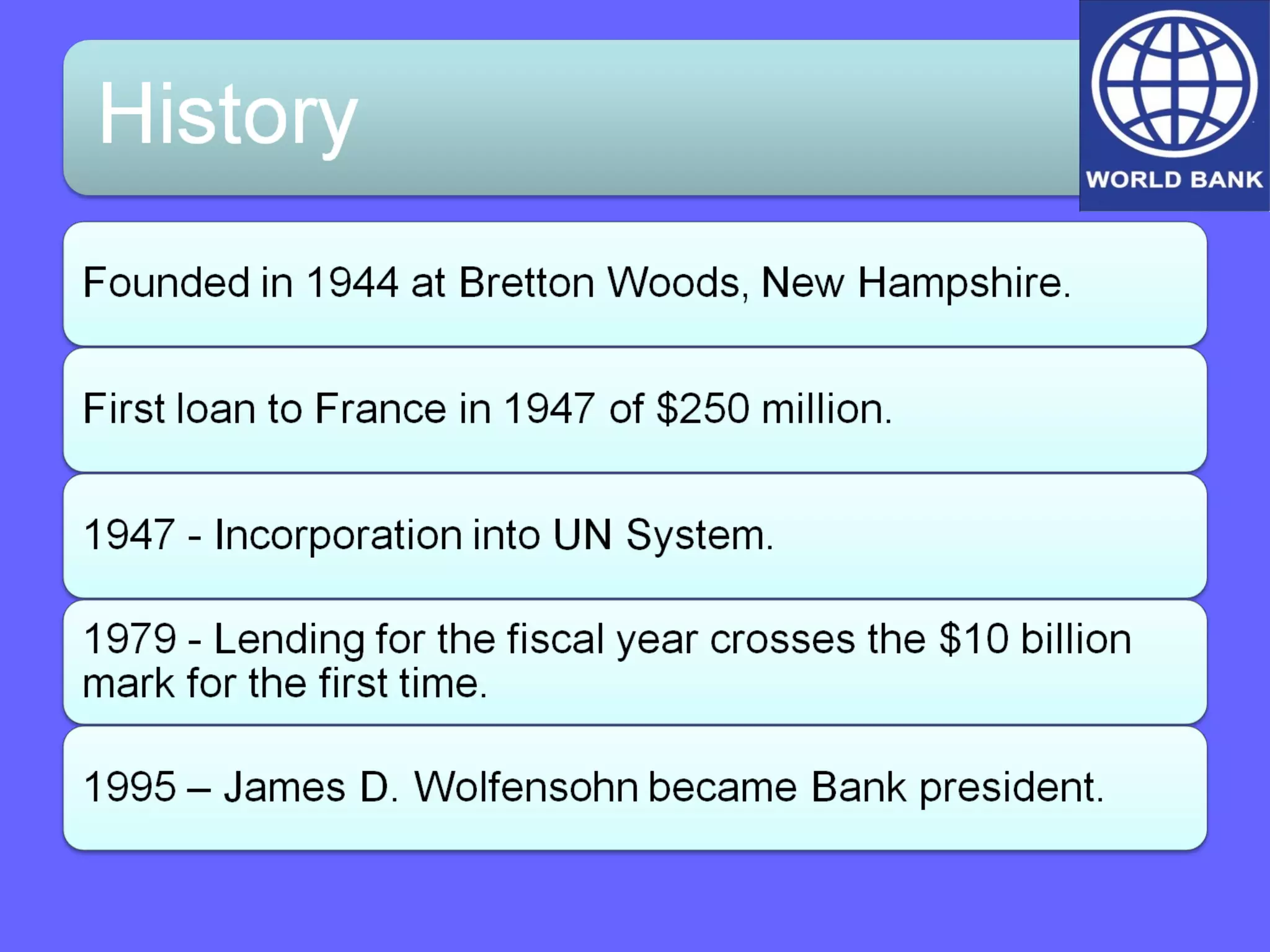
• The IMF was conceived in July 1944, when representatives of 45
governments meeting in the town of Bretton Woods, New
Hampshire, in the north-eastern United States, agreed on a
framework for international economic cooperation.
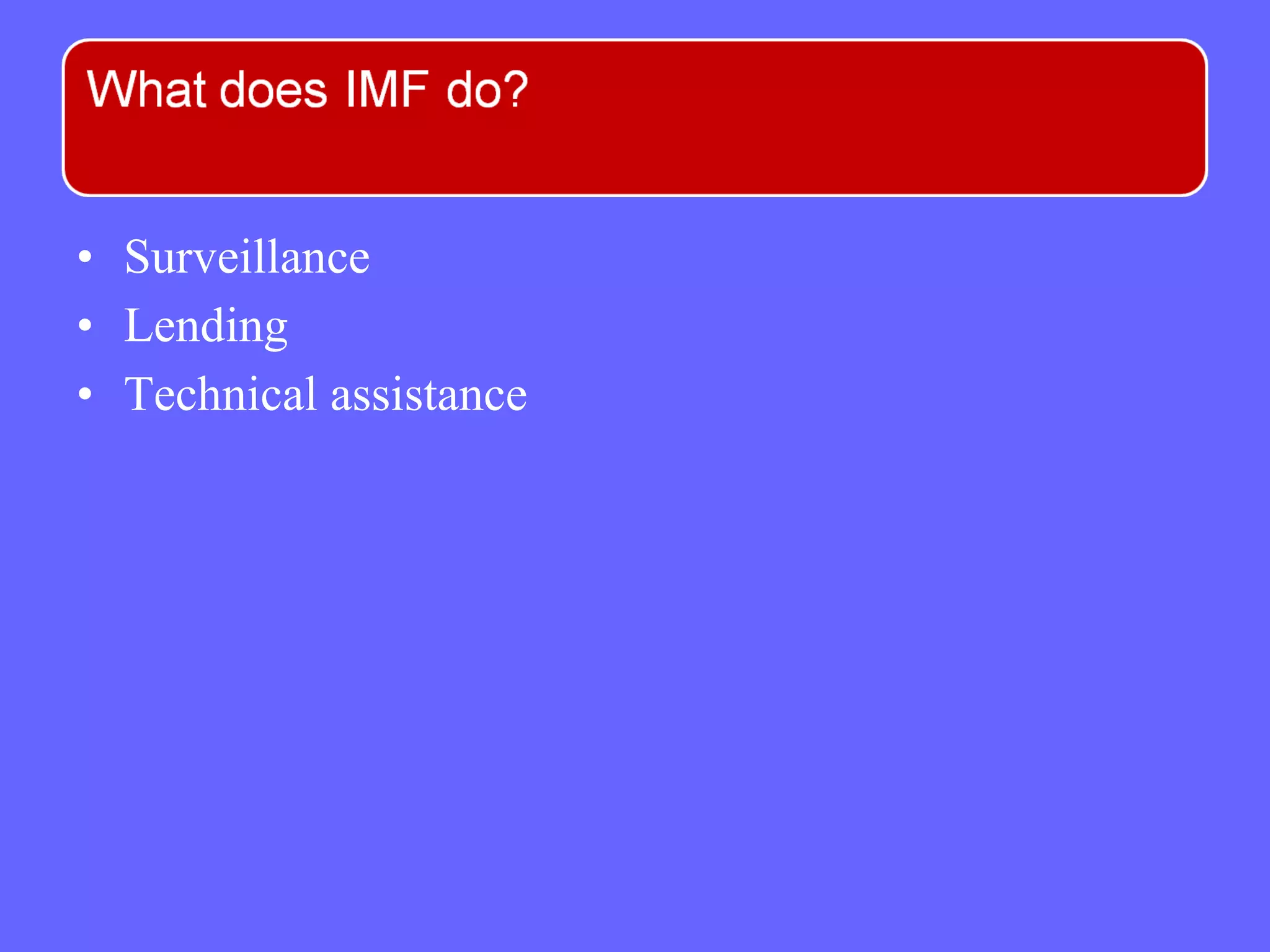
• Surveillance
• Lending
• Technical assistance
• It is an assessment of economic and financial developments,
which provides a framework that facilitates the exchange of
goods, services, and capital among countries and sustains
sound economic growth. It consists in:
• Focusing on assessing whether countries' policies promote
external stability
• It is to be remembered that surveillance is a collaborative,
candid, and evenhanded process between the Fund and its
members
• IMF lending enables countries to rebuild their international
reserves; stabilize their currencies; continue paying for
imports; and restore conditions for strong economic growth.
• IMF does not lend for specific projects
• It eases the adjustment policies and reforms that a country
must make to correct its balance of payments problem and
restore conditions for strong economic growth.
• It supports the development of the productive resources of
member countries by helping them to effectively manage their
economic policy and financial affairs.
• About 90 percent of IMF technical assistance goes to low and
lower-middle income countries, particularly in sub-Saharan
Africa and Asia.
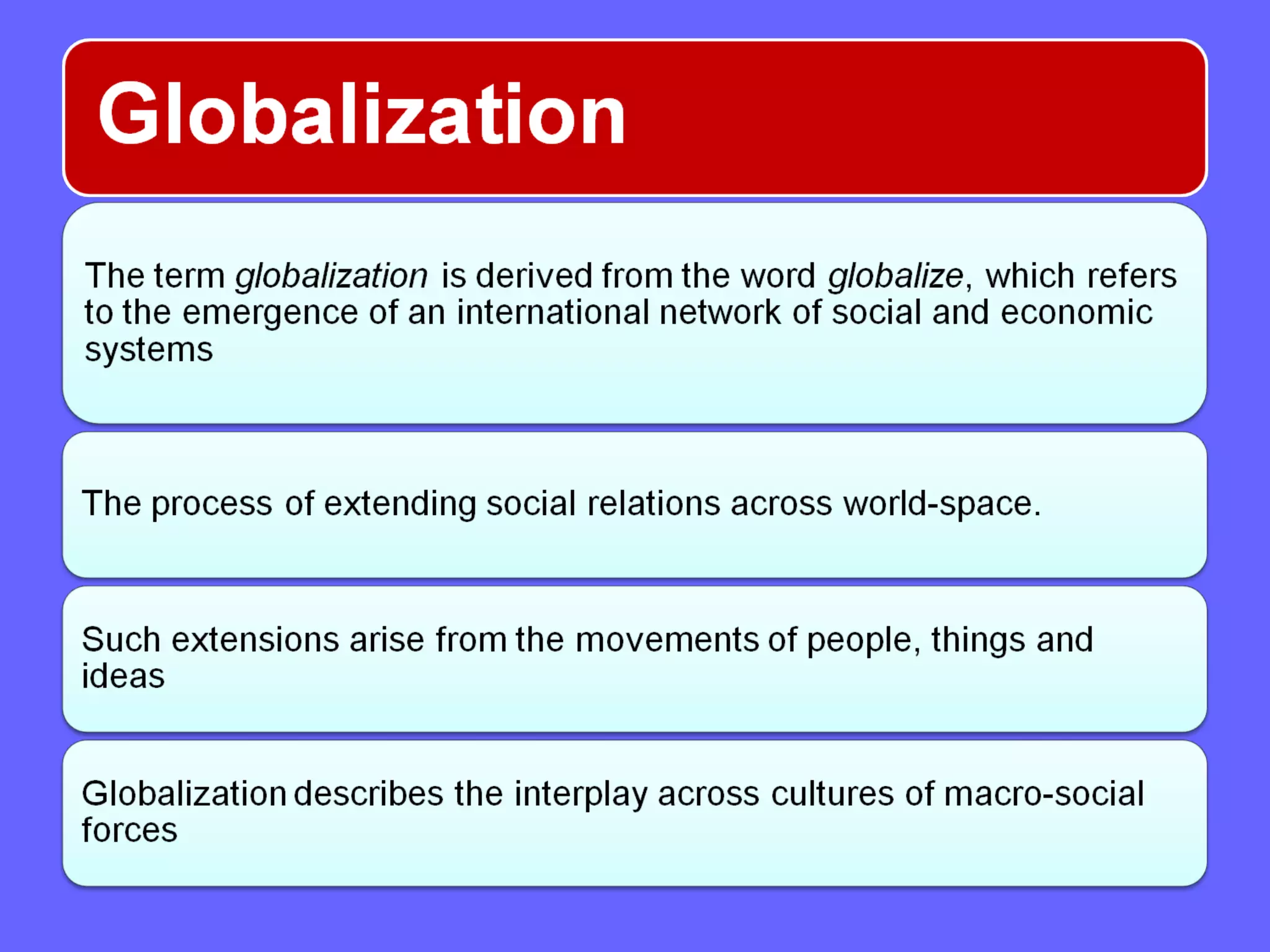
• The term globalization is derived from the word
globalize, which refers to the emergence of an
international network of social and economic systems
• The WTO represents the rules-based regime of the
policy of economic globalization.
• World Trade Organization (WTO) talks collapsed
from internal conflicting divisions and the weight of
protests directed at labor, human rights, the
environment and secrecy.
Globalization

Globalization

  • 2.
    Globalizationrefers to theincreasingly global relationships of culture, people, and economic activity. It is generally used to refer to economic globalization: the global distribution of the production of goods and services, through reduction of barriers to international trade such as tariffs, export fees, and import quotas.
  • 3.
    According to most researchers,it is the modern age which led to the origin of globalization.
  • 4.
    In this age,wide spread development took place in the field of infrastructure and connectivity. This led to more interaction between the nations and sharing of ideas, culture and tradition took place.
  • 5.
    However, there aresome researchers who point out that the origins of the history of globalization can be traced back to the ancient civilizations. The example of the earliest forms of globalization is the trade links between the Sumerian civilization and the Indus Valley Civilization. In fact, after this age, there are numerous instances where trade links were established between various countries like India, Egypt, Greece, and Roman Empire and so on. There were regular business links between the Parthian Empire, Roman Empire and Han Dynasty.
  • 6.
    Globalization in themedieval age The Islamic period in the medieval era is an important epoch in the history of globalization. This was when the Jewish and the Muslim traders started going to various parts of the world to sell various items.
  • 7.
    Globalization between thepre modern periods to modern period The industrial revolution in the 19th century was one of the major periods in the history of globalization. Due to the industrial revolution, there was a significant increase in the quantity and quality of the products. This led to higher exports and better trade and business relations. Due to better products and colonization, lots of countries across the world became the consumers of the European market. The phase of pre globalization perhaps came to an end after the First World War.
  • 8.
    Globalization in themodern era Globalization, in the modern sense of the term, came into existence after the Second World War. One of the main factors for this was the plan by the world leaders to break down the borders for fostering trade relations between nations. It was also in this period that major countries like India, Sri Lanka, Indonesia and some countries in South America gained independence. As a result, these countries started having their own economic systems and established trade relations with the rest of the world.
  • 9.
    The establishment of theUnited Nations Organization (UNO) was also a major step in this regard.
  • 10.
    Another milestone in thehistory of globalization is the creation of the World Trade Organization which led to the growth of a uniform platform to settle trade and commercial disputes.
  • 17.
    • refers tothe intensification and expansion of cultural flows across the globe. • Culture is a very broad concept and has many facets, but in the discussion on globalization • symbolic construction, articulation, and dissemination • development of a global culture, the role of the media in shaping our identities and desires, and the globalization of languages. • Merging or “watering down” of the world’s cultures e.g. food, entertainment, language, etc. • Heavily criticized as destructive of local culture • e.g. The Simpsons is shown in over 200 countries in the world.
  • 18.
    • refers tothe global environmental issues. • includes population growth, access to food, worldwide reduction in biodiversity, the gap between rich and poor as well as between the global North and global South, human-induced climate change, and global environmental degradation. • seeing the Earth as a single ecosystem rather than a collection of separate ecological systems because so many problems are global in nature • e.g. International treaties to deal with environmental issues like biodiversity, climate change or the ozone layer, wildlife reserves that span several countries
  • 19.
    • filled witha range of norms, claims, beliefs, and narratives about the phenomenon itself. According to Steger, there are three main types of globalisms • market globalism • justice globalism • and jihadist globalism. Steger defines them as follows
  • 20.
    • Interconnection ofthe world’s financial systems e.g. stock markets • More of a connection between large cities than of nations • Example: What happens in Asian markets affects the North American markets.
  • 21.
    • The formationof the World Trade Organization (WTO) and the acceleration of import liberalization had started in 1995. • It had further opened the economies of the developing countries to the influx of foreign companies, foreign goods and foreign service providers. • The organization deals with regulation of trade between participating countries. • It provides a framework for negotiating and formalizing trade agreements.
  • 22.
    • Expanding free-tradeconcessions equally to all members. • Establishing free global trade with fewer barriers. • Making trade more predictable through established rules. • Making trade more competitive by removing subsidies.
  • 23.
    • It overseesthe implementation, administration and operation of the covered agreements. • It provides a forum for negotiations and for settling disputes.
  • 24.
    • The WTOrepresents the rules-based regime of the policy of economic globalization. • The central operating principal of the WTO is that commercial interests should succeed all others. • Any obstacles in the path of operations and expansion of global business enterprise must be subordinated.
  • 25.
    • World TradeOrganization (WTO) talks collapsed from internal conflicting divisions and the weight of protests directed at labor, human rights, the environment and secrecy. • IT created a system that promotes healthy economic development which required creating new “rules,” new institutions and funds.
  • 26.
    • A newarchitecture for global governance could have three elements: • Rules: New rules are needed to constrain capital flows to prevent the volatile, destabilizing, speculative movement of capital and to direct funds towards healthy development. • Institutions: A union of the UN Development Program, the UN Environmental Program and the WB. Recently it has increased Non-Governmental Organization (NGO) participation, inadequate, and its funding is grossly insufficient. • Incentives and Funds: Perverse subsidies those encouraging the extraction, mining, refining and combustion of coal and oil must be eliminated.
  • 31.
    •The IMF isan international organization of 185 member countries. It was established to promote international monetary cooperation, exchange stability, and orderly exchange arrangements; to foster economic growth and high levels of employment; and to provide temporary financial assistance to countries to help ease balance of payments adjustments. • The IMF was conceived in July 1944, when representatives of 45 governments meeting in the town of Bretton Woods, New Hampshire, in the north-eastern United States, agreed on a framework for international economic cooperation.
  • 32.
  • 33.
    • It isan assessment of economic and financial developments, which provides a framework that facilitates the exchange of goods, services, and capital among countries and sustains sound economic growth. It consists in: • Focusing on assessing whether countries' policies promote external stability • It is to be remembered that surveillance is a collaborative, candid, and evenhanded process between the Fund and its members
  • 34.
    • IMF lendingenables countries to rebuild their international reserves; stabilize their currencies; continue paying for imports; and restore conditions for strong economic growth. • IMF does not lend for specific projects • It eases the adjustment policies and reforms that a country must make to correct its balance of payments problem and restore conditions for strong economic growth.
  • 35.
    • It supportsthe development of the productive resources of member countries by helping them to effectively manage their economic policy and financial affairs. • About 90 percent of IMF technical assistance goes to low and lower-middle income countries, particularly in sub-Saharan Africa and Asia.
  • 36.
    • The termglobalization is derived from the word globalize, which refers to the emergence of an international network of social and economic systems • The WTO represents the rules-based regime of the policy of economic globalization. • World Trade Organization (WTO) talks collapsed from internal conflicting divisions and the weight of protests directed at labor, human rights, the environment and secrecy.