Abdul Raouf
Roll No 17
Topic
Introduction of Development
Planning & Aid
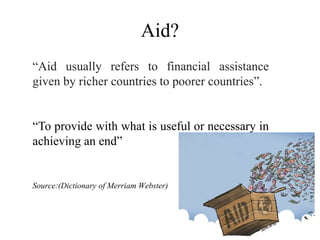
Aid?
“Aid usually refers to financial assistance
given by richer countries to poorer countries”.
“To provide with what is useful or necessary in
achieving an end”
Source:(Dictionary of Merriam Webster)
Development & Sustainable
Development
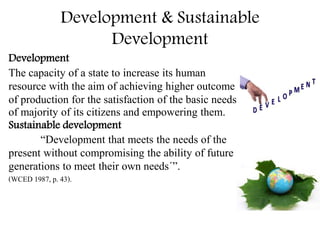
Development
The capacity of a state to increase its human
resource with the aim of achieving higher outcome
of production for the satisfaction of the basic needs
of majority of its citizens and empowering them.
Sustainable development
“Development that meets the needs of the
present without compromising the ability of future
generations to meet their own needs´”.
(WCED 1987, p. 43).
Objectives of Development
Three main objectives of Aid:
1. Raising peoples’ living levels
2. Creating conditions conducive
to the growth of peoples’
3. Increasing peoples’ freedom
Types of Aid Through Video
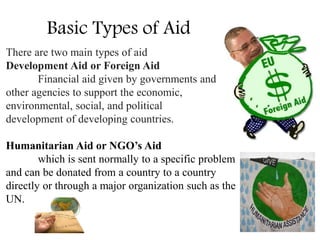
Basic Types of Aid
There are two main types of aid
Development Aid or Foreign Aid
Financial aid given by governments and
other agencies to support the economic,
environmental, social, and political
development of developing countries.
Humanitarian Aid or NGO’s Aid
which is sent normally to a specific problem
and can be donated from a country to a country
directly or through a major organization such as the
UN.
Main Types of Aid
Two Main Types of Aid are:
Bilateral Aid
Which is assistance given by a government directly
to the government of another country. This is usually the
largest share of a country's aid. It is often directed
according to strategic political considerations as well as
humanitarian ones.
Multilateral Aid
Where multiple countries donate to a central
organization and the organization determines who gets the
money and for what.
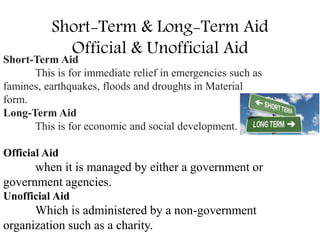
Short-Term & Long-Term Aid
Official & Unofficial AidShort-Term Aid
This is for immediate relief in emergencies such as
famines, earthquakes, floods and droughts in Material
form.
Long-Term Aid
This is for economic and social development.
Official Aid
when it is managed by either a government or
government agencies.
Unofficial Aid
Which is administered by a non-government
organization such as a charity.
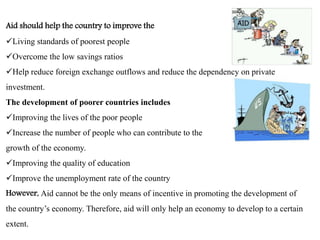
Aid should help the country to improve the
Living standards of poorest people
Overcome the low savings ratios
Help reduce foreign exchange outflows and reduce the dependency on private
investment.
The development of poorer countries includes
Improving the lives of the poor people
Increase the number of people who can contribute to the
growth of the economy.
Improving the quality of education
Improve the unemployment rate of the country
However, Aid cannot be the only means of incentive in promoting the development of
the country’s economy. Therefore, aid will only help an economy to develop to a certain
extent.
Ayesha Salem 19
Sub Topic:
Effectiveness Of Development Aid
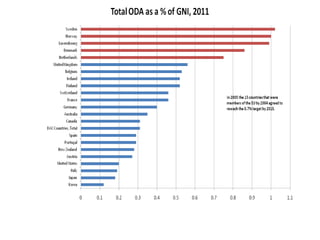
Aid Donor's Countries
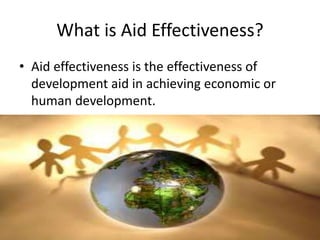
What is Aid Effectiveness?
• Aid effectiveness is the effectiveness of
development aid in achieving economic or
human development.
History Of Development Aid
• The international aid system was born out of
the ruins of the Second World War, when the
United States used their aid funds to help
rebuild Europe. The system came of age
during the Cold War era from the 1960s to the
1980s. During this time, foreign aid was often
used to support client states in the developing
world
Aid Effectiveness After War
• After the end of the Cold War, the declared
focus of official aid began to move further
towards the alleviation of poverty and the
promotion of development. The countries that
were in the most need and poverty became
more of a priority. It is against this background
that the international aid effectiveness
movement began taking shape in the late
1990s.
Aid Effectiveness
• Research on aid effectiveness focuses on the
policies and practices of bilateral and
multilateral donors. The Center’s researchers
analyze existing programs, monitor donor
innovations, and design innovative
approaches to deliver more effective aid.
Research also provides insight into how
policies ranging from trade to migration to
investment undermine or complement foreign
aid policies.
Effectiveness
• Aid effectiveness is the impact that aid has in
reducing poverty and inequality, increasing
growth, building capacity, and accelerating
achievement of the Millennium Development
Goals set by the international community.
Indicators here cover aid received as well as
progress in reducing poverty and improving
education, health, and other measures of
human welfare.
Aid
• Aid may be bilateral: given from one country
directly to another; or it may be multilateral:
given by the donor country to an international
organization such as the World Bank or the
United Nations Agencies (UNDP, UNICEF,
UNAIDS, etc.) which then distributes it among
the developing countries. The proportion is
currently about 70% bilateral 30% multilateral.
Top 10 aid donor countries (2013)
• European Union
• United States
• United Kingdom
• Germany Japan
• France
• Sweden
• Norway
• Netherlands
• Canada
• Australia
Failure Development Aids
Muhammad Shafiq
Roll No.6
Attention of Developing
Countries
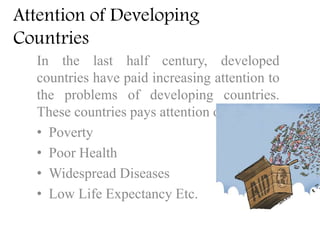
In the last half century, developed
countries have paid increasing attention to
the problems of developing countries.
These countries pays attention on
• Poverty
• Poor Health
• Widespread Diseases
• Low Life Expectancy Etc.
BenefitsofDonor's
• Part of any aid constantly flows back
to donors through highly ratio.
• Aid has also increased the potential
for donors to buy preferential future
treatment for the business firms of
their own nationality.
• Politically, aid can be seen as serving
to buy increased international and
regional clout through new political
allies.
• Development aid is also seen as a way
WhyAidFails?
Because These Two Studies explains the failure of Aid
1. Aid has increased aggregate savings and
investments, though by less than the aid flow itself,
and has led to increased economic growth in cases
where the lack of capital base was the most Important
factor in holding back growth.
Dalgaard, Hansen, and Tarp (2000) summarize the findings
from the last 30 years and a total of 131 cross-country
studies.
2. Aid given to countries with good institutions and
policies has a far higher likelihood to affect
growth positively than aid given to countries
of poor institutions and policies.
Burnside and Dollar (2000) examined the
WhyAidFails?
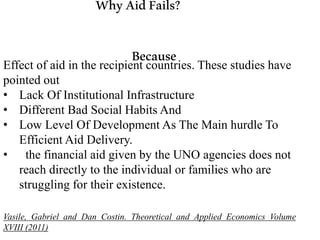
BecauseEffect of aid in the recipient countries. These studies have
pointed out
• Lack Of Institutional Infrastructure
• Different Bad Social Habits And
• Low Level Of Development As The Main hurdle To
Efficient Aid Delivery.
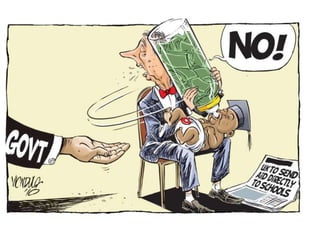
• the financial aid given by the UNO agencies does not
reach directly to the individual or families who are
struggling for their existence.
Vasile, Gabriel and Dan Costin. Theoretical and Applied Economics Volume
XVIII (2011)
Corruption
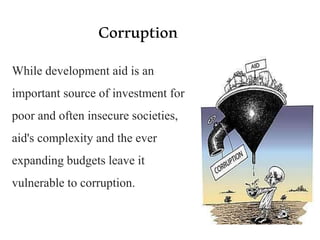
While development aid is an
important source of investment for
poor and often insecure societies,
aid's complexity and the ever
expanding budgets leave it
vulnerable to corruption.
Muhammad Nadeem
Roll no 10
Sub Topic :
Impacts of Foreign Aid
Lack of Aid
Real Picture about Aid
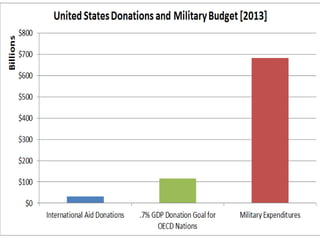
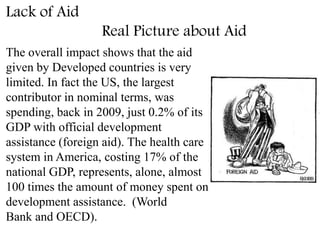
The overall impact shows that the aid
given by Developed countries is very
limited. In fact the US, the largest
contributor in nominal terms, was
spending, back in 2009, just 0.2% of its
GDP with official development
assistance (foreign aid). The health care
system in America, costing 17% of the
national GDP, represents, alone, almost
100 times the amount of money spent on
development assistance. (World
Bank and OECD).
Working Against there Aim
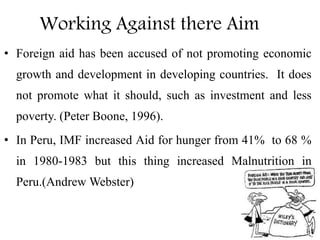
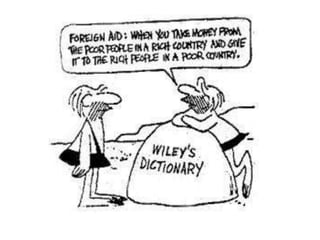
• Foreign aid has been accused of not promoting economic
growth and development in developing countries. It does
not promote what it should, such as investment and less
poverty. (Peter Boone, 1996).
• In Peru, IMF increased Aid for hunger from 41% to 68 %
in 1980-1983 but this thing increased Malnutrition in
Peru.(Andrew Webster)
Two Sided Picture
Negative Impacts
According to (UNDP), development is much more than "the rise
or fall of national incomes".
The results of aid are mixed.
 In some cases, it has neither reduced poverty nor
contributed to overall development.
 It has actually increasing corruption as well as income
inequality. Consequently, poor people in under developed
countries did not benefit from the inflow of foreign aid.
Other Side of Picture
• Foreign aid on positive side, has helped in boosting
the GDP growth, laid foundations of industrial and
agricultural sectors, policy advice and modern
technology, assisted in overcoming the budget
deficits and has also funded the projects for the social
sector development projects.
• But on the negative side, aid seemed to have
substituted for domestic savings, increase debt burden
Positive Impacts
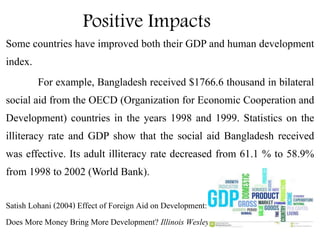
Some countries have improved both their GDP and human development
index.
For example, Bangladesh received $1766.6 thousand in bilateral
social aid from the OECD (Organization for Economic Cooperation and
Development) countries in the years 1998 and 1999. Statistics on the
illiteracy rate and GDP show that the social aid Bangladesh received
was effective. Its adult illiteracy rate decreased from 61.1 % to 58.9%
from 1998 to 2002 (World Bank).
Satish Lohani (2004) Effect of Foreign Aid on Development:
Does More Money Bring More Development? Illinois Wesleyan University
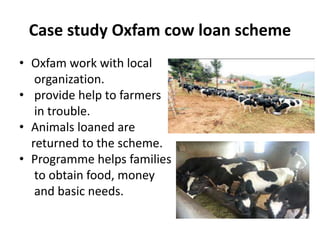
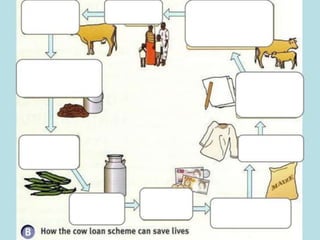
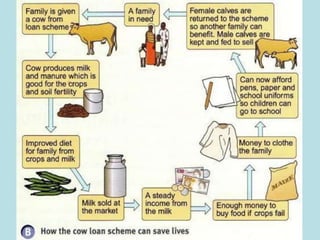
Case study Oxfam cow loan scheme
• Oxfam work with local
organization.
• provide help to farmers
in trouble.
• Animals loaned are
returned to the scheme.
• Programme helps families
to obtain food, money
and basic needs.
Aid is Based on Government
Some even argue that it is not promoting democracy
because evidence was found that corrupt
governments tend to receive more aid than less
corrupt governments (Alberto Alesina & Weder,
1999).
Ali Hassan Roll No 33
Sub Topic:
Rural Development Program
What is rural area
• Where are the people are engaged in primary
industry in the sense that they produce things
directly for the first time in cooperation with
nature
• Rural areas are separately settled places away
from the influence of large cities and towns
• Rural areas can have an agricultural character,
through many rural areas are characterized by an
economy based on cottage industry, mining, oil
and gas exploration, or tourism
Rural Community
• A group of people with a common
characteristic or interest living together in a
village.
• A Rural community can be classified as rural
based on the criteria of lower population
density, less social differentiation, less social
and spatial mobility, slow rate of social
change, etc
• Agriculture is the major occupation of rural
people
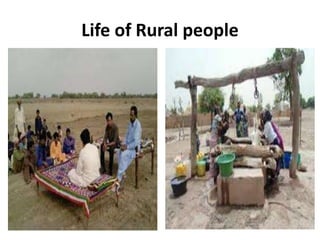
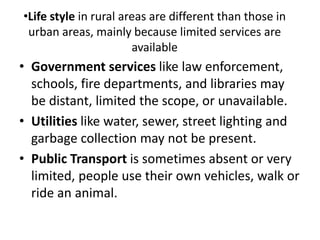
Life of Rural people
•Life style in rural areas are different than those in
urban areas, mainly because limited services are
available
• Government services like law enforcement,
schools, fire departments, and libraries may
be distant, limited the scope, or unavailable.
• Utilities like water, sewer, street lighting and
garbage collection may not be present.
• Public Transport is sometimes absent or very
limited, people use their own vehicles, walk or
ride an animal.
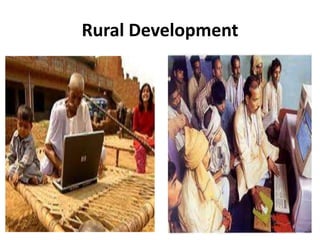
Rural Development
• Rural development is a strategy designed to improve
the economic and social life of rural poor
it is a process, which aims at improving the
well being and self realization of people living
outside the urbanized areas through collective
process
• Rural development is all about bringing
change among rural community from the
traditional way of living to progressive way of
living. It is also expressed as a movement for
progress.
The united nations defines
rural development as:
• Rural development is a process of change, by
which the efforts of the people themselves are
united those of government authorities to
improve their economic, social, and cultural
conditions of communities in to the life of the
nation and to enable them
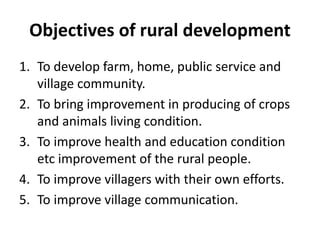
Objectives of rural development
1. To develop farm, home, public service and
village community.
2. To bring improvement in producing of crops
and animals living condition.
3. To improve health and education condition
etc improvement of the rural people.
4. To improve villagers with their own efforts.
5. To improve village communication.
SABA SARDAR 60
SUB TOPIC:
What is development board?
Functions of planning commission and
Five year plans of Pakistan
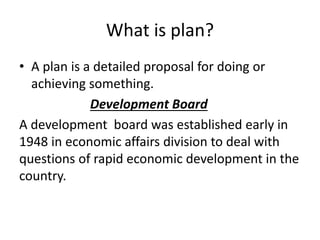
What is plan?
• A plan is a detailed proposal for doing or
achieving something.
Development Board
A development board was established early in
1948 in economic affairs division to deal with
questions of rapid economic development in the
country.
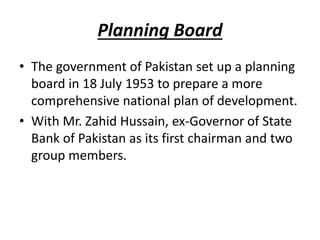
Planning Board
• The government of Pakistan set up a planning
board in 18 July 1953 to prepare a more
comprehensive national plan of development.
• With Mr. Zahid Hussain, ex-Governor of State
Bank of Pakistan as its first chairman and two
group members.
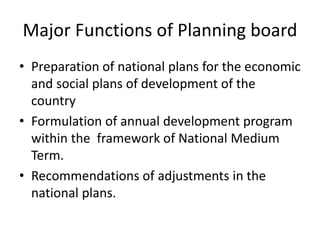
Major Functions of Planning board
• Preparation of national plans for the economic
and social plans of development of the
country
• Formulation of annual development program
within the framework of National Medium
Term.
• Recommendations of adjustments in the
national plans.
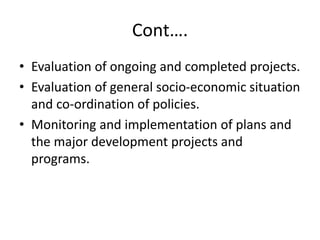
Cont….
• Evaluation of ongoing and completed projects.
• Evaluation of general socio-economic situation
and co-ordination of policies.
• Monitoring and implementation of plans and
the major development projects and
programs.
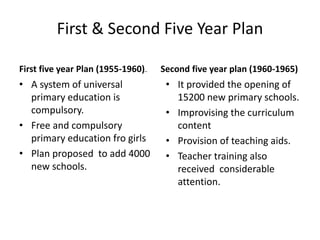
First & Second Five Year Plan
First five year Plan (1955-1960)2011
• A system of universal
primary education is
compulsory.
• Free and compulsory
primary education fro girls
• Plan proposed to add 4000
new schools.
Second five year plan (1960-1965)
• It provided the opening of
15200 new primary schools.
• Improvising the curriculum
content
• Provision of teaching aids.
• Teacher training also
received considerable
attention.
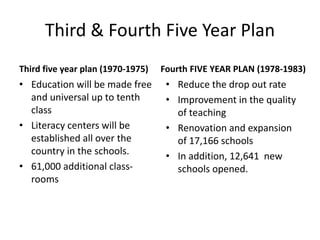
Third & Fourth Five Year Plan
Third five year plan (1970-1975)
• Education will be made free
and universal up to tenth
class
• Literacy centers will be
established all over the
country in the schools.
• 61,000 additional class-
rooms
Fourth FIVE YEAR PLAN (1978-1983)
• Reduce the drop out rate
• Improvement in the quality
of teaching
• Renovation and expansion
of 17,166 schools
• In addition, 12,641 new
schools opened.
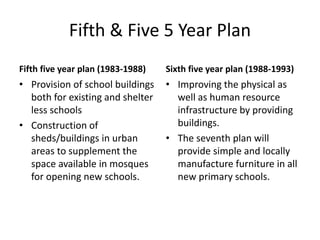
Fifth & Five 5 Year Plan
Fifth five year plan (1983-1988)
• Provision of school buildings
both for existing and shelter
less schools
• Construction of
sheds/buildings in urban
areas to supplement the
space available in mosques
for opening new schools.
Sixth five year plan (1988-1993)
• Improving the physical as
well as human resource
infrastructure by providing
buildings.
• The seventh plan will
provide simple and locally
manufacture furniture in all
new primary schools.
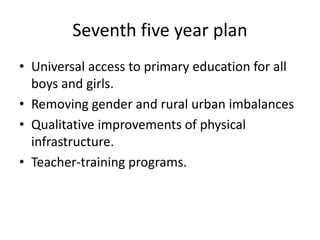
Seventh five year plan
• Universal access to primary education for all
boys and girls.
• Removing gender and rural urban imbalances
• Qualitative improvements of physical
infrastructure.
• Teacher-training programs.
Muhammad Aqeel
Roll No 29
Sub Topic
Conclusion
On Development Planning
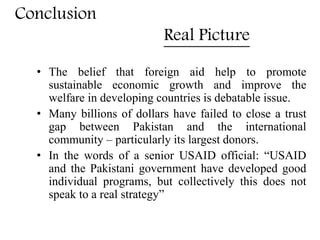
Conclusion
Real Picture
• The belief that foreign aid help to promote
sustainable economic growth and improve the
welfare in developing countries is debatable issue.
• Many billions of dollars have failed to close a trust
gap between Pakistan and the international
community – particularly its largest donors.
• In the words of a senior USAID official: “USAID
and the Pakistani government have developed good
individual programs, but collectively this does not
speak to a real strategy”
Situation of Pakistan
• In case of Pakistan, a brief look on foreign aid and
economic growth propose that ineffectiveness of aid is
due to
o Bad macroeconomic policies of the country and foreign aid
may affects economic growth positively only if the
macroeconomic policies are right.
• The huge inflows of external resources have failed to
contribute in economic development process of country
and in the improvement of living standard of the ordinary
people.
Macroeconomicpolicyisusuallyimplementedthroughtwosetsoftools:fiscaland
monetarypolicy.Bothformsofpolicyareusedtostabilizetheeconomy
How to make Aid Effective?
Aid has a positive impact on growth in
developing countries with good fiscal, monetary,
and trade policies. Aid appears not to affect
policies systematically either for good or for ill.
Any tendency for aid to reward good policies has
been overwhelmed by donors pursuit of their own
strategic interests.
What should be done ?
Literature suggests that sound economic management
policy in terms of low inflation, trade openness and low budget
deficit is crucial for aid effectiveness. There is need to
implement appropriate policy measure, in order to achieve the
positive impact of foreign aid on economic growth
through minimizing budgetary deficits, lower the inflation rate and
to achieve trade openness.
What should be done ?
Aid inflow is a highly unstable and unpredictable source of
external financing and it is always depend on donor’s
strategic interest. Policy makers take into account the stable
and sustainable sources of external financing like exports,
FDI (foreign direct investment) and portfolio investment for
stimulating growth of economy.
Portfolio Investment is an investment made by an investor who is not
involved in the management of a company.

Development Planning And Aid

  • 1.
    Abdul Raouf Roll No17 Topic Introduction of Development Planning & Aid
  • 2.
    Aid? “Aid usually refersto financial assistance given by richer countries to poorer countries”. “To provide with what is useful or necessary in achieving an end” Source:(Dictionary of Merriam Webster)
  • 3.
    Development & Sustainable Development Development Thecapacity of a state to increase its human resource with the aim of achieving higher outcome of production for the satisfaction of the basic needs of majority of its citizens and empowering them. Sustainable development “Development that meets the needs of the present without compromising the ability of future generations to meet their own needs´”. (WCED 1987, p. 43).
  • 4.
    Objectives of Development Threemain objectives of Aid: 1. Raising peoples’ living levels 2. Creating conditions conducive to the growth of peoples’ 3. Increasing peoples’ freedom
  • 5.
    Types of AidThrough Video
  • 6.
    Basic Types ofAid There are two main types of aid Development Aid or Foreign Aid Financial aid given by governments and other agencies to support the economic, environmental, social, and political development of developing countries. Humanitarian Aid or NGO’s Aid which is sent normally to a specific problem and can be donated from a country to a country directly or through a major organization such as the UN.
  • 7.
    Main Types ofAid Two Main Types of Aid are: Bilateral Aid Which is assistance given by a government directly to the government of another country. This is usually the largest share of a country's aid. It is often directed according to strategic political considerations as well as humanitarian ones. Multilateral Aid Where multiple countries donate to a central organization and the organization determines who gets the money and for what.
  • 8.
    Short-Term & Long-TermAid Official & Unofficial AidShort-Term Aid This is for immediate relief in emergencies such as famines, earthquakes, floods and droughts in Material form. Long-Term Aid This is for economic and social development. Official Aid when it is managed by either a government or government agencies. Unofficial Aid Which is administered by a non-government organization such as a charity.
  • 9.
    Aid should helpthe country to improve the Living standards of poorest people Overcome the low savings ratios Help reduce foreign exchange outflows and reduce the dependency on private investment. The development of poorer countries includes Improving the lives of the poor people Increase the number of people who can contribute to the growth of the economy. Improving the quality of education Improve the unemployment rate of the country However, Aid cannot be the only means of incentive in promoting the development of the country’s economy. Therefore, aid will only help an economy to develop to a certain extent.
  • 11.
    Ayesha Salem 19 SubTopic: Effectiveness Of Development Aid Aid Donor's Countries
  • 12.
    What is AidEffectiveness? • Aid effectiveness is the effectiveness of development aid in achieving economic or human development.
  • 13.
    History Of DevelopmentAid • The international aid system was born out of the ruins of the Second World War, when the United States used their aid funds to help rebuild Europe. The system came of age during the Cold War era from the 1960s to the 1980s. During this time, foreign aid was often used to support client states in the developing world
  • 15.
    Aid Effectiveness AfterWar • After the end of the Cold War, the declared focus of official aid began to move further towards the alleviation of poverty and the promotion of development. The countries that were in the most need and poverty became more of a priority. It is against this background that the international aid effectiveness movement began taking shape in the late 1990s.
  • 17.
    Aid Effectiveness • Researchon aid effectiveness focuses on the policies and practices of bilateral and multilateral donors. The Center’s researchers analyze existing programs, monitor donor innovations, and design innovative approaches to deliver more effective aid. Research also provides insight into how policies ranging from trade to migration to investment undermine or complement foreign aid policies.
  • 18.
    Effectiveness • Aid effectivenessis the impact that aid has in reducing poverty and inequality, increasing growth, building capacity, and accelerating achievement of the Millennium Development Goals set by the international community. Indicators here cover aid received as well as progress in reducing poverty and improving education, health, and other measures of human welfare.
  • 19.
    Aid • Aid maybe bilateral: given from one country directly to another; or it may be multilateral: given by the donor country to an international organization such as the World Bank or the United Nations Agencies (UNDP, UNICEF, UNAIDS, etc.) which then distributes it among the developing countries. The proportion is currently about 70% bilateral 30% multilateral.
  • 21.
    Top 10 aiddonor countries (2013) • European Union • United States • United Kingdom • Germany Japan • France • Sweden • Norway • Netherlands • Canada • Australia
  • 22.
  • 23.
    Attention of Developing Countries Inthe last half century, developed countries have paid increasing attention to the problems of developing countries. These countries pays attention on • Poverty • Poor Health • Widespread Diseases • Low Life Expectancy Etc.
  • 24.
    BenefitsofDonor's • Part ofany aid constantly flows back to donors through highly ratio. • Aid has also increased the potential for donors to buy preferential future treatment for the business firms of their own nationality. • Politically, aid can be seen as serving to buy increased international and regional clout through new political allies. • Development aid is also seen as a way
  • 25.
    WhyAidFails? Because These TwoStudies explains the failure of Aid 1. Aid has increased aggregate savings and investments, though by less than the aid flow itself, and has led to increased economic growth in cases where the lack of capital base was the most Important factor in holding back growth. Dalgaard, Hansen, and Tarp (2000) summarize the findings from the last 30 years and a total of 131 cross-country studies. 2. Aid given to countries with good institutions and policies has a far higher likelihood to affect growth positively than aid given to countries of poor institutions and policies. Burnside and Dollar (2000) examined the
  • 26.
    WhyAidFails? BecauseEffect of aidin the recipient countries. These studies have pointed out • Lack Of Institutional Infrastructure • Different Bad Social Habits And • Low Level Of Development As The Main hurdle To Efficient Aid Delivery. • the financial aid given by the UNO agencies does not reach directly to the individual or families who are struggling for their existence. Vasile, Gabriel and Dan Costin. Theoretical and Applied Economics Volume XVIII (2011)
  • 27.
    Corruption While development aidis an important source of investment for poor and often insecure societies, aid's complexity and the ever expanding budgets leave it vulnerable to corruption.
  • 28.
    Muhammad Nadeem Roll no10 Sub Topic : Impacts of Foreign Aid
  • 29.
    Lack of Aid RealPicture about Aid The overall impact shows that the aid given by Developed countries is very limited. In fact the US, the largest contributor in nominal terms, was spending, back in 2009, just 0.2% of its GDP with official development assistance (foreign aid). The health care system in America, costing 17% of the national GDP, represents, alone, almost 100 times the amount of money spent on development assistance. (World Bank and OECD).
  • 30.
    Working Against thereAim • Foreign aid has been accused of not promoting economic growth and development in developing countries. It does not promote what it should, such as investment and less poverty. (Peter Boone, 1996). • In Peru, IMF increased Aid for hunger from 41% to 68 % in 1980-1983 but this thing increased Malnutrition in Peru.(Andrew Webster)
  • 32.
    Two Sided Picture NegativeImpacts According to (UNDP), development is much more than "the rise or fall of national incomes". The results of aid are mixed.  In some cases, it has neither reduced poverty nor contributed to overall development.  It has actually increasing corruption as well as income inequality. Consequently, poor people in under developed countries did not benefit from the inflow of foreign aid.
  • 33.
    Other Side ofPicture • Foreign aid on positive side, has helped in boosting the GDP growth, laid foundations of industrial and agricultural sectors, policy advice and modern technology, assisted in overcoming the budget deficits and has also funded the projects for the social sector development projects. • But on the negative side, aid seemed to have substituted for domestic savings, increase debt burden
  • 34.
    Positive Impacts Some countrieshave improved both their GDP and human development index. For example, Bangladesh received $1766.6 thousand in bilateral social aid from the OECD (Organization for Economic Cooperation and Development) countries in the years 1998 and 1999. Statistics on the illiteracy rate and GDP show that the social aid Bangladesh received was effective. Its adult illiteracy rate decreased from 61.1 % to 58.9% from 1998 to 2002 (World Bank). Satish Lohani (2004) Effect of Foreign Aid on Development: Does More Money Bring More Development? Illinois Wesleyan University
  • 35.
    Case study Oxfamcow loan scheme • Oxfam work with local organization. • provide help to farmers in trouble. • Animals loaned are returned to the scheme. • Programme helps families to obtain food, money and basic needs.
  • 38.
    Aid is Basedon Government Some even argue that it is not promoting democracy because evidence was found that corrupt governments tend to receive more aid than less corrupt governments (Alberto Alesina & Weder, 1999).
  • 39.
    Ali Hassan RollNo 33 Sub Topic: Rural Development Program
  • 40.
    What is ruralarea • Where are the people are engaged in primary industry in the sense that they produce things directly for the first time in cooperation with nature • Rural areas are separately settled places away from the influence of large cities and towns • Rural areas can have an agricultural character, through many rural areas are characterized by an economy based on cottage industry, mining, oil and gas exploration, or tourism
  • 41.
    Rural Community • Agroup of people with a common characteristic or interest living together in a village. • A Rural community can be classified as rural based on the criteria of lower population density, less social differentiation, less social and spatial mobility, slow rate of social change, etc • Agriculture is the major occupation of rural people
  • 42.
  • 43.
    •Life style inrural areas are different than those in urban areas, mainly because limited services are available • Government services like law enforcement, schools, fire departments, and libraries may be distant, limited the scope, or unavailable. • Utilities like water, sewer, street lighting and garbage collection may not be present. • Public Transport is sometimes absent or very limited, people use their own vehicles, walk or ride an animal.
  • 44.
  • 45.
    • Rural developmentis a strategy designed to improve the economic and social life of rural poor it is a process, which aims at improving the well being and self realization of people living outside the urbanized areas through collective process • Rural development is all about bringing change among rural community from the traditional way of living to progressive way of living. It is also expressed as a movement for progress.
  • 46.
    The united nationsdefines rural development as: • Rural development is a process of change, by which the efforts of the people themselves are united those of government authorities to improve their economic, social, and cultural conditions of communities in to the life of the nation and to enable them
  • 47.
    Objectives of ruraldevelopment 1. To develop farm, home, public service and village community. 2. To bring improvement in producing of crops and animals living condition. 3. To improve health and education condition etc improvement of the rural people. 4. To improve villagers with their own efforts. 5. To improve village communication.
  • 48.
    SABA SARDAR 60 SUBTOPIC: What is development board? Functions of planning commission and Five year plans of Pakistan
  • 49.
    What is plan? •A plan is a detailed proposal for doing or achieving something. Development Board A development board was established early in 1948 in economic affairs division to deal with questions of rapid economic development in the country.
  • 50.
    Planning Board • Thegovernment of Pakistan set up a planning board in 18 July 1953 to prepare a more comprehensive national plan of development. • With Mr. Zahid Hussain, ex-Governor of State Bank of Pakistan as its first chairman and two group members.
  • 51.
    Major Functions ofPlanning board • Preparation of national plans for the economic and social plans of development of the country • Formulation of annual development program within the framework of National Medium Term. • Recommendations of adjustments in the national plans.
  • 52.
    Cont…. • Evaluation ofongoing and completed projects. • Evaluation of general socio-economic situation and co-ordination of policies. • Monitoring and implementation of plans and the major development projects and programs.
  • 53.
    First & SecondFive Year Plan First five year Plan (1955-1960)2011 • A system of universal primary education is compulsory. • Free and compulsory primary education fro girls • Plan proposed to add 4000 new schools. Second five year plan (1960-1965) • It provided the opening of 15200 new primary schools. • Improvising the curriculum content • Provision of teaching aids. • Teacher training also received considerable attention.
  • 54.
    Third & FourthFive Year Plan Third five year plan (1970-1975) • Education will be made free and universal up to tenth class • Literacy centers will be established all over the country in the schools. • 61,000 additional class- rooms Fourth FIVE YEAR PLAN (1978-1983) • Reduce the drop out rate • Improvement in the quality of teaching • Renovation and expansion of 17,166 schools • In addition, 12,641 new schools opened.
  • 55.
    Fifth & Five5 Year Plan Fifth five year plan (1983-1988) • Provision of school buildings both for existing and shelter less schools • Construction of sheds/buildings in urban areas to supplement the space available in mosques for opening new schools. Sixth five year plan (1988-1993) • Improving the physical as well as human resource infrastructure by providing buildings. • The seventh plan will provide simple and locally manufacture furniture in all new primary schools.
  • 56.
    Seventh five yearplan • Universal access to primary education for all boys and girls. • Removing gender and rural urban imbalances • Qualitative improvements of physical infrastructure. • Teacher-training programs.
  • 57.
    Muhammad Aqeel Roll No29 Sub Topic Conclusion On Development Planning
  • 58.
    Conclusion Real Picture • Thebelief that foreign aid help to promote sustainable economic growth and improve the welfare in developing countries is debatable issue. • Many billions of dollars have failed to close a trust gap between Pakistan and the international community – particularly its largest donors. • In the words of a senior USAID official: “USAID and the Pakistani government have developed good individual programs, but collectively this does not speak to a real strategy”
  • 59.
    Situation of Pakistan •In case of Pakistan, a brief look on foreign aid and economic growth propose that ineffectiveness of aid is due to o Bad macroeconomic policies of the country and foreign aid may affects economic growth positively only if the macroeconomic policies are right. • The huge inflows of external resources have failed to contribute in economic development process of country and in the improvement of living standard of the ordinary people. Macroeconomicpolicyisusuallyimplementedthroughtwosetsoftools:fiscaland monetarypolicy.Bothformsofpolicyareusedtostabilizetheeconomy
  • 60.
    How to makeAid Effective? Aid has a positive impact on growth in developing countries with good fiscal, monetary, and trade policies. Aid appears not to affect policies systematically either for good or for ill. Any tendency for aid to reward good policies has been overwhelmed by donors pursuit of their own strategic interests.
  • 61.
    What should bedone ? Literature suggests that sound economic management policy in terms of low inflation, trade openness and low budget deficit is crucial for aid effectiveness. There is need to implement appropriate policy measure, in order to achieve the positive impact of foreign aid on economic growth through minimizing budgetary deficits, lower the inflation rate and to achieve trade openness.
  • 62.
    What should bedone ? Aid inflow is a highly unstable and unpredictable source of external financing and it is always depend on donor’s strategic interest. Policy makers take into account the stable and sustainable sources of external financing like exports, FDI (foreign direct investment) and portfolio investment for stimulating growth of economy. Portfolio Investment is an investment made by an investor who is not involved in the management of a company.