Global Redirective Practices Workshop i561 -  Adam Williams,  Eugene Chang,  Kshitiz Anand,  Sean Connolly -Designing a collaborative workshop for redirective designers. Adam Williams, Eugene Chang, Kshitiz Anand, Sean Connolly School of Informatics,  Indiana University
From the highest perspective, in the grandest terms, our client asked us to design an online workshop for his new course - and new discipline - of global redirective practices.  Big Picture http://www.flickr.com/photos/chelmsfordpubliclibrary/2210233729/
The workshop to be designed, should be “an electronic facility to be created in order to encourage graduate research students world-wide to tell each other about their projects, exchange information, make their research available to their peers, share problems, issue invitations to comment or collaborate.”  - Tony Fry 2008   The Request
Our client was proactive and delivered the following request for features: User Profiles Forums  Login / Registration Moderator Controls Ability to Scale  Chat  Technical Features Requested http://www.flickr.com/photos/jakob/83393263/
When many viable options are available; how do we decide which option most completely satisfies our particular client, at this particular time, with these particular immediate needs, and this particular vision for the future? The design question
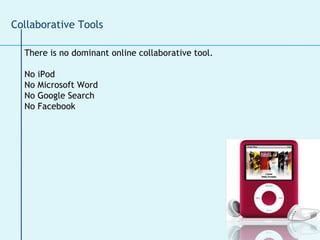
There is no dominant online collaborative tool. No iPod No Microsoft Word No Google Search No Facebook  Collaborative Tools
Highly successful communities exist. Yet technically similar communities fail to gain traction. “ At the time of this conference, the tendency of those involved in building graphical virtual worlds is to create visually compelling worlds that look good, but do a poor job of fostering social interaction. Many of these systems have more in common with lonely museums than with the vibrant communities they set out to create.”  (Kollock 1997) Online Communities
Peter Kollock et al,1997 “ The key challenges the Internet community will face in the future are not technological, but rather sociological… This is not to diminish the difficulties of creating new technologies, but rather to emphasize that even these tasks will pale besides the problems of facilitating and encouraging successful online interaction and online communities .” Design Principles for Online Communities
“ If information about individuals and their behavior is shared among the group, this encourages the development of reputations, which can be a vital source of social information and control (institutional memory).” (Kollock 1997) Design Principles of Cooperation between individuals
EVOLUTION OF COOPERATION (Axelrod 1984) 1 ST  - Must be the potential that interacting individuals will meet again 2 ND  - Individuals must be able to identify each other 3 RD  - Have information about how the others have behaved till now Design Principles of Cooperation between individuals
GOVERNING THE COMMONS (Ostrom 1990) 1 ST  - Group identity is clearly defined 2 ND  -  Most individuals in community can participate in modifying rules 3 RD  - The right of individuals to create new rules is respected 4 TH  - The members particpate in moderating group behaviors 5 TH  - A graduated system of sanctions are used  6 TH  - Focus community on a particular interest group  7 TH  - Confront members with a specific crisis to build union Design Principles of Successful Communities
(Kelly, Sung & Farnham 2002) “ There are 3 major questions facing designers of on-line communities:  how to get users to behave well, how to get users to contribute quality content, and how to get users to return and contribute on an ongoing basis” Encouraging Positive Actions from the Using Audience
“ While providing most of the standard services one expects from an on-line community (such as discussion forums, homepage building, chat, user reviews, etc) these [highly successful] sites feature custom tools that have contributed greatly to the success of the sites in a largely un-moderated capacity. These tools include a built-in member status/reputation system, a navigable member contribution history, tracking tools for members usually only available to moderators… and a popularity ranking system for all member-contributed lesson material.” Encouraging Positive and Return Interactions from the Audience
USE DATA THAT ENCOURAGES PROPER PROTOCOL “ Community data is used to encourage its users to act in accordance with accepted community norms, to make the community environment self-policing, and to correctly identify continually deviant users.” Member identity : members are asked for real first & last name Identity in Context : the absence of role playing and anonymity within the community is a hugely important factor in creating accountability, real social consciousness, and behavioral norms.  User Control of Resources :  invested members tend to protect, promote, and update their specific contributed resources in the community, look for feedback, and ensure that the experience for their public audience is a rewarding one Repurposing Data Collection to promote sustainable community
“ Community data is fed back into the site for three distinct purposes:  to increase social consciousness, to encourage and reward user participation, and to increase the navigability of the site .”  (Sung, Kelly, Farnham 2002) Status Metrics
WITH STATUS METRICS Members become aware of what counts as positive contribution Low level point-rewards encourage newcomer use and return High level point rewards encourage valuable user added content Influence and prestige accord to most valued members Since sites pays no one, sites take pains to let users know where and how their content is being appreciated Status Metrics – outcomes
WITH STATUS METRICS Status metrics emerged as an entry point for new user engagement Proper users add more content because the see how others value viewpoint Users provide answers because it is “their job” not because of personal connection to the inquirers. Metrics allow multiple viewpoints of same types of data, and have thus become major facets of the emergent navigation scheme of users. Status Metrics – outcomes
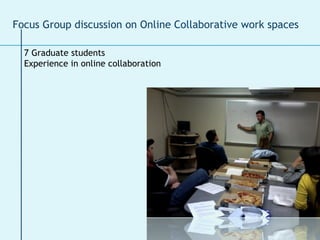
Focus Group discussion on Online Collaborative work spaces 7 Graduate students Experience in online collaboration
No standard method of tool use  No standard performance measure Being forced to participate No useful profile information Real interaction has social cues and allows for informal interaction Asynchronous content management Online Collaborative work spaces - Dislikes
Searching through time (Eg Google Groups) Organization of threads Update emails / RSS Usage history User has a role in the process Rate quality of posts Quantity of posts Online Collaborative work spaces - Likes
Provides a common ground for discussion Contextual relativity – tools by need, finding contextually appropriate  solutions.  Having a task to perform Easy access Visible presentation of the dialogue Sticky like (having a closure to a discussion, summarizing it and  putting in the lifecycle of the discussions.)  Online Collaborative work spaces - Likes
Comparative Analysis of Online Collaborative Tools After our research into the literature and after focus group with  appropriate high-level students in the niche field of question, we now  felt we were finally able to look into the available tools and begin to  assess what might fit our client’s needs.  So we went out into the field and we found out the different collaborating platforms that exist in the market today.
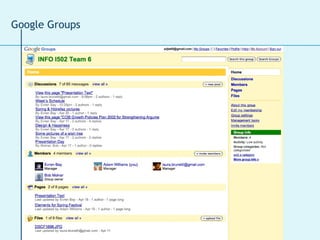
Google Groups
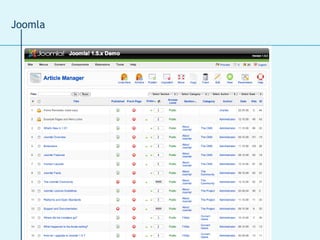
Joomla
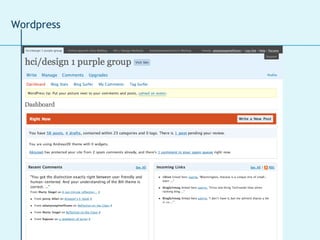
Wordpress
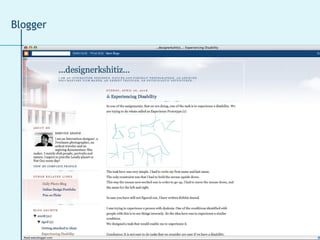
Blogger
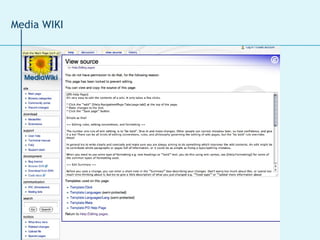
Media WIKI
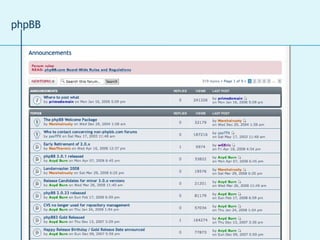
phpBB
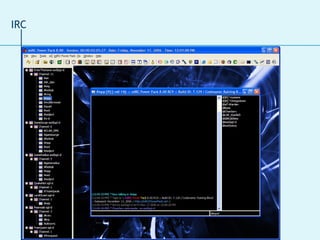
IRC
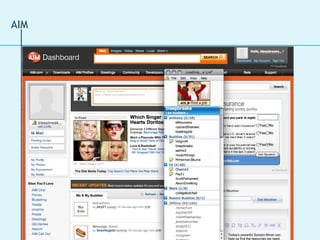
AIM
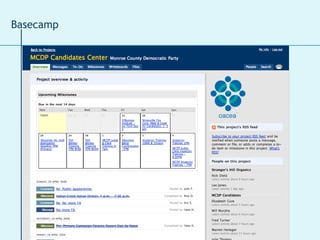
Basecamp
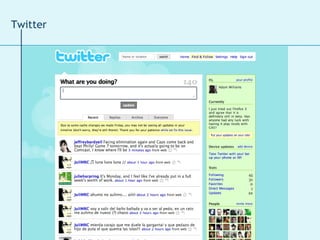
Twitter
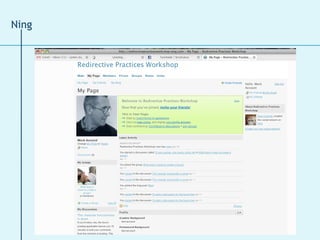
Ning
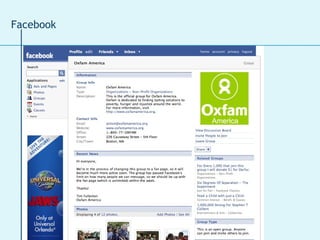
Facebook
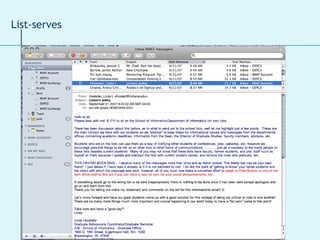
List-serves
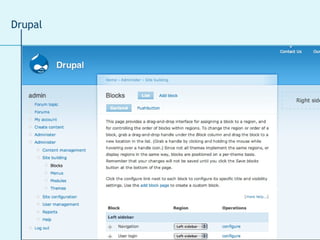
Drupal
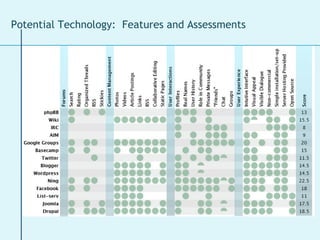
After collecting what we could find, we matched it up against  the pre-determined criteria that we extracted from both the  research and the focus group.  The current online tool that turned out perfect was – ? Comparing the collected online tools
None
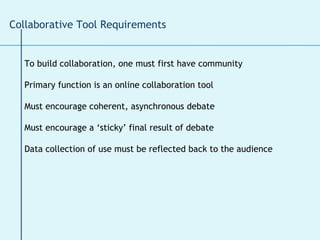
To build collaboration, one must first have community Primary function is an online collaboration tool  Must encourage coherent, asynchronous debate Must encourage a ‘sticky’ final result of debate Data collection of use must be reflected back to the audience Collaborative Tool Requirements
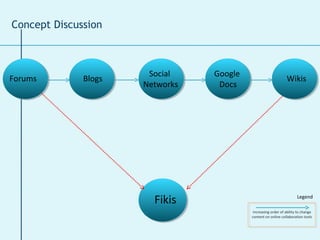
Concept Discussion Wikis Forums Fikis Google  Docs Blogs Social  Networks Increasing order of ability to change  content on online collaboration tools Legend
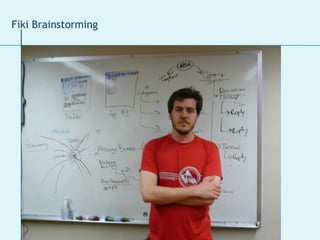
Fiki Brainstorming
Fiki Concept
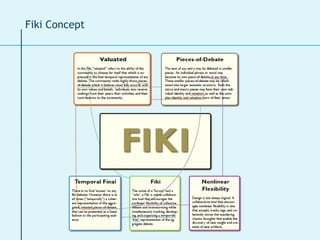
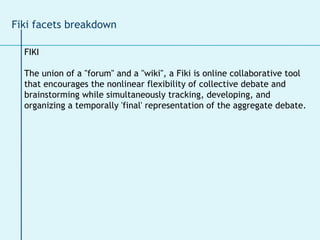
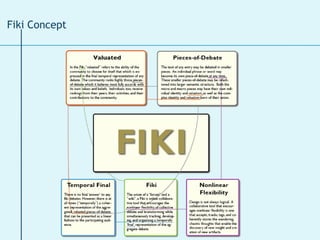
Fiki facets breakdown FIKI The union of a "forum" and a "wiki", a Fiki is online collaborative tool  that encourages the nonlinear flexibility of collective debate and  brainstorming while simultaneously tracking, developing, and  organizing a temporally 'final' representation of the aggregate debate.
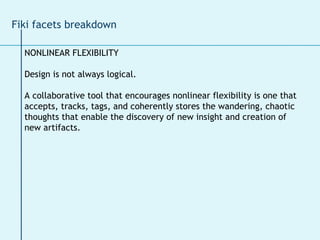
NONLINEAR FLEXIBILITY Design is not always logical.  A collaborative tool that encourages nonlinear flexibility is one that  accepts, tracks, tags, and coherently stores the wandering, chaotic  thoughts that enable the discovery of new insight and creation of  new artifacts. Fiki facets breakdown
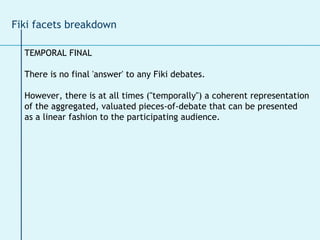
TEMPORAL FINAL There is no final 'answer' to any Fiki debates.  However, there is at all times ("temporally") a coherent representation  of the aggregated, valuated pieces-of-debate that can be presented  as a linear fashion to the participating audience. Fiki facets breakdown
Fiki facets breakdown VALUATED In the Fiki, "valuated" refers to the ability of the community to choose  for itself that which is expressed in the final temporal representation  of any debate.  The community ranks highly those pieces-of-debate which it believes  most fully accords with its own values and beliefs. Individuals, too; receive rankings from their peers, their activities,  and their contributions to the community
Fiki facets breakdown PIECES-OF-DEBATE Any text added to the community through debate may be parsed into  smaller pieces by any other users.  Paragraphs may be parsed into sentences.  Sentences may be parsed into phrases.  Phrases may be parsed into words.  Similarly, smaller pieces-of-debate may be refashioned into larger  semantic structure.  Both the micro and macro pieces may have their own individual  identity and valuation, as well as the complex identity and valuation  born of their union.
Fiki Concept
No cost / low cost Community of technical developers Low technical requirement for the client Three Additional Constraints for deployment
Potential Technology:  Features and Assessments
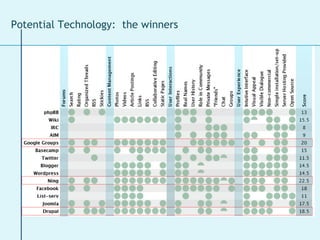
Potential Technology:  the winners
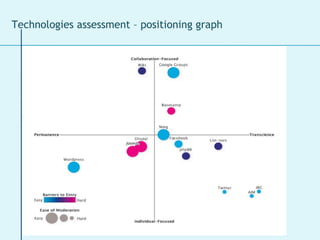
Ease of Entry  Ease of Moderation   Collaboration Orientation  Transience of Records  Technologies assessment
Technologies assessment – positioning graph
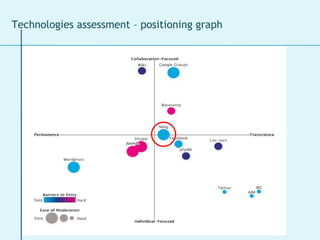
The Winner
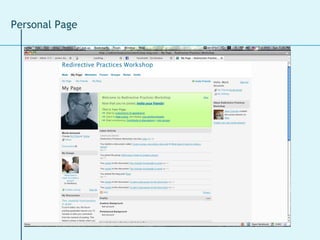
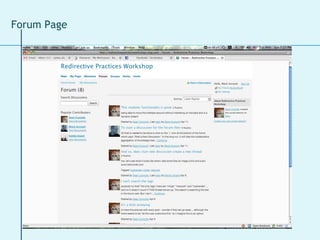
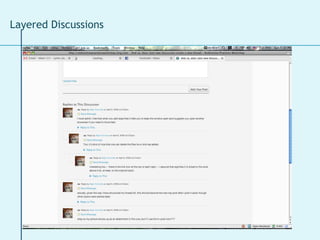
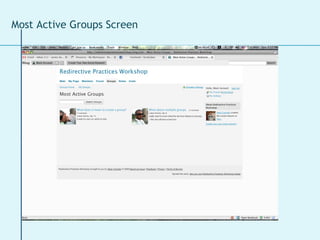
Set up a mock Ning group ourselves Redefined the interface to make it a forum focused community Redefined the interface according to usability Still allow flexibility of the client Still allow flexibility of individual users. Deliverable
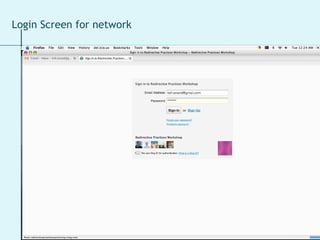
Login Screen for network
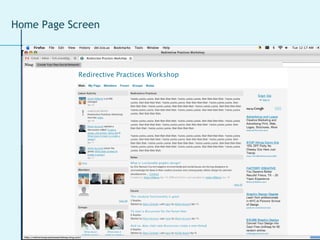
Home Page Screen
Personal Page
Forum Page
Layered Discussions
Most Active Groups Screen
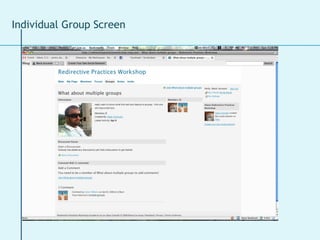
Individual Group Screen
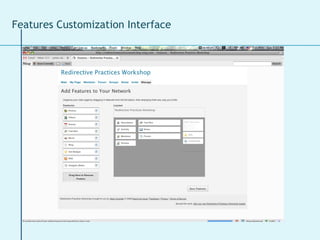
Features Customization Interface
What does Ning Deliver? So, while we were not delivering anything new to the client, the decision to use Ning, was a well thought about.  It took into considerations factors  a) Feasibility b) Implementation c) Technical Competency d) Maintenance
What do We Deliver? A list of the available technologies A list of the modern literature A strategic design vision for the future experience A working prototype for the client  A working, functional prototype that is the best deliverable for this particular client, with these particular needs, at this particular time, and with this particular vision for the future
Global Redirective Practices Thank You.
ON BUILDING VIRUTAL COMMUNITIES AND ON ONLINE COLLABORATION   Kollock, P., University of California, Los Angeles. Design Principles for Online Communities 1996 Kelly, S., Sung, C., & Farnham S. (2002). Designing for Improved Social Responsibility and Content in  On-Line Communities. In Proceedings of CHI 2002, Minneapolis, April 2002. Jensen, C., Davis, J., & Farnham, S. (2002). Finding Others Online: Reputation Systems for Social  Online Spaces. In Proceedings of CHI 2002, Minneapolis, April 2002. Farnham, S. (2002). Predicting Active Participation in MSN Communities. Its All in the Conversation.  Microsoft Technical Report MSR-TR-2002-36. Davis, J., Farnham, S., Jensen, C. (2002). Decreasing Online Bad Behavior. In Extended Abstracts of CHI 2002, Minneapolis, April 2002. Davis, J. P. (2002). The experience of bad behavior in online social spaces: A survey of online users.  Internal paper. Swinth, K., Farnham, S., & Davis, J. (2002). Sharing Personal Information in Online Community Member Profiles. Internal paper. Farnham, S. D., Chesley, H. McGhee, D., & Kawal, R. (2000). Structured On-line Interactions: Improving the Decision-making of Small Discussion Groups. In Proceedings of CSCW 2000, Philadelphia, December. APPENDIX A – LITERATURE REVIEW
ON BUILDING VIRUTAL COMMUNITIES AND ON ONLINE COLLABORATION   Davis, J. P., Zaner, M., Farnham, S., Marcjan, C., & McCarthy, B. P. (2002). Wireless brainstorming:  Overcoming status effects in small group decisions. Paper submitted to journal Computers in  Human Interaction. Grudin, J., Tallarico, S, and Counts, S. (2005). As Technophobia Disappears: Implications for Design.  Group 2005. Farnham, S., & Turski, A. (2002) Social Network Project: Applications for Online Communication and  Information Navigation. Internal paper. Farnham, S. (2002). Visualizing Discourse Architectures with Automatically Generated Person-Centric  Social Networks Paper presented at CHI Workshop 2002: Discource Architectures. Farnham, S. D., Chesley, H. McGhee, D., & Kawal, R. Structured On-line Interactions: Improving the  Decision-making of Small Discussion Groups. In Proceedings of CSCW 2000, Philadelphia, December 2000. Jensen, C., Farnham, S., Drucker, S., & Kollock, P. The Effect of Communication Modality on Cooperation  in Online Environments. In Proceedings of CHI 2000, The Hague, Netherlands March 2000. Smith, M., Farnham, S., & Drucker S. The Social Life of Small Graphical Chat Spaces. In Proceedings  of CHI 2000, The Hague, Netherlands March 2000. APPENDIX A – LITERATURE REVIEW
ON BUILDING VIRUTAL COMMUNITIES AND ON ONLINE COLLABORATION   White, S, Gupta, A., Grudin, J., Chesley, H., Kimberly, G., Sanocki, E. Evolving Use of a System for  Education at a Distance. 1999 Kollock, P., Smith, M., University of California, Los Angeles. What Do People Do in Virtual Worlds? An  Anlalysis of V-Chat Log File Data 1998 Kollock, P., Smith, M., University of California, Los Angeles. Managing the Virtual Commons: Cooperation  and Conflict in Computer Communities 1996 Eighmey, J., & McCord L. (1998). Adding value in the information age: Uses and gratifications of sites  on the world-wide web. Journal of Business Research, 41(3), 187-194. Rafaeli, S. (1986). The electronic bulletin board: A computer-driven mass medium. Computers an d the Social Sciences, 2 Braina, M. (2001, August). The uses and gratifications of the Internet among African American college  students. Paper presented to the Minorities and Communication Division, Association for Education  in Journalism and Mass Communication, Washington, DC. Angleman, S. (2000, December). Uses and gratifications and Internet profiles: A factor analysis. Is internet  use and travel to cyberspace reinforced by unrealized gratifications? Paper presented to the  Western Science Social Association 2001 Conference APPENDIX A – LITERATURE REVIEW

Global Redirective Practices

  • 1.
    Global Redirective PracticesWorkshop i561 - Adam Williams, Eugene Chang, Kshitiz Anand, Sean Connolly -Designing a collaborative workshop for redirective designers. Adam Williams, Eugene Chang, Kshitiz Anand, Sean Connolly School of Informatics, Indiana University
  • 2.
    From the highestperspective, in the grandest terms, our client asked us to design an online workshop for his new course - and new discipline - of global redirective practices. Big Picture http://www.flickr.com/photos/chelmsfordpubliclibrary/2210233729/
  • 3.
    The workshop tobe designed, should be “an electronic facility to be created in order to encourage graduate research students world-wide to tell each other about their projects, exchange information, make their research available to their peers, share problems, issue invitations to comment or collaborate.” - Tony Fry 2008 The Request
  • 4.
    Our client wasproactive and delivered the following request for features: User Profiles Forums Login / Registration Moderator Controls Ability to Scale Chat Technical Features Requested http://www.flickr.com/photos/jakob/83393263/
  • 5.
    When many viableoptions are available; how do we decide which option most completely satisfies our particular client, at this particular time, with these particular immediate needs, and this particular vision for the future? The design question
  • 6.
    There is nodominant online collaborative tool. No iPod No Microsoft Word No Google Search No Facebook Collaborative Tools
  • 7.
    Highly successful communitiesexist. Yet technically similar communities fail to gain traction. “ At the time of this conference, the tendency of those involved in building graphical virtual worlds is to create visually compelling worlds that look good, but do a poor job of fostering social interaction. Many of these systems have more in common with lonely museums than with the vibrant communities they set out to create.” (Kollock 1997) Online Communities
  • 8.
    Peter Kollock etal,1997 “ The key challenges the Internet community will face in the future are not technological, but rather sociological… This is not to diminish the difficulties of creating new technologies, but rather to emphasize that even these tasks will pale besides the problems of facilitating and encouraging successful online interaction and online communities .” Design Principles for Online Communities
  • 9.
    “ If informationabout individuals and their behavior is shared among the group, this encourages the development of reputations, which can be a vital source of social information and control (institutional memory).” (Kollock 1997) Design Principles of Cooperation between individuals
  • 10.
    EVOLUTION OF COOPERATION(Axelrod 1984) 1 ST - Must be the potential that interacting individuals will meet again 2 ND - Individuals must be able to identify each other 3 RD - Have information about how the others have behaved till now Design Principles of Cooperation between individuals
  • 11.
    GOVERNING THE COMMONS(Ostrom 1990) 1 ST - Group identity is clearly defined 2 ND - Most individuals in community can participate in modifying rules 3 RD - The right of individuals to create new rules is respected 4 TH - The members particpate in moderating group behaviors 5 TH - A graduated system of sanctions are used 6 TH - Focus community on a particular interest group 7 TH - Confront members with a specific crisis to build union Design Principles of Successful Communities
  • 12.
    (Kelly, Sung &Farnham 2002) “ There are 3 major questions facing designers of on-line communities: how to get users to behave well, how to get users to contribute quality content, and how to get users to return and contribute on an ongoing basis” Encouraging Positive Actions from the Using Audience
  • 13.
    “ While providingmost of the standard services one expects from an on-line community (such as discussion forums, homepage building, chat, user reviews, etc) these [highly successful] sites feature custom tools that have contributed greatly to the success of the sites in a largely un-moderated capacity. These tools include a built-in member status/reputation system, a navigable member contribution history, tracking tools for members usually only available to moderators… and a popularity ranking system for all member-contributed lesson material.” Encouraging Positive and Return Interactions from the Audience
  • 14.
    USE DATA THATENCOURAGES PROPER PROTOCOL “ Community data is used to encourage its users to act in accordance with accepted community norms, to make the community environment self-policing, and to correctly identify continually deviant users.” Member identity : members are asked for real first & last name Identity in Context : the absence of role playing and anonymity within the community is a hugely important factor in creating accountability, real social consciousness, and behavioral norms. User Control of Resources : invested members tend to protect, promote, and update their specific contributed resources in the community, look for feedback, and ensure that the experience for their public audience is a rewarding one Repurposing Data Collection to promote sustainable community
  • 15.
    “ Community datais fed back into the site for three distinct purposes: to increase social consciousness, to encourage and reward user participation, and to increase the navigability of the site .” (Sung, Kelly, Farnham 2002) Status Metrics
  • 16.
    WITH STATUS METRICSMembers become aware of what counts as positive contribution Low level point-rewards encourage newcomer use and return High level point rewards encourage valuable user added content Influence and prestige accord to most valued members Since sites pays no one, sites take pains to let users know where and how their content is being appreciated Status Metrics – outcomes
  • 17.
    WITH STATUS METRICSStatus metrics emerged as an entry point for new user engagement Proper users add more content because the see how others value viewpoint Users provide answers because it is “their job” not because of personal connection to the inquirers. Metrics allow multiple viewpoints of same types of data, and have thus become major facets of the emergent navigation scheme of users. Status Metrics – outcomes
  • 18.
    Focus Group discussionon Online Collaborative work spaces 7 Graduate students Experience in online collaboration
  • 19.
    No standard methodof tool use No standard performance measure Being forced to participate No useful profile information Real interaction has social cues and allows for informal interaction Asynchronous content management Online Collaborative work spaces - Dislikes
  • 20.
    Searching through time(Eg Google Groups) Organization of threads Update emails / RSS Usage history User has a role in the process Rate quality of posts Quantity of posts Online Collaborative work spaces - Likes
  • 21.
    Provides a commonground for discussion Contextual relativity – tools by need, finding contextually appropriate solutions. Having a task to perform Easy access Visible presentation of the dialogue Sticky like (having a closure to a discussion, summarizing it and putting in the lifecycle of the discussions.) Online Collaborative work spaces - Likes
  • 22.
    Comparative Analysis ofOnline Collaborative Tools After our research into the literature and after focus group with appropriate high-level students in the niche field of question, we now felt we were finally able to look into the available tools and begin to assess what might fit our client’s needs. So we went out into the field and we found out the different collaborating platforms that exist in the market today.
  • 23.
  • 24.
  • 25.
  • 26.
  • 27.
  • 28.
  • 29.
  • 30.
  • 31.
  • 32.
  • 33.
  • 34.
  • 35.
  • 36.
  • 37.
    After collecting whatwe could find, we matched it up against the pre-determined criteria that we extracted from both the research and the focus group. The current online tool that turned out perfect was – ? Comparing the collected online tools
  • 38.
  • 39.
    To build collaboration,one must first have community Primary function is an online collaboration tool Must encourage coherent, asynchronous debate Must encourage a ‘sticky’ final result of debate Data collection of use must be reflected back to the audience Collaborative Tool Requirements
  • 40.
    Concept Discussion WikisForums Fikis Google Docs Blogs Social Networks Increasing order of ability to change content on online collaboration tools Legend
  • 41.
  • 42.
  • 43.
    Fiki facets breakdownFIKI The union of a "forum" and a "wiki", a Fiki is online collaborative tool that encourages the nonlinear flexibility of collective debate and brainstorming while simultaneously tracking, developing, and organizing a temporally 'final' representation of the aggregate debate.
  • 44.
    NONLINEAR FLEXIBILITY Designis not always logical. A collaborative tool that encourages nonlinear flexibility is one that accepts, tracks, tags, and coherently stores the wandering, chaotic thoughts that enable the discovery of new insight and creation of new artifacts. Fiki facets breakdown
  • 45.
    TEMPORAL FINAL Thereis no final 'answer' to any Fiki debates. However, there is at all times ("temporally") a coherent representation of the aggregated, valuated pieces-of-debate that can be presented as a linear fashion to the participating audience. Fiki facets breakdown
  • 46.
    Fiki facets breakdownVALUATED In the Fiki, "valuated" refers to the ability of the community to choose for itself that which is expressed in the final temporal representation of any debate. The community ranks highly those pieces-of-debate which it believes most fully accords with its own values and beliefs. Individuals, too; receive rankings from their peers, their activities, and their contributions to the community
  • 47.
    Fiki facets breakdownPIECES-OF-DEBATE Any text added to the community through debate may be parsed into smaller pieces by any other users. Paragraphs may be parsed into sentences. Sentences may be parsed into phrases. Phrases may be parsed into words. Similarly, smaller pieces-of-debate may be refashioned into larger semantic structure. Both the micro and macro pieces may have their own individual identity and valuation, as well as the complex identity and valuation born of their union.
  • 48.
  • 49.
    No cost /low cost Community of technical developers Low technical requirement for the client Three Additional Constraints for deployment
  • 50.
    Potential Technology: Features and Assessments
  • 51.
  • 52.
    Ease of Entry Ease of Moderation Collaboration Orientation Transience of Records Technologies assessment
  • 53.
    Technologies assessment –positioning graph
  • 54.
    Technologies assessment –positioning graph
  • 55.
  • 56.
    Set up amock Ning group ourselves Redefined the interface to make it a forum focused community Redefined the interface according to usability Still allow flexibility of the client Still allow flexibility of individual users. Deliverable
  • 57.
  • 58.
  • 59.
  • 60.
  • 61.
  • 62.
  • 63.
  • 64.
  • 65.
    What does NingDeliver? So, while we were not delivering anything new to the client, the decision to use Ning, was a well thought about. It took into considerations factors a) Feasibility b) Implementation c) Technical Competency d) Maintenance
  • 66.
    What do WeDeliver? A list of the available technologies A list of the modern literature A strategic design vision for the future experience A working prototype for the client A working, functional prototype that is the best deliverable for this particular client, with these particular needs, at this particular time, and with this particular vision for the future
  • 67.
  • 68.
    ON BUILDING VIRUTALCOMMUNITIES AND ON ONLINE COLLABORATION Kollock, P., University of California, Los Angeles. Design Principles for Online Communities 1996 Kelly, S., Sung, C., & Farnham S. (2002). Designing for Improved Social Responsibility and Content in On-Line Communities. In Proceedings of CHI 2002, Minneapolis, April 2002. Jensen, C., Davis, J., & Farnham, S. (2002). Finding Others Online: Reputation Systems for Social Online Spaces. In Proceedings of CHI 2002, Minneapolis, April 2002. Farnham, S. (2002). Predicting Active Participation in MSN Communities. Its All in the Conversation. Microsoft Technical Report MSR-TR-2002-36. Davis, J., Farnham, S., Jensen, C. (2002). Decreasing Online Bad Behavior. In Extended Abstracts of CHI 2002, Minneapolis, April 2002. Davis, J. P. (2002). The experience of bad behavior in online social spaces: A survey of online users. Internal paper. Swinth, K., Farnham, S., & Davis, J. (2002). Sharing Personal Information in Online Community Member Profiles. Internal paper. Farnham, S. D., Chesley, H. McGhee, D., & Kawal, R. (2000). Structured On-line Interactions: Improving the Decision-making of Small Discussion Groups. In Proceedings of CSCW 2000, Philadelphia, December. APPENDIX A – LITERATURE REVIEW
  • 69.
    ON BUILDING VIRUTALCOMMUNITIES AND ON ONLINE COLLABORATION Davis, J. P., Zaner, M., Farnham, S., Marcjan, C., & McCarthy, B. P. (2002). Wireless brainstorming: Overcoming status effects in small group decisions. Paper submitted to journal Computers in Human Interaction. Grudin, J., Tallarico, S, and Counts, S. (2005). As Technophobia Disappears: Implications for Design. Group 2005. Farnham, S., & Turski, A. (2002) Social Network Project: Applications for Online Communication and Information Navigation. Internal paper. Farnham, S. (2002). Visualizing Discourse Architectures with Automatically Generated Person-Centric Social Networks Paper presented at CHI Workshop 2002: Discource Architectures. Farnham, S. D., Chesley, H. McGhee, D., & Kawal, R. Structured On-line Interactions: Improving the Decision-making of Small Discussion Groups. In Proceedings of CSCW 2000, Philadelphia, December 2000. Jensen, C., Farnham, S., Drucker, S., & Kollock, P. The Effect of Communication Modality on Cooperation in Online Environments. In Proceedings of CHI 2000, The Hague, Netherlands March 2000. Smith, M., Farnham, S., & Drucker S. The Social Life of Small Graphical Chat Spaces. In Proceedings of CHI 2000, The Hague, Netherlands March 2000. APPENDIX A – LITERATURE REVIEW
  • 70.
    ON BUILDING VIRUTALCOMMUNITIES AND ON ONLINE COLLABORATION White, S, Gupta, A., Grudin, J., Chesley, H., Kimberly, G., Sanocki, E. Evolving Use of a System for Education at a Distance. 1999 Kollock, P., Smith, M., University of California, Los Angeles. What Do People Do in Virtual Worlds? An Anlalysis of V-Chat Log File Data 1998 Kollock, P., Smith, M., University of California, Los Angeles. Managing the Virtual Commons: Cooperation and Conflict in Computer Communities 1996 Eighmey, J., & McCord L. (1998). Adding value in the information age: Uses and gratifications of sites on the world-wide web. Journal of Business Research, 41(3), 187-194. Rafaeli, S. (1986). The electronic bulletin board: A computer-driven mass medium. Computers an d the Social Sciences, 2 Braina, M. (2001, August). The uses and gratifications of the Internet among African American college students. Paper presented to the Minorities and Communication Division, Association for Education in Journalism and Mass Communication, Washington, DC. Angleman, S. (2000, December). Uses and gratifications and Internet profiles: A factor analysis. Is internet use and travel to cyberspace reinforced by unrealized gratifications? Paper presented to the Western Science Social Association 2001 Conference APPENDIX A – LITERATURE REVIEW