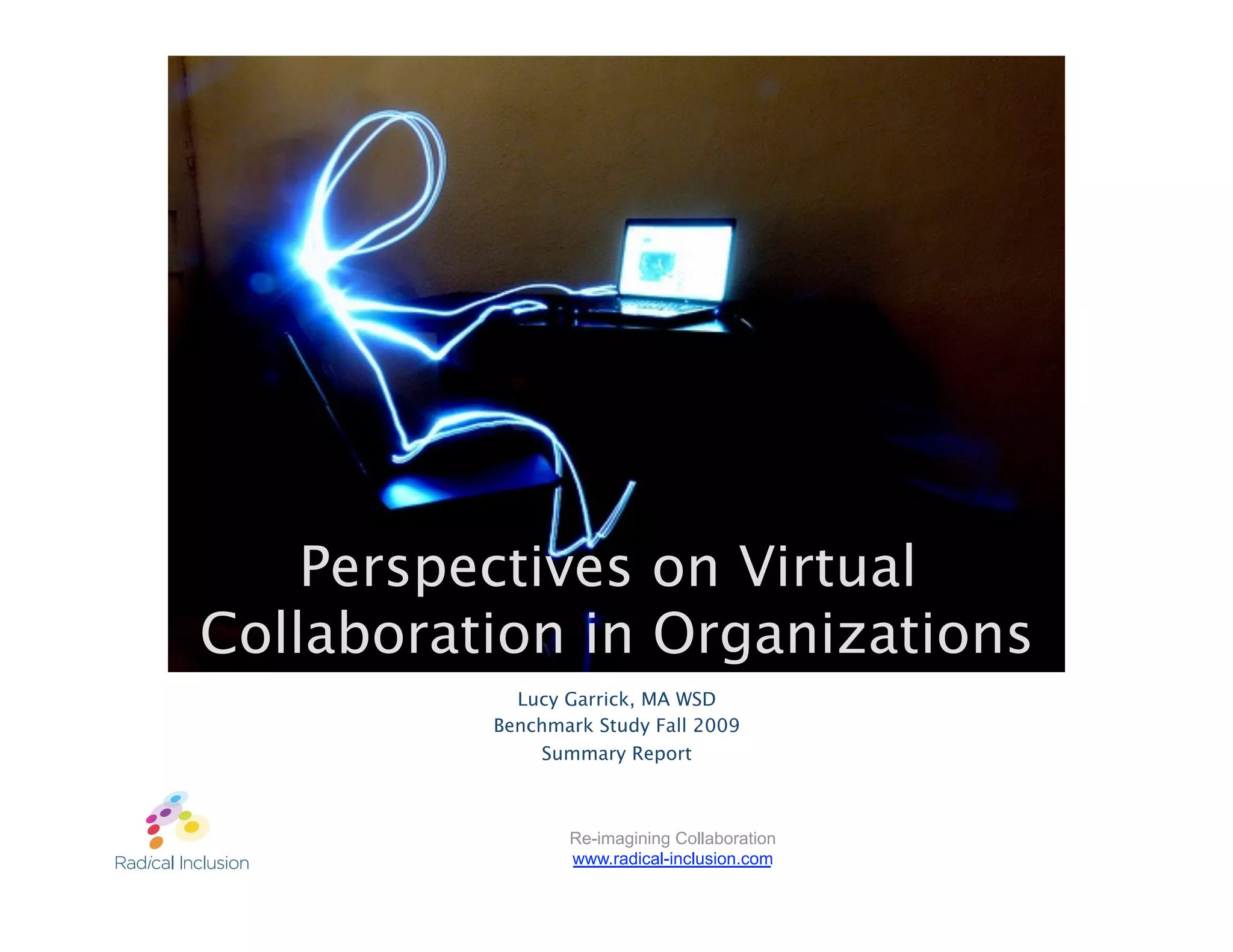
Perspectives on Virtual
Collaboration in Organizations
            Lucy Garrick, MA WSD
          Benchmark Study Fall 2009
               Summary Report


                 Re-imagining Collaboration
                 www.radical-inclusion.com
Contents

•    Impact of Social Media
•    Executive Summary
•    Key Findings
•    How To Learn More


                       Re-imagining Collaboration   2
                       www.radical-inclusion.com
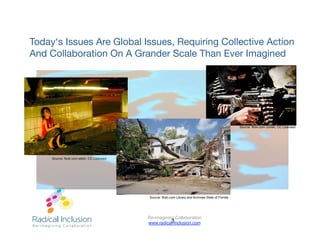
Today‘s Issues Are Global Issues, Requiring Collective Action
And Collaboration On A Grander Scale Than Ever Imagined


                                                                                                         Source: flickr.com Zoriah, CC Licensed


     Source: flickr.com stitch, CC Licensed


                                              Source: flickr.com Library and Archives State of Florida


                                              Re-imagining Collaboration
                                                         3
                                              www.radical-inclusion.com
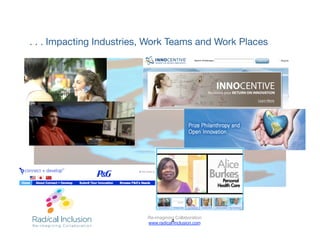
. . . Impacting Industries, Work Teams and Work Places


                          Re-imagining Collaboration
                                     4
                          www.radical-inclusion.com
What Is Really Happening
With Virtual Collaboration?
   Why Is It Important?


           Re-imagining Collaboration
           www.radical-inclusion.com
What Do The Words Mean?
•  Social Media
    –  Computer tools used over the internet
       •  Enable you to find, relate and share
            –  Information (text, video, sound), relationships & expertise (people)

•  Collaboration
    –  Two or more people coming together to accomplishing
       something within a defined boundary
       •  Lots of different forms of collaboration
            –  Online and sometimes blending physical and virtual worlds
       •  More on “accomplishing something” later.
•  Social Collaborators
    –  A variety of formal groups using computer and other
       tools over the internet to accomplish a work purpose
       with a defined boundary.
       •  Business, non-profit, government, educational, professional or community
          groups


                                           Re-imagining Collaboration                 6
                                           www.radical-inclusion.com
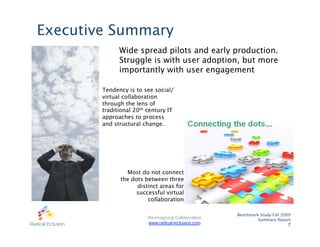
Executive Summary
              Wide spread pilots and early production.
              Struggle is with user adoption, but more
              importantly with user engagement

        Tendency is to see social/
        virtual collaboration
        through the lens of
        traditional 20th century IT
        approaches to process
        and structural change.


                Most do not connect
              the dots between three
                    distinct areas for
                    successful virtual
                        collaboration

                                                      Benchmark Study Fall 2009
                         Re-imagining Collaboration            Summary Report
                         www.radical-inclusion.com                            7
Re-imagining Collaboration   8
www.radical-inclusion.com
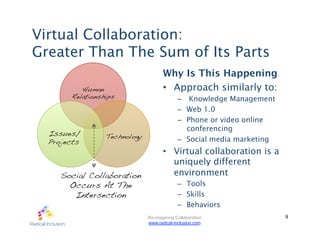
Virtual Collaboration:
Greater Than The Sum of Its Parts
                                        Why Is This Happening
           Human                        •  Approach similarly to:
        Relationships!                         –  Knowledge Management
                                               –  Web 1.0
                                               –  Phone or video online
                                                  conferencing
  
Issues/         Technology!
  Projects!                                    –  Social media marketing
                                        •  Virtual collaboration is a
                                           uniquely different
     Social Collaboration                  environment
       Occurs At The !                         –  Tools
        Intersection !                         –  Skills
                                               –  Behaviors
                                 Re-imagining Collaboration                9
                                 www.radical-inclusion.com
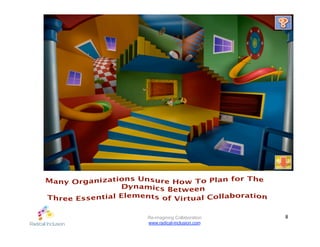
Analogous to the Fisher’s Rotating Tower!

  Calls For A Dynamic Design Approach!
     To Strategy, Adoption, Engagement and ROI
                                                    Source: http://www.dynamicarchitecture.net/home.html

                       Re-imagining Collaboration                                                      10
                       www.radical-inclusion.com
Key Findings


    Re-imagining Collaboration   11
    www.radical-inclusion.com
Biggest Barrier to Collaboration
#1 – Engaging others in collaboration
      •  Varying perceptions about meaning of collaboration
      •  Knowledge of collaborative skills
          –  Lack of leadership modeling behaviors
          –  Time pressure: real and perceived
          –  Competitive attitudes
               »  Sharing content and getting credit
      •  Willingness to try new things
          –  How to use the technical tools with others
          –  Assumptions about face-to-face vs. virtual
          –  Cultural differences (ethnic, organizational, generational)

#2 – Rigid emphasis on risk leading to control rather
  than design
          –  Policies narrowly defined by a single group – IT, Executives, Legal,
             etc.
          –  Concerns about privacy and competitive intelligence


                                   Re-imagining Collaboration                       12
                                   www.radical-inclusion.com
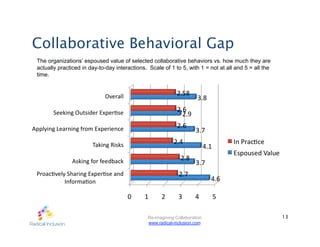
Collaborative Behavioral Gap
The organizations’ espoused value of selected collaborative behaviors vs. how much they are
actually practiced in day-to-day interactions. Scale of 1 to 5, with 1 = not at all and 5 = all the
time.


                                               Re-imagining Collaboration                             13
                                               www.radical-inclusion.com
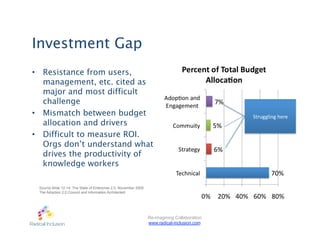
Investment Gap
•  Resistance from users,
   management, etc. cited as
   major and most difficult
   challenge
•  Mismatch between budget                                                                     Struggling
here

   allocation and drivers
•  Difficult to measure ROI.
   Orgs don’t understand what
   drives the productivity of
   knowledge workers

 Source Slide 12-14: The State of Enterprise 2.0, November 2009
 The Adoption 2.0 Council and Information Architected


                                                                  Re-imagining Collaboration
                                                                  www.radical-inclusion.com
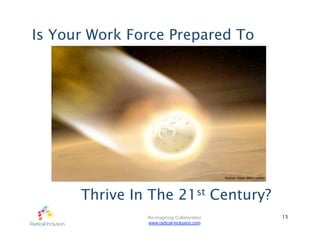
Is Your Work Force Prepared To


                                            Source: Nasa: Mars Lander


      Thrive In The 21st Century?
               Re-imagining Collaboration                               15
               www.radical-inclusion.com
Complete Benchmark Contents
•  Segmentation Research
   –  Conducted Fall 2009
   –  Sectors interviewed
       •  Higher education, aerospace, professional associations, non-profits and
          foundations, computer technology, online retail, online marketing, financial
          services
   –  Size
       •  40 to >150K employees
       •  Projects serving hundreds to 1000s of members
   –  Tools used
       •  Varied widely from public social sites, i.e. LinkedIn FB and Twitter, custom-built
          web communities and proprietary platforms behind the firewall
•  Enterprise 2.0 Trends
•  Perspectives
   –  Conclusions
   –  Challenges to Traditional Thinking About Technology Adoption
   –  Frontiers for Tools Vendors and Organizations


                                       Re-imagining Collaboration                         16
                                       www.radical-inclusion.com
Thank you!!


        For Inquires contact:
          Lucy Garrick, MA
Founder and Partner, Radical Inclusion
     lucy@radical-inclusion.com
          +1-206-335-5635
   Twitter: @newsaboutchange or
            @radinclusion
       Time Zone: PST -8 GMT


            Re-imagining Collaboration
            www.radical-inclusion.com    17

Benchmark Fall 09 Ext Summary

  • 1.
    Perspectives on Virtual Collaborationin Organizations Lucy Garrick, MA WSD Benchmark Study Fall 2009 Summary Report Re-imagining Collaboration www.radical-inclusion.com
  • 2.
    Contents •  Impact of Social Media •  Executive Summary •  Key Findings •  How To Learn More Re-imagining Collaboration 2 www.radical-inclusion.com
  • 3.
    Today‘s Issues AreGlobal Issues, Requiring Collective Action And Collaboration On A Grander Scale Than Ever Imagined Source: flickr.com Zoriah, CC Licensed Source: flickr.com stitch, CC Licensed Source: flickr.com Library and Archives State of Florida Re-imagining Collaboration 3 www.radical-inclusion.com
  • 4.
    . . .Impacting Industries, Work Teams and Work Places Re-imagining Collaboration 4 www.radical-inclusion.com
  • 5.
    What Is ReallyHappening With Virtual Collaboration? Why Is It Important? Re-imagining Collaboration www.radical-inclusion.com
  • 6.
    What Do TheWords Mean? •  Social Media –  Computer tools used over the internet •  Enable you to find, relate and share –  Information (text, video, sound), relationships & expertise (people) •  Collaboration –  Two or more people coming together to accomplishing something within a defined boundary •  Lots of different forms of collaboration –  Online and sometimes blending physical and virtual worlds •  More on “accomplishing something” later. •  Social Collaborators –  A variety of formal groups using computer and other tools over the internet to accomplish a work purpose with a defined boundary. •  Business, non-profit, government, educational, professional or community groups Re-imagining Collaboration 6 www.radical-inclusion.com
  • 7.
    Executive Summary Wide spread pilots and early production. Struggle is with user adoption, but more importantly with user engagement Tendency is to see social/ virtual collaboration through the lens of traditional 20th century IT approaches to process and structural change. Most do not connect the dots between three distinct areas for successful virtual collaboration Benchmark Study Fall 2009 Re-imagining Collaboration Summary Report www.radical-inclusion.com 7
  • 8.
    Re-imagining Collaboration 8 www.radical-inclusion.com
  • 9.
    Virtual Collaboration: Greater ThanThe Sum of Its Parts Why Is This Happening Human •  Approach similarly to: Relationships! –  Knowledge Management –  Web 1.0 –  Phone or video online conferencing 
Issues/ Technology! Projects! –  Social media marketing •  Virtual collaboration is a uniquely different Social Collaboration environment Occurs At The ! –  Tools Intersection ! –  Skills –  Behaviors Re-imagining Collaboration 9 www.radical-inclusion.com
  • 10.
    Analogous to theFisher’s Rotating Tower! Calls For A Dynamic Design Approach! To Strategy, Adoption, Engagement and ROI Source: http://www.dynamicarchitecture.net/home.html Re-imagining Collaboration 10 www.radical-inclusion.com
  • 11.
    Key Findings Re-imagining Collaboration 11 www.radical-inclusion.com
  • 12.
    Biggest Barrier toCollaboration #1 – Engaging others in collaboration •  Varying perceptions about meaning of collaboration •  Knowledge of collaborative skills –  Lack of leadership modeling behaviors –  Time pressure: real and perceived –  Competitive attitudes »  Sharing content and getting credit •  Willingness to try new things –  How to use the technical tools with others –  Assumptions about face-to-face vs. virtual –  Cultural differences (ethnic, organizational, generational) #2 – Rigid emphasis on risk leading to control rather than design –  Policies narrowly defined by a single group – IT, Executives, Legal, etc. –  Concerns about privacy and competitive intelligence Re-imagining Collaboration 12 www.radical-inclusion.com
  • 13.
    Collaborative Behavioral Gap Theorganizations’ espoused value of selected collaborative behaviors vs. how much they are actually practiced in day-to-day interactions. Scale of 1 to 5, with 1 = not at all and 5 = all the time. Re-imagining Collaboration 13 www.radical-inclusion.com
  • 14.
    Investment Gap •  Resistancefrom users, management, etc. cited as major and most difficult challenge •  Mismatch between budget Struggling
here
 allocation and drivers •  Difficult to measure ROI. Orgs don’t understand what drives the productivity of knowledge workers Source Slide 12-14: The State of Enterprise 2.0, November 2009 The Adoption 2.0 Council and Information Architected Re-imagining Collaboration www.radical-inclusion.com
  • 15.
    Is Your WorkForce Prepared To Source: Nasa: Mars Lander Thrive In The 21st Century? Re-imagining Collaboration 15 www.radical-inclusion.com
  • 16.
    Complete Benchmark Contents • Segmentation Research –  Conducted Fall 2009 –  Sectors interviewed •  Higher education, aerospace, professional associations, non-profits and foundations, computer technology, online retail, online marketing, financial services –  Size •  40 to >150K employees •  Projects serving hundreds to 1000s of members –  Tools used •  Varied widely from public social sites, i.e. LinkedIn FB and Twitter, custom-built web communities and proprietary platforms behind the firewall •  Enterprise 2.0 Trends •  Perspectives –  Conclusions –  Challenges to Traditional Thinking About Technology Adoption –  Frontiers for Tools Vendors and Organizations Re-imagining Collaboration 16 www.radical-inclusion.com
  • 17.
    Thank you!! For Inquires contact: Lucy Garrick, MA Founder and Partner, Radical Inclusion lucy@radical-inclusion.com +1-206-335-5635 Twitter: @newsaboutchange or @radinclusion Time Zone: PST -8 GMT Re-imagining Collaboration www.radical-inclusion.com 17