Global Economic Systems
Viv Grigg
By PresenterMedia.com
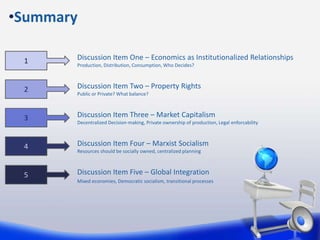
•Summary
Discussion Item One – Economics as Institutionalized Relationships
Production, Distribution, Consumption, Who Decides?
Discussion Item Two – Property Rights
Public or Private? What balance?
Discussion Item Four – Marxist Socialism
Resources should be socially owned, centralized planning
Discussion Item Five – Global Integration
Mixed economies, Democratic socialism, transitional processes
1
2
5
3
4
Discussion Item Three – Market Capitalism
Decentralized Decision-making, Private ownership of production, Legal enforcability
•Fundamental Questions on Economic Systems
• l. What is an economic system?
• 2 What choices must any economic system create
answers to? Why must it do so?
• 3. What arguments would you advance for market
capitalism as a desirable economic system?
• 4. What is planned socialism? What are its main
differences from market capitalism?
• 5. Sketch the main points of Marx's model of history and
explain why Marx’s prediction about the collapse of
capitalism has not come true.
• 6. What is meant by the Marxist term. "surplus value"?
What is the labor theory of value on which it was based?
•Fundamental Questions 2
• 7. Why do property rights and the level at which
choices about using resources matter to an
economic society?
• 8. What seems to be the explanation for the fact
that most economies in the late 20th century are
"mixed economies" ?
• 9. What is the problem of "fatal conceit" that has
afflicted planned socialist economies in the 20th
century? What causes the problem?
• I0. Why has planned socialism largely lost out in
the contest with market capitalism?
• Economics as a discipline is based on the
fundamental:
Scarcity(need) requires institutionalized
arrangements of making, selling goods.
• Choices.
• Which goods for which people?
• How many of each good produced?
• Distributed to which groups
• Who decides?
•The Discipline of Economics: Study of
Institutionalized Relationships
The most
efficient survive.
In over 6000
civilizations
economic
configurations
have constantly
morphed
•Basic Economic Choices
1. Productive Output
Choices are imposed by scarcity. Regardless of the
philosophical or ideological preferences of a society,
these are the questions about using resources that
must be answered. These choices are:
1. What shall be the composition of Output? Since
everything that is desirable cannot be produced in the
quantities desired, choices, often difficult ones-must
somehow be made about allocating resources to
produce one good as opposed to another. Shall these
choices be made by individual consumers or shall
government planners make the decisions? Whose
tastes and preferences shall dominate the choice
about output?
•Choices 2: Production
2.How shall goods be produced? At any
particular time. there is a menu of choices
about producing goods. Shall we, for example
produce information for making economic
decisions with typewriters and telephones or
with computer hardware and software? An
answer to this question is necessary: shall it
come from individual managers and
entrepreneurs or from central planners?
•Choices 3: Distribution
This question of distribution is perhaps the most
difficult and potentially divisive one for all nations.
Shall markets, responding to productivity signals.
ration output on the basis of (market-earned)
incomes and tastes or shall planners set prices and
factor incomes according to some set of ·social
objectives?
What is equitable or fair? Since, there is no unique
definition of distributive equity, each society must
not only find a means or process to distribute
income, but must also agree on the results of that
process.
•Evaluation of Economic Systems
• Efficiency in resource usage?
• Property rights: invested in State, individual or
mixture?
• Ethics, morality, alignment with Biblical
principle?
PUBLIC
• Enables planned redistribution
• Results in an expanding
bureaucracy
• Creates incentive and innovation
• Creates differentiation of rich and
poor, oppressed and oppressor,
owners and workers
PRIVATE
•Property Rights
Rights to own, transfer and profit from ownership of resources
Its mine!
Its ours!
•Planned Socialism
• (There are many cooperative systems. This is
one outlier in the spectrum).
• Property Rights are held publicly
• Choices about production and distribution are
made centrally
•Blessings and Problems of Socialism
• Inequalities can be equalized out
• e.g. socialism provides housing for all
• Distribution can be better planned.
• Disincentives to work: Why work harder for the
same pay?
• The Myopia of altruistic planning
• The technical problem of planning
• Quotas mean production numbers are jigged.
• E.g. too many shoes for some areas and not to others
•Marx and Socialism
• Dialectic Materialism
• Class Conflict
• Falling Profits and the Reserve Army of the Unemployed
• The rising number of unemployed caused by increased mechanization,
plus increased capital compete with the employed and drop wages.
• Recurring Business cycles
• The economy expands but workers don’t have the wages to buy. (e.g.
10,000 washing machines per month, but the public only have capacity
to buy 5000. Creates crisis and collapse and recurring depression
• The Collapse of Capitalism
• He predicted that the exploitiaton of laour based on the reserve
army would become larger and larger and eventually the boom and
bust cycles get so great that capitalism would collapse.
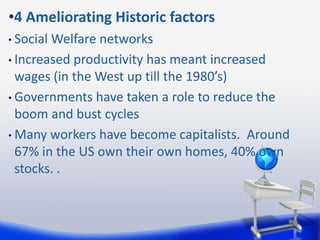
•4 Ameliorating Historic factors
• Social Welfare networks
• Increased productivity has meant increased
wages (in the West up till the 1980’s)
• Governments have taken a role to reduce the
boom and bust cycles
• Many workers have become capitalists. Around
67% in the US own their own homes, 40% own
stocks. .
• Thesis: Communism
• Centralized State planning to meet needs
• Redistribution so there are no poor.
• Antithesis: Capitalism
• Free market decides on needs through
networks of markets
• Capital is concentrated
• Expansion of capitalist class is seen as
efficient.
• Wages are part of production so kept
low.
•Late 21st Century Competition
The theory
• Thesis: Communism
• Centralized State planning results in a rich
bureaucratic class
• Redistribution so there are no poor results in
low efficiency.
• Antithesis: Capitalism
• Free market decides on needs through
networks of markets – this requires
considerable government legislation and
control.
• Capital is concentrated
• Expansion of capitalist class does not direct
resources to social needs, cannot provide
housing for the poor or medical care etc.
• Wages are part of production so kept low
• Positive incentives to produce.
• Lack of controls have resulted in expanding
printed money 30-50 x the actual wealth of
nations
•Late 21st Century Competition
The practice
• Capitalism
• The markets drive
decision-making
• Differentiation of rich
and poor is
encouraged.
• Private property rights
are protected
• Enforcable contracts
• Globalized Mixed
Economies
• Free market and free trade
encouraged
• All economies have significant
government planning
• Government planning
redistributes profits to a safety
net.
• Expanded processes of
property rights and contracts
• Socialism
• Government
bureaucratic planning
• No poor through
redistribution
•Globalizing Bureaucratic Capitalism
The synthesis.
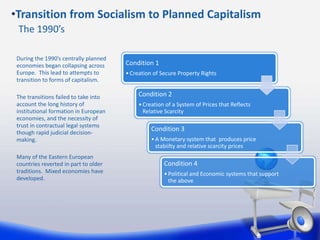
Condition 1
•Creation of Secure Property Rights
Condition 2
•Creation of a System of Prices that Reflects
Relative Scarcity
Condition 3
•A Monetary system that produces price
stabiilty and relative scarcity prices
Condition 4
•Political and Economic systems that support
the above
During the 1990’s centrally planned
economies began collapsing across
Europe. This lead to attempts to
transition to forms of capitalism.
The transitions failed to take into
account the long history of
institutional formation in European
economies, and the necessity of
trust in contractual legal systems
though rapid judicial decision-
making.
Many of the Eastern European
countries reverted in part to older
traditions. Mixed economies have
developed.
•Transition from Socialism to Planned Capitalism
The 1990’s
•
•Global and Urban Economic Systems
• Summary of Rostow, W.W. (1991). The Stages of Economic Growth: A Non-Communist Manifesto (3rd ed.).
Cambridge: Cambridge University Press.
• Jeffrey Sachs (2005). The End of Poverty. Penguin Group. U.K.
Patterning Global Systems on the Kingdom Themes
• Grigg, V (2010). Conversations on Kingdom Economics. (Access
athttp://www.urbanleaders.org/home/publications.html). (Use Guest, password: matul2010) Read the Section
contrasting Capitalism and Socialism with Biblical principles.
Is Equality the Goal?
• Wilkenson, Richard, and Kate Pickett. (2009). The End of an Era. The Spirit Level. Bloomsbury Press. (needs editing)
• O’Hanlon, Gerry S.J. (2007) How Much Equality is Needed for Justice? Working Notes • Issue 56 • November
2007.
Urban Economic Studies
• Santos, Milton. (1979). The Financial Mechanism of the Lower Circuit. The Shared Space (trans from Portuguese, C.
Gerry, Trans.). London and New York: Methuen ·
• de Soto, Hernando. (1989). The Costs and Importance of the Law. The Other Path (June Abbott, Trans.). New York:
Harper & Row. pp 121-131.
• Jacobs, Jane. (1984). Cities and the Wealth of Nations. The Atlantic Monthly (Mar/Apr 1984). ch 2.
• Donald MacNeill and Aidan While. (2001). The Urban Economy. Handbook of Urban Studies. Paddison, Ronan, ed.
Sage Publications.
• Bannerjee, Abhijit. (2009). Poor Economics. (see interview)
Supplementary on the critique of Global Capitalism ·
• Schumacher, E.F. (1973). Small is Beautiful – Economics As If People Matter, Colophon Books (Ch. III, pp.180-193)
• Korten, David (2000) “The Post-Corporate World: Life After Capitalism”, BK Currents ( Berrett-Koehler Publ.) (Ch.
18-20)
• Korten, David (2001) “When Corporations Rule the World” , 2nd ed., Kumarian Press. (Ch. 6-9).
Theological Reflections
• (1990) The Oxford Declaration on Christian Faith and Economics

TUL 560-10-1 Global Economic Systems

  • 1.
    Global Economic Systems VivGrigg By PresenterMedia.com
  • 2.
    •Summary Discussion Item One– Economics as Institutionalized Relationships Production, Distribution, Consumption, Who Decides? Discussion Item Two – Property Rights Public or Private? What balance? Discussion Item Four – Marxist Socialism Resources should be socially owned, centralized planning Discussion Item Five – Global Integration Mixed economies, Democratic socialism, transitional processes 1 2 5 3 4 Discussion Item Three – Market Capitalism Decentralized Decision-making, Private ownership of production, Legal enforcability
  • 3.
    •Fundamental Questions onEconomic Systems • l. What is an economic system? • 2 What choices must any economic system create answers to? Why must it do so? • 3. What arguments would you advance for market capitalism as a desirable economic system? • 4. What is planned socialism? What are its main differences from market capitalism? • 5. Sketch the main points of Marx's model of history and explain why Marx’s prediction about the collapse of capitalism has not come true. • 6. What is meant by the Marxist term. "surplus value"? What is the labor theory of value on which it was based?
  • 4.
    •Fundamental Questions 2 •7. Why do property rights and the level at which choices about using resources matter to an economic society? • 8. What seems to be the explanation for the fact that most economies in the late 20th century are "mixed economies" ? • 9. What is the problem of "fatal conceit" that has afflicted planned socialist economies in the 20th century? What causes the problem? • I0. Why has planned socialism largely lost out in the contest with market capitalism?
  • 5.
    • Economics asa discipline is based on the fundamental: Scarcity(need) requires institutionalized arrangements of making, selling goods. • Choices. • Which goods for which people? • How many of each good produced? • Distributed to which groups • Who decides? •The Discipline of Economics: Study of Institutionalized Relationships The most efficient survive. In over 6000 civilizations economic configurations have constantly morphed
  • 6.
    •Basic Economic Choices 1.Productive Output Choices are imposed by scarcity. Regardless of the philosophical or ideological preferences of a society, these are the questions about using resources that must be answered. These choices are: 1. What shall be the composition of Output? Since everything that is desirable cannot be produced in the quantities desired, choices, often difficult ones-must somehow be made about allocating resources to produce one good as opposed to another. Shall these choices be made by individual consumers or shall government planners make the decisions? Whose tastes and preferences shall dominate the choice about output?
  • 7.
    •Choices 2: Production 2.Howshall goods be produced? At any particular time. there is a menu of choices about producing goods. Shall we, for example produce information for making economic decisions with typewriters and telephones or with computer hardware and software? An answer to this question is necessary: shall it come from individual managers and entrepreneurs or from central planners?
  • 8.
    •Choices 3: Distribution Thisquestion of distribution is perhaps the most difficult and potentially divisive one for all nations. Shall markets, responding to productivity signals. ration output on the basis of (market-earned) incomes and tastes or shall planners set prices and factor incomes according to some set of ·social objectives? What is equitable or fair? Since, there is no unique definition of distributive equity, each society must not only find a means or process to distribute income, but must also agree on the results of that process.
  • 9.
    •Evaluation of EconomicSystems • Efficiency in resource usage? • Property rights: invested in State, individual or mixture? • Ethics, morality, alignment with Biblical principle?
  • 10.
    PUBLIC • Enables plannedredistribution • Results in an expanding bureaucracy • Creates incentive and innovation • Creates differentiation of rich and poor, oppressed and oppressor, owners and workers PRIVATE •Property Rights Rights to own, transfer and profit from ownership of resources Its mine! Its ours!
  • 11.
    •Planned Socialism • (Thereare many cooperative systems. This is one outlier in the spectrum). • Property Rights are held publicly • Choices about production and distribution are made centrally
  • 12.
    •Blessings and Problemsof Socialism • Inequalities can be equalized out • e.g. socialism provides housing for all • Distribution can be better planned. • Disincentives to work: Why work harder for the same pay? • The Myopia of altruistic planning • The technical problem of planning • Quotas mean production numbers are jigged. • E.g. too many shoes for some areas and not to others
  • 13.
    •Marx and Socialism •Dialectic Materialism • Class Conflict • Falling Profits and the Reserve Army of the Unemployed • The rising number of unemployed caused by increased mechanization, plus increased capital compete with the employed and drop wages. • Recurring Business cycles • The economy expands but workers don’t have the wages to buy. (e.g. 10,000 washing machines per month, but the public only have capacity to buy 5000. Creates crisis and collapse and recurring depression • The Collapse of Capitalism • He predicted that the exploitiaton of laour based on the reserve army would become larger and larger and eventually the boom and bust cycles get so great that capitalism would collapse.
  • 14.
    •4 Ameliorating Historicfactors • Social Welfare networks • Increased productivity has meant increased wages (in the West up till the 1980’s) • Governments have taken a role to reduce the boom and bust cycles • Many workers have become capitalists. Around 67% in the US own their own homes, 40% own stocks. .
  • 15.
    • Thesis: Communism •Centralized State planning to meet needs • Redistribution so there are no poor. • Antithesis: Capitalism • Free market decides on needs through networks of markets • Capital is concentrated • Expansion of capitalist class is seen as efficient. • Wages are part of production so kept low. •Late 21st Century Competition The theory
  • 16.
    • Thesis: Communism •Centralized State planning results in a rich bureaucratic class • Redistribution so there are no poor results in low efficiency. • Antithesis: Capitalism • Free market decides on needs through networks of markets – this requires considerable government legislation and control. • Capital is concentrated • Expansion of capitalist class does not direct resources to social needs, cannot provide housing for the poor or medical care etc. • Wages are part of production so kept low • Positive incentives to produce. • Lack of controls have resulted in expanding printed money 30-50 x the actual wealth of nations •Late 21st Century Competition The practice
  • 17.
    • Capitalism • Themarkets drive decision-making • Differentiation of rich and poor is encouraged. • Private property rights are protected • Enforcable contracts • Globalized Mixed Economies • Free market and free trade encouraged • All economies have significant government planning • Government planning redistributes profits to a safety net. • Expanded processes of property rights and contracts • Socialism • Government bureaucratic planning • No poor through redistribution •Globalizing Bureaucratic Capitalism The synthesis.
  • 18.
    Condition 1 •Creation ofSecure Property Rights Condition 2 •Creation of a System of Prices that Reflects Relative Scarcity Condition 3 •A Monetary system that produces price stabiilty and relative scarcity prices Condition 4 •Political and Economic systems that support the above During the 1990’s centrally planned economies began collapsing across Europe. This lead to attempts to transition to forms of capitalism. The transitions failed to take into account the long history of institutional formation in European economies, and the necessity of trust in contractual legal systems though rapid judicial decision- making. Many of the Eastern European countries reverted in part to older traditions. Mixed economies have developed. •Transition from Socialism to Planned Capitalism The 1990’s
  • 19.
    • •Global and UrbanEconomic Systems • Summary of Rostow, W.W. (1991). The Stages of Economic Growth: A Non-Communist Manifesto (3rd ed.). Cambridge: Cambridge University Press. • Jeffrey Sachs (2005). The End of Poverty. Penguin Group. U.K. Patterning Global Systems on the Kingdom Themes • Grigg, V (2010). Conversations on Kingdom Economics. (Access athttp://www.urbanleaders.org/home/publications.html). (Use Guest, password: matul2010) Read the Section contrasting Capitalism and Socialism with Biblical principles. Is Equality the Goal? • Wilkenson, Richard, and Kate Pickett. (2009). The End of an Era. The Spirit Level. Bloomsbury Press. (needs editing) • O’Hanlon, Gerry S.J. (2007) How Much Equality is Needed for Justice? Working Notes • Issue 56 • November 2007. Urban Economic Studies • Santos, Milton. (1979). The Financial Mechanism of the Lower Circuit. The Shared Space (trans from Portuguese, C. Gerry, Trans.). London and New York: Methuen · • de Soto, Hernando. (1989). The Costs and Importance of the Law. The Other Path (June Abbott, Trans.). New York: Harper & Row. pp 121-131. • Jacobs, Jane. (1984). Cities and the Wealth of Nations. The Atlantic Monthly (Mar/Apr 1984). ch 2. • Donald MacNeill and Aidan While. (2001). The Urban Economy. Handbook of Urban Studies. Paddison, Ronan, ed. Sage Publications. • Bannerjee, Abhijit. (2009). Poor Economics. (see interview) Supplementary on the critique of Global Capitalism · • Schumacher, E.F. (1973). Small is Beautiful – Economics As If People Matter, Colophon Books (Ch. III, pp.180-193) • Korten, David (2000) “The Post-Corporate World: Life After Capitalism”, BK Currents ( Berrett-Koehler Publ.) (Ch. 18-20) • Korten, David (2001) “When Corporations Rule the World” , 2nd ed., Kumarian Press. (Ch. 6-9). Theological Reflections • (1990) The Oxford Declaration on Christian Faith and Economics