Texas Government
GOVT 2306: Summer 2020; MAYMESTER
Critical Thinking in political economy
Critical Thinking
• Hunting Assumptions (our own and those of others)
• Examine Assumptions from Multiple Viewpoints
• Purpose: take action based on evidence, not ideology and bias
• Difficult to uncover assumptions underlying dominant ideologies
• Capitalism, Democracy, Republicanism, Patrimony, Heterosexism, etc.
• Paradigmatic, Causal, and Prescriptive Assumptions
• Assumptions are more or less appropriate for particular CONTEXTS
• Can we create as hierarchy of appropriate assumptions?
Why Critical Thinking is Essential
• It encourages curiosity.
• It enhances creativity.
• It improves problem-solving ability.
• It is multi-faceted, cross-disciplinary, exercise for the mind.
• It promotes independence of thought and action.
• It stimulates life-long learning.
• Critical thinking can challenge ideologies and cultural hegemony.
Cultural Hegemony
• Cultural Hegemony is the domination of a culturally diverse
society by the ruling class which manipulate the culture of that
society — the beliefs and explanations, perceptions, values, and
mores — so that the ruling-class worldview becomes the
accepted cultural norm; the universally valid dominant
ideology, which justifies the social, political, and economic
status quo as natural and inevitable, perpetual and beneficial
for every social class, rather than as artificial social constructs
that benefit mainly the ruling class.
Scout Mindset or Soldier Mindset?
• Soldier Mindset: defend accepted assumptions and viewpoints
• Emotional response, tribalism, nationalism, status quo
• SCOUT MINDSET: discover reality
• Emotional ability to question status quo, personal opinions
• Be inquisitive, take pride in recognizing your errors
• Groups need both scouts as leaders and soldiers as followers
• College students wishing to understand the world need scout mindset
• Knowledge of reality provides practical benefits critical thinkers
• Scout mindset is essential for effective critical thinking.
Daniel Kahneman: Thinking Fast and Slow
SYSTEM 1; Fast Thinking
• Intuition
• Heuristics
• Useful but potentially biased
• Dominates mental processes
• Often unconsciously
SYSTER 2; Slow Thinking
• Analytic and calculating
• Requires effort and attention
• WE BELIEVE WE ARE ANALYTIC
RATIONAL DECISIONMAKERS
BUT MOST OF OUR THINKING IS
DOMINATED BY SYSTEM 1
•
Daniel Kahneman: Thinking Fast and Slow
• Experiencing Self
• the "you" in the moment who
lives through the event
• Experience and memory differ
• Remembering Self
• the "you" that writes the history
• We rely on the remembering self's
construction of past experience
• Duration does not count.
• Only the peak (best/ worst moment)
and the end are remembered
• This leads us to make wrong choices
The implication of our recognition of unconscious bias and flawed decision making is that as
social beings, we need to develop both MORAL and INTELLECTUAL HUMILITY
Moral humility: my values and the values of others should be questioned
Intellectual humility: my beliefs about reality and the beliefs of others should be questioned
This does not mean that all values and beliefs about reality are of equal merit.
We may attempt to work out a hierarchy of values.
We may attempt to discover beliefs about reality that are based on logic and evidence.
Discovering Assumptions: Capitalism
• Invisible hand of the market: magically turns self-interest into the
public good?
• Economic growth is the goal; economic growth raises all boats
• Inequality reflects unequal merit, abilities, hard work, not luck
• Competition is the driver of progress
• Homo Economicus: man as all knowing rational decision maker
• Motivated by self interest
• Perfect knowledge
• Capital is more important than labor: Say’s Law; supply creates demand
• Laissez faire: government should have minimal/no role in the economy
Discovering Assumptions: Socialism
• Markets alone will not automatically promote well-being.
• Government planning and regulation can improve markets.
• We are social beings that exist in communities.
• New technologies allow us to cooperate effectively.
• Cooperation can work better than competition.
• Labor creates value
• Demand creates supply
• Private companies lack the resources/motivation to solve many
social problems
Discovering Assumptions: Socialism in TEXAS
• Texas Treasury Safekeeping Trust Company:
• State owned investment funds worth $58 billion
• Texas Permanent School Fund
• State owned sovereign wealth fund worth about $47 Billion
• UTIMCO: University of Texas/Texas A&M Investment Management
Company
• State Management company with assets of about $47 billion
• Texas General Land Office
• The State of Texas owns 22.5 million acres
Discovering Assumptions: Government
• Texans love to hate government.
• Government is bad, inefficient, corrupt, wasteful, etc. …
• Representative democracy is the best form of bad government.
• Representative democracy: AKA republican form of government
• Choose representatives through elections
• US Constitution: Federalism; nation & states each have legitimate authority
• Separation of Powers: separately elected chief executive
• ?
Neoliberalism Supply Side
Economics
Monetarism Keynesian Economics Speculative
Liberalism
Progressive Reforms Classical Liberalism Mercantilism
Globalization: free
movement of capita
and products across
borders
Ronald Reagan and
Margaret Thatcher go
neoliberal
Stagflation in the
1970s was a problem
for Keynsians
Say’s law says supply
creates demand
Keynes disagreed
Banks speculated in
stock market
Industrialization
Guilded Age
Robber Barons
Trusts
Adam Smith – first
thorough critique of
mercantilism
Govt monopoly granted
to joint stock
companies
Market
fundamentalism:
Reagan buster air
traffic controller union
Milton Friedman
Chicago School said
fiscal policy too
cumbersome
Keynes: demand
creates supply
Poorly functioning gold
standard
Child labor unsafe
working conditions
Open trade would
produce more wealth
Companies were
armed and used force
to colonize
Reduce role of govt,
cut taxes,
deregulation,
privatization
Expanded military
spending and cut social
welfare
Monetary policy easier
using tools of Federal
Reserve System
Deficit spending
required to create
demand
Exuberance after end
of WWI
Low pay and poor
living conditions
Reliance on markets:
invisible hand
Colonies trade raw
materials for finished
goods
Corporations seek
changes in national
laws to make it easier
to do business
Laffer Curve: tax cuts
will lead to more govt
revenue
Beginnings of
neoliberalism, Chicago
School implement in
Chile
New Deal: Glass-
Steagall (banks) Social
Security (excluded
Blacks)
Stock market crashed
in 1929
Cities unsanitary,
crime ridden,
politically corrupt
Markets turn self-
interest into public
interest
Trade used as weapon
and way to keep
colonies under control
Seek uniform
application of patent,
copyright, intellectual
property
Did not work so Reagan
raised some taxes
Financial innovations
reduced ability of FED
to regulate
Bretton-Woods
conference creates
new monetary system
Great Depression 25%
unemployed run on
banks
Legislation to busty
trusts, promote
unions, right to strike
Markets self-regulating Colonies came to
resent monopolies
Seek arbitration
rather than litigation
Deregulation of
financial markets
GI Bill of Rights
College funding, Home
loans
Many bank failures Food and drug safety,
regulation of business
Smith saw areas where
markets would not
work
Many colonists were
smugglers
Enhanced corporate
profits and power
Glass-Steagall
repealed, and
derivatives
deregulated under
Affirmative Action for
Whites
Investment in
production at standstill
Limits on political
contributions, new
forms local govt
Still need government East India monopoly
led to Boston Tea
Party
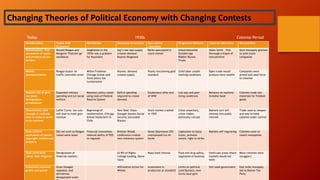
Changing Theories of Political Economy with Changing Contests
Today 1930s Colonial Period
Discovering Assumptions: Neoliberalism
• Dominant Ideology of government and corporate elites is NEOLIBERALISM.
• Reliance on markets as dominant form of social control.
• Reduction of government regulation of markets is a preferred option.
• Reduction of taxes to promote markets and shrink government.
• Privatization of formerly governmental functions.
• Move to private schools and charter schools (public schools with private governance.
• Privatization of Fannie May and Freddie Mac for secondary mortgage market.
• Abandon net neutrality and allow preference for ISP owned content, paid prioritization
of content, throttling of content.
• Globalization
• Neoliberals claim their approach is inevitable.
• THERE IS NO ALTERNATINE, at least according to former British Prime Minister
Margaret Thatcher. TINA
New Theories of Political Economy Emerging
• Context Today:
• Extreme inequality of wealth and income
• Reduced generational social and economic upward mobility
• Growing world population mostly in the developing world
• Hollowing out of the middle class in developed countries
• Job loss through globalization and technological change
• Global COVID 19 pandemic
• Capital losses, job losses, businesses closed
• Growing social and political unrest
• Populist backlash against established practices and market outcomes
• Taking the form of anti-immigrant and anti-minority sentiment
• Destroying the planet: climate change, ocean acidification, etc.
Heterodox Economics
•Many new theories of economics
•BEHAVIORAL ECONOMICS
•DONUT ECONOMICS; Kate Raworth
•MODERN MONETARY THEORY
• Yes, we can afford it.
•STEADY-STATE, NO-GROWTH, DE-GROWTH
• Be agnostic toward growth.
New Theories of Political Economy Emerging
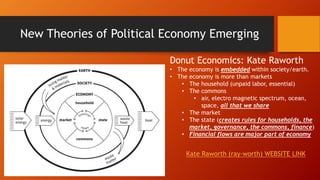
Donut Economics: Kate Raworth
• The economy is embedded within society/earth.
• The economy is more than markets
• The household (unpaid labor, essential)
• The commons
• air, electro magnetic spectrum, ocean,
space, all that we share
• The market
• The state (creates rules for households, the
market, governance, the commons, finance)
• Financial flows are major part of economy
Kate Raworth (ray-worth) WEBSITE LINK
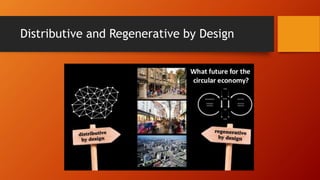
Distributive and Regenerative by Design
New Theories of Political Economy Emerging
Donut Economics: Kate Raworth
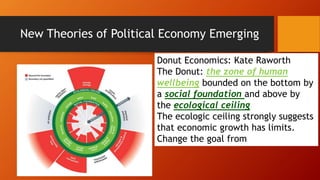
The Donut: the zone of human
wellbeing bounded on the bottom by
a social foundation and above by
the ecological ceiling
The ecologic ceiling strongly suggests
that economic growth has limits.
Change the goal from
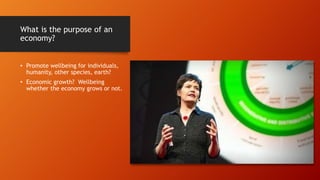
What is the purpose of an
economy?
• Promote wellbeing for individuals,
humanity, other species, earth?
• Economic growth? Wellbeing
whether the economy grows or not.
New Theories of Political Economy Emerging
• DONUT ECONOMICS: Kate Raworth
GROWTH?
New Theories of Political Economy Emerging
• DONUT ECONOMICS: Kate Raworth
DONUT SUMMARY
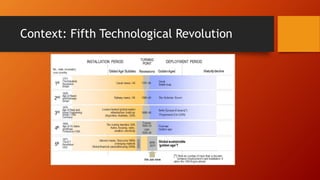
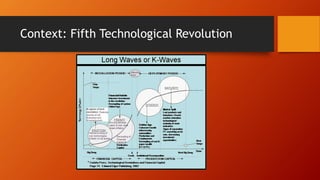
Context: Fifth Technological Revolution
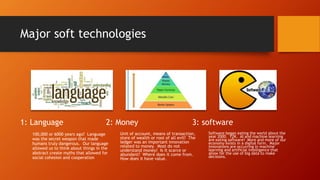
Major soft technologies
1: Language
100,000 or 6000 years ago? Language
was the secret weapon that made
humans truly dangerous. Our language
allowed us to think about things in the
abstract create myths that allowed for
social cohesion and cooperation
2: Money
Unit of account, means of transaction,
store of wealth or root of all evil? The
ledger was an important innovation
related to money. Most do not
understand money! Is it scarce or
abundant? Where does it come from.
How does it have value.
3: software
Software began eating the world about the
year 2000. Y2K. AI and machine learning
are eating software! More and more of our
economy exists in a digital form. Major
innovations are occurring in machine
learning and artificial intelligence that
allow for the use of big data to make
decisions.
What will we make of the ITC revolution?
Dystopian
• Artificial Intelligence dominates humans
• Unemployment not the fault of workers
• First movers gain monopoly power
• Amazon, Google, Facebook
• More concentration of wealth
• Gig economy reduces worker well-being
• Inconsistent work with no benefits
• Political and Social Unrest
Utopian
• Slouching towards Utopia
• Conditions for mass flourishing
• Zero marginal cost of digitized products
• Abundance rather than scarcity
• Cooperation trumps competition
• Distributed decision making
• BLOCKCHAIN
• Open source rather than proprietary
Is there a new Progressive movement underway today?
• Break up Amazon, Facebook, Google, and other tech ? Anti-trust policy.
• Privacy and Data Ownership/Control Issues; MY Data, MY Identity
• Other innovations that lead to mass flourishing?
• Crowdfunding, Crowdocracy, Open Knowledge Commons, Intellectual Property Reforms,
• Artificial Intelligence, Blochchain technology, electric automobiles
• Carlota Perez and Others have Argued for a Green New Deal.
• New & Retrofit Infrastructure, Research, take advantage of low interest rates
• Distributed Renewable Energy, Especially Solar
• Distributed
• Zero Marginal Cost Goods and Services, Consumer Utopia, More Leisure
Humans Need Not Apply

Critical thinking texas style 2020

  • 1.
    Texas Government GOVT 2306:Summer 2020; MAYMESTER Critical Thinking in political economy
  • 2.
    Critical Thinking • HuntingAssumptions (our own and those of others) • Examine Assumptions from Multiple Viewpoints • Purpose: take action based on evidence, not ideology and bias • Difficult to uncover assumptions underlying dominant ideologies • Capitalism, Democracy, Republicanism, Patrimony, Heterosexism, etc. • Paradigmatic, Causal, and Prescriptive Assumptions • Assumptions are more or less appropriate for particular CONTEXTS • Can we create as hierarchy of appropriate assumptions?
  • 3.
    Why Critical Thinkingis Essential • It encourages curiosity. • It enhances creativity. • It improves problem-solving ability. • It is multi-faceted, cross-disciplinary, exercise for the mind. • It promotes independence of thought and action. • It stimulates life-long learning. • Critical thinking can challenge ideologies and cultural hegemony.
  • 4.
    Cultural Hegemony • CulturalHegemony is the domination of a culturally diverse society by the ruling class which manipulate the culture of that society — the beliefs and explanations, perceptions, values, and mores — so that the ruling-class worldview becomes the accepted cultural norm; the universally valid dominant ideology, which justifies the social, political, and economic status quo as natural and inevitable, perpetual and beneficial for every social class, rather than as artificial social constructs that benefit mainly the ruling class.
  • 5.
    Scout Mindset orSoldier Mindset? • Soldier Mindset: defend accepted assumptions and viewpoints • Emotional response, tribalism, nationalism, status quo • SCOUT MINDSET: discover reality • Emotional ability to question status quo, personal opinions • Be inquisitive, take pride in recognizing your errors • Groups need both scouts as leaders and soldiers as followers • College students wishing to understand the world need scout mindset • Knowledge of reality provides practical benefits critical thinkers • Scout mindset is essential for effective critical thinking.
  • 6.
    Daniel Kahneman: ThinkingFast and Slow SYSTEM 1; Fast Thinking • Intuition • Heuristics • Useful but potentially biased • Dominates mental processes • Often unconsciously SYSTER 2; Slow Thinking • Analytic and calculating • Requires effort and attention • WE BELIEVE WE ARE ANALYTIC RATIONAL DECISIONMAKERS BUT MOST OF OUR THINKING IS DOMINATED BY SYSTEM 1 •
  • 7.
    Daniel Kahneman: ThinkingFast and Slow • Experiencing Self • the "you" in the moment who lives through the event • Experience and memory differ • Remembering Self • the "you" that writes the history • We rely on the remembering self's construction of past experience • Duration does not count. • Only the peak (best/ worst moment) and the end are remembered • This leads us to make wrong choices
  • 8.
    The implication ofour recognition of unconscious bias and flawed decision making is that as social beings, we need to develop both MORAL and INTELLECTUAL HUMILITY Moral humility: my values and the values of others should be questioned Intellectual humility: my beliefs about reality and the beliefs of others should be questioned This does not mean that all values and beliefs about reality are of equal merit. We may attempt to work out a hierarchy of values. We may attempt to discover beliefs about reality that are based on logic and evidence.
  • 9.
    Discovering Assumptions: Capitalism •Invisible hand of the market: magically turns self-interest into the public good? • Economic growth is the goal; economic growth raises all boats • Inequality reflects unequal merit, abilities, hard work, not luck • Competition is the driver of progress • Homo Economicus: man as all knowing rational decision maker • Motivated by self interest • Perfect knowledge • Capital is more important than labor: Say’s Law; supply creates demand • Laissez faire: government should have minimal/no role in the economy
  • 10.
    Discovering Assumptions: Socialism •Markets alone will not automatically promote well-being. • Government planning and regulation can improve markets. • We are social beings that exist in communities. • New technologies allow us to cooperate effectively. • Cooperation can work better than competition. • Labor creates value • Demand creates supply • Private companies lack the resources/motivation to solve many social problems
  • 11.
    Discovering Assumptions: Socialismin TEXAS • Texas Treasury Safekeeping Trust Company: • State owned investment funds worth $58 billion • Texas Permanent School Fund • State owned sovereign wealth fund worth about $47 Billion • UTIMCO: University of Texas/Texas A&M Investment Management Company • State Management company with assets of about $47 billion • Texas General Land Office • The State of Texas owns 22.5 million acres
  • 12.
    Discovering Assumptions: Government •Texans love to hate government. • Government is bad, inefficient, corrupt, wasteful, etc. … • Representative democracy is the best form of bad government. • Representative democracy: AKA republican form of government • Choose representatives through elections • US Constitution: Federalism; nation & states each have legitimate authority • Separation of Powers: separately elected chief executive • ?
  • 13.
    Neoliberalism Supply Side Economics MonetarismKeynesian Economics Speculative Liberalism Progressive Reforms Classical Liberalism Mercantilism Globalization: free movement of capita and products across borders Ronald Reagan and Margaret Thatcher go neoliberal Stagflation in the 1970s was a problem for Keynsians Say’s law says supply creates demand Keynes disagreed Banks speculated in stock market Industrialization Guilded Age Robber Barons Trusts Adam Smith – first thorough critique of mercantilism Govt monopoly granted to joint stock companies Market fundamentalism: Reagan buster air traffic controller union Milton Friedman Chicago School said fiscal policy too cumbersome Keynes: demand creates supply Poorly functioning gold standard Child labor unsafe working conditions Open trade would produce more wealth Companies were armed and used force to colonize Reduce role of govt, cut taxes, deregulation, privatization Expanded military spending and cut social welfare Monetary policy easier using tools of Federal Reserve System Deficit spending required to create demand Exuberance after end of WWI Low pay and poor living conditions Reliance on markets: invisible hand Colonies trade raw materials for finished goods Corporations seek changes in national laws to make it easier to do business Laffer Curve: tax cuts will lead to more govt revenue Beginnings of neoliberalism, Chicago School implement in Chile New Deal: Glass- Steagall (banks) Social Security (excluded Blacks) Stock market crashed in 1929 Cities unsanitary, crime ridden, politically corrupt Markets turn self- interest into public interest Trade used as weapon and way to keep colonies under control Seek uniform application of patent, copyright, intellectual property Did not work so Reagan raised some taxes Financial innovations reduced ability of FED to regulate Bretton-Woods conference creates new monetary system Great Depression 25% unemployed run on banks Legislation to busty trusts, promote unions, right to strike Markets self-regulating Colonies came to resent monopolies Seek arbitration rather than litigation Deregulation of financial markets GI Bill of Rights College funding, Home loans Many bank failures Food and drug safety, regulation of business Smith saw areas where markets would not work Many colonists were smugglers Enhanced corporate profits and power Glass-Steagall repealed, and derivatives deregulated under Affirmative Action for Whites Investment in production at standstill Limits on political contributions, new forms local govt Still need government East India monopoly led to Boston Tea Party Changing Theories of Political Economy with Changing Contests Today 1930s Colonial Period
  • 14.
    Discovering Assumptions: Neoliberalism •Dominant Ideology of government and corporate elites is NEOLIBERALISM. • Reliance on markets as dominant form of social control. • Reduction of government regulation of markets is a preferred option. • Reduction of taxes to promote markets and shrink government. • Privatization of formerly governmental functions. • Move to private schools and charter schools (public schools with private governance. • Privatization of Fannie May and Freddie Mac for secondary mortgage market. • Abandon net neutrality and allow preference for ISP owned content, paid prioritization of content, throttling of content. • Globalization • Neoliberals claim their approach is inevitable. • THERE IS NO ALTERNATINE, at least according to former British Prime Minister Margaret Thatcher. TINA
  • 15.
    New Theories ofPolitical Economy Emerging • Context Today: • Extreme inequality of wealth and income • Reduced generational social and economic upward mobility • Growing world population mostly in the developing world • Hollowing out of the middle class in developed countries • Job loss through globalization and technological change • Global COVID 19 pandemic • Capital losses, job losses, businesses closed • Growing social and political unrest • Populist backlash against established practices and market outcomes • Taking the form of anti-immigrant and anti-minority sentiment • Destroying the planet: climate change, ocean acidification, etc.
  • 16.
    Heterodox Economics •Many newtheories of economics •BEHAVIORAL ECONOMICS •DONUT ECONOMICS; Kate Raworth •MODERN MONETARY THEORY • Yes, we can afford it. •STEADY-STATE, NO-GROWTH, DE-GROWTH • Be agnostic toward growth.
  • 17.
    New Theories ofPolitical Economy Emerging Donut Economics: Kate Raworth • The economy is embedded within society/earth. • The economy is more than markets • The household (unpaid labor, essential) • The commons • air, electro magnetic spectrum, ocean, space, all that we share • The market • The state (creates rules for households, the market, governance, the commons, finance) • Financial flows are major part of economy Kate Raworth (ray-worth) WEBSITE LINK
  • 18.
  • 19.
    New Theories ofPolitical Economy Emerging Donut Economics: Kate Raworth The Donut: the zone of human wellbeing bounded on the bottom by a social foundation and above by the ecological ceiling The ecologic ceiling strongly suggests that economic growth has limits. Change the goal from
  • 20.
    What is thepurpose of an economy? • Promote wellbeing for individuals, humanity, other species, earth? • Economic growth? Wellbeing whether the economy grows or not.
  • 21.
    New Theories ofPolitical Economy Emerging • DONUT ECONOMICS: Kate Raworth GROWTH?
  • 22.
    New Theories ofPolitical Economy Emerging • DONUT ECONOMICS: Kate Raworth
  • 23.
  • 24.
  • 25.
  • 26.
    Major soft technologies 1:Language 100,000 or 6000 years ago? Language was the secret weapon that made humans truly dangerous. Our language allowed us to think about things in the abstract create myths that allowed for social cohesion and cooperation 2: Money Unit of account, means of transaction, store of wealth or root of all evil? The ledger was an important innovation related to money. Most do not understand money! Is it scarce or abundant? Where does it come from. How does it have value. 3: software Software began eating the world about the year 2000. Y2K. AI and machine learning are eating software! More and more of our economy exists in a digital form. Major innovations are occurring in machine learning and artificial intelligence that allow for the use of big data to make decisions.
  • 27.
    What will wemake of the ITC revolution? Dystopian • Artificial Intelligence dominates humans • Unemployment not the fault of workers • First movers gain monopoly power • Amazon, Google, Facebook • More concentration of wealth • Gig economy reduces worker well-being • Inconsistent work with no benefits • Political and Social Unrest Utopian • Slouching towards Utopia • Conditions for mass flourishing • Zero marginal cost of digitized products • Abundance rather than scarcity • Cooperation trumps competition • Distributed decision making • BLOCKCHAIN • Open source rather than proprietary
  • 28.
    Is there anew Progressive movement underway today? • Break up Amazon, Facebook, Google, and other tech ? Anti-trust policy. • Privacy and Data Ownership/Control Issues; MY Data, MY Identity • Other innovations that lead to mass flourishing? • Crowdfunding, Crowdocracy, Open Knowledge Commons, Intellectual Property Reforms, • Artificial Intelligence, Blochchain technology, electric automobiles • Carlota Perez and Others have Argued for a Green New Deal. • New & Retrofit Infrastructure, Research, take advantage of low interest rates • Distributed Renewable Energy, Especially Solar • Distributed • Zero Marginal Cost Goods and Services, Consumer Utopia, More Leisure
  • 29.