What is economic activity?
The organization of
the decisions that
allow the use, as
rational as possible,
of the resources,
that is, of the
PRODUCTION
FACTORS
(labor, land,
capital)
We define the set of
structures
(technical,
economic, political,
etc.) that make this
decision-making
possible as
ECONOMIC
SYSTEM
BASIC QUESTIONS
Production
structure
what to
produce?
Resources and
techniques
how to
produce?
People who will
enjoy goods and
services
For
whom?
EXAMPLE: INDIGENOUS GROUPS
Agricultural,
livestock, hunting
and fishing goods
what to
produce?
Pens, nets, bows,
arrows, basic tools
how to
produce?
For the community
itself. They put in
common
harvests and
distribute goods.
For
whom?
In the history of humanity, the ways of coordinating the factors of production
(land, labor and capital) have been very diverse. In our western world the
following economic systems can be mentioned:
HISTORY OF ECONOMIC SYSTEMS
Primitive
economy
Slavery
Feudalism
Mercantilism
Capitalism
Communism
Mixed
economy
?
ECONOMIC SYSTEM:
primitive economy
01
It was generated in Paleolithic times, at this
time man was a nomad and hunter, as a
result of this man saw the need to associate
with other people to satisfy their primary
needs (food, clothing and survival).
The groups were called: clans or tribes,
where their main objective is simple
cooperativism or mutuality. It is
characterized because the goods it
produces are consumed almost immediately,
there are no economic surpluses (profits).
There is no exploitation or social class.
Besides that the division of labor occurs
naturally or socially.
ECONOMIC SYSTEM:
slavery
02
The slave system of economic organization
reached its peak in ancient Greece and
Rome. The dominant economic activity was
agriculture. The production system was
based on the exploitation of slave labor by
the patricians (Roman nobility).
The result of it was distributed between this
ruling class and freed or freed slaves and
commoners. Social relationships are based
on property and the right to something or
someone. At this time, social classes began
to be generated.
ECONOMIC SYSTEM:
feudalism 03
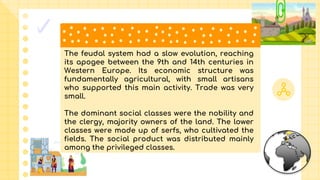
The feudal system had a slow evolution, reaching
its apogee between the 9th and 14th centuries in
Western Europe. Its economic structure was
fundamentally agricultural, with small artisans
who supported this main activity. Trade was very
small.
The dominant social classes were the nobility and
the clergy, majority owners of the land. The lower
classes were made up of serfs, who cultivated the
fields. The social product was distributed mainly
among the privileged classes.
ECONOMIC SYSTEM:
mercantilism
04
ECONOMIC SYSTEM:
capitalism
05
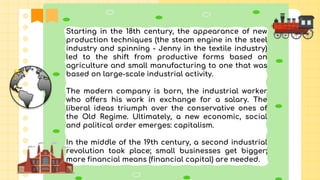
Starting in the 18th century, the appearance of new
production techniques (the steam engine in the steel
industry and spinning - Jenny in the textile industry)
led to the shift from productive forms based on
agriculture and small manufacturing to one that was
based on large-scale industrial activity.
The modern company is born, the industrial worker
who offers his work in exchange for a salary. The
liberal ideas triumph over the conservative ones of
the Old Regime. Ultimately, a new economic, social
and political order emerges: capitalism.
In the middle of the 19th century, a second industrial
revolution took place; small businesses get bigger;
more financial means (financial capital) are needed.
Also, the large banking entities appear that little by
little are going to interrelate with the industries.
The great benefits accumulated during this time were
based on three basic pillars:
1. The progress of the technique that led to high
productivity.
2. Exploitation of the workforce to unimaginable limits.
3. The exploitation of the colonies that provided an
important flow of cheap raw materials.
All this sanctioned by a political regime in which the
State had no intervention in the economic system and
was limited to defending the political power of the
ruling class.
ECONOMIC SYSTEM:
communism
06
This situation definitely exploded at the end of the 19th
century with the appearance of trade unions, political
parties that advocated a more just social system,
following the theoretical postulates of Marx and Engels.
The Bolshevik Revolution of 1917 gave rise to a new
social, political and economic system: the communist
system. The most outstanding characteristics of this
system are the following:
1. The State is the owner of all the means of
production, thereby trying to avoid the exploitation
of man by man. There is no private initiative in
economic activity.
2. There is no market as we know them today. It is the
State that assumes the role of distributing
resources, setting productions and setting prices.
3. The organization of production is carried out
through a Central Planning Body that sets
production plans (five-year in nature in the former
USSR). Everything is regulated in these plans. For
different reasons, but which we could sum up as
"inefficiency", the planning system failed in the
former USSR and with it a social way of life.
The consequences were immediately extended to other
countries, so that today it is difficult to find any
(perhaps Cuba) that maintains the economic forms of
action of the USSR. Most of them have evolved towards
market economy systems and others (China) towards
intermediate forms between both systems.
ECONOMIC SYSTEM:
mixed economy
07
The mixed economy is an economic system
characterized by the combination of the public sector,
the State and the market, to facilitate economic
control of the region and optimize the supply of the
necessary resources for the population.
With this economic model, the private sector is the one
who establishes market prices, based on the law of
supply and demand. The State has the right to
intervene in the event of market failures, such as very
large inequalities or a shortage of resources.
The maintenance of free social rights for all its
citizens, led the countries to institute this system in
which the State participated in an important way in
the economy (public companies in strategic sectors)
and provided social services to the less favored social
sectors.
CREDITS: This presentation template was created by Slidesgo,
including icons by Flaticon, and infographics & images by
Freepik.

Economy systems

  • 2.
    What is economicactivity? The organization of the decisions that allow the use, as rational as possible, of the resources, that is, of the PRODUCTION FACTORS (labor, land, capital) We define the set of structures (technical, economic, political, etc.) that make this decision-making possible as ECONOMIC SYSTEM
  • 3.
    BASIC QUESTIONS Production structure what to produce? Resourcesand techniques how to produce? People who will enjoy goods and services For whom?
  • 4.
    EXAMPLE: INDIGENOUS GROUPS Agricultural, livestock,hunting and fishing goods what to produce? Pens, nets, bows, arrows, basic tools how to produce? For the community itself. They put in common harvests and distribute goods. For whom?
  • 5.
    In the historyof humanity, the ways of coordinating the factors of production (land, labor and capital) have been very diverse. In our western world the following economic systems can be mentioned: HISTORY OF ECONOMIC SYSTEMS Primitive economy Slavery Feudalism Mercantilism Capitalism Communism Mixed economy ?
  • 6.
  • 7.
    It was generatedin Paleolithic times, at this time man was a nomad and hunter, as a result of this man saw the need to associate with other people to satisfy their primary needs (food, clothing and survival). The groups were called: clans or tribes, where their main objective is simple cooperativism or mutuality. It is characterized because the goods it produces are consumed almost immediately, there are no economic surpluses (profits). There is no exploitation or social class. Besides that the division of labor occurs naturally or socially.
  • 8.
  • 9.
    The slave systemof economic organization reached its peak in ancient Greece and Rome. The dominant economic activity was agriculture. The production system was based on the exploitation of slave labor by the patricians (Roman nobility). The result of it was distributed between this ruling class and freed or freed slaves and commoners. Social relationships are based on property and the right to something or someone. At this time, social classes began to be generated.
  • 10.
  • 11.
    The feudal systemhad a slow evolution, reaching its apogee between the 9th and 14th centuries in Western Europe. Its economic structure was fundamentally agricultural, with small artisans who supported this main activity. Trade was very small. The dominant social classes were the nobility and the clergy, majority owners of the land. The lower classes were made up of serfs, who cultivated the fields. The social product was distributed mainly among the privileged classes.
  • 12.
  • 14.
  • 15.
    Starting in the18th century, the appearance of new production techniques (the steam engine in the steel industry and spinning - Jenny in the textile industry) led to the shift from productive forms based on agriculture and small manufacturing to one that was based on large-scale industrial activity. The modern company is born, the industrial worker who offers his work in exchange for a salary. The liberal ideas triumph over the conservative ones of the Old Regime. Ultimately, a new economic, social and political order emerges: capitalism. In the middle of the 19th century, a second industrial revolution took place; small businesses get bigger; more financial means (financial capital) are needed.
  • 16.
    Also, the largebanking entities appear that little by little are going to interrelate with the industries. The great benefits accumulated during this time were based on three basic pillars: 1. The progress of the technique that led to high productivity. 2. Exploitation of the workforce to unimaginable limits. 3. The exploitation of the colonies that provided an important flow of cheap raw materials. All this sanctioned by a political regime in which the State had no intervention in the economic system and was limited to defending the political power of the ruling class.
  • 17.
  • 18.
    This situation definitelyexploded at the end of the 19th century with the appearance of trade unions, political parties that advocated a more just social system, following the theoretical postulates of Marx and Engels. The Bolshevik Revolution of 1917 gave rise to a new social, political and economic system: the communist system. The most outstanding characteristics of this system are the following: 1. The State is the owner of all the means of production, thereby trying to avoid the exploitation of man by man. There is no private initiative in economic activity. 2. There is no market as we know them today. It is the State that assumes the role of distributing resources, setting productions and setting prices.
  • 19.
    3. The organizationof production is carried out through a Central Planning Body that sets production plans (five-year in nature in the former USSR). Everything is regulated in these plans. For different reasons, but which we could sum up as "inefficiency", the planning system failed in the former USSR and with it a social way of life. The consequences were immediately extended to other countries, so that today it is difficult to find any (perhaps Cuba) that maintains the economic forms of action of the USSR. Most of them have evolved towards market economy systems and others (China) towards intermediate forms between both systems.
  • 20.
  • 21.
    The mixed economyis an economic system characterized by the combination of the public sector, the State and the market, to facilitate economic control of the region and optimize the supply of the necessary resources for the population. With this economic model, the private sector is the one who establishes market prices, based on the law of supply and demand. The State has the right to intervene in the event of market failures, such as very large inequalities or a shortage of resources. The maintenance of free social rights for all its citizens, led the countries to institute this system in which the State participated in an important way in the economy (public companies in strategic sectors) and provided social services to the less favored social sectors.
  • 22.
    CREDITS: This presentationtemplate was created by Slidesgo, including icons by Flaticon, and infographics & images by Freepik.