Services to support FAIR data
Sarah Jones
Digital Curation Centre, Glasgow
sarah.jones@glasgow.ac.uk
Twitter: @sjDCC
24 April 2019, University of Vienna
A series of three workshops
1. Prague, April 12 2019 | EOSC-hub week
• Target audience: Service providers and research infrastructures
2. Vienna, April 24 2019 | Linking Open Science
• Target audience: Research support staff & researchers
3. Porto, September 17 2019 | Open Science FAIR
• Target audience: Service users and service providers
https://www.openaire.eu/workshops-series-services-to-support-fair-data-
from-theory-to-implementation
Workshop objectives
• Share perspectives on how to support researchers
with FAIR
• Explore existing services and extensions needed
to support FAIR research outputs
• Explore how existing services and infrastructures
can work together
• Identify priorities & recommendations for
supporting FAIR data
Report planned
White paper to the EOSC EB working group on FAIR noting
challenges, recommendations & priorities for services
Mustapha Mokrane
FAIRsFAIR
Daniel Bangert
RDA Europe
Emilie Hermans
OpenAIRE
Rene van Horik
EOSChub
European Open Science Cloud (EOSC)
“offer 1.7 million European researchers and 70 million professionals in
science and technology a virtual environment with free at the point of
use, open and seamless services for storage, management, analysis and
re-use of research data, across borders and scientific disciplines”
• Add value
• Federate, don’t reinvent
• Be research / user-focused & led
• Make things easier – be the choice!
• Engage all stakeholders, including industry
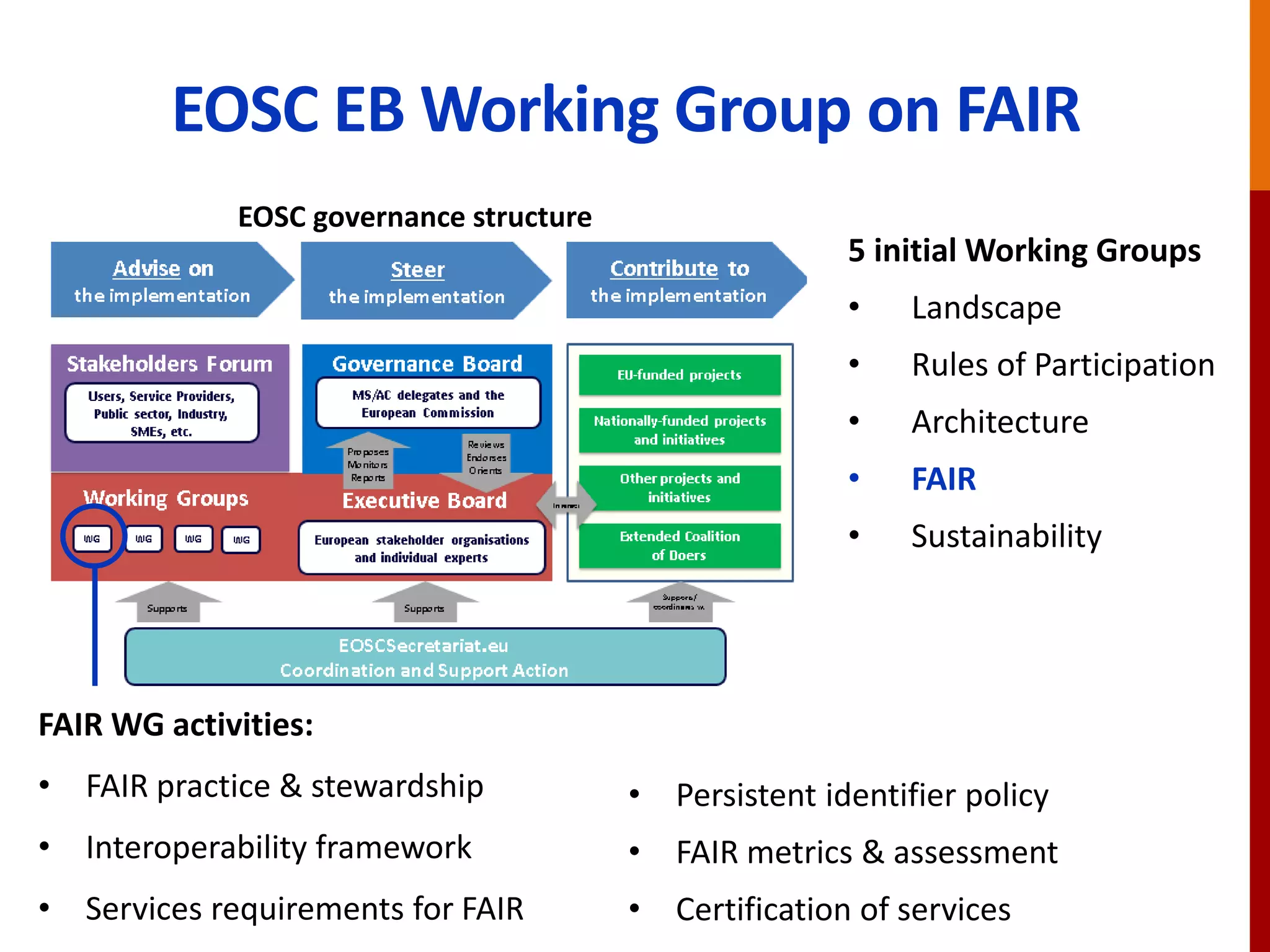
EOSC EB Working Group on FAIR
5 initial Working Groups
• Landscape
• Rules of Participation
• Architecture
• FAIR
• Sustainability
FAIR WG activities:
• FAIR practice & stewardship
• Interoperability framework
• Services requirements for FAIR
• Persistent identifier policy
• FAIR metrics & assessment
• Certification of services
EOSC governance structure
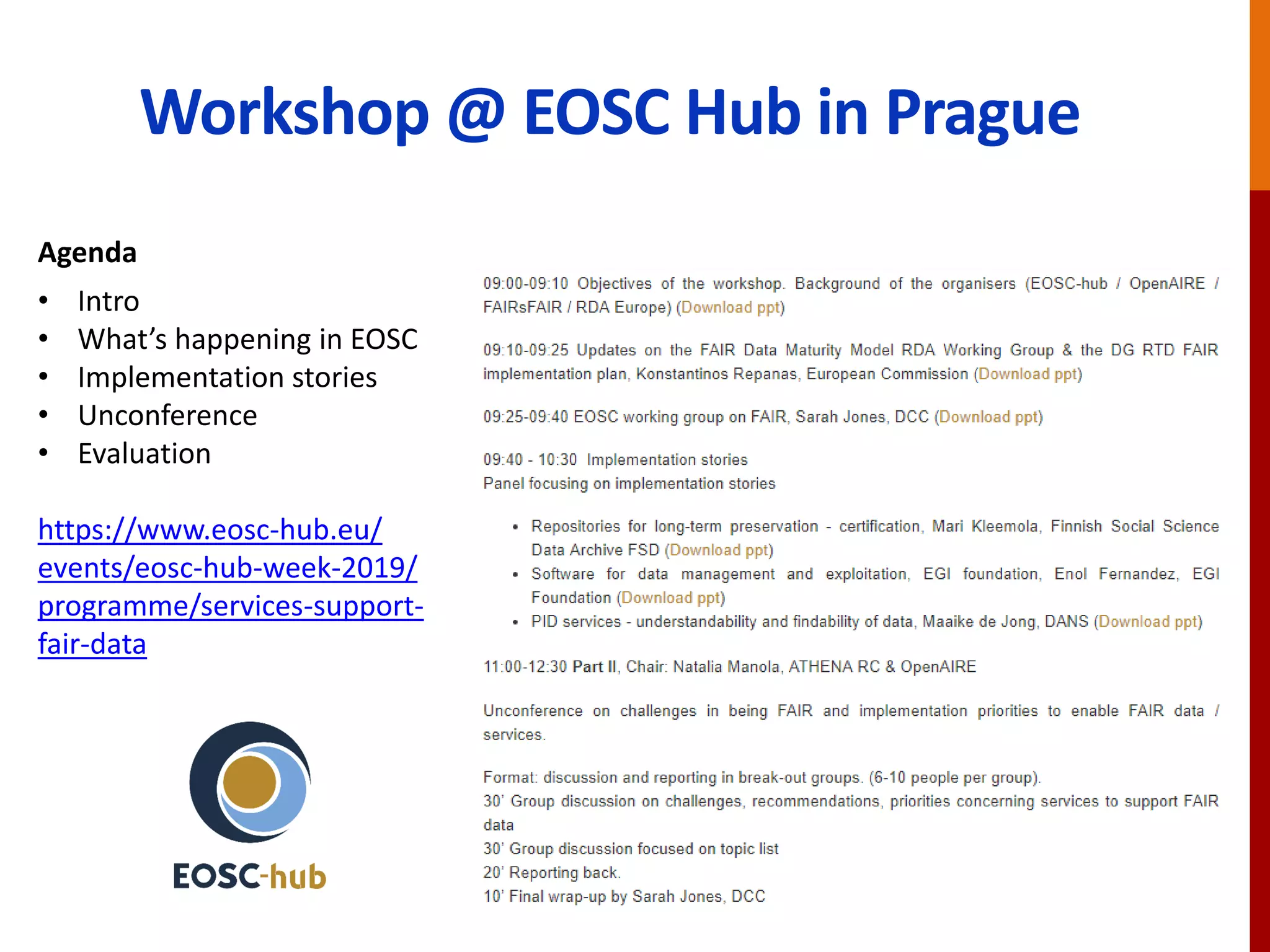
Workshop @ EOSC Hub in Prague
Agenda
• Intro
• What’s happening in EOSC
• Implementation stories
• Unconference
• Evaluation
https://www.eosc-hub.eu/
events/eosc-hub-week-2019/
programme/services-support-
fair-data
Enabling FAIR – wish list from implementers
• Need provenance – unbroken chain of trust
• Need to pay attention to the environment in which
data are held – trustworthiness of stewardship
• Need to assign PIDs to all resource resources
• Make metadata richer – link PIDs
“Research data will not become nor stay FAIR by magic.
We need skilled people, transparent processes,
interoperable technologies and collaboration to build,
operate and maintain research data infrastructures.”
Mari Kleemola
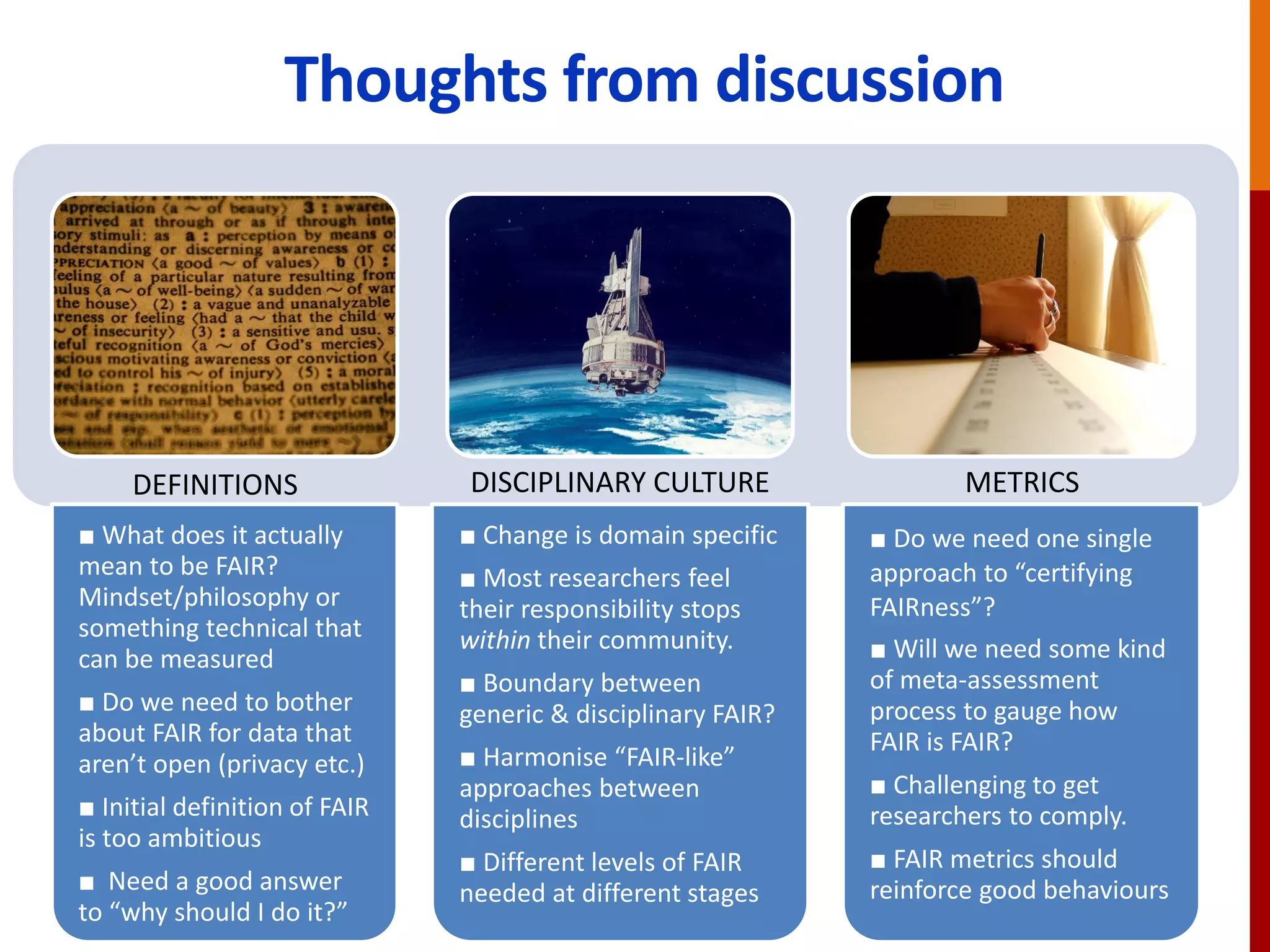
Thoughts from discussion
■ What does it actually
mean to be FAIR?
Mindset/philosophy or
something technical that
can be measured
■ Do we need to bother
about FAIR for data that
aren’t open (privacy etc.)
■ Initial definition of FAIR
is too ambitious
■ Need a good answer
to “why should I do it?”
■ Change is domain specific
■ Most researchers feel
their responsibility stops
within their community.
■ Boundary between
generic & disciplinary FAIR?
■ Harmonise “FAIR-like”
approaches between
disciplines
■ Different levels of FAIR
needed at different stages
■ Do we need one single
approach to “certifying
FAIRness”?
■ Will we need some kind
of meta-assessment
process to gauge how
FAIR is FAIR?
■ Challenging to get
researchers to comply.
■ FAIR metrics should
reinforce good behaviours
DEFINITIONS DISCIPLINARY CULTURE METRICS
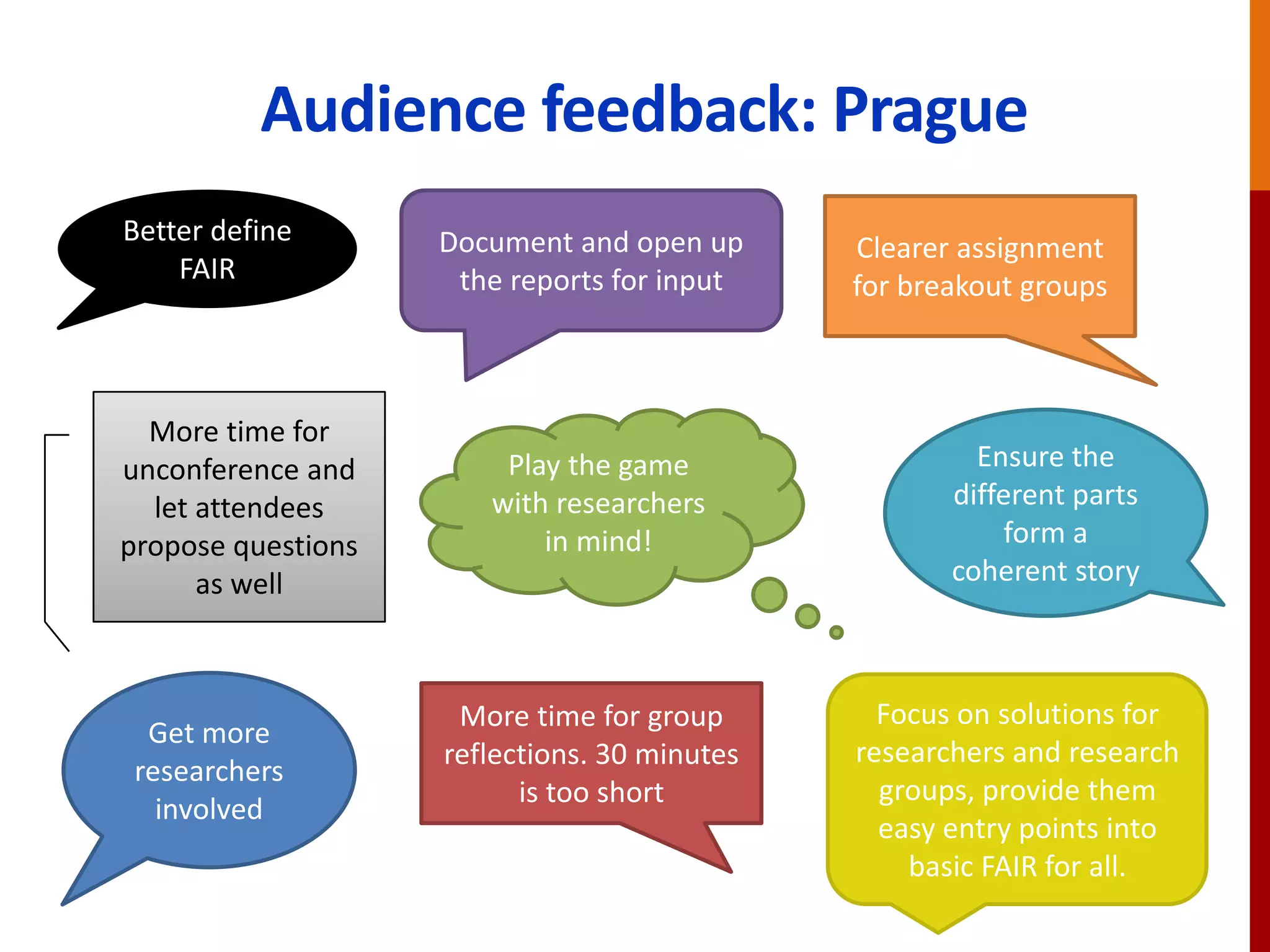
Audience feedback: Prague
Get more
researchers
involved
Clearer assignment
for breakout groups
Play the game
with researchers
in mind!
Better define
FAIR
More time for group
reflections. 30 minutes
is too short
Document and open up
the reports for input
More time for
unconference and
let attendees
propose questions
as well
Focus on solutions for
researchers and research
groups, provide them
easy entry points into
basic FAIR for all.
Ensure the
different parts
form a
coherent story
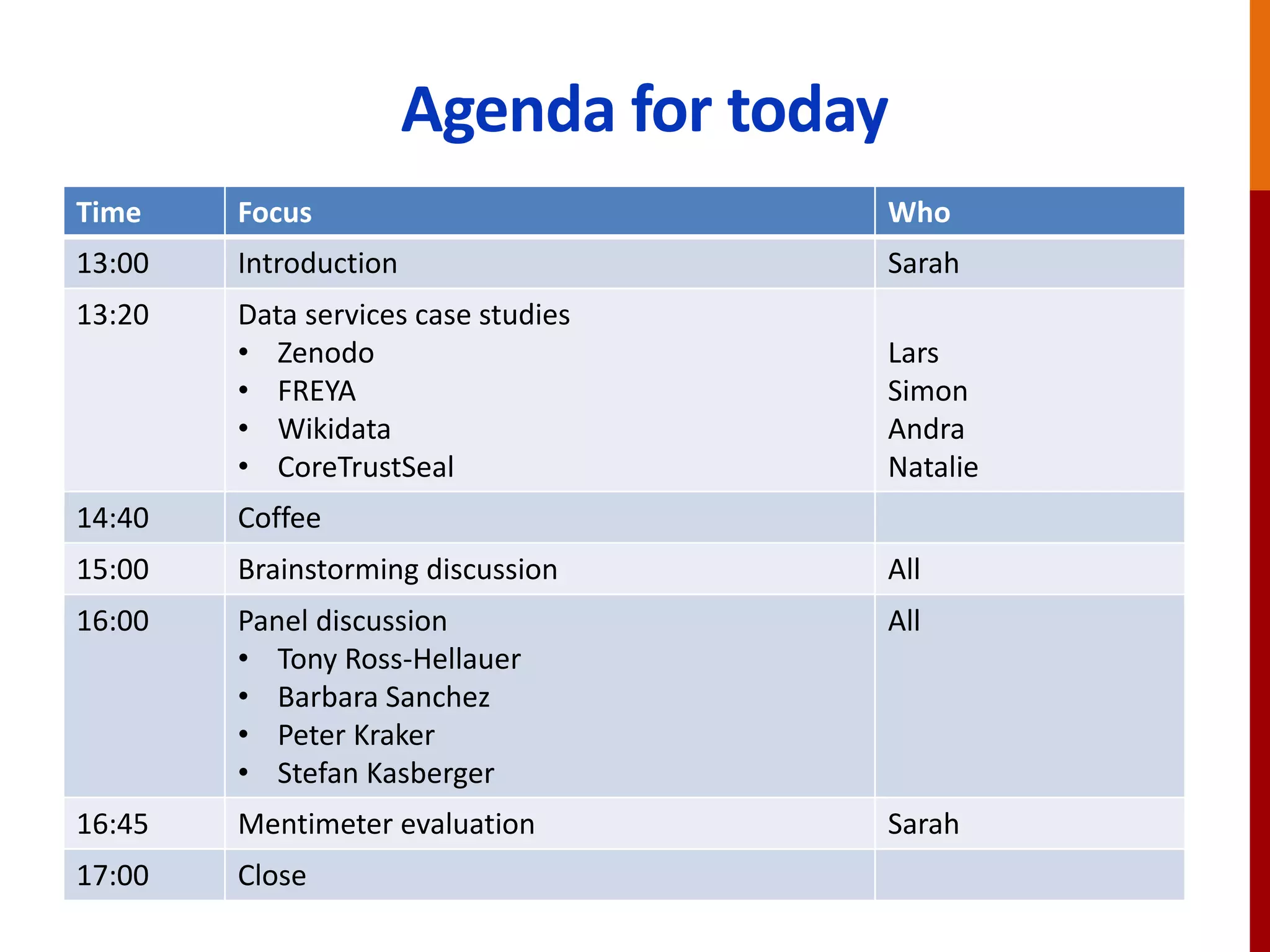
Agenda for today
Time Focus Who
13:00 Introduction Sarah
13:20 Data services case studies
• Zenodo
• FREYA
• Wikidata
• CoreTrustSeal
Lars
Simon
Andra
Natalie
14:40 Coffee
15:00 Brainstorming discussion All
16:00 Panel discussion
• Tony Ross-Hellauer
• Barbara Sanchez
• Peter Kraker
• Stefan Kasberger
All
16:45 Mentimeter evaluation Sarah
17:00 Close
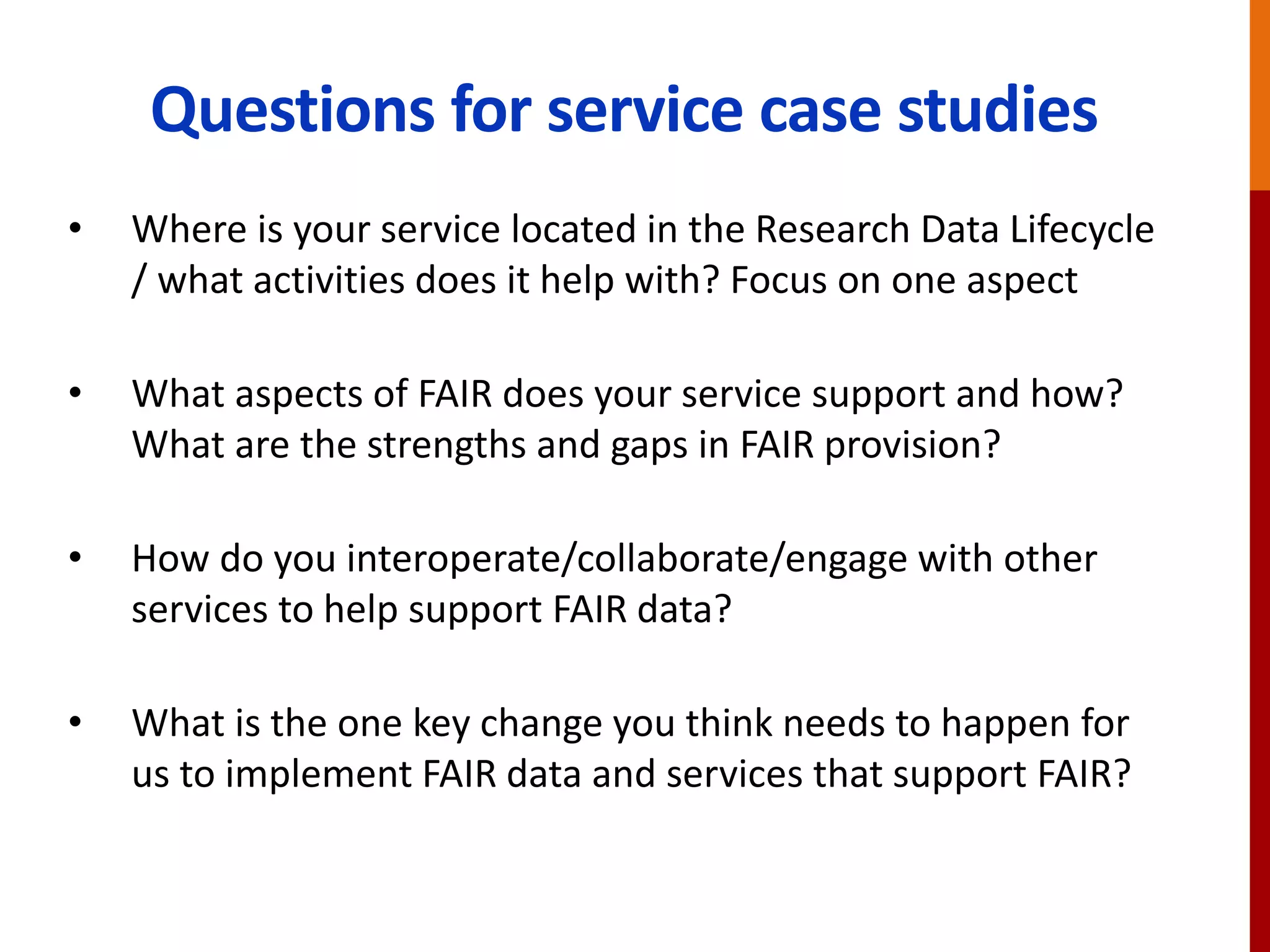
Questions for service case studies
• Where is your service located in the Research Data Lifecycle
/ what activities does it help with? Focus on one aspect
• What aspects of FAIR does your service support and how?
What are the strengths and gaps in FAIR provision?
• How do you interoperate/collaborate/engage with other
services to help support FAIR data?
• What is the one key change you think needs to happen for
us to implement FAIR data and services that support FAIR?
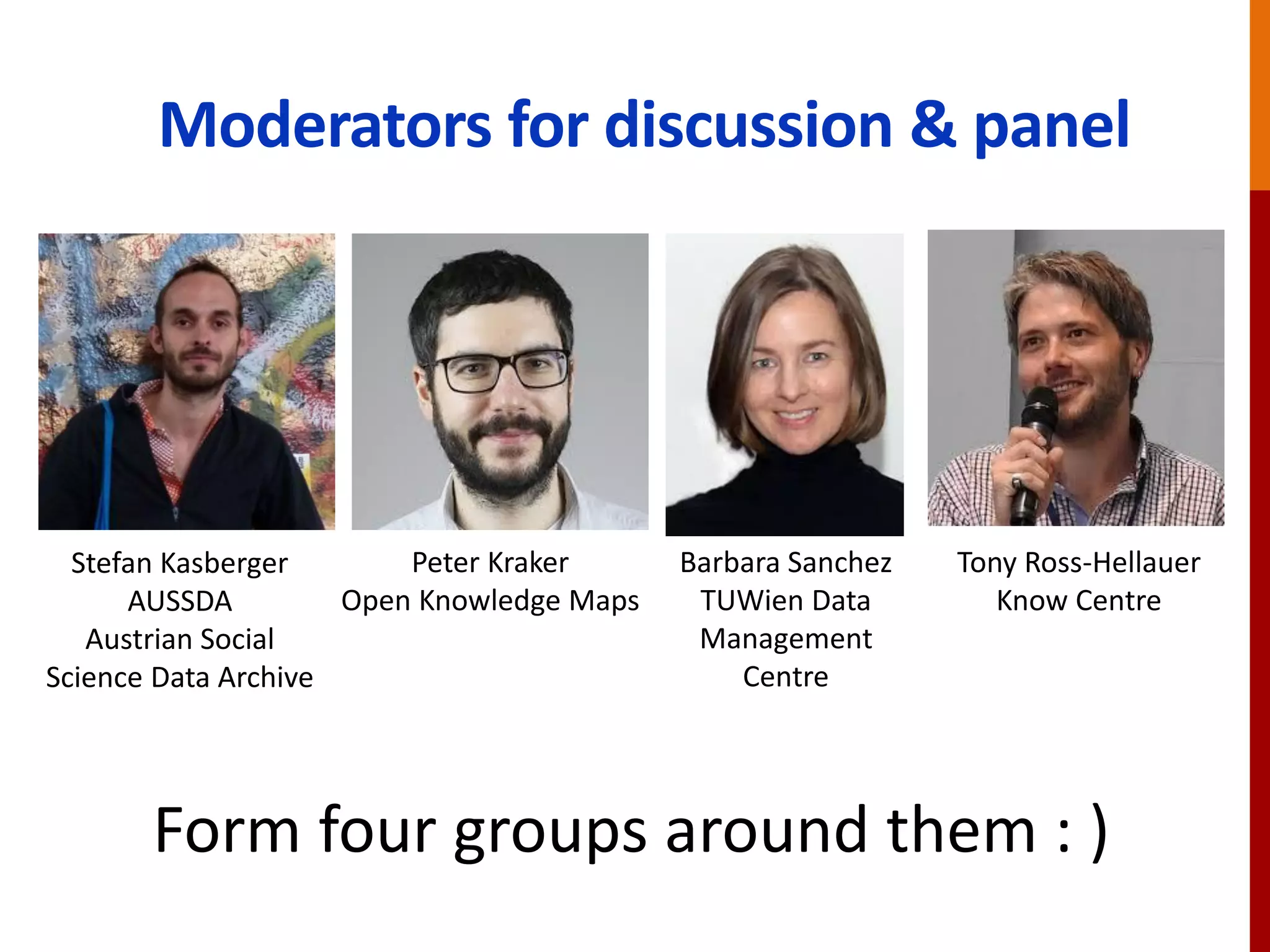
Moderators for discussion & panel
Stefan Kasberger
AUSSDA
Austrian Social
Science Data Archive
Peter Kraker
Open Knowledge Maps
Barbara Sanchez
TUWien Data
Management
Centre
Tony Ross-Hellauer
Know Centre
Form four groups around them : )
Brainstorming discussion
1. What does it mean for researchers to make data FAIR?
2. How does / could your institution or service help
researchers make their data FAIR?
3. What could / should you do that you aren’t already doing?
What is the priority?
4. Where are the biggest gaps in provision? Missing services
and weaker aspect of FAIR e.g. interoperability
5. How does / could your institution or service reach
researchers and explain the importance of FAIR?
Focus for reporting back – service gaps and priorities
Panel discussion
1. What were the main conclusions from your discussion?
(specifically about service gaps / priorities)
2. What are the priorities for your organisation?
3. What would you highlight in the White Paper to the EOSC FAIR
WG? What are the key challenges or priorities for supporting
FAIR that need to be addressed?
4. What services do you support at your organisation and what
would you like to see from EOSC? Who is responsible for what?
Other things we need to discuss?
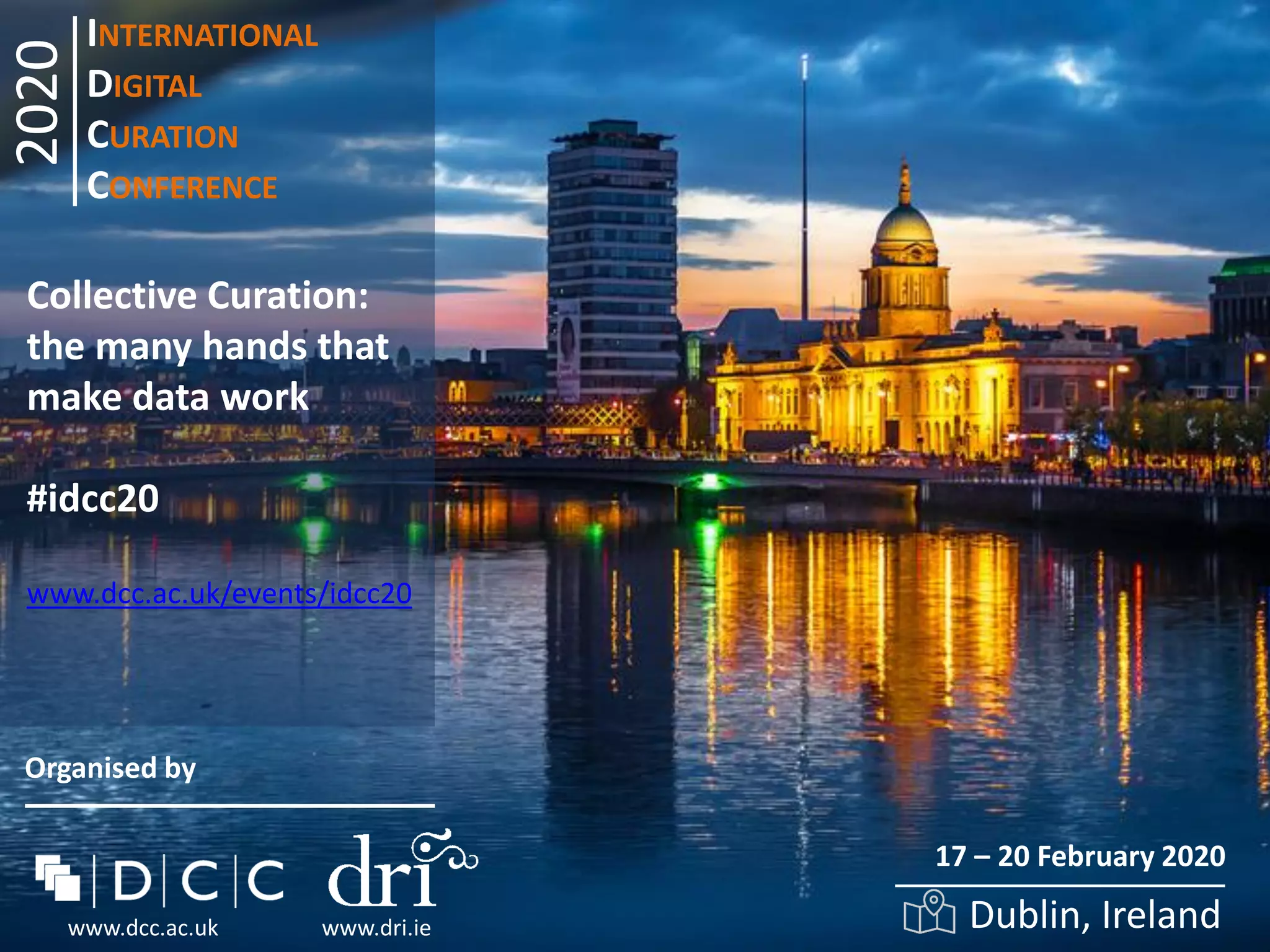
INTERNATIONAL
DIGITAL
CURATION
CONFERENCE
Collective Curation:
the many hands that
make data work
#idcc20
www.dcc.ac.uk/events/idcc20
Organised by
www.dcc.ac.uk www.dri.ie
2020
17 – 20 February 2020
Dublin, Ireland
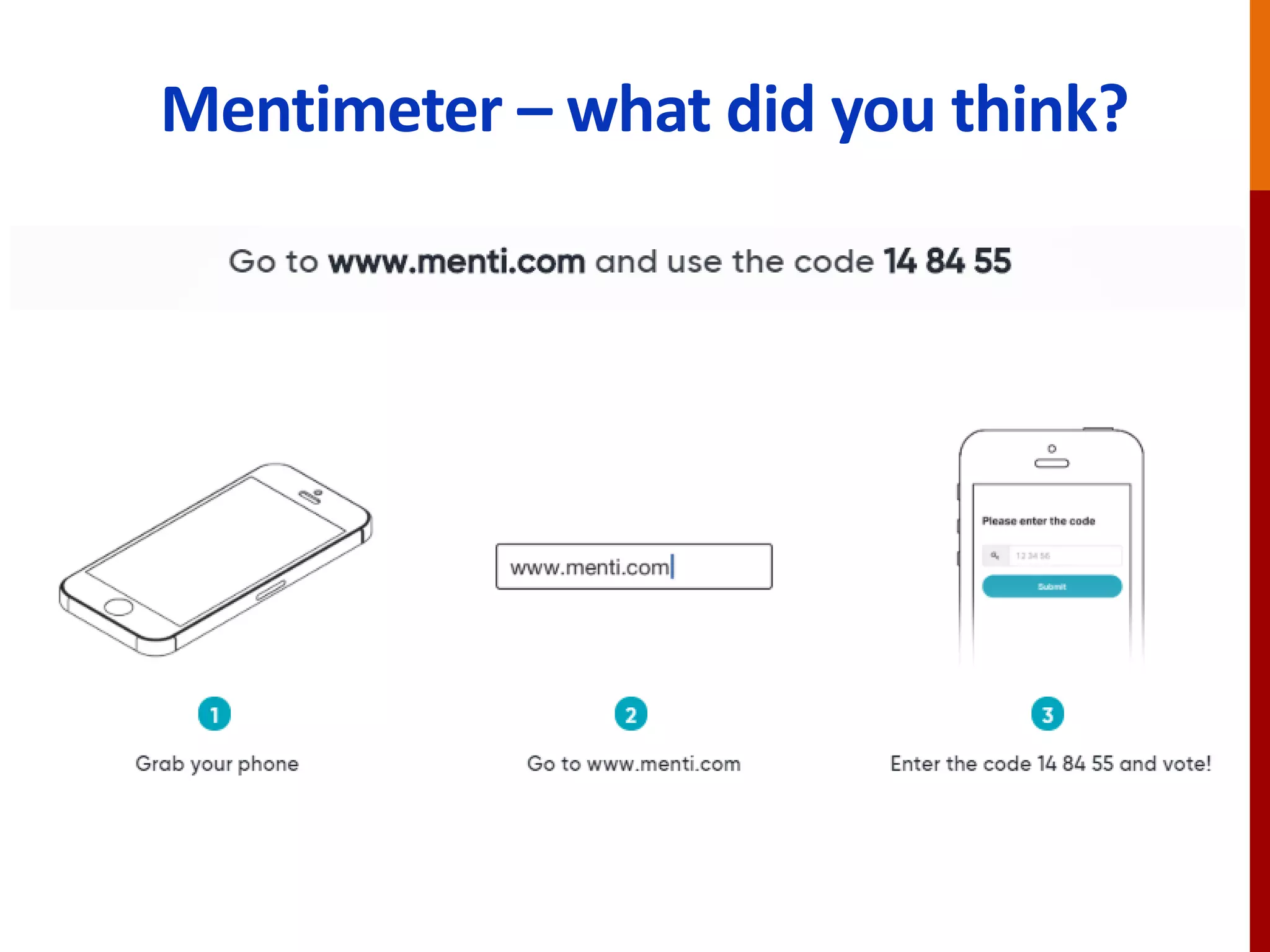
Mentimeter – what did you think?

Introduction to the workshop Services to support FAIR data - Sarah Jones

  • 1.
    Services to supportFAIR data Sarah Jones Digital Curation Centre, Glasgow sarah.jones@glasgow.ac.uk Twitter: @sjDCC 24 April 2019, University of Vienna
  • 2.
    A series ofthree workshops 1. Prague, April 12 2019 | EOSC-hub week • Target audience: Service providers and research infrastructures 2. Vienna, April 24 2019 | Linking Open Science • Target audience: Research support staff & researchers 3. Porto, September 17 2019 | Open Science FAIR • Target audience: Service users and service providers https://www.openaire.eu/workshops-series-services-to-support-fair-data- from-theory-to-implementation
  • 3.
    Workshop objectives • Shareperspectives on how to support researchers with FAIR • Explore existing services and extensions needed to support FAIR research outputs • Explore how existing services and infrastructures can work together • Identify priorities & recommendations for supporting FAIR data
  • 4.
    Report planned White paperto the EOSC EB working group on FAIR noting challenges, recommendations & priorities for services Mustapha Mokrane FAIRsFAIR Daniel Bangert RDA Europe Emilie Hermans OpenAIRE Rene van Horik EOSChub
  • 5.
    European Open ScienceCloud (EOSC) “offer 1.7 million European researchers and 70 million professionals in science and technology a virtual environment with free at the point of use, open and seamless services for storage, management, analysis and re-use of research data, across borders and scientific disciplines” • Add value • Federate, don’t reinvent • Be research / user-focused & led • Make things easier – be the choice! • Engage all stakeholders, including industry
  • 6.
    EOSC EB WorkingGroup on FAIR 5 initial Working Groups • Landscape • Rules of Participation • Architecture • FAIR • Sustainability FAIR WG activities: • FAIR practice & stewardship • Interoperability framework • Services requirements for FAIR • Persistent identifier policy • FAIR metrics & assessment • Certification of services EOSC governance structure
  • 7.
    Workshop @ EOSCHub in Prague Agenda • Intro • What’s happening in EOSC • Implementation stories • Unconference • Evaluation https://www.eosc-hub.eu/ events/eosc-hub-week-2019/ programme/services-support- fair-data
  • 8.
    Enabling FAIR –wish list from implementers • Need provenance – unbroken chain of trust • Need to pay attention to the environment in which data are held – trustworthiness of stewardship • Need to assign PIDs to all resource resources • Make metadata richer – link PIDs “Research data will not become nor stay FAIR by magic. We need skilled people, transparent processes, interoperable technologies and collaboration to build, operate and maintain research data infrastructures.” Mari Kleemola
  • 9.
    Thoughts from discussion ■What does it actually mean to be FAIR? Mindset/philosophy or something technical that can be measured ■ Do we need to bother about FAIR for data that aren’t open (privacy etc.) ■ Initial definition of FAIR is too ambitious ■ Need a good answer to “why should I do it?” ■ Change is domain specific ■ Most researchers feel their responsibility stops within their community. ■ Boundary between generic & disciplinary FAIR? ■ Harmonise “FAIR-like” approaches between disciplines ■ Different levels of FAIR needed at different stages ■ Do we need one single approach to “certifying FAIRness”? ■ Will we need some kind of meta-assessment process to gauge how FAIR is FAIR? ■ Challenging to get researchers to comply. ■ FAIR metrics should reinforce good behaviours DEFINITIONS DISCIPLINARY CULTURE METRICS
  • 10.
    Audience feedback: Prague Getmore researchers involved Clearer assignment for breakout groups Play the game with researchers in mind! Better define FAIR More time for group reflections. 30 minutes is too short Document and open up the reports for input More time for unconference and let attendees propose questions as well Focus on solutions for researchers and research groups, provide them easy entry points into basic FAIR for all. Ensure the different parts form a coherent story
  • 11.
    Agenda for today TimeFocus Who 13:00 Introduction Sarah 13:20 Data services case studies • Zenodo • FREYA • Wikidata • CoreTrustSeal Lars Simon Andra Natalie 14:40 Coffee 15:00 Brainstorming discussion All 16:00 Panel discussion • Tony Ross-Hellauer • Barbara Sanchez • Peter Kraker • Stefan Kasberger All 16:45 Mentimeter evaluation Sarah 17:00 Close
  • 12.
    Questions for servicecase studies • Where is your service located in the Research Data Lifecycle / what activities does it help with? Focus on one aspect • What aspects of FAIR does your service support and how? What are the strengths and gaps in FAIR provision? • How do you interoperate/collaborate/engage with other services to help support FAIR data? • What is the one key change you think needs to happen for us to implement FAIR data and services that support FAIR?
  • 13.
    Moderators for discussion& panel Stefan Kasberger AUSSDA Austrian Social Science Data Archive Peter Kraker Open Knowledge Maps Barbara Sanchez TUWien Data Management Centre Tony Ross-Hellauer Know Centre Form four groups around them : )
  • 14.
    Brainstorming discussion 1. Whatdoes it mean for researchers to make data FAIR? 2. How does / could your institution or service help researchers make their data FAIR? 3. What could / should you do that you aren’t already doing? What is the priority? 4. Where are the biggest gaps in provision? Missing services and weaker aspect of FAIR e.g. interoperability 5. How does / could your institution or service reach researchers and explain the importance of FAIR? Focus for reporting back – service gaps and priorities
  • 15.
    Panel discussion 1. Whatwere the main conclusions from your discussion? (specifically about service gaps / priorities) 2. What are the priorities for your organisation? 3. What would you highlight in the White Paper to the EOSC FAIR WG? What are the key challenges or priorities for supporting FAIR that need to be addressed? 4. What services do you support at your organisation and what would you like to see from EOSC? Who is responsible for what?
  • 16.
    Other things weneed to discuss?
  • 18.
    INTERNATIONAL DIGITAL CURATION CONFERENCE Collective Curation: the manyhands that make data work #idcc20 www.dcc.ac.uk/events/idcc20 Organised by www.dcc.ac.uk www.dri.ie 2020 17 – 20 February 2020 Dublin, Ireland
  • 19.
    Mentimeter – whatdid you think?