Global Blindness: Planning and managing eye care services
Situation analysis
Learning outcomes
Understand the definition of
situation analysis
Identify its key components
Apply the concept to an eye
unit at the district level
Definition of
situation analysis
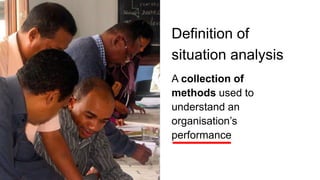
A collection of
methods used to
understand an
organisation’s
performance
Situation analysis
of an eye unit
Capacity
Capabilities
Difficulties
Environment
Possibilities
Where
we are
NOW
Eye health and the wider health
system
District
level
National level
Eye unit
Policies
National level
Key questions:
1. National prevention of blindness programme?
2. Strategy for universal health coverage?
3. Data on blindness and visual impairment?
4. Targets for diseases?
National level
Key questions:
5. Guidance on ophthalmic human resources,
training and distribution?
6. Local leaders in eye care?
7. Policy on infrastructure and development?
District level
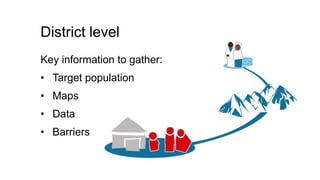
Key information to gather:
• Target population
District level
Key information to gather:
• Target population
• Maps
District level
Key information to gather:
• Target population
• Maps
• Data
District level
Key information to gather:
• Target population
• Maps
• Data
• Barriers
District level
We need to know:
• Population in the district
• Prevalence of blindness and visual impairment
(VI)
District level
No. of blind
people
=
Prevalence
of blindness
x Population
Then we can calculate:
No. of VI
people
=
Prevalence
of VI
x Population
The 5 Ms
Manpower
Materials
Mobility
Management
Money
Sources of information
Data needed:
Target
population
Census
data
i
Sources of information
Data needed:
No. of blind and
visually impaired
Extrapolate
i
Survey data
i
Sources of information
Data needed: Manpower
Observation
i
Hospital
records
i
Sources of information
Data needed: Materials
Inventory
i Hospital
records
i
Sources of information
Data needed:
Mobility
Hospital
records
i
Sources of information
Data needed:
Management
Hospital
administration
i
Sources of information
Data needed: Money
Stakeholders
i Hospital
finances
i
SWOT analysis: Eye unit example
Strengths
Cataract surgeon in
place
Weaknesses
Long waiting list
Opportunities
NGO to provide
consumables
Threats
Fear of eye surgery
In conclusion
Situation analysis is an
important first step
Provides details on:
magnitude of need,
manpower, materials, money,
mobility and management
In conclusion
A SWOT analysis will
highlight issues, opportunities
and threats
Situation analysis identifies
gaps
Using this knowledge effectively
makes change achievable
Written by Dr Daksha Patel
© 2016 International Centre for Eye Health, London School of
Hygiene & Tropical Medicine. This work is licensed under a
Creative Commons Attribution-NonCommercial-ShareAlike 4.0
International license.
Taken from the free online course: Global Blindness: Planning
and Managing Eye Care Services. We encourage the use and
adaptation of this resource for teaching and learning. Find more
Open Educational Resources for eye care on our website at
http://iceh.lshtm.ac.uk/oer

Global Blindness: Situation analysis

Editor's Notes

  • #3 Welcome. By the end of this presentation on situation analysis you should be able to: Understand the definition of situation analysis Identify its key components Apply the concept to an eye unit at a district level.
  • #4 A situation analysis is defined as a collection of methods that planners and managers use to understand an organisation’s performance and internal and external factors affecting it. Image: Edson Mwaipopo CC BY-NC 2.0 flic.kr/p/orLt7U
  • #5 Situation analysis can be used to describe the performance of eye unit in terms of: Capacity – numbers of patients Capabilities – staff training and available equipment Difficulties – which affect output and outcome Environment – supports and threats to the unit Possibilities - opportunities for the unit Situation analysis helps us to understand where we are now – the first stage in any planning cycle. Image: Aravind Eye Care System
  • #6 Any situation analysis of an eye unit needs to explore the wider levels of the health system the unit is part of. Understanding existing policies and programmes at national and district level means the unit can plan to address the burden and need of blindness using the right models of care and with the right resources in place.
  • #7 At national level, the key questions to ask include: 1. Is there a national prevention of blindness programme? 2. Is there a strategy for universal health coverage? 3. What data is there on blindness and visual impairment? 4. Are there targets for diseases such as cataract and refractive error?
  • #8 5. Is there guidance on ophthalmic human resources, training and distribution? 6. Who are the leaders in eye care locally, what are their roles? Is it possible to contact them? 7. Is there a policy on infrastructure and equipment?
  • #9 At district level, the key information to gather includes: The size of the target population the eye unit serves and the kinds of people that make up the population – for example, young or old, male or female, rich or poor.
  • #10 Maps of how the population is distributed and of people’s access to health care. These can highlight previously unknown challenges of geography and infrastructure
  • #11 Data on the prevalence & causes of eye disease and blindness locally. Knowing these gives an understanding of the need for eye care.
  • #12 Barriers. It is important to find out any reasons blind or visually impaired people have for not been coming to the eye unit.
  • #13 To start gathering this information and making it relevant for a local level, we need to know: The population in the district And the prevalence of blindness and visual impairment in the district.
  • #14 Then we can calculate the number of blind people. This is equal to the prevalence of blindness multiplied by the population the number of visually impaired people, This is equal to the prevalence of visual impairment multiplied by the population. It is also important to calculate the percentage of cataract blind or visually impaired locally, as cataract is a leading cause of blindness.
  • #15 The 5 Ms provide guidance on the information that needs to be gathered within the eye unit or hospital for a situation analysis. Manpower: Numbers of cadres available, whether staff work part or full time, how many volunteers there are, and so on Materials: The quantity, quality, regularity of supply and so on for both hard and soft materials. HARD materials are infrastructure, instruments and equipment. SOFT materials are medicines and consumables. Mobility: The kinds of outreach services used Management: A flow chart is a useful way to represent decision making processes Money: The sources of funding and amount available
  • #16 Finding good information for a situation analysis means looking for it in a number of different places: For data on the target population census data is a good potential source
  • #17 To estimate the numbers of blind and visually impaired people we can carry out a local study or extrapolate it from a previous study in a similar region
  • #18 For data on manpower we can use hospital records if they exist, or we can observe the unit
  • #19 For materials information we can use hospital records or take our own inventory
  • #20 For information on mobile services, we can use hospital records on outreach models, locations, and outputs
  • #21 For information on management we need to ask the hospital administration.
  • #22 And finally, to know how the unit is funded and how much money is available we need to ask key stakeholders and look into the hospital finances.
  • #23 A useful tool to support a situation analysis is a SWOT analysis. A SWOT analysis identifies an organisation’s internal strengths and weaknesses, as well as the external opportunities and threats. For example, a SWOT analysis of an eye unit might identify A strength as having a well-trained cataract surgeon in place A weakness as a long waiting list caused by lack of consumable and not enough available surgery time An unexplored opportunity of an NGO which could provide consumables And a threat from a fear of eye surgery amongst many in the local population.
  • #24 In conclusion: Situation analysis is an important first step when considering any change It provides a depth of local understanding for the possibilities and ability to change Details provided by a situation analysis include: understanding the magnitude of need, available manpower, materials, money, mobility and management
  • #25 A SWOT analysis will highlight both internal and external issues, opportunities and threats. Situation analysis enables gaps to be identified. Using this knowledge effectively makes change achievable.