Operation Eyesight
South Asia Programme
Strategy 2018 to 2022
Anup Zimba
Assistant Director – Operation Eyesight Universal
Operation Eyesight Universal
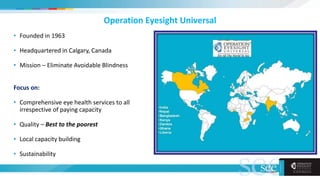
• Founded in 1963
• Headquartered in Calgary, Canada
• Mission – Eliminate Avoidable Blindness
Focus on:
• Comprehensive eye health services to all
irrespective of paying capacity
• Quality – Best to the poorest
• Local capacity building
• Sustainability
Problem analysis
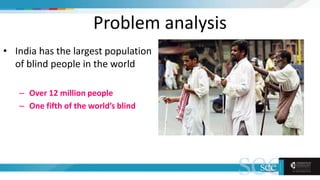
• India has the largest population
of blind people in the world
– Over 12 million people
– One fifth of the world’s blind
Problem analysis - contd.
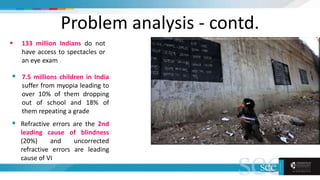
 133 million Indians do not
have access to spectacles or
an eye exam
 7.5 millions children in India
suffer from myopia leading to
over 10% of them dropping
out of school and 18% of
them repeating a grade
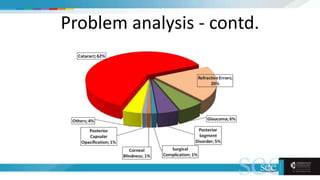
 Refractive errors are the 2nd
leading cause of blindness
(20%) and uncorrected
refractive errors are leading
cause of VI
Problem analysis - contd.
Strategic goal 2018 to 2022
Goal
Eliminate avoidable blindness among vulnerable
populations in OE’s geographic areas of intervention in
20 states in India by 2022
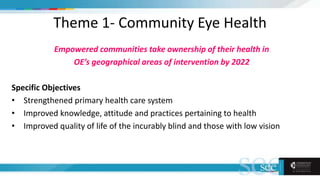
Theme 1- Community Eye Health
Empowered communities take ownership of their health in
OE’s geographical areas of intervention by 2022
Specific Objectives
• Strengthened primary health care system
• Improved knowledge, attitude and practices pertaining to health
• Improved quality of life of the incurably blind and those with low vision
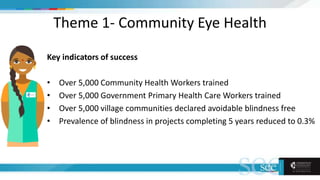
Theme 1- Community Eye Health
Key indicators of success
• Over 5,000 Community Health Workers trained
• Over 5,000 Government Primary Health Care Workers trained
• Over 5,000 village communities declared avoidable blindness free
• Prevalence of blindness in projects completing 5 years reduced to 0.3%
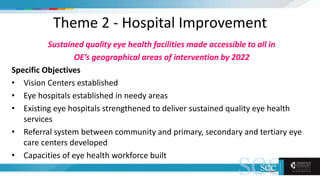
Theme 2 - Hospital Improvement
Sustained quality eye health facilities made accessible to all in
OE’s geographical areas of intervention by 2022
Specific Objectives
• Vision Centers established
• Eye hospitals established in needy areas
• Existing eye hospitals strengthened to deliver sustained quality eye health
services
• Referral system between community and primary, secondary and tertiary eye
care centers developed
• Capacities of eye health workforce built
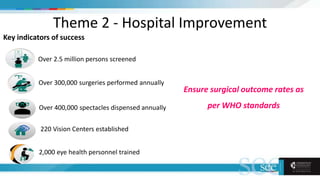
Theme 2 - Hospital Improvement
Key indicators of success
Over 2.5 million persons screened
Over 400,000 spectacles dispensed annually
220 Vision Centers established
2,000 eye health personnel trained
Over 300,000 surgeries performed annually
Ensure surgical outcome rates as
per WHO standards
Theme 3 - Disease Control
Prevalence of avoidable blindness caused by emerging eye diseases significantly
reduced in OE's geographical areas of intervention by 2020
Specific Objectives
• Screen, identify, treat and empower target populations with the objective to reduce
prevalence of avoidable blindness due to diabetic retinopathy
• Prevalence of blindness among children as a result of Retinopathy of Pre-maturity
reduced
• Prevalence of blindness due to eye cancers reduced
• Backlog of cataract blindness reduced
• Backlog of uncorrected refractive errors reduced
Theme 3 - Disease Control
Key indicators of success
• 20 Community Based Diabetic Retinopathy projects in 20 cities
• 5 cities covered under the Born too Soon project
• 5 cities have Institutes for Eye Cancers
• 50% increase in CSR in our areas of intervention
• 25% reduction in uncorrected refractive errors in our areas of
intervention
Geographic area(s) of intervention
• 20 states of India
• 4 districts of Nepal
• 2 districts of Bangladesh
• 2 districts of Sri Lanka
• 4 atolls of Maldives
Target beneficiaries
• 30 million persons
Programme implementation strategy
Summary
• Expand models and approaches to other countries in SEAR
• Develop models and up-scale interventions in RoP, Eye Cancer, and DR
• Document and publish impact of our models and interventions
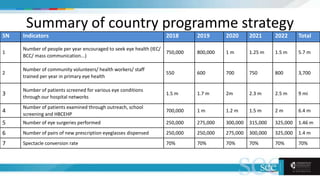
Summary of country programme strategy
SN Indicators 2018 2019 2020 2021 2022 Total
1
Number of people per year encouraged to seek eye health (IEC/
BCC/ mass communication...)
750,000 800,000 1 m 1.25 m 1.5 m 5.7 m
2
Number of community volunteers/ health workers/ staff
trained per year in primary eye health
550 600 700 750 800 3,700
3
Number of patients screened for various eye conditions
through our hospital networks
1.5 m 1.7 m 2m 2.3 m 2.5 m 9 mi
4
Number of patients examined through outreach, school
screening and HBCEHP
700,000 1 m 1.2 m 1.5 m 2 m 6.4 m
5 Number of eye surgeries performed 250,000 275,000 300,000 315,000 325,000 1.46 m
6 Number of pairs of new prescription eyeglasses dispensed 250,000 250,000 275,000 300,000 325,000 1.4 m
7 Spectacle conversion rate 70% 70% 70% 70% 70% 70%
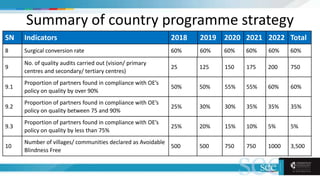
Summary of country programme strategy
SN Indicators 2018 2019 2020 2021 2022 Total
8 Surgical conversion rate 60% 60% 60% 60% 60% 60%
9
No. of quality audits carried out (vision/ primary
centres and secondary/ tertiary centres)
25 125 150 175 200 750
9.1
Proportion of partners found in compliance with OE’s
policy on quality by over 90%
50% 50% 55% 55% 60% 60%
9.2
Proportion of partners found in compliance with OE’s
policy on quality between 75 and 90%
25% 30% 30% 35% 35% 35%
9.3
Proportion of partners found in compliance with OE’s
policy on quality by less than 75%
25% 20% 15% 10% 5% 5%
10
Number of villages/ communities declared as Avoidable
Blindness Free
500 500 750 750 1000 3,500
Impact of our work
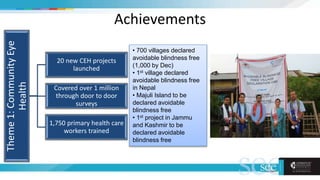
Achievements
Theme1:CommunityEye
Health
20 new CEH projects
launched
Covered over 1 million
through door to door
surveys
1,750 primary health care
workers trained
• 700 villages declared
avoidable blindness free
(1,000 by Dec)
• 1st village declared
avoidable blindness free
in Nepal
• Majuli Island to be
declared avoidable
blindness free
• 1st project in Jammu
and Kashmir to be
declared avoidable
blindness free
Achievements
Theme2:Hospital
Improvement
•Renovation/ upgradation of
NEH
•Quality assessments
conducted in 6 hospitals
Supported establishment/
adoption of 116 Vision Centers
Built capacities of over 500 eye
health personnel
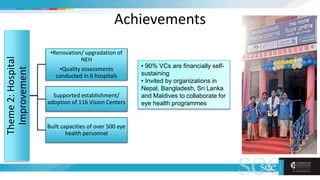
• 90% VCs are financially self-
sustaining
• Invited by organizations in
Nepal, Bangladesh, Sri Lanka
and Maldives to collaborate for
eye health programmes
AchievementsTheme3:DiseaseControl
•Launched 5 Community Based
Diabetic Retinopathy
Programme in 5 cities
Partnered with BFIL to launch
4th phase of Project DRISHTI
Established the first Institute for
Eye Cancer in India/ South Asia
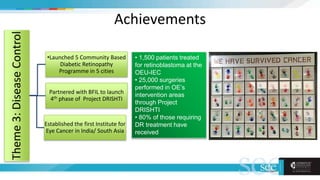
• 1,500 patients treated
for retinoblastoma at the
OEU-IEC
• 25,000 surgeries
performed in OE’s
intervention areas
through Project
DRISHTI
• 80% of those requiring
DR treatment have
received
Achievements
Theme4:Researchand
Advocacy
•Increased focus on Vision 2020
India and other Government
organizations
Conducted evaluations
(external and internal) and
impact assessment
Initiated fundraising and
advocacy activities in a
structure manner
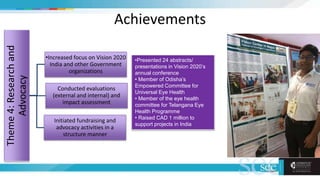
•Presented 24 abstracts/
presentations in Vision 2020’s
annual conference
• Member of Odisha’s
Empowered Committee for
Universal Eye Health
• Member of the eye health
committee for Telangana Eye
Health Programme
• Raised CAD 1 million to
support projects in India
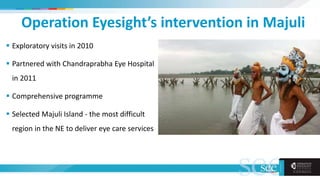
Operation Eyesight’s intervention in Majuli
 Exploratory visits in 2010
 Partnered with Chandraprabha Eye Hospital
in 2011
 Comprehensive programme
 Selected Majuli Island - the most difficult
region in the NE to deliver eye care services
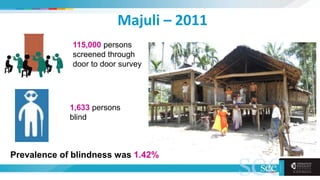
Majuli – 2011
115,000 persons
screened through
door to door survey
1,633 persons
blind
Prevalence of blindness was 1.42%
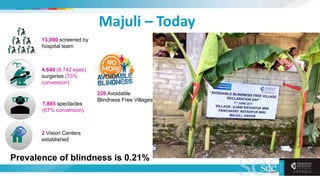
Majuli – Today
13,090 screened by
hospital team
4,649 (8,742 eyes)
surgeries (73%
conversion)
7,885 spectacles
(67% conversion)
2 Vision Centers
established
220 Avoidable
Blindness Free Villages
Prevalence of blindness is 0.21%
Majuli - Tomorrow
• Remaining 76 villages will be declared
avoidable blindness free in World Sight
day 2018
• Entire Island/ district will be declared
ABF by the end of Dec 2018
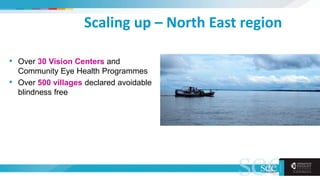
Scaling up – North East region
• Over 30 Vision Centers and
Community Eye Health Programmes
• Over 500 villages declared avoidable
blindness free
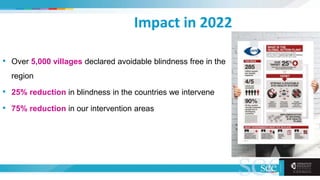
Impact in 2022
• Over 5,000 villages declared avoidable blindness free in the
region
• 25% reduction in blindness in the countries we intervene
• 75% reduction in our intervention areas
Thank you
operationeyesight.com

Sight first anup zimba

  • 1.
    Operation Eyesight South AsiaProgramme Strategy 2018 to 2022 Anup Zimba Assistant Director – Operation Eyesight Universal
  • 2.
    Operation Eyesight Universal •Founded in 1963 • Headquartered in Calgary, Canada • Mission – Eliminate Avoidable Blindness Focus on: • Comprehensive eye health services to all irrespective of paying capacity • Quality – Best to the poorest • Local capacity building • Sustainability
  • 3.
    Problem analysis • Indiahas the largest population of blind people in the world – Over 12 million people – One fifth of the world’s blind
  • 4.
    Problem analysis -contd.  133 million Indians do not have access to spectacles or an eye exam  7.5 millions children in India suffer from myopia leading to over 10% of them dropping out of school and 18% of them repeating a grade  Refractive errors are the 2nd leading cause of blindness (20%) and uncorrected refractive errors are leading cause of VI
  • 5.
  • 7.
    Strategic goal 2018to 2022 Goal Eliminate avoidable blindness among vulnerable populations in OE’s geographic areas of intervention in 20 states in India by 2022
  • 8.
    Theme 1- CommunityEye Health Empowered communities take ownership of their health in OE’s geographical areas of intervention by 2022 Specific Objectives • Strengthened primary health care system • Improved knowledge, attitude and practices pertaining to health • Improved quality of life of the incurably blind and those with low vision
  • 9.
    Theme 1- CommunityEye Health Key indicators of success • Over 5,000 Community Health Workers trained • Over 5,000 Government Primary Health Care Workers trained • Over 5,000 village communities declared avoidable blindness free • Prevalence of blindness in projects completing 5 years reduced to 0.3%
  • 10.
    Theme 2 -Hospital Improvement Sustained quality eye health facilities made accessible to all in OE’s geographical areas of intervention by 2022 Specific Objectives • Vision Centers established • Eye hospitals established in needy areas • Existing eye hospitals strengthened to deliver sustained quality eye health services • Referral system between community and primary, secondary and tertiary eye care centers developed • Capacities of eye health workforce built
  • 11.
    Theme 2 -Hospital Improvement Key indicators of success Over 2.5 million persons screened Over 400,000 spectacles dispensed annually 220 Vision Centers established 2,000 eye health personnel trained Over 300,000 surgeries performed annually Ensure surgical outcome rates as per WHO standards
  • 12.
    Theme 3 -Disease Control Prevalence of avoidable blindness caused by emerging eye diseases significantly reduced in OE's geographical areas of intervention by 2020 Specific Objectives • Screen, identify, treat and empower target populations with the objective to reduce prevalence of avoidable blindness due to diabetic retinopathy • Prevalence of blindness among children as a result of Retinopathy of Pre-maturity reduced • Prevalence of blindness due to eye cancers reduced • Backlog of cataract blindness reduced • Backlog of uncorrected refractive errors reduced
  • 13.
    Theme 3 -Disease Control Key indicators of success • 20 Community Based Diabetic Retinopathy projects in 20 cities • 5 cities covered under the Born too Soon project • 5 cities have Institutes for Eye Cancers • 50% increase in CSR in our areas of intervention • 25% reduction in uncorrected refractive errors in our areas of intervention
  • 14.
    Geographic area(s) ofintervention • 20 states of India • 4 districts of Nepal • 2 districts of Bangladesh • 2 districts of Sri Lanka • 4 atolls of Maldives Target beneficiaries • 30 million persons
  • 15.
    Programme implementation strategy Summary •Expand models and approaches to other countries in SEAR • Develop models and up-scale interventions in RoP, Eye Cancer, and DR • Document and publish impact of our models and interventions
  • 16.
    Summary of countryprogramme strategy SN Indicators 2018 2019 2020 2021 2022 Total 1 Number of people per year encouraged to seek eye health (IEC/ BCC/ mass communication...) 750,000 800,000 1 m 1.25 m 1.5 m 5.7 m 2 Number of community volunteers/ health workers/ staff trained per year in primary eye health 550 600 700 750 800 3,700 3 Number of patients screened for various eye conditions through our hospital networks 1.5 m 1.7 m 2m 2.3 m 2.5 m 9 mi 4 Number of patients examined through outreach, school screening and HBCEHP 700,000 1 m 1.2 m 1.5 m 2 m 6.4 m 5 Number of eye surgeries performed 250,000 275,000 300,000 315,000 325,000 1.46 m 6 Number of pairs of new prescription eyeglasses dispensed 250,000 250,000 275,000 300,000 325,000 1.4 m 7 Spectacle conversion rate 70% 70% 70% 70% 70% 70%
  • 17.
    Summary of countryprogramme strategy SN Indicators 2018 2019 2020 2021 2022 Total 8 Surgical conversion rate 60% 60% 60% 60% 60% 60% 9 No. of quality audits carried out (vision/ primary centres and secondary/ tertiary centres) 25 125 150 175 200 750 9.1 Proportion of partners found in compliance with OE’s policy on quality by over 90% 50% 50% 55% 55% 60% 60% 9.2 Proportion of partners found in compliance with OE’s policy on quality between 75 and 90% 25% 30% 30% 35% 35% 35% 9.3 Proportion of partners found in compliance with OE’s policy on quality by less than 75% 25% 20% 15% 10% 5% 5% 10 Number of villages/ communities declared as Avoidable Blindness Free 500 500 750 750 1000 3,500
  • 18.
  • 19.
    Achievements Theme1:CommunityEye Health 20 new CEHprojects launched Covered over 1 million through door to door surveys 1,750 primary health care workers trained • 700 villages declared avoidable blindness free (1,000 by Dec) • 1st village declared avoidable blindness free in Nepal • Majuli Island to be declared avoidable blindness free • 1st project in Jammu and Kashmir to be declared avoidable blindness free
  • 20.
    Achievements Theme2:Hospital Improvement •Renovation/ upgradation of NEH •Qualityassessments conducted in 6 hospitals Supported establishment/ adoption of 116 Vision Centers Built capacities of over 500 eye health personnel • 90% VCs are financially self- sustaining • Invited by organizations in Nepal, Bangladesh, Sri Lanka and Maldives to collaborate for eye health programmes
  • 21.
    AchievementsTheme3:DiseaseControl •Launched 5 CommunityBased Diabetic Retinopathy Programme in 5 cities Partnered with BFIL to launch 4th phase of Project DRISHTI Established the first Institute for Eye Cancer in India/ South Asia • 1,500 patients treated for retinoblastoma at the OEU-IEC • 25,000 surgeries performed in OE’s intervention areas through Project DRISHTI • 80% of those requiring DR treatment have received
  • 22.
    Achievements Theme4:Researchand Advocacy •Increased focus onVision 2020 India and other Government organizations Conducted evaluations (external and internal) and impact assessment Initiated fundraising and advocacy activities in a structure manner •Presented 24 abstracts/ presentations in Vision 2020’s annual conference • Member of Odisha’s Empowered Committee for Universal Eye Health • Member of the eye health committee for Telangana Eye Health Programme • Raised CAD 1 million to support projects in India
  • 23.
    Operation Eyesight’s interventionin Majuli  Exploratory visits in 2010  Partnered with Chandraprabha Eye Hospital in 2011  Comprehensive programme  Selected Majuli Island - the most difficult region in the NE to deliver eye care services
  • 24.
    Majuli – 2011 115,000persons screened through door to door survey 1,633 persons blind Prevalence of blindness was 1.42%
  • 25.
    Majuli – Today 13,090screened by hospital team 4,649 (8,742 eyes) surgeries (73% conversion) 7,885 spectacles (67% conversion) 2 Vision Centers established 220 Avoidable Blindness Free Villages Prevalence of blindness is 0.21%
  • 26.
    Majuli - Tomorrow •Remaining 76 villages will be declared avoidable blindness free in World Sight day 2018 • Entire Island/ district will be declared ABF by the end of Dec 2018
  • 27.
    Scaling up –North East region • Over 30 Vision Centers and Community Eye Health Programmes • Over 500 villages declared avoidable blindness free
  • 28.
    Impact in 2022 •Over 5,000 villages declared avoidable blindness free in the region • 25% reduction in blindness in the countries we intervene • 75% reduction in our intervention areas
  • 29.

Editor's Notes