GIT Vasculitis
Prof.Adel Abd Eslam
Professor of internal medicine
Rheumatology&immunology unit
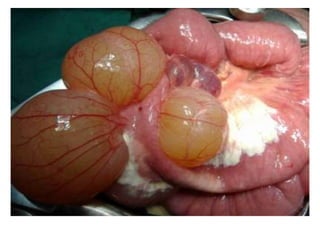
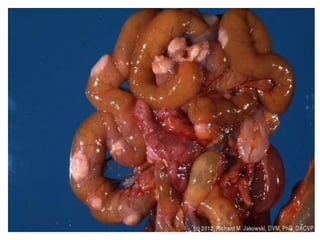
• It can affect vessel of all size.
• The clinical course and pathological features are quite
variable dependent on size and location of affected vessel.
• It can cause local or diffuse pathologic changes in the GIT.
• Clinical features; ulcer, submucosal edema, hemorrhage,
paralytic ileus, mesenteric ischemia, bowel obstruction and
perforation.
• Bowel ischemia and perforation are associated with
significant mortality.
• Clinical suspicion must confirmed radiology by CT and
endoscopic histological biopsy.
Hokama A et al,2012;
GIT Vasculitis
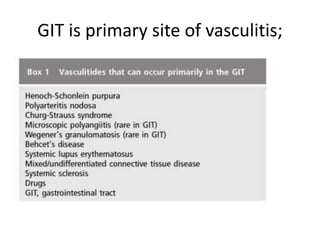
GIT is primary site of vasculitis;
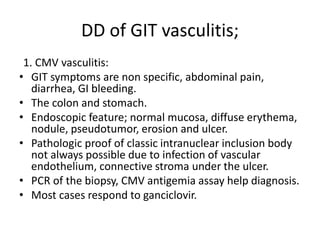
DD of GIT vasculitis;
1. CMV vasculitis:
• GIT symptoms are non specific, abdominal pain,
diarrhea, GI bleeding.
• The colon and stomach.
• Endoscopic feature; normal mucosa, diffuse erythema,
nodule, pseudotumor, erosion and ulcer.
• Pathologic proof of classic intranuclear inclusion body
not always possible due to infection of vascular
endothelium, connective stroma under the ulcer.
• PCR of the biopsy, CMV antigemia assay help diagnosis.
• Most cases respond to ganciclovir.
2. NSAID induced GI damage;
Various type of enteropathy in small and large
intestine due to long stand NSAID.
Gastrodudoneal peptic ulcer has been reported.
Improvement symptoms with discontuation of
steroid.
Manifestation of GIT vasculitis;
Large vessel vasculitis:
1. Gaint cell arteritis;
• Granulomatus arteritis of the aorta and its major branches with
predilection to cranial branches of the cartoid artery .
• The frequency of GIT involvement is very rare.
2. Takayasus arteritisi;
• Granulomatus inflammation of the aorta and its major branches
with characteristic occular affection and decrease brachial artery
pulse (pulseless disease).
• The descending aorta syndrome cause mesenteric vasculitis, but
the frequency of mesenteric and celiac involvement is rare.
• Farrant M,etal2008 reported a young women female develop TA
following Crohn disease , concluded that common pathology in
both diseases.
Medium vessel vasculitis;
Kawasaki disease;
• Vasculitis involving large, medium and small
arteries.
• Associated with mucocutaneous lymph node
syndrome.
• Usually in children, coronary arteries are
involved.
• GIT is relatively uncommon, but acute abdomen
with paralytic ileus, ischemic enteritis and
vasculitic appendicitis may occur.
Morgan MD,etal2005
polyarteritis-nodosa;
• Medium sized vessel.
• Usually spare veins.
• Necrotizing inflammation without glomerulonephritis.
• Fourth decade of life.
• Male> female by 2 folds.
• ANCA negative.
• HBV, HCV, drug abuser, idiopathic.
• Usually vessel in the skin, kidney, nerves and GIT.
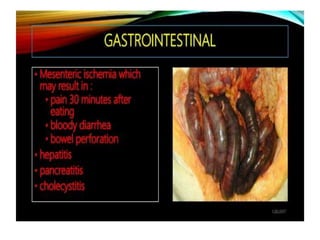
• GIT; 50%, acute, abdominal pain, diarrhea, bleeding,
hemorrhage, infarction, peritonitis, cholecystitis,
infarction, hematochezia and perforation.
• Mimic inflammatory bowel disease.
• Pathology; trans mural necrosis, fibrinoid
necrosis, all layers are involved, centered to
media.
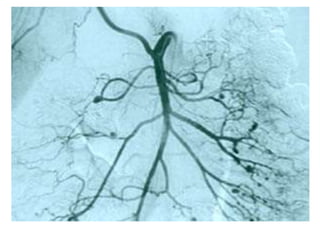
• Typical radiological feature include; aneurysm
up to 1 CM in diameter within renal,
mesenteric and hepatic vasculature.
polyarteritis-nodosa;
ANCA associated vasculitis;
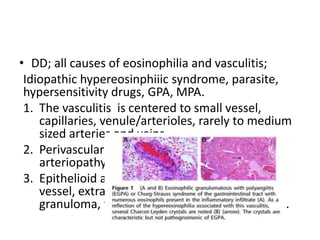
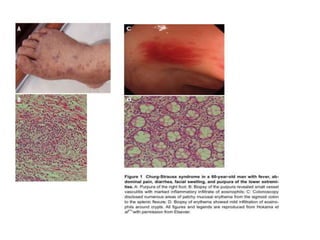
Eosinophilia granulmatosis with polyangitis / churg-stauss
syndrome.
• Least common.
• Vasculitis of small/medium vessel.
• Eosinophilia rich >10%/ necrotizing granulomatous.
• Sever asthma, fever, eosinophilia, cardiac, renal failure, peripheral
neuropathy, pulmonary infiltrate, sinusitis, purpura, subcutaneous
nodule and hypertension.
GIT manifestation;
• (age 40 to 60), male > female.
• Abdominal pain and bloody diarrhea are two most characteristics
symptoms.
• When mesenteric vasculitis due to EGPA, histological finding similar
to PAN.
• DD; all causes of eosinophilia and vasculitis;
Idiopathic hypereosinphiiic syndrome, parasite,
hypersensitivity drugs, GPA, MPA.
1. The vasculitis is centered to small vessel,
capillaries, venule/arterioles, rarely to medium
sized arteries and veins.
2. Perivascular eosinophilia infiltration,
arteriopathy > true vasculitis.
3. Epithelioid and giant cells are found around
vessel, extravascular eosinophilia rich
granuloma, that spills over surrounding tissue.
Microscopic polyangitis (MPA):
• Microscopic form of PAN, hypersensitivity vasculitis.
• 1994, it is a disease entity, despite overlap with PAN, EGPA, GPA,
cutaneous leukocytoclastic vasculitis.
• All ages, all ethnicity, equal male and female.
• Involve small vessel mainly, occasionally medium sized vessel.
GIT manifestation;
• Rarely affected, abdominal pain is the most common symptoms.
• The paucity of immune complex in MPA differentiated it from GPA,
EGPA by absence granuloma, peripheral eosinophilia, asthma.
• DD; immune complex mediated vasculitis (HSP, cryoglobulinemia
vasculitis)
Granulomatosis polyangitis/ Wegner granulomatosis;
• More in middle age, may all age.
• No gender difference.
• Vasculitis with granuloma and large area of vessel
necrosis.
• Small and medium sized arteries and veins.
• Any vessel from anywhere of body can be affected,
with predication for upper respiratory tract, lung and
kidney.
• GIT involvement is extremely rare.
Immune complex vasculitis;
Henoch- schonlein purpura;
Ig A vasculitis; (IgAV):
• Linked to immunization, food allergy, infection(GABHS),
drugs(quinine, ranitidine, clarithromycin).
• Ig A glycosated, recruit inflammatory mediators, complement
cascade.
• Children> adult, self limited in children, very poor prognosis in
adult.
• Systemic or localized (kidney).
• Skin (purpura), joint (arthritis), kidney (nephritis), GIT.
• Leukoctoclastic vasculitis of small and medium capillaries, vein
and arteries, with deposition of IgA and C3.
• DD; MPA, GPA, EGPA, leukocyotoclastic vasculitis.
GIT manifestation;
• In 50-85% of IgA vasculitis, 14% first presentation.
• Any part of GIT, second part of the dueodenum and
terminal ileum are preferentially.
• Diarrhea, distension, colicky abdominal pain caused by
bowel ischemia and edema.
• serious complication include; obstruction,
intususception, perforation, hematmesis,
hematochesia.
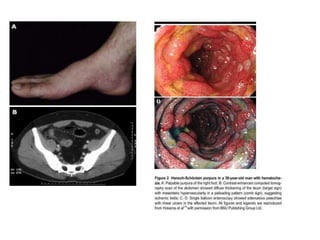
• Endoscopic feature; diffuse mucosal redness,
petechiae, hemorrhagic erosion and ulcer.
• CT abdomen; bowel thickening with the target sign and
engorgement of mesenteric vessel with comb sign.
Cryoglobulinemic vasculitis;
• Small vessel, capillries, venules, arterioles with
cryoglobulin deposition.
• Either related to HCV ‘HCV cryoglobulinemic’,or
idiopathic.
• 3 types;
1. Type1; monoclonal, lymphoma, waldastrom , meyloma.
2. Type2; monoconal, RF related, lymphoproliferative,
rheumatic diseases, chronic infection.
3. Type3; polyclonal, RF related, rheumatic disease an
dchronic infections.
• Type2 and 3 are related to vasculitis.
SLE;
• Defective T cell/ activate B cell, deposition C3 and
immune complex in the media and adventitia,
necrotizing vasculititis.
• Small and medium vessel arteritis/venulitis with
fibrinoid necrosis in sever cases.
• GIT manifestation;
• Any part, liver and pancreas.
• Ischemic changes affect any layer of GIT;
• Mucosa;;;;;; ulcer and hemorrhage.
• Submucosa;;;;;;; edema.
• Muscularis mucosa;;;;;;;;;;;; intestinal
pesudobstruction.
• Serosa;;;;;;;;;;;ascitis and perforation.
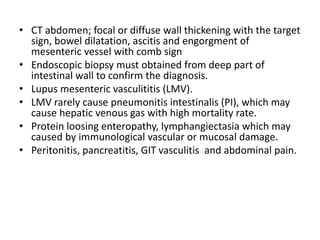
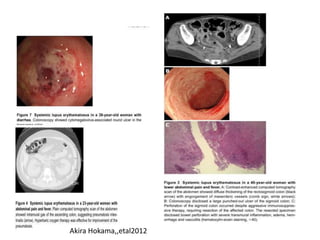
• CT abdomen; focal or diffuse wall thickening with the target
sign, bowel dilatation, ascitis and engorgment of
mesenteric vessel with comb sign
• Endoscopic biopsy must obtained from deep part of
intestinal wall to confirm the diagnosis.
• Lupus mesenteric vasculititis (LMV).
• LMV rarely cause pneumonitis intestinalis (PI), which may
cause hepatic venous gas with high mortality rate.
• Protein loosing enteropathy, lymphangiectasia which may
caused by immunological vascular or mucosal damage.
• Peritonitis, pancreatitis, GIT vasculitis and abdominal pain.
Akira Hokama,,etal2012
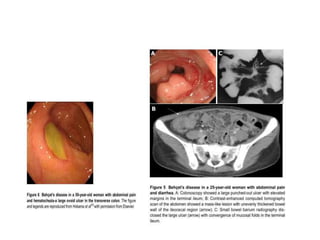
• Behcets syndrome:
• Non sepefic necrotizing vasculitis.
• Triad of oral and genital ulcer, uveitis.
• GIT is integral part of behcet with characteristic ileocecal
valve and esophagus.
• Behcets characterized by ulcerating lesion, either localized or
diffuse.
Localized lesion
• cause deeply penetrating ulcer in ileocecal valve with high
frequency of hemorrhage.
• CT, mass like lesion and thickened bowel with marked
enhanced lesion.
• Barium, marked irregular ulcer with marked thickening of
intestinal wall.
Diffuse lesion;
• Multiple discrete punched out ulcer, mainly in the colon.
Mixed connective tissue disease;
• SLE, scleroderma and Polymyositis overlap symptoms.
• antiU1 ribonucleoprotein antibodies.
• Dysphagia, heartburn, perforation and malabsorption.
Drug induced vasculitis;
• Either with first use or with long period.
• All pharmacological drugs cause drug induced
vasculitis/lupus like syndrome.
• Cutaneous vasculitis in majority after 7-12 days of
administration, systemic vasculitis in minority.
GIT manifestation;
• Involved as part of systemic vasculitis rather than isolated
manifestation or very rarely initial presentation.
• diagnosis depend on temporal relation between clinically
evident vasculitis and drug administration.
• Most cases require stoppage offending drugs, in minority
of cases resistant and require immunosuppresion.
• Clinical presentation; nonspecific, similar to primary
vasculitis, most case are restricted to single organ , but
involvement of kidney, skin, lung .
• Usually good prognosis,
Single organ vasculitis
• Isolated PAN like vasculitis.
• arteries, veins of any size.
• a single organ with no evidence of systemic vasculitis.
• Unifocal or multifocal within an organ.
• It is a limited expression of systemic vasculitis process.
• Clinical, serological and pathological correlation is required to
confirm the diagnosis systemic vasculitis limited in single organ;
SOV.
• SOV can occur in anywhere in the body, several location inside
abdomen.
• GIT is the most frequently site of SOV.
• Any part of GIT, esophagus stomach, omentum, Small and large
intestine, appendix, gall bladder, pancreas.
• GIT symptoms;
• pain, hemorrhage, infarction.
• or purely incidental ,
asymptomatic.
• or occult with the patient
presenting with symptoms
unrelated to vasculitis.
• Incidental or isolated vasculitis of female genital
tract is addressed(Abu-Farsakh H;etal1994).
• PAN like or giant cell arteritis affecting uterine
cervix and myometrium.
Relation of SOV to systemic vasculitis;
• Not addressed a specific relationship.
• Case report; a true incidental SOV and need to be
managed, does not report a temporal relationship.
• Every SOV case should be flagged, work up to exclude
latent or dormant systemic vasculitis , don’t need
treatment , only routine follow up.
• Follow up preoid is not uniformly agreed but
Gonzalez-Gay and colleagues recommended, a full
work up for 3-5 years would be sufficient.
• Association with vasculitis is not known, the
possibility of some unknown, undetected antigen or
local factor could be operative.
http://dx.doi.org/10.1016/j.pathol.2017.05.013
• Hoppé et al described 99.1% of SOV with no
progression to systemic vasculitis.
• By this mean , the vasculitis was unsuspected,
asymptomatic and specimen harboured other
pathology which was the reason for removal.
• Surgical pathologist are akin to examine the
vasculture even when the primary diagnosis
explain patients symptoms.
• Communication with clinical colleagues and
clinical pathologist is only way for proper work
up to exclude systemic vasculitis at time of
presentation.
Conclusion:
• Systemic vasculitis can initially manifest in the GIT.
• Histological examination for evidence of vasculitis
(hemorrhage, infarction and ischemia) especially in
the omentum and deep layer of the bowel.
• If highly clinical suspicious of vasculitis without
evidence of histological finding, multiple section
should be examined.
• SOV without evidence of systemic vasculitis, can be
encounted co-existing GI vasculitis.
Reference:
• Gonzalez-Gay MA, Vazquez-Rodriguez TR, Miranda-Filloy JA, Pazos-Ferro A, Garcia-
Rodeja E. Localized vasculitis of the gastrointestinal tract: a case report and
literature review. Clin Exp Rheumatol 2008; 26(Suppl 49): S102e5.
• Abu-Farsakh H, Mody D, Brown RW, Truong LD. Isolated vasculitis involving the
female genital tract: clinicopathologic spectrum and phenotyping of inflammatory
cells. Mod Pathol 1994; 7: 610e5.
Git vasculitis

Git vasculitis

  • 1.
    GIT Vasculitis Prof.Adel AbdEslam Professor of internal medicine Rheumatology&immunology unit
  • 2.
    • It canaffect vessel of all size. • The clinical course and pathological features are quite variable dependent on size and location of affected vessel. • It can cause local or diffuse pathologic changes in the GIT. • Clinical features; ulcer, submucosal edema, hemorrhage, paralytic ileus, mesenteric ischemia, bowel obstruction and perforation. • Bowel ischemia and perforation are associated with significant mortality. • Clinical suspicion must confirmed radiology by CT and endoscopic histological biopsy. Hokama A et al,2012; GIT Vasculitis
  • 5.
    GIT is primarysite of vasculitis;
  • 6.
    DD of GITvasculitis; 1. CMV vasculitis: • GIT symptoms are non specific, abdominal pain, diarrhea, GI bleeding. • The colon and stomach. • Endoscopic feature; normal mucosa, diffuse erythema, nodule, pseudotumor, erosion and ulcer. • Pathologic proof of classic intranuclear inclusion body not always possible due to infection of vascular endothelium, connective stroma under the ulcer. • PCR of the biopsy, CMV antigemia assay help diagnosis. • Most cases respond to ganciclovir.
  • 7.
    2. NSAID inducedGI damage; Various type of enteropathy in small and large intestine due to long stand NSAID. Gastrodudoneal peptic ulcer has been reported. Improvement symptoms with discontuation of steroid.
  • 8.
    Manifestation of GITvasculitis; Large vessel vasculitis: 1. Gaint cell arteritis; • Granulomatus arteritis of the aorta and its major branches with predilection to cranial branches of the cartoid artery . • The frequency of GIT involvement is very rare. 2. Takayasus arteritisi; • Granulomatus inflammation of the aorta and its major branches with characteristic occular affection and decrease brachial artery pulse (pulseless disease). • The descending aorta syndrome cause mesenteric vasculitis, but the frequency of mesenteric and celiac involvement is rare. • Farrant M,etal2008 reported a young women female develop TA following Crohn disease , concluded that common pathology in both diseases.
  • 9.
    Medium vessel vasculitis; Kawasakidisease; • Vasculitis involving large, medium and small arteries. • Associated with mucocutaneous lymph node syndrome. • Usually in children, coronary arteries are involved. • GIT is relatively uncommon, but acute abdomen with paralytic ileus, ischemic enteritis and vasculitic appendicitis may occur. Morgan MD,etal2005
  • 10.
    polyarteritis-nodosa; • Medium sizedvessel. • Usually spare veins. • Necrotizing inflammation without glomerulonephritis. • Fourth decade of life. • Male> female by 2 folds. • ANCA negative. • HBV, HCV, drug abuser, idiopathic. • Usually vessel in the skin, kidney, nerves and GIT. • GIT; 50%, acute, abdominal pain, diarrhea, bleeding, hemorrhage, infarction, peritonitis, cholecystitis, infarction, hematochezia and perforation.
  • 11.
    • Mimic inflammatorybowel disease. • Pathology; trans mural necrosis, fibrinoid necrosis, all layers are involved, centered to media. • Typical radiological feature include; aneurysm up to 1 CM in diameter within renal, mesenteric and hepatic vasculature. polyarteritis-nodosa;
  • 13.
    ANCA associated vasculitis; Eosinophiliagranulmatosis with polyangitis / churg-stauss syndrome. • Least common. • Vasculitis of small/medium vessel. • Eosinophilia rich >10%/ necrotizing granulomatous. • Sever asthma, fever, eosinophilia, cardiac, renal failure, peripheral neuropathy, pulmonary infiltrate, sinusitis, purpura, subcutaneous nodule and hypertension. GIT manifestation; • (age 40 to 60), male > female. • Abdominal pain and bloody diarrhea are two most characteristics symptoms. • When mesenteric vasculitis due to EGPA, histological finding similar to PAN.
  • 14.
    • DD; allcauses of eosinophilia and vasculitis; Idiopathic hypereosinphiiic syndrome, parasite, hypersensitivity drugs, GPA, MPA. 1. The vasculitis is centered to small vessel, capillaries, venule/arterioles, rarely to medium sized arteries and veins. 2. Perivascular eosinophilia infiltration, arteriopathy > true vasculitis. 3. Epithelioid and giant cells are found around vessel, extravascular eosinophilia rich granuloma, that spills over surrounding tissue.
  • 16.
    Microscopic polyangitis (MPA): •Microscopic form of PAN, hypersensitivity vasculitis. • 1994, it is a disease entity, despite overlap with PAN, EGPA, GPA, cutaneous leukocytoclastic vasculitis. • All ages, all ethnicity, equal male and female. • Involve small vessel mainly, occasionally medium sized vessel. GIT manifestation; • Rarely affected, abdominal pain is the most common symptoms. • The paucity of immune complex in MPA differentiated it from GPA, EGPA by absence granuloma, peripheral eosinophilia, asthma. • DD; immune complex mediated vasculitis (HSP, cryoglobulinemia vasculitis)
  • 17.
    Granulomatosis polyangitis/ Wegnergranulomatosis; • More in middle age, may all age. • No gender difference. • Vasculitis with granuloma and large area of vessel necrosis. • Small and medium sized arteries and veins. • Any vessel from anywhere of body can be affected, with predication for upper respiratory tract, lung and kidney. • GIT involvement is extremely rare.
  • 18.
    Immune complex vasculitis; Henoch-schonlein purpura; Ig A vasculitis; (IgAV): • Linked to immunization, food allergy, infection(GABHS), drugs(quinine, ranitidine, clarithromycin). • Ig A glycosated, recruit inflammatory mediators, complement cascade. • Children> adult, self limited in children, very poor prognosis in adult. • Systemic or localized (kidney). • Skin (purpura), joint (arthritis), kidney (nephritis), GIT. • Leukoctoclastic vasculitis of small and medium capillaries, vein and arteries, with deposition of IgA and C3. • DD; MPA, GPA, EGPA, leukocyotoclastic vasculitis.
  • 19.
    GIT manifestation; • In50-85% of IgA vasculitis, 14% first presentation. • Any part of GIT, second part of the dueodenum and terminal ileum are preferentially. • Diarrhea, distension, colicky abdominal pain caused by bowel ischemia and edema. • serious complication include; obstruction, intususception, perforation, hematmesis, hematochesia. • Endoscopic feature; diffuse mucosal redness, petechiae, hemorrhagic erosion and ulcer. • CT abdomen; bowel thickening with the target sign and engorgement of mesenteric vessel with comb sign.
  • 21.
    Cryoglobulinemic vasculitis; • Smallvessel, capillries, venules, arterioles with cryoglobulin deposition. • Either related to HCV ‘HCV cryoglobulinemic’,or idiopathic. • 3 types; 1. Type1; monoclonal, lymphoma, waldastrom , meyloma. 2. Type2; monoconal, RF related, lymphoproliferative, rheumatic diseases, chronic infection. 3. Type3; polyclonal, RF related, rheumatic disease an dchronic infections. • Type2 and 3 are related to vasculitis.
  • 22.
    SLE; • Defective Tcell/ activate B cell, deposition C3 and immune complex in the media and adventitia, necrotizing vasculititis. • Small and medium vessel arteritis/venulitis with fibrinoid necrosis in sever cases. • GIT manifestation; • Any part, liver and pancreas. • Ischemic changes affect any layer of GIT; • Mucosa;;;;;; ulcer and hemorrhage. • Submucosa;;;;;;; edema. • Muscularis mucosa;;;;;;;;;;;; intestinal pesudobstruction. • Serosa;;;;;;;;;;;ascitis and perforation.
  • 27.
    • CT abdomen;focal or diffuse wall thickening with the target sign, bowel dilatation, ascitis and engorgment of mesenteric vessel with comb sign • Endoscopic biopsy must obtained from deep part of intestinal wall to confirm the diagnosis. • Lupus mesenteric vasculititis (LMV). • LMV rarely cause pneumonitis intestinalis (PI), which may cause hepatic venous gas with high mortality rate. • Protein loosing enteropathy, lymphangiectasia which may caused by immunological vascular or mucosal damage. • Peritonitis, pancreatitis, GIT vasculitis and abdominal pain.
  • 28.
  • 29.
    • Behcets syndrome: •Non sepefic necrotizing vasculitis. • Triad of oral and genital ulcer, uveitis. • GIT is integral part of behcet with characteristic ileocecal valve and esophagus. • Behcets characterized by ulcerating lesion, either localized or diffuse. Localized lesion • cause deeply penetrating ulcer in ileocecal valve with high frequency of hemorrhage. • CT, mass like lesion and thickened bowel with marked enhanced lesion. • Barium, marked irregular ulcer with marked thickening of intestinal wall. Diffuse lesion; • Multiple discrete punched out ulcer, mainly in the colon.
  • 31.
    Mixed connective tissuedisease; • SLE, scleroderma and Polymyositis overlap symptoms. • antiU1 ribonucleoprotein antibodies. • Dysphagia, heartburn, perforation and malabsorption. Drug induced vasculitis; • Either with first use or with long period. • All pharmacological drugs cause drug induced vasculitis/lupus like syndrome. • Cutaneous vasculitis in majority after 7-12 days of administration, systemic vasculitis in minority.
  • 32.
    GIT manifestation; • Involvedas part of systemic vasculitis rather than isolated manifestation or very rarely initial presentation. • diagnosis depend on temporal relation between clinically evident vasculitis and drug administration. • Most cases require stoppage offending drugs, in minority of cases resistant and require immunosuppresion. • Clinical presentation; nonspecific, similar to primary vasculitis, most case are restricted to single organ , but involvement of kidney, skin, lung . • Usually good prognosis,
  • 33.
    Single organ vasculitis •Isolated PAN like vasculitis. • arteries, veins of any size. • a single organ with no evidence of systemic vasculitis. • Unifocal or multifocal within an organ. • It is a limited expression of systemic vasculitis process. • Clinical, serological and pathological correlation is required to confirm the diagnosis systemic vasculitis limited in single organ; SOV. • SOV can occur in anywhere in the body, several location inside abdomen. • GIT is the most frequently site of SOV. • Any part of GIT, esophagus stomach, omentum, Small and large intestine, appendix, gall bladder, pancreas.
  • 34.
    • GIT symptoms; •pain, hemorrhage, infarction. • or purely incidental , asymptomatic. • or occult with the patient presenting with symptoms unrelated to vasculitis. • Incidental or isolated vasculitis of female genital tract is addressed(Abu-Farsakh H;etal1994). • PAN like or giant cell arteritis affecting uterine cervix and myometrium.
  • 35.
    Relation of SOVto systemic vasculitis; • Not addressed a specific relationship. • Case report; a true incidental SOV and need to be managed, does not report a temporal relationship. • Every SOV case should be flagged, work up to exclude latent or dormant systemic vasculitis , don’t need treatment , only routine follow up. • Follow up preoid is not uniformly agreed but Gonzalez-Gay and colleagues recommended, a full work up for 3-5 years would be sufficient. • Association with vasculitis is not known, the possibility of some unknown, undetected antigen or local factor could be operative. http://dx.doi.org/10.1016/j.pathol.2017.05.013
  • 36.
    • Hoppé etal described 99.1% of SOV with no progression to systemic vasculitis. • By this mean , the vasculitis was unsuspected, asymptomatic and specimen harboured other pathology which was the reason for removal. • Surgical pathologist are akin to examine the vasculture even when the primary diagnosis explain patients symptoms. • Communication with clinical colleagues and clinical pathologist is only way for proper work up to exclude systemic vasculitis at time of presentation.
  • 38.
    Conclusion: • Systemic vasculitiscan initially manifest in the GIT. • Histological examination for evidence of vasculitis (hemorrhage, infarction and ischemia) especially in the omentum and deep layer of the bowel. • If highly clinical suspicious of vasculitis without evidence of histological finding, multiple section should be examined. • SOV without evidence of systemic vasculitis, can be encounted co-existing GI vasculitis.
  • 39.
    Reference: • Gonzalez-Gay MA,Vazquez-Rodriguez TR, Miranda-Filloy JA, Pazos-Ferro A, Garcia- Rodeja E. Localized vasculitis of the gastrointestinal tract: a case report and literature review. Clin Exp Rheumatol 2008; 26(Suppl 49): S102e5. • Abu-Farsakh H, Mody D, Brown RW, Truong LD. Isolated vasculitis involving the female genital tract: clinicopathologic spectrum and phenotyping of inflammatory cells. Mod Pathol 1994; 7: 610e5.