Kurdistan Board GEH/GIT Surgery J Club 2021
Supervised by Professor Dr. Mohamed Alshekhani.
Introduction:
 EoE is increasing in incidence& prevalence&more commonly seen in
clinical practice.
 During endoscopy, the suspicion should be high.
 EoE diagnosed in ~6% of all patients undergoing upper endoscopy for any
reason, >15% having endoscopy for dysphagia&>50% requiring
endoscopy in the setting of a food impaction.
 Careful esophageal exam is critical to optimize diagnosis, allows potential
therapeutics, as dilation in patients with eso strictures or narrowing& sets
the stage for monitoring treatment response &assessing outcomes.
Assessing endoscopic features:
 In other esoc onditions, it is routine practice to assess findings with a
classification system,as LA Grade classification for erosive esophagitis&the
Prague classification for Barrett’s eso.
 EoE Endoscopic Reference Score (EREFS) should be used for patients
with suspected or known EoE,to quantify the major endoscopic features of
EoE, including edema, rings, exudates, furrows&strictures.
 Edema:absent (grade 0) or present (1; decreased or absent vascularity).
 Rings:absent (0), mild (1; subtle ridges), moderate (2; distinct rings), or
severe (3; standard scope will not pass).
 Exudates:absent (0), mild (1; 10% of the mucosal surface area), or severe
(2; >10% of the surface).
 Furrows:absent (0),mild (1present without depth),or severe (2;with depth).
 Stricture:absent (0) or present (1), & minimum diameter is recorded.
Assessing endoscopic features:
 Narrowing& crepe-paper mucosa are not formally part of the score.
 The score ranges from 0-9 (though some other ranges have been used,
including with furrows graded dichotomously as 0/1).
 Higher scores indicating more severe endoscopic disease activity&in
clinical practice each element should reflect the overall worst area in eso.
 Interobserver & intraobserver agreement of EREFS is excellent, findings
discriminate EoE from other conditions with high levels of accuracy
(although it is possible to have a normala ppearing esophagus in EoE),
 Higher scores have been associated with adverse outcomes
 A major determinant disease activity.
 Predicts response to treatment in several clinical trials (scores improve
with active trt&relatively unchanged with placebo).
 It is the ideal system to use for endoscopic findings in EoE.
 The second E is referred to as“Ex”, so edema & exudates are not confused.
Approaching endoscopic exam:
 Challenges is wide implementation&optimal accurate use in clin practice.
 The best practices for examination of the esophagus in EoE.:
 1. Fully examine the eso on insertion, before the entire upper exam is
complete, because advancing the scope (or performing therapeutics, as
dilation) can rub off the exudates falsely lowering the score for this feature.
Only may advance to the stomach to make sure there is no retained food or
significant fluid that could impact the safety, but after this, withdraw back
to the eso for the exam, with gentle washing & suctioning of mucosa to
clear off saliva, mucous, blood&debris.
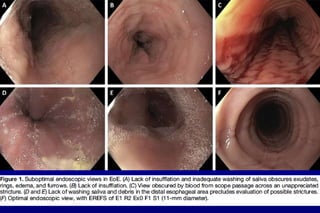
 3. Full insufflation is essential to accurately assess the features,determine
the extent of edema, depth of furrows,severity or rings& differntiate
between felinization (transient rings caused by esop fore shortening&/or
contraction of the longitudinal muscles, not EoE- or EREFS-related)&
fixed rings scored being EREFS-related).
 Take enough time (several mins) to exam a fully insufflated, clean eso.
High degree of suspicion in assessing narrowing/strictures:
 The most challenging parts are determining whether strictures or
narrowing are present & estimating esophageal caliber.
 Endoscopists do not reliably detect less severe strictures on visual exam
alone.
 In EoE, strictures can occur at any location in the eso, can be focal or
multifocal, or can be diffuse narrowing of the esophagus.
 An endoscopist should be on the alert for subtle findings.
 Sometimes strictures can “hide” at the GER or at the level of UES, areas
difficult to fully insufflate.
 Similarly narrow caliber in proximal eso can be missed if the scope is
inserted too rapidly & the exam begins 25 cm or more from incisors.
 The tactile sensation of passing the scope can also provide a clue to
strictures or narrowing.
 Is there any mild resistance? This could be a stricture.
 Is there the feeling of “speed bumps,” or a plication of folds on advancing
the scope? This could indicate rings& narrowing.
High degree of suspicion in assessing narrowing/strictures:
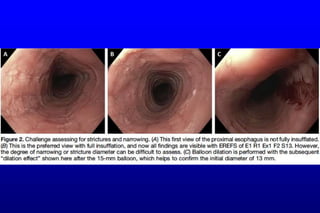
 Sometimes the extent of narrowing is only noted after eso dilation or if
crepe-paper is noted after scope passage.
 With incomplete insufflation the presence of rings is not clear, but with full
insufflation an area of mild rings& narrowing is notable.
 After balloon dilation to 15 mm a good dilation effect is seen&caliber noted
, a size that is hard to determine on visual inspection alone.
 In patients with ongoing dysphagia despite treatment, assessing for
potential subtle strictures is particularly important.
 Using a tool, as the functional lumen imaging probe, that may have utility
in cases where it is critical to assess esophageal compliance & caliber.
Taking biopsies:
 A basic &critical aspect of the endoscopic exam is obtaining eso biopsies
for the histologic assessment used for diagnosis& treatment monitoring.
 The eosinophilic infiltration in EoE is patchy, that the biopsy yield is
increased by targeting specific endoscopic findings of EoE (particularly
exudates&furrows)&a higher number of biopsies increases the diag yield.
 Current guidelines recommend at least 6 from at least 2 diff locations,
commonly to take 4 fragments distally & 4 fragments proximally,targeting
the areas where there are findings&avoiding the so-called subeso stricture
area, an area of several centimeters where the eso often appears normal
&biopsies tend to lack inflammation.
 The “turn& suck” approach to targeted esop biopsies in EoE.
 As with scope passage, there is a tactile feel when obtaining eso biopsies.
 The “pull sign,” a sense of requiring increased force to remove the tissue
during a biopsy, has been reported to be highly specific for EoE.
Conclusion:
 The endoscopic examination in EoE should be an area of focus given that
EoE is commonly encountered in the procedures unit.
 It is important to do a careful eso exam, with full insufflation, washing of
debris&sufficient time to fully assess & photo document all findings.
 The presence or absence of features should be recorded with EREFS at
each endoscopy to quantify the endoscopic severity of disease activity.
 At the same time, a careful assessment for signs of fibrostenosis (strictures/
narrowing) should be made&dilation performed if clinically indicated.
 Appropriate technique for obtaining esophageal biopsies should also be
used, with multiple biopsies targeting active features of EoE from several
locations in the esophagus.
 These techniques allow for an optimal examination, an increased
diagnostic yield&accurate monitoring of endoscopic features of EoE after
treatment & during long-term follow-up.

Git j club eo e erefs 21

  • 1.
    Kurdistan Board GEH/GITSurgery J Club 2021 Supervised by Professor Dr. Mohamed Alshekhani.
  • 2.
    Introduction:  EoE isincreasing in incidence& prevalence&more commonly seen in clinical practice.  During endoscopy, the suspicion should be high.  EoE diagnosed in ~6% of all patients undergoing upper endoscopy for any reason, >15% having endoscopy for dysphagia&>50% requiring endoscopy in the setting of a food impaction.  Careful esophageal exam is critical to optimize diagnosis, allows potential therapeutics, as dilation in patients with eso strictures or narrowing& sets the stage for monitoring treatment response &assessing outcomes.
  • 3.
    Assessing endoscopic features: In other esoc onditions, it is routine practice to assess findings with a classification system,as LA Grade classification for erosive esophagitis&the Prague classification for Barrett’s eso.  EoE Endoscopic Reference Score (EREFS) should be used for patients with suspected or known EoE,to quantify the major endoscopic features of EoE, including edema, rings, exudates, furrows&strictures.  Edema:absent (grade 0) or present (1; decreased or absent vascularity).  Rings:absent (0), mild (1; subtle ridges), moderate (2; distinct rings), or severe (3; standard scope will not pass).  Exudates:absent (0), mild (1; 10% of the mucosal surface area), or severe (2; >10% of the surface).  Furrows:absent (0),mild (1present without depth),or severe (2;with depth).  Stricture:absent (0) or present (1), & minimum diameter is recorded.
  • 4.
    Assessing endoscopic features: Narrowing& crepe-paper mucosa are not formally part of the score.  The score ranges from 0-9 (though some other ranges have been used, including with furrows graded dichotomously as 0/1).  Higher scores indicating more severe endoscopic disease activity&in clinical practice each element should reflect the overall worst area in eso.  Interobserver & intraobserver agreement of EREFS is excellent, findings discriminate EoE from other conditions with high levels of accuracy (although it is possible to have a normala ppearing esophagus in EoE),  Higher scores have been associated with adverse outcomes  A major determinant disease activity.  Predicts response to treatment in several clinical trials (scores improve with active trt&relatively unchanged with placebo).  It is the ideal system to use for endoscopic findings in EoE.  The second E is referred to as“Ex”, so edema & exudates are not confused.
  • 5.
    Approaching endoscopic exam: Challenges is wide implementation&optimal accurate use in clin practice.  The best practices for examination of the esophagus in EoE.:  1. Fully examine the eso on insertion, before the entire upper exam is complete, because advancing the scope (or performing therapeutics, as dilation) can rub off the exudates falsely lowering the score for this feature. Only may advance to the stomach to make sure there is no retained food or significant fluid that could impact the safety, but after this, withdraw back to the eso for the exam, with gentle washing & suctioning of mucosa to clear off saliva, mucous, blood&debris.  3. Full insufflation is essential to accurately assess the features,determine the extent of edema, depth of furrows,severity or rings& differntiate between felinization (transient rings caused by esop fore shortening&/or contraction of the longitudinal muscles, not EoE- or EREFS-related)& fixed rings scored being EREFS-related).  Take enough time (several mins) to exam a fully insufflated, clean eso.
  • 6.
    High degree ofsuspicion in assessing narrowing/strictures:  The most challenging parts are determining whether strictures or narrowing are present & estimating esophageal caliber.  Endoscopists do not reliably detect less severe strictures on visual exam alone.  In EoE, strictures can occur at any location in the eso, can be focal or multifocal, or can be diffuse narrowing of the esophagus.  An endoscopist should be on the alert for subtle findings.  Sometimes strictures can “hide” at the GER or at the level of UES, areas difficult to fully insufflate.  Similarly narrow caliber in proximal eso can be missed if the scope is inserted too rapidly & the exam begins 25 cm or more from incisors.  The tactile sensation of passing the scope can also provide a clue to strictures or narrowing.  Is there any mild resistance? This could be a stricture.  Is there the feeling of “speed bumps,” or a plication of folds on advancing the scope? This could indicate rings& narrowing.
  • 7.
    High degree ofsuspicion in assessing narrowing/strictures:  Sometimes the extent of narrowing is only noted after eso dilation or if crepe-paper is noted after scope passage.  With incomplete insufflation the presence of rings is not clear, but with full insufflation an area of mild rings& narrowing is notable.  After balloon dilation to 15 mm a good dilation effect is seen&caliber noted , a size that is hard to determine on visual inspection alone.  In patients with ongoing dysphagia despite treatment, assessing for potential subtle strictures is particularly important.  Using a tool, as the functional lumen imaging probe, that may have utility in cases where it is critical to assess esophageal compliance & caliber.
  • 8.
    Taking biopsies:  Abasic &critical aspect of the endoscopic exam is obtaining eso biopsies for the histologic assessment used for diagnosis& treatment monitoring.  The eosinophilic infiltration in EoE is patchy, that the biopsy yield is increased by targeting specific endoscopic findings of EoE (particularly exudates&furrows)&a higher number of biopsies increases the diag yield.  Current guidelines recommend at least 6 from at least 2 diff locations, commonly to take 4 fragments distally & 4 fragments proximally,targeting the areas where there are findings&avoiding the so-called subeso stricture area, an area of several centimeters where the eso often appears normal &biopsies tend to lack inflammation.  The “turn& suck” approach to targeted esop biopsies in EoE.  As with scope passage, there is a tactile feel when obtaining eso biopsies.  The “pull sign,” a sense of requiring increased force to remove the tissue during a biopsy, has been reported to be highly specific for EoE.
  • 13.
    Conclusion:  The endoscopicexamination in EoE should be an area of focus given that EoE is commonly encountered in the procedures unit.  It is important to do a careful eso exam, with full insufflation, washing of debris&sufficient time to fully assess & photo document all findings.  The presence or absence of features should be recorded with EREFS at each endoscopy to quantify the endoscopic severity of disease activity.  At the same time, a careful assessment for signs of fibrostenosis (strictures/ narrowing) should be made&dilation performed if clinically indicated.  Appropriate technique for obtaining esophageal biopsies should also be used, with multiple biopsies targeting active features of EoE from several locations in the esophagus.  These techniques allow for an optimal examination, an increased diagnostic yield&accurate monitoring of endoscopic features of EoE after treatment & during long-term follow-up.