GIS services Development
using CloudEO Platform
Data and Tools
BY DAVID ELISEO MARTINEZ
EL SALVADOR
Where do landslides happen in El
Salvador?
In the volcanic chain, where are located also the main population centers, and in the north
mountain chain. The diversity of soil/rocks, topography and climate contribute to the high
landslide hazard susceptibility.
When do landslides happen?
Only with very specific studies is possible to determine the landslide potential on an area, but it is
known that on the rainy season the hazard is higher.
In El Salvador, the rainy season goes from May to October and in this period is when most landslides
occur.
Source: www.snet.gob.sv
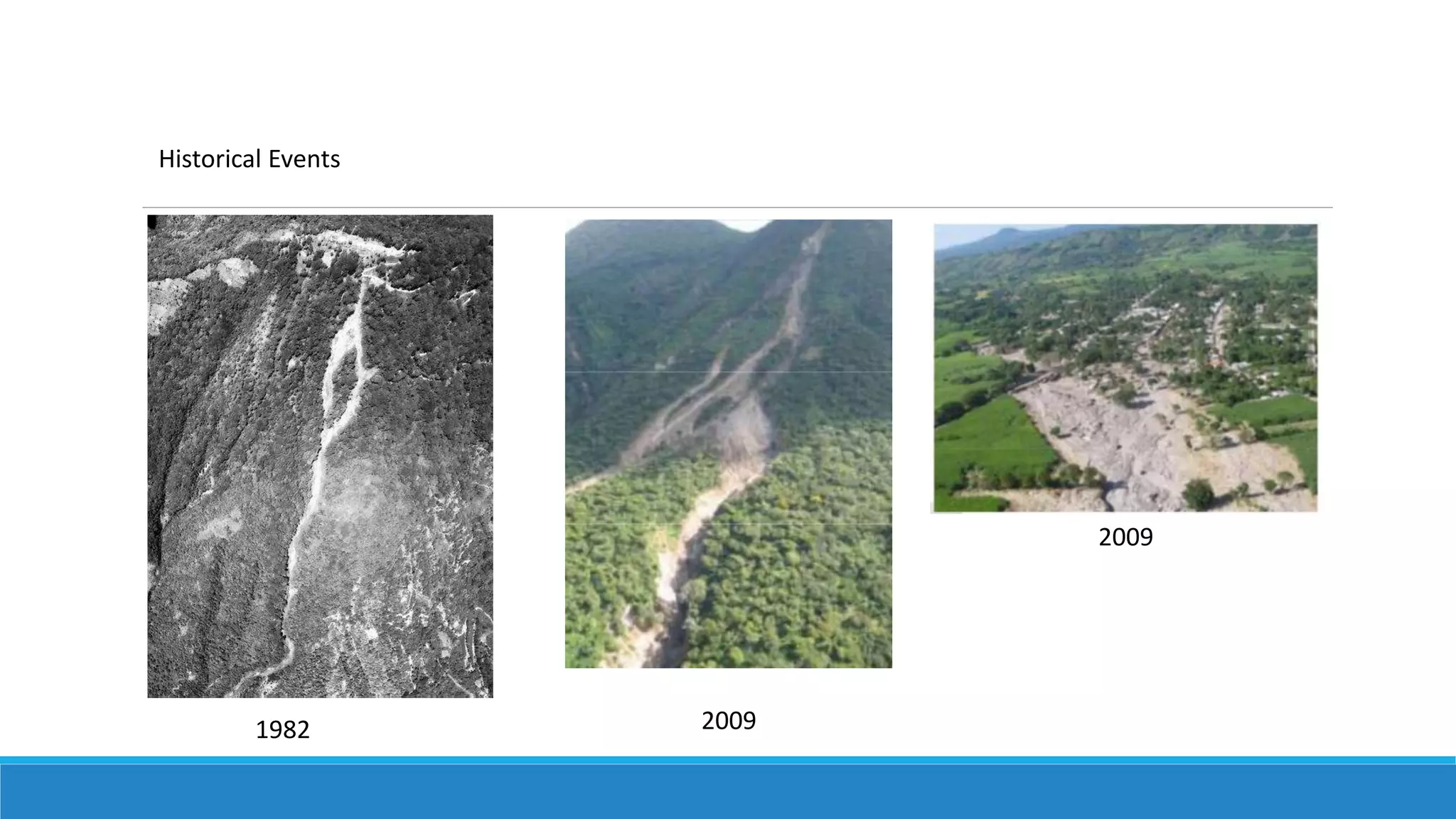
1982
2009
2009
Historical Events
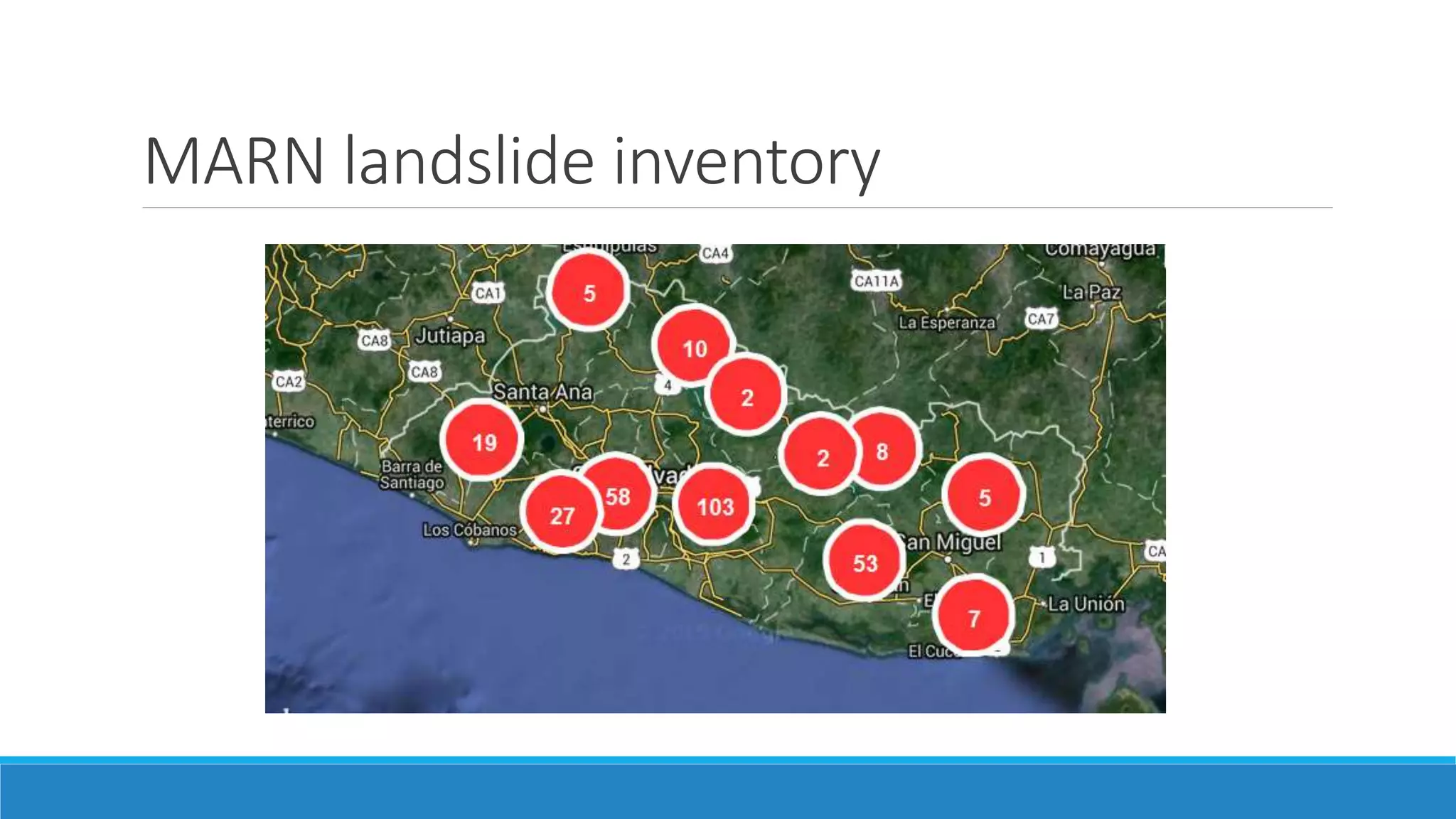
MARN landslide inventory
Concept of the service
GIS dynamic visualization of areas that would present a higher landslide susceptibility for early
warning systems and available to be consumed from mobile web, desktop and mobile
applications.
INPUTS:
•30 m DEM provided by CloudEO
•Rain gauge observations obtained from MARN/SNET web site.
Data preparation: Tools
•QGIS to visualize and process the DEM tiles:
Merge DEM tiles and then clip El Salvador extent, slope derivation.
•R Statistical Language, using rgdal, gstat, raster, sp packages:
Reclassifiy slope by those slopes 30 degrees or more.
Polygonize and dissolve.
•PostgreSQL + PostGIS
Storate of resulting slope Shapefile, allows quering slope on intersecting regions.
The process
1. Rain gauge observations are collected from MARN web site.
2. Rain data is interpolated using ordinary krigin method, the result of thes interpolation is saved as an
image.
3. Interpolated rain is reclassified according to certain warning levels.
4. The result of the reclassification is intercepted with the slopes previously generated.
The process run every 20 minutes. During extreme rain events this could provide valuable information.
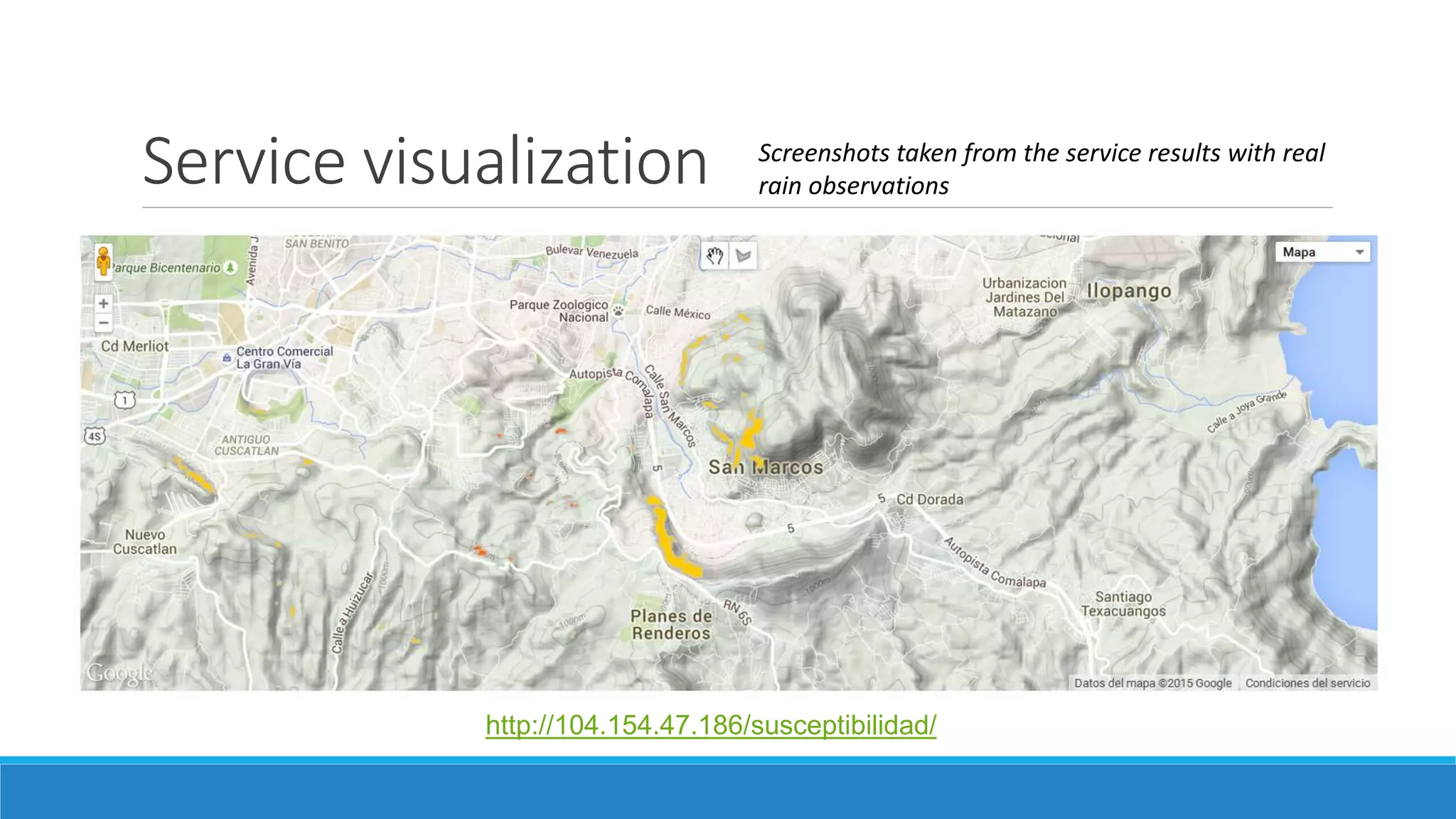
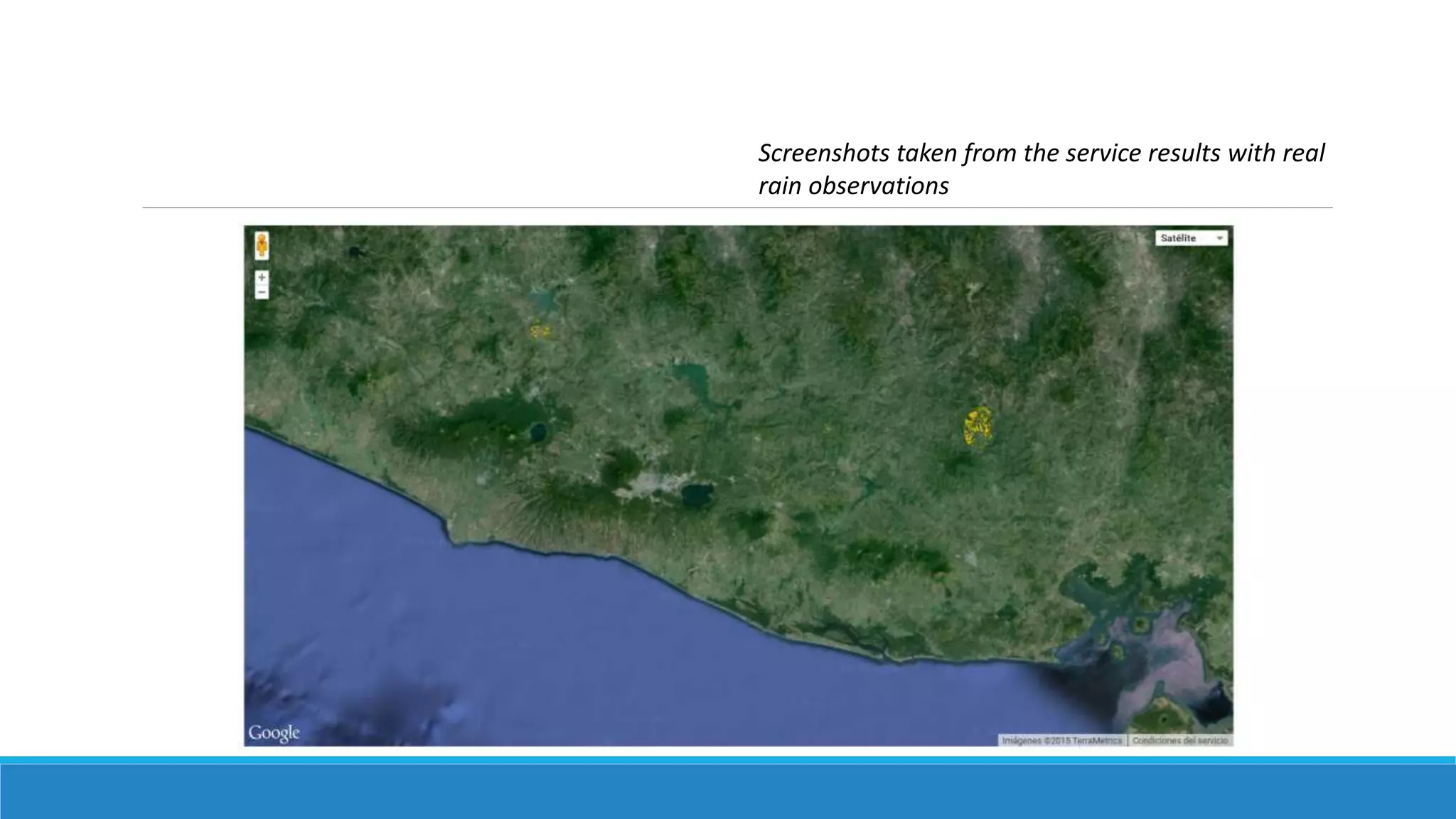
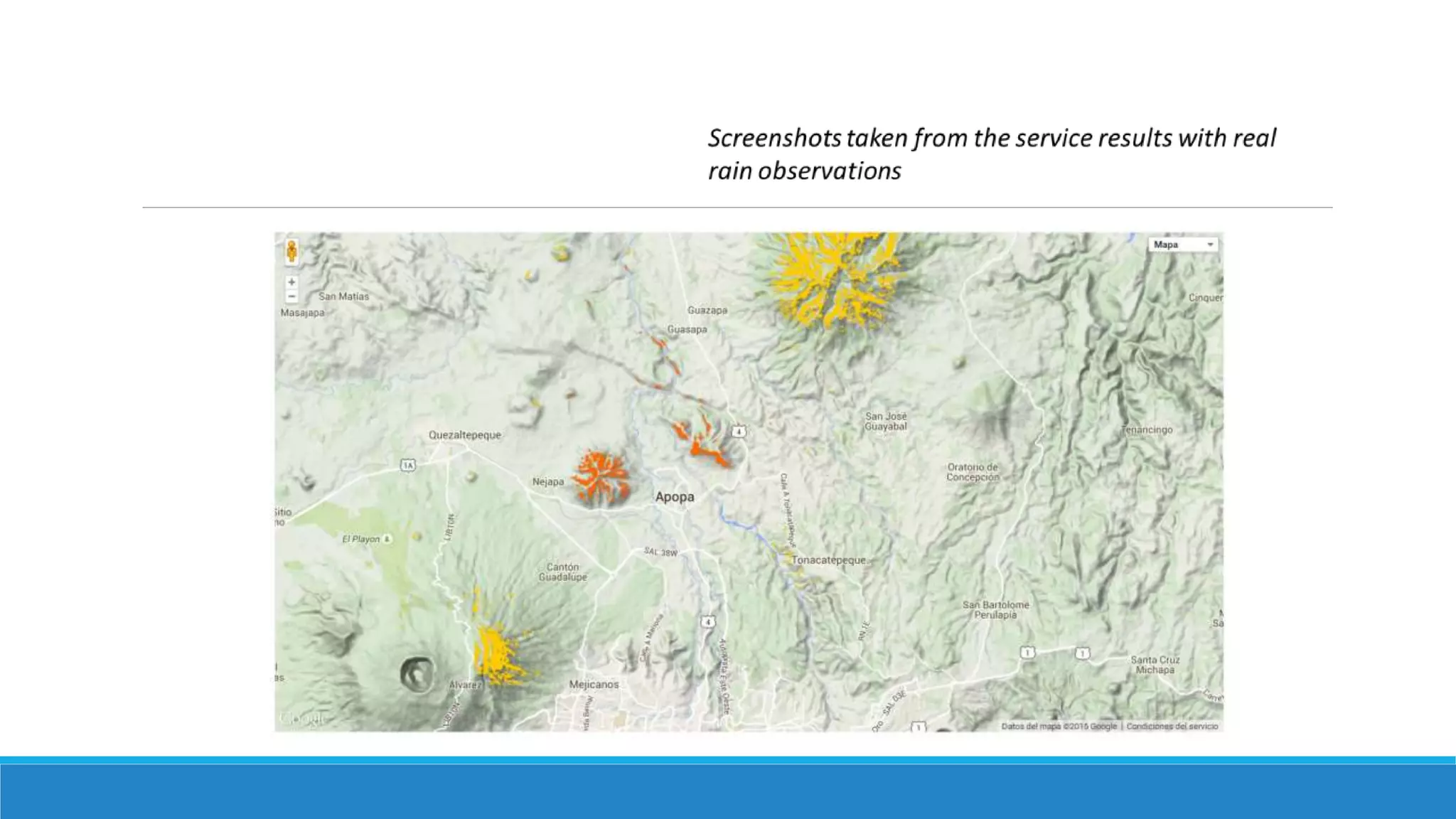
Service visualization Screenshots taken from the service results with real
rain observations
http://104.154.47.186/susceptibilidad/
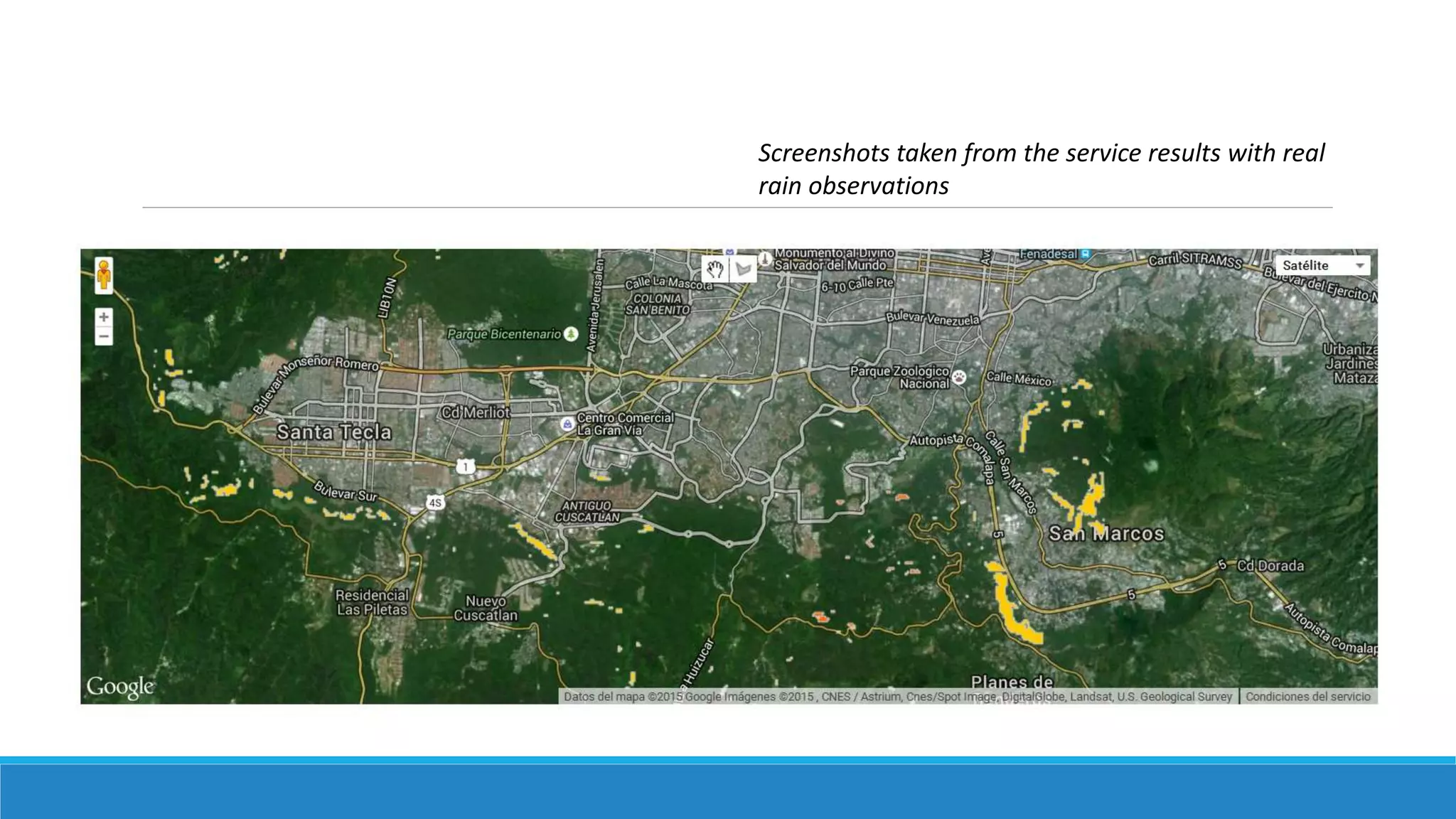
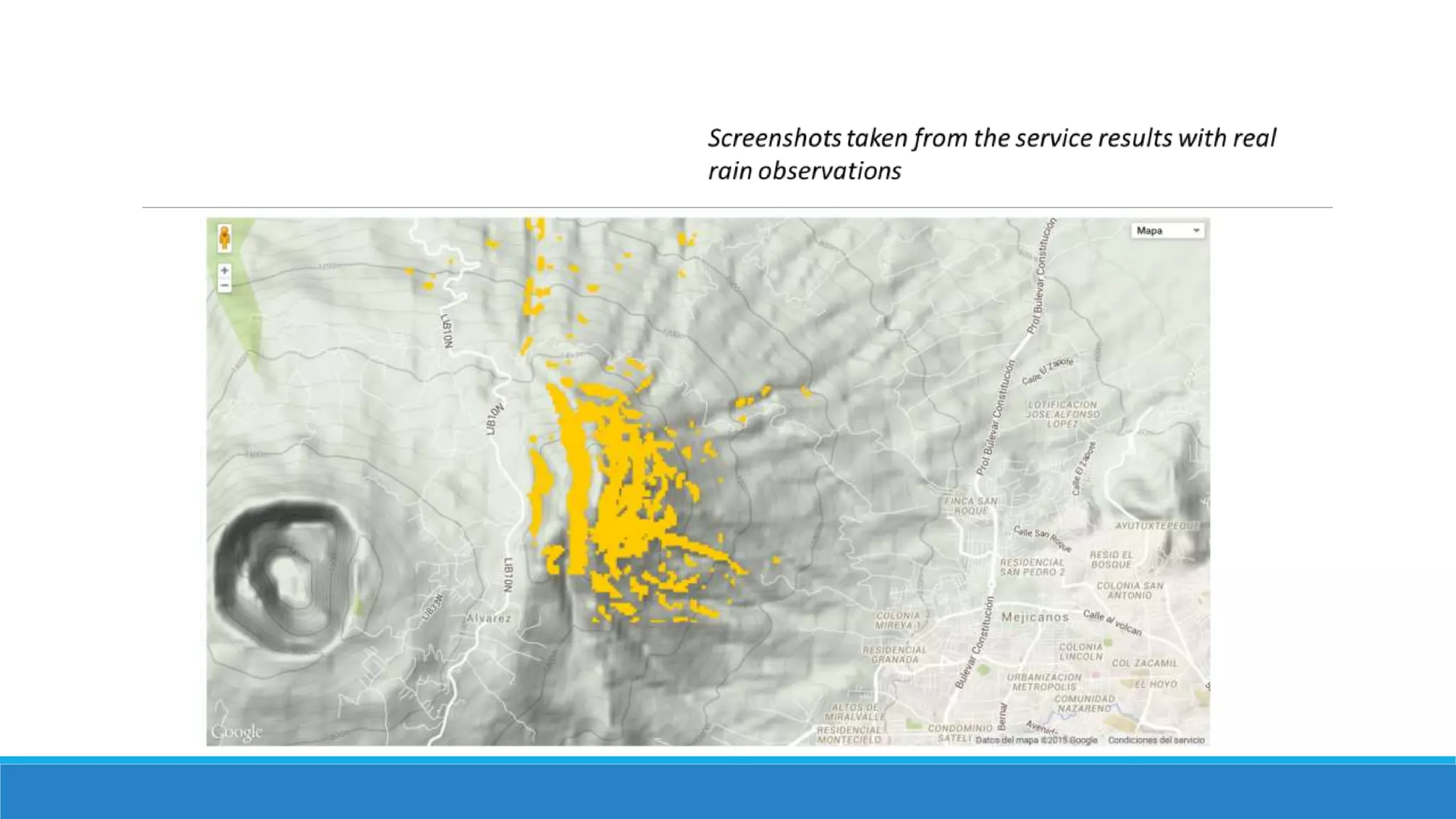
Screenshots taken from the service results with real
rain observations
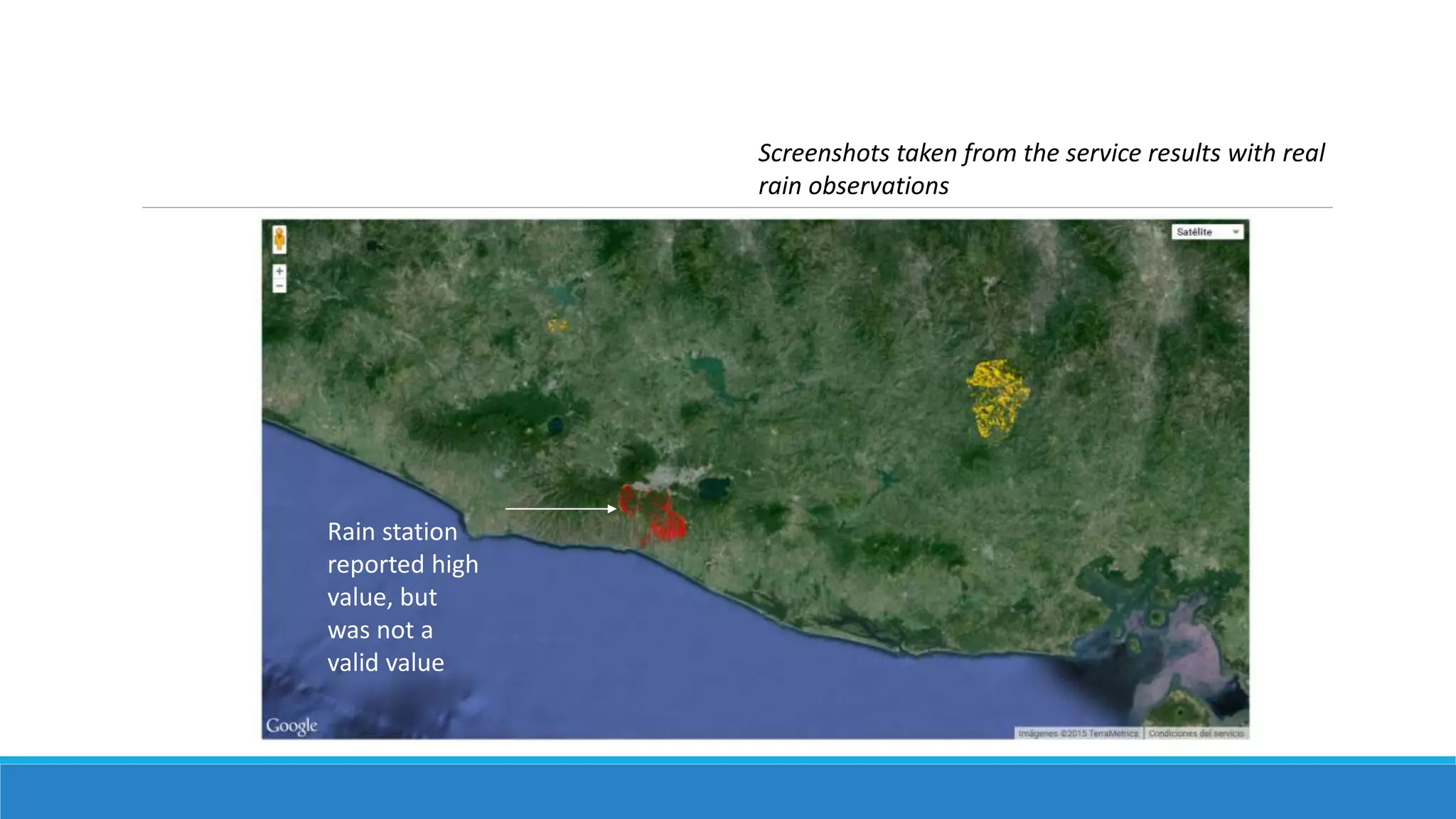
Screenshots taken from the service results with real
rain observations
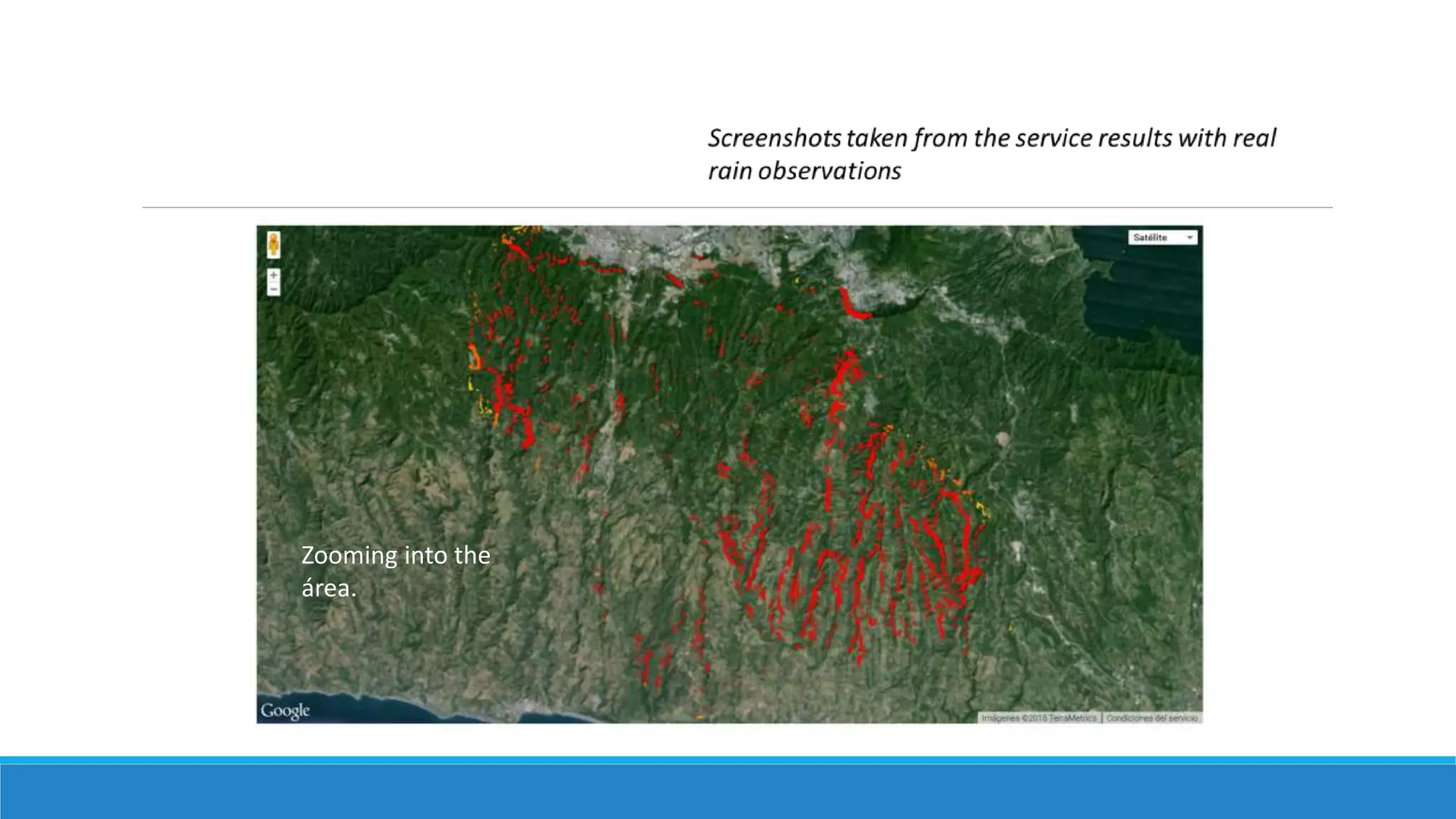
Screenshots taken from the service results with real
rain observations
Rain station
reported high
value, but
was not a
valid value
Zooming into the
área.
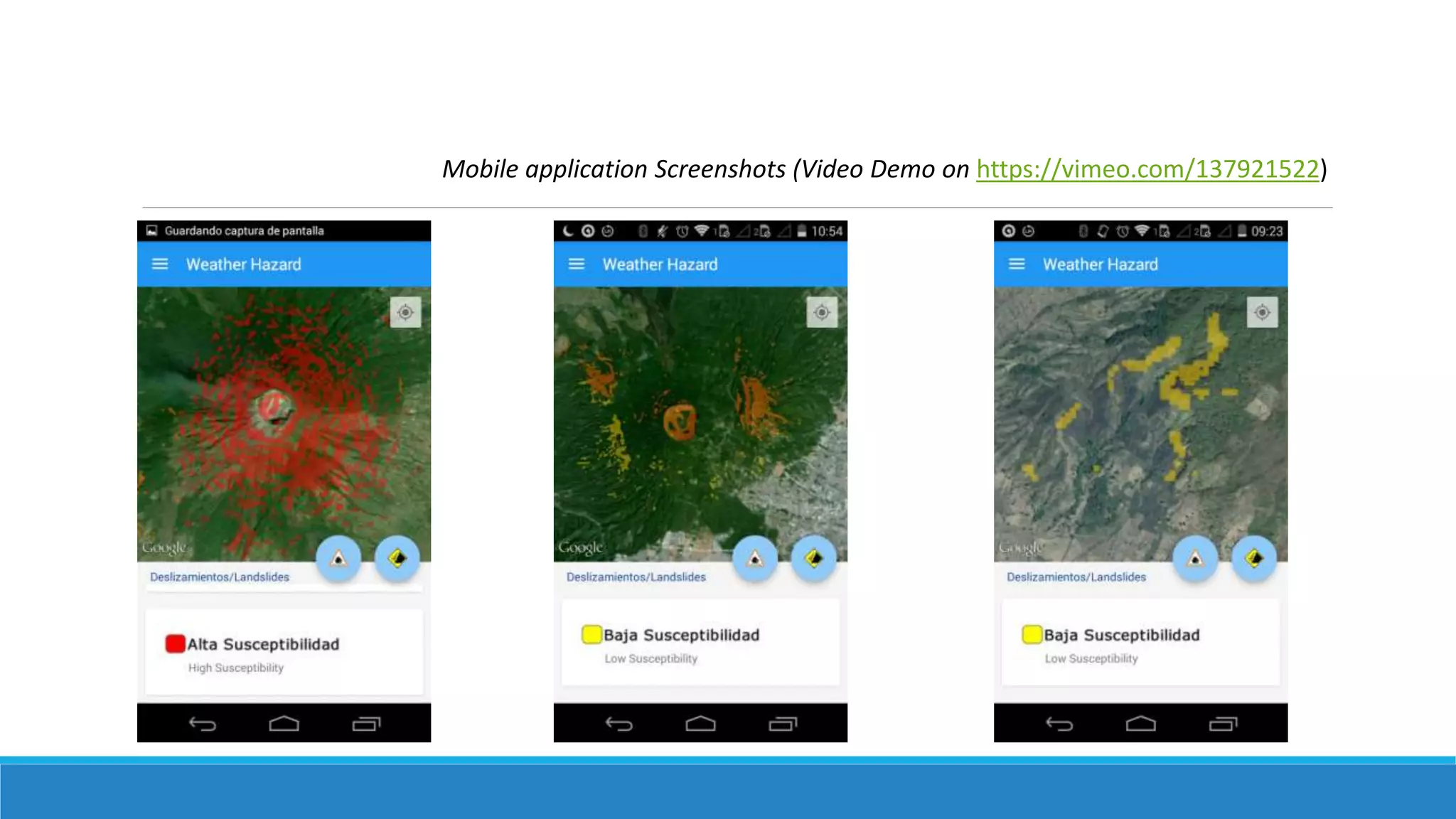
Mobile application Screenshots (Video Demo on https://vimeo.com/137921522)
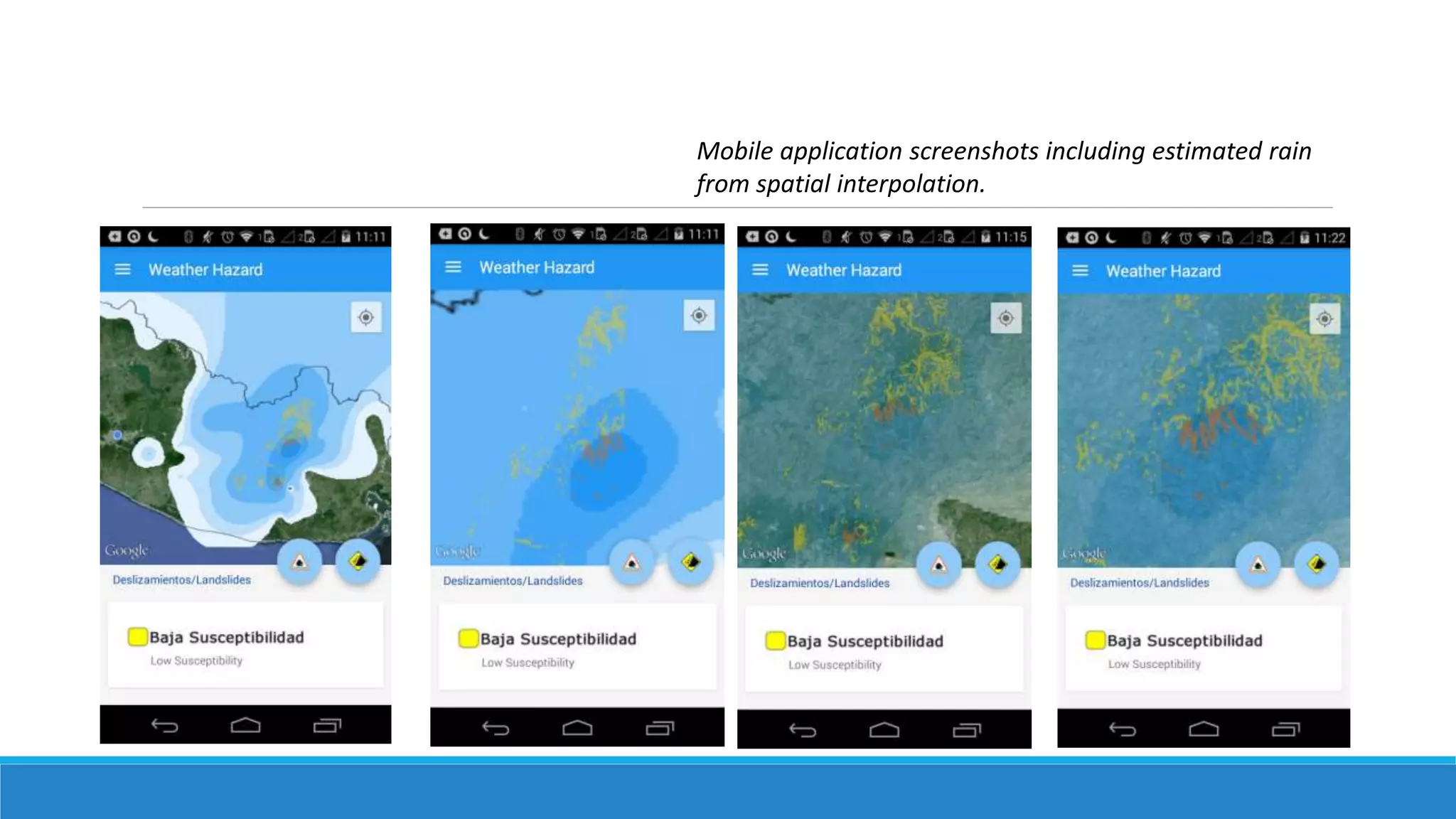
Mobile application screenshots including estimated rain
from spatial interpolation.
What is next?
* MARN technical and scientific team will review the result to offer feedback and determine the
warning levels and additional inputs to make the visualization valid (They seem to be interested)
* After valitation an update for Weather Hazard can go live, including the developed service.
THANKS
David Eliseo Martínez
eliseo.Martinez@gmail.com

GIS Services development using CloudEO platform data and Tools

  • 1.
    GIS services Development usingCloudEO Platform Data and Tools BY DAVID ELISEO MARTINEZ EL SALVADOR
  • 2.
    Where do landslideshappen in El Salvador? In the volcanic chain, where are located also the main population centers, and in the north mountain chain. The diversity of soil/rocks, topography and climate contribute to the high landslide hazard susceptibility. When do landslides happen? Only with very specific studies is possible to determine the landslide potential on an area, but it is known that on the rainy season the hazard is higher. In El Salvador, the rainy season goes from May to October and in this period is when most landslides occur. Source: www.snet.gob.sv
  • 3.
  • 4.
  • 5.
    Concept of theservice GIS dynamic visualization of areas that would present a higher landslide susceptibility for early warning systems and available to be consumed from mobile web, desktop and mobile applications. INPUTS: •30 m DEM provided by CloudEO •Rain gauge observations obtained from MARN/SNET web site.
  • 6.
    Data preparation: Tools •QGISto visualize and process the DEM tiles: Merge DEM tiles and then clip El Salvador extent, slope derivation. •R Statistical Language, using rgdal, gstat, raster, sp packages: Reclassifiy slope by those slopes 30 degrees or more. Polygonize and dissolve. •PostgreSQL + PostGIS Storate of resulting slope Shapefile, allows quering slope on intersecting regions.
  • 7.
    The process 1. Raingauge observations are collected from MARN web site. 2. Rain data is interpolated using ordinary krigin method, the result of thes interpolation is saved as an image. 3. Interpolated rain is reclassified according to certain warning levels. 4. The result of the reclassification is intercepted with the slopes previously generated. The process run every 20 minutes. During extreme rain events this could provide valuable information.
  • 8.
    Service visualization Screenshotstaken from the service results with real rain observations http://104.154.47.186/susceptibilidad/
  • 9.
    Screenshots taken fromthe service results with real rain observations
  • 10.
    Screenshots taken fromthe service results with real rain observations
  • 11.
    Screenshots taken fromthe service results with real rain observations Rain station reported high value, but was not a valid value
  • 12.
  • 15.
    Mobile application Screenshots(Video Demo on https://vimeo.com/137921522)
  • 16.
    Mobile application screenshotsincluding estimated rain from spatial interpolation.
  • 17.
    What is next? *MARN technical and scientific team will review the result to offer feedback and determine the warning levels and additional inputs to make the visualization valid (They seem to be interested) * After valitation an update for Weather Hazard can go live, including the developed service. THANKS David Eliseo Martínez eliseo.Martinez@gmail.com