Dr: Enas Elgendy
Ass. Prof. of Oral Medicine and Periodontology
Gingival Enlargement
It is excessive over-growth of the gum tissue
surrounding teeth. This growth is usually
irregular and may or may not be associated
with bleeding.
It has several causes and patients should be
carefully evaluated to determine the origin of
the problem.
Causes of Gingival Enlargement
• Inflammatory Enlargement
• Acute ( gingival abscess, periodontal abscess)
• Chronic (plaque induced)
• Medication Causes
• Phenytoin (Dilantin) occurs in 40-50% pts
• Calcium Channel Blockers (occurs rarely)
– Nifedipine (Procardia)
– Diltiazem (Cardizem)
• Cyclosporine
• birth control pills.
• Conditioned
• Pregnancy
• Puberty
• Vitamin C deficiency
• Plasma cell gingivitis
• Pyogenic granuloma
• Mouth- breathing
Causes of gingival enlargement
• Systemic Diseases
• Leukemia
• Granulomatous diseases (sarcoidosis, Wegene’s
granulomatosis)
• Acromegaly
• Neoplastic Enlargement
• Benign tumors
• Malignant tumors
• False Enlargement
Increase size of underlying bone or dental tissue
Effects of gingival enlargement
• Oral hygiene becomes impeded.
• Interfere with speech, occlusion, and
esthetics.
• Interferes with normal tooth
eruption.
• Can cause tooth migration.
After management of the inflammatory component by
phase 1 therapy surgical correction can be carried out.
GINGIVECTOMY AND GINGIVOPLASTY
• Gingivectomy: is the excisional removal of gingival
tissues for pocket reduction or elimination.
• Gingivoplasty: is the reshaping of the gingiva to
attain a more physiologic contour.
• Gingivectomy and gingivoplasty are usually
performed at the same time.
Aim
• is pocket elimination for root accessibility and
establishment of physiologic gingival contours.
INDICATIONS
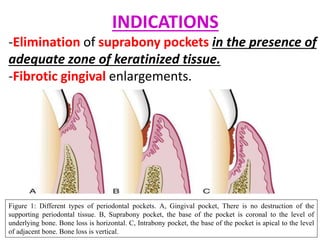
-Elimination of suprabony pockets in the presence of
adequate zone of keratinized tissue.
-Fibrotic gingival enlargements.
Figure 1: Different types of periodontal pockets. A, Gingival pocket, There is no destruction of the
supporting periodontal tissue. B, Suprabony pocket, the base of the pocket is coronal to the level of
underlying bone. Bone loss is horizontal. C, Intrabony pocket, the base of the pocket is apical to the level
of adjacent bone. Bone loss is vertical.
INDICATIONS
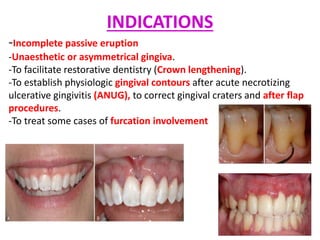
-Incomplete passive eruption
-Unaesthetic or asymmetrical gingiva.
-To facilitate restorative dentistry (Crown lengthening).
-To establish physiologic gingival contours after acute necrotizing
ulcerative gingivitis (ANUG), to correct gingival craters and after flap
procedures.
-To treat some cases of furcation involvement
Contraindications:
*Absence of adequate zone of keratinized tissue.
*Pockets that extend beyond the mucogingival line.
*Treatment of intrabony pockets.
*When osseous surgery or inductive techniques are
recommended.
*Gingival enlargement due to blood diseases (e.g.
leukemic gingival enlargement)
*Highly inflamed or edematous tissues.
*Bad oral hygiene.
Advantages:
Predictability.
Ease of pocket elimination.
Good access to tooth surface.
Disadvantages:
Healing by secondary intention.
Post operative bleeding.
Loss of keratinized gingiva.
Inability to treat intraosseous
defects.
Various techniques of GINGIVECTOMY
Surgical gingivectomy (external and internal
bevel gingivectomy)
Gingivectomy by electrosurgery
Laser gingivectomy
Gingivectomy with chemosurgery
Surgical Electrosurgery
Laser Chemosurgery
1- Surgical gingivectomy
Instrument uses
1- Surgical gingivectomy
1- Anesthesia: Infiltration into marginal and papillary tissues with
lidocaine and 1:100,000 epinephrine (vasoconstriction) provides
tissue rigidity to facilitate resection.
Anesthetic without epinephrine may be used on patients with
hypertension or heart disease.
2- Pocket marking
The Crane Kaplan or pocket marking
forceps
bleeding points marked
Pocket marking forceps
(Crane kaplane tweezers)
Marking the pocket
depths
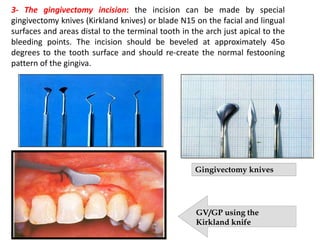
Gingivectomy knives
GV/GP using the
Kirkland knife
3- The gingivectomy incision: the incision can be made by special
gingivectomy knives (Kirkland knives) or blade N15 on the facial and lingual
surfaces and areas distal to the terminal tooth in the arch just apical to the
bleeding points. The incision should be beveled at approximately 45o
degrees to the tooth surface and should re-create the normal festooning
pattern of the gingiva.
GV/GP using the Orban papilla knife
4- Orban and Buck knives are used for interdental
incisions. Bard parker blades no 11 and 12 and scissors
are used as auxiliary instruments. Following the
beveled incisions, horizontal incisions are made
between each interdental space with an Orban or Buck
knife or using a no. 12 blade on a conventional scalpel
handle in order to separate interdental wedges of
tissue.
4- Tissue removal: If the incision has completely separated the
pocket wall from the underlying tissues, the pocket wall can be
removed easily using a curette or scaler. Remains of fibrous
connective tissue and granulation tissue are removed
thoroughly with sharp curettes. Any further trimming of the
gingiva could be done by fine scissors. Residual calculus on the
roots should be scaled off the root and root should be planed
leaving a smooth clean surface
Periodontal dressing:
• To protect wound from irritation.
• To control bleeding
• To control excess granulation tissue
• Production during initial healing.
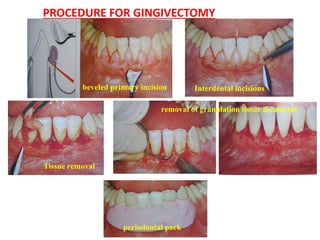
PROCEDURE FOR GINGIVECTOMY
beveled primary incision Interdental incisions
Tissue removal
removal of granulation tissue &calculus
periodontal pack
The Incision should be beveled 45 degree to the tooth surface to follow normal
contouring of the gingiva
Healing after gingivectomy
The initial response after gingivectomy is the
formation of a protective surface clot. The area
under the clot undergoes a short phase of acute
inflammation. The clot is then replaced by
granulation tissue. Epithelial cells migrate from
the edge of the wound beneath the clot. They
cover the wound in 7-14 days, and keratinize in
2-3 weeks. The formation of a new epithelial
attachment may take as long as 4 weeks.
Surgical Electrosurgery
Laser Chemosurgery
Uses high frequency current of 1.5 to 7.5 million cycles per second.
Electrosurgery - Device and tips
5. When the electrode touches the root, areas of
cementum burn are produced.
Surgical Electrosurgery
Laser Chemosurgery
Disadvantage
• Crown lengthening is a procedure
performed to increase the clinical
crown
Indication for crown lengthening
• To increase the clinical crown for
restorative treatment.
• In cases of altered passive eruption
(tooth eruption consists of an active
and a passive phase. Active eruption is
the movement of the teeth in the
direction of the occlusal plane,
whereas passive eruption is related to
the exposure of the teeth by apical
migration of the gingiva).
• For esthetic recontouring of the
gingiva in cases of excessive gingival
display passive eruption is a normal
condition
CROWN LENGTHENING
CROWN LENGTHENING
• Procedures for crown lengthening
• Crown lengthening can be performed by either extension apically
• Or extension coronally by orthodontic extrusion .
in all situations the crown root ratio has to be considered.
Biologic width and level
of interproximal bone
Width of
keratinized
gingiva
Gingival biotype
1- Biologic Width
• It is the dimension of
space occupied by JE
and CT attachment
above the alveolar
bone.
• It is recommended
that there should be
at least 2 mm
between the
restoration margin
and the bone crest to
allow adequate
biologic width.
Biologic width
Extension of restorations margin too far subgingivally (2 mm or less from
the alveolar bone) will impinge on the attachment apparatus leading to:
1- Gingival inflammation,
2- Bone loss
3- Pocket formation
2- Gingival biotype
Direct measurement: Using a periodontal probe Thick B.>1.5mm>Thin B.
More prone to additional recession following crown lengthening surgery.
CROWN LENGTHENING
• Surgical procedures for crown lengthening
Gingivectomy: this procedure is applied when
• Ostectomy is not required and the level of the alveolar
bone crest allows for the biologic width to be established.
• Cases of delayed passive eruption & gingival enlargement.
• Thick gingival biotype
• Enough zone of keratinized gingiva
Apical repositioned flap in cases of
• Insufficient zone of keratinized gingival.
• Osseous recontouring and establishment of the biologic
width.
• Thin gingival biotype.
CROWN LENGTHENING
• Procedures for crown lengthening
Gingivectomy

Gingivectomy

  • 1.
    Dr: Enas Elgendy Ass.Prof. of Oral Medicine and Periodontology
  • 2.
    Gingival Enlargement It isexcessive over-growth of the gum tissue surrounding teeth. This growth is usually irregular and may or may not be associated with bleeding. It has several causes and patients should be carefully evaluated to determine the origin of the problem.
  • 3.
    Causes of GingivalEnlargement • Inflammatory Enlargement • Acute ( gingival abscess, periodontal abscess) • Chronic (plaque induced) • Medication Causes • Phenytoin (Dilantin) occurs in 40-50% pts • Calcium Channel Blockers (occurs rarely) – Nifedipine (Procardia) – Diltiazem (Cardizem) • Cyclosporine • birth control pills. • Conditioned • Pregnancy • Puberty • Vitamin C deficiency • Plasma cell gingivitis • Pyogenic granuloma • Mouth- breathing
  • 4.
    Causes of gingivalenlargement • Systemic Diseases • Leukemia • Granulomatous diseases (sarcoidosis, Wegene’s granulomatosis) • Acromegaly • Neoplastic Enlargement • Benign tumors • Malignant tumors • False Enlargement Increase size of underlying bone or dental tissue
  • 5.
    Effects of gingivalenlargement • Oral hygiene becomes impeded. • Interfere with speech, occlusion, and esthetics. • Interferes with normal tooth eruption. • Can cause tooth migration.
  • 6.
    After management ofthe inflammatory component by phase 1 therapy surgical correction can be carried out.
  • 7.
    GINGIVECTOMY AND GINGIVOPLASTY •Gingivectomy: is the excisional removal of gingival tissues for pocket reduction or elimination. • Gingivoplasty: is the reshaping of the gingiva to attain a more physiologic contour. • Gingivectomy and gingivoplasty are usually performed at the same time. Aim • is pocket elimination for root accessibility and establishment of physiologic gingival contours.
  • 8.
    INDICATIONS -Elimination of suprabonypockets in the presence of adequate zone of keratinized tissue. -Fibrotic gingival enlargements. Figure 1: Different types of periodontal pockets. A, Gingival pocket, There is no destruction of the supporting periodontal tissue. B, Suprabony pocket, the base of the pocket is coronal to the level of underlying bone. Bone loss is horizontal. C, Intrabony pocket, the base of the pocket is apical to the level of adjacent bone. Bone loss is vertical.
  • 9.
    INDICATIONS -Incomplete passive eruption -Unaestheticor asymmetrical gingiva. -To facilitate restorative dentistry (Crown lengthening). -To establish physiologic gingival contours after acute necrotizing ulcerative gingivitis (ANUG), to correct gingival craters and after flap procedures. -To treat some cases of furcation involvement
  • 10.
    Contraindications: *Absence of adequatezone of keratinized tissue. *Pockets that extend beyond the mucogingival line. *Treatment of intrabony pockets. *When osseous surgery or inductive techniques are recommended. *Gingival enlargement due to blood diseases (e.g. leukemic gingival enlargement) *Highly inflamed or edematous tissues. *Bad oral hygiene.
  • 11.
    Advantages: Predictability. Ease of pocketelimination. Good access to tooth surface. Disadvantages: Healing by secondary intention. Post operative bleeding. Loss of keratinized gingiva. Inability to treat intraosseous defects.
  • 12.
    Various techniques ofGINGIVECTOMY Surgical gingivectomy (external and internal bevel gingivectomy) Gingivectomy by electrosurgery Laser gingivectomy Gingivectomy with chemosurgery
  • 13.
  • 14.
  • 15.
  • 17.
    1- Surgical gingivectomy 1-Anesthesia: Infiltration into marginal and papillary tissues with lidocaine and 1:100,000 epinephrine (vasoconstriction) provides tissue rigidity to facilitate resection. Anesthetic without epinephrine may be used on patients with hypertension or heart disease. 2- Pocket marking The Crane Kaplan or pocket marking forceps bleeding points marked
  • 18.
    Pocket marking forceps (Cranekaplane tweezers) Marking the pocket depths
  • 19.
    Gingivectomy knives GV/GP usingthe Kirkland knife 3- The gingivectomy incision: the incision can be made by special gingivectomy knives (Kirkland knives) or blade N15 on the facial and lingual surfaces and areas distal to the terminal tooth in the arch just apical to the bleeding points. The incision should be beveled at approximately 45o degrees to the tooth surface and should re-create the normal festooning pattern of the gingiva.
  • 20.
    GV/GP using theOrban papilla knife 4- Orban and Buck knives are used for interdental incisions. Bard parker blades no 11 and 12 and scissors are used as auxiliary instruments. Following the beveled incisions, horizontal incisions are made between each interdental space with an Orban or Buck knife or using a no. 12 blade on a conventional scalpel handle in order to separate interdental wedges of tissue.
  • 21.
    4- Tissue removal:If the incision has completely separated the pocket wall from the underlying tissues, the pocket wall can be removed easily using a curette or scaler. Remains of fibrous connective tissue and granulation tissue are removed thoroughly with sharp curettes. Any further trimming of the gingiva could be done by fine scissors. Residual calculus on the roots should be scaled off the root and root should be planed leaving a smooth clean surface
  • 22.
    Periodontal dressing: • Toprotect wound from irritation. • To control bleeding • To control excess granulation tissue • Production during initial healing.
  • 23.
    PROCEDURE FOR GINGIVECTOMY beveledprimary incision Interdental incisions Tissue removal removal of granulation tissue &calculus periodontal pack
  • 24.
    The Incision shouldbe beveled 45 degree to the tooth surface to follow normal contouring of the gingiva
  • 26.
    Healing after gingivectomy Theinitial response after gingivectomy is the formation of a protective surface clot. The area under the clot undergoes a short phase of acute inflammation. The clot is then replaced by granulation tissue. Epithelial cells migrate from the edge of the wound beneath the clot. They cover the wound in 7-14 days, and keratinize in 2-3 weeks. The formation of a new epithelial attachment may take as long as 4 weeks.
  • 27.
  • 28.
    Uses high frequencycurrent of 1.5 to 7.5 million cycles per second. Electrosurgery - Device and tips
  • 29.
    5. When theelectrode touches the root, areas of cementum burn are produced.
  • 30.
  • 33.
  • 34.
    • Crown lengtheningis a procedure performed to increase the clinical crown Indication for crown lengthening • To increase the clinical crown for restorative treatment. • In cases of altered passive eruption (tooth eruption consists of an active and a passive phase. Active eruption is the movement of the teeth in the direction of the occlusal plane, whereas passive eruption is related to the exposure of the teeth by apical migration of the gingiva). • For esthetic recontouring of the gingiva in cases of excessive gingival display passive eruption is a normal condition CROWN LENGTHENING
  • 35.
    CROWN LENGTHENING • Proceduresfor crown lengthening • Crown lengthening can be performed by either extension apically • Or extension coronally by orthodontic extrusion . in all situations the crown root ratio has to be considered.
  • 36.
    Biologic width andlevel of interproximal bone Width of keratinized gingiva Gingival biotype
  • 37.
    1- Biologic Width •It is the dimension of space occupied by JE and CT attachment above the alveolar bone. • It is recommended that there should be at least 2 mm between the restoration margin and the bone crest to allow adequate biologic width.
  • 38.
    Biologic width Extension ofrestorations margin too far subgingivally (2 mm or less from the alveolar bone) will impinge on the attachment apparatus leading to: 1- Gingival inflammation, 2- Bone loss 3- Pocket formation
  • 39.
    2- Gingival biotype Directmeasurement: Using a periodontal probe Thick B.>1.5mm>Thin B. More prone to additional recession following crown lengthening surgery.
  • 40.
    CROWN LENGTHENING • Surgicalprocedures for crown lengthening Gingivectomy: this procedure is applied when • Ostectomy is not required and the level of the alveolar bone crest allows for the biologic width to be established. • Cases of delayed passive eruption & gingival enlargement. • Thick gingival biotype • Enough zone of keratinized gingiva Apical repositioned flap in cases of • Insufficient zone of keratinized gingival. • Osseous recontouring and establishment of the biologic width. • Thin gingival biotype.
  • 41.
    CROWN LENGTHENING • Proceduresfor crown lengthening