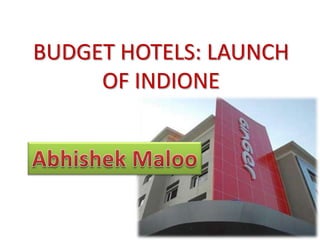
BUDGET HOTELS: LAUNCH
     OF INDIONE
HOSPITALITY INDUSTRY
• It is one of the fastest growing industry in the
  world as well as in India.
• With the advancement of the budget hotels
  its pace is accelerated.
• According to World Travel and Tourism Council
  India has the potential of becoming the
  number one tourist destination with the
  demand growing at 10.1%/ annum.
HOSPITALITY INDUSTRY
• The World Travel Organisation predicts that India
  will receive 25 million tourist by 2015.
• India currently has over 200,000 hotel rooms and
  is still facing a shortfall of over 100,000
  rooms(source-FHRAI).
• India will be adding 114,000 hotel rooms over the
  next five years and investment of INR 40, 463.10
  crore (source-HVS).
• Application of aggressive strategies through its
  campaign “Incredible India” to promote tourism.
The Current Scenario
• Existing hotel rooms in India:- 202,963(source-
  FHRAI)
• Revenue of the Indian hotel industry FY 2009-
  10: US $ 137.36 million (INR 47,889.03 crore)
• 30% of the revenue i.e. US $ 41.2 million (INR
  14, 366.7 crore) went back into the market in
  FY 2008 – 09 as operating expenses.
COMPANY PROFILE
• The Indian Hotels Company (IHCL) and its
  subsidies are collectively known as Taj Hotels
  Resorts and Palaces.
• It is one of Asia’s finest and largest group of
  hotels.
• Incorporated by the founder of Tata group
  Jamsedji Tata.
COMPANY PROFILE
• Taj Hotels Resorts and Palaces comprises 93
  hotels in 53 locations.
• It includes 25 Ginger hotels across India and
  16 international hotels.
• IHCL operates in the luxury, upper upscale and
  value segment of the market.
• IHCL’s head office is in Mumbai, India.
BUDGET HOTELS :
• It is India’s first of its kind chain of Smart Basics
  hotels.
• It is a innovative concept which redefines the way
  the business travel is done in India.
• It is a GenNext category of hotels in India.
• It signify simplicity, convenience, informality, style,
  warmth, modernity and affordability.
• The concept was developed in association with Dr.
  C.K. Prahalad.
BUDGET HOTELS :
• It was first launched in Bangalore and was
  called IndiOne, a brand name given by
  Chlorophyll (communication consultancy).
• Chlorophyll also designed the signage,
  curtains, furnishing and the website.
• It was also provided with the job of direct
  marketing activities of the brand.
INITIAL PROBLEMS
• The venture was not under the Brand name of
  Taj.
• After stripping features in the services and
  cutting cost, they cannot go below Rs. 2500.
• It was not a competitive price for the Budget
  Segment.
STRATEGIC MOVE
• They took the assistance of Dr. Prahalad.
• He suggested the bottom – up approach to
  arrive at a price and the service offering.
• They surveyed managers, salespersons and
  business travellers of mid-sized companies.
• This gave them a fair idea of price range i.e.
  Rs. 1000/room.
STRATEGIC MOVE
• Each hotel was built in the area of 1 acre with
  100 rooms.
• They budget of each hotel was marked at Rs.
  100 millions which means Rs. 1 million/ room.
• This was comparatively far lower than the
  investment of Rs. 5 millions – 15 millions /
  room in developing five star hotels.
STRATEGIC MOVE
• Size of the room was kept small- around 180
  sq. ft. as compared to 250- 400 sq. ft. of
  premium segment hotel.
• The company cut down room service and
  applied the concept of “Help Yourself”.
• This concept helped in operating the hotel
  with 25 people as compared to 250 people in
  premium category hotel.
PRICING
• Single Room Charges- Rs.
• Double Room Charges- Rs. 950.
• The customers were entitled to a discount of
  Rs. 50 if booking is made through internet.
• This practice helped to cut their marketing
  costs which contributes to 10% -15 % of room
  costs.
SPECIAL OFFERS
• Early Booking Offer:- “SAVE NOW” Book Early and
  Pay Less.
• Last Minutes Rates:- Sensational last minutes
  rates in their top destinations.
• Day Use Rates:- Introducing special day use rates
  for travelers to freshen up or relax before
  heading to work.
• Coolest Offer Packages:- Visit most popular
  destination starting at just Rs. 2799/- onwards.
FACILITIES
• Ginger’s facilities and services are intelligently
  designed for customers comfort and convenience.
• It provides:-
      •   meeting room,
      •   conference room,
      •   restaurant and WiFi and net zone
      •   self checking
      •   safe zone
      •   CCD,
      •   water dispenser
      •   20 inch flat-TV in each room with satellite channel
      •   Mini fridge
      •   24 hr hot /cold water
BOOKING SYSTEM
• It provides a toll- free number-1860-266-3333
  to book over phone.
• Payment Options:-
      American Express Card.
      Master Card / Debit Card.
      Visa credit/ Debit Card.
      Net Banking.
• Facility of group booking is also available.
CORPORATE ADVANTAGES
• Optimizes costs:- Enjoy special customized rates.
• Enjoy exciting facilities.
• Convenience and peace of mind:- suitable
  location, rooms are hygienic, peaceful &
  comfortable.
• Consistency:- Uniform standard in services.
• Hassle free resevations.
• Transparency in booking process
• National Contract.
GLOBAL TRENDS
• Enjoy unmatched blend of comfort and
  economy & convenience in India.
• According to global study, international
  travelers are increasingly concerned about
  their safety while choosing hotels, so Ginger
  ensures stringent checks.
• The Ease of the internet for booking solutions
  and customer can also get SMS and e-mail
  updates of every transaction.
STRATEGIES ADOPTED BY GINGER HOTELS
Meeting room for Corporate
Banquet halls
Gymnasium facilities with Certified Trainers
Hotels in Malls
PPP models-Yatri Niwas
HEALTH TOURISM & “HOTEL IN MALLS”


• India’s gaining popularity in Health tourism
  – Disparity cost in healthcare services.
  – Yoga, meditation, ayurveda etc
• Hotel in Malls for seasoned business travellers
  or tourists
  – Tristar Hotels Private Limited, first in Delhi
SUCCESS FACTOR FOR BUDGET HOTELS

• Site & location

• Positioning

• Financial flexibility

• Brand equity
EXISTING PLAYERS
• ITC Fortune Hotels- strong presence in
   – Ahmedabad, Chennai, Darjeeling, Indore,Jodhpur, Jamshedpur

• Courtyard - Mariott International
   – commissioned hotels in Goa, Chennai, Pune, Hyderabad

• Lemon Tree Hotels- Delhi based Company
   – presence in cities like Goa, Gurgaon, Ahmedabad, Aurangabad, Indore,
     Chennai

• Formula 1-joint venture between France hospitality giant Accor and
  Emaar MGF
UPCOMING PLAYERS
• Keys -backed by NewYork based Berggruen Holdings.
• Premier Inn-UK’s largest hotel chain
• Hilton Garden Inn- a joint venture launched by DLF and
  Hilton Hotels

• Indian Railways, in the public sector, has announced its plans
  to set up 100 budget hotels all over country on railway land
CHALLANGES
• Poor domestic tourism infrastructure
• Highly prone to socio-economic & political
  conditions
• Tourism on the verge of ecological imbalance
• India’s growing economy and new entrants
PORTER’S FIVE FORCES
             COMPETITORS
             • Existing players
             • Unorganized hotel sector

NEW ENTRANTS                              SUBSTITUTES
• India's growing economy thereby         • Mid- Size hotels
  attracting new competitors
• 100% FDI permissible
• Low investment


         BARGAINING POWER                 BARGAINIG POWER OF
         OF BUYER                         SUPPLIERS
         • Higher in metro cities           Limited due to higher
           due to increasing room           competition (metros)
           supply.
ANALYSIS OF GINGER HOTEL,
             BHUBANESWAR

•   Implementation of all “Smart Basics” concept
•   Coffee Café day
•   Presence of Swosti Premium, May Fair, Hilton
•   No proper advertisement & promotion
Our strategies

•   Target to middle class foreign tourists
•   Corporate tie-ups
•   Loyalty cards
•   Referral system
•   Travel agents
•   Hop-on-Hop-off
GINGER HOTELS

GINGER HOTELS

  • 1.
  • 2.
    HOSPITALITY INDUSTRY • Itis one of the fastest growing industry in the world as well as in India. • With the advancement of the budget hotels its pace is accelerated. • According to World Travel and Tourism Council India has the potential of becoming the number one tourist destination with the demand growing at 10.1%/ annum.
  • 3.
    HOSPITALITY INDUSTRY • TheWorld Travel Organisation predicts that India will receive 25 million tourist by 2015. • India currently has over 200,000 hotel rooms and is still facing a shortfall of over 100,000 rooms(source-FHRAI). • India will be adding 114,000 hotel rooms over the next five years and investment of INR 40, 463.10 crore (source-HVS). • Application of aggressive strategies through its campaign “Incredible India” to promote tourism.
  • 5.
    The Current Scenario •Existing hotel rooms in India:- 202,963(source- FHRAI) • Revenue of the Indian hotel industry FY 2009- 10: US $ 137.36 million (INR 47,889.03 crore) • 30% of the revenue i.e. US $ 41.2 million (INR 14, 366.7 crore) went back into the market in FY 2008 – 09 as operating expenses.
  • 6.
    COMPANY PROFILE • TheIndian Hotels Company (IHCL) and its subsidies are collectively known as Taj Hotels Resorts and Palaces. • It is one of Asia’s finest and largest group of hotels. • Incorporated by the founder of Tata group Jamsedji Tata.
  • 7.
    COMPANY PROFILE • TajHotels Resorts and Palaces comprises 93 hotels in 53 locations. • It includes 25 Ginger hotels across India and 16 international hotels. • IHCL operates in the luxury, upper upscale and value segment of the market. • IHCL’s head office is in Mumbai, India.
  • 8.
    BUDGET HOTELS : •It is India’s first of its kind chain of Smart Basics hotels. • It is a innovative concept which redefines the way the business travel is done in India. • It is a GenNext category of hotels in India. • It signify simplicity, convenience, informality, style, warmth, modernity and affordability. • The concept was developed in association with Dr. C.K. Prahalad.
  • 9.
    BUDGET HOTELS : •It was first launched in Bangalore and was called IndiOne, a brand name given by Chlorophyll (communication consultancy). • Chlorophyll also designed the signage, curtains, furnishing and the website. • It was also provided with the job of direct marketing activities of the brand.
  • 11.
    INITIAL PROBLEMS • Theventure was not under the Brand name of Taj. • After stripping features in the services and cutting cost, they cannot go below Rs. 2500. • It was not a competitive price for the Budget Segment.
  • 12.
    STRATEGIC MOVE • Theytook the assistance of Dr. Prahalad. • He suggested the bottom – up approach to arrive at a price and the service offering. • They surveyed managers, salespersons and business travellers of mid-sized companies. • This gave them a fair idea of price range i.e. Rs. 1000/room.
  • 13.
    STRATEGIC MOVE • Eachhotel was built in the area of 1 acre with 100 rooms. • They budget of each hotel was marked at Rs. 100 millions which means Rs. 1 million/ room. • This was comparatively far lower than the investment of Rs. 5 millions – 15 millions / room in developing five star hotels.
  • 14.
    STRATEGIC MOVE • Sizeof the room was kept small- around 180 sq. ft. as compared to 250- 400 sq. ft. of premium segment hotel. • The company cut down room service and applied the concept of “Help Yourself”. • This concept helped in operating the hotel with 25 people as compared to 250 people in premium category hotel.
  • 15.
    PRICING • Single RoomCharges- Rs. • Double Room Charges- Rs. 950. • The customers were entitled to a discount of Rs. 50 if booking is made through internet. • This practice helped to cut their marketing costs which contributes to 10% -15 % of room costs.
  • 16.
    SPECIAL OFFERS • EarlyBooking Offer:- “SAVE NOW” Book Early and Pay Less. • Last Minutes Rates:- Sensational last minutes rates in their top destinations. • Day Use Rates:- Introducing special day use rates for travelers to freshen up or relax before heading to work. • Coolest Offer Packages:- Visit most popular destination starting at just Rs. 2799/- onwards.
  • 17.
    FACILITIES • Ginger’s facilitiesand services are intelligently designed for customers comfort and convenience. • It provides:- • meeting room, • conference room, • restaurant and WiFi and net zone • self checking • safe zone • CCD, • water dispenser • 20 inch flat-TV in each room with satellite channel • Mini fridge • 24 hr hot /cold water
  • 18.
    BOOKING SYSTEM • Itprovides a toll- free number-1860-266-3333 to book over phone. • Payment Options:- American Express Card. Master Card / Debit Card. Visa credit/ Debit Card. Net Banking. • Facility of group booking is also available.
  • 19.
    CORPORATE ADVANTAGES • Optimizescosts:- Enjoy special customized rates. • Enjoy exciting facilities. • Convenience and peace of mind:- suitable location, rooms are hygienic, peaceful & comfortable. • Consistency:- Uniform standard in services. • Hassle free resevations. • Transparency in booking process • National Contract.
  • 20.
    GLOBAL TRENDS • Enjoyunmatched blend of comfort and economy & convenience in India. • According to global study, international travelers are increasingly concerned about their safety while choosing hotels, so Ginger ensures stringent checks. • The Ease of the internet for booking solutions and customer can also get SMS and e-mail updates of every transaction.
  • 21.
    STRATEGIES ADOPTED BYGINGER HOTELS Meeting room for Corporate Banquet halls Gymnasium facilities with Certified Trainers Hotels in Malls PPP models-Yatri Niwas
  • 22.
    HEALTH TOURISM &“HOTEL IN MALLS” • India’s gaining popularity in Health tourism – Disparity cost in healthcare services. – Yoga, meditation, ayurveda etc • Hotel in Malls for seasoned business travellers or tourists – Tristar Hotels Private Limited, first in Delhi
  • 23.
    SUCCESS FACTOR FORBUDGET HOTELS • Site & location • Positioning • Financial flexibility • Brand equity
  • 24.
    EXISTING PLAYERS • ITCFortune Hotels- strong presence in – Ahmedabad, Chennai, Darjeeling, Indore,Jodhpur, Jamshedpur • Courtyard - Mariott International – commissioned hotels in Goa, Chennai, Pune, Hyderabad • Lemon Tree Hotels- Delhi based Company – presence in cities like Goa, Gurgaon, Ahmedabad, Aurangabad, Indore, Chennai • Formula 1-joint venture between France hospitality giant Accor and Emaar MGF
  • 25.
    UPCOMING PLAYERS • Keys-backed by NewYork based Berggruen Holdings. • Premier Inn-UK’s largest hotel chain • Hilton Garden Inn- a joint venture launched by DLF and Hilton Hotels • Indian Railways, in the public sector, has announced its plans to set up 100 budget hotels all over country on railway land
  • 26.
    CHALLANGES • Poor domestictourism infrastructure • Highly prone to socio-economic & political conditions • Tourism on the verge of ecological imbalance • India’s growing economy and new entrants
  • 27.
    PORTER’S FIVE FORCES COMPETITORS • Existing players • Unorganized hotel sector NEW ENTRANTS SUBSTITUTES • India's growing economy thereby • Mid- Size hotels attracting new competitors • 100% FDI permissible • Low investment BARGAINING POWER BARGAINIG POWER OF OF BUYER SUPPLIERS • Higher in metro cities Limited due to higher due to increasing room competition (metros) supply.
  • 28.
    ANALYSIS OF GINGERHOTEL, BHUBANESWAR • Implementation of all “Smart Basics” concept • Coffee Café day • Presence of Swosti Premium, May Fair, Hilton • No proper advertisement & promotion
  • 29.
    Our strategies • Target to middle class foreign tourists • Corporate tie-ups • Loyalty cards • Referral system • Travel agents • Hop-on-Hop-off