

Indian Hotels Company Limited-The Taj
Critical Success Factor*
MACFAST, Thiruvalla, Kerala
Presented by (S4,MBA)
• Abhijith R Nair
• Abin John Jacob
• Ajisha c.s
• Ajithkumar R.
• Akhil George
• Akhila R. pillai
• Ajmal Shajahan
Indian Hotels Company Limited(IHCL) operates
the largest hotel chain in India under the brand
“Taj Hotels, Palaces & Resorts”
• Recognised as one of Asia's largest and finest hotel company.
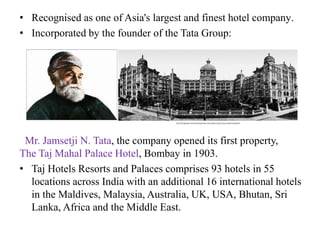
• Incorporated by the founder of the Tata Group:
Mr. Jamsetji N. Tata, the company opened its first property,
The Taj Mahal Palace Hotel, Bombay in 1903.
• Taj Hotels Resorts and Palaces comprises 93 hotels in 55
locations across India with an additional 16 international hotels
in the Maldives, Malaysia, Australia, UK, USA, Bhutan, Sri
Lanka, Africa and the Middle East.
• The Company then undertook major expansion of The Taj Mahal
Palace & Tower, Mumbai by constructing an adjacent tower block and
increasing the number of rooms from 225 to 565 rooms.
• With the completion of its initial public offering in the early 1970s,
the Company began a long term programme of geographic expansion
and development of new tourist destinations in India which led to its
emergence as a leading hotel chain in India.
• From the 1970s to the present day, the Taj Group has played an
important role in launching several of India's key tourist destinations,
working in close association with the Indian Government.
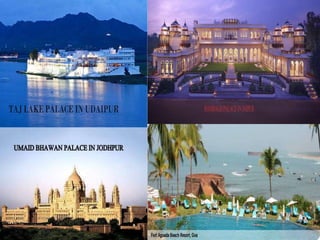
• The Taj Group has been active in converting former royal
palaces in India into world class luxury hotels such as the Taj
Lake Palace in Udaipur, the Rambagh Palace in Jaipur
and Umaid Bhawan Palace in Jodhpur.
• In 1974, the Taj Group opened India's first international five
star deluxe beach resort, the Fort Aguada Beach Resort in Goa.
• The Taj Group also began its business in metropolitan hotels in
the 1970s, opening the five-star deluxe hotel Taj Coromandel
in Chennai in 1974, acquiring an equity interest and operating
contract for the Taj President, a business hotel in Mumbai, in
1977, and opening the Taj Mahal Hotel in Delhi in 1978.
• The Taj Group of Hotels commits itself to the overall improvement
of the ecological environment, which we are all a part of.
• We recognize that we are not owners but caretakers of the Planet
and owe it to our children and future generations of humankind.
• It is our endeavour not only to conserve and protect but also to
renew and regenerate the environment in which we live and
operate.
• Our commitment encompasses all actions related to our products,
services, associates, partners, vendors and communities.
• We will partner and engage with our environment through EARTH:
Environmental Awareness and Renewal at Taj Hotels.
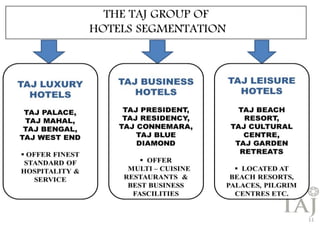
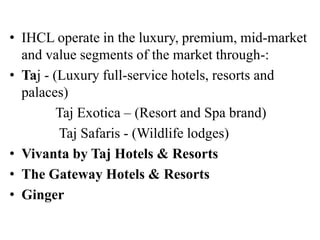
• IHCL operate in the luxury, premium, mid-market
and value segments of the market through-:
• Taj - (Luxury full-service hotels, resorts and
palaces)
Taj Exotica – (Resort and Spa brand)
Taj Safaris - (Wildlife lodges)
• Vivanta by Taj Hotels & Resorts
• The Gateway Hotels & Resorts
• Ginger
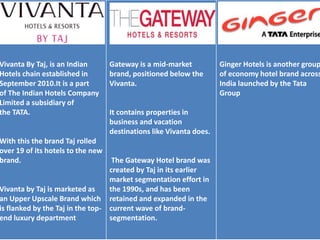
Vivanta By Taj, is an Indian
Hotels chain established in
September 2010.It is a part
of The Indian Hotels Company
Limited a subsidiary of
the TATA.
With this the brand Taj rolled
over 19 of its hotels to the new
brand.
Vivanta by Taj is marketed as
an Upper Upscale Brand which
is flanked by the Taj in the top-
end luxury department
Gateway is a mid-market
brand, positioned below the
Vivanta.
It contains properties in
business and vacation
destinations like Vivanta does.
The Gateway Hotel brand was
created by Taj in its earlier
market segmentation effort in
the 1990s, and has been
retained and expanded in the
current wave of brand-
segmentation.
Ginger Hotels is another group
of economy hotel brand across
India launched by the Tata
Group
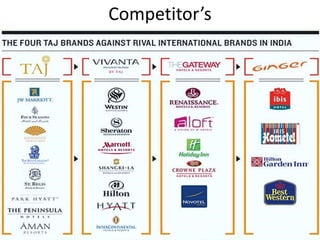
Competitor’s
• Taj Hotels also promise a whole new experience
of tranquillity and total 'wellness', through Jiva
Spas
• IHCL operates Taj Air, a luxury private jet
operation with state-of-the-art Falcon 2000
aircrafts designed by Dassault Aviation, France
• IHCL also operates Taj SATS Air Catering Ltd.,
the largest airline catering service in South Asia
• Additionally, it operates the Indian Institute of
Hotel Management, Aurangabad since 1993
Key initiatives
• New properties and expansion plan
• Wildlife lodges
• Serviced apartments
• Spas
• Guest experience
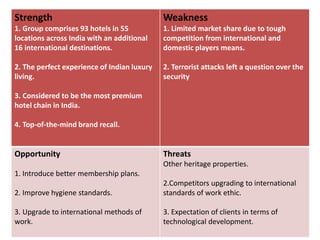
Strength
1. Group comprises 93 hotels in 55
locations across India with an additional
16 international destinations.
2. The perfect experience of Indian luxury
living.
3. Considered to be the most premium
hotel chain in India.
4. Top-of-the-mind brand recall.
Weakness
1. Limited market share due to tough
competition from international and
domestic players means.
2. Terrorist attacks left a question over the
security
Opportunity
1. Introduce better membership plans.
2. Improve hygiene standards.
3. Upgrade to international methods of
work.
Threats
Other heritage properties.
2.Competitors upgrading to international
standards of work ethic.
3. Expectation of clients in terms of
technological development.
THANK YOU

Strategic management case study, The Taj,IHCL

  • 1.
    Indian Hotels CompanyLimited-The Taj Critical Success Factor*
  • 2.
    MACFAST, Thiruvalla, Kerala Presentedby (S4,MBA) • Abhijith R Nair • Abin John Jacob • Ajisha c.s • Ajithkumar R. • Akhil George • Akhila R. pillai • Ajmal Shajahan
  • 3.
    Indian Hotels CompanyLimited(IHCL) operates the largest hotel chain in India under the brand “Taj Hotels, Palaces & Resorts”
  • 4.
    • Recognised asone of Asia's largest and finest hotel company. • Incorporated by the founder of the Tata Group: Mr. Jamsetji N. Tata, the company opened its first property, The Taj Mahal Palace Hotel, Bombay in 1903. • Taj Hotels Resorts and Palaces comprises 93 hotels in 55 locations across India with an additional 16 international hotels in the Maldives, Malaysia, Australia, UK, USA, Bhutan, Sri Lanka, Africa and the Middle East.
  • 5.
    • The Companythen undertook major expansion of The Taj Mahal Palace & Tower, Mumbai by constructing an adjacent tower block and increasing the number of rooms from 225 to 565 rooms. • With the completion of its initial public offering in the early 1970s, the Company began a long term programme of geographic expansion and development of new tourist destinations in India which led to its emergence as a leading hotel chain in India. • From the 1970s to the present day, the Taj Group has played an important role in launching several of India's key tourist destinations, working in close association with the Indian Government.
  • 6.
    • The TajGroup has been active in converting former royal palaces in India into world class luxury hotels such as the Taj Lake Palace in Udaipur, the Rambagh Palace in Jaipur and Umaid Bhawan Palace in Jodhpur. • In 1974, the Taj Group opened India's first international five star deluxe beach resort, the Fort Aguada Beach Resort in Goa. • The Taj Group also began its business in metropolitan hotels in the 1970s, opening the five-star deluxe hotel Taj Coromandel in Chennai in 1974, acquiring an equity interest and operating contract for the Taj President, a business hotel in Mumbai, in 1977, and opening the Taj Mahal Hotel in Delhi in 1978.
  • 8.
    • The TajGroup of Hotels commits itself to the overall improvement of the ecological environment, which we are all a part of. • We recognize that we are not owners but caretakers of the Planet and owe it to our children and future generations of humankind. • It is our endeavour not only to conserve and protect but also to renew and regenerate the environment in which we live and operate. • Our commitment encompasses all actions related to our products, services, associates, partners, vendors and communities. • We will partner and engage with our environment through EARTH: Environmental Awareness and Renewal at Taj Hotels.
  • 10.
    • IHCL operatein the luxury, premium, mid-market and value segments of the market through-: • Taj - (Luxury full-service hotels, resorts and palaces) Taj Exotica – (Resort and Spa brand) Taj Safaris - (Wildlife lodges) • Vivanta by Taj Hotels & Resorts • The Gateway Hotels & Resorts • Ginger
  • 11.
    Vivanta By Taj,is an Indian Hotels chain established in September 2010.It is a part of The Indian Hotels Company Limited a subsidiary of the TATA. With this the brand Taj rolled over 19 of its hotels to the new brand. Vivanta by Taj is marketed as an Upper Upscale Brand which is flanked by the Taj in the top- end luxury department Gateway is a mid-market brand, positioned below the Vivanta. It contains properties in business and vacation destinations like Vivanta does. The Gateway Hotel brand was created by Taj in its earlier market segmentation effort in the 1990s, and has been retained and expanded in the current wave of brand- segmentation. Ginger Hotels is another group of economy hotel brand across India launched by the Tata Group
  • 12.
  • 13.
    • Taj Hotelsalso promise a whole new experience of tranquillity and total 'wellness', through Jiva Spas • IHCL operates Taj Air, a luxury private jet operation with state-of-the-art Falcon 2000 aircrafts designed by Dassault Aviation, France • IHCL also operates Taj SATS Air Catering Ltd., the largest airline catering service in South Asia • Additionally, it operates the Indian Institute of Hotel Management, Aurangabad since 1993
  • 14.
    Key initiatives • Newproperties and expansion plan • Wildlife lodges • Serviced apartments • Spas • Guest experience
  • 16.
    Strength 1. Group comprises93 hotels in 55 locations across India with an additional 16 international destinations. 2. The perfect experience of Indian luxury living. 3. Considered to be the most premium hotel chain in India. 4. Top-of-the-mind brand recall. Weakness 1. Limited market share due to tough competition from international and domestic players means. 2. Terrorist attacks left a question over the security Opportunity 1. Introduce better membership plans. 2. Improve hygiene standards. 3. Upgrade to international methods of work. Threats Other heritage properties. 2.Competitors upgrading to international standards of work ethic. 3. Expectation of clients in terms of technological development.
  • 17.