CIRCLES 
SUBMITTED BY 
KAVITHA.C.KURUP, 
REG NO:13304005 
MATHEMATICS
Introduction 
The word "circle" derives from the Greek κίρκος (kirkos), itself a metathesis of the Homeric Greek κρίκος 
(krikos), meaning "hoop" or "ring".[2] The origins of the words "ci rcus" and "circuit" are closely related. 
The circle has been known since before the beginning of recorded history. Natural circles would have 
been observed, such as the Moon, Sun, and a short plant stalk blowing in the wind on sand, which forms 
a circle shape in the sand. The circle is the basis for the wheel, which, with related inventions such as 
gears, makes much of modern machinery possible. In mathematics, the study of the circle has helped 
inspire the development of geometry, astronomy, and calculus. 
Early science, particularly geometry and astrology and astronomy, was connected to the divine for most 
medieval scholars, and many believed that there was something intrinsically "divine" or "perfect" that 
could be found in circles.[3][4]
CIRCLES 
A circle is a simple shape of Euclidean geometry that is the set of all points in a plane that are at a given 
distance from a given point, the centre. The distance between any of the points and the centre is called 
the radius. It can also be defined as the locus of a point equidistant from a fixed point. 
A circle is a simple closed curve which divides the plane into two regions: an interior and an exterior. In 
everyday use, the term "circle" may be used interchangeably to refer to either the boundary of the 
figure, or to the whole figure including its interior; in strict technical usage, the circle is the former and 
the latter is called a disk. 
A circle can be defined as the curve traced out by a point that moves so that its distance from a given 
point is constant. 
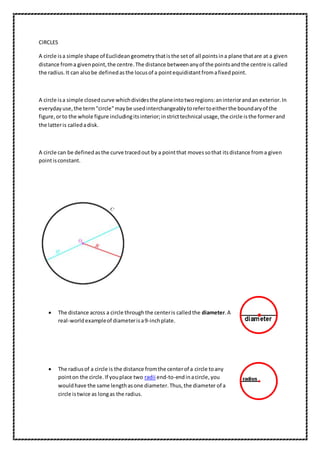
 The distance across a circle through the center is called the diameter. A 
real-world example of diameter is a 9-inch plate. 
 The radius of a circle is the distance from the center of a circle to any 
point on the circle. If you place two radii end-to-end in a circle, you 
would have the same length as one diameter. Thus, the diameter of a 
circle is twice as long as the radius.
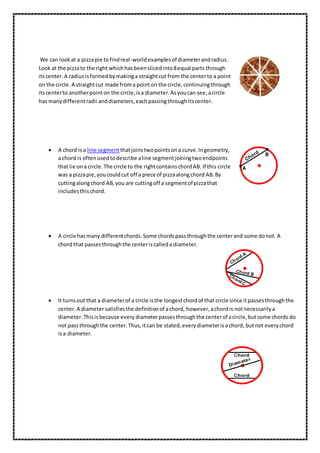
We can look at a pizza pie to find real-world examples of diameter and radius. 
Look at the pizza to the right which has been sliced into 8 equal parts through 
its center. A radius is formed by making a straight cut from the center to a point 
on the circle. A straight cut made from a point on the circle, continuing through 
its center to another point on the circle, is a diameter. As you can see, a circle 
has many different radii and diameters, each passing through its center. 
 A chord is a line segment that joins two points on a curve. In geometry, 
a chord is often used to describe a line segment joining two endpoints 
that lie on a circle. The circle to the right contains chord AB. If this circle 
was a pizza pie, you could cut off a piece of pizza along chord AB. By 
cutting along chord AB, you are cutting off a segment of pizza that 
includes this chord. 
 A circle has many different chords. Some chords pass through the center and some do not. A 
chord that passes through the center is called a diameter. 
 It turns out that a diameter of a circle is the longest chord of that circle since it passes through the 
center. A diameter satisfies the definition of a chord, however, a chord is not necessarily a 
diameter. This is because every diameter passes through the center of a circle, but some chords do 
not pass through the center. Thus, it can be stated, every diameter is a chord, but not every chord 
is a diameter.
EXERCISES 
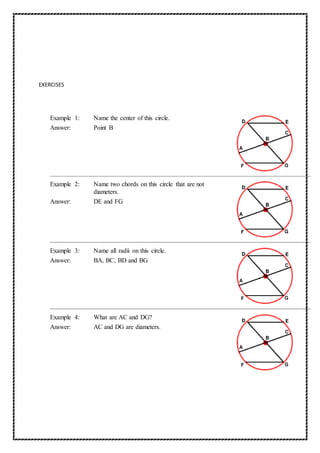
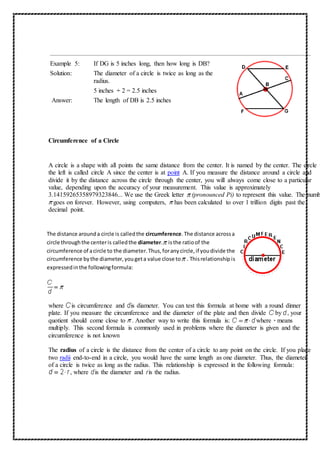
Example 1: Name the center of this circle. 
Answer: Point B 
Example 2: Name two chords on this circle that are not 
diameters. 
Answer: DE and FG 
Example 3: Name all radii on this circle. 
Answer: BA, BC, BD and BG 
Example 4: What are AC and DG? 
Answer: AC and DG are diameters.
Example 5: If DG is 5 inches long, then how long is DB? 
Solution: The diameter of a circle is twice as long as the 
radius. 
5 inches ÷ 2 = 2.5 inches 
Answer: The length of DB is 2.5 inches 
Circumference of a Circle 
A circle is a shape with all points the same distance from the center. It is named by the center. The circle to 
the left is called circle A since the center is at point A. If you measure the distance around a circle and 
divide it by the distance across the circle through the center, you will always come close to a particular 
value, depending upon the accuracy of your measurement. This value is approximately 
3.14159265358979323846... We use the Greek letter (pronounced Pi) to represent this value. The number 
goes on forever. However, using computers, has been calculated to over 1 trillion digits past the 
decimal point. 
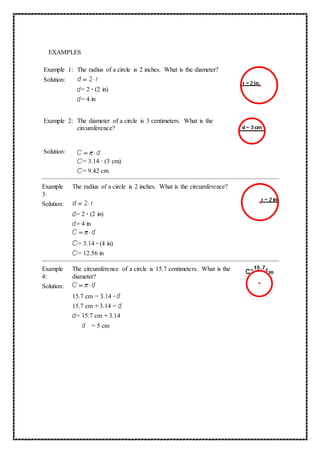
The distance around a circle is called the circumference. The distance across a 
circle through the center is called the diameter. is the ratio of the 
circumference of a circle to the diameter. Thus, for any circle, if you divide the 
circumference by the diameter, you get a value close to . This relationship is 
expressed in the following formula: 
where is circumference and is diameter. You can test this formula at home with a round dinner 
plate. If you measure the circumference and the diameter of the plate and then divide by , your 
quotient should come close to . Another way to write this formula is: where · means 
multiply. This second formula is commonly used in problems where the diameter is given and the 
circumference is not known 
The radius of a circle is the distance from the center of a circle to any point on the circle. If you place 
two radii end-to-end in a circle, you would have the same length as one diameter. Thus, the diameter 
of a circle is twice as long as the radius. This relationship is expressed in the following formula: 
, where is the diameter and is the radius.
EXAMPLES 
Example 1: The radius of a circle is 2 inches. What is the diameter? 
Solution: 
= 2 · (2 in) 
= 4 in 
Example 2: The diameter of a circle is 3 centimeters. What is the 
circumference? 
Solution: 
= 3.14 · (3 cm) 
= 9.42 cm 
Example 
3: 
The radius of a circle is 2 inches. What is the circumference? 
Solution: 
= 2 · (2 in) 
= 4 in 
= 3.14 · (4 in) 
= 12.56 in 
Example 
4: 
The circumference of a circle is 15.7 centimeters. What is the 
diameter? 
Solution: 
15.7 cm = 3.14 · 
15.7 cm ÷ 3.14 = 
= 15.7 cm ÷ 3.14 
= 5 cm
Area of a Circle 
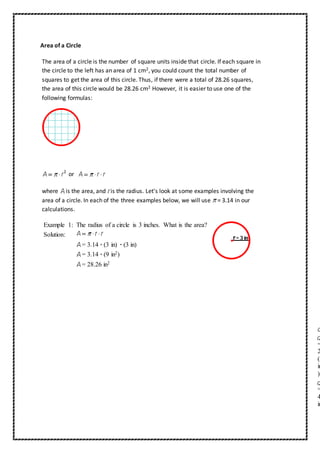
The area of a circle is the number of square units inside that circle. If each square in 
the circle to the left has an area of 1 cm2, you could count the total number of 
squares to get the area of this circle. Thus, if there were a total of 28.26 squares, 
the area of this circle would be 28.26 cm2 However, it is easier to use one of the 
following formulas: 
or 
where is the area, and is the radius. Let's look at some examples involving the 
area of a circle. In each of the three examples below, we will use = 3.14 in our 
calculations. 
Example 1: The radius of a circle is 3 inches. What is the area? 
Solution: 
= 3.14 · (3 in) · (3 in) 
= 3.14 · (9 in2) 
= 28.26 in2 
= 
2 (2 
in 
) 
= 
4 
in
Circles

Circles

  • 1.
    CIRCLES SUBMITTED BY KAVITHA.C.KURUP, REG NO:13304005 MATHEMATICS
  • 2.
    Introduction The word"circle" derives from the Greek κίρκος (kirkos), itself a metathesis of the Homeric Greek κρίκος (krikos), meaning "hoop" or "ring".[2] The origins of the words "ci rcus" and "circuit" are closely related. The circle has been known since before the beginning of recorded history. Natural circles would have been observed, such as the Moon, Sun, and a short plant stalk blowing in the wind on sand, which forms a circle shape in the sand. The circle is the basis for the wheel, which, with related inventions such as gears, makes much of modern machinery possible. In mathematics, the study of the circle has helped inspire the development of geometry, astronomy, and calculus. Early science, particularly geometry and astrology and astronomy, was connected to the divine for most medieval scholars, and many believed that there was something intrinsically "divine" or "perfect" that could be found in circles.[3][4]
  • 3.
    CIRCLES A circleis a simple shape of Euclidean geometry that is the set of all points in a plane that are at a given distance from a given point, the centre. The distance between any of the points and the centre is called the radius. It can also be defined as the locus of a point equidistant from a fixed point. A circle is a simple closed curve which divides the plane into two regions: an interior and an exterior. In everyday use, the term "circle" may be used interchangeably to refer to either the boundary of the figure, or to the whole figure including its interior; in strict technical usage, the circle is the former and the latter is called a disk. A circle can be defined as the curve traced out by a point that moves so that its distance from a given point is constant.  The distance across a circle through the center is called the diameter. A real-world example of diameter is a 9-inch plate.  The radius of a circle is the distance from the center of a circle to any point on the circle. If you place two radii end-to-end in a circle, you would have the same length as one diameter. Thus, the diameter of a circle is twice as long as the radius.
  • 4.
    We can lookat a pizza pie to find real-world examples of diameter and radius. Look at the pizza to the right which has been sliced into 8 equal parts through its center. A radius is formed by making a straight cut from the center to a point on the circle. A straight cut made from a point on the circle, continuing through its center to another point on the circle, is a diameter. As you can see, a circle has many different radii and diameters, each passing through its center.  A chord is a line segment that joins two points on a curve. In geometry, a chord is often used to describe a line segment joining two endpoints that lie on a circle. The circle to the right contains chord AB. If this circle was a pizza pie, you could cut off a piece of pizza along chord AB. By cutting along chord AB, you are cutting off a segment of pizza that includes this chord.  A circle has many different chords. Some chords pass through the center and some do not. A chord that passes through the center is called a diameter.  It turns out that a diameter of a circle is the longest chord of that circle since it passes through the center. A diameter satisfies the definition of a chord, however, a chord is not necessarily a diameter. This is because every diameter passes through the center of a circle, but some chords do not pass through the center. Thus, it can be stated, every diameter is a chord, but not every chord is a diameter.
  • 5.
    EXERCISES Example 1:Name the center of this circle. Answer: Point B Example 2: Name two chords on this circle that are not diameters. Answer: DE and FG Example 3: Name all radii on this circle. Answer: BA, BC, BD and BG Example 4: What are AC and DG? Answer: AC and DG are diameters.
  • 6.
    Example 5: IfDG is 5 inches long, then how long is DB? Solution: The diameter of a circle is twice as long as the radius. 5 inches ÷ 2 = 2.5 inches Answer: The length of DB is 2.5 inches Circumference of a Circle A circle is a shape with all points the same distance from the center. It is named by the center. The circle to the left is called circle A since the center is at point A. If you measure the distance around a circle and divide it by the distance across the circle through the center, you will always come close to a particular value, depending upon the accuracy of your measurement. This value is approximately 3.14159265358979323846... We use the Greek letter (pronounced Pi) to represent this value. The number goes on forever. However, using computers, has been calculated to over 1 trillion digits past the decimal point. The distance around a circle is called the circumference. The distance across a circle through the center is called the diameter. is the ratio of the circumference of a circle to the diameter. Thus, for any circle, if you divide the circumference by the diameter, you get a value close to . This relationship is expressed in the following formula: where is circumference and is diameter. You can test this formula at home with a round dinner plate. If you measure the circumference and the diameter of the plate and then divide by , your quotient should come close to . Another way to write this formula is: where · means multiply. This second formula is commonly used in problems where the diameter is given and the circumference is not known The radius of a circle is the distance from the center of a circle to any point on the circle. If you place two radii end-to-end in a circle, you would have the same length as one diameter. Thus, the diameter of a circle is twice as long as the radius. This relationship is expressed in the following formula: , where is the diameter and is the radius.
  • 7.
    EXAMPLES Example 1:The radius of a circle is 2 inches. What is the diameter? Solution: = 2 · (2 in) = 4 in Example 2: The diameter of a circle is 3 centimeters. What is the circumference? Solution: = 3.14 · (3 cm) = 9.42 cm Example 3: The radius of a circle is 2 inches. What is the circumference? Solution: = 2 · (2 in) = 4 in = 3.14 · (4 in) = 12.56 in Example 4: The circumference of a circle is 15.7 centimeters. What is the diameter? Solution: 15.7 cm = 3.14 · 15.7 cm ÷ 3.14 = = 15.7 cm ÷ 3.14 = 5 cm
  • 8.
    Area of aCircle The area of a circle is the number of square units inside that circle. If each square in the circle to the left has an area of 1 cm2, you could count the total number of squares to get the area of this circle. Thus, if there were a total of 28.26 squares, the area of this circle would be 28.26 cm2 However, it is easier to use one of the following formulas: or where is the area, and is the radius. Let's look at some examples involving the area of a circle. In each of the three examples below, we will use = 3.14 in our calculations. Example 1: The radius of a circle is 3 inches. What is the area? Solution: = 3.14 · (3 in) · (3 in) = 3.14 · (9 in2) = 28.26 in2 = 2 (2 in ) = 4 in