*
    Elizabeth Artemis Bailey
*
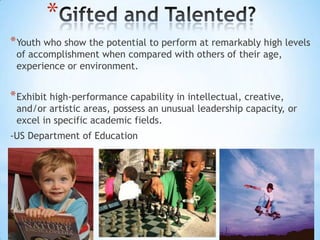
* Youth who show the potential to perform at remarkably high levels
 of accomplishment when compared with others of their age,
 experience or environment.


* Exhibit high-performance capability in intellectual, creative,
 and/or artistic areas, possess an unusual leadership capacity, or
 excel in specific academic fields.
-US Department of Education
*
* A series of misconceptions surrounds gifted learners, fueling   a
 severe failure on the part of our education system to meet
 their needs.
*
* MYTH: Global Giftedness. The idea that gifted children are gifted
 across the board


* REALITY: This idea that all gifted children are “globally gifted” is
 about as mythic as a robot unicorn, and nearly as dangerous. It
 ignores the existence of “twice-exceptional” kids, children who
 are gifted in one area and learning disabled in another. Belief this
 myth can result in a lack of support for learning-disabled gifted
 students as well as the failure to properly identify some students
 as gifted.
*
* MYTH: Giftedness is entirely biological
* REALITY: Environmental factors play a major role in determining
 the development of gifts. This is why we must deliberately
 create a nurturing environment.


* Myth: Giftedness is entirely environmental.
* REALITY: This myth ignores the powerful role of biology.
*
* MYTH: Exceptional IQs are held by all gifted children.

* REALITY: There are many ways to be gifted, and not all of
 them necessarily involve high IQ. For example, art and music.
 These children’s needs are still not met by regular school
 programming.
*
* MYTH: Gifted children are “made” by pushy, obsessive parents,
 which often results on the child’s loss of interest.


* REALITY: Gifted children want to develop their gifts, and the
 involvement of supportive and dedicated parents is extremely
 positive! This is especially true when schools fail to meet gifted
 needs.
*
* MYTH: Gifted children glow with psychological health.

* REALITY: Non-gifted peers often ridicule gifted students because
 they are different. Gifted students often feel unable to connect
 with classmates who are on a completely different intellectual
 level. Gifted students often feel like they should not participate
 in class, for fear of being perceived “show-offs.” Gifted students
 often feel like their daily school routines are pointless.
* …Do these sounds like ideal conditions   for cultivating glowing
 psychological health?
*
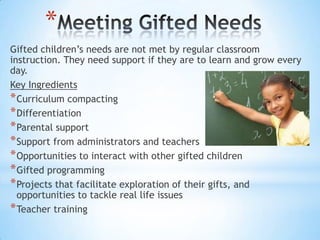
Gifted children’s needs are not met by regular classroom
instruction. They need support if they are to learn and grow every
day.
Key Ingredients
* Curriculum compacting
* Differentiation
* Parental support
* Support from administrators and teachers
* Opportunities to interact with other gifted children
* Gifted programming
* Projects that facilitate exploration of their gifts, and
  opportunities to tackle real life issues
* Teacher training
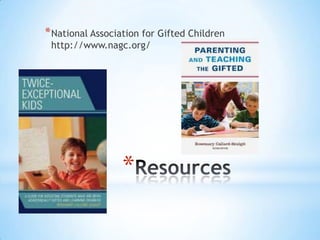
* National Association for Gifted Children
 http://www.nagc.org/


                  *
Winner, E. (1996). Gifted Children. New York, New
York: Basic Books.
Callard-Szulgit, R. (2012). perfectionism and gifted
children. Lanham, Maryland: Rowman & Littlefield.
Callard-Szulgit, R. (2010). Parenting and Teaching
the Gifted. Lanham, Maryland: Rowman &
Littlefield.


             *

Advocating for the gifted learner

  • 1.
    * Elizabeth Artemis Bailey
  • 2.
    * * Youth whoshow the potential to perform at remarkably high levels of accomplishment when compared with others of their age, experience or environment. * Exhibit high-performance capability in intellectual, creative, and/or artistic areas, possess an unusual leadership capacity, or excel in specific academic fields. -US Department of Education
  • 3.
    * * A seriesof misconceptions surrounds gifted learners, fueling a severe failure on the part of our education system to meet their needs.
  • 4.
    * * MYTH: GlobalGiftedness. The idea that gifted children are gifted across the board * REALITY: This idea that all gifted children are “globally gifted” is about as mythic as a robot unicorn, and nearly as dangerous. It ignores the existence of “twice-exceptional” kids, children who are gifted in one area and learning disabled in another. Belief this myth can result in a lack of support for learning-disabled gifted students as well as the failure to properly identify some students as gifted.
  • 5.
    * * MYTH: Giftednessis entirely biological * REALITY: Environmental factors play a major role in determining the development of gifts. This is why we must deliberately create a nurturing environment. * Myth: Giftedness is entirely environmental. * REALITY: This myth ignores the powerful role of biology.
  • 6.
    * * MYTH: ExceptionalIQs are held by all gifted children. * REALITY: There are many ways to be gifted, and not all of them necessarily involve high IQ. For example, art and music. These children’s needs are still not met by regular school programming.
  • 7.
    * * MYTH: Giftedchildren are “made” by pushy, obsessive parents, which often results on the child’s loss of interest. * REALITY: Gifted children want to develop their gifts, and the involvement of supportive and dedicated parents is extremely positive! This is especially true when schools fail to meet gifted needs.
  • 8.
    * * MYTH: Giftedchildren glow with psychological health. * REALITY: Non-gifted peers often ridicule gifted students because they are different. Gifted students often feel unable to connect with classmates who are on a completely different intellectual level. Gifted students often feel like they should not participate in class, for fear of being perceived “show-offs.” Gifted students often feel like their daily school routines are pointless. * …Do these sounds like ideal conditions for cultivating glowing psychological health?
  • 9.
    * Gifted children’s needsare not met by regular classroom instruction. They need support if they are to learn and grow every day. Key Ingredients * Curriculum compacting * Differentiation * Parental support * Support from administrators and teachers * Opportunities to interact with other gifted children * Gifted programming * Projects that facilitate exploration of their gifts, and opportunities to tackle real life issues * Teacher training
  • 10.
    * National Associationfor Gifted Children http://www.nagc.org/ *
  • 11.
    Winner, E. (1996).Gifted Children. New York, New York: Basic Books. Callard-Szulgit, R. (2012). perfectionism and gifted children. Lanham, Maryland: Rowman & Littlefield. Callard-Szulgit, R. (2010). Parenting and Teaching the Gifted. Lanham, Maryland: Rowman & Littlefield. *