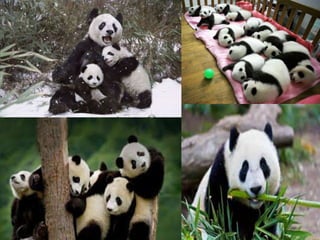
 Giant pandas are identified by their
distinctive black and white coloring. Their
ears, muzzle, eyes, shoulders and legs
are black while the rest of their body is
white. Their thick hair keeps them warm
in the cool, wet mountain zones.
 Adults pandas are 75cm high and 1.5m
long. They can be fat to 115kg. They
have short fail.
 One of the interesting evolutionary traits
of the panda is their protruding wrist
bone that acts like a thumb. This helps
the pandas hold bamboo while they
munch on it with their strong molar teeth.
Bamboo makes up nearly the entire diet
of the panda. Pandas need to eat 10-20
kg on a day.
 Occasionally pandas will eat other
available food, including small rodents,
eggs, fish and other flora. Bamboo
provides a good amount of water, but
pandas need to supplement this with
fresh water daily.
 When pandas are between 4-8 years of
age, they reach maturity and can
reproduce. However, female pandas
are only able to become pregnant for 2-
3 days each spring! In this small window
of time, male and female pandas find
each other through scents and calls
similar to that of goats or sheep. They do
not roar like other bears.
 Between 95 and 160 days of becoming
pregnant, the female panda will give
birth. The newborn cub is blind, hairless,
and tiny, weighing only 85-140g.
Completely helpless, the cub cannot
move much on its own for nearly 3
months. In turn, the mother is very
protective and careful in tending to her
cub during this time.
• Giant pandas are currently classified
on IUCN’s Red List as an endangered
species. One the main reasons that
pandas have become endangered is
habitat destruction. As the population in
China continues to grow, pandas’
habitat gets taken over by
development, pushing them into smaller
and less livable areas.
 Habitat destruction also leads to food
shortages. Pandas feed on several
varieties of bamboo that bloom at
different times of the year. If one type of
bamboo is destroyed by development, it
can leave the pandas with nothing to
eat during the time it normally blooms,
increasing the risk of starvation.
 In 1963, the first panda was exhibited
in a zoo outside of China. Today, there
are more than a dozen pandas in
most zoos. Pandas can be seen in
zoos in Washington D.C, Mexico City,
London, Tokyo, Madrid, Paris, and
Berlin. All pandas in zoos are given
double names; this is a Chinese
custom, which indicates affection.
Scientists study the zoo pandas in
hope to learn how to save wild
pandas from extinction.
 Although there are only 2000 pandas
living in the wild, they naturally inhabit
the mountain forests of southwest China.
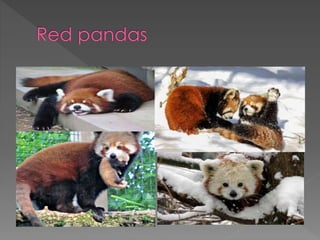
 -----------------------------------Red pandas

Giant panda

  • 2.
     Giant pandasare identified by their distinctive black and white coloring. Their ears, muzzle, eyes, shoulders and legs are black while the rest of their body is white. Their thick hair keeps them warm in the cool, wet mountain zones.
  • 3.
     Adults pandasare 75cm high and 1.5m long. They can be fat to 115kg. They have short fail.
  • 4.
     One ofthe interesting evolutionary traits of the panda is their protruding wrist bone that acts like a thumb. This helps the pandas hold bamboo while they munch on it with their strong molar teeth. Bamboo makes up nearly the entire diet of the panda. Pandas need to eat 10-20 kg on a day.
  • 5.
     Occasionally pandaswill eat other available food, including small rodents, eggs, fish and other flora. Bamboo provides a good amount of water, but pandas need to supplement this with fresh water daily.
  • 6.
     When pandasare between 4-8 years of age, they reach maturity and can reproduce. However, female pandas are only able to become pregnant for 2- 3 days each spring! In this small window of time, male and female pandas find each other through scents and calls similar to that of goats or sheep. They do not roar like other bears.
  • 7.
     Between 95and 160 days of becoming pregnant, the female panda will give birth. The newborn cub is blind, hairless, and tiny, weighing only 85-140g. Completely helpless, the cub cannot move much on its own for nearly 3 months. In turn, the mother is very protective and careful in tending to her cub during this time.
  • 8.
    • Giant pandasare currently classified on IUCN’s Red List as an endangered species. One the main reasons that pandas have become endangered is habitat destruction. As the population in China continues to grow, pandas’ habitat gets taken over by development, pushing them into smaller and less livable areas.
  • 9.
     Habitat destructionalso leads to food shortages. Pandas feed on several varieties of bamboo that bloom at different times of the year. If one type of bamboo is destroyed by development, it can leave the pandas with nothing to eat during the time it normally blooms, increasing the risk of starvation.
  • 10.
     In 1963,the first panda was exhibited in a zoo outside of China. Today, there are more than a dozen pandas in most zoos. Pandas can be seen in zoos in Washington D.C, Mexico City, London, Tokyo, Madrid, Paris, and Berlin. All pandas in zoos are given double names; this is a Chinese custom, which indicates affection. Scientists study the zoo pandas in hope to learn how to save wild pandas from extinction.
  • 11.
     Although thereare only 2000 pandas living in the wild, they naturally inhabit the mountain forests of southwest China.
  • 15.