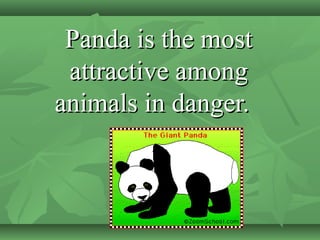
Panda is the mostPanda is the most
attractive amongattractive among
animals in danger.animals in danger.
Some factsSome facts
 The Chinese people call the panda "Da xiongThe Chinese people call the panda "Da xiong
mao," which means "giant bear cat“mao," which means "giant bear cat“
 The panda is a symbol of peace in China.The panda is a symbol of peace in China.
Panda is an emblem ofPanda is an emblem of
W W F (W W F (WorldWorld WideWide
FundFund ForFor Nature)Nature)
VocabularyVocabulary
 Male –Male – boarsboars
 Female –Female – sowssows
 The young areThe young are
calledcalled cubscubs
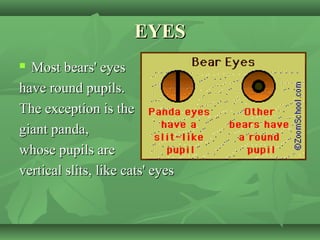
EYESEYES
 Most bears' eyesMost bears' eyes
have round pupils.have round pupils.
The exception is theThe exception is the
giant panda,giant panda,
whose pupils arewhose pupils are
vertical slits, like cats' eyesvertical slits, like cats' eyes
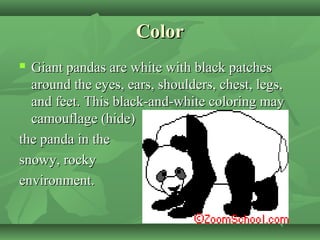
ColorColor
 Giant pandas are white with black patchesGiant pandas are white with black patches
around the eyes, ears, shoulders, chest, legs,around the eyes, ears, shoulders, chest, legs,
and feet. This black-and-white coloring mayand feet. This black-and-white coloring may
camouflage (hide)camouflage (hide)
the panda in thethe panda in the
snowy, rockysnowy, rocky
environment.environment.
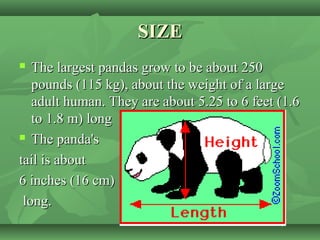
SIZESIZE
 The largest pandas grow to be about 250The largest pandas grow to be about 250
pounds (115 kg), about the weight of a largepounds (115 kg), about the weight of a large
adult human. They are about 5.25 to 6 feet (1.6adult human. They are about 5.25 to 6 feet (1.6
to 1.8 m) longto 1.8 m) long
 The panda'sThe panda's
tail is abouttail is about
6 inches (16 cm)6 inches (16 cm)
long.long.
DIETDIET
 Their diet is almost exclusively two species ofTheir diet is almost exclusively two species of
bamboo (arrow and umbrella bamboo).bamboo (arrow and umbrella bamboo).
 Pandas eat about 40 pounds (18 kg) of foodPandas eat about 40 pounds (18 kg) of food
each day.each day.
++
EATINGEATING
 bamboo plants only grow in a few places. Thisbamboo plants only grow in a few places. This
limits the range of pandas tremendously.limits the range of pandas tremendously.
 Bamboo species go through periodic die-offsBamboo species go through periodic die-offs
after they flower – pandas have to migrate allafter they flower – pandas have to migrate all
the timethe time
 Pandas usually eat while sitting in an uprightPandas usually eat while sitting in an upright
position. They can use their front paws to holdposition. They can use their front paws to hold
their food.their food.
TEETHTEETH
 They also have a few sharp teeth which theyThey also have a few sharp teeth which they
use to bite tough bamboo stalks. Pandas haveuse to bite tough bamboo stalks. Pandas have
42 teeth42 teeth
FURFUR
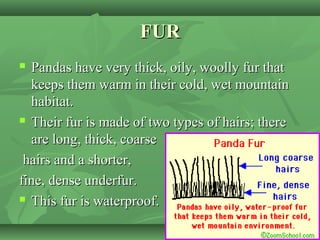
 Pandas have very thick, oily, woolly fur thatPandas have very thick, oily, woolly fur that
keeps them warm in their cold, wet mountainkeeps them warm in their cold, wet mountain
habitat.habitat.
 Their fur is made of two types of hairs; thereTheir fur is made of two types of hairs; there
are long, thick, coarseare long, thick, coarse
hairs and a shorter,hairs and a shorter,
fine, dense underfur.fine, dense underfur.
 This fur is waterproof.This fur is waterproof.
DISTRIBUTIONDISTRIBUTION
 In the wild, giant pandas only live in a fewIn the wild, giant pandas only live in a few
mountain ranges in central and western China,mountain ranges in central and western China,
mainly inmainly in
Sichuan, Shaanxi,Sichuan, Shaanxi,
and Gansuand Gansu
provinces.provinces.
HABITATHABITAT
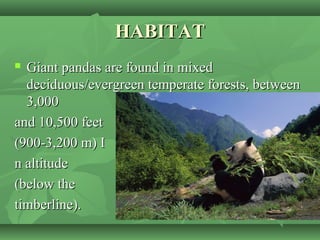
 Giant pandas are found in mixedGiant pandas are found in mixed
deciduous/evergreen temperate forests, betweendeciduous/evergreen temperate forests, between
3,0003,000
and 10,500 feetand 10,500 feet
(900-3,200 m) I(900-3,200 m) I
n altituden altitude
(below the(below the
timberline).timberline).
NUMBERSNUMBERS
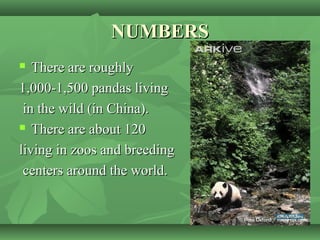
 There are roughlyThere are roughly
1,000-1,500 pandas living1,000-1,500 pandas living
in the wild (in China).in the wild (in China).
 There are about 120There are about 120
living in zoos and breedingliving in zoos and breeding
centers around the world.centers around the world.
LIFE SPANLIFE SPAN
 Some pandas in zoos have lived to be 35 yearsSome pandas in zoos have lived to be 35 years
old. Hsing-Hsing, who lives in the Nationalold. Hsing-Hsing, who lives in the National
Zoo, turned 29 inZoo, turned 29 in
1999.1999.
Most animals liveMost animals live
longer in captivitylonger in captivity
than in the wildthan in the wild
REPRODUCTIONREPRODUCTION
 Pandas have a very slow reproductive ratePandas have a very slow reproductive rate
which contributes to their declining numberswhich contributes to their declining numbers
 Females give birth between 95 and 160 daysFemales give birth between 95 and 160 days
after mating.after mating.
They haveThey have
their cubs intheir cubs in
dens thatdens that
they dig inthey dig in
the ground. One or two cubs are born but usuallythe ground. One or two cubs are born but usually
only one survivesonly one survives
BABY PANDASBABY PANDAS
 white, blind, furless, andwhite, blind, furless, and
helpless at birth. Except forhelpless at birth. Except for
marsupials (kangaroos,marsupials (kangaroos,
opossums, etc.), giant pandaopossums, etc.), giant panda
cubs are the smallest newborncubs are the smallest newborn
mammals. They weigh fourmammals. They weigh four
to six ounces (85-140 g) asto six ounces (85-140 g) as
newborns. This is lighter thannewborns. This is lighter than
an apple.an apple.
TheirTheir
future survivalfuture survival
isis
up to us.up to us.

39471e30029c77b03e831d217b110bbc

  • 1.
    Panda is themostPanda is the most attractive amongattractive among animals in danger.animals in danger.
  • 2.
    Some factsSome facts The Chinese people call the panda "Da xiongThe Chinese people call the panda "Da xiong mao," which means "giant bear cat“mao," which means "giant bear cat“  The panda is a symbol of peace in China.The panda is a symbol of peace in China. Panda is an emblem ofPanda is an emblem of W W F (W W F (WorldWorld WideWide FundFund ForFor Nature)Nature)
  • 3.
    VocabularyVocabulary  Male –Male– boarsboars  Female –Female – sowssows  The young areThe young are calledcalled cubscubs
  • 4.
    EYESEYES  Most bears'eyesMost bears' eyes have round pupils.have round pupils. The exception is theThe exception is the giant panda,giant panda, whose pupils arewhose pupils are vertical slits, like cats' eyesvertical slits, like cats' eyes
  • 5.
    ColorColor  Giant pandasare white with black patchesGiant pandas are white with black patches around the eyes, ears, shoulders, chest, legs,around the eyes, ears, shoulders, chest, legs, and feet. This black-and-white coloring mayand feet. This black-and-white coloring may camouflage (hide)camouflage (hide) the panda in thethe panda in the snowy, rockysnowy, rocky environment.environment.
  • 6.
    SIZESIZE  The largestpandas grow to be about 250The largest pandas grow to be about 250 pounds (115 kg), about the weight of a largepounds (115 kg), about the weight of a large adult human. They are about 5.25 to 6 feet (1.6adult human. They are about 5.25 to 6 feet (1.6 to 1.8 m) longto 1.8 m) long  The panda'sThe panda's tail is abouttail is about 6 inches (16 cm)6 inches (16 cm) long.long.
  • 7.
    DIETDIET  Their dietis almost exclusively two species ofTheir diet is almost exclusively two species of bamboo (arrow and umbrella bamboo).bamboo (arrow and umbrella bamboo).  Pandas eat about 40 pounds (18 kg) of foodPandas eat about 40 pounds (18 kg) of food each day.each day. ++
  • 8.
    EATINGEATING  bamboo plantsonly grow in a few places. Thisbamboo plants only grow in a few places. This limits the range of pandas tremendously.limits the range of pandas tremendously.  Bamboo species go through periodic die-offsBamboo species go through periodic die-offs after they flower – pandas have to migrate allafter they flower – pandas have to migrate all the timethe time  Pandas usually eat while sitting in an uprightPandas usually eat while sitting in an upright position. They can use their front paws to holdposition. They can use their front paws to hold their food.their food.
  • 9.
    TEETHTEETH  They alsohave a few sharp teeth which theyThey also have a few sharp teeth which they use to bite tough bamboo stalks. Pandas haveuse to bite tough bamboo stalks. Pandas have 42 teeth42 teeth
  • 10.
    FURFUR  Pandas havevery thick, oily, woolly fur thatPandas have very thick, oily, woolly fur that keeps them warm in their cold, wet mountainkeeps them warm in their cold, wet mountain habitat.habitat.  Their fur is made of two types of hairs; thereTheir fur is made of two types of hairs; there are long, thick, coarseare long, thick, coarse hairs and a shorter,hairs and a shorter, fine, dense underfur.fine, dense underfur.  This fur is waterproof.This fur is waterproof.
  • 11.
    DISTRIBUTIONDISTRIBUTION  In thewild, giant pandas only live in a fewIn the wild, giant pandas only live in a few mountain ranges in central and western China,mountain ranges in central and western China, mainly inmainly in Sichuan, Shaanxi,Sichuan, Shaanxi, and Gansuand Gansu provinces.provinces.
  • 12.
    HABITATHABITAT  Giant pandasare found in mixedGiant pandas are found in mixed deciduous/evergreen temperate forests, betweendeciduous/evergreen temperate forests, between 3,0003,000 and 10,500 feetand 10,500 feet (900-3,200 m) I(900-3,200 m) I n altituden altitude (below the(below the timberline).timberline).
  • 13.
    NUMBERSNUMBERS  There areroughlyThere are roughly 1,000-1,500 pandas living1,000-1,500 pandas living in the wild (in China).in the wild (in China).  There are about 120There are about 120 living in zoos and breedingliving in zoos and breeding centers around the world.centers around the world.
  • 14.
    LIFE SPANLIFE SPAN Some pandas in zoos have lived to be 35 yearsSome pandas in zoos have lived to be 35 years old. Hsing-Hsing, who lives in the Nationalold. Hsing-Hsing, who lives in the National Zoo, turned 29 inZoo, turned 29 in 1999.1999. Most animals liveMost animals live longer in captivitylonger in captivity than in the wildthan in the wild
  • 15.
    REPRODUCTIONREPRODUCTION  Pandas havea very slow reproductive ratePandas have a very slow reproductive rate which contributes to their declining numberswhich contributes to their declining numbers  Females give birth between 95 and 160 daysFemales give birth between 95 and 160 days after mating.after mating. They haveThey have their cubs intheir cubs in dens thatdens that they dig inthey dig in the ground. One or two cubs are born but usuallythe ground. One or two cubs are born but usually only one survivesonly one survives
  • 16.
    BABY PANDASBABY PANDAS white, blind, furless, andwhite, blind, furless, and helpless at birth. Except forhelpless at birth. Except for marsupials (kangaroos,marsupials (kangaroos, opossums, etc.), giant pandaopossums, etc.), giant panda cubs are the smallest newborncubs are the smallest newborn mammals. They weigh fourmammals. They weigh four to six ounces (85-140 g) asto six ounces (85-140 g) as newborns. This is lighter thannewborns. This is lighter than an apple.an apple.
  • 17.