 This type of Panda is only in black and
  white.
 It also comes from the bear family which
  are all mammal's .
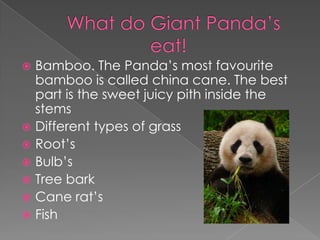
 Bamboo. The Panda’s most favourite
  bamboo is called china cane. The best
  part is the sweet juicy pith inside the
  stems
 Different types of grass
 Root’s
 Bulb’s
 Tree bark
 Cane rat’s
 Fish
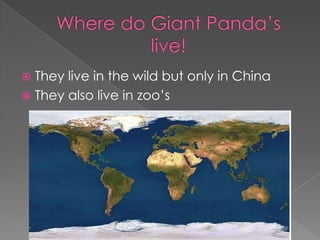
 They live in the wild but only in China
 They also live in zoo’s
   A male Giant panda’s body can
    grow up to 1.8 metres high at the
    shoulders
   Males can weigh more than 100
    kilograms
   Females are smaller and can weigh
    up to 80 kilograms
   A giant panda’s tail is only about 15
    centimetres long
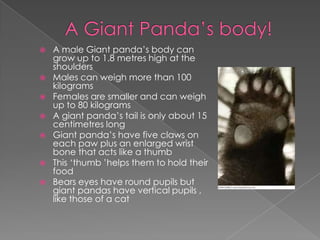
   Giant panda’s have five claws on
    each paw plus an enlarged wrist
    bone that acts like a thumb
   This ‘thumb ’helps them to hold their
    food
   Bears eyes have round pupils but
    giant pandas have vertical pupils ,
    like those of a cat
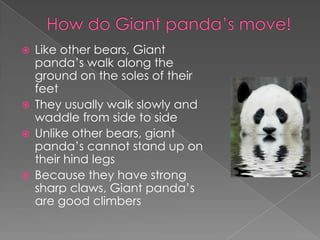
 Like other bears, Giant
  panda’s walk along the
  ground on the soles of their
  feet
 They usually walk slowly and
  waddle from side to side
 Unlike other bears, giant
  panda’s cannot stand up on
  their hind legs
 Because they have strong
  sharp claws, Giant panda’s
  are good climbers
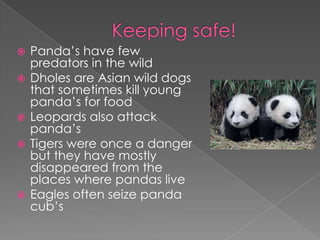
   Panda’s have few
    predators in the wild
   Dholes are Asian wild dogs
    that sometimes kill young
    panda’s for food
   Leopards also attack
    panda’s
   Tigers were once a danger
    but they have mostly
    disappeared from the
    places where pandas live
   Eagles often seize panda
    cub’s
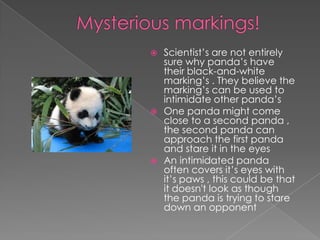
 Scientist’s are not entirely
  sure why panda’s have
  their black-and-white
  marking’s . They believe the
  marking’s can be used to
  intimidate other panda’s
 One panda might come
  close to a second panda ,
  the second panda can
  approach the first panda
  and stare it in the eyes
 An intimidated panda
  often covers it’s eyes with
  it’s paws , this could be that
  it doesn't look as though
  the panda is trying to stare
  down an opponent
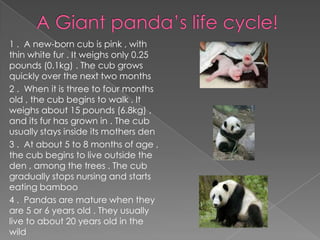
1 . A new-born cub is pink , with
thin white fur . It weighs only 0.25
pounds (0.1kg) . The cub grows
quickly over the next two months
2 . When it is three to four months
old , the cub begins to walk . It
weighs about 15 pounds (6.8kg) ,
and its fur has grown in . The cub
usually stays inside its mothers den
3 . At about 5 to 8 months of age ,
the cub begins to live outside the
den , among the trees . The cub
gradually stops nursing and starts
eating bamboo
4 . Pandas are mature when they
are 5 or 6 years old . They usually
live to about 20 years old in the
wild
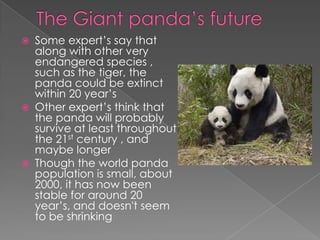
 Some expert’s say that
  along with other very
  endangered species ,
  such as the tiger, the
  panda could be extinct
  within 20 year’s
 Other expert’s think that
  the panda will probably
  survive at least throughout
  the 21st century , and
  maybe longer
 Though the world panda
  population is small, about
  2000, it has now been
  stable for around 20
  year’s, and doesn't seem
  to be shrinking
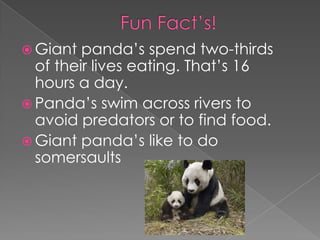
 Giant  panda’s spend two-thirds
  of their lives eating. That’s 16
  hours a day.
 Panda’s swim across rivers to
  avoid predators or to find food.
 Giant panda’s like to do
  somersaults
Giant panda!

Giant panda!

  • 2.
     This typeof Panda is only in black and white.  It also comes from the bear family which are all mammal's .
  • 3.
     Bamboo. ThePanda’s most favourite bamboo is called china cane. The best part is the sweet juicy pith inside the stems  Different types of grass  Root’s  Bulb’s  Tree bark  Cane rat’s  Fish
  • 4.
     They livein the wild but only in China  They also live in zoo’s
  • 5.
    A male Giant panda’s body can grow up to 1.8 metres high at the shoulders  Males can weigh more than 100 kilograms  Females are smaller and can weigh up to 80 kilograms  A giant panda’s tail is only about 15 centimetres long  Giant panda’s have five claws on each paw plus an enlarged wrist bone that acts like a thumb  This ‘thumb ’helps them to hold their food  Bears eyes have round pupils but giant pandas have vertical pupils , like those of a cat
  • 6.
     Like otherbears, Giant panda’s walk along the ground on the soles of their feet  They usually walk slowly and waddle from side to side  Unlike other bears, giant panda’s cannot stand up on their hind legs  Because they have strong sharp claws, Giant panda’s are good climbers
  • 7.
    Panda’s have few predators in the wild  Dholes are Asian wild dogs that sometimes kill young panda’s for food  Leopards also attack panda’s  Tigers were once a danger but they have mostly disappeared from the places where pandas live  Eagles often seize panda cub’s
  • 8.
     Scientist’s arenot entirely sure why panda’s have their black-and-white marking’s . They believe the marking’s can be used to intimidate other panda’s  One panda might come close to a second panda , the second panda can approach the first panda and stare it in the eyes  An intimidated panda often covers it’s eyes with it’s paws , this could be that it doesn't look as though the panda is trying to stare down an opponent
  • 9.
    1 . Anew-born cub is pink , with thin white fur . It weighs only 0.25 pounds (0.1kg) . The cub grows quickly over the next two months 2 . When it is three to four months old , the cub begins to walk . It weighs about 15 pounds (6.8kg) , and its fur has grown in . The cub usually stays inside its mothers den 3 . At about 5 to 8 months of age , the cub begins to live outside the den , among the trees . The cub gradually stops nursing and starts eating bamboo 4 . Pandas are mature when they are 5 or 6 years old . They usually live to about 20 years old in the wild
  • 10.
     Some expert’ssay that along with other very endangered species , such as the tiger, the panda could be extinct within 20 year’s  Other expert’s think that the panda will probably survive at least throughout the 21st century , and maybe longer  Though the world panda population is small, about 2000, it has now been stable for around 20 year’s, and doesn't seem to be shrinking
  • 11.
     Giant panda’s spend two-thirds of their lives eating. That’s 16 hours a day.  Panda’s swim across rivers to avoid predators or to find food.  Giant panda’s like to do somersaults