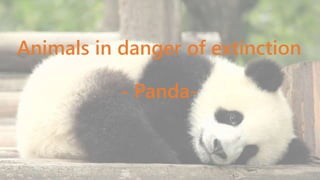
Animals in danger of extinction
- Panda-
Introduction
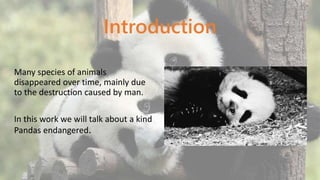
Many species of animals
disappeared over time, mainly due
to the destruction caused by man.
In this work we will talk about a kind
Pandas endangered.
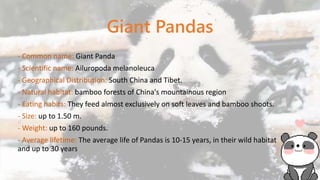
Giant Pandas
- Common name: Giant Panda
- Scientific name: Ailuropoda melanoleuca
- Geographical Distribution: South China and Tibet.
- Natural habitat: bamboo forests of China's mountainous region
- Eating habits: They feed almost exclusively on soft leaves and bamboo shoots.
- Size: up to 1.50 m.
- Weight: up to 160 pounds.
- Average lifetime: The average life of Pandas is 10-15 years, in their wild habitat
and up to 30 years
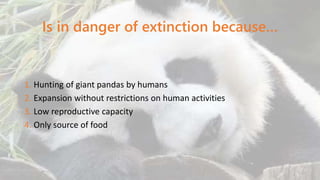
Is in danger of extinction because…
1. Hunting of giant pandas by humans
2. Expansion without restrictions on human activities
3. Low reproductive capacity
4. Only source of food
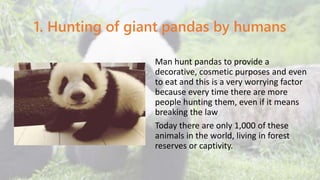
1. Hunting of giant pandas by humans
Man hunt pandas to provide a
decorative, cosmetic purposes and even
to eat and this is a very worrying factor
because every time there are more
people hunting them, even if it means
breaking the law
Today there are only 1,000 of these
animals in the world, living in forest
reserves or captivity.
2. Expansion without restrictions on
human activities
With the tremendous population growth, cities and regions have
developed, and the forests were felled on a large scale. The habitat of
giant pandas was severely destroyed and its space confined to very
small areas.
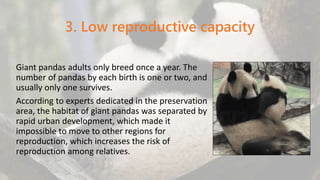
3. Low reproductive capacity
Giant pandas adults only breed once a year. The
number of pandas by each birth is one or two, and
usually only one survives.
According to experts dedicated in the preservation
area, the habitat of giant pandas was separated by
rapid urban development, which made it
impossible to move to other regions for
reproduction, which increases the risk of
reproduction among relatives.
4. Only source of food
Giant pandas have a very limited
supply because only eat bambu.
However, with the destruction of their
habitats and the disruption caused by
human today, bamboo flowering and
growth of bamboo complicated the
problem and created a shortage of
food for the giant pandas.
Many of them died of hunger.
Institutions and organizations that help
these animals
There are many institutions that give them home and give them better
living conditions, as ...
-The International Union for Conservation of Nature (IUCN)
- World Conservation Monitoring Centre (WCMC)
And global organizations ...
- Greenpeace
- World Wildlife Foudation (WWF)
- Conservation International (CI)
“No matter if the
animals are unable
or not to think.
What matters is
that they are able
to suffer.”

Endangered animals panda -

  • 1.
    Animals in dangerof extinction - Panda-
  • 2.
    Introduction Many species ofanimals disappeared over time, mainly due to the destruction caused by man. In this work we will talk about a kind Pandas endangered.
  • 3.
    Giant Pandas - Commonname: Giant Panda - Scientific name: Ailuropoda melanoleuca - Geographical Distribution: South China and Tibet. - Natural habitat: bamboo forests of China's mountainous region - Eating habits: They feed almost exclusively on soft leaves and bamboo shoots. - Size: up to 1.50 m. - Weight: up to 160 pounds. - Average lifetime: The average life of Pandas is 10-15 years, in their wild habitat and up to 30 years
  • 4.
    Is in dangerof extinction because… 1. Hunting of giant pandas by humans 2. Expansion without restrictions on human activities 3. Low reproductive capacity 4. Only source of food
  • 5.
    1. Hunting ofgiant pandas by humans Man hunt pandas to provide a decorative, cosmetic purposes and even to eat and this is a very worrying factor because every time there are more people hunting them, even if it means breaking the law Today there are only 1,000 of these animals in the world, living in forest reserves or captivity.
  • 6.
    2. Expansion withoutrestrictions on human activities With the tremendous population growth, cities and regions have developed, and the forests were felled on a large scale. The habitat of giant pandas was severely destroyed and its space confined to very small areas.
  • 7.
    3. Low reproductivecapacity Giant pandas adults only breed once a year. The number of pandas by each birth is one or two, and usually only one survives. According to experts dedicated in the preservation area, the habitat of giant pandas was separated by rapid urban development, which made it impossible to move to other regions for reproduction, which increases the risk of reproduction among relatives.
  • 8.
    4. Only sourceof food Giant pandas have a very limited supply because only eat bambu. However, with the destruction of their habitats and the disruption caused by human today, bamboo flowering and growth of bamboo complicated the problem and created a shortage of food for the giant pandas. Many of them died of hunger.
  • 9.
    Institutions and organizationsthat help these animals There are many institutions that give them home and give them better living conditions, as ... -The International Union for Conservation of Nature (IUCN) - World Conservation Monitoring Centre (WCMC) And global organizations ... - Greenpeace - World Wildlife Foudation (WWF) - Conservation International (CI)
  • 10.
    “No matter ifthe animals are unable or not to think. What matters is that they are able to suffer.”