The Giant Panda
  Teddy Willey and Evan Mega
Background
Height: 1.5 meters.


Weight: Males are 150kg and women are 125kg.


Life: The Giant Panda usually lives about 20 years
in the wild and about 30 years in captivity.


Description: Pandas have a black and white fur
coat. They are shaped like most bears. They are
known for their large molar teeth which crush
through tough bamboo.
Behavior
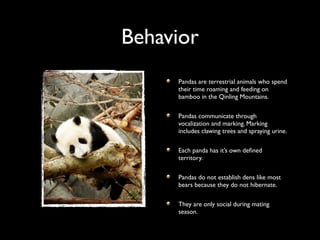
     Pandas are terrestrial animals who spend
     their time roaming and feeding on
     bamboo in the Qinling Mountains.

     Pandas communicate through
     vocalization and marking. Marking
     includes clawing trees and spraying urine.

     Each panda has it’s own defined
     territory.

     Pandas do not establish dens like most
     bears because they do not hibernate.

     They are only social during mating
     season.
Diet
 Pandas have a diet that is primarily herbivorous.


 Their diet is almost entirely bamboo.


 Pandas eat about thirty pounds of bamboo a day.


 Pandas spend 11-14 hours each day eating.


 “Like the vegetarian gorilla, the low body surface
area to body volume [of the giant panda] is indicative
of a lower metabolic rate. This lower metabolic rate
and a more sedentary lifestyle allow the giant panda
to subsist on nutrient poor resources such as
bamboo.” - Panda Researcher Russell Ciochon.
Panda Food Web
Habitat Loss
  Deforestation destroys the habitat of the panda.


  The destruction of bamboo is killing off the panda’s
food source. 99% of the panda’s diet is bamboo.


  With the destruction of bamboo forest the panda
is not only losing its food source, but also it’s habitat
and living quarters.


  Although bamboo does regrow quickly, it can take
ten years before new bamboo can support a panda
population.


 In 1998 China began to establish reserves for the
pandas. 50% of pandas live in these reserves.
Poaching


     In certain areas of China logging bans
     were established. Unfortunately, the
     economy in these areas became
     unstable. The humans in these areas
     resorted to poaching the pandas as a
     mean of boosting their personal income
     and the economy in these areas. Because
     of this time period, the panda population
     was severely at risk.
Importance of Pandas

•   They are one of most adored
    animals by humans


•   Their rarity makes them unique.


•   To the Chinese the Pandas are seen
    as unique.


•   To the human population as a whole
    pandas a very cute and therefore
    humans feel responsible for their
    safety.
Just How Cute Are
      Pandas?
Economic Value

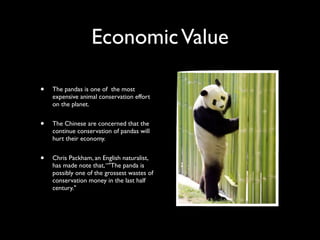
•   The pandas is one of the most
    expensive animal conservation effort
    on the planet.


•   The Chinese are concerned that the
    continue conservation of pandas will
    hurt their economy.


•   Chris Packham, an English naturalist,
    has made note that, “"The panda is
    possibly one of the grossest wastes of
    conservation money in the last half
    century."
Moral Issue

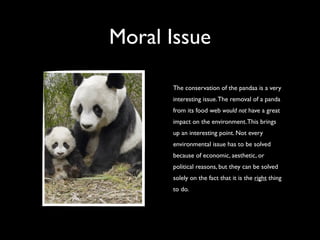
      The conservation of the pandaa is a very
      interesting issue. The removal of a panda
      from its food web would not have a great
      impact on the environment. This brings
      up an interesting point. Not every
      environmental issue has to be solved
      because of economic, aesthetic, or
      political reasons, but they can be solved
      solely on the fact that it is the right thing
      to do.

Panda

  • 1.
    The Giant Panda Teddy Willey and Evan Mega
  • 2.
    Background Height: 1.5 meters. Weight:Males are 150kg and women are 125kg. Life: The Giant Panda usually lives about 20 years in the wild and about 30 years in captivity. Description: Pandas have a black and white fur coat. They are shaped like most bears. They are known for their large molar teeth which crush through tough bamboo.
  • 3.
    Behavior Pandas are terrestrial animals who spend their time roaming and feeding on bamboo in the Qinling Mountains. Pandas communicate through vocalization and marking. Marking includes clawing trees and spraying urine. Each panda has it’s own defined territory. Pandas do not establish dens like most bears because they do not hibernate. They are only social during mating season.
  • 4.
    Diet Pandas havea diet that is primarily herbivorous. Their diet is almost entirely bamboo. Pandas eat about thirty pounds of bamboo a day. Pandas spend 11-14 hours each day eating. “Like the vegetarian gorilla, the low body surface area to body volume [of the giant panda] is indicative of a lower metabolic rate. This lower metabolic rate and a more sedentary lifestyle allow the giant panda to subsist on nutrient poor resources such as bamboo.” - Panda Researcher Russell Ciochon.
  • 5.
  • 6.
    Habitat Loss Deforestation destroys the habitat of the panda. The destruction of bamboo is killing off the panda’s food source. 99% of the panda’s diet is bamboo. With the destruction of bamboo forest the panda is not only losing its food source, but also it’s habitat and living quarters. Although bamboo does regrow quickly, it can take ten years before new bamboo can support a panda population. In 1998 China began to establish reserves for the pandas. 50% of pandas live in these reserves.
  • 7.
    Poaching In certain areas of China logging bans were established. Unfortunately, the economy in these areas became unstable. The humans in these areas resorted to poaching the pandas as a mean of boosting their personal income and the economy in these areas. Because of this time period, the panda population was severely at risk.
  • 8.
    Importance of Pandas • They are one of most adored animals by humans • Their rarity makes them unique. • To the Chinese the Pandas are seen as unique. • To the human population as a whole pandas a very cute and therefore humans feel responsible for their safety.
  • 9.
    Just How CuteAre Pandas?
  • 10.
    Economic Value • The pandas is one of the most expensive animal conservation effort on the planet. • The Chinese are concerned that the continue conservation of pandas will hurt their economy. • Chris Packham, an English naturalist, has made note that, “"The panda is possibly one of the grossest wastes of conservation money in the last half century."
  • 11.
    Moral Issue The conservation of the pandaa is a very interesting issue. The removal of a panda from its food web would not have a great impact on the environment. This brings up an interesting point. Not every environmental issue has to be solved because of economic, aesthetic, or political reasons, but they can be solved solely on the fact that it is the right thing to do.