Erasmus Mundus Joint Doctorate Programme
“Agricultural Transformation by Innovation (AgTraIn)”

“Reduced emissions from intensified rice production systems
Prepared by:
Syed Faiz-ul Islam
Supervisors:
Andreas de Neergaard
Faculty of Science, University of Copenhagen.
&
Jan Willem van Groenigen
Department of Soil Quality, Wageningen University.

”
Outline
 Background & Justification
 Objective & Research Questions
 Methodology
 Expected Outcomes
 List of References
Background & Justification
•

Rice (Oryza sativa) is one of the most
important agricultural staples that feed more
than half of the world population.



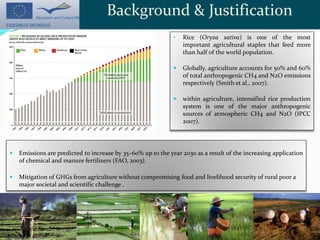
Globally, agriculture accounts for 50% and 60%
of total anthropogenic CH4 and N2O emissions
respectively (Smith et al., 2007).



within agriculture, intensified rice production
system is one of the major anthropogenic
sources of atmospheric CH4 and N2O (IPCC
2007).



Emissions are predicted to increase by 35–60% up to the year 2030 as a result of the increasing application
of chemical and manure fertilizers (FAO, 2003).



Mitigation of GHGs from agriculture without compromising food and livelihood security of rural poor a
major societal and scientific challenge .
Background & Justification


CH4 and N2O production and emission depend on
timing between fertilization and water management and
on the size of the labile N and C pools, which yet to be
investigated.



Agronomic productivity has to be linked with GHG
emission (Yield-scaled GHG emission).



Efficient utilization of differently treated Farm yard manures can be a potential alternative of chemical
fertilizers while their possible alternative GHG emissions need clarification.



Integrated rice farming systems and farmers socio-phychological trait need to be investigated for better
adoption and diffusion of climate smart technologies.
Objective and Research Questions
The objective of the current project is to identify and test management practices
which can reduce methane (CH4) and nitrous oxide (N2O) emissions from smallholders
intensified rice farming systems per unit of area as well as per unit of yield and analyze
the farming dimensions and farmers rationale toward adoption and diffusion of
climate smart techniques related to soil nutrients and water management.
 1. What is the impact of timely application of mineral and organic
fertilisers–relative to water table management on N2O and CH4
emissions from smallholders intensified rice farming systems?
 2. What is the yield-scaled nitrous oxide and methane emission
(agronomic assessment of GHG) of intensified rice production systems
and its difference with traditional area based emissions?
 3. How does the quality of organic fertilisers influence methane and
nitrous oxide emissions, their best ways of utilization, and what are the
possible alternate emissions from these organic materials?
 4. What are the livelihood and farming dimensions of integrated rice
farming systems along with smallholder famer’s rationale of adoption
of various “climate smart” techniques related to fertilisation and water
management?
Methodology
University of Copenhagen, Wageningen University and International Rice Research Institute
(IRRI) research and laboratory facility will be used for fieldwork and laboratory analysis.

 Field experiment:
Split-plot experiment comprise of water regime (the main plot)and
fertilizer application (the sub-plot) treatments (Liu et al., 2010; Liu et al.,
2012).

CH4 and N2O emission:
Static chamber and gas chromatography techniques (Rochette and
Eriksen-Hamel , 2008).

 Yield-scaled GHG emissions:
According to Mosier et al., (2006) and Linquist et al., (2012)

 GHG emissions and nutrient turnover analysis of Farm Yard
Manure(FYM):
Greenhouse Gas Assessment Incubations (Spokas & Reicosky, 2009) and
real time analysis of FYM

 Farming systems and livelihood impacts:
Farming System and Sustainable livelihood Approach with single visit
recall data collection, interviews and PRA
Expected Outcomes
Scientific publications……..
 One to two literature review article
 One to two paper on emissions as studies in fields
 One paper on laboratory experiments
 One paper on Integrated rice farming system and livelihood
List of References














FAO (Food and Agricultural Organization), 2003. World Agricultural Towards 2015/2030. An FAO Perspective. Rome.
IPCC(Intergovernmental Panel on Climate Change), 2007. Climate Change 2007: The Physical Science Basis,
Contribution of Working Group I to the Fourth Assessment Report of the Intergovernmental Panel on Climate
Change. In: Solomon S, Qin D, Manning M, Chen Z, Marquis M, Averyt K B, Tignor M, and Miller H L (Eds.),
Cambridge University Press, Cambridge, United Kingdom and New York, NY, USA.
Linquist, B., Van Groenigen, K. J., Adviento-Borbe, M. A., Pittelkow, Cameron., Van Kessel, C., 2012. An agronomic
assessment of greenhouse gas emissions from major cereal crops. Global Change Biology 18, 194–209.
Liu, S., Qin, Y., Zou, J., Liu, Q., 2010. Effects of water regime during rice-growing season on annual direct N2O
emission in a paddy rice–winter wheat rotation system in southeast China. Science of the Total Environment 408, 906–
913.
Liu, S., Zhang, L., Jiang, J., Chen, N., Yang, X., Xiong, Z., Zou, J., 2012. Methane and nitrous oxide emissions from rice
seedling nurseries under flooding and moist irrigation regimes in Southeast China. Science of the Total Environment
426, 166-171.
Mosier, A.R., Halvorson, A.D., Reule, C.A., Liu, X.J., 2006. Net global warming potential and greenhouse gas intensity
in irrigated cropping systems in north-eastern Colorado. J. Environ. Qual. 35, 1584.
Rochette P., and Eriksen-Hamel N.S., 2008. Chamber Measurements of Soil Nitrous Oxide Flux: Are Absolute Values
Reliable. Soil Sci. Soc. Am. J. 72, 331-342.
Smith P., Martino D., Cai Z., Gwary D., Janzen H., Kumar P., et al., 2007. Agriculture. In:Metz B, Davidson OR, Bosch
PR, Dave R,Meyer LA, editors. Climate Change 2007: Mitigation. Contribution of Working Group III to the Fourth
Assessment Report of the Intergovernmental Panel on Climate ChangeCambridge: Cambridge University Press p.
497–540.
Spokas, A.K., and Reicosky, C.D., 2009. Impacts of sixteen different biochars on soil greenhouse gas production.
Annals of Environmental Science 3, 179-193.
Reduced emissions from intensified rice production systems

Reduced emissions from intensified rice production systems

  • 1.
    Erasmus Mundus JointDoctorate Programme “Agricultural Transformation by Innovation (AgTraIn)” “Reduced emissions from intensified rice production systems Prepared by: Syed Faiz-ul Islam Supervisors: Andreas de Neergaard Faculty of Science, University of Copenhagen. & Jan Willem van Groenigen Department of Soil Quality, Wageningen University. ”
  • 2.
    Outline  Background &Justification  Objective & Research Questions  Methodology  Expected Outcomes  List of References
  • 3.
    Background & Justification • Rice(Oryza sativa) is one of the most important agricultural staples that feed more than half of the world population.  Globally, agriculture accounts for 50% and 60% of total anthropogenic CH4 and N2O emissions respectively (Smith et al., 2007).  within agriculture, intensified rice production system is one of the major anthropogenic sources of atmospheric CH4 and N2O (IPCC 2007).  Emissions are predicted to increase by 35–60% up to the year 2030 as a result of the increasing application of chemical and manure fertilizers (FAO, 2003).  Mitigation of GHGs from agriculture without compromising food and livelihood security of rural poor a major societal and scientific challenge .
  • 4.
    Background & Justification  CH4and N2O production and emission depend on timing between fertilization and water management and on the size of the labile N and C pools, which yet to be investigated.  Agronomic productivity has to be linked with GHG emission (Yield-scaled GHG emission).  Efficient utilization of differently treated Farm yard manures can be a potential alternative of chemical fertilizers while their possible alternative GHG emissions need clarification.  Integrated rice farming systems and farmers socio-phychological trait need to be investigated for better adoption and diffusion of climate smart technologies.
  • 5.
    Objective and ResearchQuestions The objective of the current project is to identify and test management practices which can reduce methane (CH4) and nitrous oxide (N2O) emissions from smallholders intensified rice farming systems per unit of area as well as per unit of yield and analyze the farming dimensions and farmers rationale toward adoption and diffusion of climate smart techniques related to soil nutrients and water management.  1. What is the impact of timely application of mineral and organic fertilisers–relative to water table management on N2O and CH4 emissions from smallholders intensified rice farming systems?  2. What is the yield-scaled nitrous oxide and methane emission (agronomic assessment of GHG) of intensified rice production systems and its difference with traditional area based emissions?  3. How does the quality of organic fertilisers influence methane and nitrous oxide emissions, their best ways of utilization, and what are the possible alternate emissions from these organic materials?  4. What are the livelihood and farming dimensions of integrated rice farming systems along with smallholder famer’s rationale of adoption of various “climate smart” techniques related to fertilisation and water management?
  • 6.
    Methodology University of Copenhagen,Wageningen University and International Rice Research Institute (IRRI) research and laboratory facility will be used for fieldwork and laboratory analysis.  Field experiment: Split-plot experiment comprise of water regime (the main plot)and fertilizer application (the sub-plot) treatments (Liu et al., 2010; Liu et al., 2012). CH4 and N2O emission: Static chamber and gas chromatography techniques (Rochette and Eriksen-Hamel , 2008).  Yield-scaled GHG emissions: According to Mosier et al., (2006) and Linquist et al., (2012)  GHG emissions and nutrient turnover analysis of Farm Yard Manure(FYM): Greenhouse Gas Assessment Incubations (Spokas & Reicosky, 2009) and real time analysis of FYM  Farming systems and livelihood impacts: Farming System and Sustainable livelihood Approach with single visit recall data collection, interviews and PRA
  • 7.
    Expected Outcomes Scientific publications…….. One to two literature review article  One to two paper on emissions as studies in fields  One paper on laboratory experiments  One paper on Integrated rice farming system and livelihood
  • 8.
    List of References          FAO(Food and Agricultural Organization), 2003. World Agricultural Towards 2015/2030. An FAO Perspective. Rome. IPCC(Intergovernmental Panel on Climate Change), 2007. Climate Change 2007: The Physical Science Basis, Contribution of Working Group I to the Fourth Assessment Report of the Intergovernmental Panel on Climate Change. In: Solomon S, Qin D, Manning M, Chen Z, Marquis M, Averyt K B, Tignor M, and Miller H L (Eds.), Cambridge University Press, Cambridge, United Kingdom and New York, NY, USA. Linquist, B., Van Groenigen, K. J., Adviento-Borbe, M. A., Pittelkow, Cameron., Van Kessel, C., 2012. An agronomic assessment of greenhouse gas emissions from major cereal crops. Global Change Biology 18, 194–209. Liu, S., Qin, Y., Zou, J., Liu, Q., 2010. Effects of water regime during rice-growing season on annual direct N2O emission in a paddy rice–winter wheat rotation system in southeast China. Science of the Total Environment 408, 906– 913. Liu, S., Zhang, L., Jiang, J., Chen, N., Yang, X., Xiong, Z., Zou, J., 2012. Methane and nitrous oxide emissions from rice seedling nurseries under flooding and moist irrigation regimes in Southeast China. Science of the Total Environment 426, 166-171. Mosier, A.R., Halvorson, A.D., Reule, C.A., Liu, X.J., 2006. Net global warming potential and greenhouse gas intensity in irrigated cropping systems in north-eastern Colorado. J. Environ. Qual. 35, 1584. Rochette P., and Eriksen-Hamel N.S., 2008. Chamber Measurements of Soil Nitrous Oxide Flux: Are Absolute Values Reliable. Soil Sci. Soc. Am. J. 72, 331-342. Smith P., Martino D., Cai Z., Gwary D., Janzen H., Kumar P., et al., 2007. Agriculture. In:Metz B, Davidson OR, Bosch PR, Dave R,Meyer LA, editors. Climate Change 2007: Mitigation. Contribution of Working Group III to the Fourth Assessment Report of the Intergovernmental Panel on Climate ChangeCambridge: Cambridge University Press p. 497–540. Spokas, A.K., and Reicosky, C.D., 2009. Impacts of sixteen different biochars on soil greenhouse gas production. Annals of Environmental Science 3, 179-193.