Graciela Hernandez
EDTC_6340 Applications of Technologies
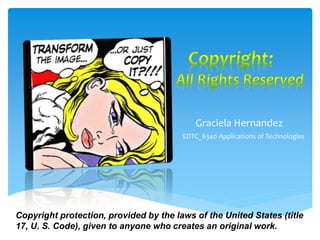
Copyright protection, provided by the laws of the United States (title
17, U. S. Code), given to anyone who creates an original work.
Welcome to Copyright Kids!
The Copyright Act gives copyright holders the exclusive right to reproduce works for a
limited time period. Fair use is a limitation on this right. Fair use allows people other
than the copyright owner to copy part or, in some circumstances, all of a copyrighted
work, even where the copyright holder has not given permission or objects.
Copyright is a form of protection from the moment you
create one of the work below:
 Literary Work
 Musical work
 Dramatic & Artistic Work
 Pictorial/Motion picture Work
 Graphic Art Work
 Music and sound recordings
WHAT IS COPYRIGHT?
Any of the items listed above with a work created is illegal to copy or use
with out your permission. A limitation is the doctrine of “Fair Use.”
Copyright law in the United States is embodied in federal laws enacted by
Congress. The current copyright law, the Copyright Act of 1976 (as
amended), is codified in Title 17 of the U.S. Code.
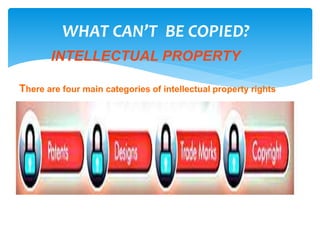
WHAT CAN’T BE COPIED?
INTELLECTUAL PROPERTY
There are four main categories of intellectual property rights
HOW ARE YOU PROTECTED?
Educate Yourself!
This video is provided through and was released through
special consideration for the use in this power point.
Copyright on Campus Video. (n.d.). Retrieved January 26, 2015, from http://www.copyright.com
Art Tech L@w. (n.d.). Retrieved January 25, 2015, from http://arttechlaw.com/fair-use-101
Color This Area of the Law Gray by Daniel Grant & Cartoon by David Klein from
http://www.wsj.com/articles/SB123319795753727521
Duke Law: Centers for the Study of the Public Domain: The Incredible Shrinking Public Domain: The Copyright
Term Grows to unrecognizable proportions Gobbling up The Public Domain Cartoon:
http://web.law.duke.edu/cspd/publicdomainday/2012/shrinking
Fair Use-Use It or Lose It! Harper, George.(2007) The Copyright Crash Course. In University of Texas Libraries.
Retrieved September 1, 2011, from Tales from the Public Domain: Bound by law? From
http://www.nonfictioncomics.net/category/law/
Lipinski, Tomas A. The Complete Copyright Liability Handbook for Librarians and Educators. New York, NY:
Neal-Schuman Publishers, 2006
Various (Ed.). (2015, January 26). World Intellectual Property Organization. Retrieved January 26, 2015,
from http://www.wipo.int/
Wherry, Timothy Lee. Intellectual Property: Everything the Digital-Age Librarian Needs to Know. Chicago, IL:
American Library Association, 2008
Reference

Ghedtc6340 pp tfinal

  • 1.
    Graciela Hernandez EDTC_6340 Applicationsof Technologies Copyright protection, provided by the laws of the United States (title 17, U. S. Code), given to anyone who creates an original work.
  • 2.
  • 3.
    The Copyright Actgives copyright holders the exclusive right to reproduce works for a limited time period. Fair use is a limitation on this right. Fair use allows people other than the copyright owner to copy part or, in some circumstances, all of a copyrighted work, even where the copyright holder has not given permission or objects.
  • 4.
    Copyright is aform of protection from the moment you create one of the work below:  Literary Work  Musical work  Dramatic & Artistic Work  Pictorial/Motion picture Work  Graphic Art Work  Music and sound recordings WHAT IS COPYRIGHT? Any of the items listed above with a work created is illegal to copy or use with out your permission. A limitation is the doctrine of “Fair Use.” Copyright law in the United States is embodied in federal laws enacted by Congress. The current copyright law, the Copyright Act of 1976 (as amended), is codified in Title 17 of the U.S. Code.
  • 5.
    WHAT CAN’T BECOPIED? INTELLECTUAL PROPERTY There are four main categories of intellectual property rights
  • 6.
    HOW ARE YOUPROTECTED?
  • 7.
    HOW ARE YOUPROTECTED?
  • 8.
  • 10.
    This video isprovided through and was released through special consideration for the use in this power point.
  • 11.
    Copyright on CampusVideo. (n.d.). Retrieved January 26, 2015, from http://www.copyright.com Art Tech L@w. (n.d.). Retrieved January 25, 2015, from http://arttechlaw.com/fair-use-101 Color This Area of the Law Gray by Daniel Grant & Cartoon by David Klein from http://www.wsj.com/articles/SB123319795753727521 Duke Law: Centers for the Study of the Public Domain: The Incredible Shrinking Public Domain: The Copyright Term Grows to unrecognizable proportions Gobbling up The Public Domain Cartoon: http://web.law.duke.edu/cspd/publicdomainday/2012/shrinking Fair Use-Use It or Lose It! Harper, George.(2007) The Copyright Crash Course. In University of Texas Libraries. Retrieved September 1, 2011, from Tales from the Public Domain: Bound by law? From http://www.nonfictioncomics.net/category/law/ Lipinski, Tomas A. The Complete Copyright Liability Handbook for Librarians and Educators. New York, NY: Neal-Schuman Publishers, 2006 Various (Ed.). (2015, January 26). World Intellectual Property Organization. Retrieved January 26, 2015, from http://www.wipo.int/ Wherry, Timothy Lee. Intellectual Property: Everything the Digital-Age Librarian Needs to Know. Chicago, IL: American Library Association, 2008 Reference