End Copyright Confusion!Fair Use & Citation GuidelinesLynn ZottnickInstructional Technology Lakeview Academy July 2009Certain materials are included under the fair use exemption of the U. S. Copyright Law and have been prepared according to the fair use multimedia guidelines and are restricted from further use
“If you cannot protect what you own, you don’t own anything.”-Jack Valenti, 2002
“New networked technologies enable users to participate in the consumption, distribution, and creation of content in ways that are revolutionary…young people are now confronting copyright law on a regular basis.-Harvard University 2009
The Challenge      Students do not understand… …..copyright law (or value it) and its impact on the creative work of an individual. Teachers do not understand … the concept of “educational fair use.” Technology is making it…easier and easier to duplicate copyrighted work.
The Challenge Typical Student Comments…No one is going to take the time to track me down.
They make so much money, they’ll never miss it.
I am enhancing the value!
I bought it!  Why can’t I do what I want with it?
It’s not plagiarism because…The Myths "If it doesn't have a copyright notice, it's not copyrighted.""If I make up my own stories, but base them on another work, my new work belongs to me.""If they don’t charge for it, it’s not a violation.” And more…
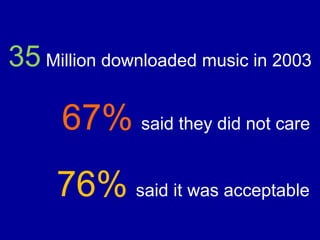
35 Million downloaded music in 2003  67%said they did not care76%said it was acceptable
Disconnect!
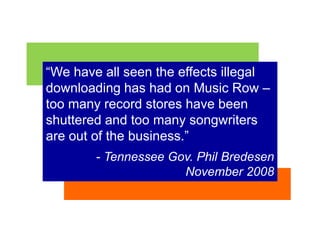
“We have all seen the effects illegal downloading has had on Music Row – too many record stores have been shuttered and too many songwriters are out of the business.”-Tennessee Gov. Phil BredesenNovember 2008
The Truth The Recording Industry Association of America (RIAA) is pursuing and prosecuting violators.
The Truth “RIAA sent new wave of 401 pre-lawsuit letters to 12 universities this week.”RIAA Newsroom, February 21. 2008Worldwide piracy of intellectual property is a problem – congress is calling for meaningful reforms in the global area.RIAA Newsrooom May 2009“The First-Ever Campus Downloading Bill Passed”RIAA Newsroom, November 2008
Confusion!
“Confusion about what constitutes plagiarism — not malicious intent — is the leading cause of plagiarism at the graduate school level… the increasingly worrisome problem…”-George M. Bodner, Ph.D.ScienceDaily (Mar. 22, 2009)
Universities are concerned about the next "Google generation" of students, who might have cut and pasted all their … essays and then see nothing wrong in carrying on with this approach in higher education….”-Conference to tackle university plagiarism problemOctober 17, 2006 s
The Truth Plagiarism has become an epidemic."Internet plagiarism is probably by far the most common form of cheating or academic dishonesty" DidiKuo, Emory University graduate, University's Honor Council ChairmanNational Crosstalk Winter 2006s
The History
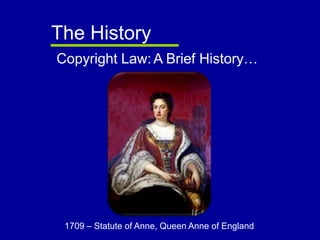
The History Copyright Law:A Brief History…1709 – Statute of Anne, Queen Anne of England
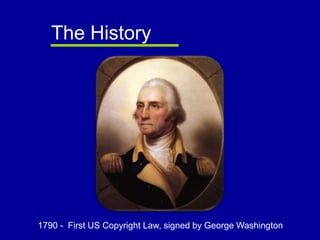
The History 1790 -  First US Copyright Law, signed by George Washington
The History 1841 -  Concept of “Fair Use” introduced
1976 -  “Fair Use” statute added to the US              s Copyright Law
1998-  Digital Millennium Copyright Act (DMCA)
2003 - Teacher Act Interactive Copyright Timeline
Copyright Law
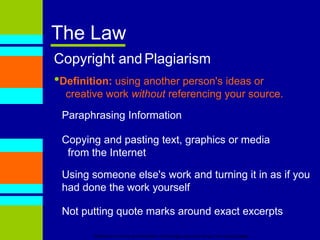
The Law Copyright LawIntellectual property protection for original works    are automatically protected by copyright law.
Protection begins at the moment they are     “fixed in a tangible medium.”
Rights include: reproduction, modification,      distribution, display, and performance.The Law Copyright Law:How Long Does it Last?Created Prior 1923Public Domain – Can be used without permission
Created after 1923  but before1978    95 years  from the date of publication.
Created on or after January 1,1978The life of the author plus 70 years    (Sonny Bono Copyright Term Extension Act)“Copyright law’s perennial dilemma is to determine where exclusive rights should end and unrestrained public access should begin.”-Neil WeinstockNetanel“Copyright and a Democratic Civil Society”Yale Law Journal 1996
The Law Copyright Law:EducationalFair UseThe right to use copyrighted materials freely without payment or permission for purposes such as “criticism, comment, news reporting, teaching, scholarship, and research.”Section 107Copyright Act of 1976
The Law Copyright Law:EducationalFair UseA single copy can be made of any of the following….A chapter from a book
An article from a periodical or newspaper
A short story, short essay, or short poem  whether or not it is from a collective work
A graph, chart, diagram, picture or cartoon  from a book, periodical or newspaperThe Law Copyright Law:EducationalFair UseThe copy must meet these requirements…Test of brevity of the material, the spontaneity, and the cumulative effect of the creationAll copies must include a notice of copyrightNOTICE: THIS MATERIAL MAY BE PROTECTED BY COPYRIGHT LAW.Title 17 U.S>.Code
The Law Copyright Law:EducationalFair UseBefore copying, consider the following…
Is the purpose instructional
Was the material acquired legally?
What is the effect of the amount or portion used?
Is the material given proper credit or attribution?
Was the material copied as a substitute for a    purchase? Bottom Line!
Fair UseTransformative UseCreative Commons
Fair Use:Transformative UseAs a general rule, if you are using a small portion of somebody else's work in a non-competitive way and the purpose for your use is to benefit the public, you're on pretty safe ground. - Mimi CalterStanford University Libraries--Joyce Valencia, Library School Journal
Fair Use:Transformative Use“When the user of copyrighted material add value to or repurposes materials for a use different from that which it was originally intended, it will likely  be considered transformative use; it will also likely be considered fair use.  Fair use embraces the modifying of existing media content, placing it in a new context.”--Joyce Valencia Library School Journal
Creative CommonsShare, Remix, Reuse, Legallyhttp://creativecommons.org/
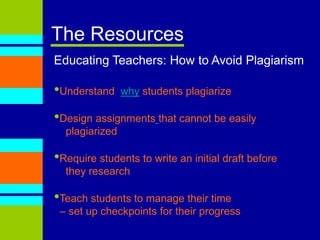
The Resources Educating TeachersMedia Education lab – Temple UniversityCopyright & Fair Use – Stanford University
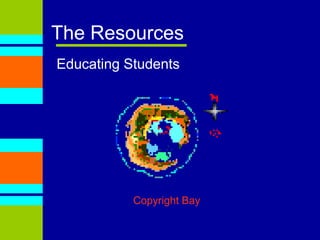
The Resources Educating Students Copyright Bay
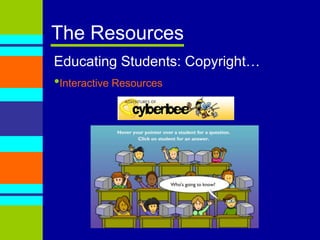
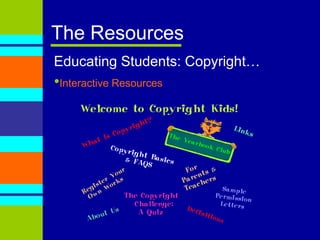
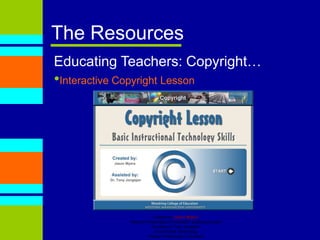
The Resources Educating Students: Copyright…Interactive Resources The Resources Educating Students: Copyright…Interactive Resources The Resources Educating Teachers: Copyright…Interactive Copyright LessonCreated by Jason Myers,Western Washington University/IT graduate studentCourtesy of Tony JongejanInstructional TechnologyWestern Washington University
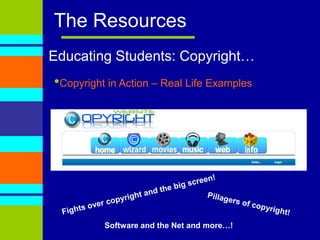
TheResourcesEducating Students: Copyright…Copyright in Action – Real Life ExamplesFights over copyright and the big screen!Pillagers of copyright! Software and the Net and more…!
TheResources Educating Students: Copyright…Copyright in Action – Additional ResourcesRecording Academy (Grammy Awards) site    -  Issues, views, digital and music newsRecording Industry of America
Plagiarism

Copyright & Plaigarism 2009

  • 1.
    End Copyright Confusion!FairUse & Citation GuidelinesLynn ZottnickInstructional Technology Lakeview Academy July 2009Certain materials are included under the fair use exemption of the U. S. Copyright Law and have been prepared according to the fair use multimedia guidelines and are restricted from further use
  • 2.
    “If you cannotprotect what you own, you don’t own anything.”-Jack Valenti, 2002
  • 3.
    “New networked technologiesenable users to participate in the consumption, distribution, and creation of content in ways that are revolutionary…young people are now confronting copyright law on a regular basis.-Harvard University 2009
  • 4.
    The Challenge Students do not understand… …..copyright law (or value it) and its impact on the creative work of an individual. Teachers do not understand … the concept of “educational fair use.” Technology is making it…easier and easier to duplicate copyrighted work.
  • 5.
    The Challenge TypicalStudent Comments…No one is going to take the time to track me down.
  • 6.
    They make somuch money, they’ll never miss it.
  • 7.
    I am enhancingthe value!
  • 8.
    I bought it! Why can’t I do what I want with it?
  • 9.
    It’s not plagiarismbecause…The Myths "If it doesn't have a copyright notice, it's not copyrighted.""If I make up my own stories, but base them on another work, my new work belongs to me.""If they don’t charge for it, it’s not a violation.” And more…
  • 10.
    35 Million downloadedmusic in 2003 67%said they did not care76%said it was acceptable
  • 11.
  • 12.
    “We have allseen the effects illegal downloading has had on Music Row – too many record stores have been shuttered and too many songwriters are out of the business.”-Tennessee Gov. Phil BredesenNovember 2008
  • 13.
    The Truth TheRecording Industry Association of America (RIAA) is pursuing and prosecuting violators.
  • 14.
    The Truth “RIAAsent new wave of 401 pre-lawsuit letters to 12 universities this week.”RIAA Newsroom, February 21. 2008Worldwide piracy of intellectual property is a problem – congress is calling for meaningful reforms in the global area.RIAA Newsrooom May 2009“The First-Ever Campus Downloading Bill Passed”RIAA Newsroom, November 2008
  • 15.
  • 16.
    “Confusion about whatconstitutes plagiarism — not malicious intent — is the leading cause of plagiarism at the graduate school level… the increasingly worrisome problem…”-George M. Bodner, Ph.D.ScienceDaily (Mar. 22, 2009)
  • 17.
    Universities are concernedabout the next "Google generation" of students, who might have cut and pasted all their … essays and then see nothing wrong in carrying on with this approach in higher education….”-Conference to tackle university plagiarism problemOctober 17, 2006 s
  • 18.
    The Truth Plagiarismhas become an epidemic."Internet plagiarism is probably by far the most common form of cheating or academic dishonesty" DidiKuo, Emory University graduate, University's Honor Council ChairmanNational Crosstalk Winter 2006s
  • 19.
  • 20.
    The History CopyrightLaw:A Brief History…1709 – Statute of Anne, Queen Anne of England
  • 21.
    The History 1790- First US Copyright Law, signed by George Washington
  • 22.
    The History 1841- Concept of “Fair Use” introduced
  • 23.
    1976 - “Fair Use” statute added to the US s Copyright Law
  • 24.
    1998- DigitalMillennium Copyright Act (DMCA)
  • 25.
    2003 - TeacherAct Interactive Copyright Timeline
  • 26.
  • 27.
    The Law CopyrightLawIntellectual property protection for original works are automatically protected by copyright law.
  • 28.
    Protection begins atthe moment they are “fixed in a tangible medium.”
  • 29.
    Rights include: reproduction,modification, distribution, display, and performance.The Law Copyright Law:How Long Does it Last?Created Prior 1923Public Domain – Can be used without permission
  • 30.
    Created after 1923 but before1978 95 years from the date of publication.
  • 31.
    Created on orafter January 1,1978The life of the author plus 70 years (Sonny Bono Copyright Term Extension Act)“Copyright law’s perennial dilemma is to determine where exclusive rights should end and unrestrained public access should begin.”-Neil WeinstockNetanel“Copyright and a Democratic Civil Society”Yale Law Journal 1996
  • 32.
    The Law CopyrightLaw:EducationalFair UseThe right to use copyrighted materials freely without payment or permission for purposes such as “criticism, comment, news reporting, teaching, scholarship, and research.”Section 107Copyright Act of 1976
  • 33.
    The Law CopyrightLaw:EducationalFair UseA single copy can be made of any of the following….A chapter from a book
  • 34.
    An article froma periodical or newspaper
  • 35.
    A short story,short essay, or short poem whether or not it is from a collective work
  • 36.
    A graph, chart,diagram, picture or cartoon from a book, periodical or newspaperThe Law Copyright Law:EducationalFair UseThe copy must meet these requirements…Test of brevity of the material, the spontaneity, and the cumulative effect of the creationAll copies must include a notice of copyrightNOTICE: THIS MATERIAL MAY BE PROTECTED BY COPYRIGHT LAW.Title 17 U.S>.Code
  • 37.
    The Law CopyrightLaw:EducationalFair UseBefore copying, consider the following…
  • 38.
    Is the purposeinstructional
  • 39.
    Was the materialacquired legally?
  • 40.
    What is theeffect of the amount or portion used?
  • 41.
    Is the materialgiven proper credit or attribution?
  • 42.
    Was the materialcopied as a substitute for a purchase? Bottom Line!
  • 43.
  • 44.
    Fair Use:Transformative UseAsa general rule, if you are using a small portion of somebody else's work in a non-competitive way and the purpose for your use is to benefit the public, you're on pretty safe ground. - Mimi CalterStanford University Libraries--Joyce Valencia, Library School Journal
  • 45.
    Fair Use:Transformative Use“Whenthe user of copyrighted material add value to or repurposes materials for a use different from that which it was originally intended, it will likely be considered transformative use; it will also likely be considered fair use. Fair use embraces the modifying of existing media content, placing it in a new context.”--Joyce Valencia Library School Journal
  • 46.
    Creative CommonsShare, Remix,Reuse, Legallyhttp://creativecommons.org/
  • 47.
    The Resources EducatingTeachersMedia Education lab – Temple UniversityCopyright & Fair Use – Stanford University
  • 48.
    The Resources EducatingStudents Copyright Bay
  • 49.
    The Resources EducatingStudents: Copyright…Interactive Resources The Resources Educating Students: Copyright…Interactive Resources The Resources Educating Teachers: Copyright…Interactive Copyright LessonCreated by Jason Myers,Western Washington University/IT graduate studentCourtesy of Tony JongejanInstructional TechnologyWestern Washington University
  • 50.
    TheResourcesEducating Students: Copyright…Copyrightin Action – Real Life ExamplesFights over copyright and the big screen!Pillagers of copyright! Software and the Net and more…!
  • 51.
    TheResources Educating Students:Copyright…Copyright in Action – Additional ResourcesRecording Academy (Grammy Awards) site - Issues, views, digital and music newsRecording Industry of America
  • 52.

Editor's Notes

  • #10 First-Ever Campus Downloading Bill
  • #14 First-Ever Campus Downloading Bill
  • #15 First-Ever Campus Downloading Bill
  • #25 Includes transofrmative use
  • #31 Includes transofrmative use
  • #32 Includes transofrmative use