JASEM ISSN 1119-8362                Full-text Available Online at         J. Appl. Sci. Environ. Manage. September, 2008
                    All rights reserved              www.bioline.org.br/ja                                   Vol. 12(3) 67 - 69


                        Anti termite activity of Jatropha curcas Linn. biochemicals
                                     1
                                         NEELU SINGH* AND 2SUSHILKUMAR
1
    Tropical Forest Research Institute,Mandla Road , Jabalpur (India). 2National Research Centre For Weed Science (ICAR), Jabalpur(India)

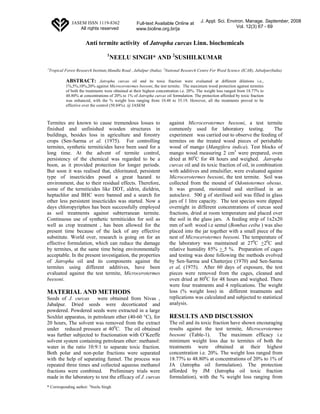
             ABSTRACT:            Jatropha curcas oil and its toxic fraction were evaluated at different dilutions i.e.,
             1%,5%,10%,20% against Microcerotermes beesoni, the test termite. The maximum wood protection against termites
             of both the treatments were obtained at their highest concentration i.e. 20%. The weight loss ranged from 18.77% to
             48.80% at concentrations of 20% to 1% of Jatropha curcas oil formulation. The protection afforded by toxic fraction
             was enhanced, with the % weight loss ranging from 10.48 to 35.19. However, all the treatments proved to be
             effective over the control (50.84%). @ JASEM


Termites are known to cause tremendous losses to                         against Microcerotermes beesoni, a test termite
finished and unfinished wooden structures in                             commonly used for laboratory testing.               The
buildings, besides loss in agriculture and forestry                      experiment was carried out to observe the feeding of
crops (Sen-Sarma et al. (1975). For controlling                          termites on the treated wood pieces of perishable
termites, synthetic termiticides have been used for a                    wood of mango (Mangifera indica). Test blocks of
long time. At the advent of termite control,                             mango wood measuring 2 cm3 were prepared, oven
persistency of the chemical was regarded to be a                         dried at 800C for 48 hours and weighed. Jatropha
boon, as it provided protection for longer periods.                      curcas oil and its toxic fraction of oil, in combination
But soon it was realised that, chlorinated, persistent                   with additives and emulsifier, were evaluated against
type of insecticides posed a great hazard to                             Microcerotermes beesoni, the test termite. Soil was
environment, due to their residual effects. Therefore,                   collected from the mound of Odontotermes obesus.
some of the termiticides like DDT, aldrin, dieldrin,                     It was ground, moistened and sterilised in an
heptachlor and BHC were banned and a search for                          autoclave. 500 g of sterilised soil was filled in glass
other less persistent insecticides was started. Now a                    jars of 1 litre capacity. The test species were dipped
days chloropyriphos has been successfully employed                       overnight in different concentrations of curcas seed
as soil treatments against subterranean termite.                         fractions, dried at room temperature and placed over
Continuous use of synthetic termiticides for soil as                     the soil in the glass jars. A feeding strip of 1x2x20
well as crop treatment , has been allowed for the                        mm of soft wood i.e semul (Bombax ceiba ) was also
present time because of the lack of any effective                        placed into the jar together with a small piece of the
substitute. World over, research is going on for an                      nest of Microcerotermes beesoni. The temperature of
effective formulation, which can reduce the damage                       the laboratory was maintained at 270C +20C and
by termites, at the same time being environmentally                      relative humidity 85% + 5 %. Preparation of cages
acceptable. In the present investigation, the properties                 and testing was done following the methods evolved
of Jatropha oil and its components against the                           by Sen-Sarma and Chatterjee (1970) and Sen-Sarma
termites using different additives, have been                            et al, (1975). After 60 days of exposure, the test
evaluated against the test termite, Microcerotermes                      pieces were removed from the cages, cleaned and
beesoni.                                                                 oven dried at 800C for 48 hours and weighed. There
                                                                         were four treatments and 4 replications. The weight
MATERIAL AND METHODS                                                     loss (% weight loss) in different treatments and
Seeds of J. curcas      were obtained from Nivas ,                       replications was calculated and subjected to statistical
Jabalpur. Dried seeds were decorticated and                              analysis.
powdered. Powdered seeds were extracted in a large
Soxhlet apparatus, in petroleum ether (40-60 °C), for                    RESULTS AND DISCUSSION
20 hours, The solvent was removed from the extract                       The oil and its toxic fraction have shown encouraging
under reduced pressure at 400C. The oil obtained                         results against the test termite, Microcerotermes
was further subjected to fractionation with O’Keeffe                     beesoni (Table-1).       The maximum efficacy i.e
solvent system containing petroleum ether: methanol:                     minimum weight loss due to termites of both the
water in the ratio 10:9:1 to separate toxic fraction.                    treatments were obtained at their highest
Both polar and non-polar fractions were separated                        concentration i.e. 20%. The weight loss ranged from
with the help of separating funnel. The process was                      18.77% to 48.80% at concentrations of 20% to 1% of
repeated three times and collected aqueous methanol                      JA (Jatropha oil formulation). The protection
fractions were combined. Preliminary trials were                         afforded by JM (Jatropha oil toxic fraction
made in the laboratory to test the efficacy of J. curcas                 formulation), with the % weight loss ranging from
* Corresponding author: 1Neelu Singh
Anti termite activity of Jatropha curcas Linn. biochemicals                               68

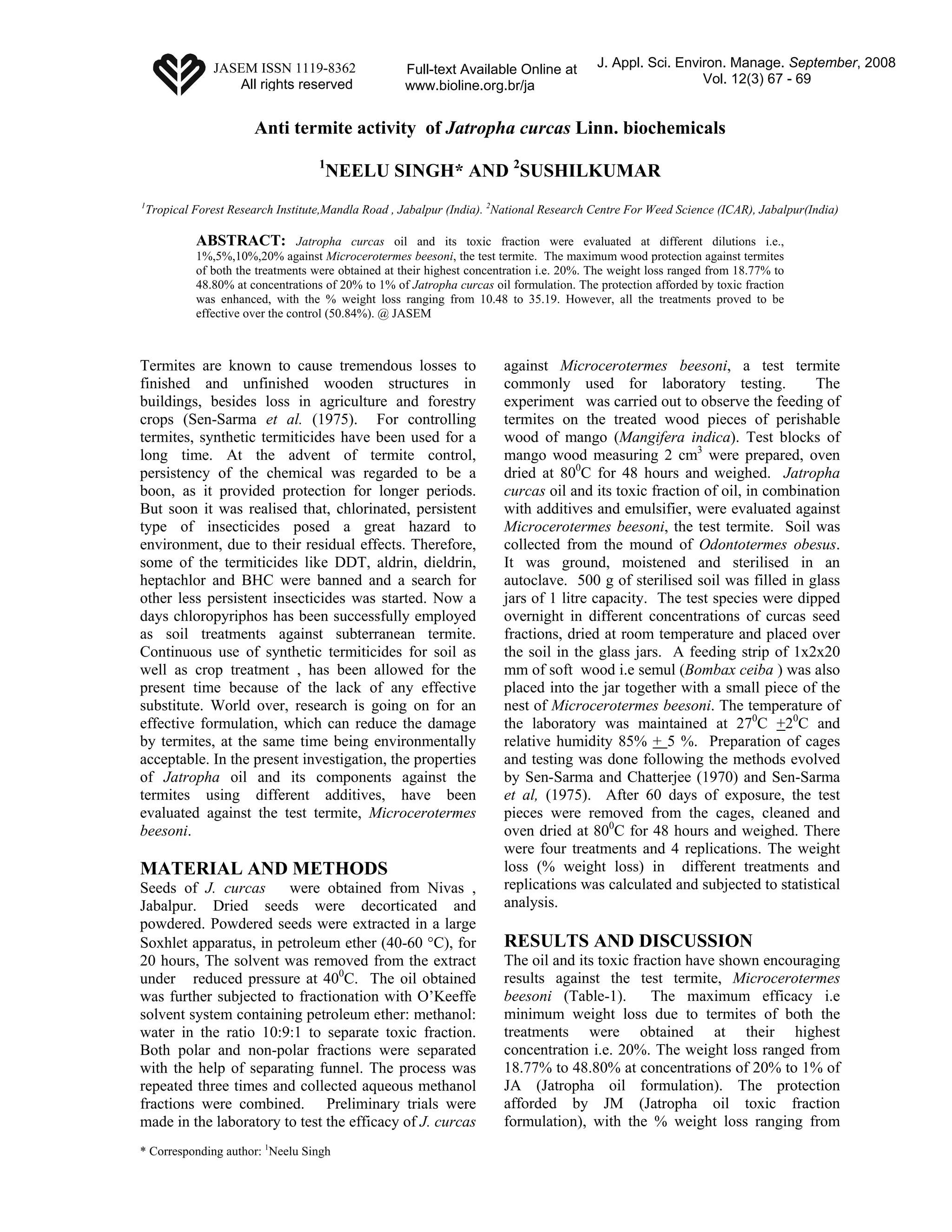
10.48 to 35.19. However, all the treatments proved to                     control, while maximum weight loss in blocks was
more effective over the control (50.84%). The                             recorded in treatment T4 (48.80%) which was at par
difference in the weight of the wood pieces before                        with control (T9). The mean weight loss was 4.48g in
treatment was non significant. The weight of the test                     control, which indicates that control wooden blocks
pieces, after the various treatments (T1-T9), as well                     were more damaged by termites as compare to 1.79,
as their weight loss, was highly significant at P<0.01.                   2.69, 3.37, 4.32, 0.86, 1.55, 2.45 and 3.0 g post
Minimum loss was observed in T5 (10.48%), which                           treatment weight of T1 to T8, respectively.
was highly significant (P=0.01) in comparison to

Table-1 Efficacy of Jatropha curcas seed components against test termite Microcerotermes beesoni
Treatment         Treatment              Pretreatment            Post treatment          Weight loss in test   Weight
                  concentration          weight of test          weight of test          pieces        after   loss
                                         pieces                  pieces                  exposure
                  (%)                    (g)                     (g)                     (g)                   (%)

T1                20                     9.53                    7.75a                   1.79e                 18.77
                                                                                                               (25.66) d

T2                10                     9.39                    6.69bc                  2.69cd                29.45
                                                                                                               (32.86) c

T3                5                      8.67                    5.29de                  3.37b                 38.54
                                                                                                               (38.37) b

T4                1                      8.82                    4.56ef                  4.32a                 48.80
                                                                                                               (44.31) a

T5                20                     8.32                    7.45ab                  0.86f                 10.48
                                                                                                               (18.85) e

T6                10                     8.88                    7.33ab                  1.55e                 17.34
                                                                                                               (24.60) d

T7                5                      8.57                    6.11cd                  2.45d                 28.70
                                                                                                               (32.39) c

T8                1                      8.52                    5.52d                   3.00bc                35.19
                                                                                                               (36.37) b

T9                                       8.81                    4.34f                   4.48a                 50.84
Control                                                                                                        (45.48)a

C.D.                                     NS                      0.852**                 0.4648**              2.197
Values are mean of 4 replications.
NS- Non-significant
Values in parenthesis are arc sine transformed values.
Values followed by the same alphabet are not significantly different at P<0.01.


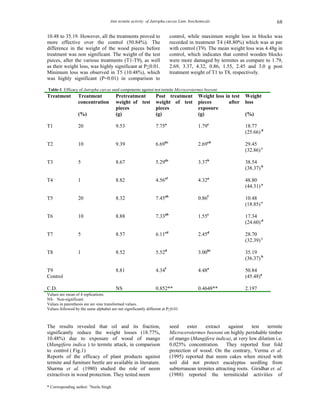
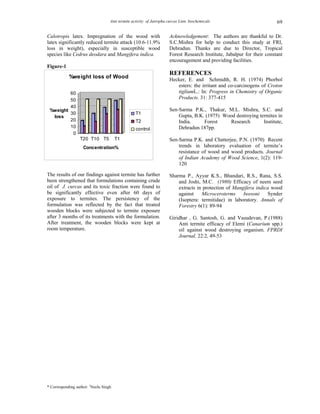
The results revealed that oil and its fraction,                           seed     ester   extract     against    test   termite
significantly reduce the weight losses (18.77%,                           Microcerotermes beesoni on highly perishable timber
10.48%) due to exposure of wood of mango                                  of mango (Mangifera indica), at very low dilution i.e.
(Mangifera indica ) to termite attack, in comparison                      0.025% concentration. They reported four fold
to control ( Fig.1)                                                       protection of wood. On the contrary, Verma et al.
Reports of the efficacy of plant products against                         (1995) reported that neem cakes when mixed with
termite and furniture beetle are available in literature.                 soil did not protect eucalyptus seedling from
Sharma et al. (1980) studied the role of neem                             subterranean termites attracting roots. Giridhar et. al.
extractives in wood protection. They tested neem                          (1988) reported the termiticidal activities of

* Corresponding author: 1Neelu Singh
Anti termite activity of Jatropha curcas Linn. biochemicals                           69

Calotropis latex. Impregnation of the wood with                       Acknowledgement: The authors are thankful to Dr.
latex significantly reduced termite attack (10.6-11.9%                S.C.Mishra for help to conduct this study at FRI,
loss in weight), especially in susceptible wood                       Dehradun. Thanks are due to Director, Tropical
species like Cedrus deodara and Mangifera indica.                     Forest Research Institute, Jabalpur for their constant
                                                                      encouragement and providing facilities.
Figure-1
                                                                      REFERENCES
            %weight loss of Wood                                      Hecker, E. and Schmidth, R. H. (1974) Phorbol
                                                                         esters: the irritant and co-carcinogens of Croton
         60                                                              tigliumL.: In: Progress in Chemistry of Organic
         50                                                              Products. 31: 377-415
         40
 %weight                                                              Sen-Sarma P.K., Thakur, M.L. Mishra, S.C. and
         30                                       T1
  loss                                                                    Gupta, B.K. (1975) Wood destroying termites in
         20                                       T2                      India.     Forest    Research        Institute,
         10                                       control                 Dehradun.187pp.
          0
                  T20 T10 T5           T1                             Sen-Sarma P.K. and Chatterjee, P.N. (1970) Recent
                    Concentration%                                        trends in laboratory evaluation of termite’s
                                                                          resistance of wood and wood products. Journal
                                                                          of Indian Academy of Wood Science, 1(2): 119-
                                                                          120

The results of our findings against termite has further               Sharma P., Ayyar K.S., Bhandari, R.S., Rana, S.S.
been strengthened that formulations containing crude                      and Joshi, M.C. (1980) Efficacy of neem seed
oil of J. curcas and its toxic fraction were found to                     extracts in protection of Mangifera indica wood
be significantly effective even after 60 days of                          against    Microceroterms     beesoni    Synder
exposure to termites. The persistency of the                              (Isoptera: termitidae) in laboratory. Annals of
formulation was reflected by the fact that treated                        Forestry 6(1): 89-94
wooden blocks were subjected to termite exposure
after 3 months of its treatments with the formulation.                Giridhar , G. Santosh, G. and Vasudevan, P.(1988)
After treatment, the wooden blocks were kept at                           Anti termite efficacy of Elemi (Canarium spp.)
room temperature.                                                         oil against wood destroying organism. FPRDI
                                                                          Journal, 22:2, 49-53


* Corresponding author: 1Neelu Singh

Anti Termite Activity of Jatropha Curcas Linn. Biochemicals

  • 1.
    JASEM ISSN 1119-8362 Full-text Available Online at J. Appl. Sci. Environ. Manage. September, 2008 All rights reserved www.bioline.org.br/ja Vol. 12(3) 67 - 69 Anti termite activity of Jatropha curcas Linn. biochemicals 1 NEELU SINGH* AND 2SUSHILKUMAR 1 Tropical Forest Research Institute,Mandla Road , Jabalpur (India). 2National Research Centre For Weed Science (ICAR), Jabalpur(India) ABSTRACT: Jatropha curcas oil and its toxic fraction were evaluated at different dilutions i.e., 1%,5%,10%,20% against Microcerotermes beesoni, the test termite. The maximum wood protection against termites of both the treatments were obtained at their highest concentration i.e. 20%. The weight loss ranged from 18.77% to 48.80% at concentrations of 20% to 1% of Jatropha curcas oil formulation. The protection afforded by toxic fraction was enhanced, with the % weight loss ranging from 10.48 to 35.19. However, all the treatments proved to be effective over the control (50.84%). @ JASEM Termites are known to cause tremendous losses to against Microcerotermes beesoni, a test termite finished and unfinished wooden structures in commonly used for laboratory testing. The buildings, besides loss in agriculture and forestry experiment was carried out to observe the feeding of crops (Sen-Sarma et al. (1975). For controlling termites on the treated wood pieces of perishable termites, synthetic termiticides have been used for a wood of mango (Mangifera indica). Test blocks of long time. At the advent of termite control, mango wood measuring 2 cm3 were prepared, oven persistency of the chemical was regarded to be a dried at 800C for 48 hours and weighed. Jatropha boon, as it provided protection for longer periods. curcas oil and its toxic fraction of oil, in combination But soon it was realised that, chlorinated, persistent with additives and emulsifier, were evaluated against type of insecticides posed a great hazard to Microcerotermes beesoni, the test termite. Soil was environment, due to their residual effects. Therefore, collected from the mound of Odontotermes obesus. some of the termiticides like DDT, aldrin, dieldrin, It was ground, moistened and sterilised in an heptachlor and BHC were banned and a search for autoclave. 500 g of sterilised soil was filled in glass other less persistent insecticides was started. Now a jars of 1 litre capacity. The test species were dipped days chloropyriphos has been successfully employed overnight in different concentrations of curcas seed as soil treatments against subterranean termite. fractions, dried at room temperature and placed over Continuous use of synthetic termiticides for soil as the soil in the glass jars. A feeding strip of 1x2x20 well as crop treatment , has been allowed for the mm of soft wood i.e semul (Bombax ceiba ) was also present time because of the lack of any effective placed into the jar together with a small piece of the substitute. World over, research is going on for an nest of Microcerotermes beesoni. The temperature of effective formulation, which can reduce the damage the laboratory was maintained at 270C +20C and by termites, at the same time being environmentally relative humidity 85% + 5 %. Preparation of cages acceptable. In the present investigation, the properties and testing was done following the methods evolved of Jatropha oil and its components against the by Sen-Sarma and Chatterjee (1970) and Sen-Sarma termites using different additives, have been et al, (1975). After 60 days of exposure, the test evaluated against the test termite, Microcerotermes pieces were removed from the cages, cleaned and beesoni. oven dried at 800C for 48 hours and weighed. There were four treatments and 4 replications. The weight MATERIAL AND METHODS loss (% weight loss) in different treatments and Seeds of J. curcas were obtained from Nivas , replications was calculated and subjected to statistical Jabalpur. Dried seeds were decorticated and analysis. powdered. Powdered seeds were extracted in a large Soxhlet apparatus, in petroleum ether (40-60 °C), for RESULTS AND DISCUSSION 20 hours, The solvent was removed from the extract The oil and its toxic fraction have shown encouraging under reduced pressure at 400C. The oil obtained results against the test termite, Microcerotermes was further subjected to fractionation with O’Keeffe beesoni (Table-1). The maximum efficacy i.e solvent system containing petroleum ether: methanol: minimum weight loss due to termites of both the water in the ratio 10:9:1 to separate toxic fraction. treatments were obtained at their highest Both polar and non-polar fractions were separated concentration i.e. 20%. The weight loss ranged from with the help of separating funnel. The process was 18.77% to 48.80% at concentrations of 20% to 1% of repeated three times and collected aqueous methanol JA (Jatropha oil formulation). The protection fractions were combined. Preliminary trials were afforded by JM (Jatropha oil toxic fraction made in the laboratory to test the efficacy of J. curcas formulation), with the % weight loss ranging from * Corresponding author: 1Neelu Singh
  • 2.
    Anti termite activityof Jatropha curcas Linn. biochemicals 68 10.48 to 35.19. However, all the treatments proved to control, while maximum weight loss in blocks was more effective over the control (50.84%). The recorded in treatment T4 (48.80%) which was at par difference in the weight of the wood pieces before with control (T9). The mean weight loss was 4.48g in treatment was non significant. The weight of the test control, which indicates that control wooden blocks pieces, after the various treatments (T1-T9), as well were more damaged by termites as compare to 1.79, as their weight loss, was highly significant at P<0.01. 2.69, 3.37, 4.32, 0.86, 1.55, 2.45 and 3.0 g post Minimum loss was observed in T5 (10.48%), which treatment weight of T1 to T8, respectively. was highly significant (P=0.01) in comparison to Table-1 Efficacy of Jatropha curcas seed components against test termite Microcerotermes beesoni Treatment Treatment Pretreatment Post treatment Weight loss in test Weight concentration weight of test weight of test pieces after loss pieces pieces exposure (%) (g) (g) (g) (%) T1 20 9.53 7.75a 1.79e 18.77 (25.66) d T2 10 9.39 6.69bc 2.69cd 29.45 (32.86) c T3 5 8.67 5.29de 3.37b 38.54 (38.37) b T4 1 8.82 4.56ef 4.32a 48.80 (44.31) a T5 20 8.32 7.45ab 0.86f 10.48 (18.85) e T6 10 8.88 7.33ab 1.55e 17.34 (24.60) d T7 5 8.57 6.11cd 2.45d 28.70 (32.39) c T8 1 8.52 5.52d 3.00bc 35.19 (36.37) b T9 8.81 4.34f 4.48a 50.84 Control (45.48)a C.D. NS 0.852** 0.4648** 2.197 Values are mean of 4 replications. NS- Non-significant Values in parenthesis are arc sine transformed values. Values followed by the same alphabet are not significantly different at P<0.01. The results revealed that oil and its fraction, seed ester extract against test termite significantly reduce the weight losses (18.77%, Microcerotermes beesoni on highly perishable timber 10.48%) due to exposure of wood of mango of mango (Mangifera indica), at very low dilution i.e. (Mangifera indica ) to termite attack, in comparison 0.025% concentration. They reported four fold to control ( Fig.1) protection of wood. On the contrary, Verma et al. Reports of the efficacy of plant products against (1995) reported that neem cakes when mixed with termite and furniture beetle are available in literature. soil did not protect eucalyptus seedling from Sharma et al. (1980) studied the role of neem subterranean termites attracting roots. Giridhar et. al. extractives in wood protection. They tested neem (1988) reported the termiticidal activities of * Corresponding author: 1Neelu Singh
  • 3.
    Anti termite activityof Jatropha curcas Linn. biochemicals 69 Calotropis latex. Impregnation of the wood with Acknowledgement: The authors are thankful to Dr. latex significantly reduced termite attack (10.6-11.9% S.C.Mishra for help to conduct this study at FRI, loss in weight), especially in susceptible wood Dehradun. Thanks are due to Director, Tropical species like Cedrus deodara and Mangifera indica. Forest Research Institute, Jabalpur for their constant encouragement and providing facilities. Figure-1 REFERENCES %weight loss of Wood Hecker, E. and Schmidth, R. H. (1974) Phorbol esters: the irritant and co-carcinogens of Croton 60 tigliumL.: In: Progress in Chemistry of Organic 50 Products. 31: 377-415 40 %weight Sen-Sarma P.K., Thakur, M.L. Mishra, S.C. and 30 T1 loss Gupta, B.K. (1975) Wood destroying termites in 20 T2 India. Forest Research Institute, 10 control Dehradun.187pp. 0 T20 T10 T5 T1 Sen-Sarma P.K. and Chatterjee, P.N. (1970) Recent Concentration% trends in laboratory evaluation of termite’s resistance of wood and wood products. Journal of Indian Academy of Wood Science, 1(2): 119- 120 The results of our findings against termite has further Sharma P., Ayyar K.S., Bhandari, R.S., Rana, S.S. been strengthened that formulations containing crude and Joshi, M.C. (1980) Efficacy of neem seed oil of J. curcas and its toxic fraction were found to extracts in protection of Mangifera indica wood be significantly effective even after 60 days of against Microceroterms beesoni Synder exposure to termites. The persistency of the (Isoptera: termitidae) in laboratory. Annals of formulation was reflected by the fact that treated Forestry 6(1): 89-94 wooden blocks were subjected to termite exposure after 3 months of its treatments with the formulation. Giridhar , G. Santosh, G. and Vasudevan, P.(1988) After treatment, the wooden blocks were kept at Anti termite efficacy of Elemi (Canarium spp.) room temperature. oil against wood destroying organism. FPRDI Journal, 22:2, 49-53 * Corresponding author: 1Neelu Singh