The impacts of bioenergy crop production on
 carabids and associated biocontrol services.
   O’Rourke, E.,1,2 Whelan, P.1,2 and Emmerson, M.3

   1.Environmental Research Institute, University College Cork, Cork, Ireland.
   2. School of Biological, Earth and Environmental Sciences, University College Cork,
   Cork, Ireland.
   3. School of Biological Sciences, Queens University Belfast, Northern Ireland.


                       SIMBIOSYS Final Conference
                         Trinity College Dublin
                             28th June 2012

                       erinorourke@umail.ucc.ie
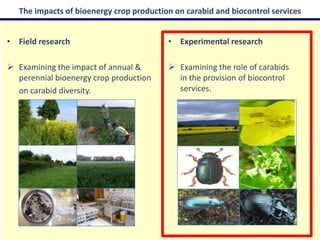
The impacts of bioenergy crop production on carabid and biocontrol services


• Field research                          • Experimental research

 Examining the impact of annual &         Examining the role of carabids
  perennial bioenergy crop production       in the provision of biocontrol
  on carabid diversity.                     services.
Predator biomass drives natural biological control


                   O’Rourke, E.1, Kirwan, L.2, Cook, S.3, Murray, D.A.4,
                           Whelan, P.M.1 & Emmerson, M.5


1. Environmental Research Institute, University College Cork, Cork, Ireland & School of Biological,
Earth and Environmental Sciences, University College Cork, Cork, Ireland.
2. Department of Computing, Mathematics & Physics, Waterford Institute of Technology, Ireland.
3. Department of AgroEcology Department, Rothamsted Research, England.
4. VSN International LTD, 5 The Waterhouse, Waterhouse St, Hemel Hempstead HP1 1ES, England.
5. School of Biological Sciences, Queens University Belfast, Northern Ireland.
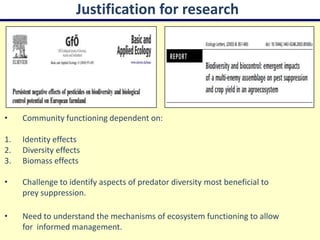
Justification for research


•    Community functioning dependent on:

1.   Identity effects
2.   Diversity effects
3.   Biomass effects

•    Challenge to identify aspects of predator diversity most beneficial to
     prey suppression.

•    Need to understand the mechanisms of ecosystem functioning to allow
     for informed management.
Hypotheses

1. Predator diversity reduces pest survival rate more than
   predator biomass.

2. Interactions amongst predators lead to complementary
   use of prey resources.

3. Predator identity effects and diversity effects remain
   consistent as predator biomass changes.
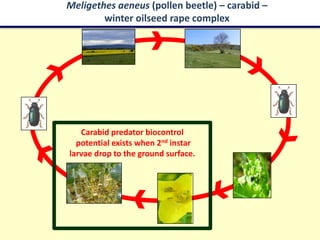
Meligethes aeneus (pollen beetle) – carabid –
        winter oilseed rape complex


   Carabid predator biocontrol
  potential exists when 2nd instar
larvae drop to the ground surface.
Understanding the study system
1. What is the impact of high and low pesticide management of
   winter oilseed rape on:
   a) crop yield
   b) carabid species richness
   c) carabid abundance (Field study)

2. What carabid species are most abundant at the time of pollen
   beetle larval drop to the soil surface? (Field study)

3. Of the most abundant carabid species, which have the capacity to
   prey on the pest? (Laboratory feeding experiment)
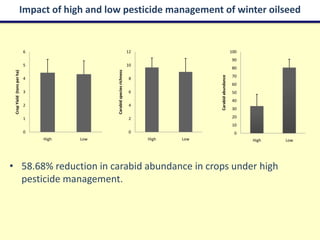
Impact of high and low pesticide management of winter oilseed


                            6                                           12                                    100
                                                                                                               90
                            5                                           10
                                                                                                               80


                                             Carabid species richness
 Crop Yield (tons per ha)


                                                                                                               70


                                                                                          Carabid abundance
                            4                                           8
                                                                                                               60
                            3                                           6                                      50
                                                                                                               40
                            2                                           4
                                                                                                               30

                            1                                           2                                      20
                                                                                                               10
                            0                                           0                                       0
                                High   Low                                   High   Low                             High   Low


• 58.68% reduction in carabid abundance in crops under high
  pesticide management.
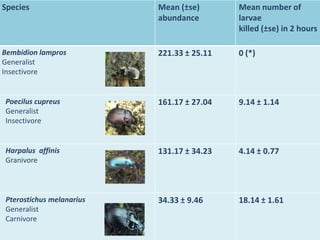
Species                   Mean (±se)       Mean number of
                          abundance        larvae
                                           killed (±se) in 2 hours

Bembidion lampros         221.33 ± 25.11   0 (*)
Generalist
Insectivore


Poecilus cupreus          161.17 ± 27.04   9.14 ± 1.14
Generalist
Insectivore


Harpalus affinis          131.17 ± 34.23   4.14 ± 0.77
Granivore


Pterostichus melanarius   34.33 ± 9.46     18.14 ± 1.61
Generalist
Carnivore
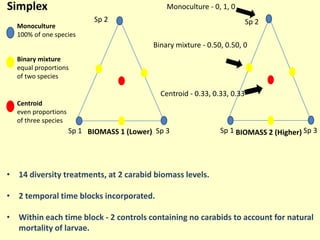
Simplex                                        Monoculture - 0, 1, 0
                           Sp 2                                            Sp 2
  Monoculture
  100% of one species
                                           Binary mixture - 0.50, 0.50, 0
  Binary mixture
  equal proportions
  of two species

                                             Centroid - 0.33, 0.33, 0.33
  Centroid
  even proportions
  of three species
                     Sp 1 BIOMASS 1 (Lower) Sp 3                Sp 1 BIOMASS 2 (Higher) Sp 3


• 14 diversity treatments, at 2 carabid biomass levels.

• 2 temporal time blocks incorporated.

• Within each time block - 2 controls containing no carabids to account for natural
  mortality of larvae.
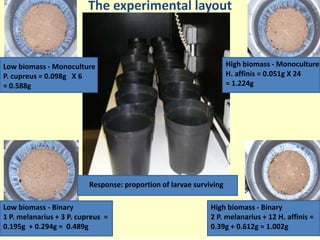
The experimental layout


Low biomass - Monoculture                                            High biomass - Monoculture
P. cupreus = 0.098g X 6                                              H. affinis = 0.051g X 24
= 0.588g                                                             = 1.224g


                          Response: proportion of larvae surviving

Low biomass - Binary                                          High biomass - Binary
1 P. melanarius + 3 P. cupreus =                              2 P. melanarius + 12 H. affinis =
0.195g + 0.294g = 0.489g                                      0.39g + 0.612g = 1.002g
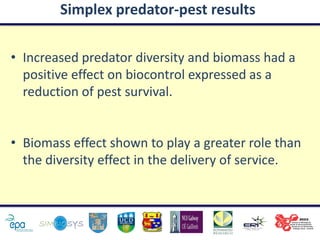
Simplex predator-pest results

• Increased predator diversity and biomass had a
  positive effect on biocontrol expressed as a
  reduction of pest survival.


• Biomass effect shown to play a greater role than
  the diversity effect in the delivery of service.
Simplex predator-pest results
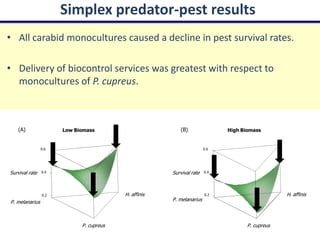
• All carabid monocultures caused a decline in pest survival rates.

• Delivery of biocontrol services was greatest with respect to
  monocultures of P. cupreus.


   (A)                 Low Biomass                                      (B)                   High Biomass


                0.6                                                                  0.6


Survival rate   0.4                                                  Survival rate   0.4


                              0.00                    1.00                                         0.00                         1.00

                0.2
                1.00                                    H. affinis                   0.2
                                                                                     1.00                                        H. affinis
P. melanarius                                                        P. melanarius
                                               0.00                                                                      0.00
                       0.00                                                                 0.00


                                             1.00                                                                      1.00


                                P. cupreus                                                                P. cupreus
Simplex predator-pest results
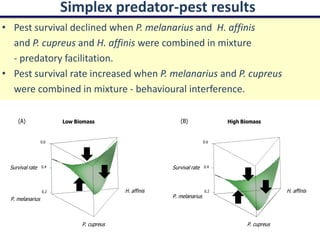
• Pest survival declined when P. melanarius and H. affinis
  and P. cupreus and H. affinis were combined in mixture
  - predatory facilitation.
• Pest survival rate increased when P. melanarius and P. cupreus
  were combined in mixture - behavioural interference.

    (A)                 Low Biomass                                      (B)                   High Biomass


                 0.6                                                                  0.6


 Survival rate   0.4                                                  Survival rate   0.4


                               0.00                    1.00                                         0.00                         1.00

                 0.2
                 1.00                                    H. affinis                   0.2
                                                                                      1.00                                        H. affinis
 P. melanarius                                                        P. melanarius
                                                0.00                                                                      0.00
                        0.00                                                                 0.00


                                              1.00                                                                      1.00


                                 P. cupreus                                                                P. cupreus
Simplex predator-pest results
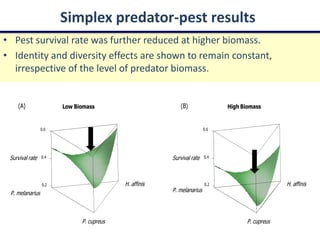
• Pest survival rate was further reduced at higher biomass.
• Identity and diversity effects are shown to remain constant,
  irrespective of the level of predator biomass.


    (A)                 Low Biomass                                      (B)                   High Biomass


                 0.6                                                                  0.6


 Survival rate   0.4                                                  Survival rate   0.4


                               0.00                    1.00                                         0.00                         1.00

                 0.2
                 1.00                                    H. affinis                   0.2
                                                                                      1.00                                        H. affinis
 P. melanarius                                                        P. melanarius
                                                0.00                                                                      0.00
                        0.00                                                                 0.00


                                              1.00                                                                      1.00


                                 P. cupreus                                                                P. cupreus
Conclusion

• Carabid community biomass drives the reduction in pest
  survival.

• A lower level of pesticide management will:

1. Enhance carabid predator biomass.
2. Improve the delivery of carabid biocontrol services.
3. Not cause producer to suffer low crop yields.
Thanks


 Prof Mark Emmerson & Dr Pádraig Whelan


Dr Sam Cook, Dr Darren Murray & Dr Laura Kirwan
         Nigel Watts & Steve Freeman


        All the farmers/landowners
     Dr Roy Anderson (carabid pictures)
Thank you for
  listening.
Predator-pest interaction experimental design

• Simplex design (Cornell 2002, Ramseier et al., 2005,
  Sheehan et al., 2006, Kirwan et al., 2007, 2009)


• Allows the use monocultures and community mixtures
  of carabids at fixed levels of overall carabid biomass
  (low & high)

The impacts of bioenergy crop production on carabids and associated biocontrol services - Erin O'Rourke

  • 1.
    The impacts ofbioenergy crop production on carabids and associated biocontrol services. O’Rourke, E.,1,2 Whelan, P.1,2 and Emmerson, M.3 1.Environmental Research Institute, University College Cork, Cork, Ireland. 2. School of Biological, Earth and Environmental Sciences, University College Cork, Cork, Ireland. 3. School of Biological Sciences, Queens University Belfast, Northern Ireland. SIMBIOSYS Final Conference Trinity College Dublin 28th June 2012 erinorourke@umail.ucc.ie
  • 2.
    The impacts ofbioenergy crop production on carabid and biocontrol services • Field research • Experimental research  Examining the impact of annual &  Examining the role of carabids perennial bioenergy crop production in the provision of biocontrol on carabid diversity. services.
  • 3.
    Predator biomass drivesnatural biological control O’Rourke, E.1, Kirwan, L.2, Cook, S.3, Murray, D.A.4, Whelan, P.M.1 & Emmerson, M.5 1. Environmental Research Institute, University College Cork, Cork, Ireland & School of Biological, Earth and Environmental Sciences, University College Cork, Cork, Ireland. 2. Department of Computing, Mathematics & Physics, Waterford Institute of Technology, Ireland. 3. Department of AgroEcology Department, Rothamsted Research, England. 4. VSN International LTD, 5 The Waterhouse, Waterhouse St, Hemel Hempstead HP1 1ES, England. 5. School of Biological Sciences, Queens University Belfast, Northern Ireland.
  • 4.
    Justification for research • Community functioning dependent on: 1. Identity effects 2. Diversity effects 3. Biomass effects • Challenge to identify aspects of predator diversity most beneficial to prey suppression. • Need to understand the mechanisms of ecosystem functioning to allow for informed management.
  • 5.
    Hypotheses 1. Predator diversityreduces pest survival rate more than predator biomass. 2. Interactions amongst predators lead to complementary use of prey resources. 3. Predator identity effects and diversity effects remain consistent as predator biomass changes.
  • 6.
    Meligethes aeneus (pollenbeetle) – carabid – winter oilseed rape complex Carabid predator biocontrol potential exists when 2nd instar larvae drop to the ground surface.
  • 7.
    Understanding the studysystem 1. What is the impact of high and low pesticide management of winter oilseed rape on: a) crop yield b) carabid species richness c) carabid abundance (Field study) 2. What carabid species are most abundant at the time of pollen beetle larval drop to the soil surface? (Field study) 3. Of the most abundant carabid species, which have the capacity to prey on the pest? (Laboratory feeding experiment)
  • 8.
    Impact of highand low pesticide management of winter oilseed 6 12 100 90 5 10 80 Carabid species richness Crop Yield (tons per ha) 70 Carabid abundance 4 8 60 3 6 50 40 2 4 30 1 2 20 10 0 0 0 High Low High Low High Low • 58.68% reduction in carabid abundance in crops under high pesticide management.
  • 9.
    Species Mean (±se) Mean number of abundance larvae killed (±se) in 2 hours Bembidion lampros 221.33 ± 25.11 0 (*) Generalist Insectivore Poecilus cupreus 161.17 ± 27.04 9.14 ± 1.14 Generalist Insectivore Harpalus affinis 131.17 ± 34.23 4.14 ± 0.77 Granivore Pterostichus melanarius 34.33 ± 9.46 18.14 ± 1.61 Generalist Carnivore
  • 10.
    Simplex Monoculture - 0, 1, 0 Sp 2 Sp 2 Monoculture 100% of one species Binary mixture - 0.50, 0.50, 0 Binary mixture equal proportions of two species Centroid - 0.33, 0.33, 0.33 Centroid even proportions of three species Sp 1 BIOMASS 1 (Lower) Sp 3 Sp 1 BIOMASS 2 (Higher) Sp 3 • 14 diversity treatments, at 2 carabid biomass levels. • 2 temporal time blocks incorporated. • Within each time block - 2 controls containing no carabids to account for natural mortality of larvae.
  • 11.
    The experimental layout Lowbiomass - Monoculture High biomass - Monoculture P. cupreus = 0.098g X 6 H. affinis = 0.051g X 24 = 0.588g = 1.224g Response: proportion of larvae surviving Low biomass - Binary High biomass - Binary 1 P. melanarius + 3 P. cupreus = 2 P. melanarius + 12 H. affinis = 0.195g + 0.294g = 0.489g 0.39g + 0.612g = 1.002g
  • 12.
    Simplex predator-pest results •Increased predator diversity and biomass had a positive effect on biocontrol expressed as a reduction of pest survival. • Biomass effect shown to play a greater role than the diversity effect in the delivery of service.
  • 13.
    Simplex predator-pest results •All carabid monocultures caused a decline in pest survival rates. • Delivery of biocontrol services was greatest with respect to monocultures of P. cupreus. (A) Low Biomass (B) High Biomass 0.6 0.6 Survival rate 0.4 Survival rate 0.4 0.00 1.00 0.00 1.00 0.2 1.00 H. affinis 0.2 1.00 H. affinis P. melanarius P. melanarius 0.00 0.00 0.00 0.00 1.00 1.00 P. cupreus P. cupreus
  • 14.
    Simplex predator-pest results •Pest survival declined when P. melanarius and H. affinis and P. cupreus and H. affinis were combined in mixture - predatory facilitation. • Pest survival rate increased when P. melanarius and P. cupreus were combined in mixture - behavioural interference. (A) Low Biomass (B) High Biomass 0.6 0.6 Survival rate 0.4 Survival rate 0.4 0.00 1.00 0.00 1.00 0.2 1.00 H. affinis 0.2 1.00 H. affinis P. melanarius P. melanarius 0.00 0.00 0.00 0.00 1.00 1.00 P. cupreus P. cupreus
  • 15.
    Simplex predator-pest results •Pest survival rate was further reduced at higher biomass. • Identity and diversity effects are shown to remain constant, irrespective of the level of predator biomass. (A) Low Biomass (B) High Biomass 0.6 0.6 Survival rate 0.4 Survival rate 0.4 0.00 1.00 0.00 1.00 0.2 1.00 H. affinis 0.2 1.00 H. affinis P. melanarius P. melanarius 0.00 0.00 0.00 0.00 1.00 1.00 P. cupreus P. cupreus
  • 16.
    Conclusion • Carabid communitybiomass drives the reduction in pest survival. • A lower level of pesticide management will: 1. Enhance carabid predator biomass. 2. Improve the delivery of carabid biocontrol services. 3. Not cause producer to suffer low crop yields.
  • 17.
    Thanks Prof MarkEmmerson & Dr Pádraig Whelan Dr Sam Cook, Dr Darren Murray & Dr Laura Kirwan Nigel Watts & Steve Freeman All the farmers/landowners Dr Roy Anderson (carabid pictures)
  • 18.
    Thank you for listening.
  • 19.
    Predator-pest interaction experimentaldesign • Simplex design (Cornell 2002, Ramseier et al., 2005, Sheehan et al., 2006, Kirwan et al., 2007, 2009) • Allows the use monocultures and community mixtures of carabids at fixed levels of overall carabid biomass (low & high)