inLab FIB & Industry 4.0
www.cit.upc.edu
http://inlab.fib.upc.edu
@inLabFIB
Director
Professor Josep Casanovas
josepk@fib.upc.edu
Ernest Teniente
ernest.teniente@upc.edu
inLab FIB UPC is a research & innovation lab of the Barcelona School of
Informatics (FIB) at UPC
It has over 35 years of experience with providing applications & services
for public and private institutions
Integrates experts with broad experience (technical and academic staff)
with young talent (students)
MISSION
To transfer knowledge to society through developing human
talent and R&D&i multidisciplinary projects based on
breakthrough ICT technologies, simulation and data science.
2
Collaboration with companies
Collaborations (some examples):
• Visualization, analysis & optimisation of current and future
scenarios -> Risk reduction
• Development of innovative ICT solutions and applications
• Technical assessment, training and specialized services in our
expertise areas
Research & Development collaboration models: Open Innovation &
Joint Labs, Industrial doctorates, Joint collaboration international
(H2020) and national projects, Subcontracting
Sponsorship Programmes (Talent Program)
4
Recent partners
See full list at http://inlab.fib.upc.edu/en/col-laboradors
Members of:
R + D Areas of expertise
Combining ICT, data science and
simulation
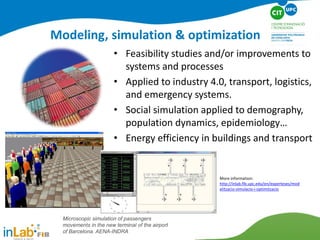
Modeling, simulation & optimization
• Feasibility studies and/or improvements to
systems and processes
• Applied to industry 4.0, transport, logistics,
and emergency systems.
• Social simulation applied to demography,
population dynamics, epidemiology…
• Energy efficiency in buildings and transport
Microscopic simulation of passengers
movements in the new terminal of the airport
of Barcelona. AENA-INDRA
More information:
http://inlab.fib.upc.edu/en/experteses/mod
elitzacio-simulacio-i-optimitzacio
7
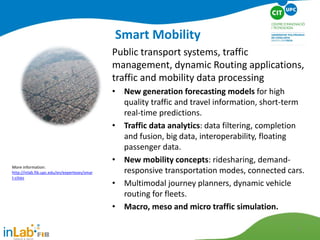
Smart Mobility
Public transport systems, traffic
management, dynamic Routing applications,
traffic and mobility data processing
• New generation forecasting models for high
quality traffic and travel information, short-term
real-time predictions.
• Traffic data analytics: data filtering, completion
and fusion, big data, interoperability, floating
passenger data.
• New mobility concepts: ridesharing, demand-
responsive transportation modes, connected cars.
• Multimodal journey planners, dynamic vehicle
routing for fleets.
• Macro, meso and micro traffic simulation.
More information:
http://inlab.fib.upc.edu/en/experteses/smar
t-cities
8
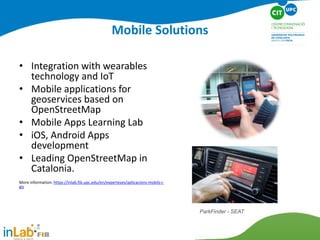
Mobile Solutions
• Integration with wearables
technology and IoT
• Mobile applications for
geoservices based on
OpenStreetMap
• Mobile Apps Learning Lab
• iOS, Android Apps
development
• Leading OpenStreetMap in
Catalonia.
More information: https://inlab.fib.upc.edu/en/experteses/aplicacions-mobils-i-
gis
ParkFinder - SEAT
9
Cybersecurity
• Training and cyber security
awareness
• Security audits
• Forensic analysis
• Incident Response
• Monitoring of networks
• Development of systems for
detecting malware and electronic
fraud
• Security of applicationsFirst Spanish Response Team
More information:
http://inlab.fib.upc.edu/en/experteses/segu
retat-i-infraestructures-tic 10
ICT environments and
services to support learning
• Learning Analytics
• Smart learning environments
• Information systems for
university management,
computer labs
• Systems for measuring and
analysing academic results.
More information:
http://inlab.fib.upc.edu/en/experteses/entorns-i-serveis-tic-de-suport-
laprenentatge-i-la-gestio-universitaria
11
Data Science and Big Data
Smart data, methods and
statistical techniques for
analysing and processing data
and their interoperability
• Data mining
• Advanced statistical analysis
• Measurement of intangibles
(satisfaction, quality, etc.)
• Open data
• Integration, fusion and processing
of large volumes of data
• Big data architectures
• Dashboards , data warehouse, BI
More information:
http://inlab.fib.upc.edu/en/experteses/anali
sis-i-tractament-de-dades
Queries and large data matrix analysis for the
Centre for Opinion Studies (CEO) of the
Government of Catalonia
12
Software (service?) engineering
• (Semantic) ontologies
• Service and business process
engineering
• Semantic integration
• Interoperability and
integration of systems
• Software as a Service and
interoperability technologies
More information:
http://inlab.fib.upc.edu/en/experteses/inter
net-collaborativa
13
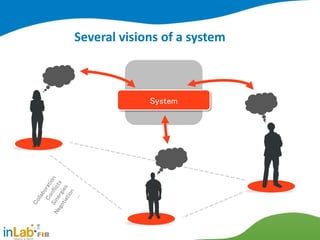
System
Several visions of a system
?
?
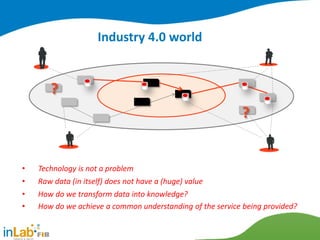
Industry 4.0 world
• Technology is not a problem
• Raw data (in itself) does not have a (huge) value
• How do we transform data into knowledge?
• How do we achieve a common understanding of the service being provided?
 All engineering disciplines are founded on models that are
analyzable and can predict the properties of the artifact being
engineered
 Key problem: have to give an unambiguous, easy to understand
account of our understanding of an organization and how it
works, also how the new system will fit in that organization
 We can do so with English (textual) descriptions; but such
descriptions are often cumbersome, incomplete, ambiguous and
can lead to misunderstandings
 Then, we use ontologies for this purpose, i.e. to describe
proposed requirements and designs for the new system
 Ontologies capture people’s understanding (conceptualization)
of what is being handled
(Semantic) Ontologies
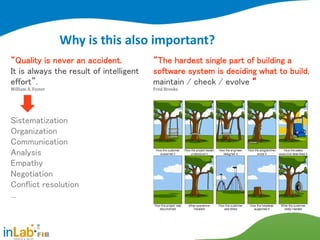
“Quality is never an accident.
It is always the result of intelligent
effort”.
William A. Foster
“The hardest single part of building a
software system is deciding what to build,
maintain / check / evolve “
Fred Brooks
Sistematization
Organization
Communication
Analysis
Empathy
Negotiation
Conflict resolution
...
Why is this also important?
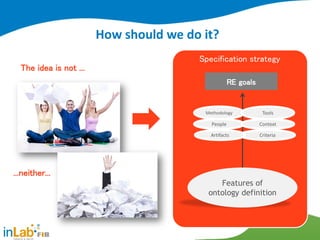
The idea is not ...
...neither...
RE goals
Features of
ontology definition
Criteria
Methodology Tools
People
Specification strategy
Context
Artifacts
How should we do it?
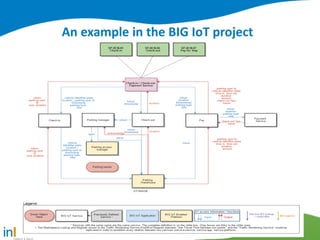
An example in the BIG IoT project
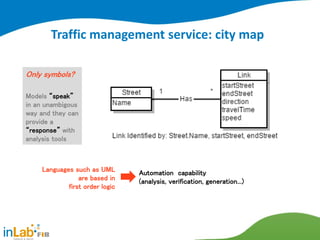
Languages such as UML
are based in
first order logic
Only symbols?
Models “speak”
in an unambigous
way and they can
provide a
“response” with
analysis tools
Automation capability
(analysis, verification, generation...)
Traffic management service: city map
 Test-driven Software Development
 Ontology-based Data Access
 Automated Code Generation
 Automated Reasoning
 Ontology-based Data Exchange
 Visualization of Large Conceptual Schemas, like HL7
 Learning Analytics
 …
Other advantages of using ontologies
 Business Process Modeling
• Key activity in organizations
 Artifact-centric process modeling
• Focus on data
• Contrast to traditional process modeling focused on activities/processes
• Business artifacts updated by services (service engineering)
• BALSA framework: 4 dimensions for artifact-centric models
• Characteristics
• Focus on data
• Intuitive
• Formal
• Flexible
 Particularly important for providing SaaS
 Business analysis can be performed from the models
(Artifact-centric) Business Process Modeling
http://inlab.fib.upc.edu
inlab@fib.upc.edu
+34 93 401 69 41
c/ Jordi Girona 1-3
Campus Nord. Edifici B6
08034 Barcelona
Twitter: @inLabFIB
Contact us

inLab FIB & Industry 4.0

  • 1.
    inLab FIB &Industry 4.0 www.cit.upc.edu http://inlab.fib.upc.edu @inLabFIB Director Professor Josep Casanovas josepk@fib.upc.edu Ernest Teniente ernest.teniente@upc.edu
  • 2.
    inLab FIB UPCis a research & innovation lab of the Barcelona School of Informatics (FIB) at UPC It has over 35 years of experience with providing applications & services for public and private institutions Integrates experts with broad experience (technical and academic staff) with young talent (students) MISSION To transfer knowledge to society through developing human talent and R&D&i multidisciplinary projects based on breakthrough ICT technologies, simulation and data science. 2
  • 3.
    Collaboration with companies Collaborations(some examples): • Visualization, analysis & optimisation of current and future scenarios -> Risk reduction • Development of innovative ICT solutions and applications • Technical assessment, training and specialized services in our expertise areas Research & Development collaboration models: Open Innovation & Joint Labs, Industrial doctorates, Joint collaboration international (H2020) and national projects, Subcontracting Sponsorship Programmes (Talent Program) 4
  • 4.
    Recent partners See fulllist at http://inlab.fib.upc.edu/en/col-laboradors Members of:
  • 5.
    R + DAreas of expertise Combining ICT, data science and simulation
  • 6.
    Modeling, simulation &optimization • Feasibility studies and/or improvements to systems and processes • Applied to industry 4.0, transport, logistics, and emergency systems. • Social simulation applied to demography, population dynamics, epidemiology… • Energy efficiency in buildings and transport Microscopic simulation of passengers movements in the new terminal of the airport of Barcelona. AENA-INDRA More information: http://inlab.fib.upc.edu/en/experteses/mod elitzacio-simulacio-i-optimitzacio 7
  • 7.
    Smart Mobility Public transportsystems, traffic management, dynamic Routing applications, traffic and mobility data processing • New generation forecasting models for high quality traffic and travel information, short-term real-time predictions. • Traffic data analytics: data filtering, completion and fusion, big data, interoperability, floating passenger data. • New mobility concepts: ridesharing, demand- responsive transportation modes, connected cars. • Multimodal journey planners, dynamic vehicle routing for fleets. • Macro, meso and micro traffic simulation. More information: http://inlab.fib.upc.edu/en/experteses/smar t-cities 8
  • 8.
    Mobile Solutions • Integrationwith wearables technology and IoT • Mobile applications for geoservices based on OpenStreetMap • Mobile Apps Learning Lab • iOS, Android Apps development • Leading OpenStreetMap in Catalonia. More information: https://inlab.fib.upc.edu/en/experteses/aplicacions-mobils-i- gis ParkFinder - SEAT 9
  • 9.
    Cybersecurity • Training andcyber security awareness • Security audits • Forensic analysis • Incident Response • Monitoring of networks • Development of systems for detecting malware and electronic fraud • Security of applicationsFirst Spanish Response Team More information: http://inlab.fib.upc.edu/en/experteses/segu retat-i-infraestructures-tic 10
  • 10.
    ICT environments and servicesto support learning • Learning Analytics • Smart learning environments • Information systems for university management, computer labs • Systems for measuring and analysing academic results. More information: http://inlab.fib.upc.edu/en/experteses/entorns-i-serveis-tic-de-suport- laprenentatge-i-la-gestio-universitaria 11
  • 11.
    Data Science andBig Data Smart data, methods and statistical techniques for analysing and processing data and their interoperability • Data mining • Advanced statistical analysis • Measurement of intangibles (satisfaction, quality, etc.) • Open data • Integration, fusion and processing of large volumes of data • Big data architectures • Dashboards , data warehouse, BI More information: http://inlab.fib.upc.edu/en/experteses/anali sis-i-tractament-de-dades Queries and large data matrix analysis for the Centre for Opinion Studies (CEO) of the Government of Catalonia 12
  • 12.
    Software (service?) engineering •(Semantic) ontologies • Service and business process engineering • Semantic integration • Interoperability and integration of systems • Software as a Service and interoperability technologies More information: http://inlab.fib.upc.edu/en/experteses/inter net-collaborativa 13
  • 13.
  • 14.
    ? ? Industry 4.0 world •Technology is not a problem • Raw data (in itself) does not have a (huge) value • How do we transform data into knowledge? • How do we achieve a common understanding of the service being provided?
  • 15.
     All engineeringdisciplines are founded on models that are analyzable and can predict the properties of the artifact being engineered  Key problem: have to give an unambiguous, easy to understand account of our understanding of an organization and how it works, also how the new system will fit in that organization  We can do so with English (textual) descriptions; but such descriptions are often cumbersome, incomplete, ambiguous and can lead to misunderstandings  Then, we use ontologies for this purpose, i.e. to describe proposed requirements and designs for the new system  Ontologies capture people’s understanding (conceptualization) of what is being handled (Semantic) Ontologies
  • 16.
    “Quality is neveran accident. It is always the result of intelligent effort”. William A. Foster “The hardest single part of building a software system is deciding what to build, maintain / check / evolve “ Fred Brooks Sistematization Organization Communication Analysis Empathy Negotiation Conflict resolution ... Why is this also important?
  • 17.
    The idea isnot ... ...neither... RE goals Features of ontology definition Criteria Methodology Tools People Specification strategy Context Artifacts How should we do it?
  • 18.
    An example inthe BIG IoT project
  • 19.
    Languages such asUML are based in first order logic Only symbols? Models “speak” in an unambigous way and they can provide a “response” with analysis tools Automation capability (analysis, verification, generation...) Traffic management service: city map
  • 20.
     Test-driven SoftwareDevelopment  Ontology-based Data Access  Automated Code Generation  Automated Reasoning  Ontology-based Data Exchange  Visualization of Large Conceptual Schemas, like HL7  Learning Analytics  … Other advantages of using ontologies
  • 21.
     Business ProcessModeling • Key activity in organizations  Artifact-centric process modeling • Focus on data • Contrast to traditional process modeling focused on activities/processes • Business artifacts updated by services (service engineering) • BALSA framework: 4 dimensions for artifact-centric models • Characteristics • Focus on data • Intuitive • Formal • Flexible  Particularly important for providing SaaS  Business analysis can be performed from the models (Artifact-centric) Business Process Modeling
  • 22.
    http://inlab.fib.upc.edu inlab@fib.upc.edu +34 93 40169 41 c/ Jordi Girona 1-3 Campus Nord. Edifici B6 08034 Barcelona Twitter: @inLabFIB Contact us