GGeeoorrggiiaa PPeerrffoorrmmaannccee SSttaannddaarrdd 
SS4H2 The student will describe European exploration 
in North America. 
a. Describe the reasons for, obstacles to, and 
accomplishments of the Spanish, French, and English 
explorations of John Cabot, Vasco Núñez de Balboa, Juan 
Ponce de León, Christopher Columbus, Henry Hudson, and 
Jacques Cartier. 
b. Describe examples of cooperation and conflict between 
Europeans and Native Americans.
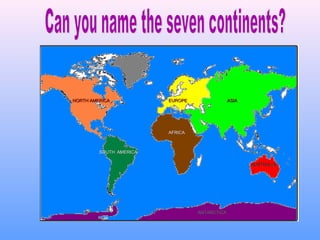
NNOORRTTHH AAMMEERRIICCAA EEUURROOPPEE AASSIIAA 
SSOOUUTTHH AAMMEERRIICCAA 
AAFFRRIICCAA 
AANNTTAARRCCTTIICCAA 
AAUUSSTTRRAALLIIAA
Atlantic Ocean 
PPaacciiffiicc OOcceeaann 
AArrccttiicc OOcceeaann 
IInnddiiaann OOcceeaann
Who sailed the ocean blue in 1492?
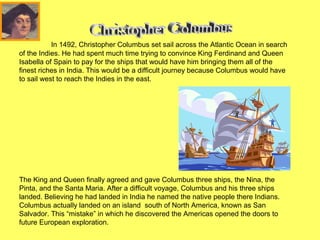
In 1492, Christopher Columbus set sail across the Atlantic Ocean in search 
of the Indies. He had spent much time trying to convince King Ferdinand and Queen 
Isabella of Spain to pay for the ships that would have him bringing them all of the 
finest riches in India. This would be a difficult journey because Columbus would have 
to sail west to reach the Indies in the east. 
The King and Queen finally agreed and gave Columbus three ships, the Nina, the 
Pinta, and the Santa Maria. After a difficult voyage, Columbus and his three ships 
landed. Believing he had landed in India he named the native people there Indians. 
Columbus actually landed on an island south of North America, known as San 
Salvador. This “mistake” in which he discovered the Americas opened the doors to 
future European exploration.
SSppaaiinn 
North 
America 
SSaann SSaallvvaaddoorr 
Europe
JJuuaann PPoonnccee ddee LLeeoonn 
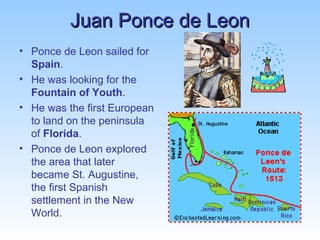
• Ponce de Leon sailed for 
Spain. 
• He was looking for the 
Fountain of Youth. 
• He was the first European 
to land on the peninsula 
of Florida. 
• Ponce de Leon explored 
the area that later 
became St. Augustine, 
the first Spanish 
settlement in the New 
World.
Ponce de Leon’s Journey 
North Spain 
America 
FFlloorriiddaa 
Europe
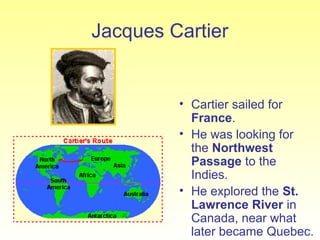
Jacques Cartier 
• Cartier sailed for 
France. 
• He was looking for 
the Northwest 
Passage to the 
Indies. 
• He explored the St. 
Lawrence River in 
Canada, near what 
later became Quebec.
Jacques Cartier’s Voyage 
FFrraannccee 
St. Lawrence River 
North 
America 
Europe
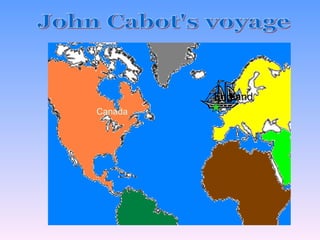
JJoohhnn CCaabboott 
•At the request of King Henry VII of England, Cabot sailed to Canada in 1497. 
•In 1497, Cabot landed near Labrador, Newfoundland, or Cape Breton Island (the 
exact spot is uncertain). Cabot claimed the land for England. 
•Cabot explored the Canadian coastline and named many of its islands and capes. 
•The mission's purpose was to search for a Northwest passage across North 
America to Asia. Cabot was unsuccessful, although he thought that he had reached 
northeastern Asia. 
•Cabot's expeditions were the first of Britain's claims to Canada. 
•John Cabot was presumed dead by 1499 after never returning from his final 
voyage. (Copyright © 1994-2010 Encyclopædia Britannica, Inc. )
England 
Canada
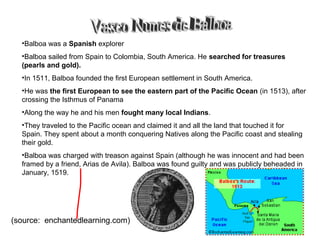
•Balboa was a Spanish explorer 
•Balboa sailed from Spain to Colombia, South America. He searched for treasures 
(pearls and gold). 
•In 1511, Balboa founded the first European settlement in South America. 
•He was the first European to see the eastern part of the Pacific Ocean (in 1513), after 
crossing the Isthmus of Panama 
•Along the way he and his men fought many local Indians. 
•They traveled to the Pacific ocean and claimed it and all the land that touched it for 
Spain. They spent about a month conquering Natives along the Pacific coast and stealing 
their gold. 
•Balboa was charged with treason against Spain (although he was innocent and had been 
framed by a friend, Arias de Avila). Balboa was found guilty and was publicly beheaded in 
January, 1519. 
(source: enchantedlearning.com)
Spain 
Isthmus of Panama 
South 
America 
North 
America 
Europe 
Pacific 
Ocean
•An English explorer who explored parts of the Arctic Ocean and 
northeastern North America. 
•Hudson made two trips (in 1607 and 1608), but failed to find a route 
to China. 
•Hudson was then hired by the Dutch East India Company in 1609, to 
try to find the Northwest Passage farther south. 
•He discovered The Hudson River, Hudson Strait, and Hudson 
Bay are named for Hudson. 
•A 1610-1611 trip through the Hudson Strait and into Hudson Bay 
ended in a mutiny. Hudson died in 1611 after his crew mutinied and 
left Hudson, his son, and seven crew members adrift in a small, open 
boat in Hudson Bay.
England Canada 
North 
America
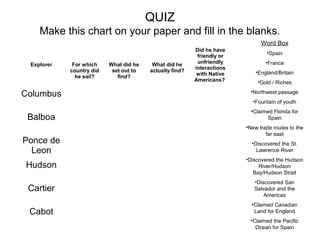
QUIZ 
Make this chart on your paper and fill in the blanks. 
Explorer For which 
country did 
he sail? 
What did he 
set out to 
find? 
What did he 
actually find? 
Did he have 
friendly or 
unfriendly 
interactions 
with Native 
Americans? 
Columbus 
Balboa 
Ponce de 
Leon 
Hudson 
Cartier 
Cabot 
Word Box 
•Spain 
•France 
•England/Britain 
•Gold / Riches 
•Northwest passage 
•Fountain of youth 
•Claimed Florida for 
Spain 
•New trade routes to the 
far east 
•Discovered the St. 
Lawrence River 
•Discovered the Hudson 
River/Hudson 
Bay/Hudson Strait 
•Discovered San 
Salvador and the 
Americas 
•Claimed Canadian 
Land for England 
•Claimed the Pacific 
Ocean for Spain

Explorers powerpoint 2

  • 1.
    GGeeoorrggiiaa PPeerrffoorrmmaannccee SSttaannddaarrdd SS4H2 The student will describe European exploration in North America. a. Describe the reasons for, obstacles to, and accomplishments of the Spanish, French, and English explorations of John Cabot, Vasco Núñez de Balboa, Juan Ponce de León, Christopher Columbus, Henry Hudson, and Jacques Cartier. b. Describe examples of cooperation and conflict between Europeans and Native Americans.
  • 3.
    NNOORRTTHH AAMMEERRIICCAA EEUURROOPPEEAASSIIAA SSOOUUTTHH AAMMEERRIICCAA AAFFRRIICCAA AANNTTAARRCCTTIICCAA AAUUSSTTRRAALLIIAA
  • 4.
    Atlantic Ocean PPaacciiffiiccOOcceeaann AArrccttiicc OOcceeaann IInnddiiaann OOcceeaann
  • 5.
    Who sailed theocean blue in 1492?
  • 6.
    In 1492, ChristopherColumbus set sail across the Atlantic Ocean in search of the Indies. He had spent much time trying to convince King Ferdinand and Queen Isabella of Spain to pay for the ships that would have him bringing them all of the finest riches in India. This would be a difficult journey because Columbus would have to sail west to reach the Indies in the east. The King and Queen finally agreed and gave Columbus three ships, the Nina, the Pinta, and the Santa Maria. After a difficult voyage, Columbus and his three ships landed. Believing he had landed in India he named the native people there Indians. Columbus actually landed on an island south of North America, known as San Salvador. This “mistake” in which he discovered the Americas opened the doors to future European exploration.
  • 7.
    SSppaaiinn North America SSaann SSaallvvaaddoorr Europe
  • 8.
    JJuuaann PPoonnccee ddeeLLeeoonn • Ponce de Leon sailed for Spain. • He was looking for the Fountain of Youth. • He was the first European to land on the peninsula of Florida. • Ponce de Leon explored the area that later became St. Augustine, the first Spanish settlement in the New World.
  • 9.
    Ponce de Leon’sJourney North Spain America FFlloorriiddaa Europe
  • 10.
    Jacques Cartier •Cartier sailed for France. • He was looking for the Northwest Passage to the Indies. • He explored the St. Lawrence River in Canada, near what later became Quebec.
  • 11.
    Jacques Cartier’s Voyage FFrraannccee St. Lawrence River North America Europe
  • 12.
    JJoohhnn CCaabboott •Atthe request of King Henry VII of England, Cabot sailed to Canada in 1497. •In 1497, Cabot landed near Labrador, Newfoundland, or Cape Breton Island (the exact spot is uncertain). Cabot claimed the land for England. •Cabot explored the Canadian coastline and named many of its islands and capes. •The mission's purpose was to search for a Northwest passage across North America to Asia. Cabot was unsuccessful, although he thought that he had reached northeastern Asia. •Cabot's expeditions were the first of Britain's claims to Canada. •John Cabot was presumed dead by 1499 after never returning from his final voyage. (Copyright © 1994-2010 Encyclopædia Britannica, Inc. )
  • 13.
  • 14.
    •Balboa was aSpanish explorer •Balboa sailed from Spain to Colombia, South America. He searched for treasures (pearls and gold). •In 1511, Balboa founded the first European settlement in South America. •He was the first European to see the eastern part of the Pacific Ocean (in 1513), after crossing the Isthmus of Panama •Along the way he and his men fought many local Indians. •They traveled to the Pacific ocean and claimed it and all the land that touched it for Spain. They spent about a month conquering Natives along the Pacific coast and stealing their gold. •Balboa was charged with treason against Spain (although he was innocent and had been framed by a friend, Arias de Avila). Balboa was found guilty and was publicly beheaded in January, 1519. (source: enchantedlearning.com)
  • 15.
    Spain Isthmus ofPanama South America North America Europe Pacific Ocean
  • 16.
    •An English explorerwho explored parts of the Arctic Ocean and northeastern North America. •Hudson made two trips (in 1607 and 1608), but failed to find a route to China. •Hudson was then hired by the Dutch East India Company in 1609, to try to find the Northwest Passage farther south. •He discovered The Hudson River, Hudson Strait, and Hudson Bay are named for Hudson. •A 1610-1611 trip through the Hudson Strait and into Hudson Bay ended in a mutiny. Hudson died in 1611 after his crew mutinied and left Hudson, his son, and seven crew members adrift in a small, open boat in Hudson Bay.
  • 17.
  • 18.
    QUIZ Make thischart on your paper and fill in the blanks. Explorer For which country did he sail? What did he set out to find? What did he actually find? Did he have friendly or unfriendly interactions with Native Americans? Columbus Balboa Ponce de Leon Hudson Cartier Cabot Word Box •Spain •France •England/Britain •Gold / Riches •Northwest passage •Fountain of youth •Claimed Florida for Spain •New trade routes to the far east •Discovered the St. Lawrence River •Discovered the Hudson River/Hudson Bay/Hudson Strait •Discovered San Salvador and the Americas •Claimed Canadian Land for England •Claimed the Pacific Ocean for Spain