mentor.com/embedded
Android is a trademark of Google Inc. Use of this trademark is subject to Google Permissions.
Linux is the registered trademark of Linus Torvalds in the U.S. and other countries.
Qt is a registered trade mark of Digia Plc and/or its subsidiaries. All other trademarks mentioned in this document are trademarks of their respective owners.
Seminar June 2014
Getting Your Medical
Device FDA Approved
2
Why and How Companies Fail
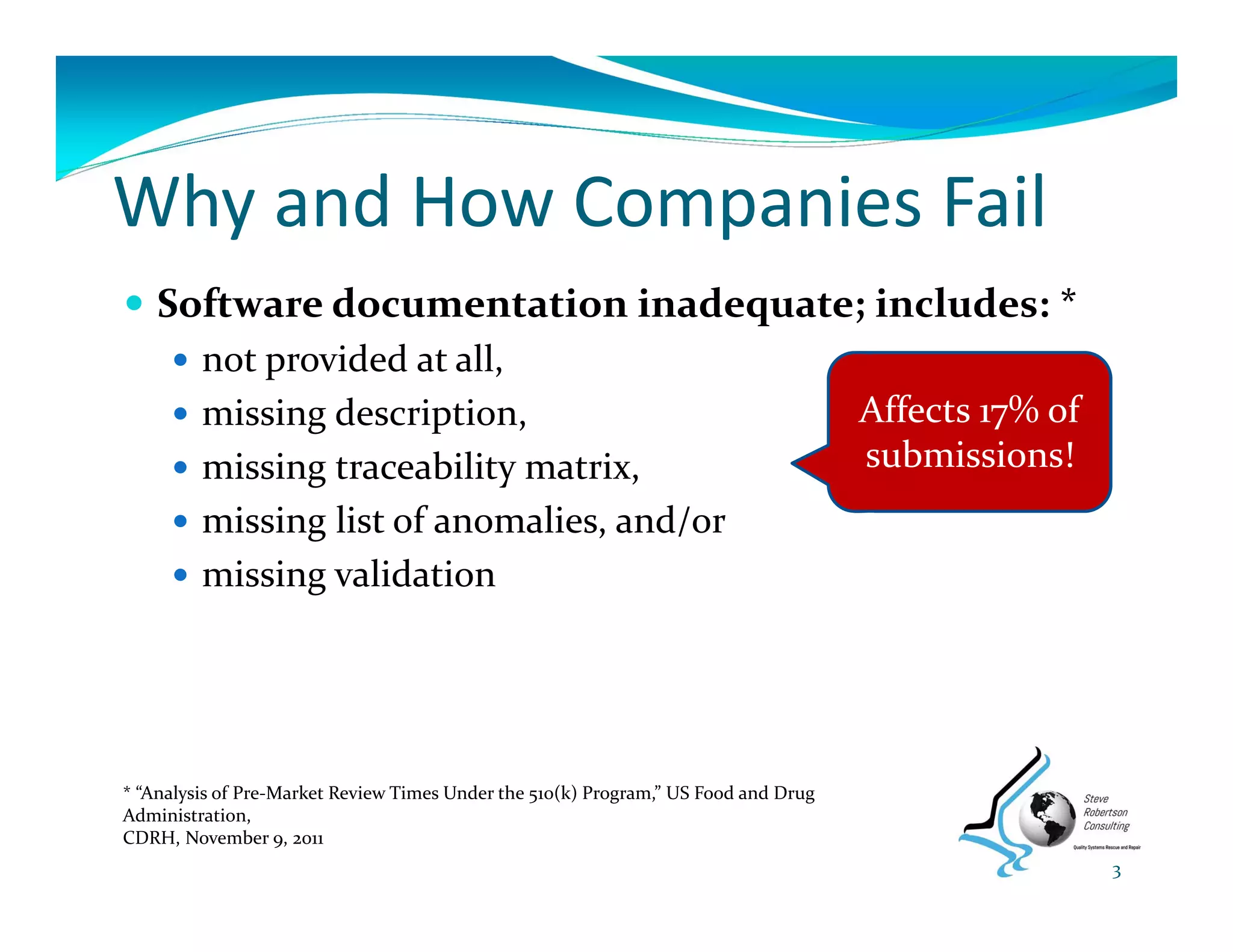
 Software documentation inadequate; includes: *
 not provided at all,
 missing description,
 missing traceability matrix,
 missing list of anomalies, and/or
 missing validation
* “Analysis of Pre‐Market Review Times Under the 510(k) Program,” US Food and Drug 
Administration, 
CDRH, November 9, 2011
Affects 17% of 
submissions!
3
Why and How Companies Fail
Source: “Medical Device Recall Report: FY2003 to FY2012,” US Food and Drug Administration, 
CDRH, March 21, 2014
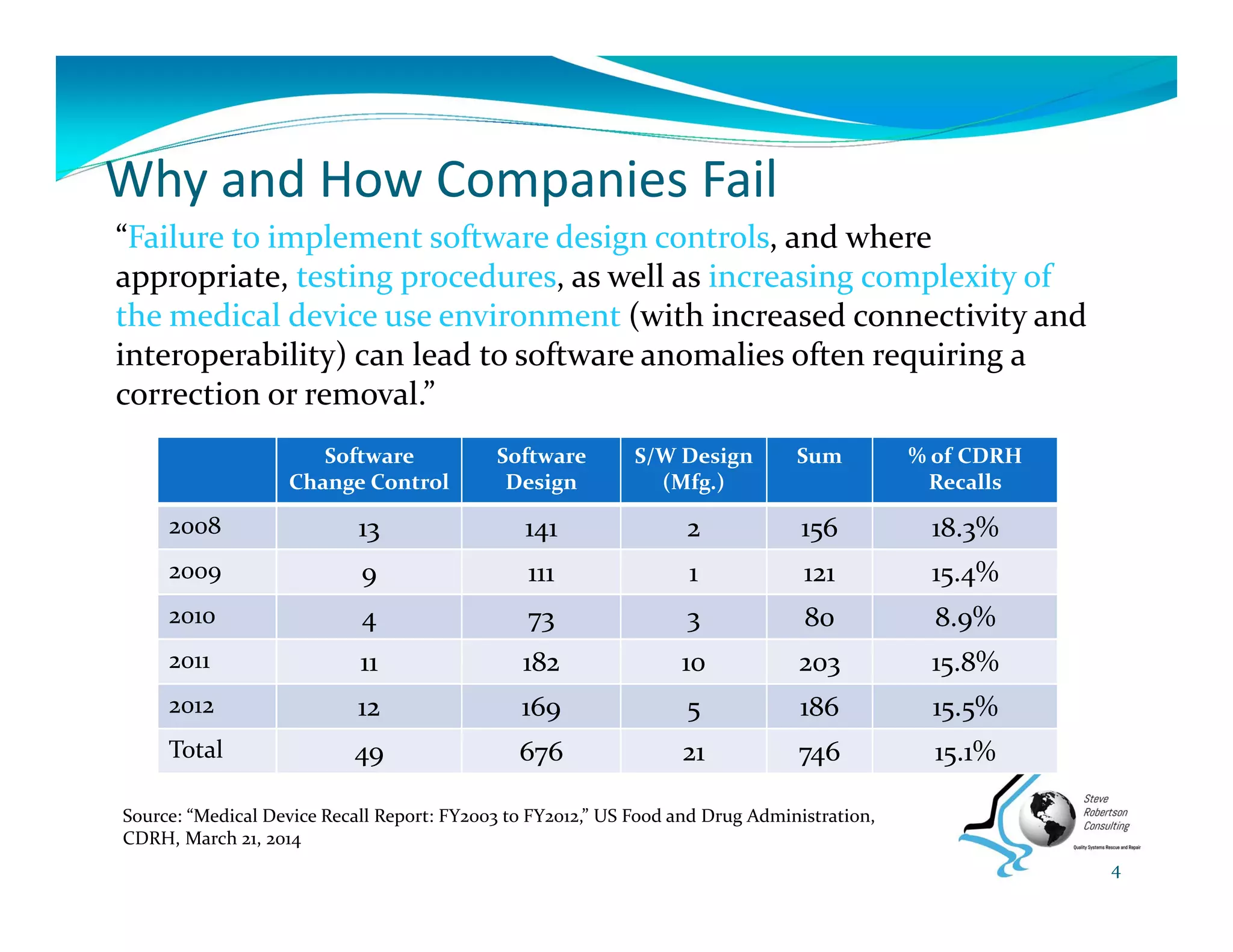
“Failure to implement software design controls, and where 
appropriate, testing procedures, as well as increasing complexity of 
the medical device use environment (with increased connectivity and 
interoperability) can lead to software anomalies often requiring a 
correction or removal.”
Software 
Change Control
Software 
Design
S/W Design 
(Mfg.)
Sum % of CDRH 
Recalls
2008 13 141 2 156 18.3%
2009 9 111 1 121 15.4%
2010 4 73 3 80 8.9%
2011 11 182 10 203 15.8%
2012 12 169 5 186 15.5%
Total 49 676 21 746 15.1%
4
Why and How Companies Fail
“Failure to follow or otherwise address current guidance 
document(s) or recognized standards ‐ FDA issues 
guidance documents or recognizes a national or international 
standard to help manufacturers determine what information 
to include in a 510(k) submission generally and for certain 
device types specifically. If a manufacturer fails to follow 
current guidance (i.e. that which is up‐to‐date) for a 
certain device type or a recognized standard, and offers 
no explanation for its failure to do so, FDA would 
consider that submission to be of poor quality and would 
issue an AI Letter that quotes current guidance to obtain the 
missing information.”
* “Analysis of Pre‐Market Review Times Under the 510(k) Program,” US Food and Drug 
Administration, 
CDRH, November 9, 2011
41% of submissions affected!
5
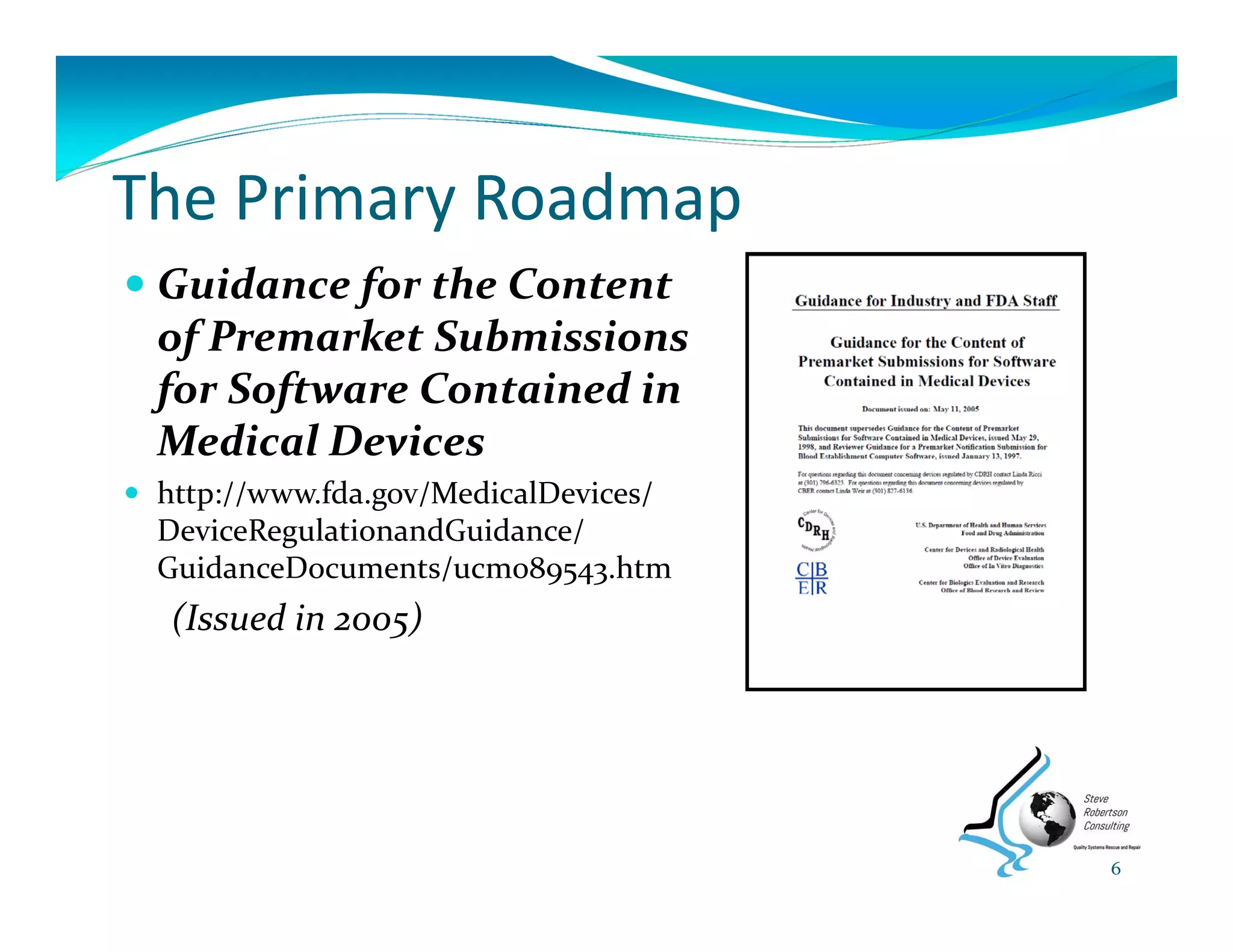
The Primary Roadmap
 Guidance for the Content 
of Premarket Submissions 
for Software Contained in 
Medical Devices
 http://www.fda.gov/MedicalDevices/ 
DeviceRegulationandGuidance/ 
GuidanceDocuments/ucm089543.htm
(Issued in 2005)
6
FDA Software Guidance
 Software “level of concern”
 Estimate (in the absence of mitigations) of the severity 
of injury that a device failure or latent design flaw could 
permit or inflict, either directly or indirectly, on a 
patient or device operator:
 Major: could result in death or serious injury 
 Moderate: could result in minor injury
 Minor: unlikely to cause any injury
 Documentation FDA recommends submitting 
depends on the level of concern
7
Software‐related Documentation
 Overview
 Describe the design of your device
 Document how your design was implemented
 Demonstrate how the device produced by your design 
implementation was tested
 Show that you identified hazards appropriately and 
managed risks effectively
 Provide traceability to link together  design, 
implementation, testing, and risk management
8
Software‐related Documentation
 Device Hazard Analysis
 Address all foreseeable hazards 
(including intentional or inadvertent 
misuse)
 Identification of the hazardous event
 Severity of the hazard
 Cause(s) of the hazard
 Method of control (e.g., alarm, hardware 
design)
 Corrective measures to eliminate, reduce, or 
warn
 Verification of correct control 
implementation
9
Software‐related Documentation
 Software Requirements Specification
 Hardware Requirements
 Programming Language Requirements
 SW Performance and Functional Requirements
 Architecture Design Chart
 Software Design Specification
 Traceability Analysis
 SW Development Environment Description
 V&V Documentation
 Revision Level History
 Unresolved Anomalies (Bug List)
10
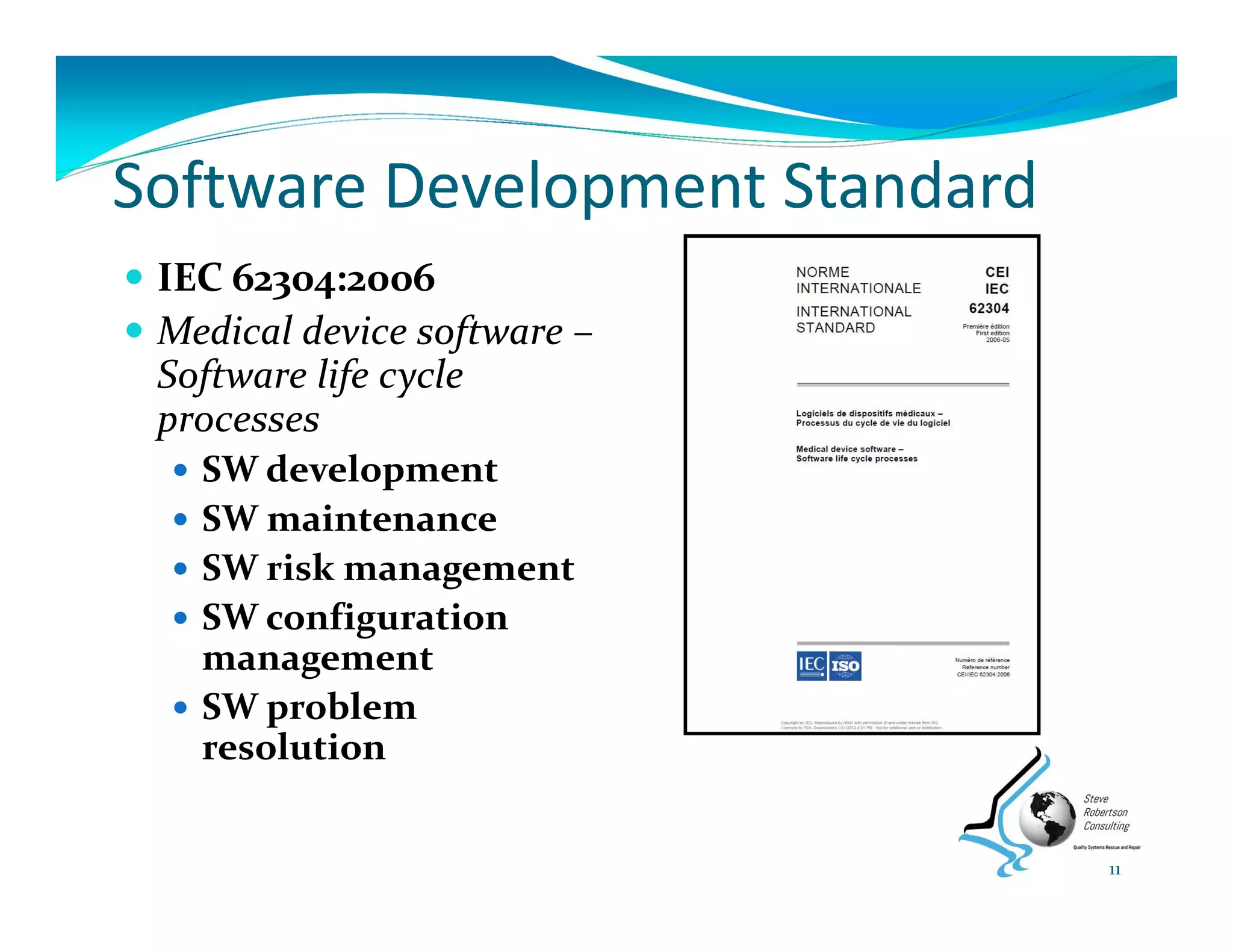
Software Development Standard
 IEC 62304:2006
 Medical device software –
Software life cycle 
processes
 SW development
 SW maintenance
 SW risk management 
 SW configuration 
management
 SW problem 
resolution
11
Overview – IEC 62304:2006
 Describes software development and maintenance 
processes for medical devices but does not specify:
 An organizational structure or responsibilities
 The name, format or explicit content of documentation
 The specific life‐cycle model to be employed
 FDA Consensus Standard (September 2008)
 IEC62304 conformance fulfills the “Software Development 
Environment Description” section of a 510(k) submission
 Normative standard in Europe for CE marking
12
Software Verification and Validation (V&V)
 MINOR LOC:
 System or device level testing, any integration testing
 Pass/fail criteria
 Summary of test results
 MODERATE LOC:
 V&V activities at the unit, integration, and system level
 Summary list of V&V activities
 Pass/fail criteria
 Test results
 MAJOR LOC:
 V&V activities at the unit, integration, and system level
 Unit, integration and system‐level test protocols
 Pass/fail criteria
 Test report, summary, test results
13
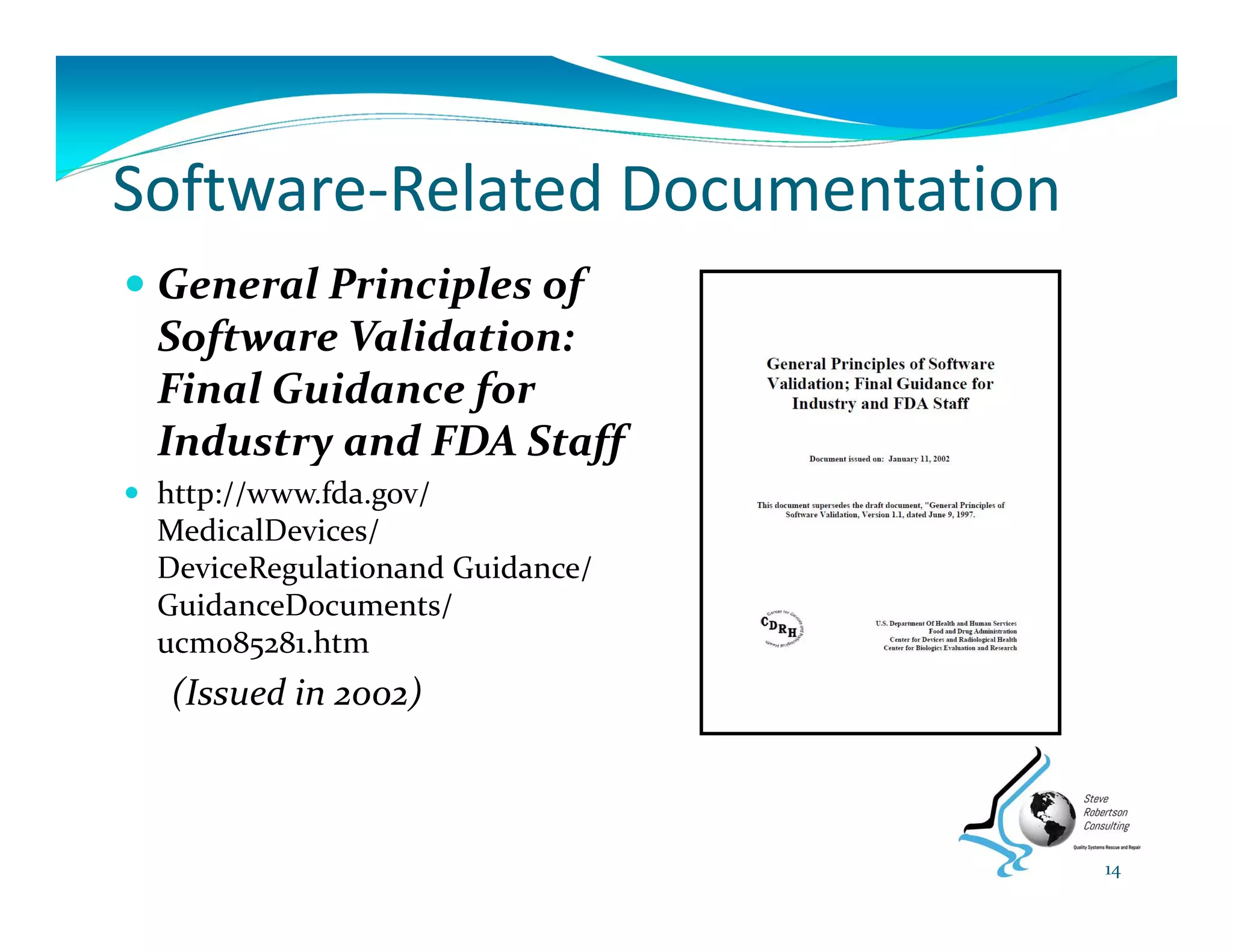
Software‐Related Documentation
 General Principles of 
Software Validation: 
Final Guidance for 
Industry and FDA Staff
 http://www.fda.gov/ 
MedicalDevices/ 
DeviceRegulationand Guidance/ 
GuidanceDocuments/ 
ucm085281.htm
(Issued in 2002)
14
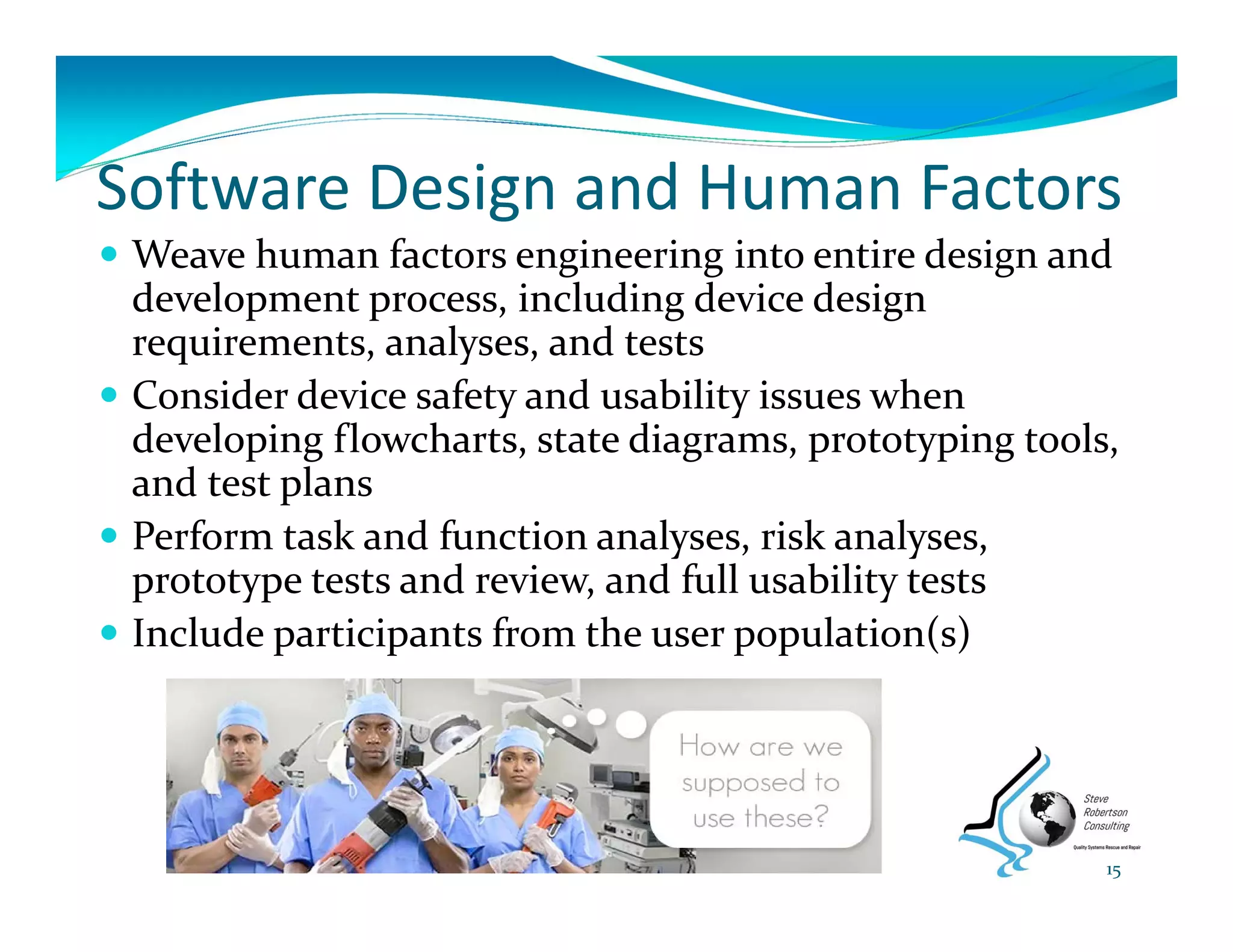
Software Design and Human Factors
 Weave human factors engineering into entire design and 
development process, including device design 
requirements, analyses, and tests
 Consider device safety and usability issues when 
developing flowcharts, state diagrams, prototyping tools, 
and test plans
 Perform task and function analyses, risk analyses, 
prototype tests and review, and full usability tests
 Include participants from the user population(s)
15
Common User Interface (UI) Issues
 UI complexity causes user confusion, delay in use, 
or inability to use the device
 UI makes it difficult for user to correct data entry 
errors or modify device settings in a timely 
fashion
 UI falsely causes the user to believe a critical 
situation exists when it does not, or vice‐versa
 UI does not draw attention to dangerous 
conditions of device operation or patient status
 UI does not prevent known, likely data input 
errors 
16
Regulatory Basis for Human Factors
 21 CFR 820.30, Design Controls (The need for human 
factors is implied):
 Design input – includes “needs of the user and 
patient”
 Design verification – performance criteria met
 Design validation – “… devices conform to defined 
user needs and intended uses and shall include 
testing of production units under actual or 
simulated use conditions. Design validation shall 
include software validation and risk analysis….” 
[incl. use‐related risks]
17
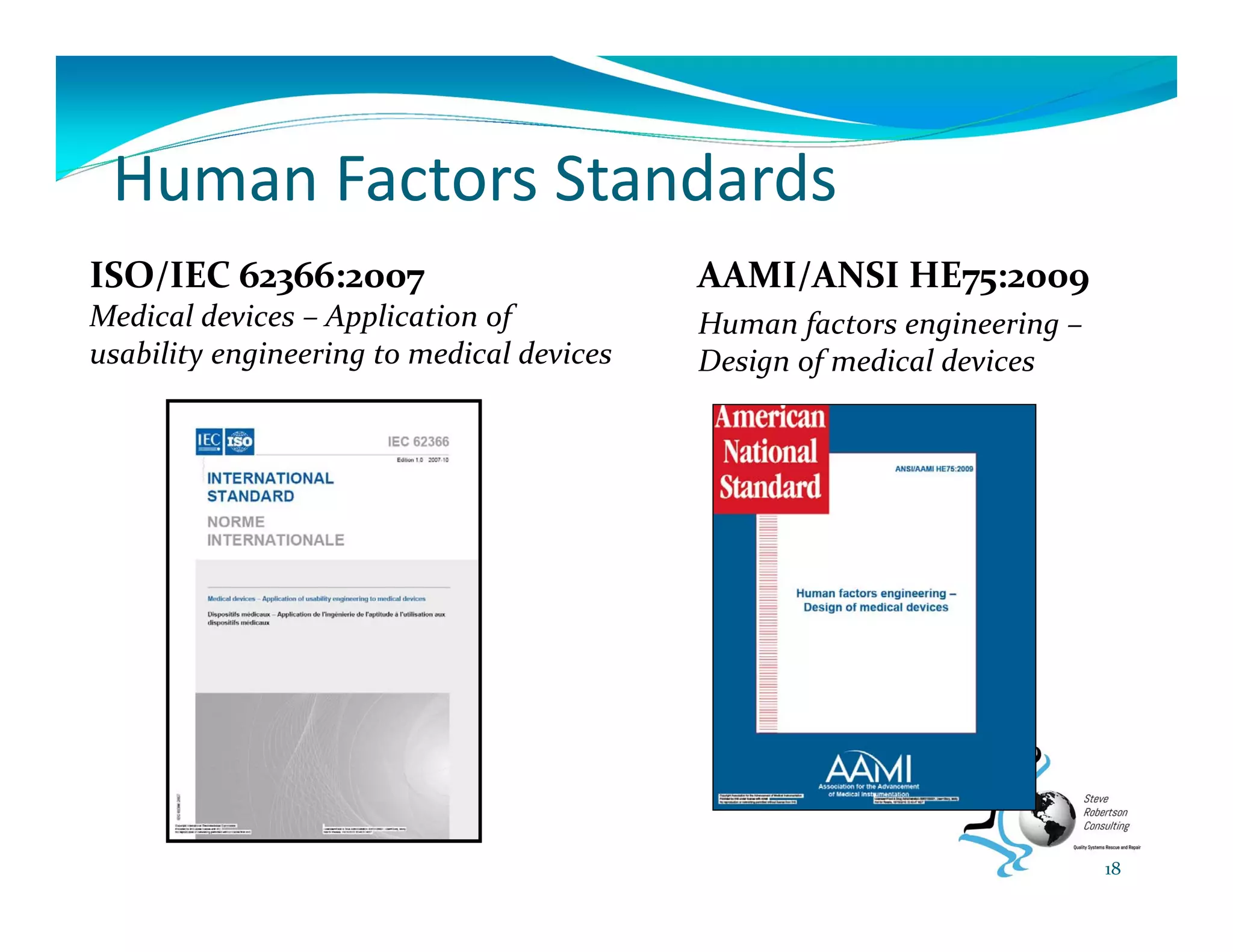
Human Factors Standards
AAMI/ANSI HE75:2009
Human factors engineering –
Design of medical devices
18
ISO/IEC 62366:2007
Medical devices – Application of 
usability engineering to medical devices
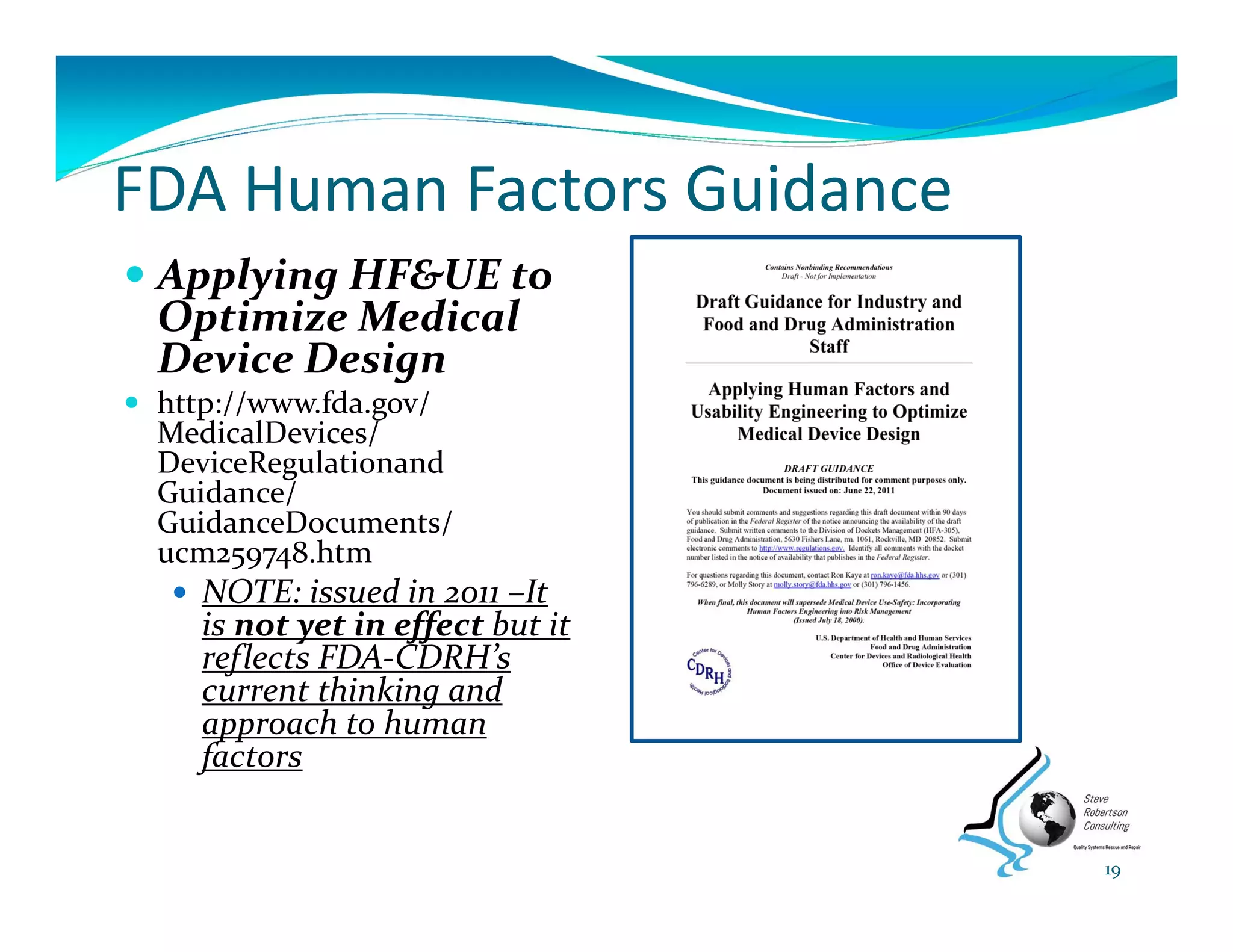
FDA Human Factors Guidance
 Applying HF&UE to 
Optimize Medical 
Device Design
 http://www.fda.gov/ 
MedicalDevices/ 
DeviceRegulationand
Guidance/ 
GuidanceDocuments/ 
ucm259748.htm 
 NOTE: issued in 2011 –It 
is not yet in effect but it 
reflects FDA‐CDRH’s 
current thinking and 
approach to human 
factors
19
2011 Draft Human Factors Guidance
FDA’s best thinking regarding: 
 Device Users, Use Environments and User Interfaces
 Use‐Related Hazard Analytical Methods
 Formative Evaluations
 Mitigation and Control of Use‐Related Hazards
 Design Verification Testing
 Human Factors Validation
20
“Use error caused by designs that are either overly complex or contrary 
to users' intuitive expectations for operation is one of the most 
persistent and critical problems encountered by FDA.”
‐ General Principles of Software Validation, Final Guidance for Industry and FDA Staff  (2002)
Submission Problems with HF/UE
 Not understanding that “usability goals” are not included 
in FDA’s recognition of the standard
 Simply state “in compliance” with 62366 and submit no HF 
report
 Not using US residents in validation studies (w/exceptions)
 Devices modified to mitigate use error issues, then the 
mitigation is not directly tested in validation testing
 Formative evaluations either not done or pretending to be 
validation testing
 Overemphasis on complex protocol, technique, and test 
conditions while the test focus, data, interpretations and 
report are impossible to interpret. 
21
A Good HF/UE Validation Report Includes:
 Intended device users, uses, use environments, 
and training
 Device user interface (graphical & verbal 
description)
 Summary of known use problems
 User task selection, characterization and 
prioritization
 Summary of formative evaluations
 Validation testing
22
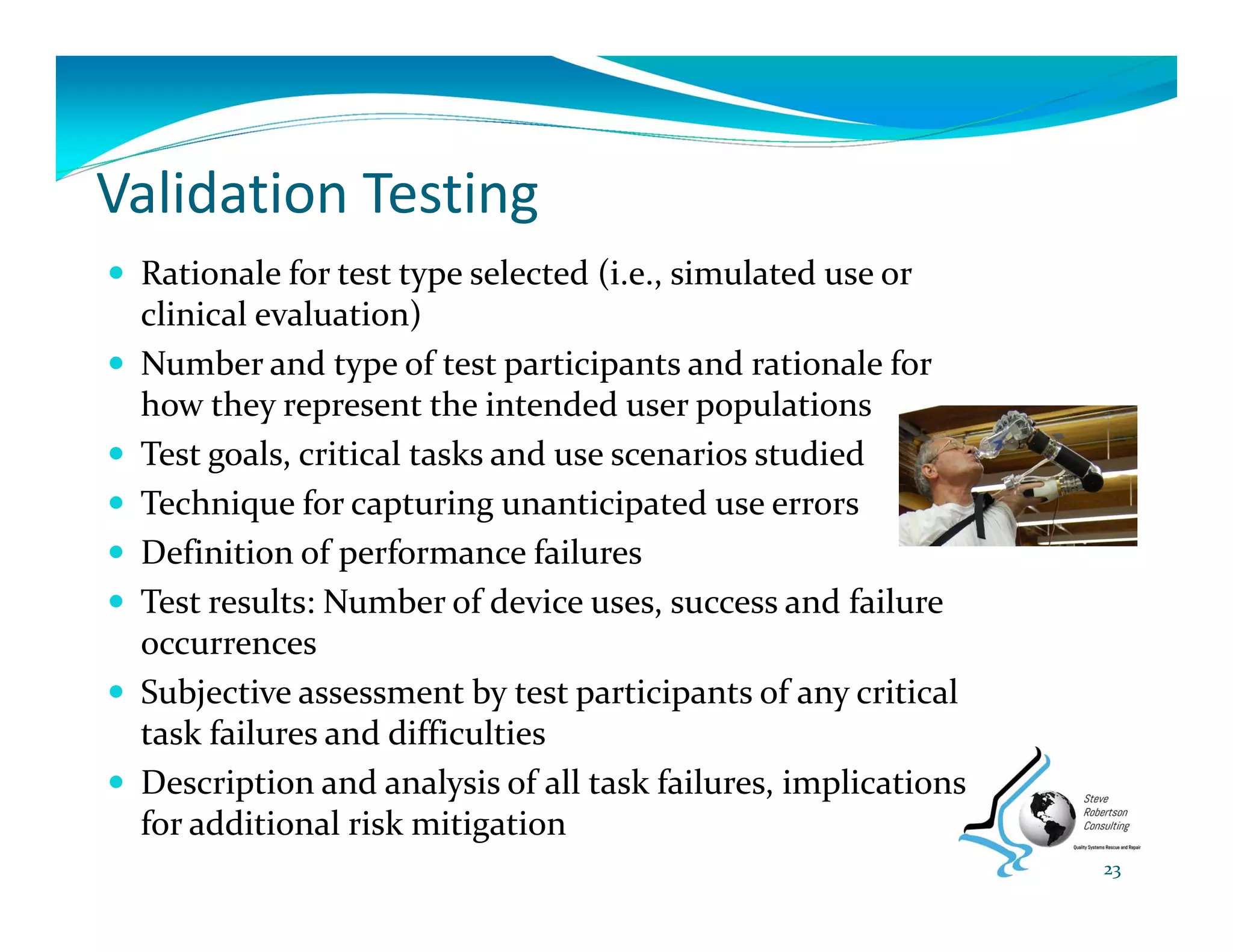
Validation Testing
 Rationale for test type selected (i.e., simulated use or 
clinical evaluation) 
 Number and type of test participants and rationale for 
how they represent the intended user populations 
 Test goals, critical tasks and use scenarios studied 
 Technique for capturing unanticipated use errors 
 Definition of performance failures 
 Test results: Number of device uses, success and failure 
occurrences 
 Subjective assessment by test participants of any critical 
task failures and difficulties 
 Description and analysis of all task failures, implications 
for additional risk mitigation
23
FDA’s Cybersecurity Concern
 Network‐connected devices disabled by 
malware
 Targeting of patient data using wireless 
technology
 Uncontrolled passwords management
 Failure to address security vulnerabilities via 
update
 Security vulnerabilities in OTS software
‐ Source:  FDA Safety Communication (June 13, 2013)
24
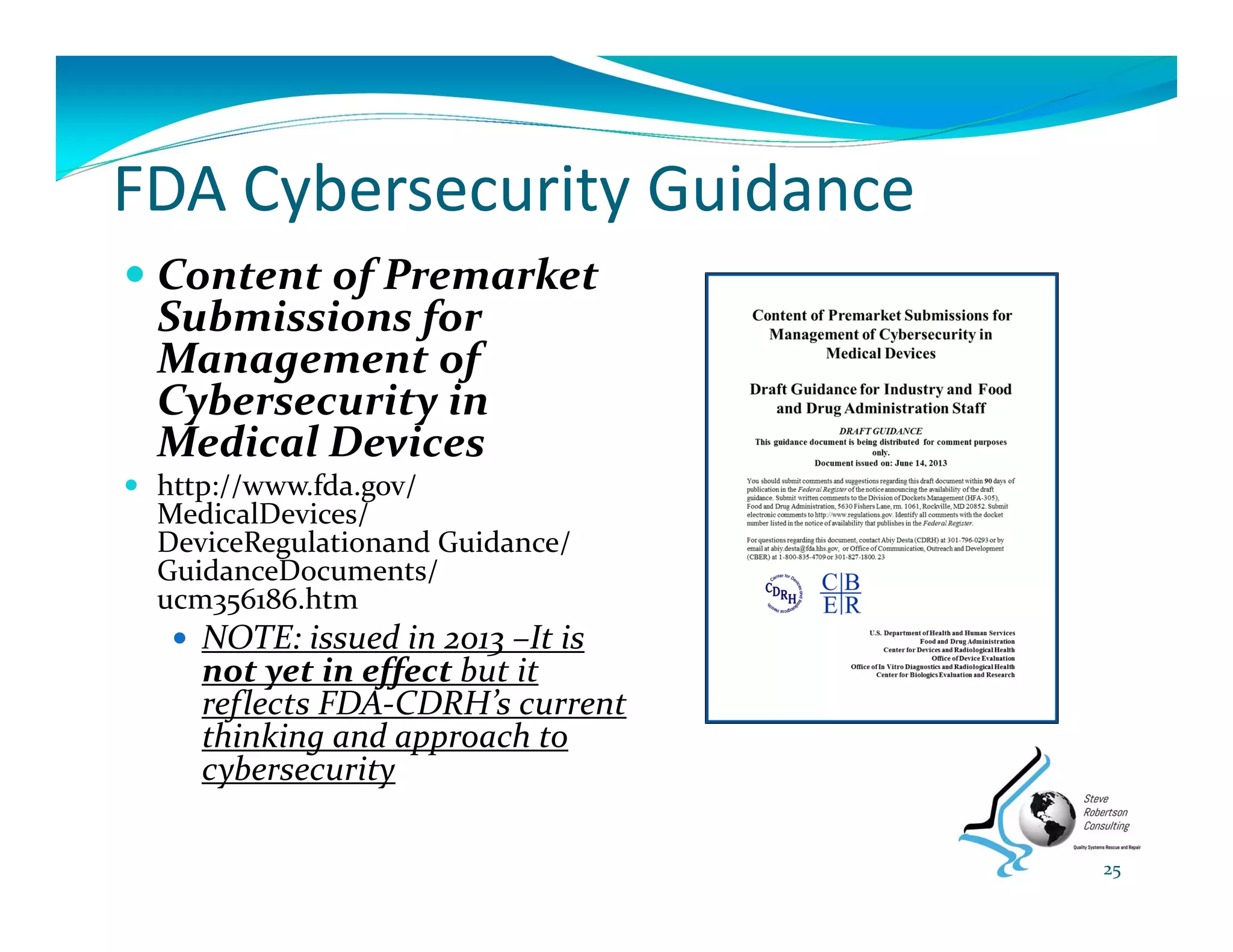
FDA Cybersecurity Guidance
 Content of Premarket 
Submissions for 
Management of 
Cybersecurity in 
Medical Devices
 http://www.fda.gov/ 
MedicalDevices/ 
DeviceRegulationand Guidance/ 
GuidanceDocuments/ 
ucm356186.htm 
 NOTE: issued in 2013 –It is 
not yet in effect but it 
reflects FDA‐CDRH’s current 
thinking and approach to 
cybersecurity
25
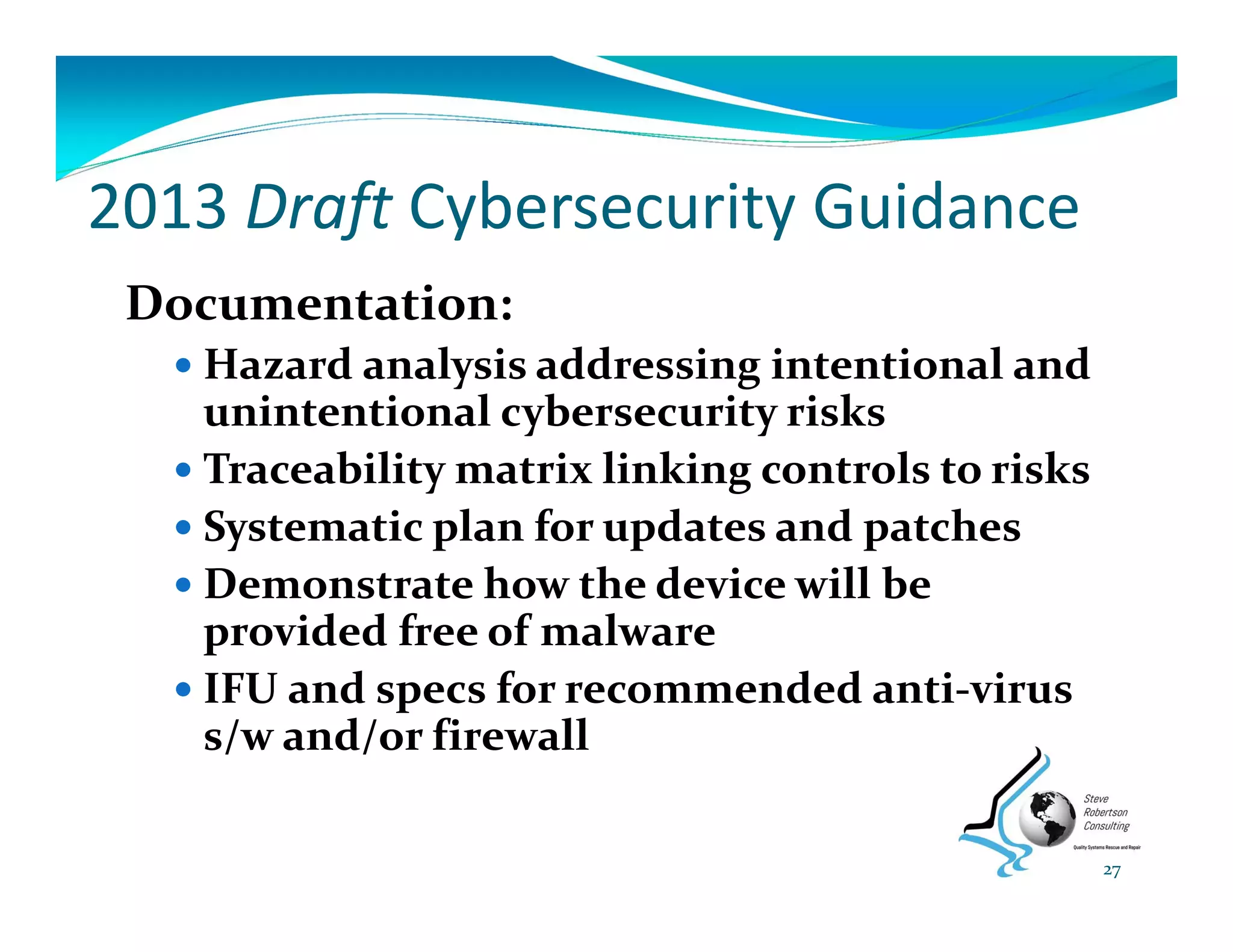
2013 Draft Cybersecurity Guidance
General Principles:
 Confidentiality – only authorized persons or 
entities have access
 Integrity – Accurate and complete data, not 
improperly modified
 Availability – Accessible and usable on a 
timely basis in the expected manner
26
2013 Draft Cybersecurity Guidance
Documentation:
 Hazard analysis addressing intentional and 
unintentional cybersecurity risks
 Traceability matrix linking controls to risks
 Systematic plan for updates and patches
 Demonstrate how the device will be 
provided free of malware
 IFU and specs for recommended anti‐virus 
s/w and/or firewall
27
Conclusions:
 Buy a copy of device‐relevant standards
 Get free FDA guidance documents online
 Read them
 Gap assess your processes and current 
records – then fix them
 implement tools that drive consistent 
outputs
 Hire a HF/UE Engineer (or make a 
consultant happy)
28
Thank You!
For questions or assistance, contact me at 
srobert999@gmail.com or (972) 505‐1920
29
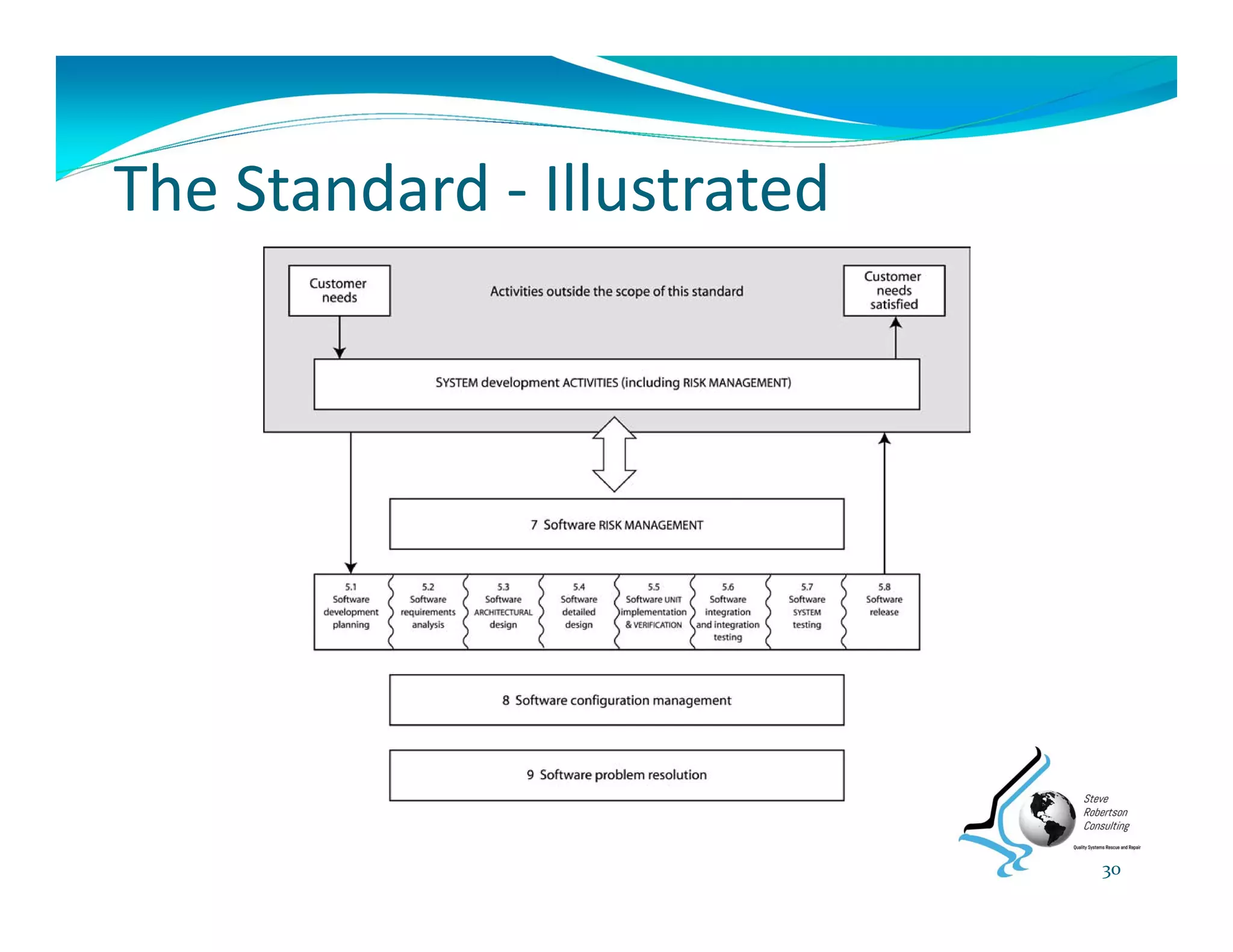
The Standard ‐ Illustrated
30
Medical Device Software under IEC 62304
George Romanski
Š
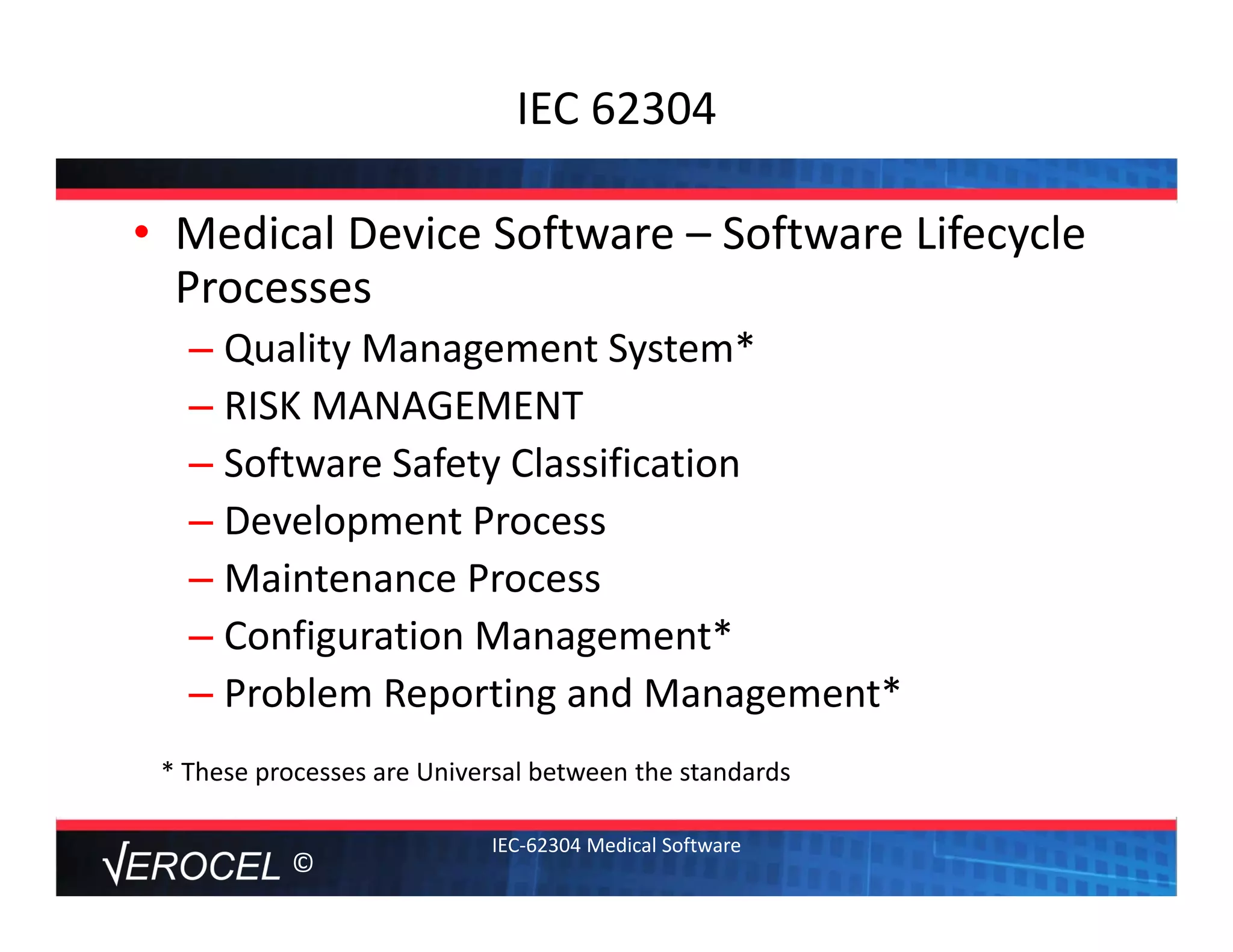
IEC 62304
• Medical Device Software – Software Lifecycle 
Processes
– Quality Management System*
– RISK MANAGEMENT
– Software Safety Classification
– Development Process
– Maintenance Process
– Configuration Management*
– Problem Reporting and Management*
IEC‐62304 Medical Software
* These processes are Universal between the standards
Š
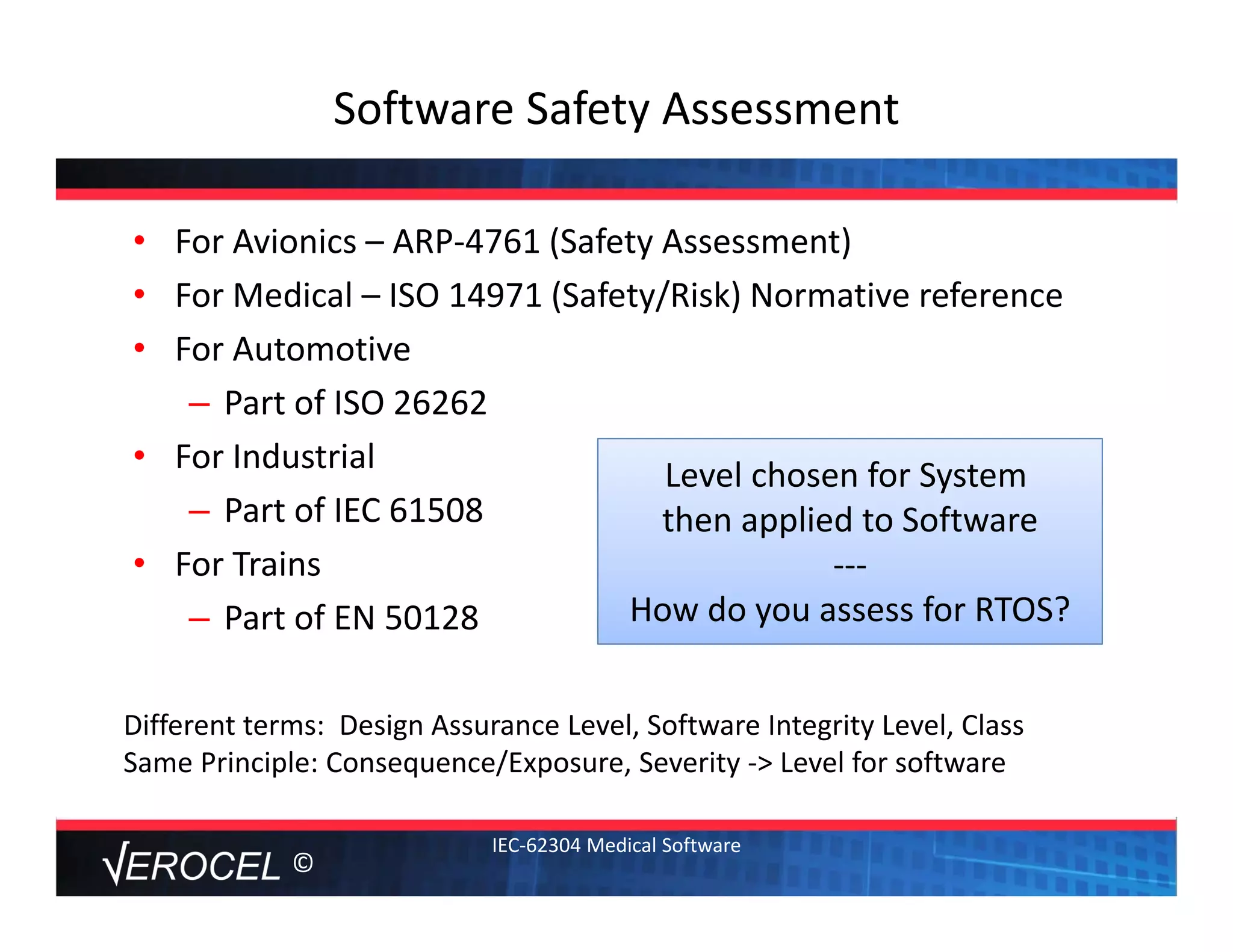
Software Safety Assessment
• For Avionics – ARP‐4761 (Safety Assessment) 
• For Medical – ISO 14971 (Safety/Risk) Normative reference 
• For Automotive 
– Part of ISO 26262
• For Industrial
– Part of IEC 61508
• For Trains
– Part of EN 50128
IEC‐62304 Medical Software
Different terms:  Design Assurance Level, Software Integrity Level, Class
Same Principle: Consequence/Exposure, Severity ‐> Level for software
Level chosen for System 
then applied to Software
‐‐‐
How do you assess for RTOS?
Š
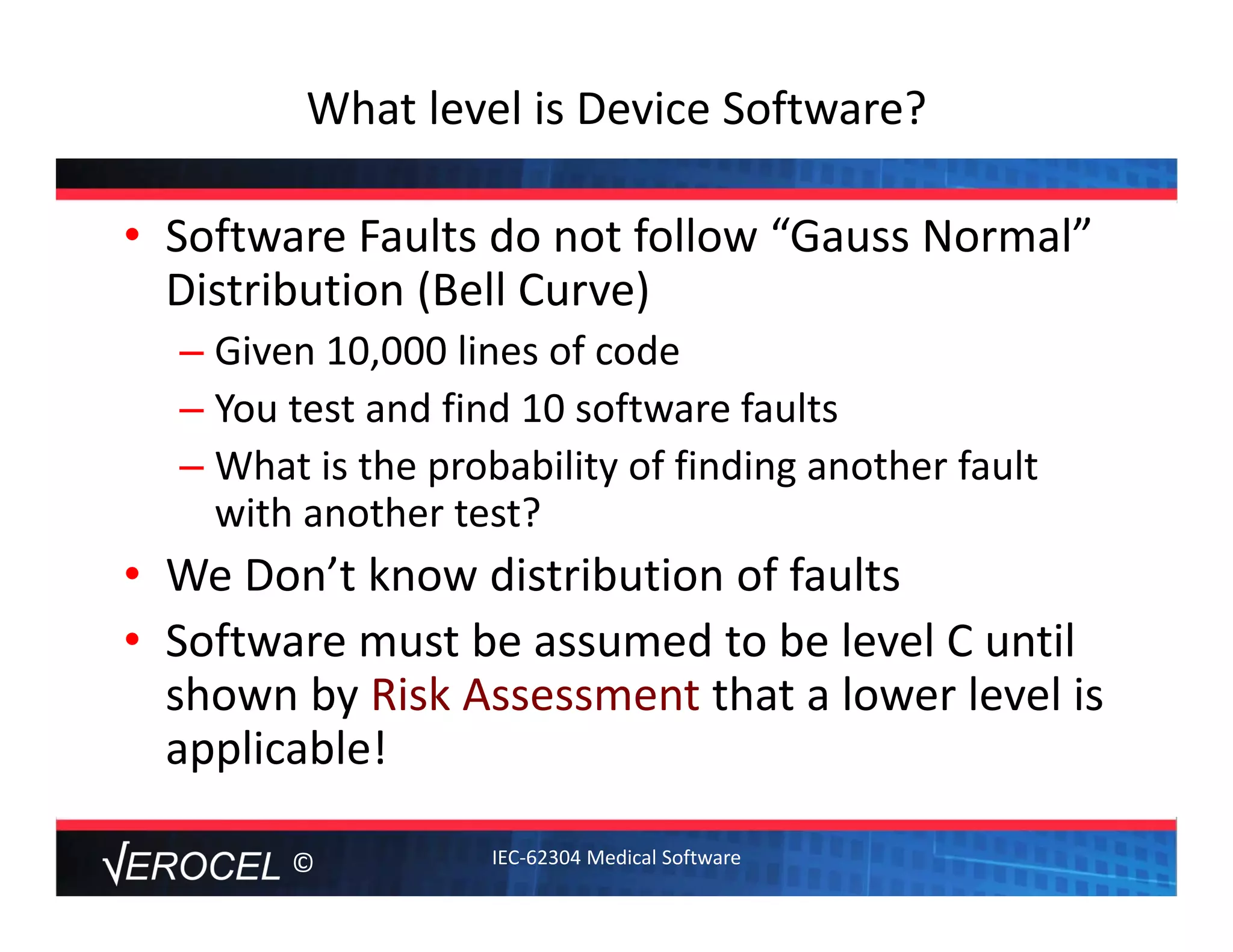
What level is Device Software? 
• Software Faults do not follow “Gauss Normal” 
Distribution (Bell Curve)
– Given 10,000 lines of code
– You test and find 10 software faults
– What is the probability of finding another fault 
with another test?
• We Don’t know distribution of faults
• Software must be assumed to be level C until 
shown by Risk Assessment that a lower level is 
applicable! 
IEC‐62304 Medical Software
Š
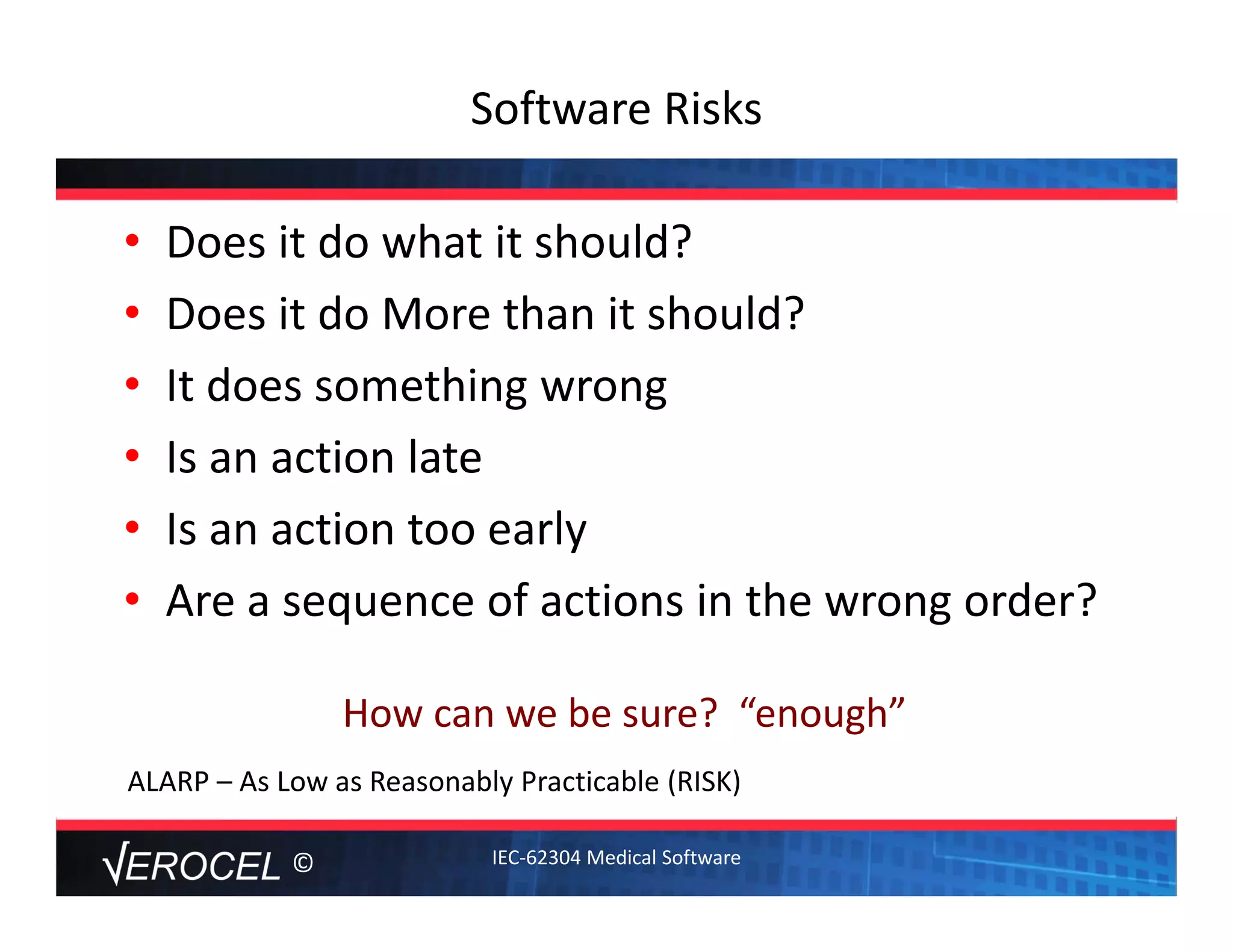
Software Risks
• Does it do what it should?
• Does it do More than it should?
• It does something wrong
• Is an action late
• Is an action too early
• Are a sequence of actions in the wrong order?
How can we be sure?  “enough”
ALARP – As Low as Reasonably Practicable (RISK)
IEC‐62304 Medical Software
Š
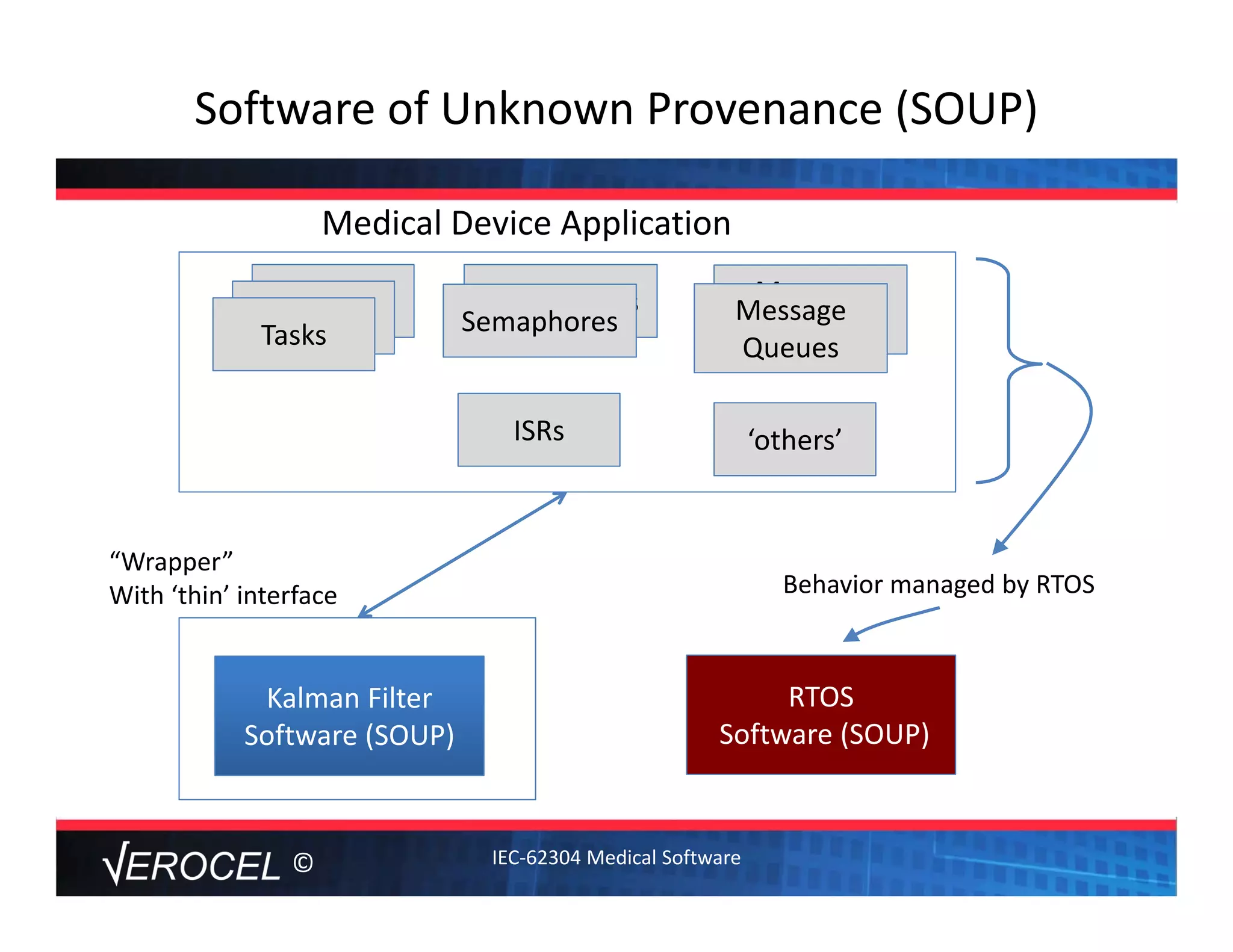
Software of Unknown Provenance (SOUP)
RTOS
Software (SOUP)
Tasks
Tasks
Tasks
Semaphores
Semaphores
ISRs
Kalman Filter 
Software (SOUP)
“Wrapper”
With ‘thin’ interface
Medical Device Application
Message 
Queues
Message 
Queues
‘others’
Behavior managed by RTOS
IEC‐62304 Medical Software
Š
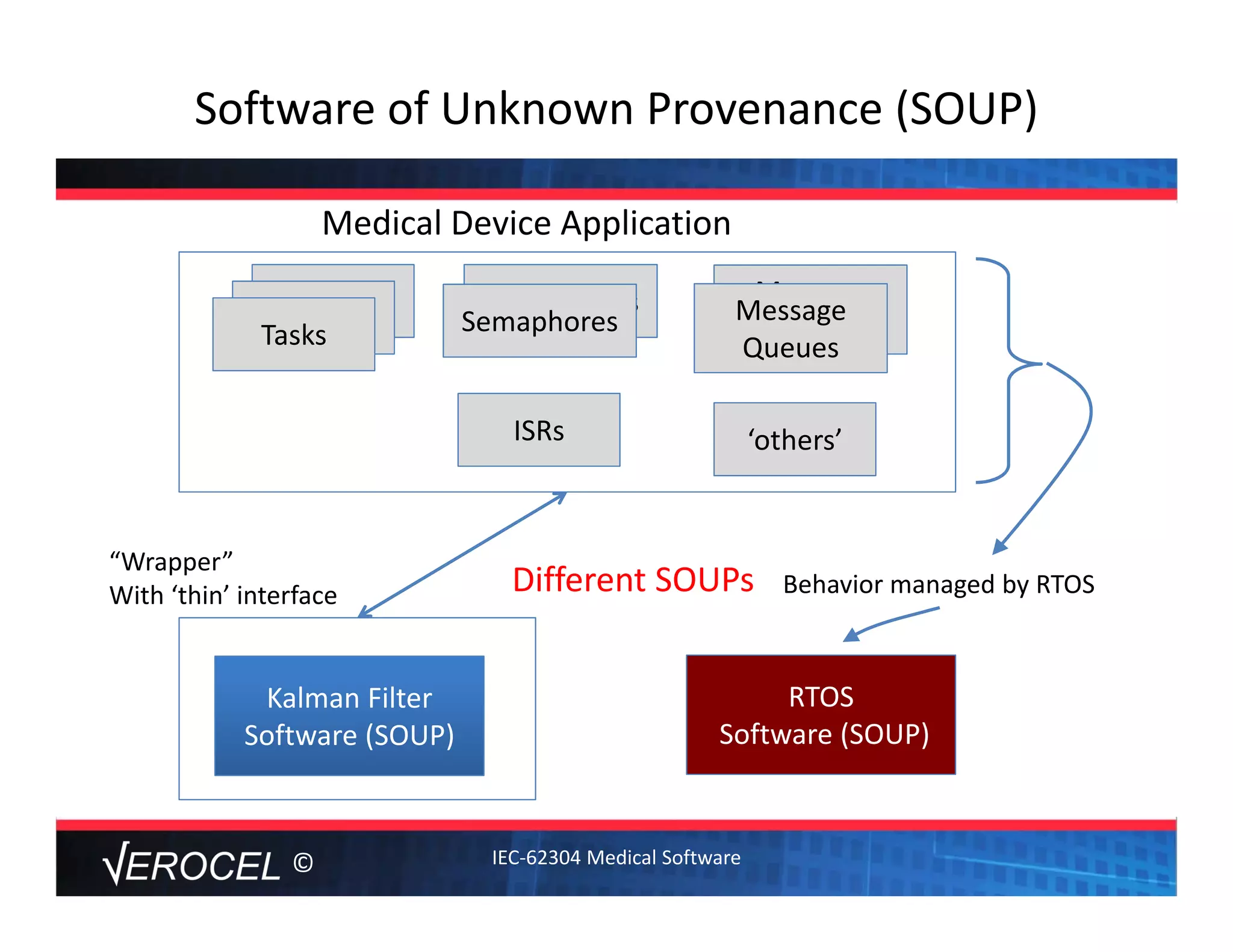
Software of Unknown Provenance (SOUP)
RTOS
Software (SOUP)
Tasks
Tasks
Tasks
Semaphores
Semaphores
ISRs
Kalman Filter 
Software (SOUP)
“Wrapper”
With ‘thin’ interface
Medical Device Application
Message 
Queues
Message 
Queues
‘others’
Behavior managed by RTOSDifferent SOUPs
IEC‐62304 Medical Software
Š
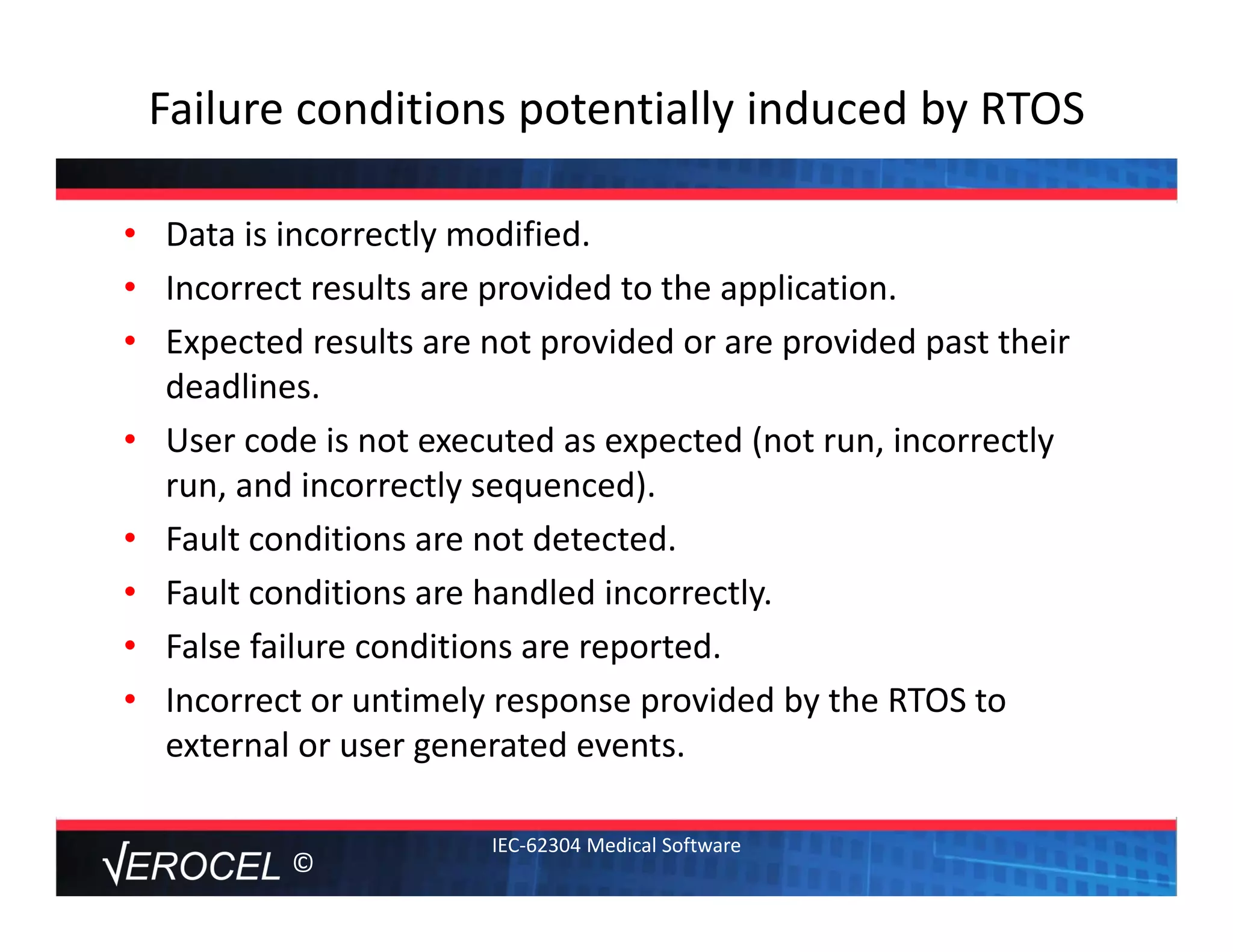
Failure conditions potentially induced by RTOS
• Data is incorrectly modified. 
• Incorrect results are provided to the application.
• Expected results are not provided or are provided past their 
deadlines.
• User code is not executed as expected (not run, incorrectly 
run, and incorrectly sequenced).
• Fault conditions are not detected.
• Fault conditions are handled incorrectly.
• False failure conditions are reported.
• Incorrect or untimely response provided by the RTOS to 
external or user generated events.
IEC‐62304 Medical Software
Š
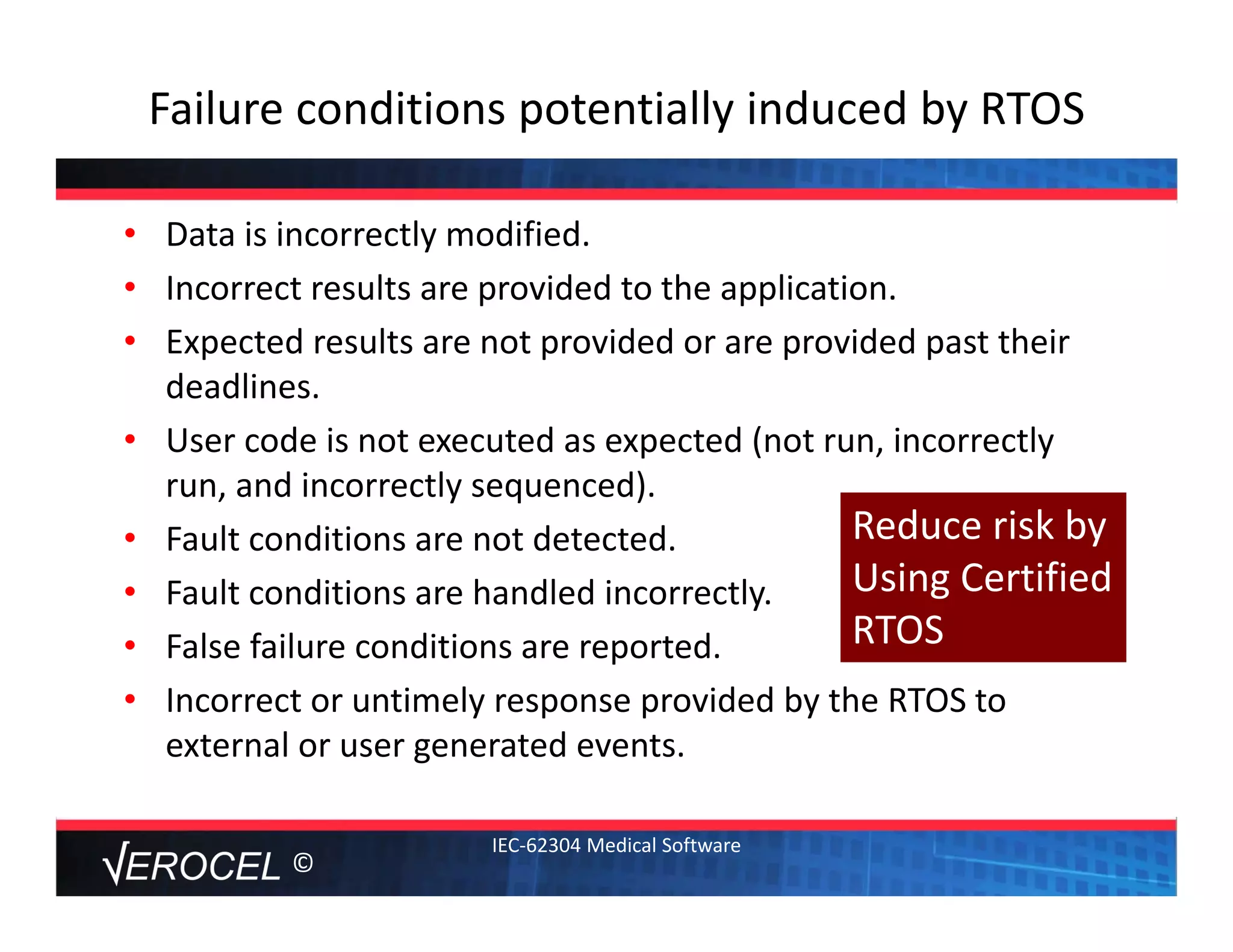
Failure conditions potentially induced by RTOS
• Data is incorrectly modified. 
• Incorrect results are provided to the application.
• Expected results are not provided or are provided past their 
deadlines.
• User code is not executed as expected (not run, incorrectly 
run, and incorrectly sequenced).
• Fault conditions are not detected.
• Fault conditions are handled incorrectly.
• False failure conditions are reported.
• Incorrect or untimely response provided by the RTOS to 
external or user generated events.
IEC‐62304 Medical Software
Reduce risk by
Using Certified 
RTOS
Š
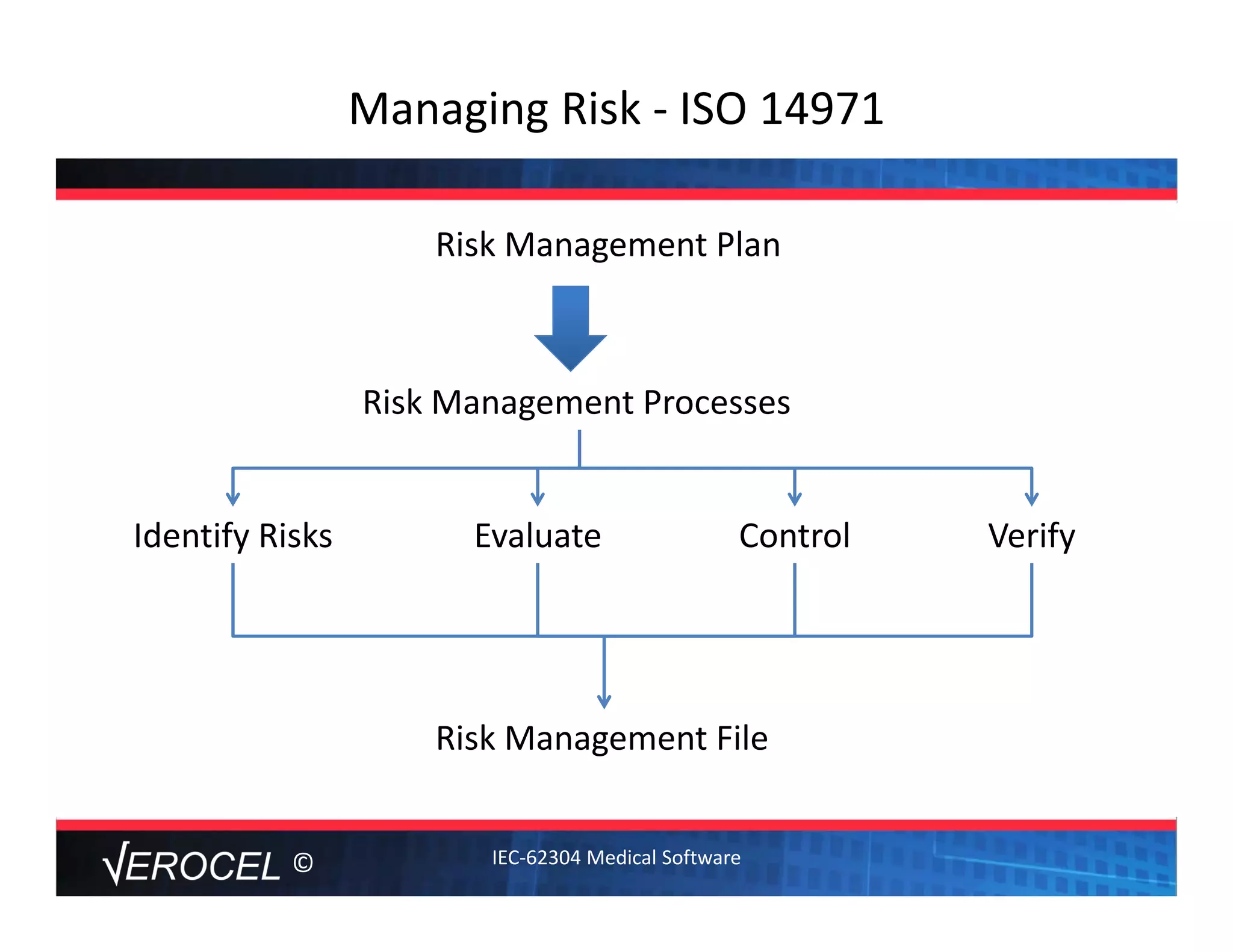
Managing Risk ‐ ISO 14971
Risk Management Plan
Identify Risks Evaluate Control Verify
Risk Management Processes
Risk Management File
IEC‐62304 Medical Software
Š
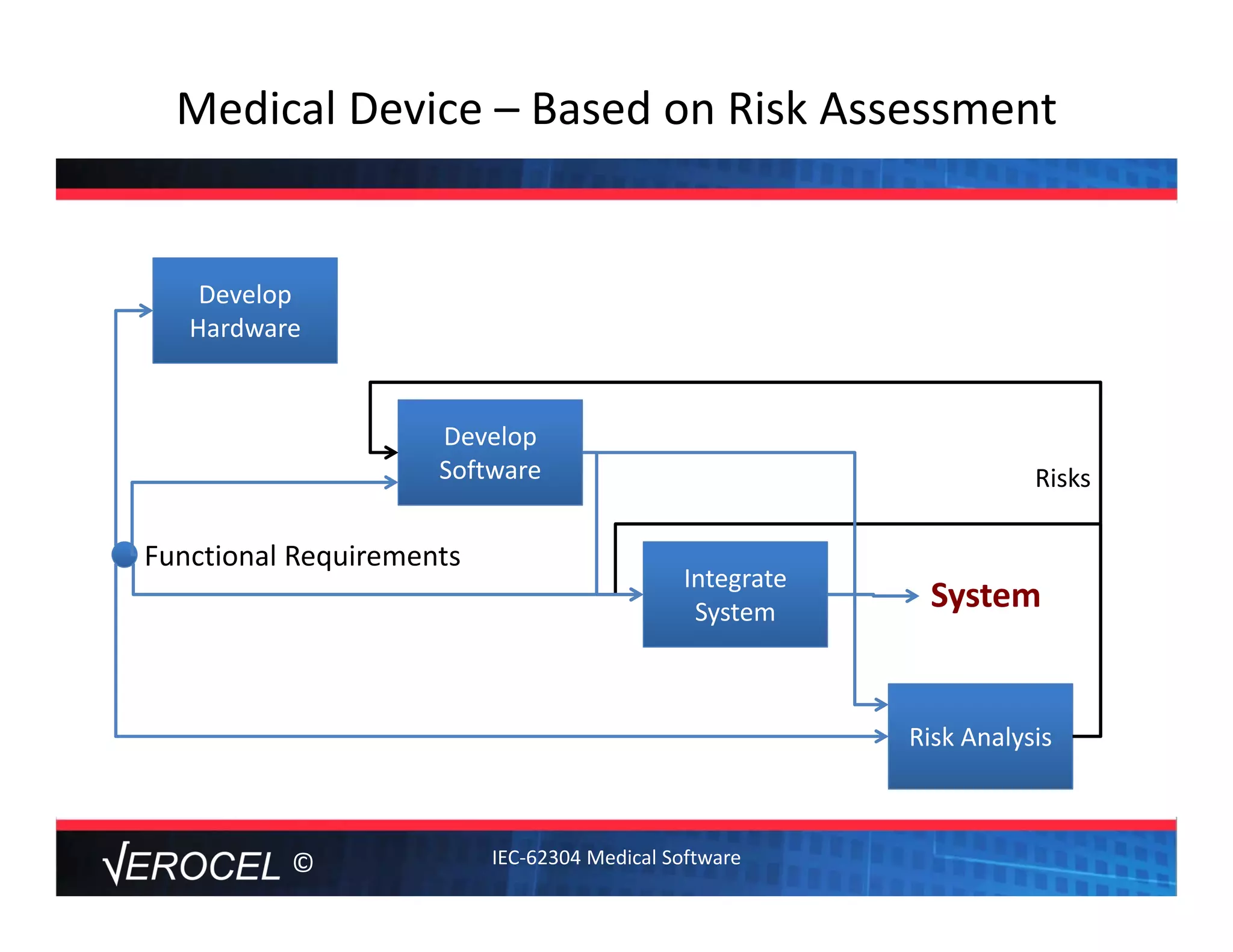
Medical Device – Based on Risk Assessment
Develop 
Hardware
Develop 
Software
Integrate
System
Risk Analysis
Risks
Functional Requirements
System
IEC‐62304 Medical Software
Š
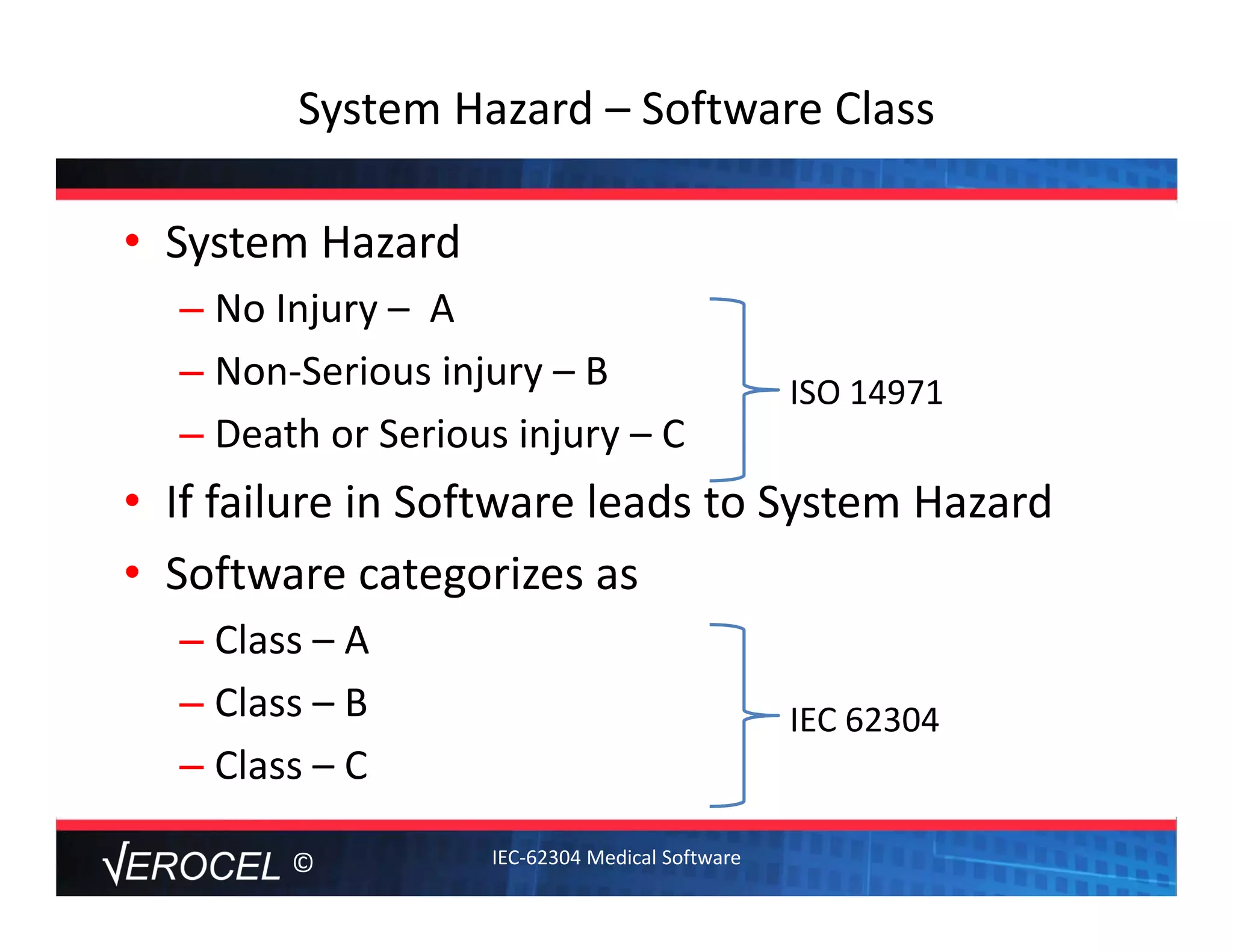
System Hazard – Software Class
• System Hazard
– No Injury – A
– Non‐Serious injury – B
– Death or Serious injury – C
• If failure in Software leads to System Hazard
• Software categorizes as
– Class – A
– Class – B
– Class – C
IEC‐62304 Medical Software
ISO 14971
IEC 62304
Š
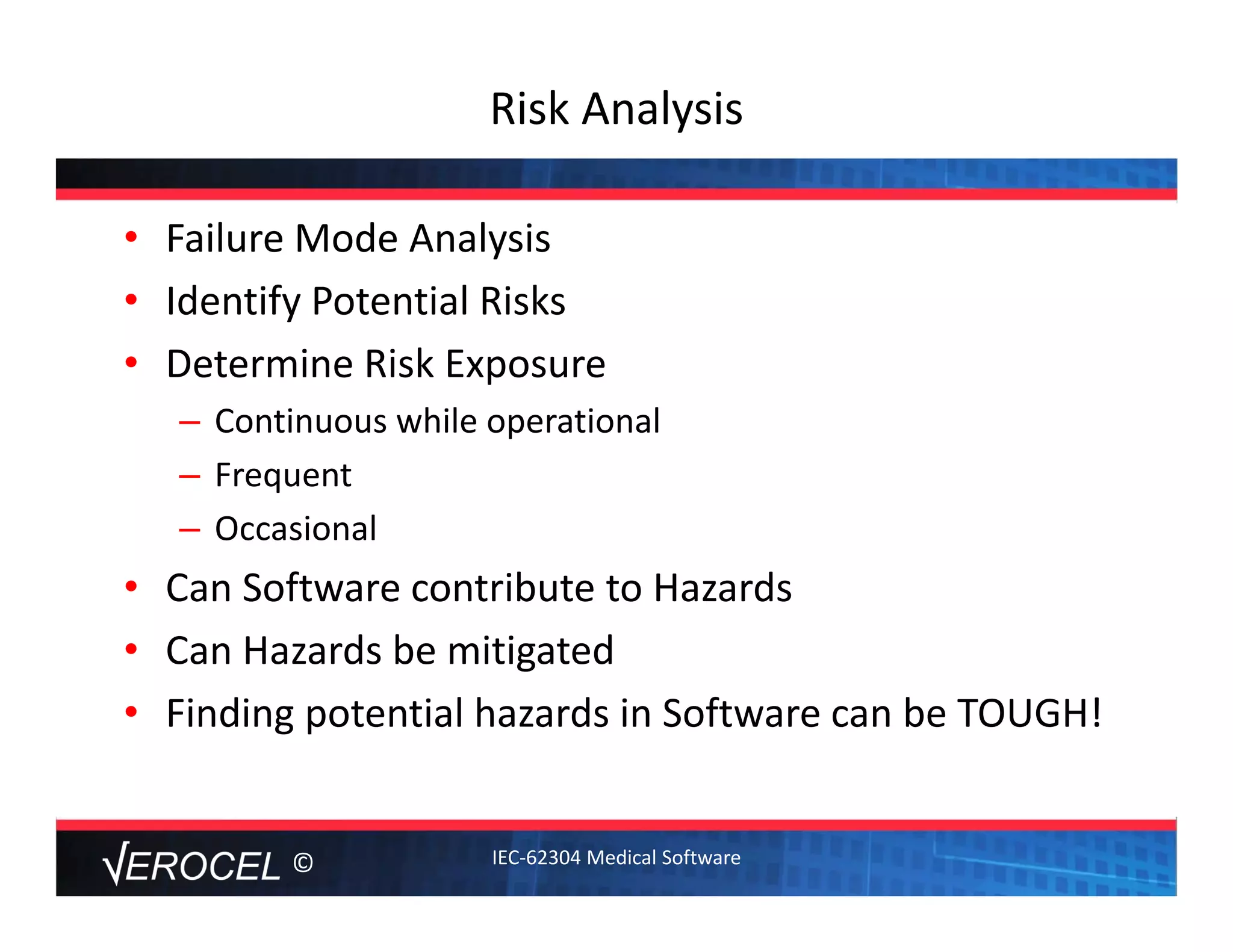
Risk Analysis
• Failure Mode Analysis
• Identify Potential Risks
• Determine Risk Exposure
– Continuous while operational
– Frequent
– Occasional
• Can Software contribute to Hazards
• Can Hazards be mitigated
• Finding potential hazards in Software can be TOUGH!
IEC‐62304 Medical Software
Š
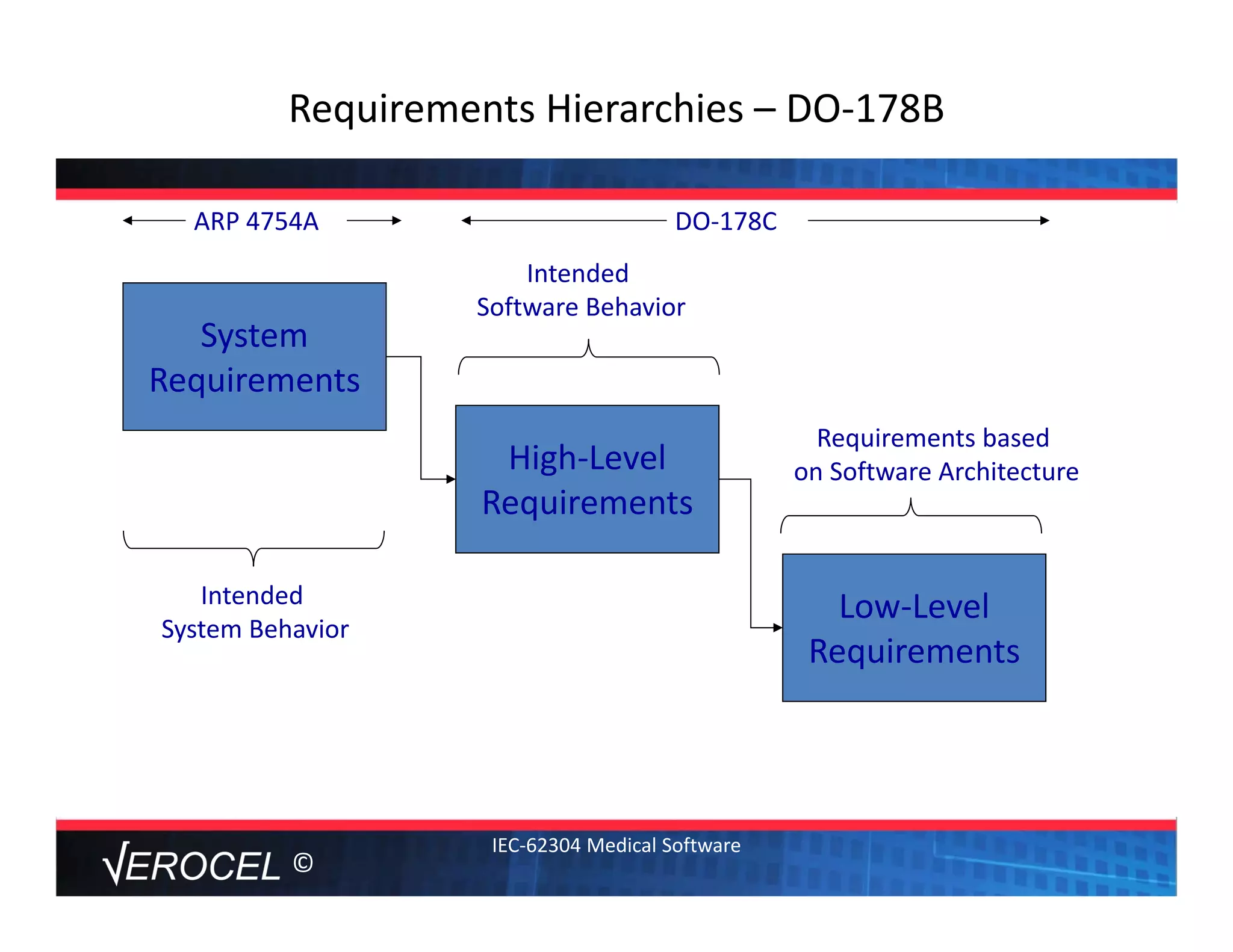
Requirements Hierarchies – DO‐178B
System
Requirements
High‐Level
Requirements
Low‐Level
Requirements
ARP 4754A
Intended 
System Behavior
Intended 
Software Behavior
DO‐178C
Requirements based
on Software Architecture
IEC‐62304 Medical Software
Š
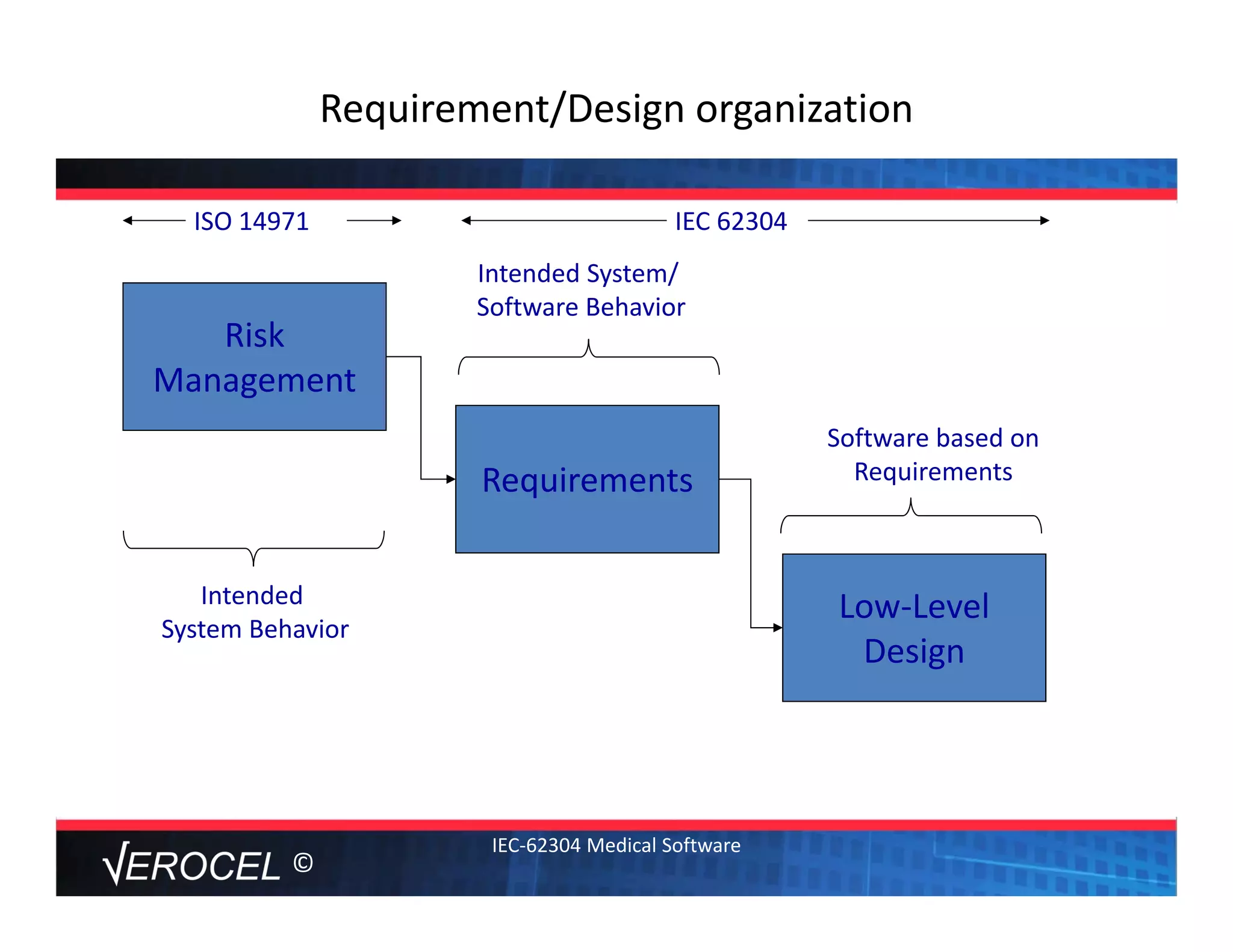
Requirement/Design organization
Risk
Management
Requirements
Low‐Level
Design
ISO 14971
Intended 
System Behavior
Intended System/ 
Software Behavior
IEC 62304
Software based on
Requirements
IEC‐62304 Medical Software
Š
Parameter Data Items 
• Parameter Data Items can be developed and verified 
separately if certain conditions are met
• The high‐level requirements describe how the software uses 
the parameter data items
• The low‐level requirements define the structure, attributes 
and allowable values of the parameter data items
• Verification should show that every data element has the 
correct value – or correct value is in equivalence class and 
boundaries are verified
e.g. Configuration Vectors
IEC‐62304 Medical Software
Š
Our Experience
• Develop verification evidence using a DO‐178C 
software Lifecycle
• All of the other Lifecycle processes will fall into 
place. 
• Some additional documents required
– Safety Plan
– Safety Manual
– Staff Competency Assessment
• Actual assessment required not just Resume
IEC‐62304 Medical Software
Š
More Experience 
• Interpretations and negotiations are prevalent 
in Automotive, Medical and Rail industries.
• TUV were strict on first Verocel certification
– Plans, procedures and standards approved
– Subsequent certifications were straightforward
– “Manufacturing – reject tracking” needed to be 
addressed (for software)?  
IEC‐62304 Medical Software
Š
Finding and eliminating unintended behavior
• Requirements describe intended behavior
• Software developed against requirements (TRACED)
• Tests written against requirements (ONLY) and 
(TRACED)
• Software coverage by tests measured
• Any software not covered demonstrates “unintended 
behavior” 
• This is a risk that must be eliminated.   
IEC‐62304 Medical Software
Š
Code Coverage Analysis
• Requirements used to specify intended behavior
• Write tests using Requirements ONLY
– Normal Range
– Robustness
– Equivalence Class
– Boundary Value
• Run tests and measure how much code was executed
• Assess is non‐executed code should not be there
Coverage Analysis not required explicitly by IEC 62304, but
Hard to mitigate “Unintended Functionality risk” without
IEC‐62304 Medical Software
Š
Coding Standards
• Standards Required – used to show goodness of 
various properties
• Code Layout
• Code consistency
• Readability
• Avoidance of risky constructs
• Etc.  
IEC‐62304 Medical Software
Š
Code Review
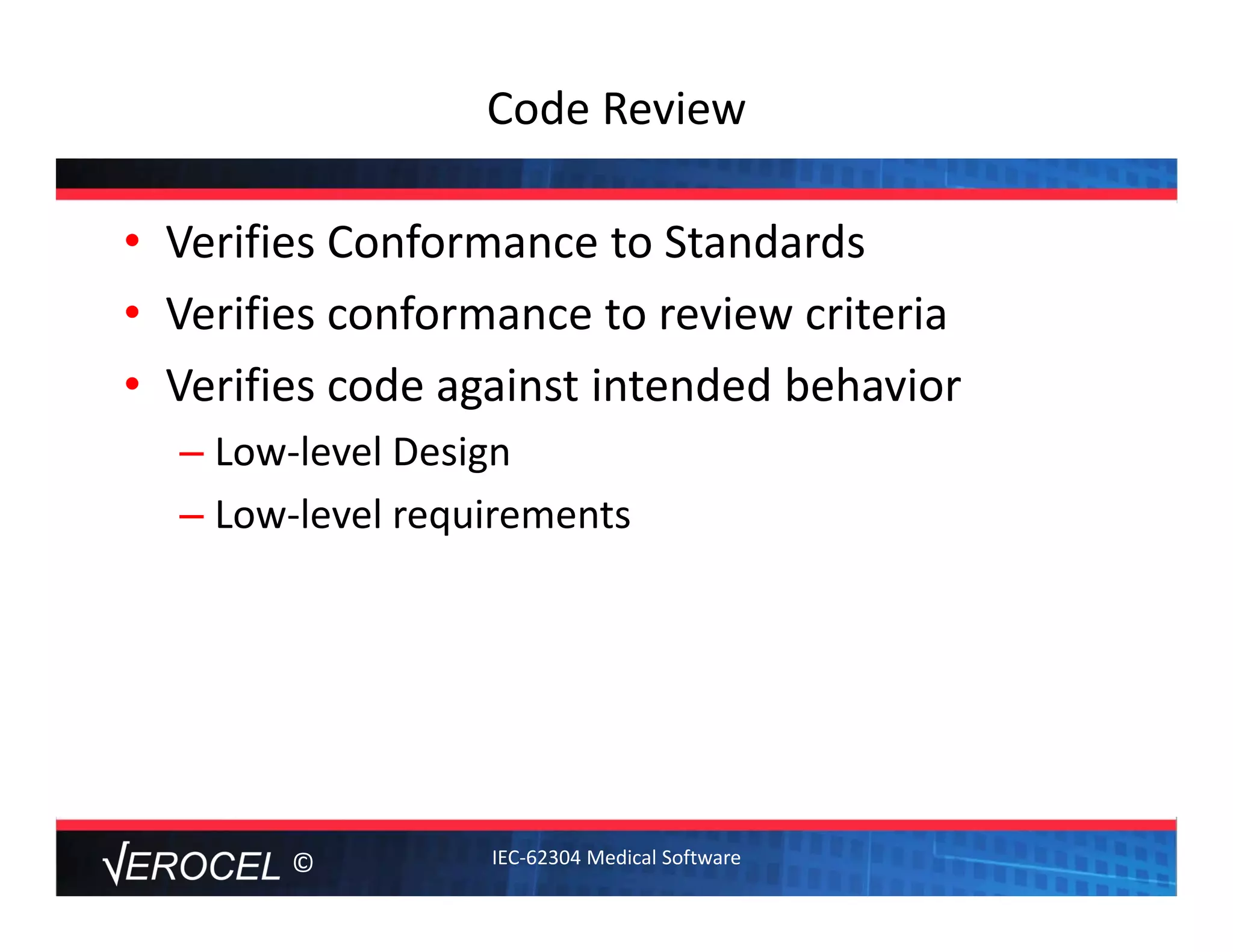
• Verifies Conformance to Standards
• Verifies conformance to review criteria
• Verifies code against intended behavior
– Low‐level Design
– Low‐level requirements
IEC‐62304 Medical Software
Š
Code Analysis Tools (The silver bullet?)
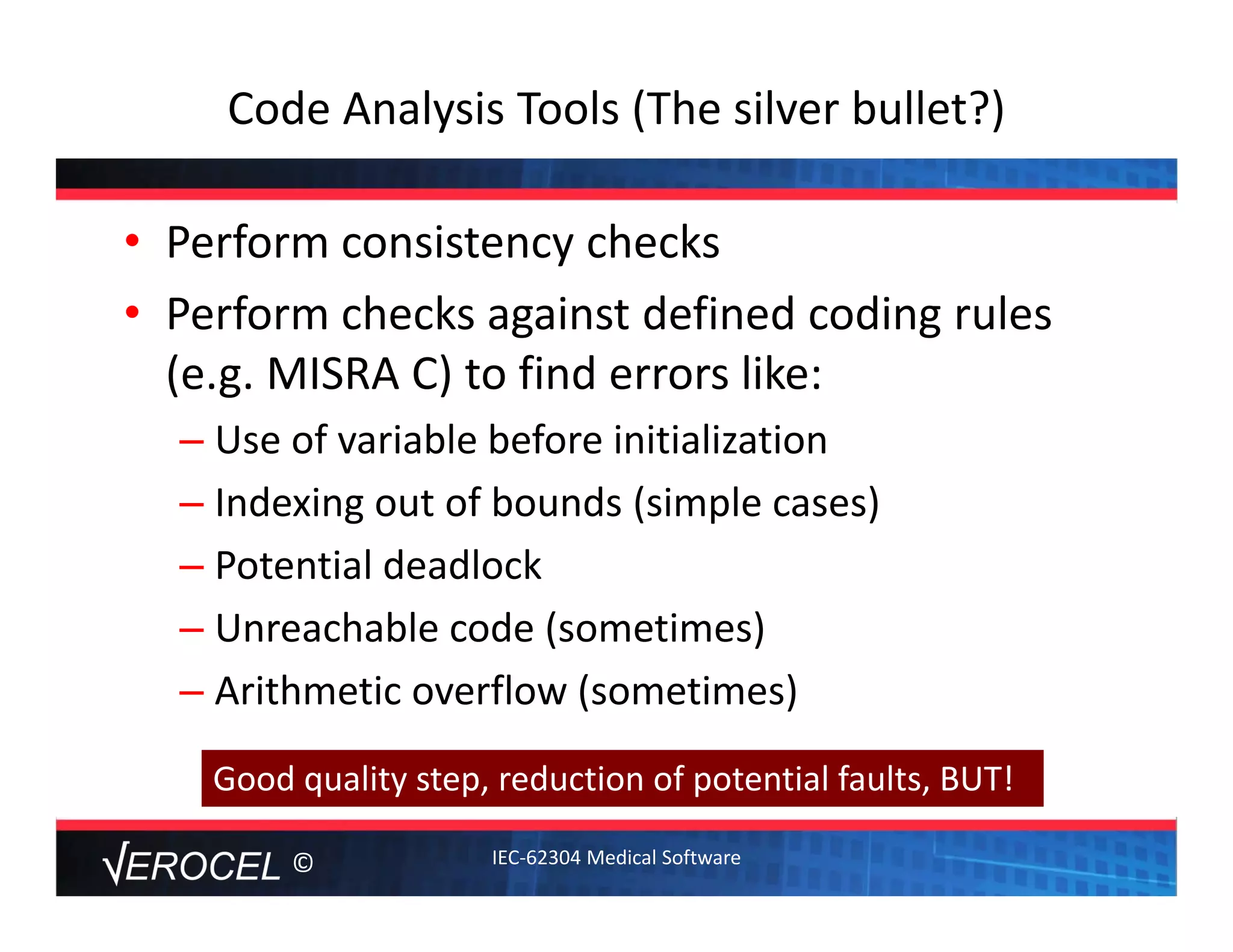
• Perform consistency checks
• Perform checks against defined coding rules 
(e.g. MISRA C) to find errors like:
– Use of variable before initialization
– Indexing out of bounds (simple cases)
– Potential deadlock
– Unreachable code (sometimes)
– Arithmetic overflow (sometimes)
Good quality step, reduction of potential faults, BUT!
IEC‐62304 Medical Software
Š
Code Analysis Tools for Certification
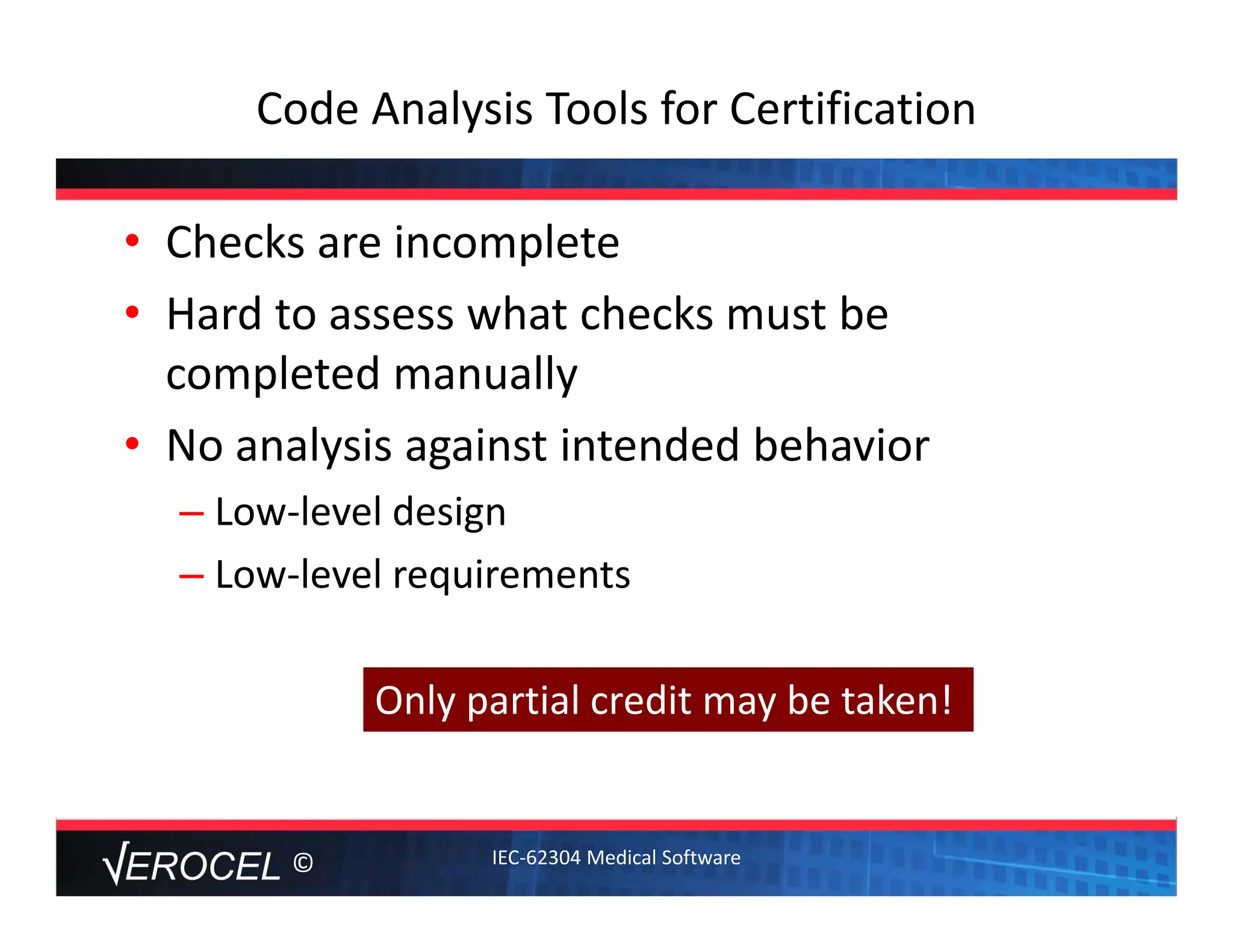
• Checks are incomplete
• Hard to assess what checks must be 
completed manually
• No analysis against intended behavior
– Low‐level design
– Low‐level requirements
Only partial credit may be taken!
IEC‐62304 Medical Software
Š
Configuration Management Processes 
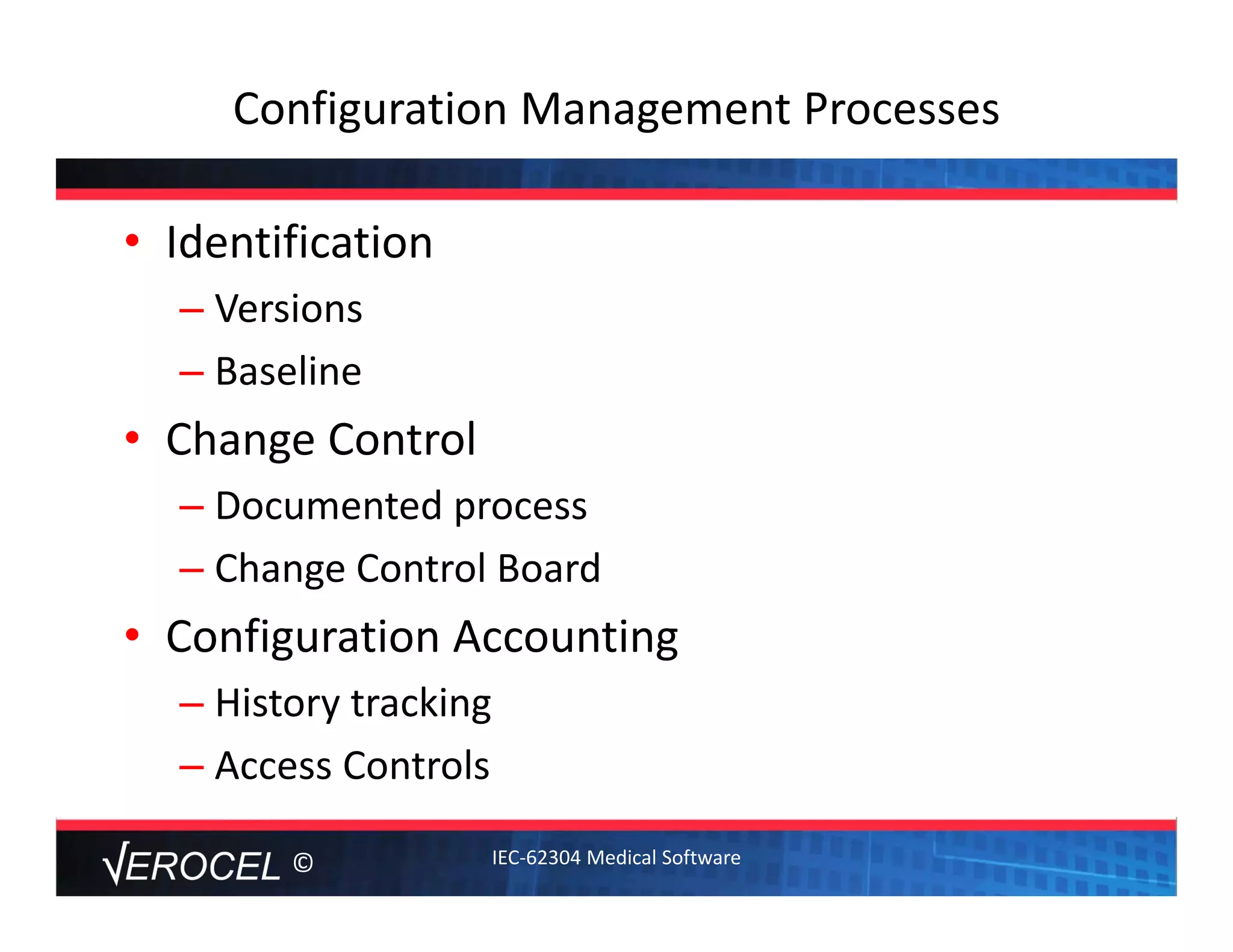
• Identification 
– Versions
– Baseline
• Change Control 
– Documented process
– Change Control Board
• Configuration Accounting
– History tracking
– Access Controls
IEC‐62304 Medical Software
Š
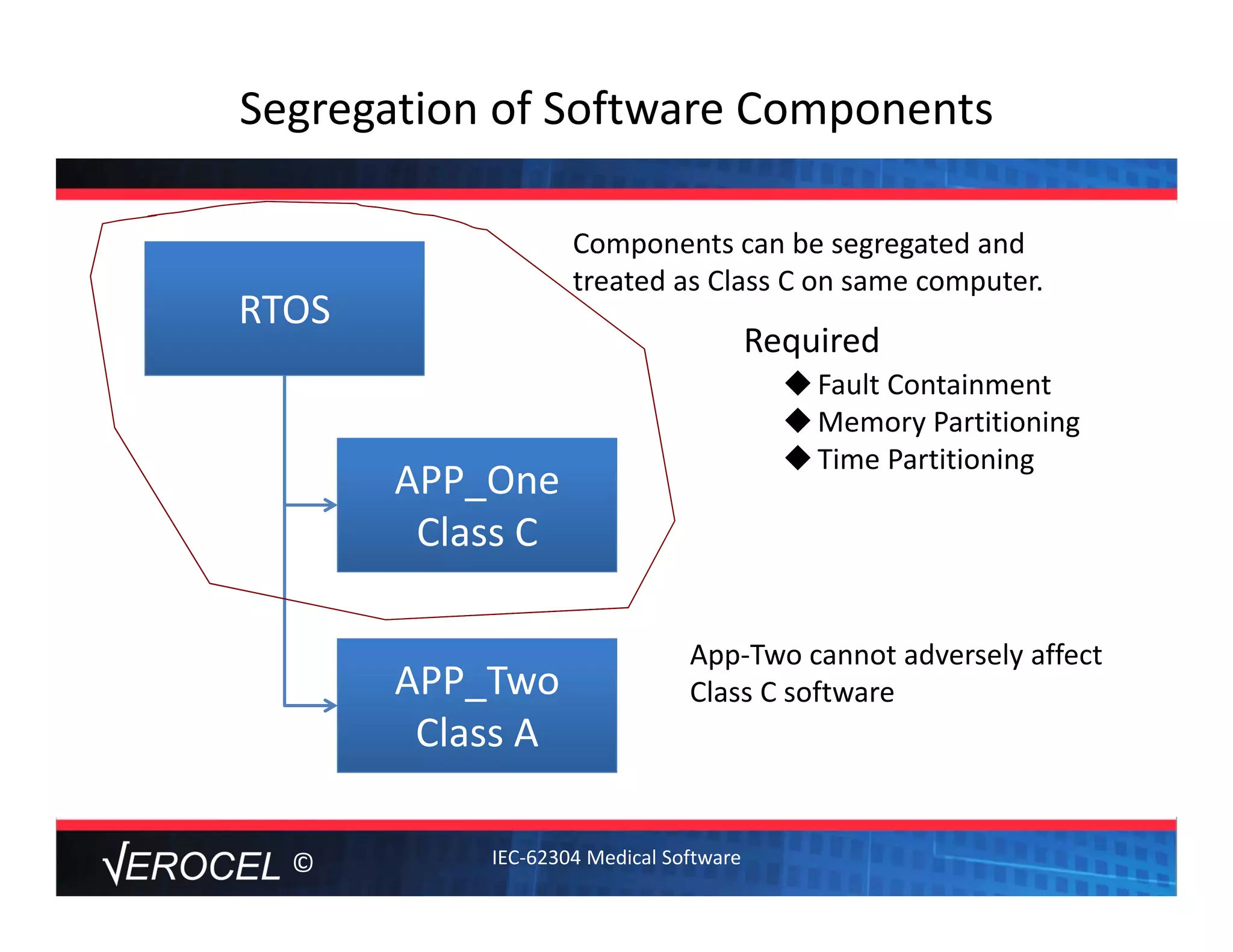
Segregation of Software Components
RTOS
APP_One
Class C
APP_Two
Class A
Components can be segregated and 
treated as Class C on same computer.
Fault Containment
Memory Partitioning
Time Partitioning
Required
App‐Two cannot adversely affect
Class C software
IEC‐62304 Medical Software
Š
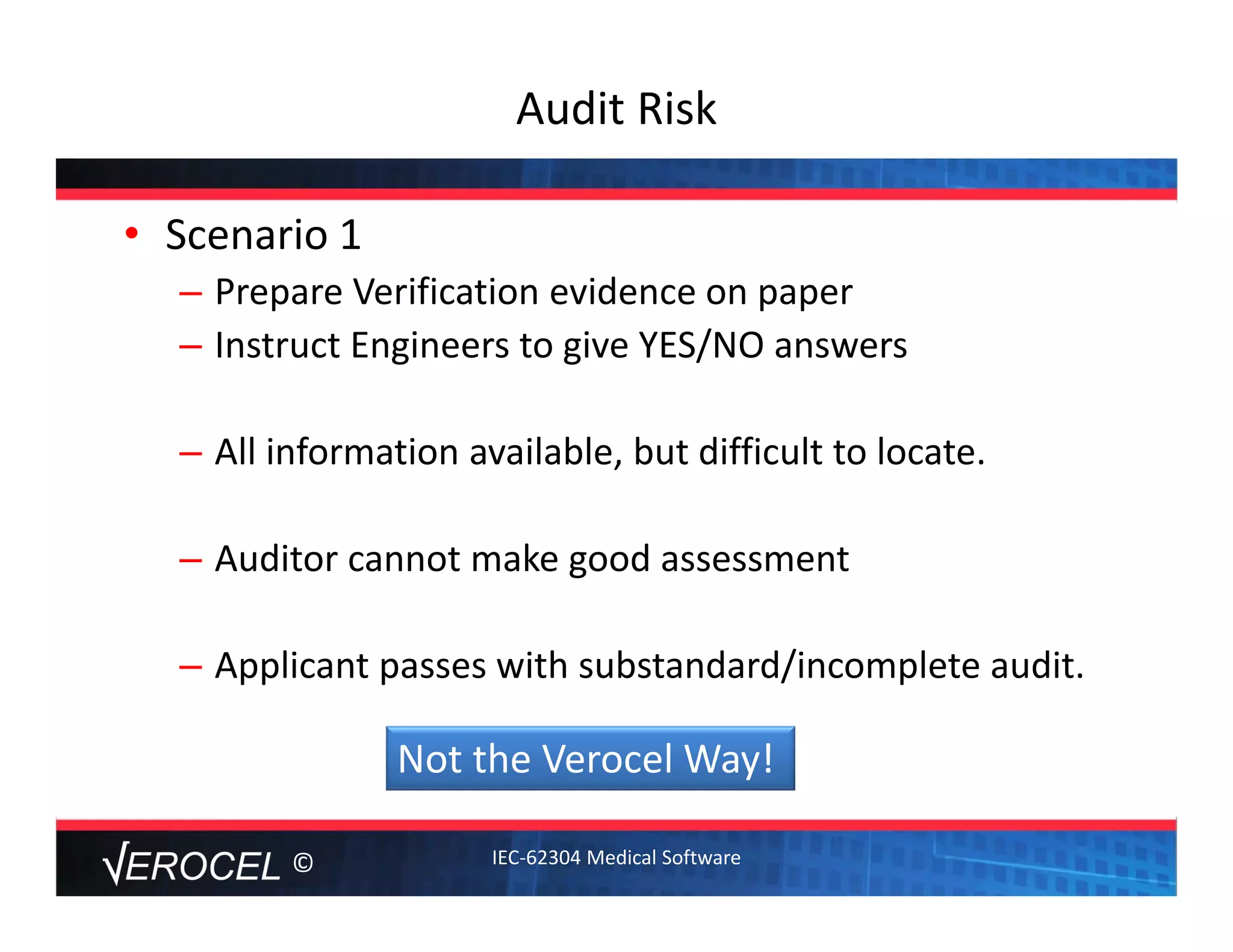
Audit Risk
• Scenario 1
– Prepare Verification evidence on paper
– Instruct Engineers to give YES/NO answers
– All information available, but difficult to locate. 
– Auditor cannot make good assessment
– Applicant passes with substandard/incomplete audit. 
Not the Verocel Way!
IEC‐62304 Medical Software
Š
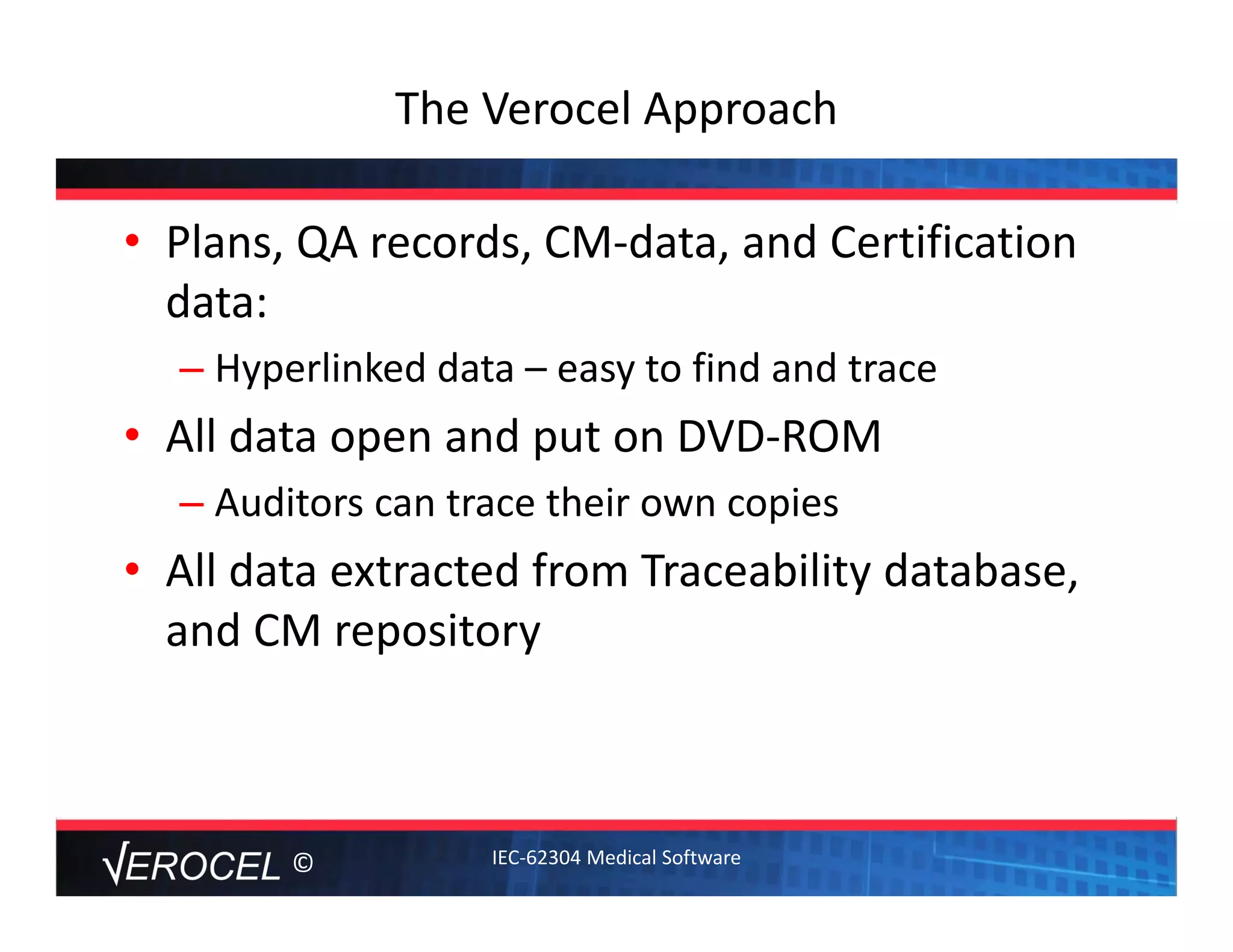
The Verocel Approach
• Plans, QA records, CM‐data, and Certification 
data: 
– Hyperlinked data – easy to find and trace
• All data open and put on DVD‐ROM
– Auditors can trace their own copies
• All data extracted from Traceability database, 
and CM repository
IEC‐62304 Medical Software
Š
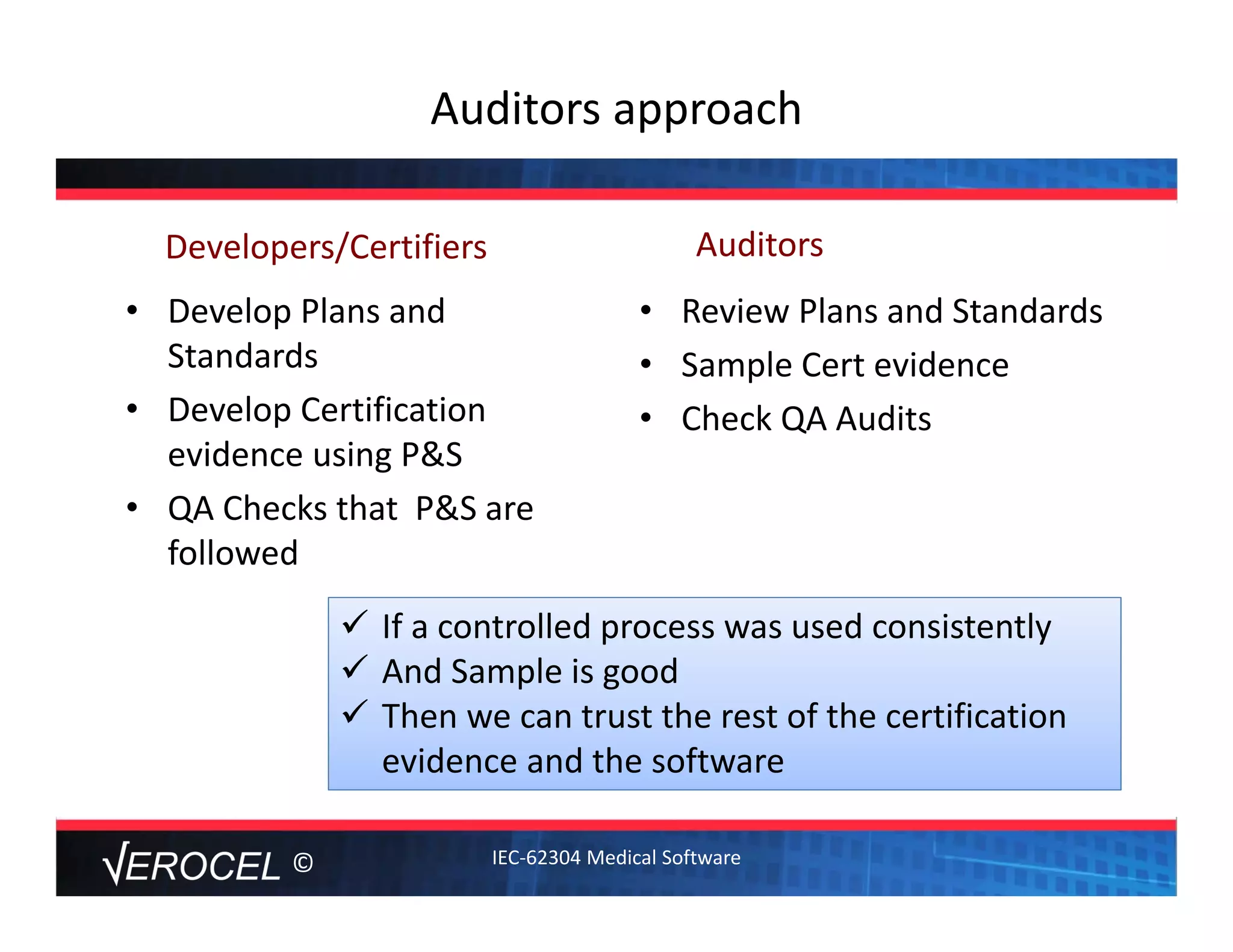
• Develop Plans and 
Standards
• Develop Certification 
evidence using P&S
• QA Checks that  P&S are 
followed
• Review Plans and Standards
• Sample Cert evidence
• Check QA Audits
Auditors approach
 If a controlled process was used consistently
 And Sample is good
 Then we can trust the rest of the certification 
evidence and the software
AuditorsDevelopers/Certifiers
IEC‐62304 Medical Software
mentor.com/embedded
Android is a trademark of Google Inc. Use of this trademark is subject to Google Permissions.
Linux is the registered trademark of Linus Torvalds in the U.S. and other countries.
Qt is a registered trade mark of Digia Plc and/or its subsidiaries. All other trademarks mentioned in this document are trademarks of their respective owners.
Andrew Caples
June 2014
Mentor Embedded
Solutions
2
mentor.com/embedded
2
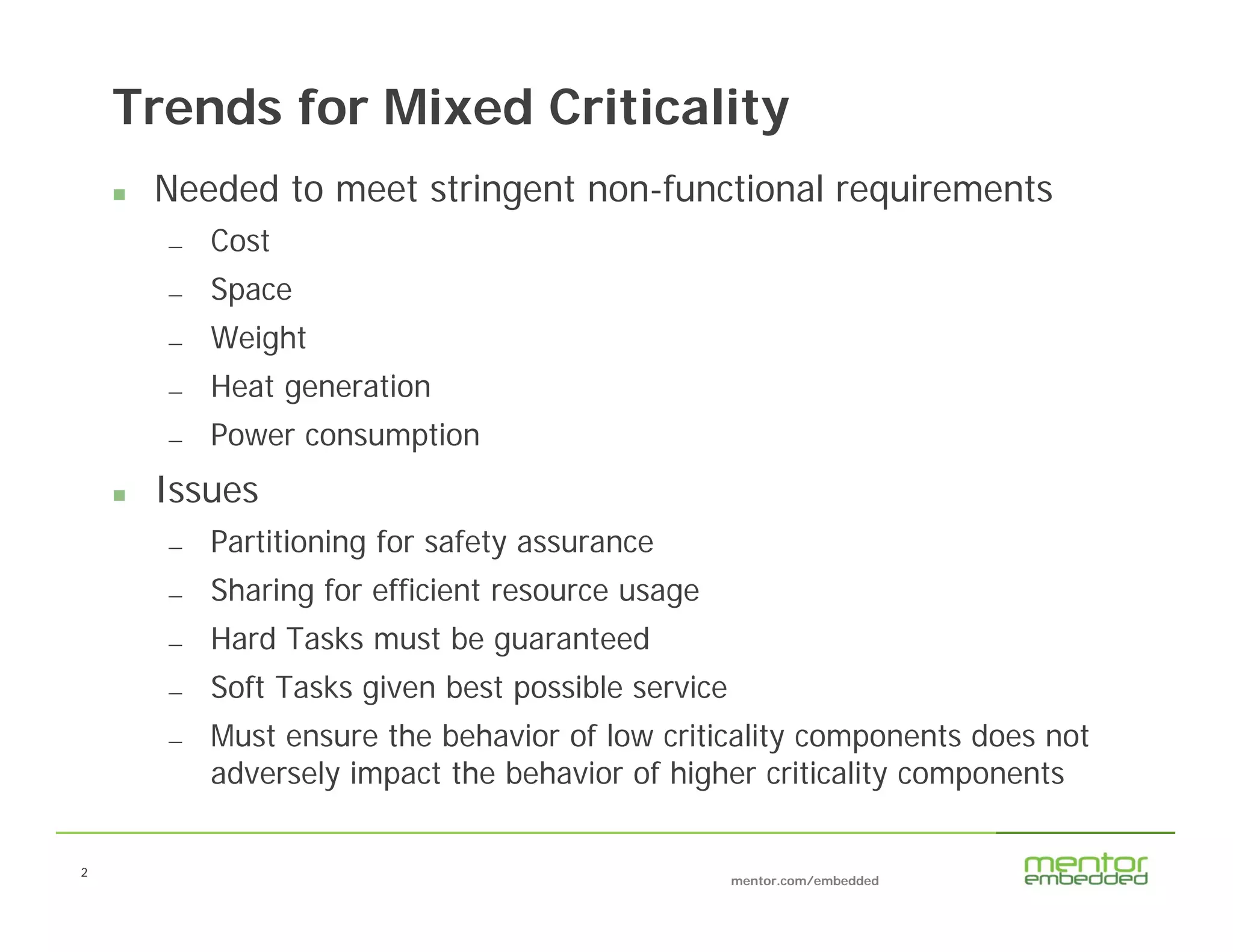
Trends for Mixed Criticality
 Needed to meet stringent non-functional requirements
— Cost
— Space
— Weight
— Heat generation
— Power consumption
 Issues
— Partitioning for safety assurance
— Sharing for efficient resource usage
— Hard Tasks must be guaranteed
— Soft Tasks given best possible service
— Must ensure the behavior of low criticality components does not
adversely impact the behavior of higher criticality components
3
mentor.com/embedded
3
Memory Protected
Memory
Protected
Memory
Protected
Memory
Protected
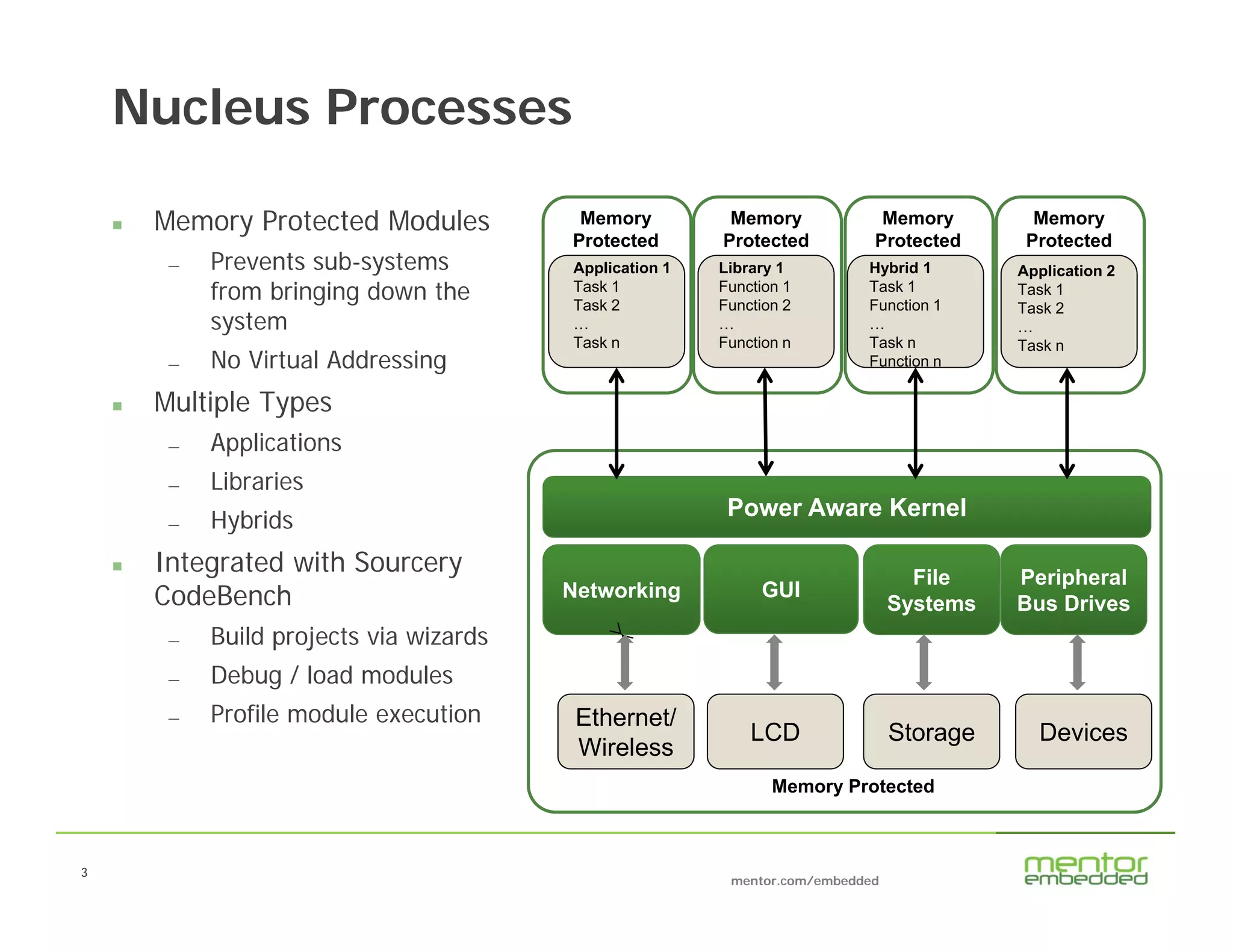
Nucleus Processes
 Memory Protected Modules
— Prevents sub-systems
from bringing down the
system
— No Virtual Addressing
 Multiple Types
— Applications
— Libraries
— Hybrids
 Integrated with Sourcery
CodeBench
— Build projects via wizards
— Debug / load modules
— Profile module execution
File
Systems
Peripheral
Bus Drives
GUINetworking
Power Aware Kernel
StorageLCD
Ethernet/
Wireless
Devices
Memory
Protected
Application 1
Task 1
Task 2
…
Task n
Library 1
Function 1
Function 2
…
Function n
Hybrid 1
Task 1
Function 1
…
Task n
Function n
Application 2
Task 1
Task 2
…
Task n
4
mentor.com/embedded
4
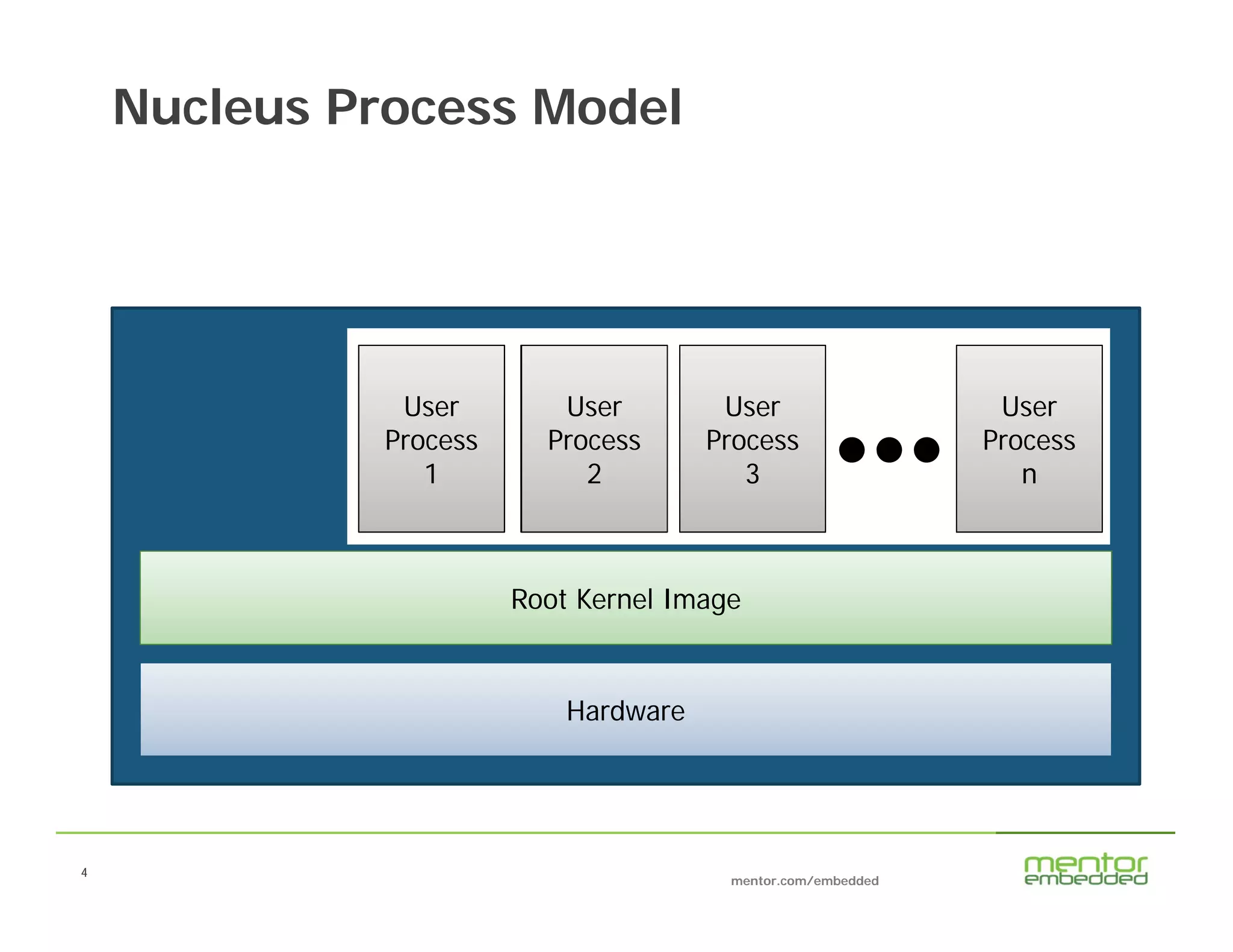
Nucleus Process Model
Root Kernel Image
User
Process
n
User
Process
2
User
Process
3
Hardware
User
Process
1
User
Process
2
5
mentor.com/embedded
5
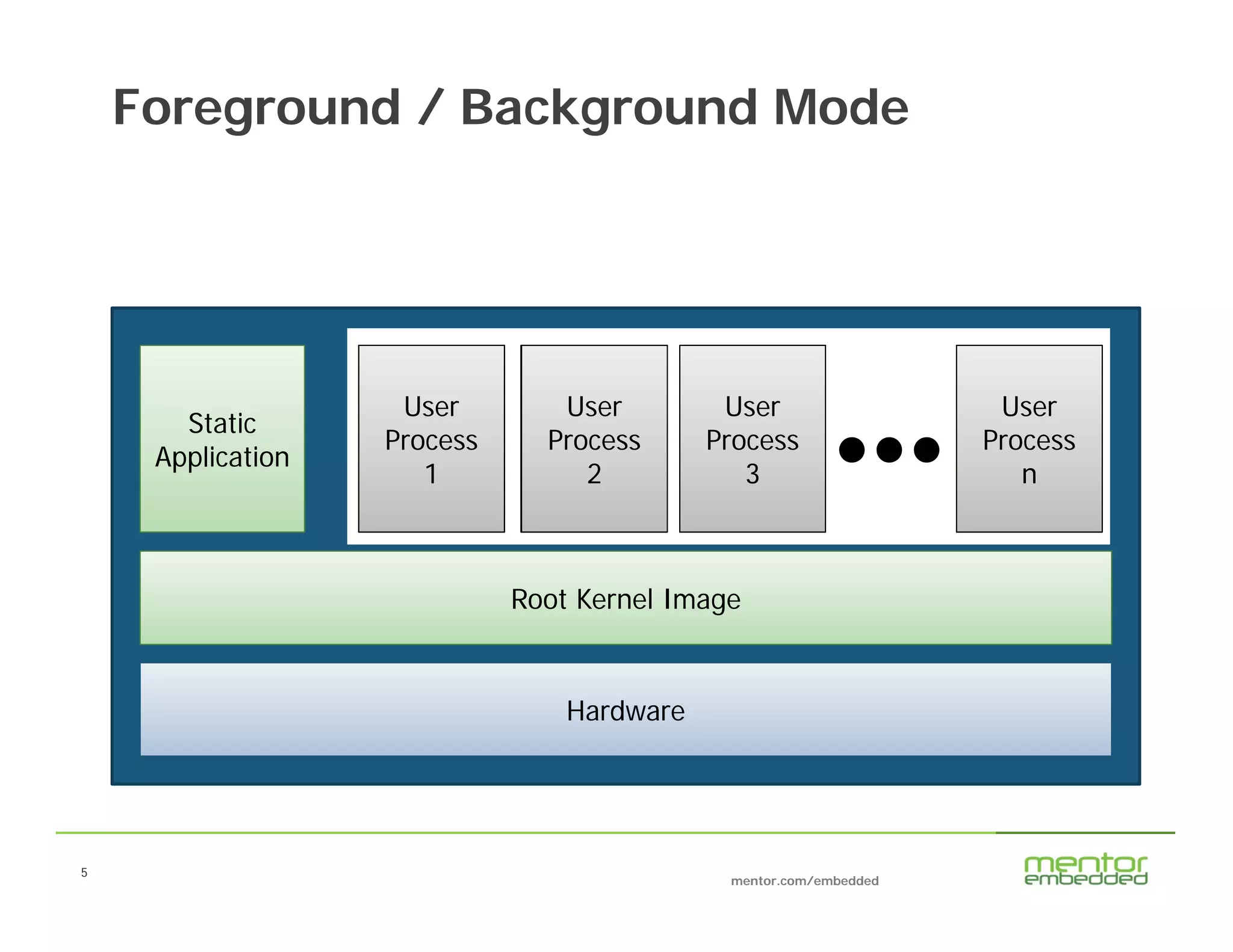
Foreground / Background Mode
Static
Application
Root Kernel Image
User
Process
n
User
Process
2
User
Process
3
Hardware
User
Process
1
User
Process
2
6
mentor.com/embedded
66
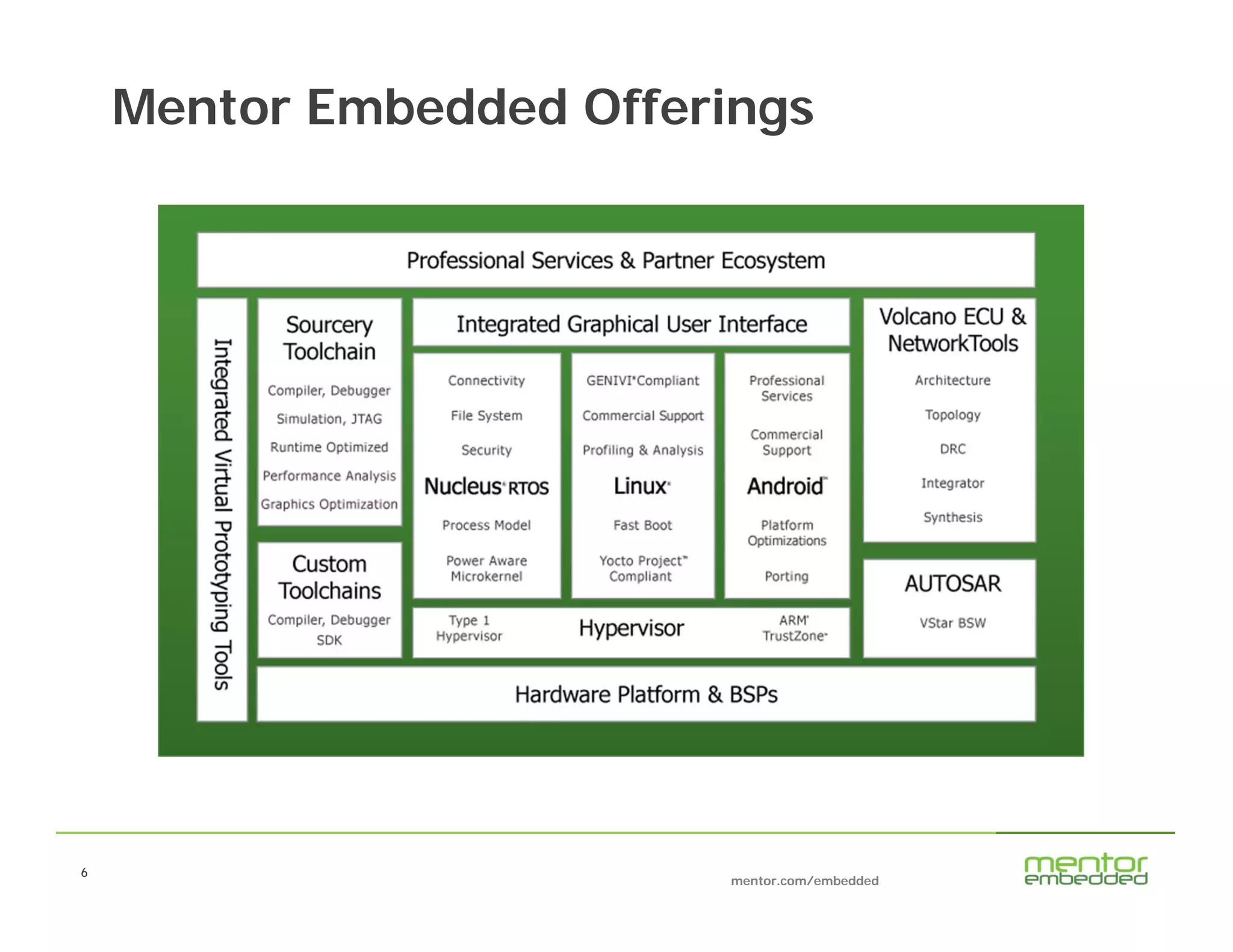
Mentor Embedded Offerings
7
mentor.com/embedded
77
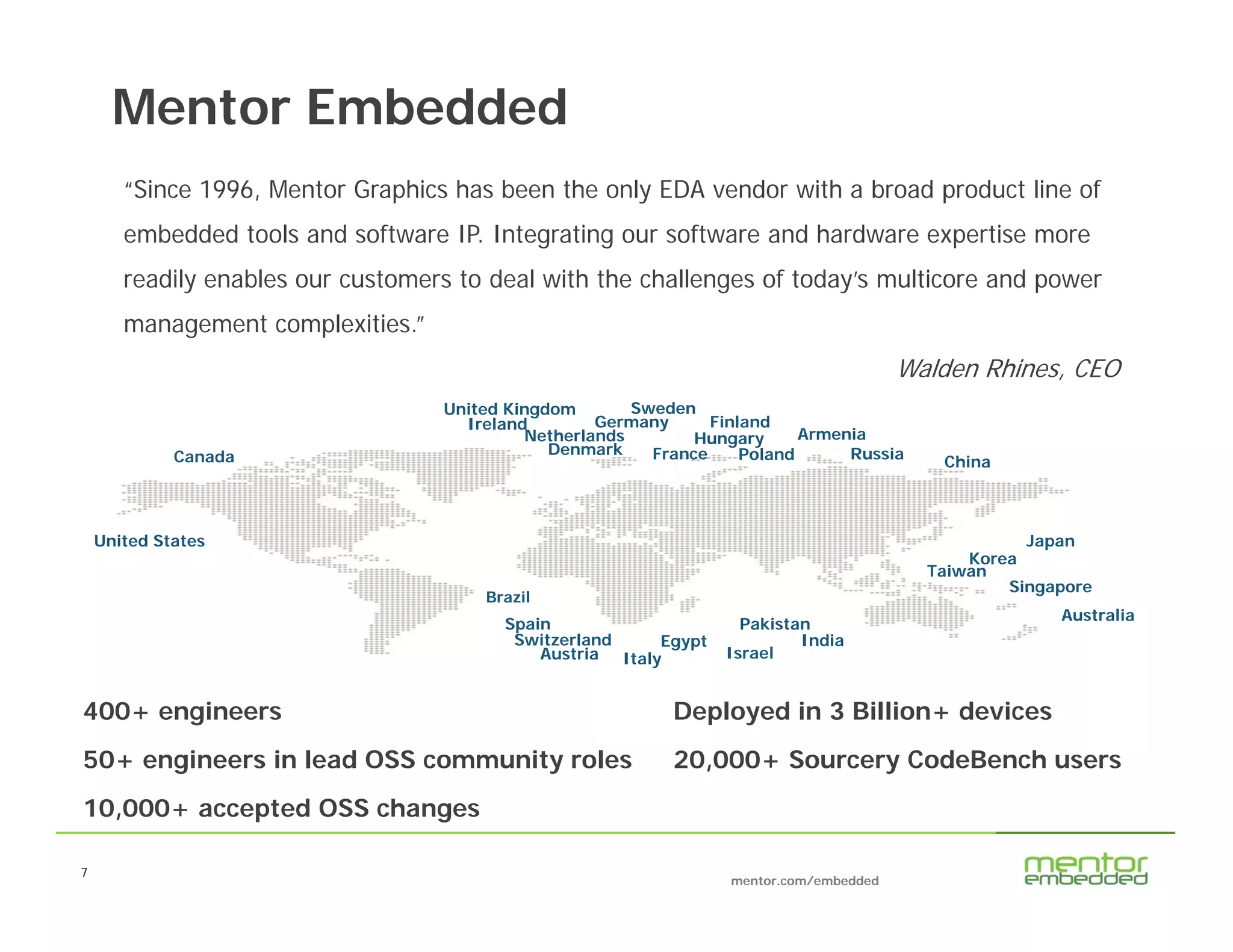
Mentor Embedded
United States
Canada
United Kingdom
Ireland
Netherlands
Germany
Denmark
Sweden
Finland
Poland
Armenia
Russia China
Japan
Korea
Taiwan
Australia
Singapore
India
Pakistan
Israel
Egypt
Hungary
ItalyAustria
Switzerland
Spain
France
Brazil
400+ engineers
50+ engineers in lead OSS community roles
10,000+ accepted OSS changes
Deployed in 3 Billion+ devices
20,000+ Sourcery CodeBench users
“Since 1996, Mentor Graphics has been the only EDA vendor with a broad product line of
embedded tools and software IP. Integrating our software and hardware expertise more
readily enables our customers to deal with the challenges of today’s multicore and power
management complexities.”
Walden Rhines, CEO

Getting Your Medical Device FDA Approved