Introduction to
OpenStack
Presented By: Azmat Hasan
Software Consultant
Knoldus Inc.
About Knoldus
Knoldus is a technology consulting firm with focus on modernizing the digital systems
at the pace your business demands.
DevOps
Functional. Reactive. Cloud Native
Our Agenda
01 Introduction
02 Benefits & Features
03 Architecture
04 Core Services
05 Demo
c
What
is OpenStack
OpenStack is a cloud operating system
that controls large pools of compute,
storage, and networking resources
throughout a datacenter, all managed
through a dashboard that gives
administrators control while empowering
their users to provision resources through
a web interface.

History
● OpenStack was created in 2010 as a joint open
source initiative between Rackspace Hosting and
NASA with the goal of enabling cloud computing
services to run on standard hardware.
● Maintained by The OpenStack Foundation
c
Benefits
of OpenStack
● Open source
● Orchestration
● Cloud Models
● Scalability
● Security
Dashboard
1
2
3
4
5
6
c
OpenStack
is not
● Hypervisor
● Single Project
● Product
1
2
3
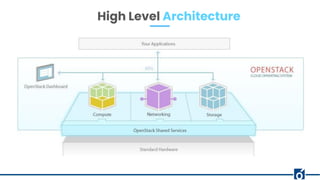
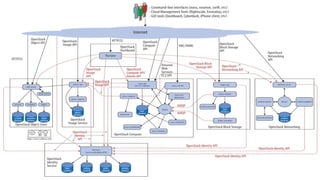
OpenStack Architecture
High Level Architecture
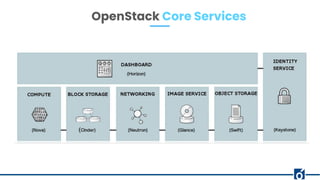
OpenStack Core Services
c
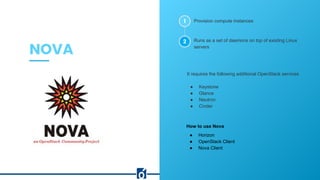
NOVA
● Provision compute instances
Runs as a set of daemons on top of existing Linux
servers
1
2
It requires the following additional OpenStack services
● Keystone
● Glance
● Neutron
● Cinder
How to use Nova
● Horizon
● OpenStack Client
● Nova Client
c
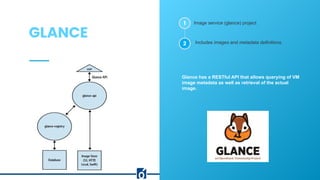
GLANCE
● Image service (glance) project
Includes images and metadata definitions.
1
2
Glance has a RESTful API that allows querying of VM
image metadata as well as retrieval of the actual
image.
c
NEUTRON
● Network connectivity as a service
Give cloud tenants an API to build rich networking
topologies, and configure advanced network
policies in the cloud.
1
2
● Horizon GUI support for:
○ Neutron L2 and L3 network and subnet
creation/deletion
○ Booting VMs on specific Neutron
networks.
c
CINDER
Cinder is the OpenStack Block Storage service for providing
volumes to Nova virtual machines, Ironic bare metal hosts,
containers and more.
Features of Cinder:
● Component based architecture: Quickly add new
behaviors
● Highly available: Scale to very serious workloads
● Fault-Tolerant: Isolated processes avoid cascading failures
● Recoverable: Failures should be easy to diagnose, debug,
and rectify
● Open Standards: Be a reference implementation for a
community-driven api
c
SWIFT
● Swift is a highly available, distributed, eventually
consistent object/blob store.
Organizations can use Swift to store lots of data
efficiently, safely, and cheaply.
1
2
c
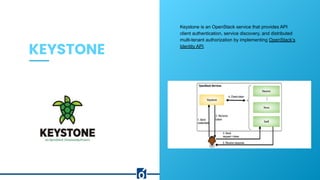
KEYSTONE
Keystone is an OpenStack service that provides API
client authentication, service discovery, and distributed
multi-tenant authorization by implementing OpenStack’s
Identity API.
c
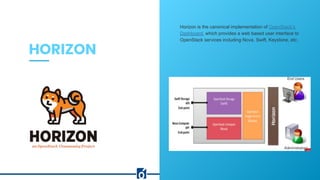
HORIZON
Horizon is the canonical implementation of OpenStack’s
Dashboard, which provides a web based user interface to
OpenStack services including Nova, Swift, Keystone, etc.
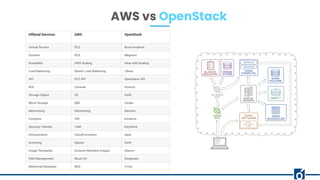
AWS vs OpenStack
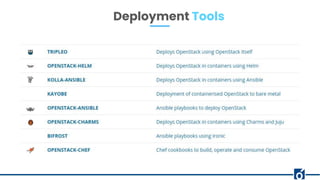
Deployment Tools
Demo
References:
1. https://docs.openstack.org
2. https://docs.openstack.org/horizon/latest/
3. https://docs.openstack.org/nova/latest/
4. https://docs.openstack.org/cinder/latest/
5. https://docs.openstack.org/swift/latest/
6. https://docs.openstack.org/neutron/latest/
7. https://docs.openstack.org/keystone/latest/
8. https://docs.openstack.org/glance/latest/
9. https://docs.openstack.org/arch-design/
Thank You!
@azmathasan92
@azmathasan92
/azmathasan92

Getting started with OpenStack

  • 1.
    Introduction to OpenStack Presented By:Azmat Hasan Software Consultant Knoldus Inc.
  • 2.
    About Knoldus Knoldus isa technology consulting firm with focus on modernizing the digital systems at the pace your business demands. DevOps Functional. Reactive. Cloud Native
  • 3.
    Our Agenda 01 Introduction 02Benefits & Features 03 Architecture 04 Core Services 05 Demo
  • 4.
    c What is OpenStack OpenStack isa cloud operating system that controls large pools of compute, storage, and networking resources throughout a datacenter, all managed through a dashboard that gives administrators control while empowering their users to provision resources through a web interface.  History ● OpenStack was created in 2010 as a joint open source initiative between Rackspace Hosting and NASA with the goal of enabling cloud computing services to run on standard hardware. ● Maintained by The OpenStack Foundation
  • 5.
    c Benefits of OpenStack ● Opensource ● Orchestration ● Cloud Models ● Scalability ● Security Dashboard 1 2 3 4 5 6
  • 6.
    c OpenStack is not ● Hypervisor ●Single Project ● Product 1 2 3
  • 8.
  • 9.
  • 11.
  • 12.
    c NOVA ● Provision computeinstances Runs as a set of daemons on top of existing Linux servers 1 2 It requires the following additional OpenStack services ● Keystone ● Glance ● Neutron ● Cinder How to use Nova ● Horizon ● OpenStack Client ● Nova Client
  • 13.
    c GLANCE ● Image service(glance) project Includes images and metadata definitions. 1 2 Glance has a RESTful API that allows querying of VM image metadata as well as retrieval of the actual image.
  • 14.
    c NEUTRON ● Network connectivityas a service Give cloud tenants an API to build rich networking topologies, and configure advanced network policies in the cloud. 1 2 ● Horizon GUI support for: ○ Neutron L2 and L3 network and subnet creation/deletion ○ Booting VMs on specific Neutron networks.
  • 15.
    c CINDER Cinder is theOpenStack Block Storage service for providing volumes to Nova virtual machines, Ironic bare metal hosts, containers and more. Features of Cinder: ● Component based architecture: Quickly add new behaviors ● Highly available: Scale to very serious workloads ● Fault-Tolerant: Isolated processes avoid cascading failures ● Recoverable: Failures should be easy to diagnose, debug, and rectify ● Open Standards: Be a reference implementation for a community-driven api
  • 16.
    c SWIFT ● Swift isa highly available, distributed, eventually consistent object/blob store. Organizations can use Swift to store lots of data efficiently, safely, and cheaply. 1 2
  • 17.
    c KEYSTONE Keystone is anOpenStack service that provides API client authentication, service discovery, and distributed multi-tenant authorization by implementing OpenStack’s Identity API.
  • 18.
    c HORIZON Horizon is thecanonical implementation of OpenStack’s Dashboard, which provides a web based user interface to OpenStack services including Nova, Swift, Keystone, etc.
  • 19.
  • 20.
  • 21.
  • 22.
    References: 1. https://docs.openstack.org 2. https://docs.openstack.org/horizon/latest/ 3.https://docs.openstack.org/nova/latest/ 4. https://docs.openstack.org/cinder/latest/ 5. https://docs.openstack.org/swift/latest/ 6. https://docs.openstack.org/neutron/latest/ 7. https://docs.openstack.org/keystone/latest/ 8. https://docs.openstack.org/glance/latest/ 9. https://docs.openstack.org/arch-design/
  • 23.