OPENSTACK
TECHNOLOGY101
Boston OpenStack Meet-Up
February 19, 2014
Theme: Open Source Cloud Computing
“The implications of a DYI
approach are profound,
organizations won’t see the
impact of their choice for months,
or years. There are a growing
number of IT organizations that
embrace risk in a new way and
reject the established approach
to enterprise software.”
Alessandro Perilli
Gartner
Agenda
• What is OpenStack?
• A brief history
• The OpenStack Foundation
• The OpenStack projects
• Compute: Nova, Glance
• Storage – Swift, Cinder
• Networks: Neutron
• Tools: Horizon, Ceilometer,
Heat, Oslo
• Security: Keystone

OpenStack looks more attractive than
most commercial solutions due to its
inherent capability to mix and match
different modules and deeply tweak the
resulting cloud infrastructure stack.
What is OpenStack?
Quick Start for the Terminally Busy…
●
●
●
●

●

Open Source Cloud software
Launched by NASA and Rackspace in 2010
Massively scalable
Managed by the OpenStack
Foundation
Rapidly taking over
the Cloud world!
What is OpenStack?
A Brief History

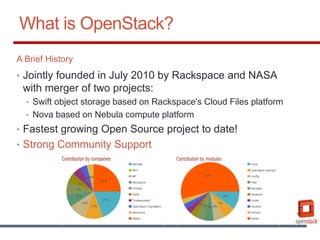
• Jointly founded in July 2010 by Rackspace and NASA

with merger of two projects:
• Swift object storage based on Rackspace's Cloud Files platform

• Nova based on Nebula compute platform

• Fastest growing Open Source project to date!
• Strong Community Support
OpenStack Project Release History
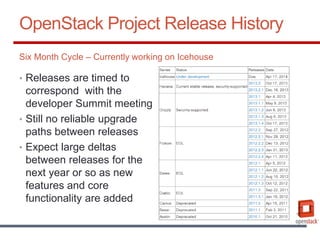
Six Month Cycle – Currently working on Icehouse

• Releases are timed to

correspond with the
developer Summit meeting
• Still no reliable upgrade
paths between releases
• Expect large deltas
between releases for the
next year or so as new
features and core
functionality are added
What is OpenStack?
An Open Source Foundation
What is OpenStack?
An Open Source Foundation

• Independent home for the OpenStack project
• Uses the Apache licensing model

• Serves developers, users, and the

entire ecosystem by providing:
• Shared resources
• Enable technology vendors targeting the platform

• Individual membership is free and accessible to anyone
What is OpenStack?
Open Source Cloud Platform
• Open source software for building private and public clouds
• Designed for flexibility and many different use cases
• Mix and match components
• Kit of administrative tools
• Enables multi-tenancy
• Quota for different users
• Users can be associated with multiple tenants

• Provides virtual machines (VM) on demand
• Self service provisioning
• Snapshotting capability
• Storage volumes
• Block storage for VM images
• Object storage for VM images and arbitrary files
OpenStack: The Open Source Cloud
Operating System
High Level Architecture - Havana
Horizon

Neutron
Glance

Nova

Cinder
Keystone
Adapted from : http://26a0ff8ca8ba32139f7d-db711c577a50b6bdc946ea71aaca027d.r97.cf1.rackcdn.com/openstack-conceptual-arch-folsom.jpg

Swift
What is OpenStack?
An Open Source Set of Cloud Technologies
• Compute (codenamed "Nova") provides virtual servers upon demand.
• Image (codenamed "Glance") provides a catalog and repository for virtual

•

•

•
•
•

disk images. These disk images are mostly commonly used in OpenStack
Compute.
Dashboard (codenamed "Horizon") provides a modular web-based user
interface for all the OpenStack services. Used to perform most operations
like launching an instance, assigning IP addresses and setting access
controls.
Identity (codenamed "Keystone") provides authentication and authorization
for all the OpenStack services. It also provides a service catalog of services
within a particular OpenStack cloud.
Object Store (codenamed "Swift") provides object storage. It allows you to
store or retrieve files (but not mount directories like a fileserver).
Block Storage (codenamed "Cinder") provides persistent block storage to
guest VMs.
Network (codenamed “Neutron") provides "network connectivity as a
service" between interface devices managed by other OpenStack services.
OpenStack Overall Architecture Compute
Horizon

Neutron
Glance

Nova

Cinder

Keystone

Swift
OpenStack Nova Compute - Introduction
• OpenStack Compute is a tool to orchestrate a cloud, including

running instances, managing networks, and controlling access
to the cloud through users and projects.
• The underlying open source project's name is Nova, and it
provides the software that can control an Infrastructure as a
Service (IaaS) cloud computing platform.
• It is similar in scope to Amazon EC2 and Rackspace Cloud
Servers.
• OpenStack Compute does not include any virtualization
software; rather it defines drivers that interact with underlying
virtualization mechanisms that run on a host operating system,
and exposes functionality over a web-based API.
OpenStack Nova Compute –
Message Queue
• Nova-compute is a worker daemon, which primarily

creates and terminates VMs via hypervisor API.
OpenStack Nova Compute – Supported
Hypervisors
• The process for selecting a hypervisor usually means

prioritizing and making decisions based on budget and
resource constraints as well as the list of supported features
and required technical specifications.
• Most development is done on KVM and Xen-based hypervisors

• With OpenStack Compute, you can orchestrate clouds using

multiple hypervisors in different zones.
• KVM - Kernel-based Virtual Machine. The virtual disk formats
that it supports it inherits from QEMU since it uses a modified
QEMU program to launch the virtual machine. The supported
formats include raw images, the qcow2, and VMware formats.
• LXC - Linux Containers (through libvirt), use to run Linux-based
virtual machines.
• QEMU - Quick EMUlator, generally only used for development
purposes.
OpenStack Nova Compute – Supported
Hypervisors
• UML - User Mode Linux, generally only used for development
•

•

•
•

•

purposes.
VMWare vSphere 4.1 update 1 and newer, runs VMWare-based Linux
and Windows images through a connection with a vCenter server or
directly with an ESXi host.
Xen - XenServer, Xen Cloud Platform (XCP), use to run Linux or
Windows virtual machines. You must install the nova-compute service
in a para-virtualized VM.
PowerVM - Server virtualization with IBM PowerVM, use to run AIX,
IBM i and Linux environments on IBM POWER technology.
Hyper-V - Server virtualization with Microsoft's Hyper-V, use to run
Windows, Linux, and FreeBSD virtual machines. Runs nova-compute
natively on the Windows virtualization platform.
Bare Metal - Not a hypervisor in the traditional sense, this driver
provisions physical hardware via pluggable sub-drivers (eg. PXE for
image deployment, and IPMI for power management).
OpenStack Overall Architecture – Image
Store
Horizon

• Glance
Neutron
Glance

Nova

Cinder

Keystone

Swift
OpenStack Glance – Introduction
• The Glance project provides services for discovering,

registering, and retrieving virtual machine images. Glance
has a RESTful API that allows querying of VM image
metadata as well as retrieval of the actual image
• Basically a database and some tools
• VM images made available through Glance can be stored
in a variety of locations:
• Simple filesystems like ZFS, LVM, etc.
• Direct attached storage
• Object-storage systems like OpenStack Swift project or S3

• Block storage like OpenStack Cinder project
OpenStack Glance – Reference
Architecture
OpenStack Overall Architecture Dashboard
Horizon

• Horizon
Neutron
Glance

Nova

Cinder

Keystone

Swift
OpenStack Horizon Dashboard –
Introduction
Horizon

Basic Operations

• Provides a baseline user

• From UI
• Login in to Horizon
• Specify parameters of VM in
“create VM” form
• Hit “create” button

interface for managing
OpenStack Services
• Stateless
• Error handling is delegated

to back-end
• Doesn’t support all API
functions
• Can use memcached or
database to store sessions
• Gets updated via nova-api
polling

• Under the Hood
• Form parameters are converted to
Post data
• “Create” request initiates HTTP
POST request to back-end
• To Keystone if authorization token

is not cached
• To nova-api if authorization token
has not yet expired
OpenStack Horizon Dashboard –
Reference Architecture

Horizon

End Users

Administrators
OpenStack Horizon Dashboard –
Example
OpenStack Overall Architecture - Security
Horizon

• Keystone
Neutron
Glance

Nova

Cinder

Keystone
Adapted from : http://26a0ff8ca8ba32139f7d-db711c577a50b6bdc946ea71aaca027d.r97.cf1.rackcdn.com/openstack-conceptual-arch-folsom.jpg

Swift
OpenStack Security - Keystone
Introduction
• Keystone provides a single point of integration for

OpenStack policy, catalog, token and authentication.
• Keystone handles API requests as well as providing configurable

catalog, policy, token and identity services.

• Communicates via OpenStack Identity API (version 2)
• Each Keystone function has a pluggable backend which

allows different ways to use the particular service.
• Standard backends include LDAP or SQL, as well as Key Value

Stores (KVS).

• Most commonly used in delegated authorization

deployments
• Most people will use this as a point of customization for
their current authentication services.
Keystone relationship to other OpenStack
Elements
OpenStack Overall Architecture - Storage
Horizon

• Swift and Cinder
Neutron
Glance

Nova

Cinder
Keystone

Swift
OpenStack Storage - Introduction
• Storage is found in many parts of the OpenStack stack,

and the differing types can cause confusion to even
experienced cloud Volumes block storage
engineers.
On-instance / ephemeral
Object Storage (Swift)
(Cinder)

Used for running Operating
System and scratch space

Used for adding additional
persistent storage to a virtual
machine (VM)

Used for storing virtual machine
images and data

Persists until VM is terminated

Persists until deleted

Persists until deleted

Access associated with a VM

Access associated with a VM

Available from anywhere

Implemented as a filesystem
underlying OpenStack Compute

Mounted via OpenStack BlockStorage controlled protocol (for
example, iSCSI)

REST API

Administrator configures size
setting, based on flavors

Sizings based on need

Easily scalable for future growth

Example: 10GB first disk,
30GB/core second disk

Example: 1TB "extra hard drive"

Example: 10s of TBs of dataset
storage
OpenStack Storage - Uses
• The two common use cases for providing object storage

in a compute cloud are:
• To provide users with a persistent

storage mechanism
• As a scalable, reliable data store
for virtual machine images
OpenStack Storage - Swift Key Features
OpenStack Storage - Swift Architecture

Disk
Server/Node

Zone
Multiple zones
make up a
Region
OpenStack Storage – Cinder Architecture
OpenStack Storage – Cinder Introduction
• Cinder separates out the persistent block storage functionality that was

previously part of OpenStack Compute into its own service.
• The OpenStack Block Storage API allows for manipulation of volumes,
volume types (similar to compute flavors) and volume snapshots.
• cinder-api accepts API requests and routes them to cinder-volume for action.
• cinder-volume acts upon the requests by reading or writing to the Cinder database

to maintain state, interacting with other processes (like cinder-scheduler) through a
message queue and directly upon block storage providing hardware or software.
• It can interact with a variety of storage providers through a driver architecture.
• Available drivers: IBM, SolidFire, NetApp, Nexenta, Zadara, linux iSCSI and other
storage providers.
• Much like nova-scheduler, the cinder-scheduler daemon picks the optimal block
storage provider node to create the volume on.

• Cinder deployments will also make use of a messaging queue to route

information between the cinder processes as well as a database to store
volume state.
• Like Neutron, Cinder will mainly interact with Nova, providing volumes for
its instances.
OpenStack Overall Architecture - Network
Horizon

• Neutron – Software Defined Networking
Neutron
Glance

Nova

Cinder

Keystone

Swift
OpenStack Network – Neutron
Introduction
• Neutron is an OpenStack project to provide "networking

as a service" between interface devices (e.g., vNICs)
managed by other OpenStack services (e.g., nova).
• Starting in the Folsom release, Neutron is a core and
supported part of the OpenStack platform
OpenStack Network - Neutron
Deployment
• Sample Deployment Model
OpenStack Network - Neutron
Architecture
• Plugin and Agent Summary
Icehouse Official Projects
• Integrated Projects (Icehouse release)
• OpenStack Compute (nova): https://launchpad.net/nova
• OpenStack Object Storage (swift): https://launchpad.net/swift
• OpenStack Image Service (glance): https://launchpad.net/glance
• OpenStack Identity (keystone): https://launchpad.net/keystone
• OpenStack Dashboard (horizon): https://launchpad.net/horizon
• OpenStack Networking (Neutron): https://launchpad.net/Neutron
• OpenStack Block Storage service (cinder):
https://launchpad.net/cinder
• Ceilometer: https://launchpad.net/ceilometer
• Heat: https://launchpad.net/heat
OpenStack Icehouse Roadmap Highlights
• Database Service (Trove) - Scalable and reliable Cloud

•
•
•
•

Database as a Service provisioning functionality for both
relational and non-relational database engines
Bare Metal (Ironic) - Provides an API for management and
provisioning of physical machines.
Queue Service (Marconi) - message queueing API and
service for distributed application messaging
Data Processing (Savannah) – Hadoop on OpenStack
Icehouse Release Features and
Status: http://wiki.openstack.org/releasestatus/
Additional Resources
• http://www.openstack.org/ - Main site
• http://docs.openstack.org/trunk/openstack•

•
•

•

•
•

compute/admin/content/ch_getting-started-with-openstack.html
http://docs.openstack.org/trunk/openstack-compute/admin/bkcompute-adminguide-trunk.pdf - Current OpenStack computer
Administration Manual – Dec 18, 2012
http://www.openstack.org/software/start/ - How To Get Started
With OpenStack
https://github.com/mseknibilel/OpenStack-Folsom-Installguide/blob/master/OpenStack_Folsom_Install_Guide_WebVers
ion.rst - OpenStack Folsom Install Guide
http://www.packtpub.com/openstack-cloud-computingcookbook/book OpenStack Cloud Computing Cookbook
http://www.openstack.org/blog/tag/training/ - Tag: Training
OPENSTACK
ICEHOUSE 101
Questions?

OpenStack 101 update

  • 1.
  • 2.
    Theme: Open SourceCloud Computing “The implications of a DYI approach are profound, organizations won’t see the impact of their choice for months, or years. There are a growing number of IT organizations that embrace risk in a new way and reject the established approach to enterprise software.” Alessandro Perilli Gartner
  • 3.
    Agenda • What isOpenStack? • A brief history • The OpenStack Foundation • The OpenStack projects • Compute: Nova, Glance • Storage – Swift, Cinder • Networks: Neutron • Tools: Horizon, Ceilometer, Heat, Oslo • Security: Keystone OpenStack looks more attractive than most commercial solutions due to its inherent capability to mix and match different modules and deeply tweak the resulting cloud infrastructure stack.
  • 4.
    What is OpenStack? QuickStart for the Terminally Busy… ● ● ● ● ● Open Source Cloud software Launched by NASA and Rackspace in 2010 Massively scalable Managed by the OpenStack Foundation Rapidly taking over the Cloud world!
  • 5.
    What is OpenStack? ABrief History • Jointly founded in July 2010 by Rackspace and NASA with merger of two projects: • Swift object storage based on Rackspace's Cloud Files platform • Nova based on Nebula compute platform • Fastest growing Open Source project to date! • Strong Community Support
  • 6.
    OpenStack Project ReleaseHistory Six Month Cycle – Currently working on Icehouse • Releases are timed to correspond with the developer Summit meeting • Still no reliable upgrade paths between releases • Expect large deltas between releases for the next year or so as new features and core functionality are added
  • 7.
    What is OpenStack? AnOpen Source Foundation
  • 8.
    What is OpenStack? AnOpen Source Foundation • Independent home for the OpenStack project • Uses the Apache licensing model • Serves developers, users, and the entire ecosystem by providing: • Shared resources • Enable technology vendors targeting the platform • Individual membership is free and accessible to anyone
  • 9.
    What is OpenStack? OpenSource Cloud Platform • Open source software for building private and public clouds • Designed for flexibility and many different use cases • Mix and match components • Kit of administrative tools • Enables multi-tenancy • Quota for different users • Users can be associated with multiple tenants • Provides virtual machines (VM) on demand • Self service provisioning • Snapshotting capability • Storage volumes • Block storage for VM images • Object storage for VM images and arbitrary files
  • 10.
    OpenStack: The OpenSource Cloud Operating System
  • 11.
    High Level Architecture- Havana Horizon Neutron Glance Nova Cinder Keystone Adapted from : http://26a0ff8ca8ba32139f7d-db711c577a50b6bdc946ea71aaca027d.r97.cf1.rackcdn.com/openstack-conceptual-arch-folsom.jpg Swift
  • 12.
    What is OpenStack? AnOpen Source Set of Cloud Technologies • Compute (codenamed "Nova") provides virtual servers upon demand. • Image (codenamed "Glance") provides a catalog and repository for virtual • • • • • disk images. These disk images are mostly commonly used in OpenStack Compute. Dashboard (codenamed "Horizon") provides a modular web-based user interface for all the OpenStack services. Used to perform most operations like launching an instance, assigning IP addresses and setting access controls. Identity (codenamed "Keystone") provides authentication and authorization for all the OpenStack services. It also provides a service catalog of services within a particular OpenStack cloud. Object Store (codenamed "Swift") provides object storage. It allows you to store or retrieve files (but not mount directories like a fileserver). Block Storage (codenamed "Cinder") provides persistent block storage to guest VMs. Network (codenamed “Neutron") provides "network connectivity as a service" between interface devices managed by other OpenStack services.
  • 13.
    OpenStack Overall ArchitectureCompute Horizon Neutron Glance Nova Cinder Keystone Swift
  • 14.
    OpenStack Nova Compute- Introduction • OpenStack Compute is a tool to orchestrate a cloud, including running instances, managing networks, and controlling access to the cloud through users and projects. • The underlying open source project's name is Nova, and it provides the software that can control an Infrastructure as a Service (IaaS) cloud computing platform. • It is similar in scope to Amazon EC2 and Rackspace Cloud Servers. • OpenStack Compute does not include any virtualization software; rather it defines drivers that interact with underlying virtualization mechanisms that run on a host operating system, and exposes functionality over a web-based API.
  • 15.
    OpenStack Nova Compute– Message Queue • Nova-compute is a worker daemon, which primarily creates and terminates VMs via hypervisor API.
  • 16.
    OpenStack Nova Compute– Supported Hypervisors • The process for selecting a hypervisor usually means prioritizing and making decisions based on budget and resource constraints as well as the list of supported features and required technical specifications. • Most development is done on KVM and Xen-based hypervisors • With OpenStack Compute, you can orchestrate clouds using multiple hypervisors in different zones. • KVM - Kernel-based Virtual Machine. The virtual disk formats that it supports it inherits from QEMU since it uses a modified QEMU program to launch the virtual machine. The supported formats include raw images, the qcow2, and VMware formats. • LXC - Linux Containers (through libvirt), use to run Linux-based virtual machines. • QEMU - Quick EMUlator, generally only used for development purposes.
  • 17.
    OpenStack Nova Compute– Supported Hypervisors • UML - User Mode Linux, generally only used for development • • • • • purposes. VMWare vSphere 4.1 update 1 and newer, runs VMWare-based Linux and Windows images through a connection with a vCenter server or directly with an ESXi host. Xen - XenServer, Xen Cloud Platform (XCP), use to run Linux or Windows virtual machines. You must install the nova-compute service in a para-virtualized VM. PowerVM - Server virtualization with IBM PowerVM, use to run AIX, IBM i and Linux environments on IBM POWER technology. Hyper-V - Server virtualization with Microsoft's Hyper-V, use to run Windows, Linux, and FreeBSD virtual machines. Runs nova-compute natively on the Windows virtualization platform. Bare Metal - Not a hypervisor in the traditional sense, this driver provisions physical hardware via pluggable sub-drivers (eg. PXE for image deployment, and IPMI for power management).
  • 18.
    OpenStack Overall Architecture– Image Store Horizon • Glance Neutron Glance Nova Cinder Keystone Swift
  • 19.
    OpenStack Glance –Introduction • The Glance project provides services for discovering, registering, and retrieving virtual machine images. Glance has a RESTful API that allows querying of VM image metadata as well as retrieval of the actual image • Basically a database and some tools • VM images made available through Glance can be stored in a variety of locations: • Simple filesystems like ZFS, LVM, etc. • Direct attached storage • Object-storage systems like OpenStack Swift project or S3 • Block storage like OpenStack Cinder project
  • 20.
    OpenStack Glance –Reference Architecture
  • 21.
    OpenStack Overall ArchitectureDashboard Horizon • Horizon Neutron Glance Nova Cinder Keystone Swift
  • 22.
    OpenStack Horizon Dashboard– Introduction Horizon Basic Operations • Provides a baseline user • From UI • Login in to Horizon • Specify parameters of VM in “create VM” form • Hit “create” button interface for managing OpenStack Services • Stateless • Error handling is delegated to back-end • Doesn’t support all API functions • Can use memcached or database to store sessions • Gets updated via nova-api polling • Under the Hood • Form parameters are converted to Post data • “Create” request initiates HTTP POST request to back-end • To Keystone if authorization token is not cached • To nova-api if authorization token has not yet expired
  • 23.
    OpenStack Horizon Dashboard– Reference Architecture Horizon End Users Administrators
  • 24.
  • 25.
    OpenStack Overall Architecture- Security Horizon • Keystone Neutron Glance Nova Cinder Keystone Adapted from : http://26a0ff8ca8ba32139f7d-db711c577a50b6bdc946ea71aaca027d.r97.cf1.rackcdn.com/openstack-conceptual-arch-folsom.jpg Swift
  • 26.
    OpenStack Security -Keystone Introduction • Keystone provides a single point of integration for OpenStack policy, catalog, token and authentication. • Keystone handles API requests as well as providing configurable catalog, policy, token and identity services. • Communicates via OpenStack Identity API (version 2) • Each Keystone function has a pluggable backend which allows different ways to use the particular service. • Standard backends include LDAP or SQL, as well as Key Value Stores (KVS). • Most commonly used in delegated authorization deployments • Most people will use this as a point of customization for their current authentication services.
  • 27.
    Keystone relationship toother OpenStack Elements
  • 28.
    OpenStack Overall Architecture- Storage Horizon • Swift and Cinder Neutron Glance Nova Cinder Keystone Swift
  • 29.
    OpenStack Storage -Introduction • Storage is found in many parts of the OpenStack stack, and the differing types can cause confusion to even experienced cloud Volumes block storage engineers. On-instance / ephemeral Object Storage (Swift) (Cinder) Used for running Operating System and scratch space Used for adding additional persistent storage to a virtual machine (VM) Used for storing virtual machine images and data Persists until VM is terminated Persists until deleted Persists until deleted Access associated with a VM Access associated with a VM Available from anywhere Implemented as a filesystem underlying OpenStack Compute Mounted via OpenStack BlockStorage controlled protocol (for example, iSCSI) REST API Administrator configures size setting, based on flavors Sizings based on need Easily scalable for future growth Example: 10GB first disk, 30GB/core second disk Example: 1TB "extra hard drive" Example: 10s of TBs of dataset storage
  • 30.
    OpenStack Storage -Uses • The two common use cases for providing object storage in a compute cloud are: • To provide users with a persistent storage mechanism • As a scalable, reliable data store for virtual machine images
  • 31.
    OpenStack Storage -Swift Key Features
  • 32.
    OpenStack Storage -Swift Architecture Disk Server/Node Zone Multiple zones make up a Region
  • 33.
    OpenStack Storage –Cinder Architecture
  • 34.
    OpenStack Storage –Cinder Introduction • Cinder separates out the persistent block storage functionality that was previously part of OpenStack Compute into its own service. • The OpenStack Block Storage API allows for manipulation of volumes, volume types (similar to compute flavors) and volume snapshots. • cinder-api accepts API requests and routes them to cinder-volume for action. • cinder-volume acts upon the requests by reading or writing to the Cinder database to maintain state, interacting with other processes (like cinder-scheduler) through a message queue and directly upon block storage providing hardware or software. • It can interact with a variety of storage providers through a driver architecture. • Available drivers: IBM, SolidFire, NetApp, Nexenta, Zadara, linux iSCSI and other storage providers. • Much like nova-scheduler, the cinder-scheduler daemon picks the optimal block storage provider node to create the volume on. • Cinder deployments will also make use of a messaging queue to route information between the cinder processes as well as a database to store volume state. • Like Neutron, Cinder will mainly interact with Nova, providing volumes for its instances.
  • 35.
    OpenStack Overall Architecture- Network Horizon • Neutron – Software Defined Networking Neutron Glance Nova Cinder Keystone Swift
  • 36.
    OpenStack Network –Neutron Introduction • Neutron is an OpenStack project to provide "networking as a service" between interface devices (e.g., vNICs) managed by other OpenStack services (e.g., nova). • Starting in the Folsom release, Neutron is a core and supported part of the OpenStack platform
  • 37.
    OpenStack Network -Neutron Deployment • Sample Deployment Model
  • 38.
    OpenStack Network -Neutron Architecture • Plugin and Agent Summary
  • 39.
    Icehouse Official Projects •Integrated Projects (Icehouse release) • OpenStack Compute (nova): https://launchpad.net/nova • OpenStack Object Storage (swift): https://launchpad.net/swift • OpenStack Image Service (glance): https://launchpad.net/glance • OpenStack Identity (keystone): https://launchpad.net/keystone • OpenStack Dashboard (horizon): https://launchpad.net/horizon • OpenStack Networking (Neutron): https://launchpad.net/Neutron • OpenStack Block Storage service (cinder): https://launchpad.net/cinder • Ceilometer: https://launchpad.net/ceilometer • Heat: https://launchpad.net/heat
  • 40.
    OpenStack Icehouse RoadmapHighlights • Database Service (Trove) - Scalable and reliable Cloud • • • • Database as a Service provisioning functionality for both relational and non-relational database engines Bare Metal (Ironic) - Provides an API for management and provisioning of physical machines. Queue Service (Marconi) - message queueing API and service for distributed application messaging Data Processing (Savannah) – Hadoop on OpenStack Icehouse Release Features and Status: http://wiki.openstack.org/releasestatus/
  • 41.
    Additional Resources • http://www.openstack.org/- Main site • http://docs.openstack.org/trunk/openstack• • • • • • compute/admin/content/ch_getting-started-with-openstack.html http://docs.openstack.org/trunk/openstack-compute/admin/bkcompute-adminguide-trunk.pdf - Current OpenStack computer Administration Manual – Dec 18, 2012 http://www.openstack.org/software/start/ - How To Get Started With OpenStack https://github.com/mseknibilel/OpenStack-Folsom-Installguide/blob/master/OpenStack_Folsom_Install_Guide_WebVers ion.rst - OpenStack Folsom Install Guide http://www.packtpub.com/openstack-cloud-computingcookbook/book OpenStack Cloud Computing Cookbook http://www.openstack.org/blog/tag/training/ - Tag: Training
  • 42.