OpenStack: Infrastructure as a Service
Denis M. Cavalcante
Outline
- Virtualization
- Definition
- Types of virtualization
- CPU Virtualization techniques
- Cloud computing
- Definition
- Essential characteristics
- Service Models
- Deployment Models
- OpenStack
- Definition
- Project characteristics / Community
- Main projects / Logical architecture / Conceptual Architecture;
- Computing as a Service (OpenStack-Nova)
- Nova / Launch instance
- Deployment architecture / tools / API - Examples
- OpenStack video Demo
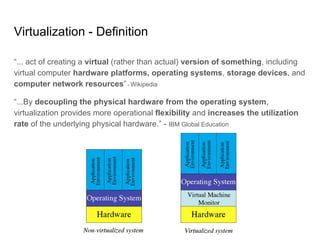
Virtualization - Definition
“... act of creating a virtual (rather than actual) version of something, including
virtual computer hardware platforms, operating systems, storage devices, and
computer network resources” - Wikipedia
“...By decoupling the physical hardware from the operating system,
virtualization provides more operational flexibility and increases the utilization
rate of the underlying physical hardware.” - IBM Global Education
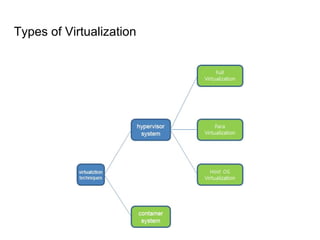
Types of Virtualization
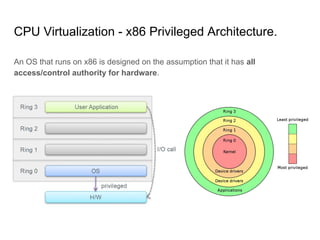
CPU Virtualization - x86 Privileged Architecture.
An OS that runs on x86 is designed on the assumption that it has all
access/control authority for hardware.
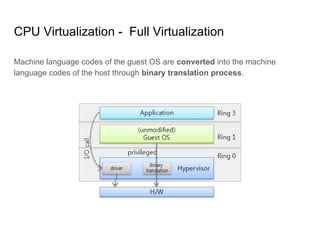
CPU Virtualization - Full Virtualization
Machine language codes of the guest OS are converted into the machine
language codes of the host through binary translation process.
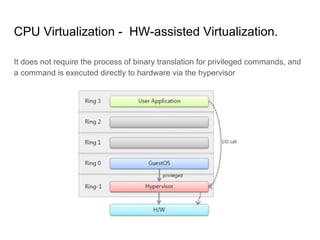
CPU Virtualization - HW-assisted Virtualization.
It does not require the process of binary translation for privileged commands, and
a command is executed directly to hardware via the hypervisor
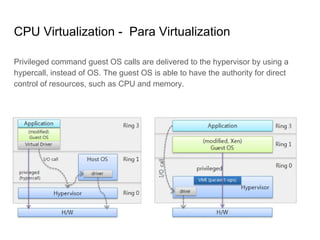
CPU Virtualization - Para Virtualization
Privileged command guest OS calls are delivered to the hypervisor by using a
hypercall, instead of OS. The guest OS is able to have the authority for direct
control of resources, such as CPU and memory.
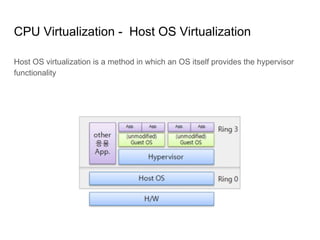
CPU Virtualization - Host OS Virtualization
Host OS virtualization is a method in which an OS itself provides the hypervisor
functionality
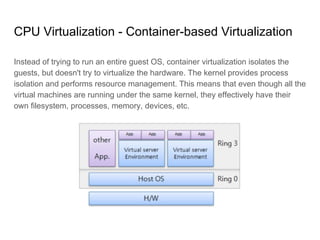
CPU Virtualization - Container-based Virtualization
Instead of trying to run an entire guest OS, container virtualization isolates the
guests, but doesn't try to virtualize the hardware. The kernel provides process
isolation and performs resource management. This means that even though all the
virtual machines are running under the same kernel, they effectively have their
own filesystem, processes, memory, devices, etc.
Cloud Computing - Definition
“Cloud computing is a model for enabling ubiquitous, convenient, on-demand
network access to a shared pool of configurable computing resources (e.g.,
networks, servers, storage, applications, and services) that can be rapidly
provisioned and released with minimal management effort or service
provider interaction.”
The NIST Definition of Cloud Computing
Cloud Computing - Essential characteristics
- On-demand self-service.
- A consumer can unilaterally provision computing capabilities as needed automatically without
requiring human interaction...
- Broad network access.
- Capabilities are available over the network and accessed through standard mechanisms that
promote use by heterogeneous thin or thick client platforms….
- Resource pooling.
- The provider’s computing resources are pooled to serve multiple consumers using a multi-
tenant model and location independence...
- Rapid elasticity.
- Capabilities can be elastically provisioned and released…
- Measured service.
- Resource usage can be monitored, controlled, and reported, providing transparency for both
the provider and consumer of the utilized service.
Cloud Computing - Service Models
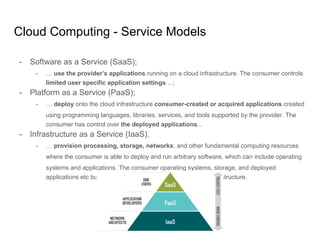
- Software as a Service (SaaS);
- … use the provider’s applications running on a cloud infrastructure. The consumer controls
limited user specific application settings ...;
- Platform as a Service (PaaS);
- … deploy onto the cloud infrastructure consumer-created or acquired applications created
using programming languages, libraries, services, and tools supported by the provider. The
consumer has control over the deployed applications...
- Infrastructure as a Service (IaaS).
- … provision processing, storage, networks, and other fundamental computing resources
where the consumer is able to deploy and run arbitrary software, which can include operating
systems and applications. The consumer operating systems, storage, and deployed
applications etc but it does not control the underlying cloud infrastructure.
Cloud Computing - Deployment Models
- Private cloud
- It may be owned, managed, and operated by the organization, a third party, or some
combination of them, and it may exist on or off premises.
- Community cloud.
- Exclusive use by a specific community of consumers from organizations that have shared
concerns.
- Public cloud.
- Open use by the general public. It may be owned, managed, and operated by a business,
academic, or government organization, or some combination of them. It exists on the
premises of the cloud provider.
- Hybrid cloud.
- Composition of two or more distinct cloud infrastructures (private, community, or public) as
unique entities, but are bound together by standardized or proprietary technology that
enables data and application portability
OpenStack - Definition
“Open source software for creating private and public clouds”.
“OpenStack software controls large pools of compute, storage, and networking
resources throughout a datacenter, managed through a dashboard or via the
OpenStack API. OpenStack works with popular enterprise and open source
technologies making it ideal for heterogeneous infrastructure.”
OpenStack - Project Characteristics
- OpenStack began in 2010 as a joint open-source project of Rackspace
Hosting and NASA;
- It is managed by the OpenStack Foundation, a non-profit corporate entity to
promote OpenStack software and its community;
- More than 500 companies have joined the project;
- Six-month time-based for release cycle and summit;
- Written in Python;
- License: Apache License 2.0;
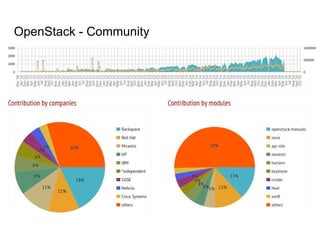
OpenStack - Community
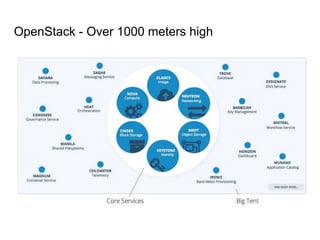
OpenStack - Over 1000 meters high
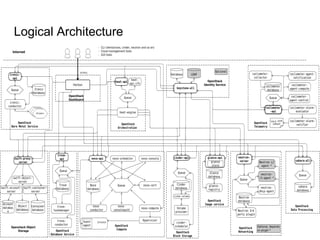
Logical Architecture
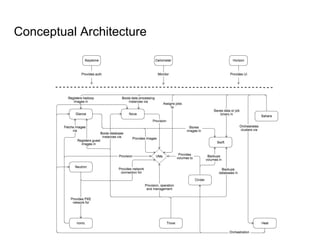
Conceptual Architecture
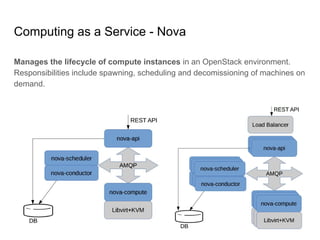
Computing as a Service - Nova
Manages the lifecycle of compute instances in an OpenStack environment.
Responsibilities include spawning, scheduling and decomissioning of machines on
demand.
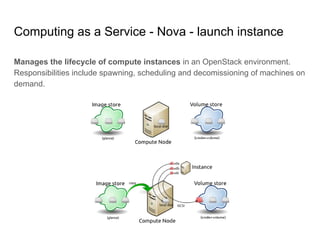
Computing as a Service - Nova - launch instance
Manages the lifecycle of compute instances in an OpenStack environment.
Responsibilities include spawning, scheduling and decomissioning of machines on
demand.
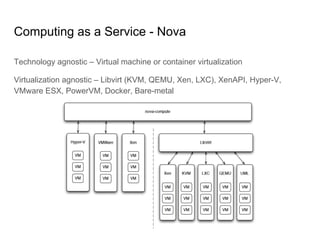
Computing as a Service - Nova
Technology agnostic – Virtual machine or container virtualization
Virtualization agnostic – Libvirt (KVM, QEMU, Xen, LXC), XenAPI, Hyper-V,
VMware ESX, PowerVM, Docker, Bare-metal
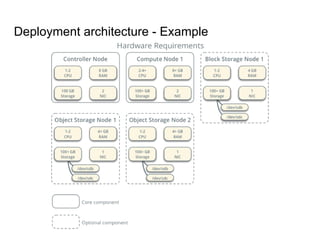
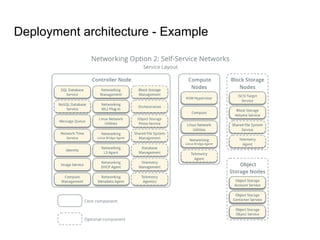
Deployment architecture - Example
Deployment tool - Examples
- Automatic deployment used by community contributors:
- Devstack: http://docs.openstack.org/developer/devstack/
- Manual deployment (Mitaka):
- Ubuntu: http://docs.openstack.org/mitaka/install-guide-ubuntu/index.html
- Redhat: http://docs.openstack.org/mitaka/install-guide-rdo/
- Suse: http://docs.openstack.org/mitaka/install-guide-obs/
- Enterprise Deployment:
- Distributions: Mirantis, RDO, SuSe Cloud, Ubuntu autopilot...
OpenStack Python API Example
import os
from novaclient import client
username = os.environ['OS_USERNAME']
api_key = os.environ['OS_PASSWORD']
auth_url = os.environ['OS_AUTH_URL']
project_id = os.environ['OS_TENANT_NAME']
nova = client.Client("2", username, api_key, project_id, auth_url)
nova.images.list()
[<Image: cirros-0.3.4-x86_64-uec>, <Image: cirros-0.3.4-x86_64-uec-ramdisk>, <Image: cirros-0.3.4-x86_64-uec-kernel>]
nova.flavors.list()
[<Flavor: m1.tiny>, <Flavor: m1.small>, <Flavor: m1.medium>, <Flavor: m1.large>, <Flavor: m1.nano>, <Flavor: m1.xlarge>]
image = nova.images.find(name="cirros-0.3.4-x86_64-uec")
flavor = nova.flavors.find(name="m1.tiny")
flavor.ram
512
instance = nova.servers.create(name="test", image=image, flavor=flavor)
nova.servers.list()
[<Server: test>]
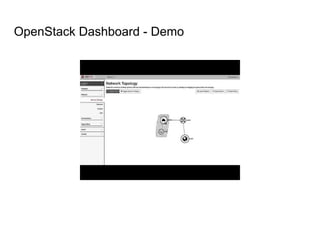
OpenStack Dashboard - Demo
Contact me
dencaval@gmail.com
denis.cavalcante@lsbd.ufc.br
https://www.linkedin.com/in/deniscavalcante
References
- http://nvlpubs.nist.gov/nistpubs/Legacy/SP/nistspecialpublication800-145.pdf
- http://nvlpubs.nist.gov/nistpubs/Legacy/SP/nistspecialpublication800-146.pdf
- https://en.wikipedia.org/wiki/Cloud_computing
- https://en.wikipedia.org/wiki/Cloud_computing#Infrastructure_as_a_service_.28IaaS.29
- https://www.openstack.org/
- http://blog.rackspace.com/architecting-vmware-vsphere-for-openstack/
- https://varchitectthoughts.files.wordpress.com/2013/06/screen-shot-2013-06-24-at-1-19-41-pm.png
- http://www.cmg.org/publications/measureit/2007-2/mit46/measureit-issue-5-11-the-performance-implications-of-container-based-os-
virtualization/#
- http://referaat.cs.utwente.nl/conference/21/paper/7449/virtualization-andcontainerization-of-application-infrastructure-a-comparison.pdf
- Container?http://i.stack.imgur.com/a5Neb.png
- https://github.com/opencontainers/runc
- http://broadcast.rackspace.com/hosting_knowledge/whitepapers/Revolution_Not_Evolution-Whitepaper.pdf
- https://www.vmware.com/files/pdf/VMware_paravirtualization.pdf
- http://www.cubrid.org/blog/dev-platform/x86-server-virtualization-technology/
- https://goldmann.pl/blog/2014/09/11/resource-management-in-docker/
- http://docs.openstack.org/mitaka/install-guide-ubuntu/overview.html
- http://www.linux-kvm.org/images/7/7b/Kvm-forum-2013-openstack.pdf
- http://cs.gmu.edu/~menasce/papers/menasce-cmg05-virtualization.pdf
- https://fawzi.wordpress.com/2009/05/24/virtualization-and-protection-rings-welcome-to-ring-1-part-i/
- http://www-07.ibm.com/solutions/in/education/download/Virtualization%20in%20Education.pdf
- https://fawzi.wordpress.com/2009/05/24/virtualization-and-protection-rings-welcome-to-ring-1-part-i/
- http://www.gta.ufrj.br/ensino/eel879/trabalhos_vf_2010_2/fernando/caracteristicas.html
- http://www.redcentricplc.com/resources/articles/what-is-saas/
- http://cs.gmu.edu/~menasce/papers/menasce-cmg05-virt-slides.pdf
- http://openstackcompute.readthedocs.io/en/latest/api.html

OpenStack - Infrastructure as a service

  • 1.
    OpenStack: Infrastructure asa Service Denis M. Cavalcante
  • 2.
    Outline - Virtualization - Definition -Types of virtualization - CPU Virtualization techniques - Cloud computing - Definition - Essential characteristics - Service Models - Deployment Models - OpenStack - Definition - Project characteristics / Community - Main projects / Logical architecture / Conceptual Architecture; - Computing as a Service (OpenStack-Nova) - Nova / Launch instance - Deployment architecture / tools / API - Examples - OpenStack video Demo
  • 3.
    Virtualization - Definition “...act of creating a virtual (rather than actual) version of something, including virtual computer hardware platforms, operating systems, storage devices, and computer network resources” - Wikipedia “...By decoupling the physical hardware from the operating system, virtualization provides more operational flexibility and increases the utilization rate of the underlying physical hardware.” - IBM Global Education
  • 4.
  • 5.
    CPU Virtualization -x86 Privileged Architecture. An OS that runs on x86 is designed on the assumption that it has all access/control authority for hardware.
  • 6.
    CPU Virtualization -Full Virtualization Machine language codes of the guest OS are converted into the machine language codes of the host through binary translation process.
  • 7.
    CPU Virtualization -HW-assisted Virtualization. It does not require the process of binary translation for privileged commands, and a command is executed directly to hardware via the hypervisor
  • 8.
    CPU Virtualization -Para Virtualization Privileged command guest OS calls are delivered to the hypervisor by using a hypercall, instead of OS. The guest OS is able to have the authority for direct control of resources, such as CPU and memory.
  • 9.
    CPU Virtualization -Host OS Virtualization Host OS virtualization is a method in which an OS itself provides the hypervisor functionality
  • 10.
    CPU Virtualization -Container-based Virtualization Instead of trying to run an entire guest OS, container virtualization isolates the guests, but doesn't try to virtualize the hardware. The kernel provides process isolation and performs resource management. This means that even though all the virtual machines are running under the same kernel, they effectively have their own filesystem, processes, memory, devices, etc.
  • 11.
    Cloud Computing -Definition “Cloud computing is a model for enabling ubiquitous, convenient, on-demand network access to a shared pool of configurable computing resources (e.g., networks, servers, storage, applications, and services) that can be rapidly provisioned and released with minimal management effort or service provider interaction.” The NIST Definition of Cloud Computing
  • 12.
    Cloud Computing -Essential characteristics - On-demand self-service. - A consumer can unilaterally provision computing capabilities as needed automatically without requiring human interaction... - Broad network access. - Capabilities are available over the network and accessed through standard mechanisms that promote use by heterogeneous thin or thick client platforms…. - Resource pooling. - The provider’s computing resources are pooled to serve multiple consumers using a multi- tenant model and location independence... - Rapid elasticity. - Capabilities can be elastically provisioned and released… - Measured service. - Resource usage can be monitored, controlled, and reported, providing transparency for both the provider and consumer of the utilized service.
  • 13.
    Cloud Computing -Service Models - Software as a Service (SaaS); - … use the provider’s applications running on a cloud infrastructure. The consumer controls limited user specific application settings ...; - Platform as a Service (PaaS); - … deploy onto the cloud infrastructure consumer-created or acquired applications created using programming languages, libraries, services, and tools supported by the provider. The consumer has control over the deployed applications... - Infrastructure as a Service (IaaS). - … provision processing, storage, networks, and other fundamental computing resources where the consumer is able to deploy and run arbitrary software, which can include operating systems and applications. The consumer operating systems, storage, and deployed applications etc but it does not control the underlying cloud infrastructure.
  • 14.
    Cloud Computing -Deployment Models - Private cloud - It may be owned, managed, and operated by the organization, a third party, or some combination of them, and it may exist on or off premises. - Community cloud. - Exclusive use by a specific community of consumers from organizations that have shared concerns. - Public cloud. - Open use by the general public. It may be owned, managed, and operated by a business, academic, or government organization, or some combination of them. It exists on the premises of the cloud provider. - Hybrid cloud. - Composition of two or more distinct cloud infrastructures (private, community, or public) as unique entities, but are bound together by standardized or proprietary technology that enables data and application portability
  • 15.
    OpenStack - Definition “Opensource software for creating private and public clouds”. “OpenStack software controls large pools of compute, storage, and networking resources throughout a datacenter, managed through a dashboard or via the OpenStack API. OpenStack works with popular enterprise and open source technologies making it ideal for heterogeneous infrastructure.”
  • 16.
    OpenStack - ProjectCharacteristics - OpenStack began in 2010 as a joint open-source project of Rackspace Hosting and NASA; - It is managed by the OpenStack Foundation, a non-profit corporate entity to promote OpenStack software and its community; - More than 500 companies have joined the project; - Six-month time-based for release cycle and summit; - Written in Python; - License: Apache License 2.0;
  • 17.
  • 18.
    OpenStack - Over1000 meters high
  • 19.
  • 20.
  • 21.
    Computing as aService - Nova Manages the lifecycle of compute instances in an OpenStack environment. Responsibilities include spawning, scheduling and decomissioning of machines on demand.
  • 22.
    Computing as aService - Nova - launch instance Manages the lifecycle of compute instances in an OpenStack environment. Responsibilities include spawning, scheduling and decomissioning of machines on demand.
  • 23.
    Computing as aService - Nova Technology agnostic – Virtual machine or container virtualization Virtualization agnostic – Libvirt (KVM, QEMU, Xen, LXC), XenAPI, Hyper-V, VMware ESX, PowerVM, Docker, Bare-metal
  • 24.
  • 25.
  • 26.
    Deployment tool -Examples - Automatic deployment used by community contributors: - Devstack: http://docs.openstack.org/developer/devstack/ - Manual deployment (Mitaka): - Ubuntu: http://docs.openstack.org/mitaka/install-guide-ubuntu/index.html - Redhat: http://docs.openstack.org/mitaka/install-guide-rdo/ - Suse: http://docs.openstack.org/mitaka/install-guide-obs/ - Enterprise Deployment: - Distributions: Mirantis, RDO, SuSe Cloud, Ubuntu autopilot...
  • 27.
    OpenStack Python APIExample import os from novaclient import client username = os.environ['OS_USERNAME'] api_key = os.environ['OS_PASSWORD'] auth_url = os.environ['OS_AUTH_URL'] project_id = os.environ['OS_TENANT_NAME'] nova = client.Client("2", username, api_key, project_id, auth_url) nova.images.list() [<Image: cirros-0.3.4-x86_64-uec>, <Image: cirros-0.3.4-x86_64-uec-ramdisk>, <Image: cirros-0.3.4-x86_64-uec-kernel>] nova.flavors.list() [<Flavor: m1.tiny>, <Flavor: m1.small>, <Flavor: m1.medium>, <Flavor: m1.large>, <Flavor: m1.nano>, <Flavor: m1.xlarge>] image = nova.images.find(name="cirros-0.3.4-x86_64-uec") flavor = nova.flavors.find(name="m1.tiny") flavor.ram 512 instance = nova.servers.create(name="test", image=image, flavor=flavor) nova.servers.list() [<Server: test>]
  • 28.
  • 29.
  • 30.
    References - http://nvlpubs.nist.gov/nistpubs/Legacy/SP/nistspecialpublication800-145.pdf - http://nvlpubs.nist.gov/nistpubs/Legacy/SP/nistspecialpublication800-146.pdf -https://en.wikipedia.org/wiki/Cloud_computing - https://en.wikipedia.org/wiki/Cloud_computing#Infrastructure_as_a_service_.28IaaS.29 - https://www.openstack.org/ - http://blog.rackspace.com/architecting-vmware-vsphere-for-openstack/ - https://varchitectthoughts.files.wordpress.com/2013/06/screen-shot-2013-06-24-at-1-19-41-pm.png - http://www.cmg.org/publications/measureit/2007-2/mit46/measureit-issue-5-11-the-performance-implications-of-container-based-os- virtualization/# - http://referaat.cs.utwente.nl/conference/21/paper/7449/virtualization-andcontainerization-of-application-infrastructure-a-comparison.pdf - Container?http://i.stack.imgur.com/a5Neb.png - https://github.com/opencontainers/runc - http://broadcast.rackspace.com/hosting_knowledge/whitepapers/Revolution_Not_Evolution-Whitepaper.pdf - https://www.vmware.com/files/pdf/VMware_paravirtualization.pdf - http://www.cubrid.org/blog/dev-platform/x86-server-virtualization-technology/ - https://goldmann.pl/blog/2014/09/11/resource-management-in-docker/ - http://docs.openstack.org/mitaka/install-guide-ubuntu/overview.html - http://www.linux-kvm.org/images/7/7b/Kvm-forum-2013-openstack.pdf - http://cs.gmu.edu/~menasce/papers/menasce-cmg05-virtualization.pdf - https://fawzi.wordpress.com/2009/05/24/virtualization-and-protection-rings-welcome-to-ring-1-part-i/ - http://www-07.ibm.com/solutions/in/education/download/Virtualization%20in%20Education.pdf - https://fawzi.wordpress.com/2009/05/24/virtualization-and-protection-rings-welcome-to-ring-1-part-i/ - http://www.gta.ufrj.br/ensino/eel879/trabalhos_vf_2010_2/fernando/caracteristicas.html - http://www.redcentricplc.com/resources/articles/what-is-saas/ - http://cs.gmu.edu/~menasce/papers/menasce-cmg05-virt-slides.pdf - http://openstackcompute.readthedocs.io/en/latest/api.html