
Openstack architecture
(part1)
mCloud department discussion 20/06/2014
Agenda
 Introduction Openstack Architecture
 Component of Openstack
 Hypervisor Platform for Openstack
 Deployment model
Introduction Openstack
Architecture
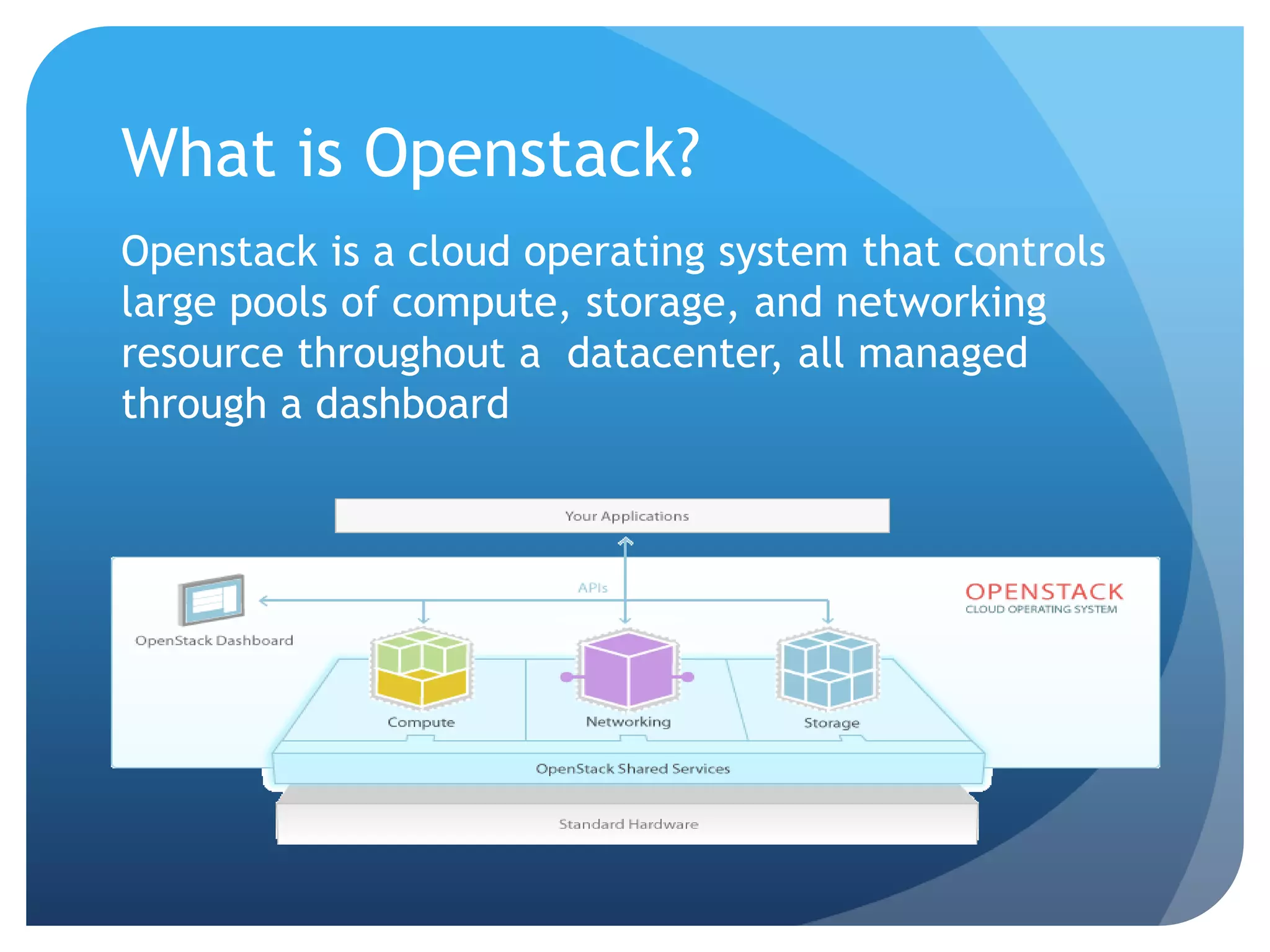
What is Openstack?
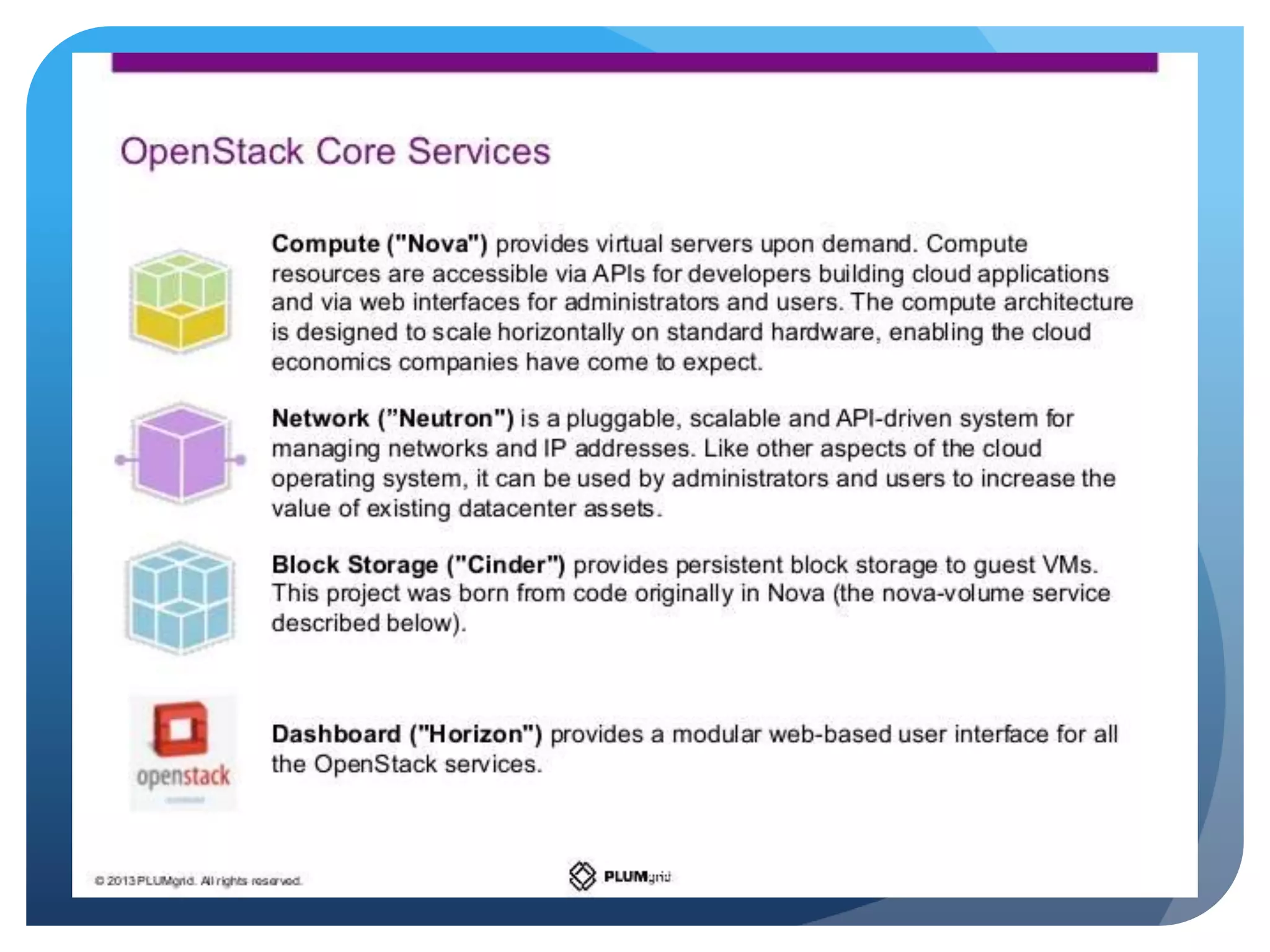
Openstack is a cloud operating system that controls
large pools of compute, storage, and networking
resource throughout a datacenter, all managed
through a dashboard
Component of Openstack
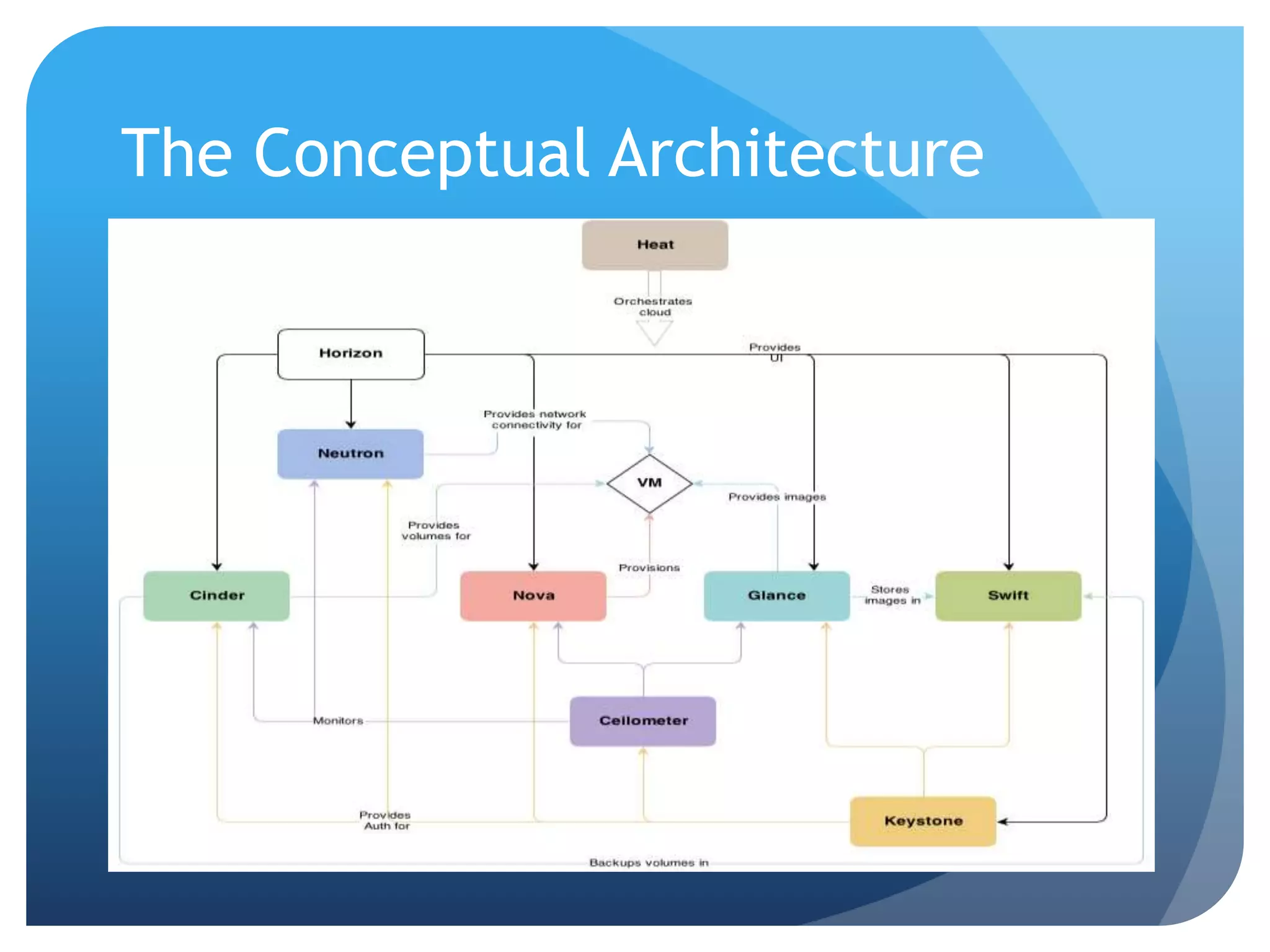
The Conceptual Architecture
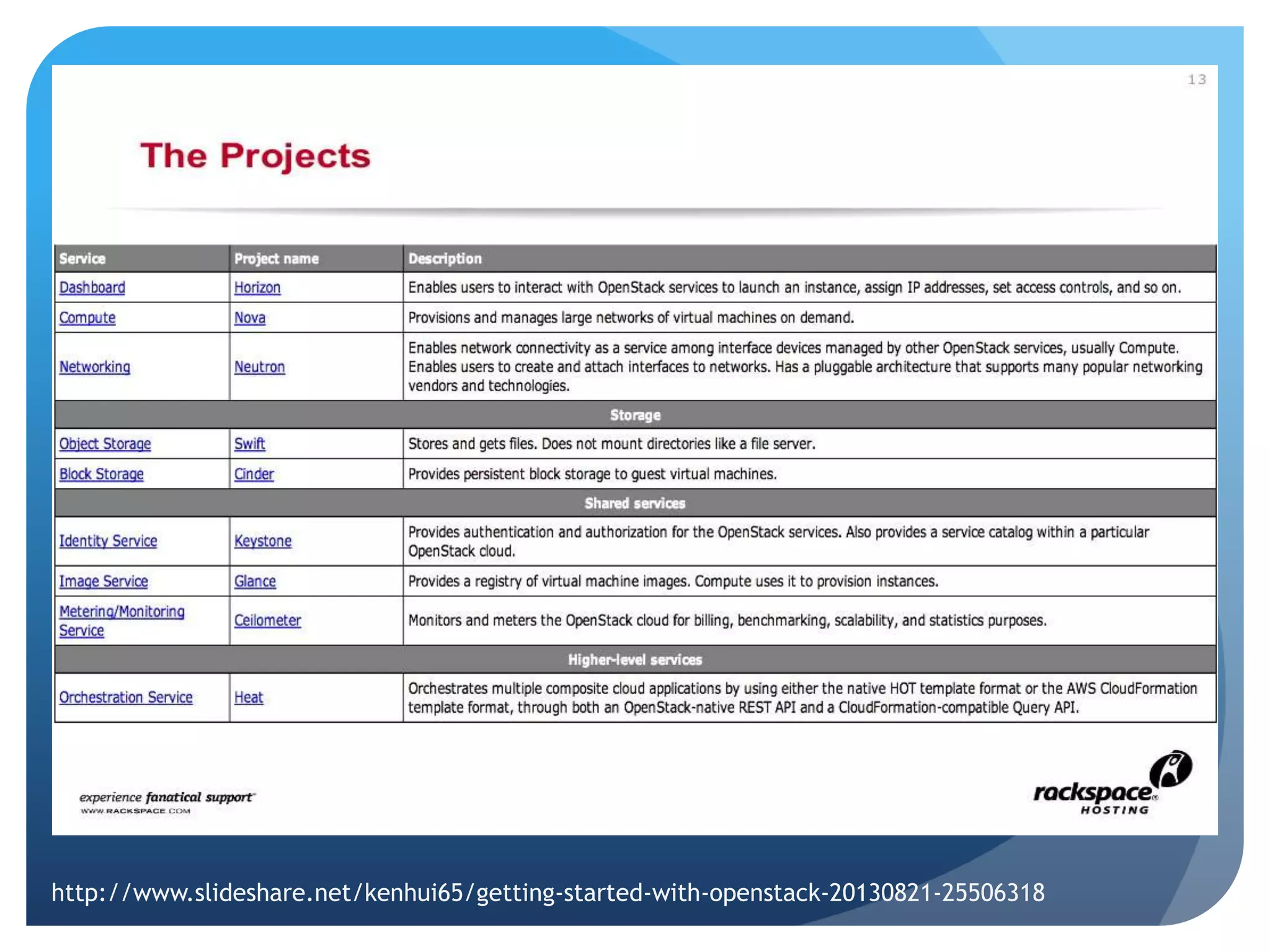
http://www.slideshare.net/kenhui65/getting-started-with-openstack-20130821-25506318
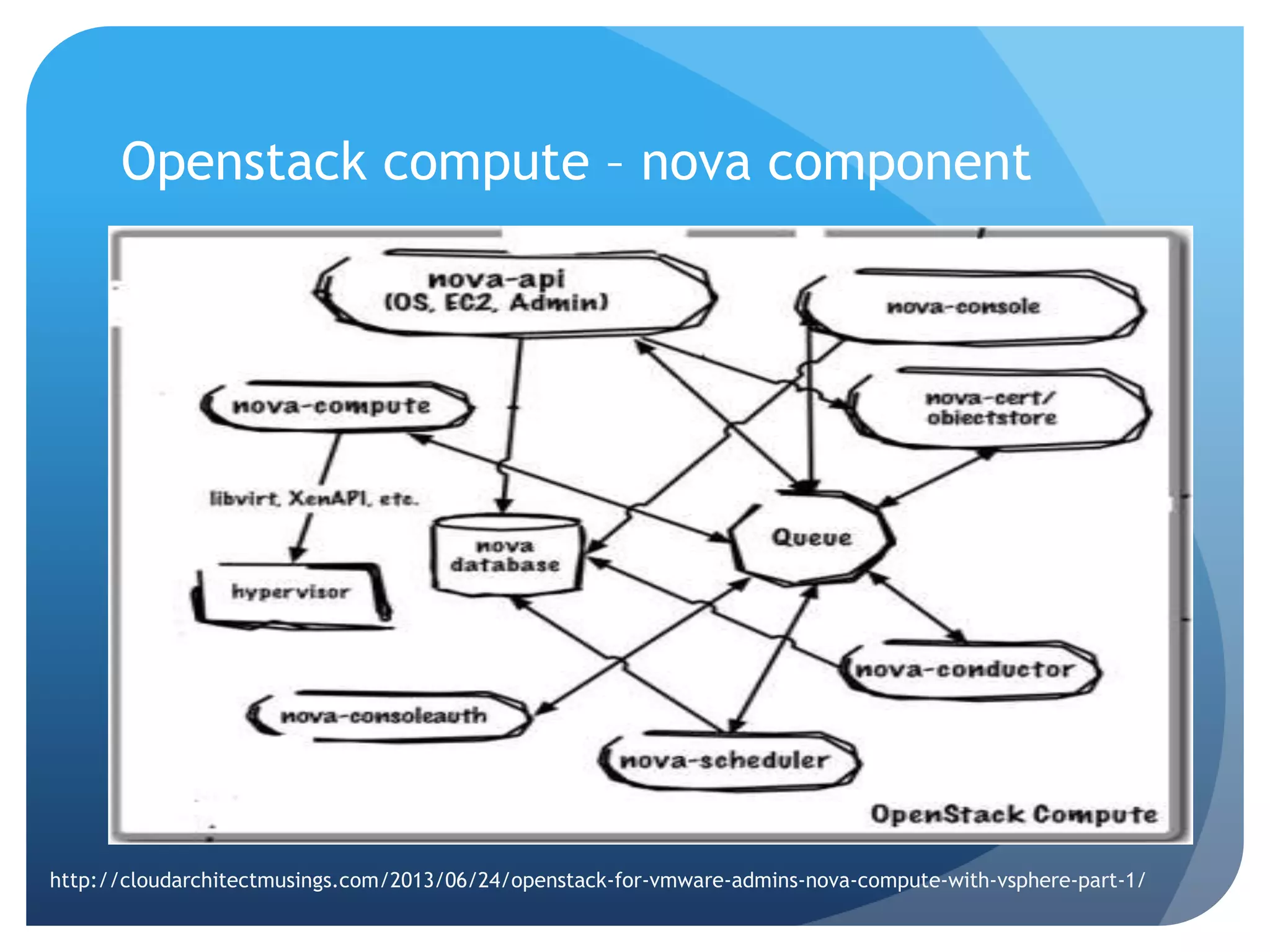
Openstack compute – nova component
http://cloudarchitectmusings.com/2013/06/24/openstack-for-vmware-admins-nova-compute-with-vsphere-part-1/
Openstack compute – nova component
(cont.)
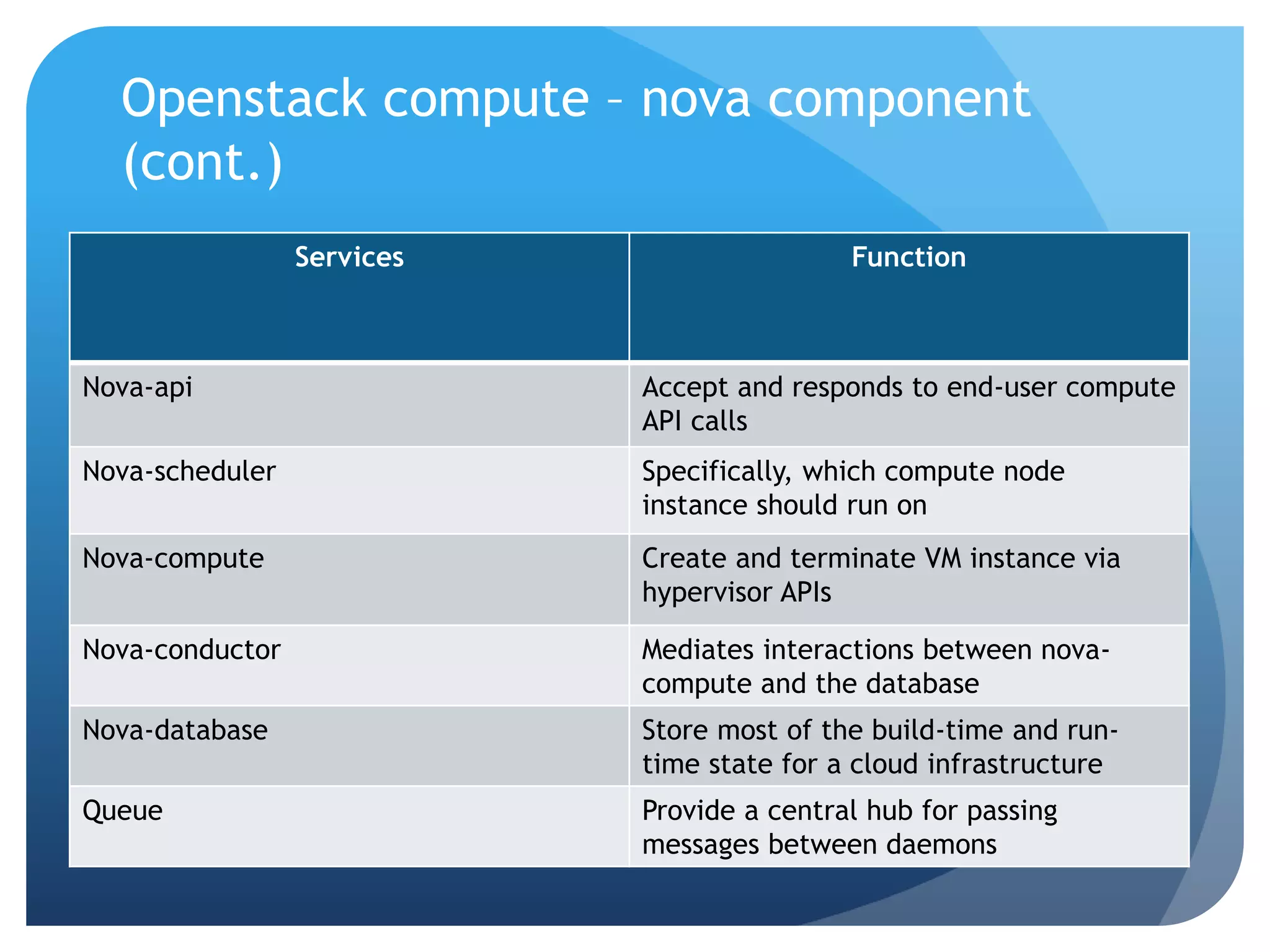
Services Function
Nova-api Accept and responds to end-user compute
API calls
Nova-scheduler Specifically, which compute node
instance should run on
Nova-compute Create and terminate VM instance via
hypervisor APIs
Nova-conductor Mediates interactions between nova-
compute and the database
Nova-database Store most of the build-time and run-
time state for a cloud infrastructure
Queue Provide a central hub for passing
messages between daemons
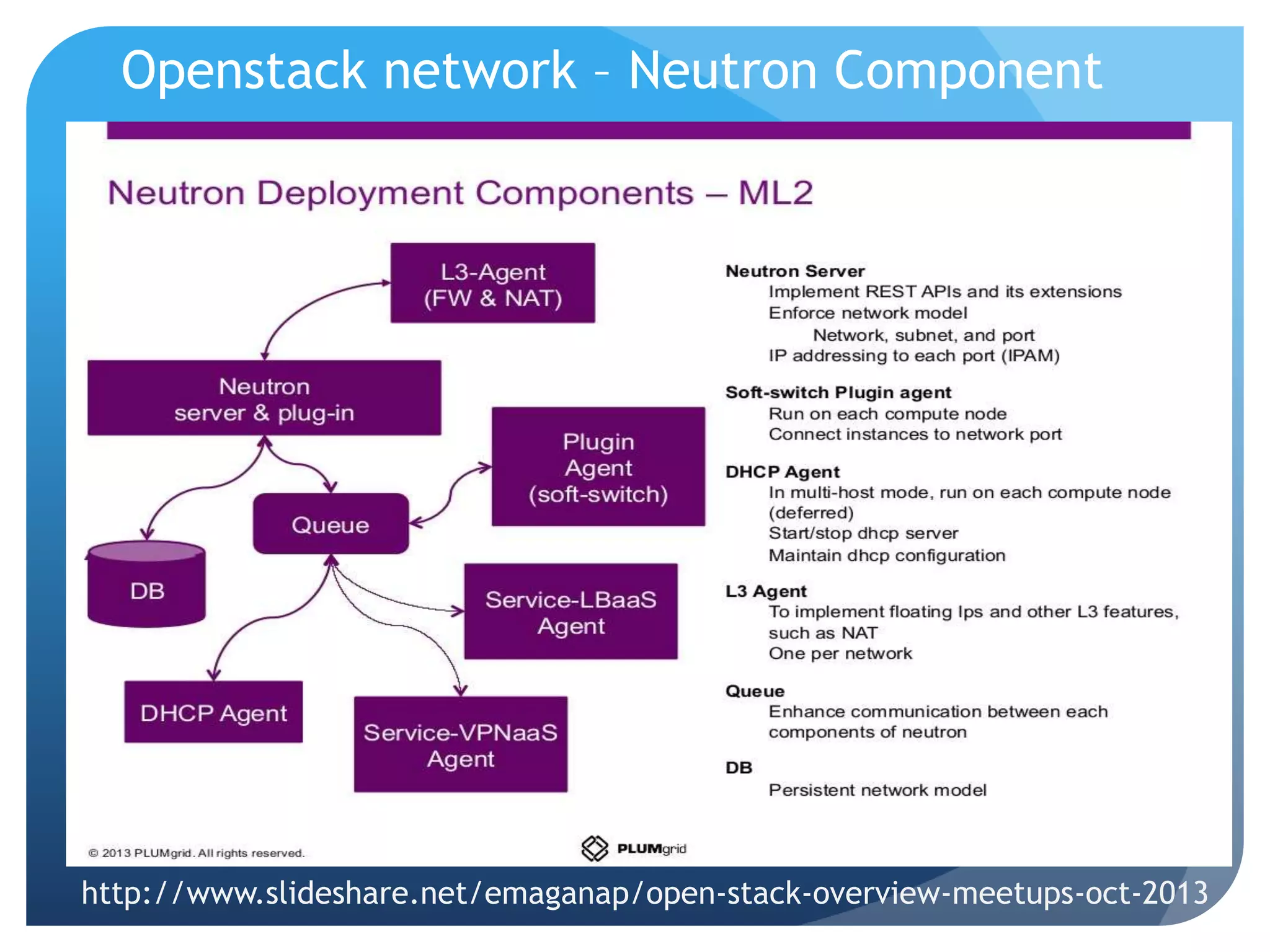
Openstack network – Neutron Component
http://www.slideshare.net/emaganap/open-stack-overview-meetups-oct-2013
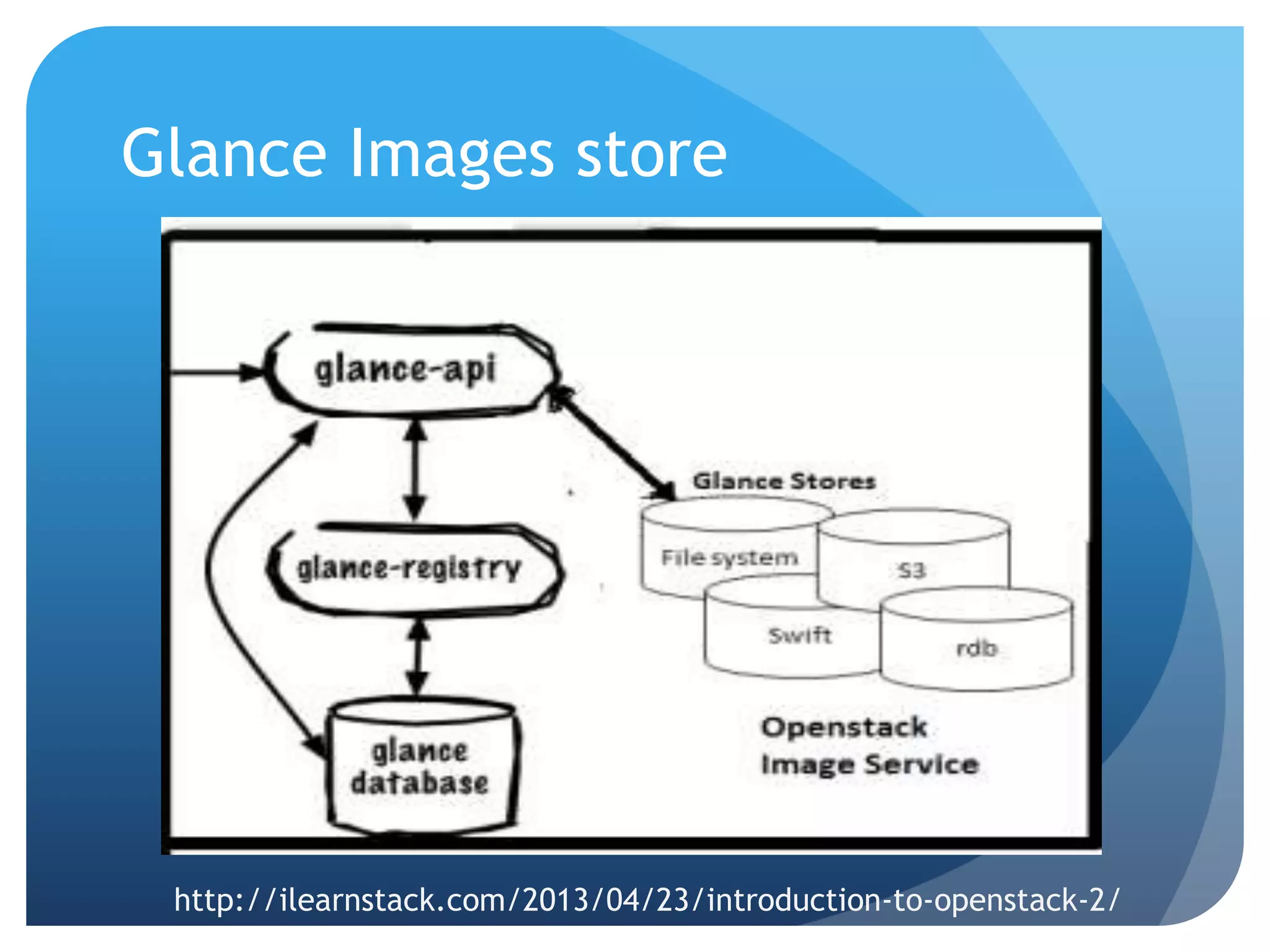
Glance Images store
http://ilearnstack.com/2013/04/23/introduction-to-openstack-2/
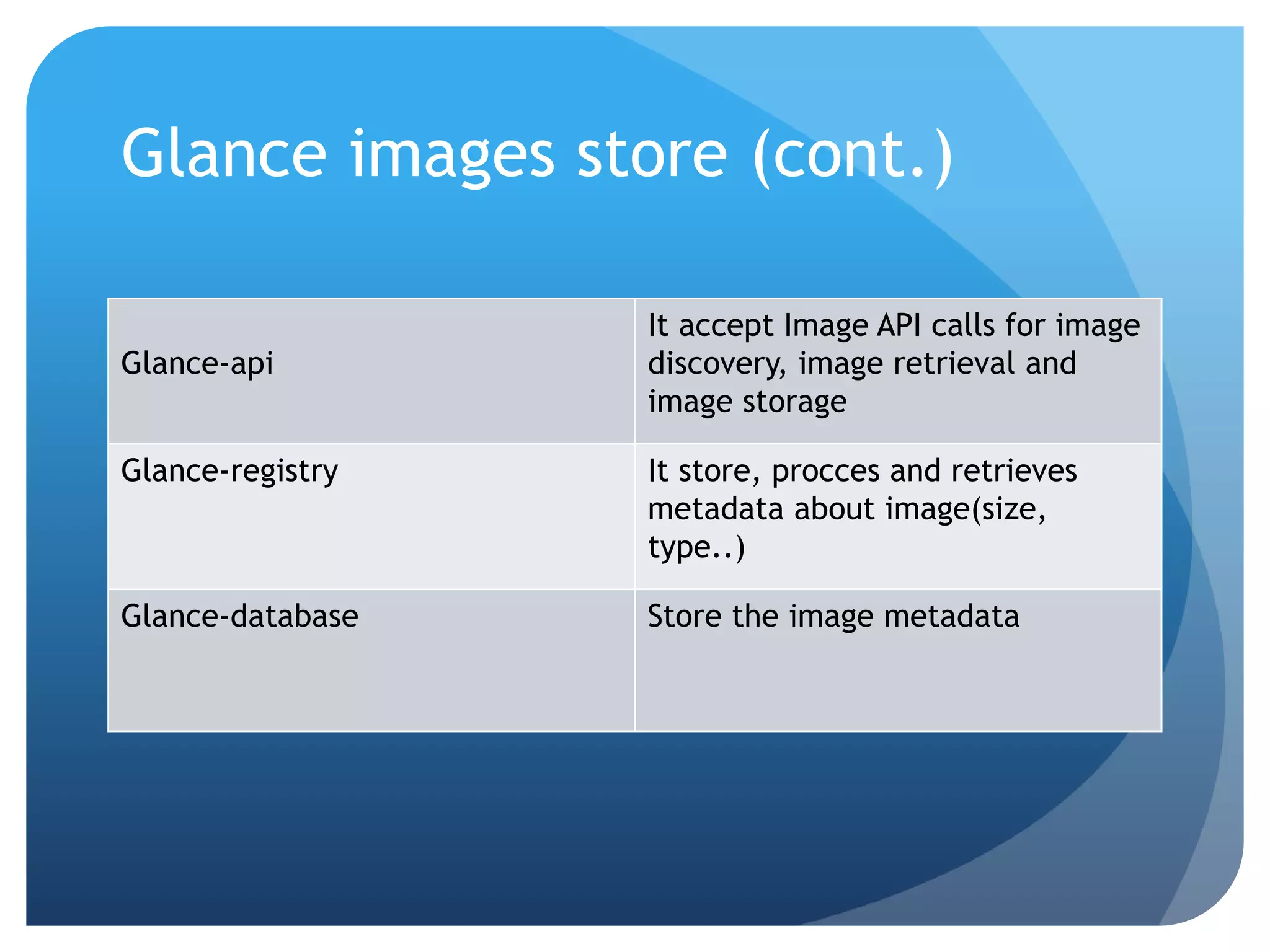
Glance images store (cont.)
Glance-api
It accept Image API calls for image
discovery, image retrieval and
image storage
Glance-registry It store, procces and retrieves
metadata about image(size,
type..)
Glance-database Store the image metadata
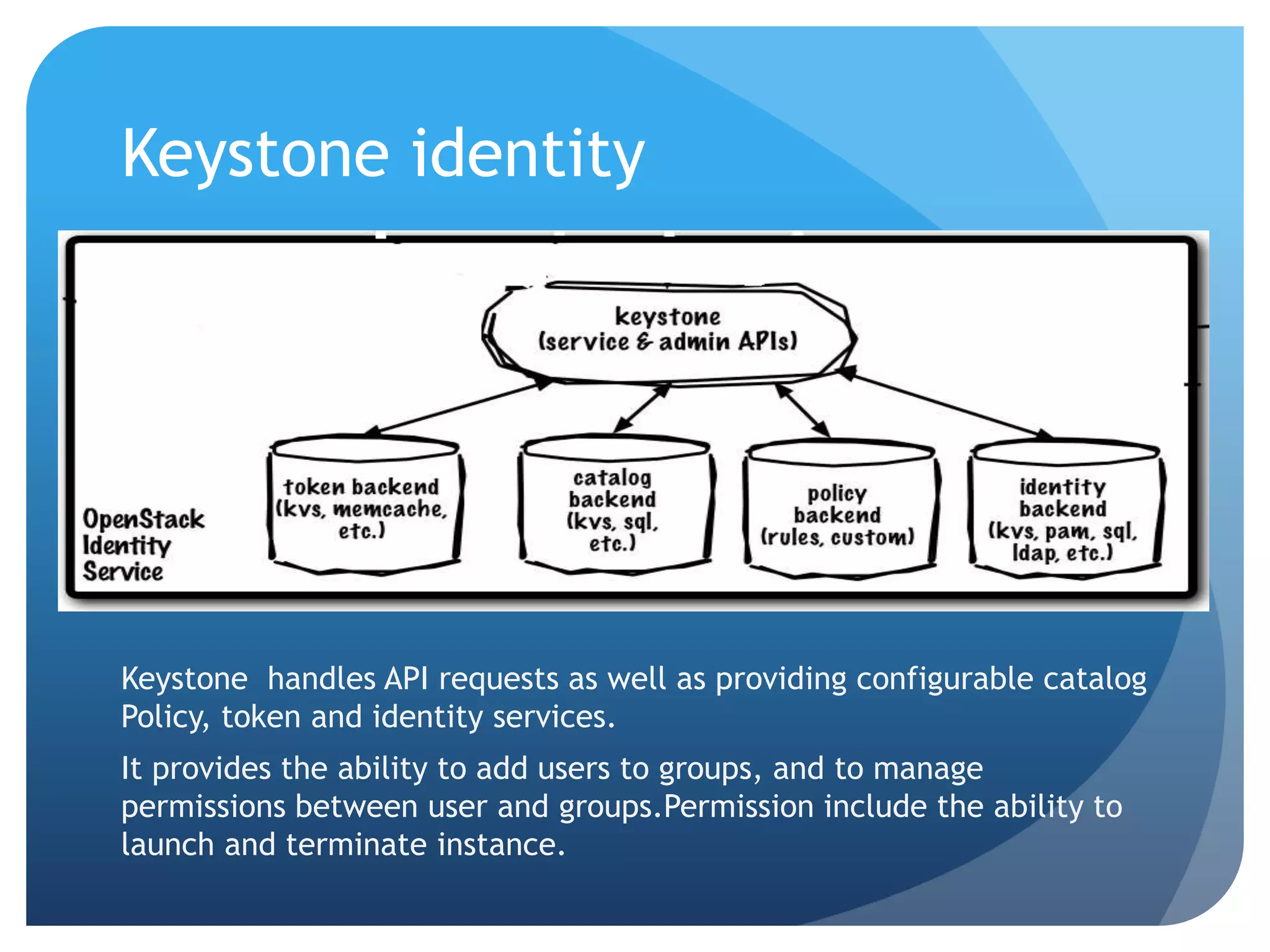
Keystone identity
Keystone handles API requests as well as providing configurable catalog
Policy, token and identity services.
It provides the ability to add users to groups, and to manage
permissions between user and groups.Permission include the ability to
launch and terminate instance.
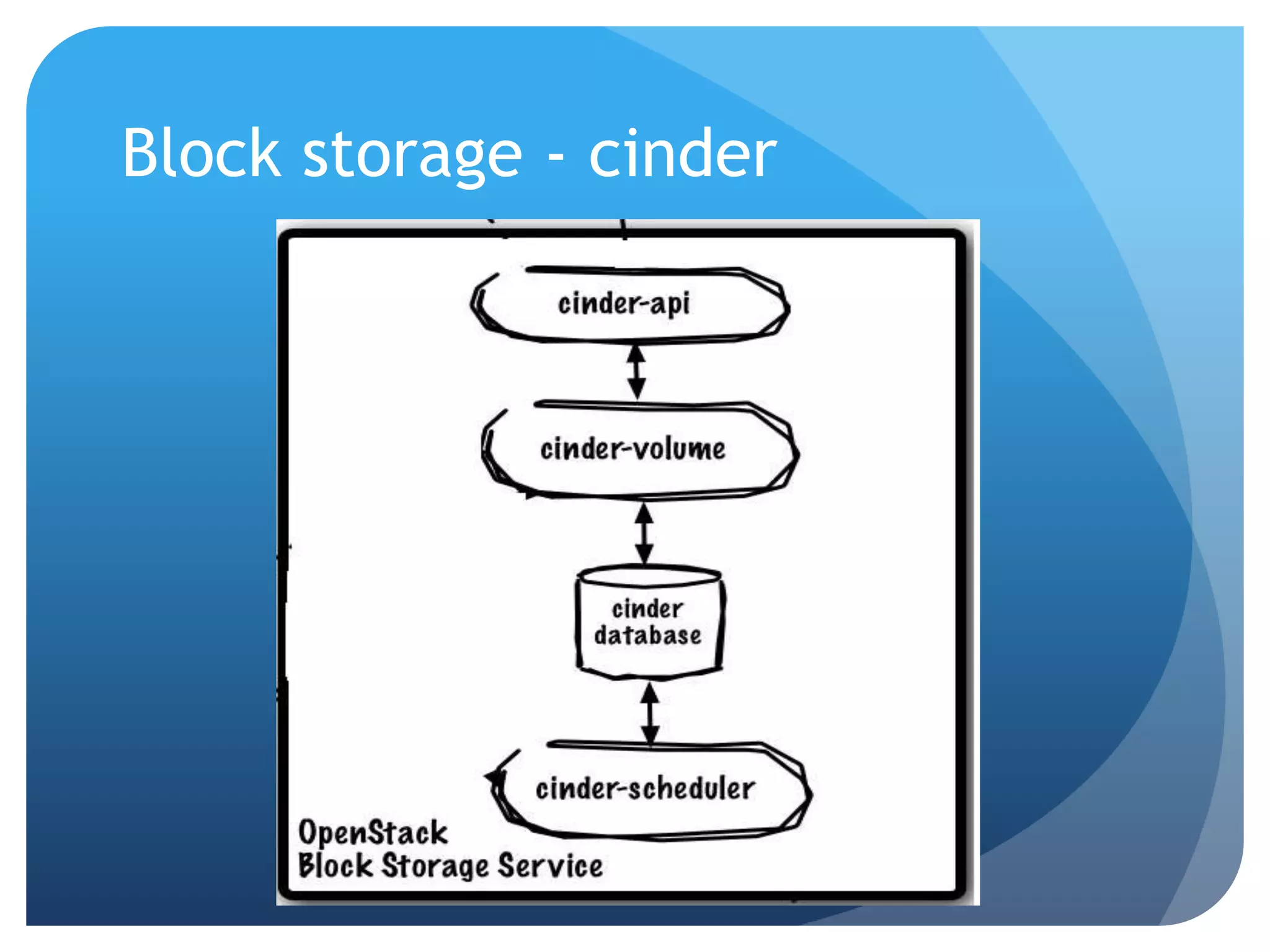
Block storage - cinder
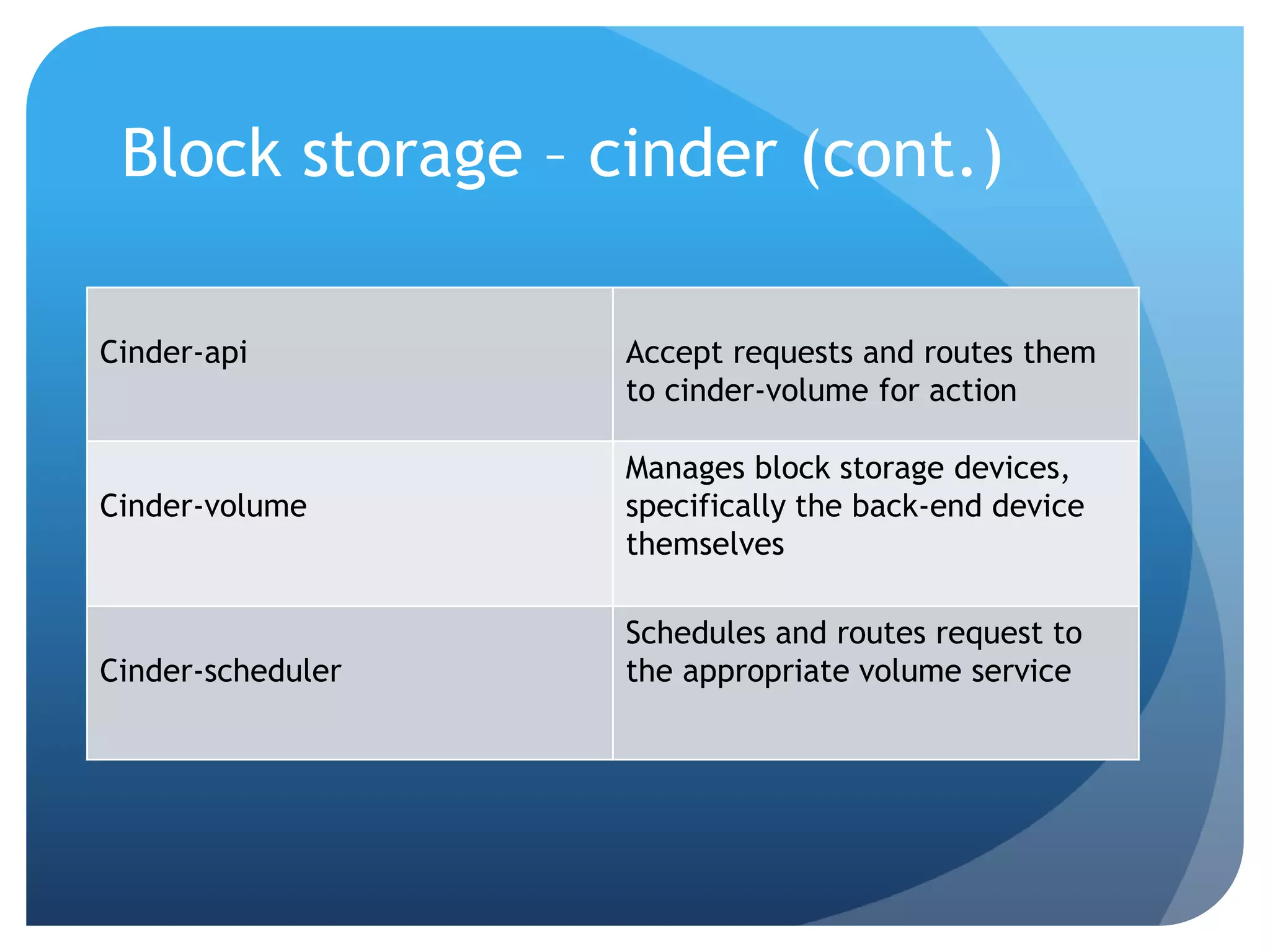
Block storage – cinder (cont.)
Cinder-api Accept requests and routes them
to cinder-volume for action
Cinder-volume
Manages block storage devices,
specifically the back-end device
themselves
Cinder-scheduler
Schedules and routes request to
the appropriate volume service
Hypervisor Platform for
Openstack
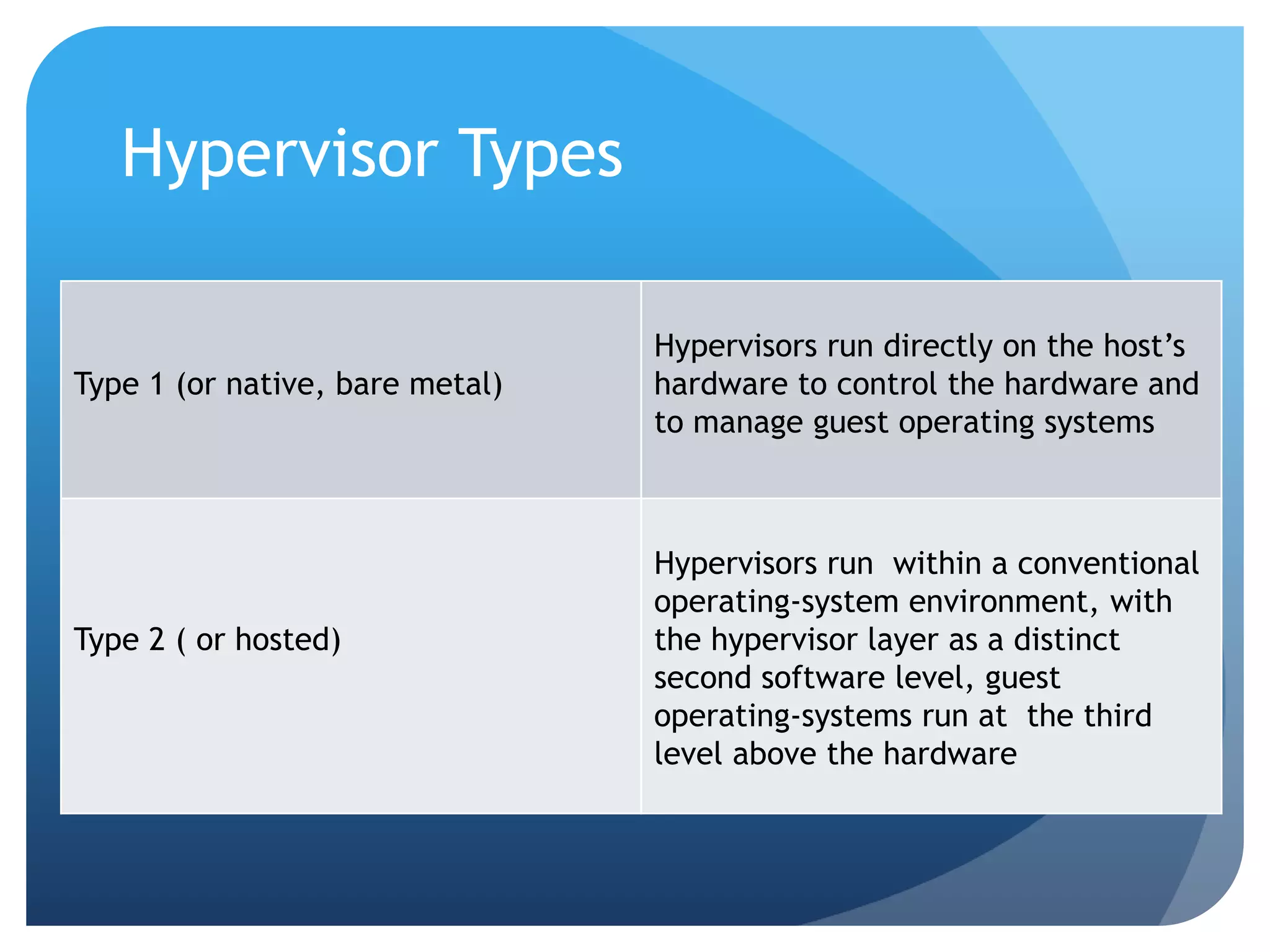
Hypervisor Types
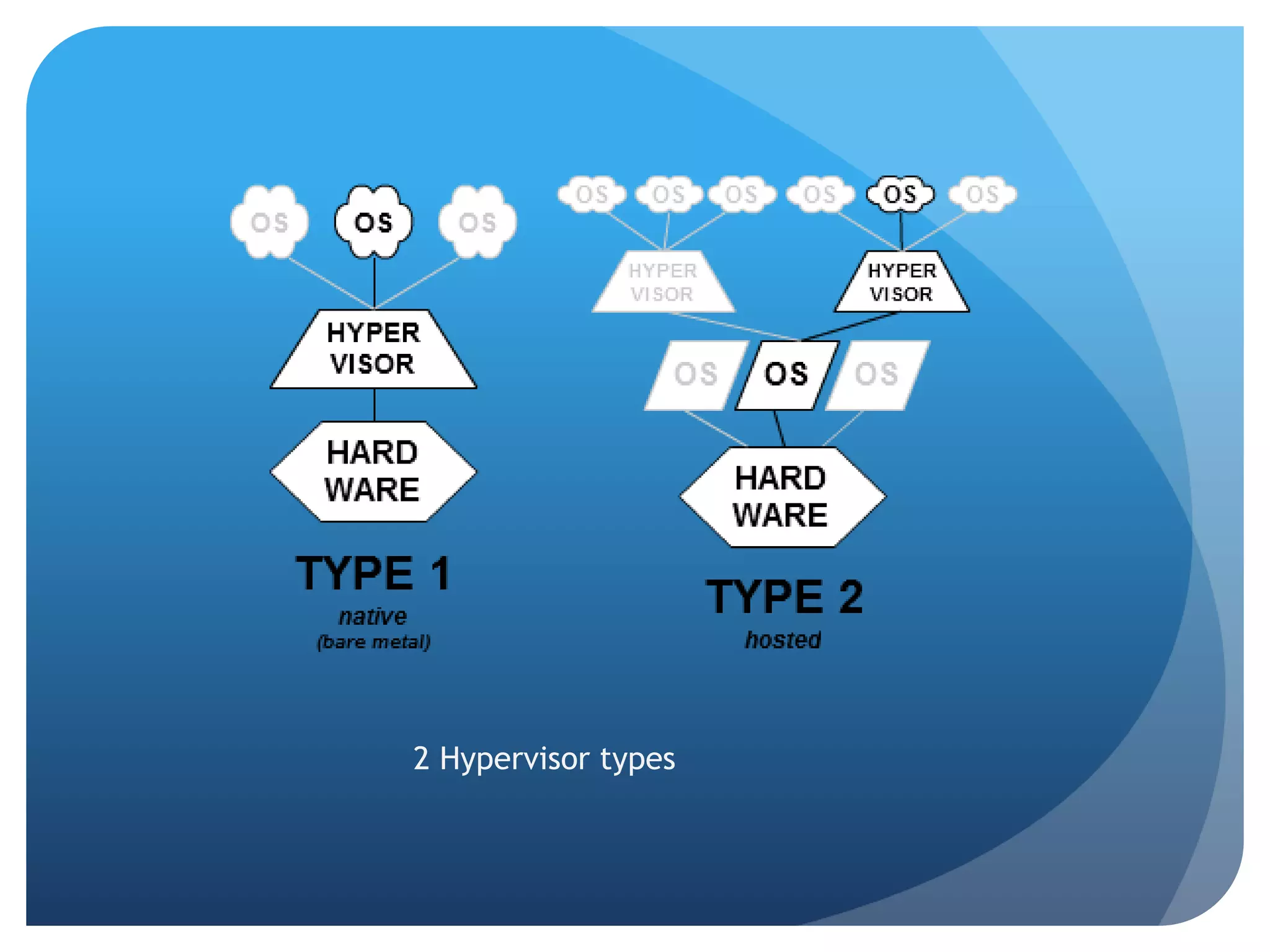
Type 1 (or native, bare metal)
Hypervisors run directly on the host’s
hardware to control the hardware and
to manage guest operating systems
Type 2 ( or hosted)
Hypervisors run within a conventional
operating-system environment, with
the hypervisor layer as a distinct
second software level, guest
operating-systems run at the third
level above the hardware
2 Hypervisor types
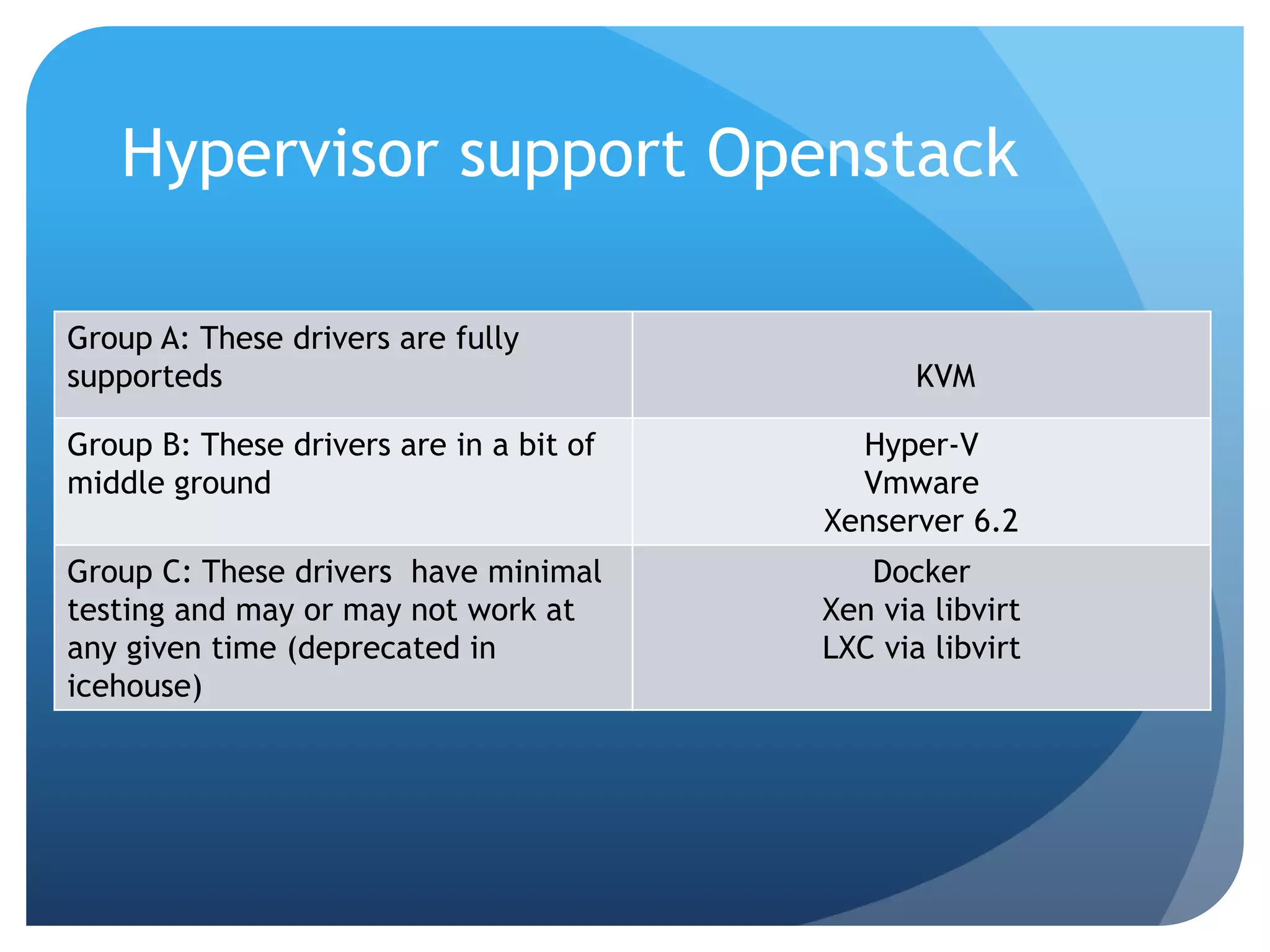
Hypervisor support Openstack
Group A: These drivers are fully
supporteds KVM
Group B: These drivers are in a bit of
middle ground
Hyper-V
Vmware
Xenserver 6.2
Group C: These drivers have minimal
testing and may or may not work at
any given time (deprecated in
icehouse)
Docker
Xen via libvirt
LXC via libvirt
Leading hypervisor options
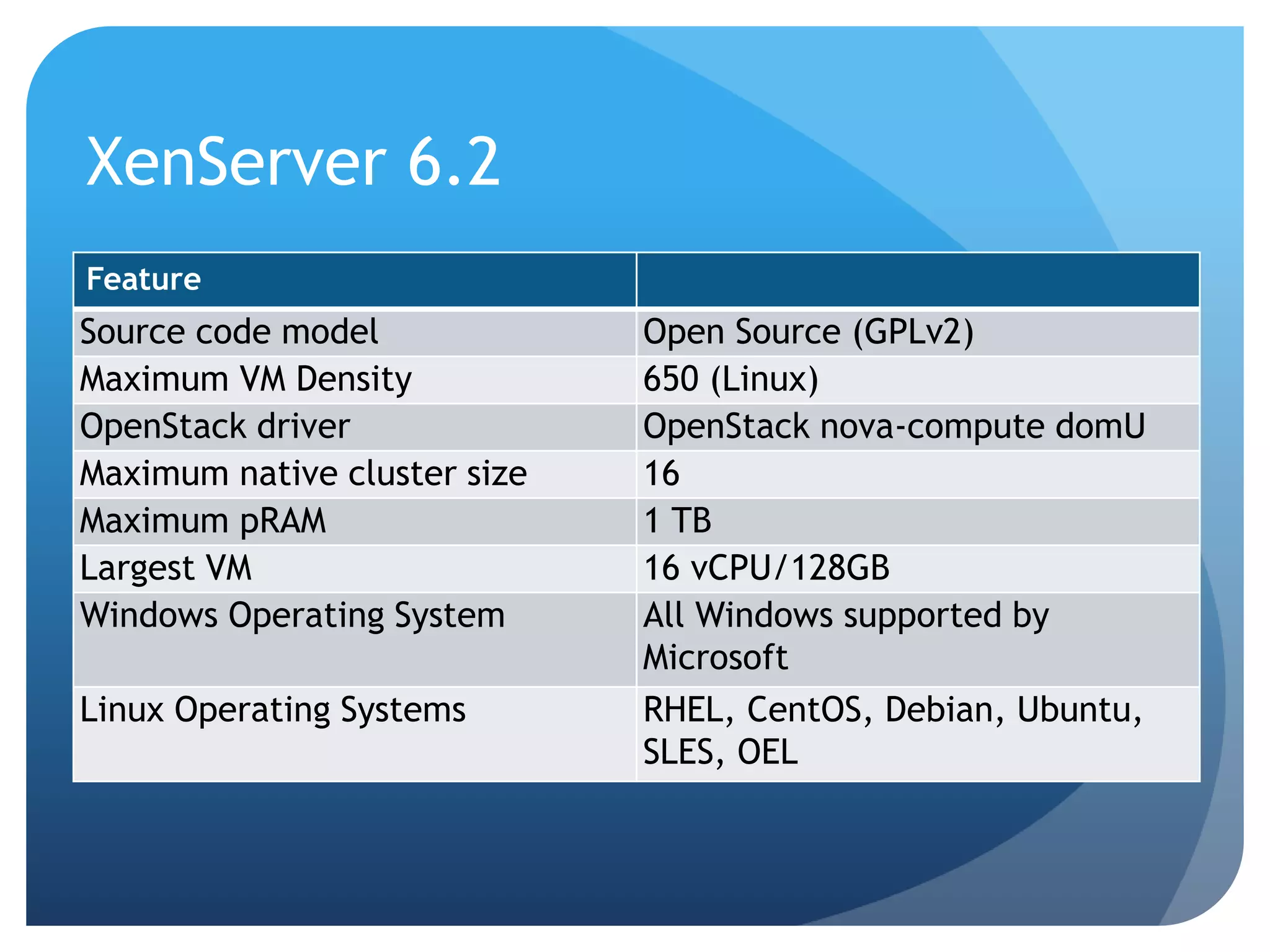
XenServer 6.2
Feature
Source code model Open Source (GPLv2)
Maximum VM Density 650 (Linux)
OpenStack driver OpenStack nova-compute domU
Maximum native cluster size 16
Maximum pRAM 1 TB
Largest VM 16 vCPU/128GB
Windows Operating System All Windows supported by
Microsoft
Linux Operating Systems RHEL, CentOS, Debian, Ubuntu,
SLES, OEL
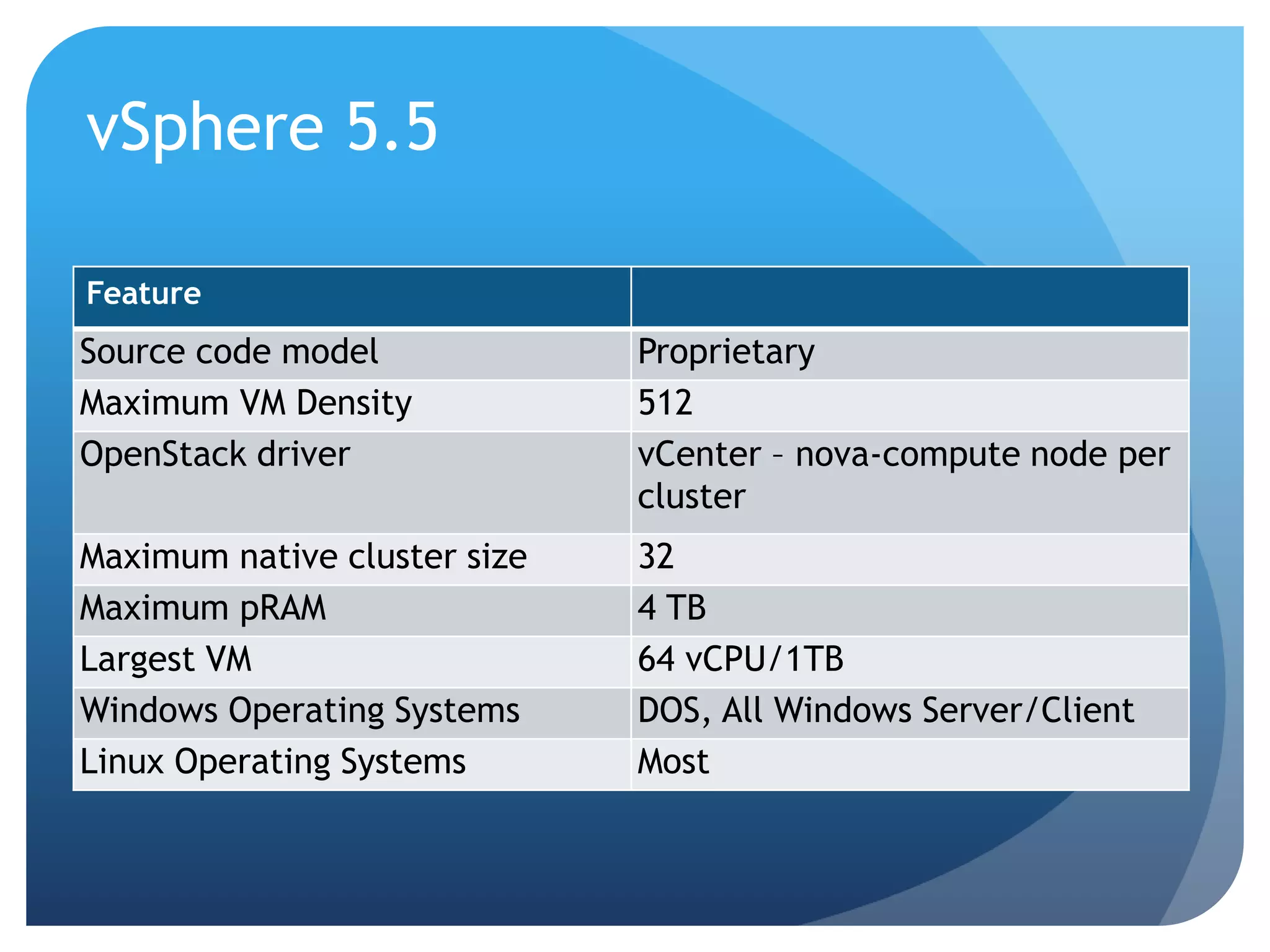
vSphere 5.5
Feature
Source code model Proprietary
Maximum VM Density 512
OpenStack driver vCenter – nova-compute node per
cluster
Maximum native cluster size 32
Maximum pRAM 4 TB
Largest VM 64 vCPU/1TB
Windows Operating Systems DOS, All Windows Server/Client
Linux Operating Systems Most
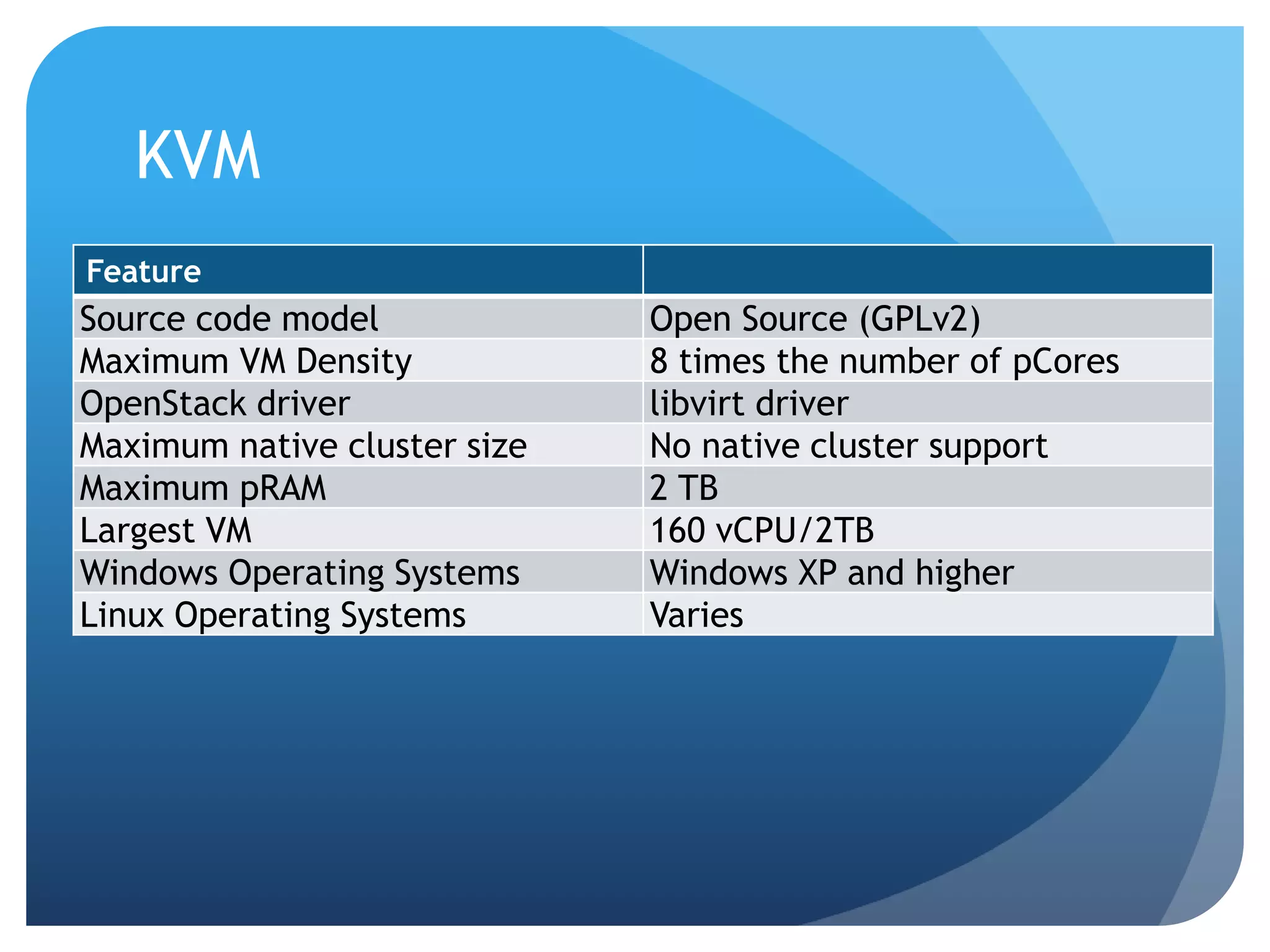
KVM
Feature
Source code model Open Source (GPLv2)
Maximum VM Density 8 times the number of pCores
OpenStack driver libvirt driver
Maximum native cluster size No native cluster support
Maximum pRAM 2 TB
Largest VM 160 vCPU/2TB
Windows Operating Systems Windows XP and higher
Linux Operating Systems Varies
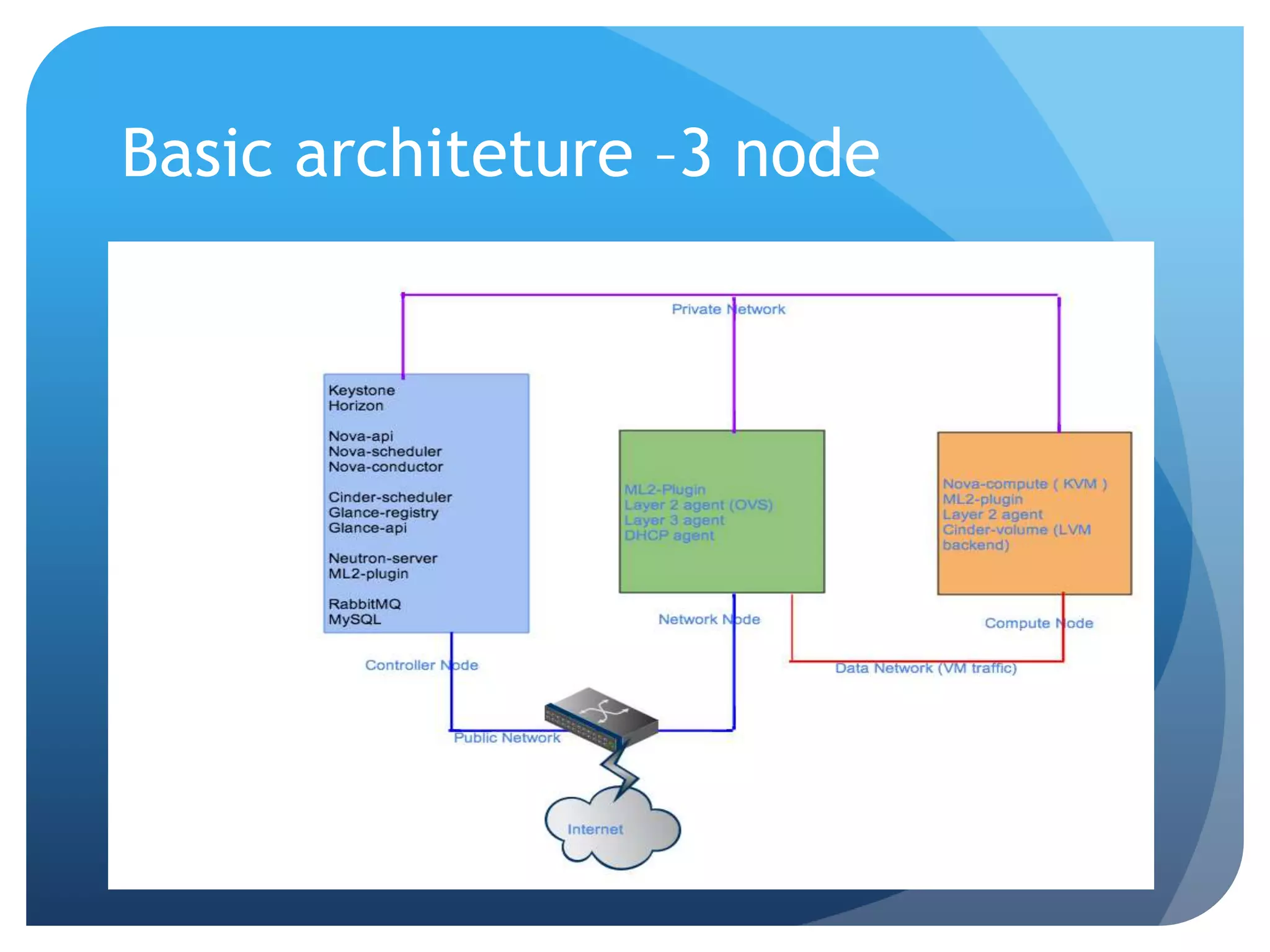
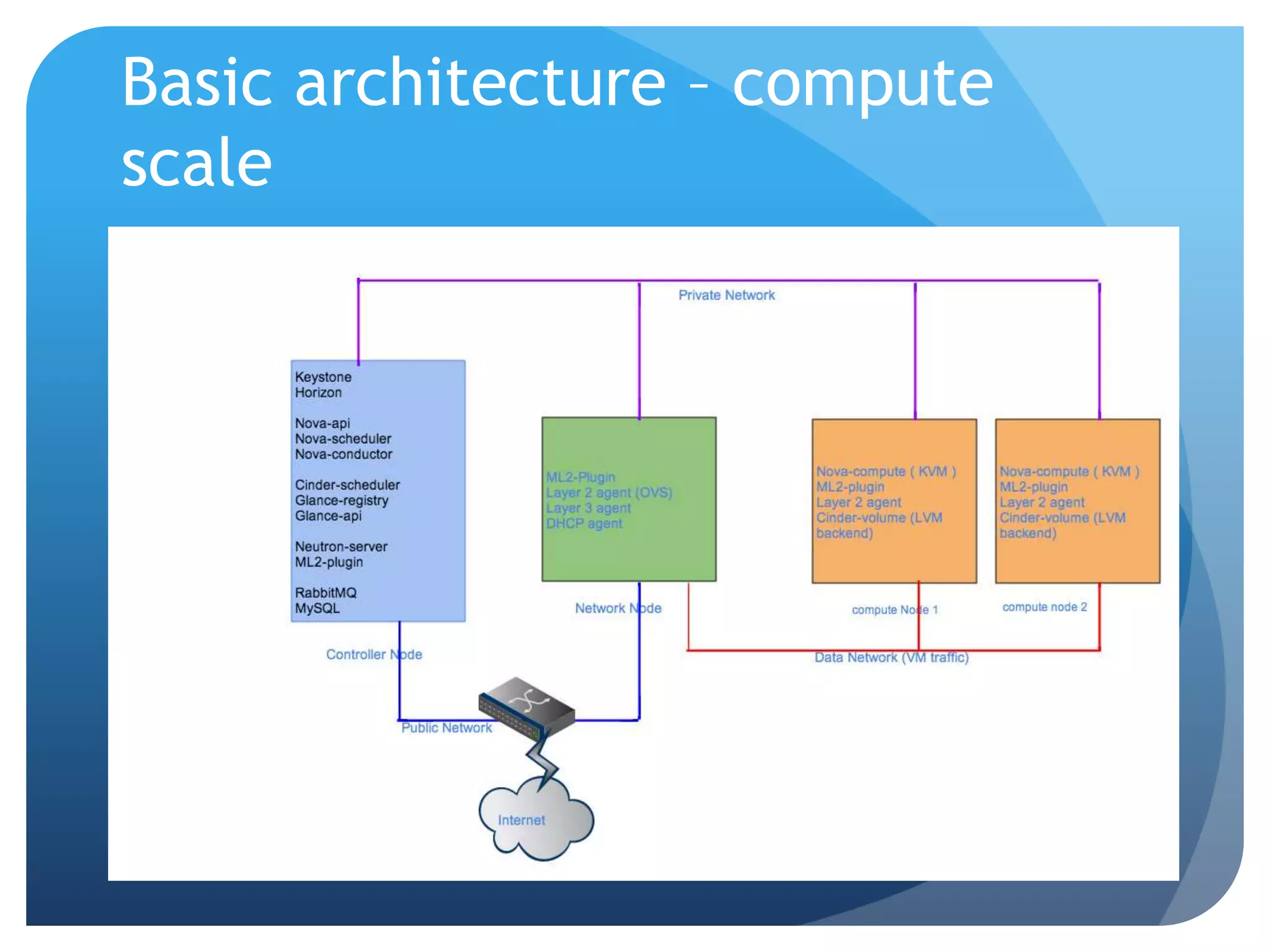
Deployment model
Basic architeture –3 node
Basic architecture – compute
scale
End of Part One
Thanks!

Openstack architure part 1

  • 1.
  • 2.
    Agenda  Introduction OpenstackArchitecture  Component of Openstack  Hypervisor Platform for Openstack  Deployment model
  • 3.
  • 4.
    What is Openstack? Openstackis a cloud operating system that controls large pools of compute, storage, and networking resource throughout a datacenter, all managed through a dashboard
  • 6.
  • 7.
  • 8.
  • 9.
    Openstack compute –nova component http://cloudarchitectmusings.com/2013/06/24/openstack-for-vmware-admins-nova-compute-with-vsphere-part-1/
  • 10.
    Openstack compute –nova component (cont.) Services Function Nova-api Accept and responds to end-user compute API calls Nova-scheduler Specifically, which compute node instance should run on Nova-compute Create and terminate VM instance via hypervisor APIs Nova-conductor Mediates interactions between nova- compute and the database Nova-database Store most of the build-time and run- time state for a cloud infrastructure Queue Provide a central hub for passing messages between daemons
  • 11.
    Openstack network –Neutron Component http://www.slideshare.net/emaganap/open-stack-overview-meetups-oct-2013
  • 12.
  • 13.
    Glance images store(cont.) Glance-api It accept Image API calls for image discovery, image retrieval and image storage Glance-registry It store, procces and retrieves metadata about image(size, type..) Glance-database Store the image metadata
  • 14.
    Keystone identity Keystone handlesAPI requests as well as providing configurable catalog Policy, token and identity services. It provides the ability to add users to groups, and to manage permissions between user and groups.Permission include the ability to launch and terminate instance.
  • 15.
  • 16.
    Block storage –cinder (cont.) Cinder-api Accept requests and routes them to cinder-volume for action Cinder-volume Manages block storage devices, specifically the back-end device themselves Cinder-scheduler Schedules and routes request to the appropriate volume service
  • 17.
  • 18.
    Hypervisor Types Type 1(or native, bare metal) Hypervisors run directly on the host’s hardware to control the hardware and to manage guest operating systems Type 2 ( or hosted) Hypervisors run within a conventional operating-system environment, with the hypervisor layer as a distinct second software level, guest operating-systems run at the third level above the hardware
  • 19.
  • 20.
    Hypervisor support Openstack GroupA: These drivers are fully supporteds KVM Group B: These drivers are in a bit of middle ground Hyper-V Vmware Xenserver 6.2 Group C: These drivers have minimal testing and may or may not work at any given time (deprecated in icehouse) Docker Xen via libvirt LXC via libvirt
  • 21.
  • 22.
    XenServer 6.2 Feature Source codemodel Open Source (GPLv2) Maximum VM Density 650 (Linux) OpenStack driver OpenStack nova-compute domU Maximum native cluster size 16 Maximum pRAM 1 TB Largest VM 16 vCPU/128GB Windows Operating System All Windows supported by Microsoft Linux Operating Systems RHEL, CentOS, Debian, Ubuntu, SLES, OEL
  • 23.
    vSphere 5.5 Feature Source codemodel Proprietary Maximum VM Density 512 OpenStack driver vCenter – nova-compute node per cluster Maximum native cluster size 32 Maximum pRAM 4 TB Largest VM 64 vCPU/1TB Windows Operating Systems DOS, All Windows Server/Client Linux Operating Systems Most
  • 24.
    KVM Feature Source code modelOpen Source (GPLv2) Maximum VM Density 8 times the number of pCores OpenStack driver libvirt driver Maximum native cluster size No native cluster support Maximum pRAM 2 TB Largest VM 160 vCPU/2TB Windows Operating Systems Windows XP and higher Linux Operating Systems Varies
  • 25.
  • 26.
  • 27.
  • 28.
    End of PartOne Thanks!