Computer Engineering and Intelligent Systems www.iiste.org
ISSN 2222-1719 (Paper) ISSN 2222-2863 (Online)
Vol.4, No.4, 2013
10
Getting Relational Database from Legacy Data-MDRE
Approach
Omar EL BEGGAR*
, Brahim BOUSETTA, and Taoufiq GADI
University Hassan 1st
, Faculty of Sciences and Techniques, Settat, Morocco
E-mail of the corresponding author: elbeggar_omar@yahoo.fr
Abstract
The previous management information systems turning on traditional mainframe environment are often
written in COBOL and store their data in files; they are usually large and complex and known as legacy
systems. These legacy systems need to be maintained and evolved due to several causes, including
correction of anomalies, requirements change, management rules change, new reorganization, etc. But, the
maintenance of legacy systems becomes over years extremely complex and highly expensive, In this case, a
new or an improved system must replace the previous one. However, replacing those systems completely
from scratch is also very expensive and it represents a huge risk. Nevertheless, they should be evolved by
profiting from the valuable knowledge embedded in them. This paper proposes a reverse engineering
process based on Model Driven engineering that presents a solution to provide a normalized relational
database which includes the integrity constraints extracted from legacy data. A CASE tool CETL: (COBOL
Extract Transform Load) is developed to support the proposal.
Keywords: legacy data, reverse engineering, model driven engineering, COBOL metamodel, domain class
diagram, relational database
1. Introduction
The evolution of technology and the diversity of tools and platform were a nightmare for companies and
left them trolling and running all the time behind. While in the current context of globalization, any
company that wishes to be competitive should procure those new technologies in real time. However, the
higher maintenance cost, the lack of documentation and the risk of data loss. Migrating legacy system to
those modern platforms remains a pain for these companies which are still unable to keep pace.
The older information systems ran on mainframe environment and they are often written in COBOL and
store their data in files [6, 15]; they are usually large and complex and known as legacy systems. These
legacy systems need to be maintained and evolved due to many factors, including error correction,
requirements change, business rules change, structural reorganization, etc [7]. But, there are many problems
to maintain and evolve legacy systems like the difficulty to retrieve and understand the original system
specifications and especially when it’s a lack of modeling and documentation supports related to those
systems. The higher cost of maintaining and evolving legacy systems represent also a challenge to
surmount. This paper propose a reverse engineering process based on Model Driven Engineering (MDE)
that represents a solution to provide systems ready to any improvements and to minimize the higher cost of
migration. COBOL applications present the most important target of reverse engineering projects. Most of
them use simple files to store persistent data [9]. The choice of COBOL is not arbitrary due to the wide
diffusion of this programming language and its existence all these years in spite of the presence of other
languages that are more sophisticated. Indeed, it was the most used language between 1960 and 1980 and it
is still widely used in financial institutions, accounting, banks, insurance companies, government
departments...
Recently, a study published in the weekly computing business magazine “eWeek” in January 24th, 2011
affirms that the fourth quarter of 2010, 5 billion of new code lines COBOL are added each year.
Furthermore, there is at least 1.5 to 2 million developers worldwide who currently work with COBOL. And
there are over 200 times more transactions processed by COBOL applications than Google search engine
every day [1]. In addition, the Micro Focus officials estimate that about 220 billion lines of Cobol code are
used in business and financial applications today. And COBOL systems are powering more than 70% of the
world’s businesses [2, 8]. After all, only the languages or softwares which are successful have been those
that have attained maturity and old age. Many others are on the contrary not useful enough that we decided
to retain and evolve them [3].
Computer Engineering and Intelligent Systems www.iiste.org
ISSN 2222-1719 (Paper) ISSN 2222-2863 (Online)
Vol.4, No.4, 2013
11
In fact, since its standardization by ANSI, COBOL has seen some improvements like (ANS 2002: XML
parsers, Object Oriented ...) and integration of tools such as CICS in mainframes and many other
improvements. Meanwhile, this article does not oppose the search for better ways to change the language to
perform new operations, on the contrary, our work is far from being a rejection of COBOL but there is
another alternative to provide a production system modeled, documented, independent of any platform and
being away from any technological rupture.
The advantages of moving existing COBOL legacy data to relational database are both financial and
technical:
Data documented: The data provided by RDBMS are better documented due to the data dictionary.
Data consistency: The data in RDBMS are consistent due to locks and concurrency access
management.
Database services: An RDBMS offers a variety of services that are not likely to be available in a
standalone program, including: security, data integrity, transaction management (commit/rollback)
and crash recovery [6].
Report generator: the reports can be established easily by report generator tools using a relational
database than be implemented by code [6].
Improving scalability: Using Model Driven Reverse Engineering (MDRE) allows generating the
database, documentation or other artifacts after each change by changing the source model and
applying simply a model transformation to obtain a target model.
Minimizing maintenance cost: the fourth generation language and modern platform are much less
expensive to maintain than legacy system [6].
Reducing time development: using MDE in reverse engineering or re-engineering much reduces
the time development since it’s a generative approach.
The proposal aims firstly to parse and analyze a legacy data from file descriptors present in code sources in
order to extract the data structure model which conforms to a COBOL meta-model. The data structures are
then merged in a general model that we have called Merged Model File Descriptors (MMFD). Next, The
MMFD will be refined by adding the integrity constraints and normal forms retrieved from physical files by
applying a set of rules explained in detail in section 5. This phase is provided by using a CASE tool
CETL®: (Cobol Extract Transform Load) that we have developed for this purpose. In the following MDRE
phase, the normalized and integrate MMFD will be represented at a higher level of abstraction by applying
a reverse model transformation to obtain a domain class diagram that will finally transformed to a relational
database.
Thus, the first scientific contribution of our work is proposing a reverse engineering approach including the
paradigms and concepts of MDE which propose a COBOL meta-model and its model transformation to
obtain the target relational database. Another scientific contribution of our work involves the development
of the CASE tool CETL®: (Cobol Extract Transform Load) used for extraction of the whole description of
legacy data, their integrity constraints and its normalization by observing data exiting in physical files.
The rest of this paper is organized as follows: In the section 2, we present a statement of prior works in the
topic of reverse engineering and the principal scientific contributions of our approach. The third section is
dedicated to give an overview of our Model Driven Reverse Engineering MDRE. The next sections are
devoted to describe the different phases of the MDRE. Thus, section 4 present the extraction phase and the
COBOL meta-model used to extract the data structure from legacy data, section 5 treat the merge phase and
present the toolset CETL used in our approach accompanied by a benchmark study to compare it with the
other tools of the same family that are employed in the market or in research laboratories. Section 6 is
dedicated to describe the model transformation as well as the mapping rules to obtain a Domain Class
Diagram (DCD) and its refinement by adding integrity constraints and normal forms. Then, Section 7 is
conserved to present and discuss the MDRE resulting. Finally, we conclude this article by presenting the
actual state of our research and the next future works.
Computer Engineering and Intelligent Systems www.iiste.org
ISSN 2222-1719 (Paper) ISSN 2222-2863 (Online)
Vol.4, No.4, 2013
12
2. Related works
In this section, we will present many works in this area of research reverse engineering process, and the
mainly differences with our approach. Firstly, a reverse engineering process aims to analyze a subject
system for two goals:
1- To identify the system’s components and their interrelationships.
2- To create representations of the system in another from or at higher level of abstraction [10]
Previous research on reverse engineering made great achievements concerning the first reverse engineering
goal but there is very little researches in creating representation of the system in another form especially at
higher level of abstraction [11] since the majority of researchers don’t integrate generally the
meta-modeling and meta-models in their reverse engineering process as higher abstract representation of a
system aspect and don’t benefit of the MDE advantages. Even though the metamodel as it is defined by
OMG is a special kind of model that specifies the abstract syntax of a modeling language. It can be
understood as the representation of the class of all models expressed in that language [12]. According to the
MDE principles [14] using a metamodel means working at higher level of abstraction. Therefore, as it was
defined by Chikofsky, to attain the second goal of reverse engineering, it’s judicious to use metamodels.
Otherwise, evolving legacy system without benefit of a higher level of representation of functionality and
structure presents risks of quality [6]. Atkinson and Kühne state that the main goal of MDE is to reduce the
sensitivity of primary software artifacts to the inevitable changes that affect a software system [13]. Our
MDRE approach belongs to this area of research that includes techniques and concepts of MDE and which
places the metamodels in the core of the different phases of the reverse engineering.
In [11], the related work presents a meta-model that unifies the conceptual view on programs with the
classical structure-based reverse engineering meta-models and thereby enables the establishment of an
explicit mapping between program elements and the real-world concepts that they implement. Concerning
reverse engineering strategies, we can distinguish two general strategies [5,6,7, 20,30,31,35]; those that get
out system features from the source code only. In this strategy, the retrieved information is completely
included in code. The other strategy is knowledge-domain method, were the source code is analyzed based
on knowledge-domain and further completed by data issued from other resources such as documents,
interview with personnel, forms, reports etc. In our case, our approach belongs to the first category of
strategies: extract entirely the description of legacy data from only source code and physical files. A lot of
research performed in this first category of strategies [16,17,21,22,34] has been done about schema
extraction from code source , but there has been limited work on reverse engineering of legacy data files
which is interested in normalization and the extraction of the data integrity constraints from physical files,
although those files contain important description and rules that can be retrieved. In [5] an approach was
proposed for automated Database Reverse Engineering and data normalization for integrating systems
based on observing data patterns to determine some constraint rules. But it didn’t present the whole
integrity constraints and didn’t propose an equivalent to some particular types in legacy data to assume a
completely translation to a relational database. Whereas, In our approach we present the necessary rules to
extract from physical files the entire integrity constraints, equivalence types to replace some particular
variables declaration in Cobol, different association multiplicities and normal forms to perform
transformation from legacy data to a relational database normalized and integrate.
Let’s assume that Database Reverse Engineering (DBRE) is a complex process that cannot be efficient
without supporting CASE tools. A many number of commercial and laboratory tools try to support the
DBRE functionalities. Though, many of those tools do not introduce the MDE principles to support their
reverse engineering process, but they enable their users to extract almost embedded information in legacy
applications [32]. We have chosen the selected reverse engineering tools to study their principal
characteristics and finding the differences with our tool CETL.
RM/plusDB [6]: provides a transparent mechanism to authorize existing COBOL programs
access to RDBMS without having to be altered. It provides a runtime environment that converts IO
Computer Engineering and Intelligent Systems www.iiste.org
ISSN 2222-1719 (Paper) ISSN 2222-2863 (Online)
Vol.4, No.4, 2013
13
statement to an access to RDBMS when a COBOL statement attempts to execute an IO operation to a
file.
SEELA [24]: supports the maintenance and the documentation of structured programs. It features
a top-down program display that increases the readability of structured programs and includes a
structure editor, browser, printer, and source code documentation generator. SEELA works with Ada,
COBOL, C, Pascal, PL/M and FORTRAN code. SEELA was designed to bridge the gap between the
project's design description and the source code, instead of requiring a separate
program-design-language (PDL) description.
Cobol Access Plus [37]: it operates on file descriptors in COBOL source language (the 'FDs' or
File Descriptors) and will automatically generate a common file the Interface Dictionary database
(DID), allowing therefore creating the database structures with the appropriate data files. This tool does
not require a knowledge of the language associated with the chosen relational DBMS, the transition is
automatic.
Eclipse MoDisco [25]: it provides an extensible framework to elaborate on model-driven
solutions supporting software reverse engineering and modernization use cases such as technical
migration, software improvement, documentation generation, quality insurance, etc.
In the conclusion, our approach that will be more explained in the next sections differs from other works in
this area of research that are interested in the process of reverse engineering by the fact that it integrates:
Meta-modeling and higher levels of abstractions
Inclusion of integrity constraints
Normalization of data structure
An automate MDRE process
Independent of technical platforms
3. Overview of our MDRE approach
In this section, we will introduce our MDRE approach and the activities performed in each phase. Our
MDRE approach consists of generating a normalized relational database from legacy data and it can be
divided into four phases: Extraction, Merge and refinement, Transformation and finally Generation
(figure1).
Extraction : the first phase, we analyze the source code and we extract the data description which
is in the Section “File Description” present in Cobol source code in order to instantiate a XMI model
conforms to the meta-model Cobol that will be presented in section 4. This phase is performed by
using the CASE tool CETL. Before extraction, the parser used in CETL transforms source code into
an intermediate program which is cleaned from unnecessary code parts such as comments, line breaks,
etc.
Merge: the second phase of our MDRE approach consists in the merge of the entire XMI model
extracted in the first phase and generating means the toolset CETL a new XMI model that we called
the Merge Model of File Descriptors (MMFD). The resulting MMFD contains all data structure used
in the different source codes.
Transformation and refinement: this phase is dedicated to perform a reverse transformation
from the Platform Specific Model (PSM): MMFD to the domain class diagram using ATL language.
The whole mapping rules used in the transformation will be explained in both natural language and
ATL language in section 6. Afterwards, we refine the DCD by applying a set of rules to extract the
normal forms, different association multiplicities and the integrity constraints from the legacy data
existing in physical files. The DCD will be available to be transformed then into a relational database
that will be normalized and integrate.
Generation: the final phase concerns a forward transformation from a refine domain class
diagram to Relational Database Diagram (RDD) and generating finally the SQL script to create
database.
In order to perform the proposal, it is more significant to make a choice of stable data files such as
customer’s management files, bank accounts, catalog of banking services, credit, instead of using
Computer Engineering and Intelligent Systems www.iiste.org
ISSN 2222-1719 (Paper) ISSN 2222-2863 (Online)
Vol.4, No.4, 2013
14
temporary files that can be regenerated each time such as sorting files, intermediate calculations,
reporting, etc.
Figure 1. The different phases of the MDRE approach
4. Extraction phase
4.1. Extracting PSM model
Due to constraints imposed by the old punch cards, COBOL requires a very rigorous and strict page layout
based on columns and levels. For this reason the first step on extraction phase consists of eliminating any
portion of useless code and create an intermediate program which excludes comment lines starting with
asterisk, the columns 1 until 6, any text located after the column 72, break lines and white space (figure 2).
The second step consists of extracting model components by division. The COBOL division "DATA
DIVISION" is the most important part in legacy programs that will be parsed because it contain the
description of data files (records and fields) necessary to determine the next domain classes and the
corresponding relational tables in the new target platform.
File1 File2 File3
COB
Program 1
COB
Program 2
COB
Program 3
COB PSM1
XMI
COB PSM2
XMI
COB PSM3
XMI
File DescriptionFile DescriptionFile Description
Normalizationandintegrityconstraints
MMFD
Merge Model File Descriptors
MMFD
metamodel
Conforms to
Reverse
transformation
Generating database codeRDBMS
Forward transformation
PIM PIM
Conforms to
COBOL
metamodel
Conforms to
Refine DCD
XMI
File4
extractextract extract
merge
DCD
Domain Class Diagram
RDM
Relational Database Model
refine
RDM metamodel
Conforms to
DCD metamodel
4. Generation
3.
Transformation
2. Merge
1. Extraction
Computer Engineering and Intelligent Systems www.iiste.org
ISSN 2222-1719 (Paper) ISSN 2222-2863 (Online)
Vol.4, No.4, 2013
15
Some COBOL programs store the description part of their files in a library called by the command "COPY"
during compilation. In this case, it will be necessary to load also this library using CETL before starting
data extraction.
4.2. The PSM: COBOL metamodel
The metamodel shown in figure 3, represents the different components and relationships of any COBOL
programs that it conforms to the norm ANSI 85, there are a little differences with the others COBOL norms
(1968,1974,1989…) that add or retrieve some elements from our meta-model. This change will not affect
significantly our transformation or generally our MDRE approach. The root meta-class
COBOLPROGRAM is composed of four meta-classes divisions:
IDENTIFICATION: it identifies the program name (required), information about the
programmer and many other various comments
ENVIRONMENT: it describes the program environment: devices and the IO files used.
DATA: Contains the description of data: calculating variables or data structure.
PROCEDURE: describe the body of the program generally.
Some COBOL compilers require the presence of the four divisions presented above, others recommend
having only two divisions (identification and procedure divisions). For this reason, the
“COBOLPROGRAM” meta-class may be formed of at least two to four divisions at most. The meta-classes
divisions are made up of sections meta-classes. The sections are composed of paragraphs meta-classes. And
finally Paragraphs are composed of meta-class sentences. In figure 3-b which is a part of the COBOL
meta-model presented above, we focused on the description of the meta-class DATA division, which
contains the structure of legacy data to extract and to transform in our MDRE approach. This last one
describes file records.
The record contains fields of three kinds: Simple data item, Group data item and Array item. The group
data item can include other data items or fillers (filling item without name). In order to facilitate its
transformation an equivalent type which will be explained next is proposed. Each data item has a level,
name, type that belongs to the enumeration “PICTUREKIND” and finally a size. Some of those fields can
represent the record keys (Simple Key / Composed Key). Concerning the array item, we have to specify its
length.
Figure 2. The Extraction phase of the MDRE approach
COBOL
intermedia
Model.XMI
PSMWithout useless code:
1- Comments (*)
2- Columns (1-6)
3- Columns (>72)
4- Break lines and white spaces
Clean up
Extract FD
uses
COBOL
source
Library
Computer Engineering and Intelligent Systems www.iiste.org
ISSN 2222-1719 (Paper) ISSN 2222-2863 (Online)
Vol.4, No.4, 2013
16
Figure 3-a. The COBOL meta-model (part1)
Figure 3-b. The COBOL File Description meta-model (part2)
Computer Engineering and Intelligent Systems www.iiste.org
ISSN 2222-1719 (Paper) ISSN 2222-2863 (Online)
Vol.4, No.4, 2013
17
5. Merge phase
5.1. Merge PSM models
The second phase in our MDRE approach consists of merging the PSM models concerning each COBOL
program extracted in the first phase and then creating a new XMI merge model using CETL toolset that we
have call the Merge Model of File Descriptors (MMFD) which regroups the whole files descriptors
programs. The MMFD is also conforms to the COBOL metamodel. The resulting MMFD will comprise
the different records presents in PSM models as well as their corresponding fields extracted in the first
phase. The MMFD allows also avoiding duplication if any PSM model contains a record that is already
extracted.
Once, The PSM models were merged in MMFD. The resulting MMFD will be next used as source model in
our model transformation to obtain the target PIM: Domain Class Diagram (DCD) the intermediate model
before performing the relational database. However, in the next subsection, we will present briefly the
CETL tool used to support generally our proposal and specially the merge phase.
5.2 Getting MMFD using CETL
Firstly, CETL is developed using Java programming language; it aims to extract the different components
of loaded COBOL programs from legacy applications and especially the description of file data, in order to
generate a XMI model conforming to the COBOL metamodel presented above (see figures 3-a and 3-b).
CETL allows also merging the extracted models in a single model that includes all the data structure to
analyze domain. CETL can parse the data stored in physical files of different organizations: (sequential,
indexed line sequential) in order to deduce the integrity constraints and verify the normalization forms.
In figure 4, an example of data structure retrieved by means CETL toolset which conforms to the COBOL
metamodel presented in section 4 of this paper. CETL extract also knowledge embedded in existent
systems, i.e. it gives the possibility to retrieve the different integrity constraints, the Association
multiplicities and the normal forms by parsing the legacy data that exists in physical file based on data
structure already extracted in primary phase. The retrieved information will be used then to refine the DCD
and allowing its transformation into a normalized and integrate relational database.
Figure 4-a. CETL-Generating MMFD model Figure 4-b. CETL-Refinement of DCD
Computer Engineering and Intelligent Systems www.iiste.org
ISSN 2222-1719 (Paper) ISSN 2222-2863 (Online)
Vol.4, No.4, 2013
18
6. Transformation phase
Models are the core of our MDRE process. Since, each process phase involves the generation of a new
model at a higher level of abstraction based on the previous one; Thus, once we have defined the
meta-models to be considered, the remaining step to complete automating of our reverse engineering
process according to MDE principles is to define the mappings between models in order to specify how
each different considered model is going to be generated during the process. We can refer to this mapping
as model transformation [26].
While, the main objective of this work can be extended to present a complete approach to automate the
reverse engineering process of legacy systems, the proposal presents merely the transformation allowing
the generation of the relational database from the MMFD. Therefore, our transformation has been defined
as a set of model-to-model (M2M) exogenous transformation that takes principally a specific Model as
input the MMFD and outputs the DCD. Secondly, it transforms the DCD to Relational Database Model
(RDM). Finally, the database will be created by generating the DDL script through a model-to-text
transformation applied to the RDM.
To perform the first M2M transformation, we used the ATLAS Transformation Language (ATL) [27, 28,
29] that is a domain-specific language for specifying model-to-model transformations. It is a part of the
AMMA (ATLAS Model Management Architecture) platform. ATL is inspired by the OMG QVT
requirements [23] and builds upon the OCL formalism [36]. The choice of using OCL is motivated by its
wide adoption in MDE and the fact that it is a standard language supported by OMG and the major tool
vendors. It is also considered as a hybrid language, i.e. it provides a mix of declarative and imperative
constructs. Regarding the definition of mappings, we have proposed the following method to develop our
model transformation:
1. First, the mappings between models are defined using natural language.
2. Next, those mappings are structured by collecting them in a set of rules, expressed then in natural
language.
3. Then the mapping rules are implemented using one of the existing model transformation
languages. In this case we have chosen the ATL language.
4. Finally, a DDL script to create the relational database will be generated.
In the next sections we will present the DCD meta-model necessary to perform the M2M transformations
(from MMFD to DCD and DCD to RDM) and the refinement of the DCD model by applying a set of rules
concerning integrity constraints and normal forms. Lastly, table 2 illustrates the different rules of the
transformation will be spelled in the natural language.
6.1 Analysis PIM: Domain classes diagram
The class diagram is one of the leading diagrams in UML modeling. It allows dissecting the system by
showing its different classes, their attributes and methods; it provides a static view of the object-oriented
system. Domain class diagram (DCD) belongs to the Analysis phase in life cycle of software
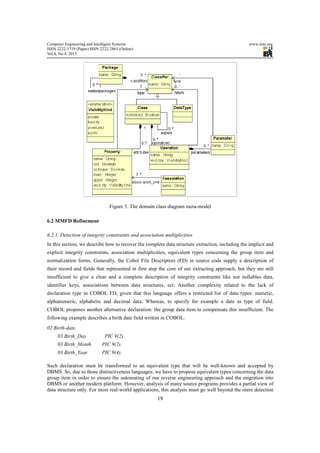
manufacturing. We note that The DCD meta-model shown in figure 5 is a reduced and simplified UML
class diagram [14, 18, 19] that respects the MOF specifications [23]. The meta-class “CLASS” which may
inherit from other classes is composed of properties and operations. A property can be simply an attribute
or an association end that belongs to an association. The operation can contain parameters and it can return
a value. The property, operation’s return and its parameters have a type that can be object class or a
DATATYPE. A property can represent the identifier class; in this case its feature isID must be true.
Concerning the property features lower and upper, they represent the different kind of association
multiplicities.
Computer Engineering and Intelligent Systems www.iiste.org
ISSN 2222-1719 (Paper) ISSN 2222-2863 (Online)
Vol.4, No.4, 2013
19
Figure 5. The domain class diagram meta-model
6.2 MMFD Refinement
6.2.1. Detection of integrity constraints and association multiplicities
In this section, we describe how to recover the complete data structure extraction, including the implicit and
explicit integrity constraints, association multiplicities, equivalent types concerning the group item and
normalization forms. Generally, the Cobol File Descriptors (FD) in source code supply a description of
their record and fields that represented in first step the core of our extracting approach, but they are still
insufficient to give a clear and a complete description of integrity constraints like not nullables data,
identifier keys, associations between data structures, ect. Another complexity related to the lack of
declaration type in COBOL FD, given that this language offers a restricted list of data types: numeric,
alphanumeric, alphabetic and decimal data. Whereas, to specify for example a date as type of field.
COBOL proposes another alternative declaration: the group data item to compensate this insufficient. The
following example describes a birth date field written in COBOL.
02 Birth-date.
03 Birth_Day PIC 9(2).
03 Birth_Month PIC 9(2).
03 Birth_Year PIC 9(4).
Such declaration must be transformed to an equivalent type that will be well-known and accepted by
DBMS. So, due to those distinctiveness languages, we have to propose equivalent types concerning the data
group item in order to ensure the automating of our reverse engineering approach and the migration into
DBMS or another modern platform. However, analysis of many source programs provides a partial view of
data structure only. For most real-world applications, this analysis must go well beyond the mere detection
Computer Engineering and Intelligent Systems www.iiste.org
ISSN 2222-1719 (Paper) ISSN 2222-2863 (Online)
Vol.4, No.4, 2013
20
of the record structures declared in the programs [4]. Therefore, it’s a necessary to include also the analysis
of the legacy data that exist in files in addition to the source code to obtain the entire description of data. In
the second step, based on the structure or the format of the record described in FD and already extracted,
we access to the physical files to parse data and retrieve the necessary constraint, association multiplicities
normal forms and new types to complete our description. To the best of our knowledge all previous work in
literature has done very little research on extracting the constraints and equivalent types from the exiting
data in files. Meanwhile, such physical data contains vital information that can be retrieved implicitly [5].
Our proposal is to use the physical data present in files in order to normalize the resulting database and
complete data description like primary key, not-null constraint, foreign key, association multiplicities
between data structures, equivalent types etc. The following paragraph will further illustrate the principals
rules used to obtain a complete data description:
1) Primary key Rule
Sometimes, the record key is not declared, such as sequential files. In fact, analyzing only source code is
useless to determine the record key and the alternative will be analyzing data existing in files. Assume we
have different occurrences of Record R1 in physical data file. We determine the record key RK or the
primary key by choosing the minimal field(s) where their values are unique and unrepeated. If they are
more than one candidate key we exceed to other criteria: the type and the length of the field(s). It is
judicious to choose from key candidates, an integer primary key and it is shorter (less length) than the other
ones. The following equation (1) shows the above explained:
(1)
2) Unique Rule
Let Fi a record field, to ensure that Fi is unique its values must be unique and they are not repeated in the
different record occurrences.
(2)
3) Not-null Rule
This rule allows determining the fields which are annullable by examining their values in physical files and
ensuring that they are all not null or not empty. So the corresponding equation (3):
(3)
4) Foreign key Rule
Suppose that we have two records R1 et R2 and RK1 is the record key of the Record R1.To find foreign
key in R2, we must consider only fields existing in R2 with the same type as the record key RK1 in R1. If
they are many ones, from those we chose the field(s) that their values exist as values of RK1 in R1. The
following illustrate the equation (4) used to retrieve foreign key from R2.
(4)
5) Bidirectional Association one-to-one/one-to-many Rule














<≠∀
≡
≠∈∧≠∀
∈∃
=
)jlength(F)ilength(Fi,j
integer)itype(F
kVj)/ViValues(FkVjVk,j
R1ii/F
RKR1








≠∈∧≠∀
∈∃
=
kVjV/)iF(ValueskVjV,kj
1RiF/i
RK1R






φ≠∈∀
∈
=
i/V)iF(ValuesiVi,
R1F
null-notF














∈⇒∈∀
≡
∈∃
=
=
)1RK(ValuesVj)F(ValuesV,j
)1RK(type)F(type
2RF/i
1R1RKSoit
2R
ij
i
i
RK
FK
Computer Engineering and Intelligent Systems www.iiste.org
ISSN 2222-1719 (Paper) ISSN 2222-2863 (Online)
Vol.4, No.4, 2013
21
After determining the foreign key of Record R2, we can deduce automatically that the multiplicity of
association in the side of the record R2 is one-to-one. But the multiplicity in the other side next to the
record R2 will be resolute by verifying if the values of the foreign key in R2 are unique and not null, in this
case we can deduce that it’s same one-to-one association in the two directions. Else, it will be one-to-many
or zero-to-many in side of R1 and one-to-one in side of R2. The following equations (5) to (6) determine all
cases treated in this rule:
(5)
(6)
6) Bidirectional Association many-to-many Rule
Assume that the record R has whole of physical data parsed in file corresponding to it issued from others
records without further adding others ones. Otherwise, if R a record that contains only FK1 a foreign key
issued from a record R1 and FK2 is another one issued from R2. Consequently, the record R is transient
and it’s only used for establish relationship between records. The result multiplicity will be many-to-many
for each side of the association between R1 and R2. Concerning the lower multiplicity is depends on
verifying if the values of foreign keys are sometimes null.
(7)
7) Equivalent type date Rule
Suppose in Record file, we have a field Group G(DD,MM,YY) that contains three simple subfields. To
verify that the field G is a date type, we have to make sure that DD, MM and YY represent respectively
Day, Month and Year. That’s why we parse the physical data to examine that the different values of
subfields DD and MM are both greater than one and they are not exceed respectively thirty one days and
twelve months. Concerning the subfield YY, we have chosen that their values belong to the interval from
1900 until 2999. The following equation (8) interprets the rule:
(8)
8) Equivalent types for the rest of group item Rule
Concerning the group data item we analyze the subfields types by verifying if they are similar in this case
the equivalent type of group item will be same as its subfields but its size will be the sum of the whole
subfields sizes. Otherwise, if the subfields types are different, in this case the equivalent type of the group
item will be always alphanumeric (PIC X) and idem its size will be the sum of subfields sizes.
1..1)2R1R(tymultiplici
kV)FK(ValkV/kjViV),FK(ValjV,iVji/j,i
1..0)2R1R(tymultiplici
kV),kF(ValkV/kjViV),FK(ValjV,iVji/j,i
1)1R2R(tymultipliciFK2RFK
one-to-one


















=→⇒
φ≠∧∈∀∧≠∈∧≠∀
=→⇒
φ=∈∃∧≠∈∧≠∀
=→∧=
=


















=→
⇒φ=∧∈∃∧=∈∧≠∀
=→
⇒φ≠∧∈∀∧=∈∧≠∀
=→∧=
=
*..0)2R1R(tymultiplici
V)FK(ValV/kVV),FK(ValV,Vji/j,i
*..1)2R1R(tymultiplici
kV)FK(ValkV/kVV),FK(ValV,Vji/j,i
1)1R2R(tymultiplici2RFK
many-to-one
kkjiji
jiji
FK
*..1)1R2Ry(ultiplicitm
*..1)2R1R(yultiplicitm2FKF1FKF,RF,i
2R2FK1R1FKSoit
many-to-many jiii
FKFK










=→
=→⇒=∨=∈∀
=∧=
=














≡⇒
≥∧≤∈∀
≥∧≤∈∀
≥∧≤∈∀
=
ii
iii
iii
iii
Date)F(type
1958YY2999YY/)YY(ValuesYY,i
1DD12MM/)MM(ValuesMM,i
1DD31DD/)DD(ValuesDD,i
Gdate
Computer Engineering and Intelligent Systems www.iiste.org
ISSN 2222-1719 (Paper) ISSN 2222-2863 (Online)
Vol.4, No.4, 2013
22
(9)
6.2.2. Normalization Rules
The essential goal of normalization is to avoid transactional anomalies that can result from poor data
modeling and avoid a number of probable problems such as reading anomalies, writing anomalies, data
redundancy and non performance. normalization of data models allows verifying the robustness of their
design to improve the modeling and to optimize data storage by applying the normal forms. Normal forms
are nested, so the respect of the normal form of higher level implies respect for the normal forms of lower
levels.
1) 1st
normal form (1NF)
In Cobol programs, multivalued fields are generally declared as arrays like a customer record that can have
tree adresses at same time:
01 Customer
02 REF PIC 9(4).
02 Name PIC X(25).
02 Adress PIC X(50) OCCURS 3.
In this case normalization in 1NF consists of avoiding the multivalued fields by transforming the array data
item to a new record associated with the first record. Note that relationship multiplicity should be
one-to-many in side of the record that contains the array and one-to-one in the other side. Otherwise, the
array data item in customer record will be remplaced by an adress reference field (foreign key).
2) 2nd
normal form (2NF)
The second normal form preconizes that the first one is respected and for each field which does not belong
to the record key depends not only on a part of the key but it must depend completely on the key. So, If the
record key is elementary the problem is not raised and the record data structure respect automatically the
second normal form. On other hand, if the record key is composed from many fields, we must verify in the
legacy data existing in physical files, if the values of the different key components are same and identicals
when the values of any other field does not belongs to it are identicals also. Otherwise, the field depends
only from a part of key that don’t change its values. The following equation (10) resume the 2NF rule :
(10)


















=∧=⇒≠∧≠∀
=∧=⇒=∧≠∀
∈
=
∑
∑
=
=
n
i
iji
n
i
iiji
n
SsizeGsizePICXGtypeStypeStypejiji
SsizeGsizeStypeGtypeStypeStypejiji
RSSSGSoit
Gtype
1
1
)()()()()(/,
)()()()()()(/,
),...,2,1(
)(
[ ]n,1k)F(V)F(VVV
)F(ValuesV,V;ji;j,i/RFRF,F
)R(Values))F(V),...,F(V),F(V(V)F,..,F,F(RSoit
FN2
kjkiji
jiRK
RKn21RKn21RK












∈∀=⇒=
∈≠∀∉∧∈∀
∈=∧=
=
Computer Engineering and Intelligent Systems www.iiste.org
ISSN 2222-1719 (Paper) ISSN 2222-2863 (Online)
Vol.4, No.4, 2013
23
After applying the equation (10), the existence of any field F that don’t depends completely on record key,
can be normalize through creating a new record that contains the part of key and the field that depends on it
and associate finally this new one with the old record. To decompose the data in order to respect the 2NF
the following algorithm describes the decomposition process:
is if there is a part of key fields F1, ..., Fn determinant of non-key field F : (by applying the equation 2NF)
1. We create a new record R' that contains F as non-key field and F1,…Fn as the primary key
2. F are removed from the initial record
3. Repeat the step 1 and 2 on R∖ and R’.
3) 3rd
normal form (3NF)
The third normal form assume that the second one is respected and for each field which does not belong to
the record key depends directly on it. In order to respect the 3NF, we must verify in the legacy data existing
in physical files, if there are any fields F1 and F2 that didn’t belong to the record key and when the values
of the F1 are same and identicals, the values of F2 are identicals also. therfore, the field F1 don’t depends
directly from record key but it depond from F2. The following equation resume the 3NF rule :
(11)
The equation (11) allows applying the 3NF on record data structure, by creating a new record which
contains the fields that do not depends directly on record key and associated them with the first record. The
principe of decomposition is for each non-key field F determinant of non-key fields F1, ..., Fn :
1. We create a new record R' with further F as the primary key and F1, ..., Fn as non-key fields
2. F1…Fn are removed from the initial record
3. R’ is not necessarily in 3NF. If this happens, repeat the process on R’
6.3 Transformation Mapping Rules
In this section, and so as to bring our proposal closer to readers and make them familiar with the principles
on which the transformation is based. We will introduce the main transformation rules written in a natural
language in table 1 and an example is given of a simple merge model of file descriptors extracted from
many COBOL programs means CETL. The case study is about the management of customer’s commands.
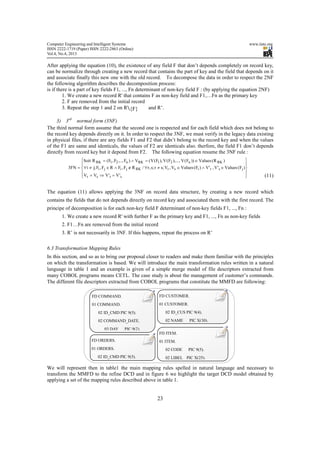
The different file descriptors extracted from COBOL programs that constitute the MMFD are following:
We will represent then in table1 the main mapping rules spelled in natural language and necessary to
transform the MMFD to the refine DCD and in figure 6 we highlight the target DCD model obtained by
applying a set of the mapping rules described above in table 1.
{F}
FD CUSTOMER.
01 CUSTOMER.
02 ID_CUS PIC 9(4).
02 NAME PIC X(30).
FD COMMAND.
01 COMMAND.
02 ID_CMD PIC 9(5).
02 COMMAND_DATE.
03 DAY PIC 9(2).
FD ITEM.
01 ITEM.
02 CODE PIC 9(5).
02 LIBEL PIC X(25).
FD ORDERS.
01 ORDERS.
02 ID_CMD PIC 9(5).
'V'VVV
)F(Values'V,'V)F(ValuesV,V;sr;s,r/RF,FRF,F;ji
)R(Values))F(V),...,F(V),F(V(V)F,..,F,F(RSoit
FN3
srsr
jsrisrRKjiji
RKn21RKn21RK










=⇒=
∈∧∈≠∀∉∧∈≠∀
∈=∧=
=
Computer Engineering and Intelligent Systems www.iiste.org
ISSN 2222-1719 (Paper) ISSN 2222-2863 (Online)
Vol.4, No.4, 2013
24
Table 1. The main mapping rules from MMFD to DCD
Rule From To Mapping Description
1 Record Class Each record in the FD merge model give place to one class
2
Simple
field
Attribute
The record’s field is mapped to an attribute keeping the same
name but its type is transformed into a DataType as follows :
Picture 9 or S9 int
Picture X or A string
Picture 9V9 or S9V9 float
3
Group
field
Attribute with an
equivalent type
The Group field will be transformed into an attribute but its
type will be deducted from types corresponding to the sub
fields existing in the Group and its size will be the sum of all
subfields attributes (Refinement rules).
4
Record
key
Attribute
isId=true,
isUnique=true,
lower=1,upper=1
The record’s key becomes an attribute which features isId and
isUnique equal to true. The lower and upper values must be
equal to 1 to avoid values null.
5 Array
Class with
multiplicities :
lower=1,upper=1
An Array Field becomes in DCD a new class associated with
the Class corresponding to the record that contains the array
further the multiplicity one-to-one is placed in side of the new
class and one-to-many in other side (1NF).
6
Foreign
Key
Association End
the foreign key detected by parsing physical files give place to
the creation of two association ends in DCD with the
multiplicity one-to-one in side of the Association end that
corresponds to the foreign key
7
2NF
and
3FN
New Classes
In case to obtain a normalized database, the 2NF and 3FN
consist in split classes into others new ones means the
algorithms described above
Computer Engineering and Intelligent Systems www.iiste.org
ISSN 2222-1719 (Paper) ISSN 2222-2863 (Online)
Vol.4, No.4, 2013
25
Rule 5
Rule 4
Rule 1
Rule 2
Rule 3
Refine Domain Class DiagramMerge Model File Descriptors
Figure 6. The intermediate DCD model
7. Getting Relational Database
The described MDRE assets enable obtaining a normalized and integrated relational database represented
by the target model transformation of our proposal the RDM and automated generation of script code to
generate database from it. Indeed, in this section we present the target RDM meta-model and the main rules
used to obtain it through the DCD as well as the DDL SQL script to create database.
In figure 7, the meta-model describe the normalized relational schema of database which shows the
principals meta-classes: The meta-class “Table” that contains columns. On the other hand, the abstract
meta-class Constraint defines the different integrity constraints that we can apply to many table columns
such as PrimaryKey, ForeignKey, NotNull and Unique. Each ForeignKey constraint must references a table
in the schema. Concerning the check integrity, the values in the data files are not enough sufficient to
deduce a check constraint on the corresponding column. Nevertheless, we can also add it in the RDM
model before generating the script through investigating the domain knowledge of the project owner. The
resulting RDM diagram is an intermediate model representation of the relational database, which can be
transformed into code according to the query ATL presented below. The resulting code is a DDL SQL
script that allows finally creating the database through the RDM.
Regarding the main mapping rules used to transform the DCD to RDM model are following:
Each class becomes a table,
Attributes class becomes table columns. Regarding those that their features isId are equal to true
will give place to the integrity constraint Primary key. About property features lower and upper in
DCD, if are both equal to 1 subsequently the RDM column is not nullable (the column has the
integrity constraint Not Null). Sometimes to create database we have to specify the column size,
precision and scale for decimal data, in this case we can use further the MMFD as source model to
retrieve those information. Finally, column can be unique if the attribute class is also unique in
DCD (the table column will have the constraint Unique).
Computer Engineering and Intelligent Systems www.iiste.org
ISSN 2222-1719 (Paper) ISSN 2222-2863 (Online)
Vol.4, No.4, 2013
26
Concerning the association ends, each one that has the values of their lower and upper
multiplicities are 1 will be mapped to the integrity constraint ForeignKey added to the
corresponding column table.
To generate the script, we must pay attention to the order of tables creation, since a table that contains a
foreign key which references another table can be created only when this last i.e. the reference table is first
created or if the tables are initially created and the foreign keys constraints are added by means “ALTER
TABLE”. Generally, the RDM model contains resulting tables in any order. Thus, in the query ATL used to
generate the DLL SQL script; we have chosen to add the foreign keys constraints at the end of the resulting
script after creating all domain tables.
Figure 7. The relational database meta-model
Figure 8. The resulting relational database model
ResultingSource DCD
Integrity
constraints
Computer Engineering and Intelligent Systems www.iiste.org
ISSN 2222-1719 (Paper) ISSN 2222-2863 (Online)
Vol.4, No.4, 2013
27
The generated SQL script to create the resulting relational database
8. Discussion and Evaluation
As mentioned above, the maintenance and the evolution of the enterprise’s legacy systems are becoming
crucial to improve the concurrency and the productivity of those enterprises in spite of the higher cost and
the complexity to maintain and evolve them. In this paper, we have shown how we can address this
problem by benefit from the most of the advantages of the MDE approach, and have defined the
meta-models according to the different MDA abstraction levels (the COBOL meta-model related to the
PSM level, the domain class diagram and relational database corresponding to the PIM level) and shown
how the transformation between PSM and PIM models can be made. In further of this model
transformation, the proposal presents how the target relational database has been normalized and integrated
by means the CASE toolset CETL. After testing the proposal with our case study, we are in a position to
Resulting Data Definition Language to create Database
CREATE TABLE ITEM(CODE integer ,LIBEL varchar(25) not null,QTS integer ,PRICE real ,
Constraint PK_ITEM Primary key(CODE));
CREATE TABLE CUSTOMER(ID_CUS integer ,NAME varchar(30) unique,Constraint
PK_CUSTOMER Primary key(ID_CUS));
CREATE TABLE ORDERS(ID_CMD integer not null,CODE integer not null,QTC integer not
null,Constraint PK_ORDERS Primary key(ID_CMD,CODE));
CREATE TABLE COMMAND(ID_CMD integer ,COMMAND_DATE timestamp not null,ID_CUS
integer
not null,Constraint PK_COMMAND Primary key(ID_CMD));
CREATE TABLE ADRESS(adress varchar(50) ,ID_CUS integer not null,Constraint PK_ADRESS
Primary key(adress));
ALTER TABLE ORDERS
ADD Constraint FK_ORDERS_ID_CMD Foreign Key(ID_CMD) references COMMAND;
ALTER TABLE ORDERS
ADD Constraint FK_ORDERS_CODE Foreign Key(CODE) references ITEM;
ALTER TABLE COMMAND
ADD Constraint FK_COMMAND_ID_CUS Foreign Key(ID_CUS) references CUSTOMER;
ALTER TABLE ADRESS
ADD Constraint FK_ADRESS_ID_CUS Foreign Key(ID_CUS) references CUSTOMER;
Computer Engineering and Intelligent Systems www.iiste.org
ISSN 2222-1719 (Paper) ISSN 2222-2863 (Online)
Vol.4, No.4, 2013
28
discuss two major points: one concerning the characteristics of the CETL tool, and which differs from
previous tools presented above, and one concerning the entire MDRE approach.
Related to the first point about tools, the RM/plusDB [6] does not include the meta-modeling concepts, but
it provides an alternative solution allowing COBOL programs access directly to RDBMS instead of access
data files without making any programs change. In other side, SEELA [24] is a reverse engineering tool
that works with many legacy languages such as Ada, Cobol, C, Pascal, PL/M and FORTRAN and it
supports the maintenance and the documentation of structured programs. Meanwhile, it doesn’t incorporate
the PSM meta-models appropriates to those languages and it doesn’t focus on extracting data description or
integrity and normalization rules. It is more oriented treatement and documentation than description of data.
Cobol Access Plus (CAP) [37] has many common points with our CETL tool since CAP operates on file
descriptors in COBOL source language and it generate a common file the Interface
Table 3. Differences between reverse engineering tools
Tool Parsing
source code
Extract integrity
constraints
Extract
FD
Support
Normalization
Support
meta-modeling
RM/plusDB √ X X X X
SEELA √ X √ X X
Cobol √ √ √ √ X
Eclipse √ X X X √
CETL √ √ √ √ √
Dictionary database (DID) to generate database. But for each new changes according the resulting database
obtained by means CAP, we should provide a modification directly on database or reproduce again the
whole process since CAP doesn’t integrate a database model. Finally, Eclipse MoDisco [25] provides an
extensible framework to elaborate a model-driven tool supporting software reverse engineering and
language modernization. And especialy for COBOL, it proposes a COBOL meta-model which
unfortunately does not include the description of data related to the File descriptors presents in programs.
Indeed, the most previous toolsets do not include the MDE concepts and they do not extract generally the
integrity constraints or normalize database by parsing legacy data. Regarding our CETL toolset, it extracts
the different components of COBOL programs and especially the description of file data, to generate a XMI
model conforming to the Cobol meta-model. it can parse also the data stored in physical files of different
organizations: (sequential, indexed line sequential) in order to deduce the integrity constraints and verify
the normalization forms. The CETL tool can be improved to produce the model transformation between
models without need to include the ATL language and ensure totally the automatic process of our proposal.
Table 2 sumurize the main caracteristics and differences between CETL and the selected tools.
The second point of our discussion concerns the evaluation of our MDRE approach, that presents an
automatic process to generate relational database from legacy data extracted from Cobol programs by
transforming the related PSM into the DCD PIM which can open others perspectives to generate further the
relational database, the business objects and the data access objects in order to extend our proposal to
obtain a partial or a total migration into modern platforms such as JEE7 or .NET. While, the proposal works
on COBOL programs that are conform to the norm ANSI 85, the others norms do not affect significantly
our transformation or generally our MDRE approach. Finally, with regard to extract the integrity
constraints and the normalization forms from legacy data, the following considerations must be taken into
account to succeed the proposal:
It is appropriate in our approach to make a choice of programs that work on persistent data files
and it’s not recommend to include programs maneuvering files, sorting, intermediate calculations,
reporting etc.
When the files contain consistent recordsets and more the data volume is greather, there will be
more pertinent results according to extracting of data integrity constraints and normalization
forms.
Computer Engineering and Intelligent Systems www.iiste.org
ISSN 2222-1719 (Paper) ISSN 2222-2863 (Online)
Vol.4, No.4, 2013
29
9. Conclusion and perspectives
Nowadays, many companies still use legacy systems to manage their business, but unfortunately some of
those systems represent a serious problem since they employ non-integrated, inconsistent, and non
normalized data without documentation and modeling supports. Hence, their maintenance and scalability
become too expensive and practically very complex. Our approach proposes a solution that helps them to
be able to control and reduce the cost of legacy system’s maintenance and evolving. The proposal allows
also these companies to be ready for a possible migration of their legacy data to integrated and normalized
relational databases. In this paper, we presented a reverse engineering process based on model-driven
approach to perform this migration.
Before introducing the model-driven reverse engineering an overview of the related works is given
especially those that were interested in reverse engineering. Next, we have presented the main goal of this
proposal that consists firstly on the parsing COBOL source code in order to extract the data structure in a
design PSM that is conform to the COBOL meta-model. Secondly, the different extracted PSM models are
merged in a common model entitled the MMFD necessary to produce a reverse model transformation to
obtain the analysis PIM DCD, which is refined in next phase by adding the integrity constraints and normal
forms, getting out from the physical files corresponding to the programs already parsed. Finally, the refine
DCD will be mapped to the RDM and a DLL SQL script is generated to create a normalized and integrate
relational database.
Our approach falls into the topic which is specialized in applying MDA to automate reverse engineering
process and presents many advantages to practitioners and researchers from industry and academia with a
vested interest in this area to discern the advantages of using MDA approach in reverse engineering
processes. Thus, the different contributions of our work are migrating legacy systems to new scalable ones
that are independents of platforms and protected from any technology rupture, improvement of system
maintenance is an additional proposal’s contribution since the modern platform and languages are much
less expensive to maintain than legacy system. And finally the proposal reduces time re-engineering given
that MDE is a generative approach. In regards to perform our MDRE process the CASE toolset CETL is
developed to extract the both information: structure and rules necessary to obtain the expected result.
This work is a part of other ones that falls into our area of research about reengineering legacy systems that
aims recovering knowledge hidden in those old systems by means of automated reverse engineering
processes and modernize them through automated forward engineering processes [38, 39, 40, 41, 42, 43].
To conclude, modernization of the entire legacy systems by applying reverse engineering process based on
MDE is a vast area of research and it’s still the principal goal that we intend to attain. Meanwhile, we are
convinced that our work is a step in the right direction which can be enriched in future work by
modernizing other parts of legacy systems such as proposing a solution to evolve legacy reporting or
migrating completely legacy systems to modern platforms such as JEE7 or .NET.
References
[1] Darryl, K. Taft: “Application Development: Modernizing COBOL Apps: 10 Reasons Why It`s
Important”; eweek 2011-01-24.
[2] http://www.microfocus.com/aboutmicrofocus/pressroom/releases/pr20100120709820.asp
[3] Jean-Marie Favre, Jonathan Musset ; « Rétro-ingénierie dirigée par les métamodèles » ; Actes des
2èmes journées IDM06, à Lille
[4] J-L. Hainaut, J-M.Hick, J.Henrard, D.Roland, V.Englebert, Knowledge Transfer in Database Reverse
Engineering A Supporting Case Study, Institut d’Informatique, University of Namur, rue Grandgagnage,
21- B-5000 Namur, IEEE 1997.
[5]M. R.Abbasifard, M. Rahgozar, A. Bayati and Pournemati, “Using Automated Database Reverse
Engineering for Database Integration”, International Journal of Engineering and Applied Sciences 1:4 2005
Computer Engineering and Intelligent Systems www.iiste.org
ISSN 2222-1719 (Paper) ISSN 2222-2863 (Online)
Vol.4, No.4, 2013
30
[6] Spencer Rugaber, Srinivas Doddapaneni, “The Transition of Application Programs From COBOL to a
Fourth Generation Language”, ICSM '93 Proceedings of the Conference on Software Maintenance, IEEE
Computer Society Washington, 1993
[7] Chih-Wei Lu, William C.Chu,Chih-Hung Chang,Yeh-Ching Chung, Xiaodong.Liu and Hongji.Yang
“Reverse Engineering”, Handbook of Software Engineering and Knowledge Engineering, Vol.2, p. 5
[8] Edward Yourdon, Structured Walkthroughs, Yourdon Press, 1989
[9] Jean-Luc Hinaut, Introduction to Database Reverse Engineering. LIBD-Laboratory of Database
Application Engineering Institut d’Informatique- University of Namur; May 2002
[10] Chikofsky, E.J., Cross, J.H.: “Reverse engineering and design recovery: A taxonomy”. IEEE Softw.7
(1) (1990).
[11] Florian Deissenboeck, Daniel Ratiu, “A Unified Meta-Model for Concept-Based Reverse
Engineering”, Proc 3rd International Workshop on Metamodels Schemas Grammars and Ontologies for
Reverse Engineering ATEM’06 Johannes Gutenberg Universitat Mainz (2006)
[12] A Proposal for an MDA Foundation Model (2005-04-01), p. 2
[13] C. Atkinson and T. Kühne: "Model-Driven Development: A Metamodeling Foundation", in: IEEE
Software, September/October 2003 (Vol. 20, No. 5), IEEE, pp. 36-41
[14] Object Management Group, Inc. Unified Modeling Language (UML) 2.1.2 Infrastructure,November
2007. Final Adopted Specification, ptc/03-09-15, p.28
[15] Rahgozar M, Oroumchian F., “An effective strategy for legacy systems evolution”, Journal of software
Maintenance & Evolution. Issue 5, Volume 15, September 2003
[16] Casanova M., Amarel De Sa., “Mapping uninterpreted Schemes into Entity-Relationship diagrams,
two applications to conceptual schema design”. IBM J. Res. & Dev., Vol.28, No1, 1984.
[17] Casanova M., Amarel De Sa., “Designing Entity Relationship Schemas for Conventional Information
Systems. In Proc. Of Entity-Relationship Approach, pp. 265-278, 1983.
[18] Object Management Group, Inc. Unified Modeling Language (UML) 2.1.2 Superstructure,November
2007. Final Adopted Specification.
[19] Rumbaugh, Jacobson, et al. - The Unified Modelling Language Reference Manual - 1999
[20] Howden, W.E.; Pak,S., “Problem Domain, Structural and Logical Abstractions in Reverse
Engineering”, Proceedings of the International Conference on Software Maintenance, IEEE Computer
Society Press, pp.214-224,1992
[21] Nilsson E., G., “The translation of COBOL Data Structure to an Entity-Rel-type Conceptual Schema”.
Proceeding of ERA Conference, IEEE/North-Holland 1985
[22] Edwards H. M., Munro M., “Deriving a Logical Model for a System Using Recast Method”.
Proceedings of the 2nd IEEE WC on Reverse Engineering, Toronto, IEEE Computer Society Press 1995.
[23] Object Management Group, Inc. Meta Object Facility (MOF) 2.0 Core Specification, January2006.
Final Adopted Specification.
[24] Harband, J., “SEELA: Maintenance and Documenting by Reverse Engineering”, Proceedings of the
International Conference on Software Maintenance, IEEE Computer Society Press, p.146.1990
Computer Engineering and Intelligent Systems www.iiste.org
ISSN 2222-1719 (Paper) ISSN 2222-2863 (Online)
Vol.4, No.4, 2013
31
[25] JavaTech Journal #10 focusing on Eclipse Indigo,”Eclipse Modisco”, 06-2011
[26] S. Sendall, W. Kozaczynski, Model transformation–the heart and soul of model-driven software
development, IEEE Software Archive 20 (5) (2003) 42–45.
[27] Freddy Allilaire , Jean Bézivin , Frédéric Jouault , Ivan Kurtev, ATL – Eclipse Support for
Model Transformation (2006) : Proc. of the Eclipse Technology eXchange Workshop (eTX) at ECOOP
[28] ATL - a model transformation technology, http://www.eclipse.org/atl/
[29] F. Jouault, F. Allilaire, J. Bezivin, I. Kurtev, ATL: a model transformation tool, Science of Computer
Programming 72 (1–2) (2008) 31–39.
[30] Hausler, PA.; Pleszkoch, M.G.; Linger, R.C.; Hevner, A.R., “Using Function Abstraction to
Understand Program Behavior”, IEEE Software, 7(1), pp. 55-63, January 1990.
[31] Holtzblatt, L.J.; Pizza, R.L; Reubenstein, H.B; Roberts, S.N; Harris, D.R., “Design Recovery for
Distributed Systems”, IEEE Transactions on Software Engineering, 23(7), pp. 461-472, July 1997.
[32] Rock-Evans, R.1990. Reverse Engineering:Markets, Methods and tools, OVUM report
[33] Object Management Group, Meta Object Facility (MOF) 2.0 Query/View/Transformation
Specification, OMG Adopted Specification ptc/05-11-01, 2005,
[34] Davis K., Arora A., A Methodology for Translating a Conventional File System into an
Entity-Relationship Model. Proceedings of ERA, IEEE/North-Holland 1985.
[35] Sere, K.; Wald’en, M., “Reverse Engineering Distributed Algorithms”, Journal of Software
maintenance: Research and Practice, 8(2), pp. 117-144,1996.
[36] OMG, « Object Constraint Language (OCL) Specification, version 2.0 », 2006. http
://www.omg.org/spec/OCL/2.0/.
[37] http://www.rldt.fr/fr/caplus.htm
[38] Omar EL BEGGAR, Brahim BOUSETTA, Taoufiq GADI, Generating methods signatures from
transition state diagram: A model transformation approach. Information Science and Technology (CIST),
2012 IEEE Colloquium in Fez, 4-9
[39] EL BEGGAR Omar, BOUSETTA Brahim, GADI Taoufiq. Automatic code generation by model
transformation from sequence diagram of system’s internal behavior. International Journal of Computer
and Information Technology (IJCIT). November 2012 Vol. 1, Issue: 2. p129-146.
[40] EL BEGGAR Omar, BOUSETTA Brahim, GADI Taoufiq. Comparative Study between Clustering
and Model Driven Reverse Engineering Approaches. International Journal of Lecture Notes on Software
Engineering (LNSE). 2013. In press
[41] EL BEGGAR Omar, BOUSETTA Brahim, GADI Taoufiq. Comparative Study between Clustering
and Model Driven Reverse Engineering Approaches. The 5th International Conference on Computer
Engineering and Technology (ICCET 2013). Vancouver, Canada, 13 and 14 April 2013.
[42] BOUSETTA Brahim, EL BEGGAR Omar, GADI Taoufiq. Generating operations specification from
domain class diagram using transition state diagram. International Journal of Computer and Information
Technology (IJCIT) January 2013 Volume 2, Issue: 1. p29-36.
[43] BOUSETTA Brahim, EL BEGGAR Omar, GADI Taoufiq. A methodology for CIM modelling and its
Computer Engineering and Intelligent Systems www.iiste.org
ISSN 2222-1719 (Paper) ISSN 2222-2863 (Online)
Vol.4, No.4, 2013
32
transformation to PIM. Journal of Information Engineering and Applications ISSN 2224-5782 (print)
ISSN 2225-0506 (online) Vol 3, No. 2, p-1-24, 2013
Omar EL BEGGAR obtained his Bachelor in Mathematics Sciences at the Royal
College Preparative for Aeronautical Techniques (CRPTA) in 1997. He received
his Degree in Informatics Engineering from the National School of Computer
Science and Systems Analysis (ENSIAS) in 2002. He later prepares his PhD
degree in the university Hassan 1st
faculty of science and technologies (FST) since
2010. Currently, he is teaching Software Engineering at the same university. He is
a member of LAVETE Laboratory and co-author of the book "UML Modeling
Guide”. His research interest focuses on Model Driven Engineering, software
process, agility systems and modernization of legacy systems with relevant publication in those disciplines.
Email: elbeggar_omar@yahoo.fr
Brahim BOUSETTA received his Degree in Informatics Engineering from
Hassan II Institute for Agronomy and Veterinary, Statistics and informatics
Department in 2007. He later prepared his PhD degree in the Hassan 1st
University, faculty of science and technologies of Settat (FSTS) since 2010. His
main interests of research are: Software Engineering, Model Driven Engineering
and Development on JEE platform. Currently, he is teaching Software
Engineering at the same university and a member of LAVETE Laboratory. He has
published papers in some prestigious scientific and professional journals and
magazines,. He is the co-author of the book "UML Modeling Guide”. You may contact him at
ibbousetta@gmail.com.
Taoufiq GADI received his PhD degree from the university Sidi Mohamed Ben
Abdellah in fez in 1997. Currently, he is Professor at the university Hassan 1st
faculty of Sciences and Technologies (FST), member of the Mediterranean
network and Telecommunication journal (RTM), reviewer in many relevant
journals and chair in many national and international conferences. He is a director
of the 2IDGL Laboratory, author of many books in software engineering and
informatics science such as "UML Modeling Guide", " Object Oriented
Programming” and leadership of research’s teams on Software engineering and 3D Data base indexing.
You may contact him at gtaoufiq@gmail.com
This academic article was published by The International Institute for Science,
Technology and Education (IISTE). The IISTE is a pioneer in the Open Access
Publishing service based in the U.S. and Europe. The aim of the institute is
Accelerating Global Knowledge Sharing.
More information about the publisher can be found in the IISTE’s homepage:
http://www.iiste.org
CALL FOR PAPERS
The IISTE is currently hosting more than 30 peer-reviewed academic journals and
collaborating with academic institutions around the world. There’s no deadline for
submission. Prospective authors of IISTE journals can find the submission
instruction on the following page: http://www.iiste.org/Journals/
The IISTE editorial team promises to the review and publish all the qualified
submissions in a fast manner. All the journals articles are available online to the
readers all over the world without financial, legal, or technical barriers other than
those inseparable from gaining access to the internet itself. Printed version of the
journals is also available upon request of readers and authors.
IISTE Knowledge Sharing Partners
EBSCO, Index Copernicus, Ulrich's Periodicals Directory, JournalTOCS, PKP Open
Archives Harvester, Bielefeld Academic Search Engine, Elektronische
Zeitschriftenbibliothek EZB, Open J-Gate, OCLC WorldCat, Universe Digtial
Library , NewJour, Google Scholar

Getting relational database from legacy data mdre approach

  • 1.
    Computer Engineering andIntelligent Systems www.iiste.org ISSN 2222-1719 (Paper) ISSN 2222-2863 (Online) Vol.4, No.4, 2013 10 Getting Relational Database from Legacy Data-MDRE Approach Omar EL BEGGAR* , Brahim BOUSETTA, and Taoufiq GADI University Hassan 1st , Faculty of Sciences and Techniques, Settat, Morocco E-mail of the corresponding author: elbeggar_omar@yahoo.fr Abstract The previous management information systems turning on traditional mainframe environment are often written in COBOL and store their data in files; they are usually large and complex and known as legacy systems. These legacy systems need to be maintained and evolved due to several causes, including correction of anomalies, requirements change, management rules change, new reorganization, etc. But, the maintenance of legacy systems becomes over years extremely complex and highly expensive, In this case, a new or an improved system must replace the previous one. However, replacing those systems completely from scratch is also very expensive and it represents a huge risk. Nevertheless, they should be evolved by profiting from the valuable knowledge embedded in them. This paper proposes a reverse engineering process based on Model Driven engineering that presents a solution to provide a normalized relational database which includes the integrity constraints extracted from legacy data. A CASE tool CETL: (COBOL Extract Transform Load) is developed to support the proposal. Keywords: legacy data, reverse engineering, model driven engineering, COBOL metamodel, domain class diagram, relational database 1. Introduction The evolution of technology and the diversity of tools and platform were a nightmare for companies and left them trolling and running all the time behind. While in the current context of globalization, any company that wishes to be competitive should procure those new technologies in real time. However, the higher maintenance cost, the lack of documentation and the risk of data loss. Migrating legacy system to those modern platforms remains a pain for these companies which are still unable to keep pace. The older information systems ran on mainframe environment and they are often written in COBOL and store their data in files [6, 15]; they are usually large and complex and known as legacy systems. These legacy systems need to be maintained and evolved due to many factors, including error correction, requirements change, business rules change, structural reorganization, etc [7]. But, there are many problems to maintain and evolve legacy systems like the difficulty to retrieve and understand the original system specifications and especially when it’s a lack of modeling and documentation supports related to those systems. The higher cost of maintaining and evolving legacy systems represent also a challenge to surmount. This paper propose a reverse engineering process based on Model Driven Engineering (MDE) that represents a solution to provide systems ready to any improvements and to minimize the higher cost of migration. COBOL applications present the most important target of reverse engineering projects. Most of them use simple files to store persistent data [9]. The choice of COBOL is not arbitrary due to the wide diffusion of this programming language and its existence all these years in spite of the presence of other languages that are more sophisticated. Indeed, it was the most used language between 1960 and 1980 and it is still widely used in financial institutions, accounting, banks, insurance companies, government departments... Recently, a study published in the weekly computing business magazine “eWeek” in January 24th, 2011 affirms that the fourth quarter of 2010, 5 billion of new code lines COBOL are added each year. Furthermore, there is at least 1.5 to 2 million developers worldwide who currently work with COBOL. And there are over 200 times more transactions processed by COBOL applications than Google search engine every day [1]. In addition, the Micro Focus officials estimate that about 220 billion lines of Cobol code are used in business and financial applications today. And COBOL systems are powering more than 70% of the world’s businesses [2, 8]. After all, only the languages or softwares which are successful have been those that have attained maturity and old age. Many others are on the contrary not useful enough that we decided to retain and evolve them [3].
  • 2.
    Computer Engineering andIntelligent Systems www.iiste.org ISSN 2222-1719 (Paper) ISSN 2222-2863 (Online) Vol.4, No.4, 2013 11 In fact, since its standardization by ANSI, COBOL has seen some improvements like (ANS 2002: XML parsers, Object Oriented ...) and integration of tools such as CICS in mainframes and many other improvements. Meanwhile, this article does not oppose the search for better ways to change the language to perform new operations, on the contrary, our work is far from being a rejection of COBOL but there is another alternative to provide a production system modeled, documented, independent of any platform and being away from any technological rupture. The advantages of moving existing COBOL legacy data to relational database are both financial and technical: Data documented: The data provided by RDBMS are better documented due to the data dictionary. Data consistency: The data in RDBMS are consistent due to locks and concurrency access management. Database services: An RDBMS offers a variety of services that are not likely to be available in a standalone program, including: security, data integrity, transaction management (commit/rollback) and crash recovery [6]. Report generator: the reports can be established easily by report generator tools using a relational database than be implemented by code [6]. Improving scalability: Using Model Driven Reverse Engineering (MDRE) allows generating the database, documentation or other artifacts after each change by changing the source model and applying simply a model transformation to obtain a target model. Minimizing maintenance cost: the fourth generation language and modern platform are much less expensive to maintain than legacy system [6]. Reducing time development: using MDE in reverse engineering or re-engineering much reduces the time development since it’s a generative approach. The proposal aims firstly to parse and analyze a legacy data from file descriptors present in code sources in order to extract the data structure model which conforms to a COBOL meta-model. The data structures are then merged in a general model that we have called Merged Model File Descriptors (MMFD). Next, The MMFD will be refined by adding the integrity constraints and normal forms retrieved from physical files by applying a set of rules explained in detail in section 5. This phase is provided by using a CASE tool CETL®: (Cobol Extract Transform Load) that we have developed for this purpose. In the following MDRE phase, the normalized and integrate MMFD will be represented at a higher level of abstraction by applying a reverse model transformation to obtain a domain class diagram that will finally transformed to a relational database. Thus, the first scientific contribution of our work is proposing a reverse engineering approach including the paradigms and concepts of MDE which propose a COBOL meta-model and its model transformation to obtain the target relational database. Another scientific contribution of our work involves the development of the CASE tool CETL®: (Cobol Extract Transform Load) used for extraction of the whole description of legacy data, their integrity constraints and its normalization by observing data exiting in physical files. The rest of this paper is organized as follows: In the section 2, we present a statement of prior works in the topic of reverse engineering and the principal scientific contributions of our approach. The third section is dedicated to give an overview of our Model Driven Reverse Engineering MDRE. The next sections are devoted to describe the different phases of the MDRE. Thus, section 4 present the extraction phase and the COBOL meta-model used to extract the data structure from legacy data, section 5 treat the merge phase and present the toolset CETL used in our approach accompanied by a benchmark study to compare it with the other tools of the same family that are employed in the market or in research laboratories. Section 6 is dedicated to describe the model transformation as well as the mapping rules to obtain a Domain Class Diagram (DCD) and its refinement by adding integrity constraints and normal forms. Then, Section 7 is conserved to present and discuss the MDRE resulting. Finally, we conclude this article by presenting the actual state of our research and the next future works.
  • 3.
    Computer Engineering andIntelligent Systems www.iiste.org ISSN 2222-1719 (Paper) ISSN 2222-2863 (Online) Vol.4, No.4, 2013 12 2. Related works In this section, we will present many works in this area of research reverse engineering process, and the mainly differences with our approach. Firstly, a reverse engineering process aims to analyze a subject system for two goals: 1- To identify the system’s components and their interrelationships. 2- To create representations of the system in another from or at higher level of abstraction [10] Previous research on reverse engineering made great achievements concerning the first reverse engineering goal but there is very little researches in creating representation of the system in another form especially at higher level of abstraction [11] since the majority of researchers don’t integrate generally the meta-modeling and meta-models in their reverse engineering process as higher abstract representation of a system aspect and don’t benefit of the MDE advantages. Even though the metamodel as it is defined by OMG is a special kind of model that specifies the abstract syntax of a modeling language. It can be understood as the representation of the class of all models expressed in that language [12]. According to the MDE principles [14] using a metamodel means working at higher level of abstraction. Therefore, as it was defined by Chikofsky, to attain the second goal of reverse engineering, it’s judicious to use metamodels. Otherwise, evolving legacy system without benefit of a higher level of representation of functionality and structure presents risks of quality [6]. Atkinson and Kühne state that the main goal of MDE is to reduce the sensitivity of primary software artifacts to the inevitable changes that affect a software system [13]. Our MDRE approach belongs to this area of research that includes techniques and concepts of MDE and which places the metamodels in the core of the different phases of the reverse engineering. In [11], the related work presents a meta-model that unifies the conceptual view on programs with the classical structure-based reverse engineering meta-models and thereby enables the establishment of an explicit mapping between program elements and the real-world concepts that they implement. Concerning reverse engineering strategies, we can distinguish two general strategies [5,6,7, 20,30,31,35]; those that get out system features from the source code only. In this strategy, the retrieved information is completely included in code. The other strategy is knowledge-domain method, were the source code is analyzed based on knowledge-domain and further completed by data issued from other resources such as documents, interview with personnel, forms, reports etc. In our case, our approach belongs to the first category of strategies: extract entirely the description of legacy data from only source code and physical files. A lot of research performed in this first category of strategies [16,17,21,22,34] has been done about schema extraction from code source , but there has been limited work on reverse engineering of legacy data files which is interested in normalization and the extraction of the data integrity constraints from physical files, although those files contain important description and rules that can be retrieved. In [5] an approach was proposed for automated Database Reverse Engineering and data normalization for integrating systems based on observing data patterns to determine some constraint rules. But it didn’t present the whole integrity constraints and didn’t propose an equivalent to some particular types in legacy data to assume a completely translation to a relational database. Whereas, In our approach we present the necessary rules to extract from physical files the entire integrity constraints, equivalence types to replace some particular variables declaration in Cobol, different association multiplicities and normal forms to perform transformation from legacy data to a relational database normalized and integrate. Let’s assume that Database Reverse Engineering (DBRE) is a complex process that cannot be efficient without supporting CASE tools. A many number of commercial and laboratory tools try to support the DBRE functionalities. Though, many of those tools do not introduce the MDE principles to support their reverse engineering process, but they enable their users to extract almost embedded information in legacy applications [32]. We have chosen the selected reverse engineering tools to study their principal characteristics and finding the differences with our tool CETL. RM/plusDB [6]: provides a transparent mechanism to authorize existing COBOL programs access to RDBMS without having to be altered. It provides a runtime environment that converts IO
  • 4.
    Computer Engineering andIntelligent Systems www.iiste.org ISSN 2222-1719 (Paper) ISSN 2222-2863 (Online) Vol.4, No.4, 2013 13 statement to an access to RDBMS when a COBOL statement attempts to execute an IO operation to a file. SEELA [24]: supports the maintenance and the documentation of structured programs. It features a top-down program display that increases the readability of structured programs and includes a structure editor, browser, printer, and source code documentation generator. SEELA works with Ada, COBOL, C, Pascal, PL/M and FORTRAN code. SEELA was designed to bridge the gap between the project's design description and the source code, instead of requiring a separate program-design-language (PDL) description. Cobol Access Plus [37]: it operates on file descriptors in COBOL source language (the 'FDs' or File Descriptors) and will automatically generate a common file the Interface Dictionary database (DID), allowing therefore creating the database structures with the appropriate data files. This tool does not require a knowledge of the language associated with the chosen relational DBMS, the transition is automatic. Eclipse MoDisco [25]: it provides an extensible framework to elaborate on model-driven solutions supporting software reverse engineering and modernization use cases such as technical migration, software improvement, documentation generation, quality insurance, etc. In the conclusion, our approach that will be more explained in the next sections differs from other works in this area of research that are interested in the process of reverse engineering by the fact that it integrates: Meta-modeling and higher levels of abstractions Inclusion of integrity constraints Normalization of data structure An automate MDRE process Independent of technical platforms 3. Overview of our MDRE approach In this section, we will introduce our MDRE approach and the activities performed in each phase. Our MDRE approach consists of generating a normalized relational database from legacy data and it can be divided into four phases: Extraction, Merge and refinement, Transformation and finally Generation (figure1). Extraction : the first phase, we analyze the source code and we extract the data description which is in the Section “File Description” present in Cobol source code in order to instantiate a XMI model conforms to the meta-model Cobol that will be presented in section 4. This phase is performed by using the CASE tool CETL. Before extraction, the parser used in CETL transforms source code into an intermediate program which is cleaned from unnecessary code parts such as comments, line breaks, etc. Merge: the second phase of our MDRE approach consists in the merge of the entire XMI model extracted in the first phase and generating means the toolset CETL a new XMI model that we called the Merge Model of File Descriptors (MMFD). The resulting MMFD contains all data structure used in the different source codes. Transformation and refinement: this phase is dedicated to perform a reverse transformation from the Platform Specific Model (PSM): MMFD to the domain class diagram using ATL language. The whole mapping rules used in the transformation will be explained in both natural language and ATL language in section 6. Afterwards, we refine the DCD by applying a set of rules to extract the normal forms, different association multiplicities and the integrity constraints from the legacy data existing in physical files. The DCD will be available to be transformed then into a relational database that will be normalized and integrate. Generation: the final phase concerns a forward transformation from a refine domain class diagram to Relational Database Diagram (RDD) and generating finally the SQL script to create database. In order to perform the proposal, it is more significant to make a choice of stable data files such as customer’s management files, bank accounts, catalog of banking services, credit, instead of using
  • 5.
    Computer Engineering andIntelligent Systems www.iiste.org ISSN 2222-1719 (Paper) ISSN 2222-2863 (Online) Vol.4, No.4, 2013 14 temporary files that can be regenerated each time such as sorting files, intermediate calculations, reporting, etc. Figure 1. The different phases of the MDRE approach 4. Extraction phase 4.1. Extracting PSM model Due to constraints imposed by the old punch cards, COBOL requires a very rigorous and strict page layout based on columns and levels. For this reason the first step on extraction phase consists of eliminating any portion of useless code and create an intermediate program which excludes comment lines starting with asterisk, the columns 1 until 6, any text located after the column 72, break lines and white space (figure 2). The second step consists of extracting model components by division. The COBOL division "DATA DIVISION" is the most important part in legacy programs that will be parsed because it contain the description of data files (records and fields) necessary to determine the next domain classes and the corresponding relational tables in the new target platform. File1 File2 File3 COB Program 1 COB Program 2 COB Program 3 COB PSM1 XMI COB PSM2 XMI COB PSM3 XMI File DescriptionFile DescriptionFile Description Normalizationandintegrityconstraints MMFD Merge Model File Descriptors MMFD metamodel Conforms to Reverse transformation Generating database codeRDBMS Forward transformation PIM PIM Conforms to COBOL metamodel Conforms to Refine DCD XMI File4 extractextract extract merge DCD Domain Class Diagram RDM Relational Database Model refine RDM metamodel Conforms to DCD metamodel 4. Generation 3. Transformation 2. Merge 1. Extraction
  • 6.
    Computer Engineering andIntelligent Systems www.iiste.org ISSN 2222-1719 (Paper) ISSN 2222-2863 (Online) Vol.4, No.4, 2013 15 Some COBOL programs store the description part of their files in a library called by the command "COPY" during compilation. In this case, it will be necessary to load also this library using CETL before starting data extraction. 4.2. The PSM: COBOL metamodel The metamodel shown in figure 3, represents the different components and relationships of any COBOL programs that it conforms to the norm ANSI 85, there are a little differences with the others COBOL norms (1968,1974,1989…) that add or retrieve some elements from our meta-model. This change will not affect significantly our transformation or generally our MDRE approach. The root meta-class COBOLPROGRAM is composed of four meta-classes divisions: IDENTIFICATION: it identifies the program name (required), information about the programmer and many other various comments ENVIRONMENT: it describes the program environment: devices and the IO files used. DATA: Contains the description of data: calculating variables or data structure. PROCEDURE: describe the body of the program generally. Some COBOL compilers require the presence of the four divisions presented above, others recommend having only two divisions (identification and procedure divisions). For this reason, the “COBOLPROGRAM” meta-class may be formed of at least two to four divisions at most. The meta-classes divisions are made up of sections meta-classes. The sections are composed of paragraphs meta-classes. And finally Paragraphs are composed of meta-class sentences. In figure 3-b which is a part of the COBOL meta-model presented above, we focused on the description of the meta-class DATA division, which contains the structure of legacy data to extract and to transform in our MDRE approach. This last one describes file records. The record contains fields of three kinds: Simple data item, Group data item and Array item. The group data item can include other data items or fillers (filling item without name). In order to facilitate its transformation an equivalent type which will be explained next is proposed. Each data item has a level, name, type that belongs to the enumeration “PICTUREKIND” and finally a size. Some of those fields can represent the record keys (Simple Key / Composed Key). Concerning the array item, we have to specify its length. Figure 2. The Extraction phase of the MDRE approach COBOL intermedia Model.XMI PSMWithout useless code: 1- Comments (*) 2- Columns (1-6) 3- Columns (>72) 4- Break lines and white spaces Clean up Extract FD uses COBOL source Library
  • 7.
    Computer Engineering andIntelligent Systems www.iiste.org ISSN 2222-1719 (Paper) ISSN 2222-2863 (Online) Vol.4, No.4, 2013 16 Figure 3-a. The COBOL meta-model (part1) Figure 3-b. The COBOL File Description meta-model (part2)
  • 8.
    Computer Engineering andIntelligent Systems www.iiste.org ISSN 2222-1719 (Paper) ISSN 2222-2863 (Online) Vol.4, No.4, 2013 17 5. Merge phase 5.1. Merge PSM models The second phase in our MDRE approach consists of merging the PSM models concerning each COBOL program extracted in the first phase and then creating a new XMI merge model using CETL toolset that we have call the Merge Model of File Descriptors (MMFD) which regroups the whole files descriptors programs. The MMFD is also conforms to the COBOL metamodel. The resulting MMFD will comprise the different records presents in PSM models as well as their corresponding fields extracted in the first phase. The MMFD allows also avoiding duplication if any PSM model contains a record that is already extracted. Once, The PSM models were merged in MMFD. The resulting MMFD will be next used as source model in our model transformation to obtain the target PIM: Domain Class Diagram (DCD) the intermediate model before performing the relational database. However, in the next subsection, we will present briefly the CETL tool used to support generally our proposal and specially the merge phase. 5.2 Getting MMFD using CETL Firstly, CETL is developed using Java programming language; it aims to extract the different components of loaded COBOL programs from legacy applications and especially the description of file data, in order to generate a XMI model conforming to the COBOL metamodel presented above (see figures 3-a and 3-b). CETL allows also merging the extracted models in a single model that includes all the data structure to analyze domain. CETL can parse the data stored in physical files of different organizations: (sequential, indexed line sequential) in order to deduce the integrity constraints and verify the normalization forms. In figure 4, an example of data structure retrieved by means CETL toolset which conforms to the COBOL metamodel presented in section 4 of this paper. CETL extract also knowledge embedded in existent systems, i.e. it gives the possibility to retrieve the different integrity constraints, the Association multiplicities and the normal forms by parsing the legacy data that exists in physical file based on data structure already extracted in primary phase. The retrieved information will be used then to refine the DCD and allowing its transformation into a normalized and integrate relational database. Figure 4-a. CETL-Generating MMFD model Figure 4-b. CETL-Refinement of DCD
  • 9.
    Computer Engineering andIntelligent Systems www.iiste.org ISSN 2222-1719 (Paper) ISSN 2222-2863 (Online) Vol.4, No.4, 2013 18 6. Transformation phase Models are the core of our MDRE process. Since, each process phase involves the generation of a new model at a higher level of abstraction based on the previous one; Thus, once we have defined the meta-models to be considered, the remaining step to complete automating of our reverse engineering process according to MDE principles is to define the mappings between models in order to specify how each different considered model is going to be generated during the process. We can refer to this mapping as model transformation [26]. While, the main objective of this work can be extended to present a complete approach to automate the reverse engineering process of legacy systems, the proposal presents merely the transformation allowing the generation of the relational database from the MMFD. Therefore, our transformation has been defined as a set of model-to-model (M2M) exogenous transformation that takes principally a specific Model as input the MMFD and outputs the DCD. Secondly, it transforms the DCD to Relational Database Model (RDM). Finally, the database will be created by generating the DDL script through a model-to-text transformation applied to the RDM. To perform the first M2M transformation, we used the ATLAS Transformation Language (ATL) [27, 28, 29] that is a domain-specific language for specifying model-to-model transformations. It is a part of the AMMA (ATLAS Model Management Architecture) platform. ATL is inspired by the OMG QVT requirements [23] and builds upon the OCL formalism [36]. The choice of using OCL is motivated by its wide adoption in MDE and the fact that it is a standard language supported by OMG and the major tool vendors. It is also considered as a hybrid language, i.e. it provides a mix of declarative and imperative constructs. Regarding the definition of mappings, we have proposed the following method to develop our model transformation: 1. First, the mappings between models are defined using natural language. 2. Next, those mappings are structured by collecting them in a set of rules, expressed then in natural language. 3. Then the mapping rules are implemented using one of the existing model transformation languages. In this case we have chosen the ATL language. 4. Finally, a DDL script to create the relational database will be generated. In the next sections we will present the DCD meta-model necessary to perform the M2M transformations (from MMFD to DCD and DCD to RDM) and the refinement of the DCD model by applying a set of rules concerning integrity constraints and normal forms. Lastly, table 2 illustrates the different rules of the transformation will be spelled in the natural language. 6.1 Analysis PIM: Domain classes diagram The class diagram is one of the leading diagrams in UML modeling. It allows dissecting the system by showing its different classes, their attributes and methods; it provides a static view of the object-oriented system. Domain class diagram (DCD) belongs to the Analysis phase in life cycle of software manufacturing. We note that The DCD meta-model shown in figure 5 is a reduced and simplified UML class diagram [14, 18, 19] that respects the MOF specifications [23]. The meta-class “CLASS” which may inherit from other classes is composed of properties and operations. A property can be simply an attribute or an association end that belongs to an association. The operation can contain parameters and it can return a value. The property, operation’s return and its parameters have a type that can be object class or a DATATYPE. A property can represent the identifier class; in this case its feature isID must be true. Concerning the property features lower and upper, they represent the different kind of association multiplicities.
  • 10.
    Computer Engineering andIntelligent Systems www.iiste.org ISSN 2222-1719 (Paper) ISSN 2222-2863 (Online) Vol.4, No.4, 2013 19 Figure 5. The domain class diagram meta-model 6.2 MMFD Refinement 6.2.1. Detection of integrity constraints and association multiplicities In this section, we describe how to recover the complete data structure extraction, including the implicit and explicit integrity constraints, association multiplicities, equivalent types concerning the group item and normalization forms. Generally, the Cobol File Descriptors (FD) in source code supply a description of their record and fields that represented in first step the core of our extracting approach, but they are still insufficient to give a clear and a complete description of integrity constraints like not nullables data, identifier keys, associations between data structures, ect. Another complexity related to the lack of declaration type in COBOL FD, given that this language offers a restricted list of data types: numeric, alphanumeric, alphabetic and decimal data. Whereas, to specify for example a date as type of field. COBOL proposes another alternative declaration: the group data item to compensate this insufficient. The following example describes a birth date field written in COBOL. 02 Birth-date. 03 Birth_Day PIC 9(2). 03 Birth_Month PIC 9(2). 03 Birth_Year PIC 9(4). Such declaration must be transformed to an equivalent type that will be well-known and accepted by DBMS. So, due to those distinctiveness languages, we have to propose equivalent types concerning the data group item in order to ensure the automating of our reverse engineering approach and the migration into DBMS or another modern platform. However, analysis of many source programs provides a partial view of data structure only. For most real-world applications, this analysis must go well beyond the mere detection
  • 11.
    Computer Engineering andIntelligent Systems www.iiste.org ISSN 2222-1719 (Paper) ISSN 2222-2863 (Online) Vol.4, No.4, 2013 20 of the record structures declared in the programs [4]. Therefore, it’s a necessary to include also the analysis of the legacy data that exist in files in addition to the source code to obtain the entire description of data. In the second step, based on the structure or the format of the record described in FD and already extracted, we access to the physical files to parse data and retrieve the necessary constraint, association multiplicities normal forms and new types to complete our description. To the best of our knowledge all previous work in literature has done very little research on extracting the constraints and equivalent types from the exiting data in files. Meanwhile, such physical data contains vital information that can be retrieved implicitly [5]. Our proposal is to use the physical data present in files in order to normalize the resulting database and complete data description like primary key, not-null constraint, foreign key, association multiplicities between data structures, equivalent types etc. The following paragraph will further illustrate the principals rules used to obtain a complete data description: 1) Primary key Rule Sometimes, the record key is not declared, such as sequential files. In fact, analyzing only source code is useless to determine the record key and the alternative will be analyzing data existing in files. Assume we have different occurrences of Record R1 in physical data file. We determine the record key RK or the primary key by choosing the minimal field(s) where their values are unique and unrepeated. If they are more than one candidate key we exceed to other criteria: the type and the length of the field(s). It is judicious to choose from key candidates, an integer primary key and it is shorter (less length) than the other ones. The following equation (1) shows the above explained: (1) 2) Unique Rule Let Fi a record field, to ensure that Fi is unique its values must be unique and they are not repeated in the different record occurrences. (2) 3) Not-null Rule This rule allows determining the fields which are annullable by examining their values in physical files and ensuring that they are all not null or not empty. So the corresponding equation (3): (3) 4) Foreign key Rule Suppose that we have two records R1 et R2 and RK1 is the record key of the Record R1.To find foreign key in R2, we must consider only fields existing in R2 with the same type as the record key RK1 in R1. If they are many ones, from those we chose the field(s) that their values exist as values of RK1 in R1. The following illustrate the equation (4) used to retrieve foreign key from R2. (4) 5) Bidirectional Association one-to-one/one-to-many Rule               <≠∀ ≡ ≠∈∧≠∀ ∈∃ = )jlength(F)ilength(Fi,j integer)itype(F kVj)/ViValues(FkVjVk,j R1ii/F RKR1         ≠∈∧≠∀ ∈∃ = kVjV/)iF(ValueskVjV,kj 1RiF/i RK1R       φ≠∈∀ ∈ = i/V)iF(ValuesiVi, R1F null-notF               ∈⇒∈∀ ≡ ∈∃ = = )1RK(ValuesVj)F(ValuesV,j )1RK(type)F(type 2RF/i 1R1RKSoit 2R ij i i RK FK
  • 12.
    Computer Engineering andIntelligent Systems www.iiste.org ISSN 2222-1719 (Paper) ISSN 2222-2863 (Online) Vol.4, No.4, 2013 21 After determining the foreign key of Record R2, we can deduce automatically that the multiplicity of association in the side of the record R2 is one-to-one. But the multiplicity in the other side next to the record R2 will be resolute by verifying if the values of the foreign key in R2 are unique and not null, in this case we can deduce that it’s same one-to-one association in the two directions. Else, it will be one-to-many or zero-to-many in side of R1 and one-to-one in side of R2. The following equations (5) to (6) determine all cases treated in this rule: (5) (6) 6) Bidirectional Association many-to-many Rule Assume that the record R has whole of physical data parsed in file corresponding to it issued from others records without further adding others ones. Otherwise, if R a record that contains only FK1 a foreign key issued from a record R1 and FK2 is another one issued from R2. Consequently, the record R is transient and it’s only used for establish relationship between records. The result multiplicity will be many-to-many for each side of the association between R1 and R2. Concerning the lower multiplicity is depends on verifying if the values of foreign keys are sometimes null. (7) 7) Equivalent type date Rule Suppose in Record file, we have a field Group G(DD,MM,YY) that contains three simple subfields. To verify that the field G is a date type, we have to make sure that DD, MM and YY represent respectively Day, Month and Year. That’s why we parse the physical data to examine that the different values of subfields DD and MM are both greater than one and they are not exceed respectively thirty one days and twelve months. Concerning the subfield YY, we have chosen that their values belong to the interval from 1900 until 2999. The following equation (8) interprets the rule: (8) 8) Equivalent types for the rest of group item Rule Concerning the group data item we analyze the subfields types by verifying if they are similar in this case the equivalent type of group item will be same as its subfields but its size will be the sum of the whole subfields sizes. Otherwise, if the subfields types are different, in this case the equivalent type of the group item will be always alphanumeric (PIC X) and idem its size will be the sum of subfields sizes. 1..1)2R1R(tymultiplici kV)FK(ValkV/kjViV),FK(ValjV,iVji/j,i 1..0)2R1R(tymultiplici kV),kF(ValkV/kjViV),FK(ValjV,iVji/j,i 1)1R2R(tymultipliciFK2RFK one-to-one                   =→⇒ φ≠∧∈∀∧≠∈∧≠∀ =→⇒ φ=∈∃∧≠∈∧≠∀ =→∧= =                   =→ ⇒φ=∧∈∃∧=∈∧≠∀ =→ ⇒φ≠∧∈∀∧=∈∧≠∀ =→∧= = *..0)2R1R(tymultiplici V)FK(ValV/kVV),FK(ValV,Vji/j,i *..1)2R1R(tymultiplici kV)FK(ValkV/kVV),FK(ValV,Vji/j,i 1)1R2R(tymultiplici2RFK many-to-one kkjiji jiji FK *..1)1R2Ry(ultiplicitm *..1)2R1R(yultiplicitm2FKF1FKF,RF,i 2R2FK1R1FKSoit many-to-many jiii FKFK           =→ =→⇒=∨=∈∀ =∧= =               ≡⇒ ≥∧≤∈∀ ≥∧≤∈∀ ≥∧≤∈∀ = ii iii iii iii Date)F(type 1958YY2999YY/)YY(ValuesYY,i 1DD12MM/)MM(ValuesMM,i 1DD31DD/)DD(ValuesDD,i Gdate
  • 13.
    Computer Engineering andIntelligent Systems www.iiste.org ISSN 2222-1719 (Paper) ISSN 2222-2863 (Online) Vol.4, No.4, 2013 22 (9) 6.2.2. Normalization Rules The essential goal of normalization is to avoid transactional anomalies that can result from poor data modeling and avoid a number of probable problems such as reading anomalies, writing anomalies, data redundancy and non performance. normalization of data models allows verifying the robustness of their design to improve the modeling and to optimize data storage by applying the normal forms. Normal forms are nested, so the respect of the normal form of higher level implies respect for the normal forms of lower levels. 1) 1st normal form (1NF) In Cobol programs, multivalued fields are generally declared as arrays like a customer record that can have tree adresses at same time: 01 Customer 02 REF PIC 9(4). 02 Name PIC X(25). 02 Adress PIC X(50) OCCURS 3. In this case normalization in 1NF consists of avoiding the multivalued fields by transforming the array data item to a new record associated with the first record. Note that relationship multiplicity should be one-to-many in side of the record that contains the array and one-to-one in the other side. Otherwise, the array data item in customer record will be remplaced by an adress reference field (foreign key). 2) 2nd normal form (2NF) The second normal form preconizes that the first one is respected and for each field which does not belong to the record key depends not only on a part of the key but it must depend completely on the key. So, If the record key is elementary the problem is not raised and the record data structure respect automatically the second normal form. On other hand, if the record key is composed from many fields, we must verify in the legacy data existing in physical files, if the values of the different key components are same and identicals when the values of any other field does not belongs to it are identicals also. Otherwise, the field depends only from a part of key that don’t change its values. The following equation (10) resume the 2NF rule : (10)                   =∧=⇒≠∧≠∀ =∧=⇒=∧≠∀ ∈ = ∑ ∑ = = n i iji n i iiji n SsizeGsizePICXGtypeStypeStypejiji SsizeGsizeStypeGtypeStypeStypejiji RSSSGSoit Gtype 1 1 )()()()()(/, )()()()()()(/, ),...,2,1( )( [ ]n,1k)F(V)F(VVV )F(ValuesV,V;ji;j,i/RFRF,F )R(Values))F(V),...,F(V),F(V(V)F,..,F,F(RSoit FN2 kjkiji jiRK RKn21RKn21RK             ∈∀=⇒= ∈≠∀∉∧∈∀ ∈=∧= =
  • 14.
    Computer Engineering andIntelligent Systems www.iiste.org ISSN 2222-1719 (Paper) ISSN 2222-2863 (Online) Vol.4, No.4, 2013 23 After applying the equation (10), the existence of any field F that don’t depends completely on record key, can be normalize through creating a new record that contains the part of key and the field that depends on it and associate finally this new one with the old record. To decompose the data in order to respect the 2NF the following algorithm describes the decomposition process: is if there is a part of key fields F1, ..., Fn determinant of non-key field F : (by applying the equation 2NF) 1. We create a new record R' that contains F as non-key field and F1,…Fn as the primary key 2. F are removed from the initial record 3. Repeat the step 1 and 2 on R∖ and R’. 3) 3rd normal form (3NF) The third normal form assume that the second one is respected and for each field which does not belong to the record key depends directly on it. In order to respect the 3NF, we must verify in the legacy data existing in physical files, if there are any fields F1 and F2 that didn’t belong to the record key and when the values of the F1 are same and identicals, the values of F2 are identicals also. therfore, the field F1 don’t depends directly from record key but it depond from F2. The following equation resume the 3NF rule : (11) The equation (11) allows applying the 3NF on record data structure, by creating a new record which contains the fields that do not depends directly on record key and associated them with the first record. The principe of decomposition is for each non-key field F determinant of non-key fields F1, ..., Fn : 1. We create a new record R' with further F as the primary key and F1, ..., Fn as non-key fields 2. F1…Fn are removed from the initial record 3. R’ is not necessarily in 3NF. If this happens, repeat the process on R’ 6.3 Transformation Mapping Rules In this section, and so as to bring our proposal closer to readers and make them familiar with the principles on which the transformation is based. We will introduce the main transformation rules written in a natural language in table 1 and an example is given of a simple merge model of file descriptors extracted from many COBOL programs means CETL. The case study is about the management of customer’s commands. The different file descriptors extracted from COBOL programs that constitute the MMFD are following: We will represent then in table1 the main mapping rules spelled in natural language and necessary to transform the MMFD to the refine DCD and in figure 6 we highlight the target DCD model obtained by applying a set of the mapping rules described above in table 1. {F} FD CUSTOMER. 01 CUSTOMER. 02 ID_CUS PIC 9(4). 02 NAME PIC X(30). FD COMMAND. 01 COMMAND. 02 ID_CMD PIC 9(5). 02 COMMAND_DATE. 03 DAY PIC 9(2). FD ITEM. 01 ITEM. 02 CODE PIC 9(5). 02 LIBEL PIC X(25). FD ORDERS. 01 ORDERS. 02 ID_CMD PIC 9(5). 'V'VVV )F(Values'V,'V)F(ValuesV,V;sr;s,r/RF,FRF,F;ji )R(Values))F(V),...,F(V),F(V(V)F,..,F,F(RSoit FN3 srsr jsrisrRKjiji RKn21RKn21RK           =⇒= ∈∧∈≠∀∉∧∈≠∀ ∈=∧= =
  • 15.
    Computer Engineering andIntelligent Systems www.iiste.org ISSN 2222-1719 (Paper) ISSN 2222-2863 (Online) Vol.4, No.4, 2013 24 Table 1. The main mapping rules from MMFD to DCD Rule From To Mapping Description 1 Record Class Each record in the FD merge model give place to one class 2 Simple field Attribute The record’s field is mapped to an attribute keeping the same name but its type is transformed into a DataType as follows : Picture 9 or S9 int Picture X or A string Picture 9V9 or S9V9 float 3 Group field Attribute with an equivalent type The Group field will be transformed into an attribute but its type will be deducted from types corresponding to the sub fields existing in the Group and its size will be the sum of all subfields attributes (Refinement rules). 4 Record key Attribute isId=true, isUnique=true, lower=1,upper=1 The record’s key becomes an attribute which features isId and isUnique equal to true. The lower and upper values must be equal to 1 to avoid values null. 5 Array Class with multiplicities : lower=1,upper=1 An Array Field becomes in DCD a new class associated with the Class corresponding to the record that contains the array further the multiplicity one-to-one is placed in side of the new class and one-to-many in other side (1NF). 6 Foreign Key Association End the foreign key detected by parsing physical files give place to the creation of two association ends in DCD with the multiplicity one-to-one in side of the Association end that corresponds to the foreign key 7 2NF and 3FN New Classes In case to obtain a normalized database, the 2NF and 3FN consist in split classes into others new ones means the algorithms described above
  • 16.
    Computer Engineering andIntelligent Systems www.iiste.org ISSN 2222-1719 (Paper) ISSN 2222-2863 (Online) Vol.4, No.4, 2013 25 Rule 5 Rule 4 Rule 1 Rule 2 Rule 3 Refine Domain Class DiagramMerge Model File Descriptors Figure 6. The intermediate DCD model 7. Getting Relational Database The described MDRE assets enable obtaining a normalized and integrated relational database represented by the target model transformation of our proposal the RDM and automated generation of script code to generate database from it. Indeed, in this section we present the target RDM meta-model and the main rules used to obtain it through the DCD as well as the DDL SQL script to create database. In figure 7, the meta-model describe the normalized relational schema of database which shows the principals meta-classes: The meta-class “Table” that contains columns. On the other hand, the abstract meta-class Constraint defines the different integrity constraints that we can apply to many table columns such as PrimaryKey, ForeignKey, NotNull and Unique. Each ForeignKey constraint must references a table in the schema. Concerning the check integrity, the values in the data files are not enough sufficient to deduce a check constraint on the corresponding column. Nevertheless, we can also add it in the RDM model before generating the script through investigating the domain knowledge of the project owner. The resulting RDM diagram is an intermediate model representation of the relational database, which can be transformed into code according to the query ATL presented below. The resulting code is a DDL SQL script that allows finally creating the database through the RDM. Regarding the main mapping rules used to transform the DCD to RDM model are following: Each class becomes a table, Attributes class becomes table columns. Regarding those that their features isId are equal to true will give place to the integrity constraint Primary key. About property features lower and upper in DCD, if are both equal to 1 subsequently the RDM column is not nullable (the column has the integrity constraint Not Null). Sometimes to create database we have to specify the column size, precision and scale for decimal data, in this case we can use further the MMFD as source model to retrieve those information. Finally, column can be unique if the attribute class is also unique in DCD (the table column will have the constraint Unique).
  • 17.
    Computer Engineering andIntelligent Systems www.iiste.org ISSN 2222-1719 (Paper) ISSN 2222-2863 (Online) Vol.4, No.4, 2013 26 Concerning the association ends, each one that has the values of their lower and upper multiplicities are 1 will be mapped to the integrity constraint ForeignKey added to the corresponding column table. To generate the script, we must pay attention to the order of tables creation, since a table that contains a foreign key which references another table can be created only when this last i.e. the reference table is first created or if the tables are initially created and the foreign keys constraints are added by means “ALTER TABLE”. Generally, the RDM model contains resulting tables in any order. Thus, in the query ATL used to generate the DLL SQL script; we have chosen to add the foreign keys constraints at the end of the resulting script after creating all domain tables. Figure 7. The relational database meta-model Figure 8. The resulting relational database model ResultingSource DCD Integrity constraints
  • 18.
    Computer Engineering andIntelligent Systems www.iiste.org ISSN 2222-1719 (Paper) ISSN 2222-2863 (Online) Vol.4, No.4, 2013 27 The generated SQL script to create the resulting relational database 8. Discussion and Evaluation As mentioned above, the maintenance and the evolution of the enterprise’s legacy systems are becoming crucial to improve the concurrency and the productivity of those enterprises in spite of the higher cost and the complexity to maintain and evolve them. In this paper, we have shown how we can address this problem by benefit from the most of the advantages of the MDE approach, and have defined the meta-models according to the different MDA abstraction levels (the COBOL meta-model related to the PSM level, the domain class diagram and relational database corresponding to the PIM level) and shown how the transformation between PSM and PIM models can be made. In further of this model transformation, the proposal presents how the target relational database has been normalized and integrated by means the CASE toolset CETL. After testing the proposal with our case study, we are in a position to Resulting Data Definition Language to create Database CREATE TABLE ITEM(CODE integer ,LIBEL varchar(25) not null,QTS integer ,PRICE real , Constraint PK_ITEM Primary key(CODE)); CREATE TABLE CUSTOMER(ID_CUS integer ,NAME varchar(30) unique,Constraint PK_CUSTOMER Primary key(ID_CUS)); CREATE TABLE ORDERS(ID_CMD integer not null,CODE integer not null,QTC integer not null,Constraint PK_ORDERS Primary key(ID_CMD,CODE)); CREATE TABLE COMMAND(ID_CMD integer ,COMMAND_DATE timestamp not null,ID_CUS integer not null,Constraint PK_COMMAND Primary key(ID_CMD)); CREATE TABLE ADRESS(adress varchar(50) ,ID_CUS integer not null,Constraint PK_ADRESS Primary key(adress)); ALTER TABLE ORDERS ADD Constraint FK_ORDERS_ID_CMD Foreign Key(ID_CMD) references COMMAND; ALTER TABLE ORDERS ADD Constraint FK_ORDERS_CODE Foreign Key(CODE) references ITEM; ALTER TABLE COMMAND ADD Constraint FK_COMMAND_ID_CUS Foreign Key(ID_CUS) references CUSTOMER; ALTER TABLE ADRESS ADD Constraint FK_ADRESS_ID_CUS Foreign Key(ID_CUS) references CUSTOMER;
  • 19.
    Computer Engineering andIntelligent Systems www.iiste.org ISSN 2222-1719 (Paper) ISSN 2222-2863 (Online) Vol.4, No.4, 2013 28 discuss two major points: one concerning the characteristics of the CETL tool, and which differs from previous tools presented above, and one concerning the entire MDRE approach. Related to the first point about tools, the RM/plusDB [6] does not include the meta-modeling concepts, but it provides an alternative solution allowing COBOL programs access directly to RDBMS instead of access data files without making any programs change. In other side, SEELA [24] is a reverse engineering tool that works with many legacy languages such as Ada, Cobol, C, Pascal, PL/M and FORTRAN and it supports the maintenance and the documentation of structured programs. Meanwhile, it doesn’t incorporate the PSM meta-models appropriates to those languages and it doesn’t focus on extracting data description or integrity and normalization rules. It is more oriented treatement and documentation than description of data. Cobol Access Plus (CAP) [37] has many common points with our CETL tool since CAP operates on file descriptors in COBOL source language and it generate a common file the Interface Table 3. Differences between reverse engineering tools Tool Parsing source code Extract integrity constraints Extract FD Support Normalization Support meta-modeling RM/plusDB √ X X X X SEELA √ X √ X X Cobol √ √ √ √ X Eclipse √ X X X √ CETL √ √ √ √ √ Dictionary database (DID) to generate database. But for each new changes according the resulting database obtained by means CAP, we should provide a modification directly on database or reproduce again the whole process since CAP doesn’t integrate a database model. Finally, Eclipse MoDisco [25] provides an extensible framework to elaborate a model-driven tool supporting software reverse engineering and language modernization. And especialy for COBOL, it proposes a COBOL meta-model which unfortunately does not include the description of data related to the File descriptors presents in programs. Indeed, the most previous toolsets do not include the MDE concepts and they do not extract generally the integrity constraints or normalize database by parsing legacy data. Regarding our CETL toolset, it extracts the different components of COBOL programs and especially the description of file data, to generate a XMI model conforming to the Cobol meta-model. it can parse also the data stored in physical files of different organizations: (sequential, indexed line sequential) in order to deduce the integrity constraints and verify the normalization forms. The CETL tool can be improved to produce the model transformation between models without need to include the ATL language and ensure totally the automatic process of our proposal. Table 2 sumurize the main caracteristics and differences between CETL and the selected tools. The second point of our discussion concerns the evaluation of our MDRE approach, that presents an automatic process to generate relational database from legacy data extracted from Cobol programs by transforming the related PSM into the DCD PIM which can open others perspectives to generate further the relational database, the business objects and the data access objects in order to extend our proposal to obtain a partial or a total migration into modern platforms such as JEE7 or .NET. While, the proposal works on COBOL programs that are conform to the norm ANSI 85, the others norms do not affect significantly our transformation or generally our MDRE approach. Finally, with regard to extract the integrity constraints and the normalization forms from legacy data, the following considerations must be taken into account to succeed the proposal: It is appropriate in our approach to make a choice of programs that work on persistent data files and it’s not recommend to include programs maneuvering files, sorting, intermediate calculations, reporting etc. When the files contain consistent recordsets and more the data volume is greather, there will be more pertinent results according to extracting of data integrity constraints and normalization forms.
  • 20.
    Computer Engineering andIntelligent Systems www.iiste.org ISSN 2222-1719 (Paper) ISSN 2222-2863 (Online) Vol.4, No.4, 2013 29 9. Conclusion and perspectives Nowadays, many companies still use legacy systems to manage their business, but unfortunately some of those systems represent a serious problem since they employ non-integrated, inconsistent, and non normalized data without documentation and modeling supports. Hence, their maintenance and scalability become too expensive and practically very complex. Our approach proposes a solution that helps them to be able to control and reduce the cost of legacy system’s maintenance and evolving. The proposal allows also these companies to be ready for a possible migration of their legacy data to integrated and normalized relational databases. In this paper, we presented a reverse engineering process based on model-driven approach to perform this migration. Before introducing the model-driven reverse engineering an overview of the related works is given especially those that were interested in reverse engineering. Next, we have presented the main goal of this proposal that consists firstly on the parsing COBOL source code in order to extract the data structure in a design PSM that is conform to the COBOL meta-model. Secondly, the different extracted PSM models are merged in a common model entitled the MMFD necessary to produce a reverse model transformation to obtain the analysis PIM DCD, which is refined in next phase by adding the integrity constraints and normal forms, getting out from the physical files corresponding to the programs already parsed. Finally, the refine DCD will be mapped to the RDM and a DLL SQL script is generated to create a normalized and integrate relational database. Our approach falls into the topic which is specialized in applying MDA to automate reverse engineering process and presents many advantages to practitioners and researchers from industry and academia with a vested interest in this area to discern the advantages of using MDA approach in reverse engineering processes. Thus, the different contributions of our work are migrating legacy systems to new scalable ones that are independents of platforms and protected from any technology rupture, improvement of system maintenance is an additional proposal’s contribution since the modern platform and languages are much less expensive to maintain than legacy system. And finally the proposal reduces time re-engineering given that MDE is a generative approach. In regards to perform our MDRE process the CASE toolset CETL is developed to extract the both information: structure and rules necessary to obtain the expected result. This work is a part of other ones that falls into our area of research about reengineering legacy systems that aims recovering knowledge hidden in those old systems by means of automated reverse engineering processes and modernize them through automated forward engineering processes [38, 39, 40, 41, 42, 43]. To conclude, modernization of the entire legacy systems by applying reverse engineering process based on MDE is a vast area of research and it’s still the principal goal that we intend to attain. Meanwhile, we are convinced that our work is a step in the right direction which can be enriched in future work by modernizing other parts of legacy systems such as proposing a solution to evolve legacy reporting or migrating completely legacy systems to modern platforms such as JEE7 or .NET. References [1] Darryl, K. Taft: “Application Development: Modernizing COBOL Apps: 10 Reasons Why It`s Important”; eweek 2011-01-24. [2] http://www.microfocus.com/aboutmicrofocus/pressroom/releases/pr20100120709820.asp [3] Jean-Marie Favre, Jonathan Musset ; « Rétro-ingénierie dirigée par les métamodèles » ; Actes des 2èmes journées IDM06, à Lille [4] J-L. Hainaut, J-M.Hick, J.Henrard, D.Roland, V.Englebert, Knowledge Transfer in Database Reverse Engineering A Supporting Case Study, Institut d’Informatique, University of Namur, rue Grandgagnage, 21- B-5000 Namur, IEEE 1997. [5]M. R.Abbasifard, M. Rahgozar, A. Bayati and Pournemati, “Using Automated Database Reverse Engineering for Database Integration”, International Journal of Engineering and Applied Sciences 1:4 2005
  • 21.
    Computer Engineering andIntelligent Systems www.iiste.org ISSN 2222-1719 (Paper) ISSN 2222-2863 (Online) Vol.4, No.4, 2013 30 [6] Spencer Rugaber, Srinivas Doddapaneni, “The Transition of Application Programs From COBOL to a Fourth Generation Language”, ICSM '93 Proceedings of the Conference on Software Maintenance, IEEE Computer Society Washington, 1993 [7] Chih-Wei Lu, William C.Chu,Chih-Hung Chang,Yeh-Ching Chung, Xiaodong.Liu and Hongji.Yang “Reverse Engineering”, Handbook of Software Engineering and Knowledge Engineering, Vol.2, p. 5 [8] Edward Yourdon, Structured Walkthroughs, Yourdon Press, 1989 [9] Jean-Luc Hinaut, Introduction to Database Reverse Engineering. LIBD-Laboratory of Database Application Engineering Institut d’Informatique- University of Namur; May 2002 [10] Chikofsky, E.J., Cross, J.H.: “Reverse engineering and design recovery: A taxonomy”. IEEE Softw.7 (1) (1990). [11] Florian Deissenboeck, Daniel Ratiu, “A Unified Meta-Model for Concept-Based Reverse Engineering”, Proc 3rd International Workshop on Metamodels Schemas Grammars and Ontologies for Reverse Engineering ATEM’06 Johannes Gutenberg Universitat Mainz (2006) [12] A Proposal for an MDA Foundation Model (2005-04-01), p. 2 [13] C. Atkinson and T. Kühne: "Model-Driven Development: A Metamodeling Foundation", in: IEEE Software, September/October 2003 (Vol. 20, No. 5), IEEE, pp. 36-41 [14] Object Management Group, Inc. Unified Modeling Language (UML) 2.1.2 Infrastructure,November 2007. Final Adopted Specification, ptc/03-09-15, p.28 [15] Rahgozar M, Oroumchian F., “An effective strategy for legacy systems evolution”, Journal of software Maintenance & Evolution. Issue 5, Volume 15, September 2003 [16] Casanova M., Amarel De Sa., “Mapping uninterpreted Schemes into Entity-Relationship diagrams, two applications to conceptual schema design”. IBM J. Res. & Dev., Vol.28, No1, 1984. [17] Casanova M., Amarel De Sa., “Designing Entity Relationship Schemas for Conventional Information Systems. In Proc. Of Entity-Relationship Approach, pp. 265-278, 1983. [18] Object Management Group, Inc. Unified Modeling Language (UML) 2.1.2 Superstructure,November 2007. Final Adopted Specification. [19] Rumbaugh, Jacobson, et al. - The Unified Modelling Language Reference Manual - 1999 [20] Howden, W.E.; Pak,S., “Problem Domain, Structural and Logical Abstractions in Reverse Engineering”, Proceedings of the International Conference on Software Maintenance, IEEE Computer Society Press, pp.214-224,1992 [21] Nilsson E., G., “The translation of COBOL Data Structure to an Entity-Rel-type Conceptual Schema”. Proceeding of ERA Conference, IEEE/North-Holland 1985 [22] Edwards H. M., Munro M., “Deriving a Logical Model for a System Using Recast Method”. Proceedings of the 2nd IEEE WC on Reverse Engineering, Toronto, IEEE Computer Society Press 1995. [23] Object Management Group, Inc. Meta Object Facility (MOF) 2.0 Core Specification, January2006. Final Adopted Specification. [24] Harband, J., “SEELA: Maintenance and Documenting by Reverse Engineering”, Proceedings of the International Conference on Software Maintenance, IEEE Computer Society Press, p.146.1990
  • 22.
    Computer Engineering andIntelligent Systems www.iiste.org ISSN 2222-1719 (Paper) ISSN 2222-2863 (Online) Vol.4, No.4, 2013 31 [25] JavaTech Journal #10 focusing on Eclipse Indigo,”Eclipse Modisco”, 06-2011 [26] S. Sendall, W. Kozaczynski, Model transformation–the heart and soul of model-driven software development, IEEE Software Archive 20 (5) (2003) 42–45. [27] Freddy Allilaire , Jean Bézivin , Frédéric Jouault , Ivan Kurtev, ATL – Eclipse Support for Model Transformation (2006) : Proc. of the Eclipse Technology eXchange Workshop (eTX) at ECOOP [28] ATL - a model transformation technology, http://www.eclipse.org/atl/ [29] F. Jouault, F. Allilaire, J. Bezivin, I. Kurtev, ATL: a model transformation tool, Science of Computer Programming 72 (1–2) (2008) 31–39. [30] Hausler, PA.; Pleszkoch, M.G.; Linger, R.C.; Hevner, A.R., “Using Function Abstraction to Understand Program Behavior”, IEEE Software, 7(1), pp. 55-63, January 1990. [31] Holtzblatt, L.J.; Pizza, R.L; Reubenstein, H.B; Roberts, S.N; Harris, D.R., “Design Recovery for Distributed Systems”, IEEE Transactions on Software Engineering, 23(7), pp. 461-472, July 1997. [32] Rock-Evans, R.1990. Reverse Engineering:Markets, Methods and tools, OVUM report [33] Object Management Group, Meta Object Facility (MOF) 2.0 Query/View/Transformation Specification, OMG Adopted Specification ptc/05-11-01, 2005, [34] Davis K., Arora A., A Methodology for Translating a Conventional File System into an Entity-Relationship Model. Proceedings of ERA, IEEE/North-Holland 1985. [35] Sere, K.; Wald’en, M., “Reverse Engineering Distributed Algorithms”, Journal of Software maintenance: Research and Practice, 8(2), pp. 117-144,1996. [36] OMG, « Object Constraint Language (OCL) Specification, version 2.0 », 2006. http ://www.omg.org/spec/OCL/2.0/. [37] http://www.rldt.fr/fr/caplus.htm [38] Omar EL BEGGAR, Brahim BOUSETTA, Taoufiq GADI, Generating methods signatures from transition state diagram: A model transformation approach. Information Science and Technology (CIST), 2012 IEEE Colloquium in Fez, 4-9 [39] EL BEGGAR Omar, BOUSETTA Brahim, GADI Taoufiq. Automatic code generation by model transformation from sequence diagram of system’s internal behavior. International Journal of Computer and Information Technology (IJCIT). November 2012 Vol. 1, Issue: 2. p129-146. [40] EL BEGGAR Omar, BOUSETTA Brahim, GADI Taoufiq. Comparative Study between Clustering and Model Driven Reverse Engineering Approaches. International Journal of Lecture Notes on Software Engineering (LNSE). 2013. In press [41] EL BEGGAR Omar, BOUSETTA Brahim, GADI Taoufiq. Comparative Study between Clustering and Model Driven Reverse Engineering Approaches. The 5th International Conference on Computer Engineering and Technology (ICCET 2013). Vancouver, Canada, 13 and 14 April 2013. [42] BOUSETTA Brahim, EL BEGGAR Omar, GADI Taoufiq. Generating operations specification from domain class diagram using transition state diagram. International Journal of Computer and Information Technology (IJCIT) January 2013 Volume 2, Issue: 1. p29-36. [43] BOUSETTA Brahim, EL BEGGAR Omar, GADI Taoufiq. A methodology for CIM modelling and its
  • 23.
    Computer Engineering andIntelligent Systems www.iiste.org ISSN 2222-1719 (Paper) ISSN 2222-2863 (Online) Vol.4, No.4, 2013 32 transformation to PIM. Journal of Information Engineering and Applications ISSN 2224-5782 (print) ISSN 2225-0506 (online) Vol 3, No. 2, p-1-24, 2013 Omar EL BEGGAR obtained his Bachelor in Mathematics Sciences at the Royal College Preparative for Aeronautical Techniques (CRPTA) in 1997. He received his Degree in Informatics Engineering from the National School of Computer Science and Systems Analysis (ENSIAS) in 2002. He later prepares his PhD degree in the university Hassan 1st faculty of science and technologies (FST) since 2010. Currently, he is teaching Software Engineering at the same university. He is a member of LAVETE Laboratory and co-author of the book "UML Modeling Guide”. His research interest focuses on Model Driven Engineering, software process, agility systems and modernization of legacy systems with relevant publication in those disciplines. Email: elbeggar_omar@yahoo.fr Brahim BOUSETTA received his Degree in Informatics Engineering from Hassan II Institute for Agronomy and Veterinary, Statistics and informatics Department in 2007. He later prepared his PhD degree in the Hassan 1st University, faculty of science and technologies of Settat (FSTS) since 2010. His main interests of research are: Software Engineering, Model Driven Engineering and Development on JEE platform. Currently, he is teaching Software Engineering at the same university and a member of LAVETE Laboratory. He has published papers in some prestigious scientific and professional journals and magazines,. He is the co-author of the book "UML Modeling Guide”. You may contact him at ibbousetta@gmail.com. Taoufiq GADI received his PhD degree from the university Sidi Mohamed Ben Abdellah in fez in 1997. Currently, he is Professor at the university Hassan 1st faculty of Sciences and Technologies (FST), member of the Mediterranean network and Telecommunication journal (RTM), reviewer in many relevant journals and chair in many national and international conferences. He is a director of the 2IDGL Laboratory, author of many books in software engineering and informatics science such as "UML Modeling Guide", " Object Oriented Programming” and leadership of research’s teams on Software engineering and 3D Data base indexing. You may contact him at gtaoufiq@gmail.com
  • 24.
    This academic articlewas published by The International Institute for Science, Technology and Education (IISTE). The IISTE is a pioneer in the Open Access Publishing service based in the U.S. and Europe. The aim of the institute is Accelerating Global Knowledge Sharing. More information about the publisher can be found in the IISTE’s homepage: http://www.iiste.org CALL FOR PAPERS The IISTE is currently hosting more than 30 peer-reviewed academic journals and collaborating with academic institutions around the world. There’s no deadline for submission. Prospective authors of IISTE journals can find the submission instruction on the following page: http://www.iiste.org/Journals/ The IISTE editorial team promises to the review and publish all the qualified submissions in a fast manner. All the journals articles are available online to the readers all over the world without financial, legal, or technical barriers other than those inseparable from gaining access to the internet itself. Printed version of the journals is also available upon request of readers and authors. IISTE Knowledge Sharing Partners EBSCO, Index Copernicus, Ulrich's Periodicals Directory, JournalTOCS, PKP Open Archives Harvester, Bielefeld Academic Search Engine, Elektronische Zeitschriftenbibliothek EZB, Open J-Gate, OCLC WorldCat, Universe Digtial Library , NewJour, Google Scholar