Gerunds
Holly Cin
Summer 2013
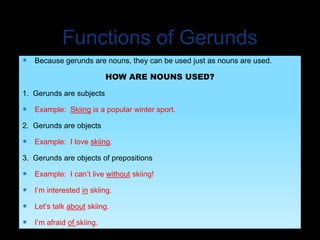
Functions of Gerunds
 Because gerunds are nouns, they can be used just as nouns are used.
HOW ARE NOUNS USED?
1. Gerunds are subjects
 Example: Skiing is a popular winter sport.
2. Gerunds are objects
 Example: I love skiing.
3. Gerunds are objects of prepositions
 Example: I can’t live without skiing!
 I’m interested in skiing.
 Let’s talk about skiing.
 I’m afraid of skiing.
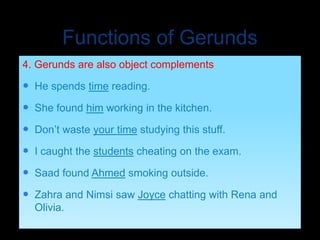
Functions of Gerunds
4. Gerunds are also object complements
 He spends time reading.
 She found him working in the kitchen.
 Don’t waste your time studying this stuff.
 I caught the students cheating on the exam.
 Saad found Ahmed smoking outside.
 Zahra and Nimsi saw Joyce chatting with Rena and
Olivia.
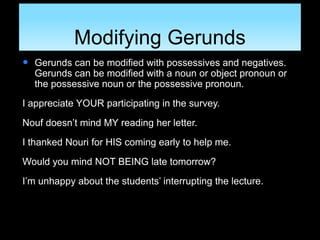
Modifying Gerunds
 Gerunds can be modified with possessives and negatives.
Gerunds can be modified with a noun or object pronoun or
the possessive noun or the possessive pronoun.
I appreciate YOUR participating in the survey.
Nouf doesn’t mind MY reading her letter.
I thanked Nouri for HIS coming early to help me.
Would you mind NOT BEING late tomorrow?
I’m unhappy about the students’ interrupting the lecture.
Modifying Gerunds
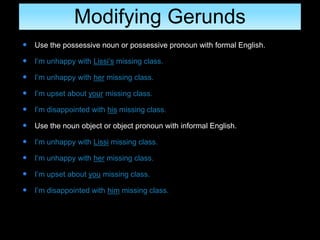
 Use the possessive noun or possessive pronoun with formal English.
 I’m unhappy with Lissi’s missing class.
 I’m unhappy with her missing class.
 I’m upset about your missing class.
 I’m disappointed with his missing class.
 Use the noun object or object pronoun with informal English.
 I’m unhappy with Lissi missing class.
 I’m unhappy with her missing class.
 I’m upset about you missing class.
 I’m disappointed with him missing class.
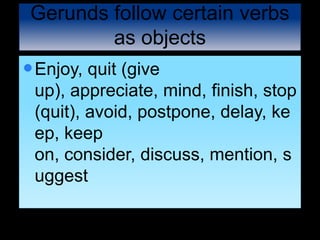
Gerunds follow certain verbs
as objects
Enjoy, quit (give
up), appreciate, mind, finish, stop
(quit), avoid, postpone, delay, ke
ep, keep
on, consider, discuss, mention, s
uggest
Examples
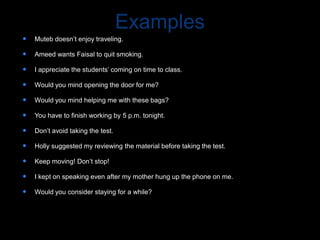
 Muteb doesn’t enjoy traveling.
 Ameed wants Faisal to quit smoking.
 I appreciate the students’ coming on time to class.
 Would you mind opening the door for me?
 Would you mind helping me with these bags?
 You have to finish working by 5 p.m. tonight.
 Don’t avoid taking the test.
 Holly suggested my reviewing the material before taking the test.
 Keep moving! Don’t stop!
 I kept on speaking even after my mother hung up the phone on me.
 Would you consider staying for a while?
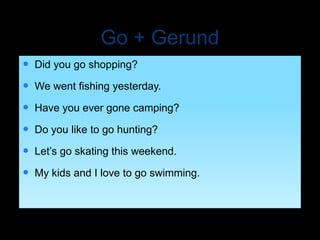
Go + Gerund
 Did you go shopping?
 We went fishing yesterday.
 Have you ever gone camping?
 Do you like to go hunting?
 Let’s go skating this weekend.
 My kids and I love to go swimming.
Special expressions
followed by gerunds
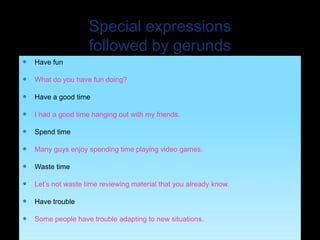
 Have fun
 What do you have fun doing?
 Have a good time
 I had a good time hanging out with my friends.
 Spend time
 Many guys enjoy spending time playing video games.
 Waste time
 Let’s not waste time reviewing material that you already know.
 Have trouble
 Some people have trouble adapting to new situations.
Special expressions followed
by gerunds
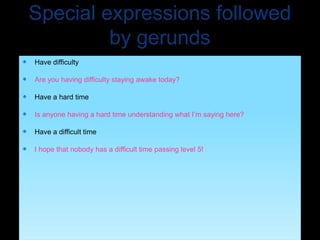
 Have difficulty
 Are you having difficulty staying awake today?
 Have a hard time
 Is anyone having a hard time understanding what I’m saying here?
 Have a difficult time
 I hope that nobody has a difficult time passing level 5!
Special expressions followed
by gerunds
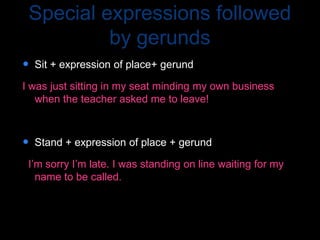
 Sit + expression of place+ gerund
I was just sitting in my seat minding my own business
when the teacher asked me to leave!
 Stand + expression of place + gerund
I’m sorry I’m late. I was standing on line waiting for my
name to be called.
Active and Passive Gerunds
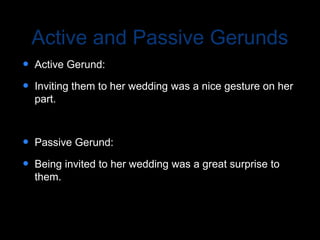
 Active Gerund:
 Inviting them to her wedding was a nice gesture on her
part.
 Passive Gerund:
 Being invited to her wedding was a great surprise to
them.
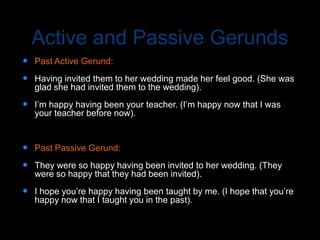
Active and Passive Gerunds
 Past Active Gerund:
 Having invited them to her wedding made her feel good. (She was
glad she had invited them to the wedding).
 I’m happy having been your teacher. (I’m happy now that I was
your teacher before now).
 Past Passive Gerund:
 They were so happy having been invited to her wedding. (They
were so happy that they had been invited).
 I hope you’re happy having been taught by me. (I hope that you’re
happy now that I taught you in the past).
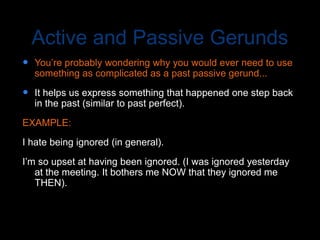
Active and Passive Gerunds
 You’re probably wondering why you would ever need to use
something as complicated as a past passive gerund...
 It helps us express something that happened one step back
in the past (similar to past perfect).
EXAMPLE:
I hate being ignored (in general).
I’m so upset at having been ignored. (I was ignored yesterday
at the meeting. It bothers me NOW that they ignored me
THEN).

Gerunds5 cde

  • 1.
  • 2.
    Functions of Gerunds Because gerunds are nouns, they can be used just as nouns are used. HOW ARE NOUNS USED? 1. Gerunds are subjects  Example: Skiing is a popular winter sport. 2. Gerunds are objects  Example: I love skiing. 3. Gerunds are objects of prepositions  Example: I can’t live without skiing!  I’m interested in skiing.  Let’s talk about skiing.  I’m afraid of skiing.
  • 3.
    Functions of Gerunds 4.Gerunds are also object complements  He spends time reading.  She found him working in the kitchen.  Don’t waste your time studying this stuff.  I caught the students cheating on the exam.  Saad found Ahmed smoking outside.  Zahra and Nimsi saw Joyce chatting with Rena and Olivia.
  • 4.
    Modifying Gerunds  Gerundscan be modified with possessives and negatives. Gerunds can be modified with a noun or object pronoun or the possessive noun or the possessive pronoun. I appreciate YOUR participating in the survey. Nouf doesn’t mind MY reading her letter. I thanked Nouri for HIS coming early to help me. Would you mind NOT BEING late tomorrow? I’m unhappy about the students’ interrupting the lecture.
  • 5.
    Modifying Gerunds  Usethe possessive noun or possessive pronoun with formal English.  I’m unhappy with Lissi’s missing class.  I’m unhappy with her missing class.  I’m upset about your missing class.  I’m disappointed with his missing class.  Use the noun object or object pronoun with informal English.  I’m unhappy with Lissi missing class.  I’m unhappy with her missing class.  I’m upset about you missing class.  I’m disappointed with him missing class.
  • 6.
    Gerunds follow certainverbs as objects Enjoy, quit (give up), appreciate, mind, finish, stop (quit), avoid, postpone, delay, ke ep, keep on, consider, discuss, mention, s uggest
  • 7.
    Examples  Muteb doesn’tenjoy traveling.  Ameed wants Faisal to quit smoking.  I appreciate the students’ coming on time to class.  Would you mind opening the door for me?  Would you mind helping me with these bags?  You have to finish working by 5 p.m. tonight.  Don’t avoid taking the test.  Holly suggested my reviewing the material before taking the test.  Keep moving! Don’t stop!  I kept on speaking even after my mother hung up the phone on me.  Would you consider staying for a while?
  • 8.
    Go + Gerund Did you go shopping?  We went fishing yesterday.  Have you ever gone camping?  Do you like to go hunting?  Let’s go skating this weekend.  My kids and I love to go swimming.
  • 9.
    Special expressions followed bygerunds  Have fun  What do you have fun doing?  Have a good time  I had a good time hanging out with my friends.  Spend time  Many guys enjoy spending time playing video games.  Waste time  Let’s not waste time reviewing material that you already know.  Have trouble  Some people have trouble adapting to new situations.
  • 10.
    Special expressions followed bygerunds  Have difficulty  Are you having difficulty staying awake today?  Have a hard time  Is anyone having a hard time understanding what I’m saying here?  Have a difficult time  I hope that nobody has a difficult time passing level 5!
  • 11.
    Special expressions followed bygerunds  Sit + expression of place+ gerund I was just sitting in my seat minding my own business when the teacher asked me to leave!  Stand + expression of place + gerund I’m sorry I’m late. I was standing on line waiting for my name to be called.
  • 12.
    Active and PassiveGerunds  Active Gerund:  Inviting them to her wedding was a nice gesture on her part.  Passive Gerund:  Being invited to her wedding was a great surprise to them.
  • 13.
    Active and PassiveGerunds  Past Active Gerund:  Having invited them to her wedding made her feel good. (She was glad she had invited them to the wedding).  I’m happy having been your teacher. (I’m happy now that I was your teacher before now).  Past Passive Gerund:  They were so happy having been invited to her wedding. (They were so happy that they had been invited).  I hope you’re happy having been taught by me. (I hope that you’re happy now that I taught you in the past).
  • 14.
    Active and PassiveGerunds  You’re probably wondering why you would ever need to use something as complicated as a past passive gerund...  It helps us express something that happened one step back in the past (similar to past perfect). EXAMPLE: I hate being ignored (in general). I’m so upset at having been ignored. (I was ignored yesterday at the meeting. It bothers me NOW that they ignored me THEN).