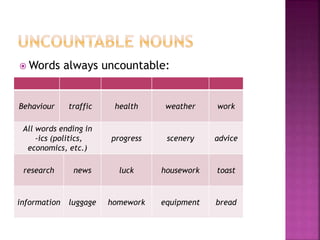
 Words always uncountable:
Behaviour traffic health weather work
All words ending in
-ics (politics,
economics, etc.)
progress scenery advice
research news luck housework toast
information luggage homework equipment bread
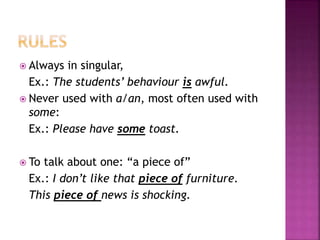
 Always in singular,
Ex.: The students’ behaviour is awful.
 Never used with a/an, most often used with
some:
Ex.: Please have some toast.
 To talk about one: “a piece of”
Ex.: I don’t like that piece of furniture.
This piece of news is shocking.
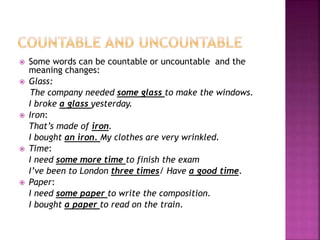
 Some words can be countable or uncountable and the
meaning changes:
 Glass:
The company needed some glass to make the windows.
I broke a glass yesterday.
 Iron:
That’s made of iron.
I bought an iron. My clothes are very wrinkled.
 Time:
I need some more time to finish the exam
I’ve been to London three times/ Have a good time.
 Paper:
I need some paper to write the composition.
I bought a paper to read on the train.
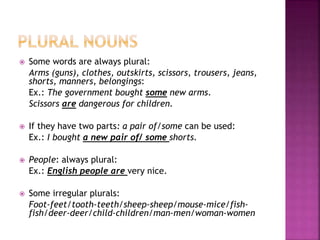
 Some words are always plural:
Arms (guns), clothes, outskirts, scissors, trousers, jeans,
shorts, manners, belongings:
Ex.: The government bought some new arms.
Scissors are dangerous for children.
 If they have two parts: a pair of/some can be used:
Ex.: I bought a new pair of/ some shorts.
 People: always plural:
Ex.: English people are very nice.
 Some irregular plurals:
Foot-feet/tooth-teeth/sheep-sheep/mouse-mice/fish-
fish/deer-deer/child-children/man-men/woman-women
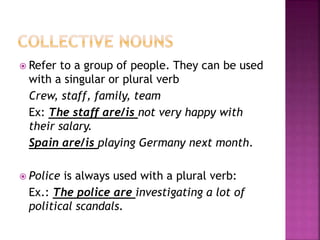
 Refer to a group of people. They can be used
with a singular or plural verb
Crew, staff, family, team
Ex: The staff are/is not very happy with
their salary.
Spain are/is playing Germany next month.
 Police is always used with a plural verb:
Ex.: The police are investigating a lot of
political scandals.

Uncountable and plural nouns

  • 2.
     Words alwaysuncountable: Behaviour traffic health weather work All words ending in -ics (politics, economics, etc.) progress scenery advice research news luck housework toast information luggage homework equipment bread
  • 3.
     Always insingular, Ex.: The students’ behaviour is awful.  Never used with a/an, most often used with some: Ex.: Please have some toast.  To talk about one: “a piece of” Ex.: I don’t like that piece of furniture. This piece of news is shocking.
  • 4.
     Some wordscan be countable or uncountable and the meaning changes:  Glass: The company needed some glass to make the windows. I broke a glass yesterday.  Iron: That’s made of iron. I bought an iron. My clothes are very wrinkled.  Time: I need some more time to finish the exam I’ve been to London three times/ Have a good time.  Paper: I need some paper to write the composition. I bought a paper to read on the train.
  • 5.
     Some wordsare always plural: Arms (guns), clothes, outskirts, scissors, trousers, jeans, shorts, manners, belongings: Ex.: The government bought some new arms. Scissors are dangerous for children.  If they have two parts: a pair of/some can be used: Ex.: I bought a new pair of/ some shorts.  People: always plural: Ex.: English people are very nice.  Some irregular plurals: Foot-feet/tooth-teeth/sheep-sheep/mouse-mice/fish- fish/deer-deer/child-children/man-men/woman-women
  • 6.
     Refer toa group of people. They can be used with a singular or plural verb Crew, staff, family, team Ex: The staff are/is not very happy with their salary. Spain are/is playing Germany next month.  Police is always used with a plural verb: Ex.: The police are investigating a lot of political scandals.