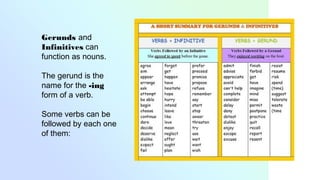
Gerunds and
Infinitives can
function as nouns.
The gerund is the
name for the -ing
form of a verb.
Some verbs can be
followed by each one
of them:
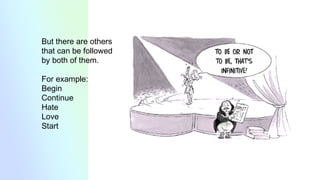
But there are others
that can be followed
by both of them.
For example:
Begin
Continue
Hate
Love
Start
We normally use the Gerund:
* After a preposition (in, at, on, for, without,
of, about, etc)
Eg: She is not interested in learning
Kiswahili.
*As the subject of a sentence.
Eg: Cheating in a test is the worst.
* After GO for a physical activity.
Eg: I go swimming every weekend.
*After certain verbs (See previous examples in slide nº 2)
Eg: He avoids doing any hard work.
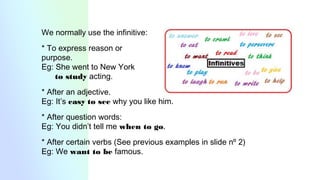
We normally use the infinitive:
* To express reason or
purpose.
Eg: She went to New York
to study acting.
* After an adjective.
Eg: It’s easy to see why you like him.
* After question words:
Eg: You didn’t tell me when to go.
* After certain verbs (See previous examples in slide nº 2)
Eg: We want to be famous.
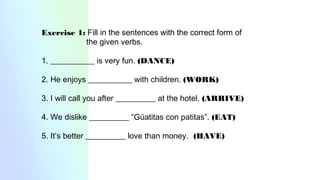
Exercise 1: Fill in the sentences with the correct form of
the given verbs.
1. ___________ is very fun. (DANCE)
2. He enjoys ___________ with children. (WORK)
3. I will call you after __________ at the hotel. (ARRIVE)
4. We dislike __________ “Güatitas con patitas”. (EAT)
5. It’s better __________ love than money. (HAVE)
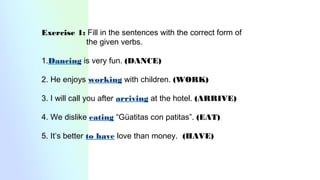
Exercise 1: Fill in the sentences with the correct form of
the given verbs.
1.Dancing is very fun. (DANCE)
2. He enjoys working with children. (WORK)
3. I will call you after arriving at the hotel. (ARRIVE)
4. We dislike eating “Güatitas con patitas”. (EAT)
5. It’s better to have love than money. (HAVE)
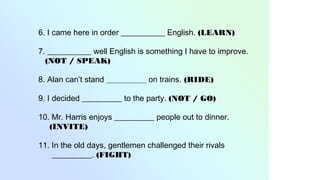
6. I came here in order ___________ English. (LEARN)
7. ___________ well English is something I have to improve.
(NOT / SPEAK)
8. Alan can’t stand __________ on trains. (RIDE)
9. I decided __________ to the party. (NOT / GO)
10. Mr. Harris enjoys __________ people out to dinner.
(INVITE)
11. In the old days, gentlemen challenged their rivals
__________. (FIGHT)
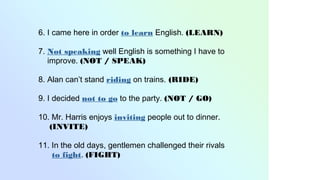
6. I came here in order to learn English. (LEARN)
7. Not speaking well English is something I have to
improve. (NOT / SPEAK)
8. Alan can’t stand riding on trains. (RIDE)
9. I decided not to go to the party. (NOT / GO)
10. Mr. Harris enjoys inviting people out to dinner.
(INVITE)
11. In the old days, gentlemen challenged their rivals
to fight. (FIGHT)
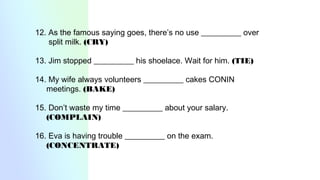
12. As the famous saying goes, there’s no use __________ over
split milk. (CRY)
13. Jim stopped __________ his shoelace. Wait for him. (TIE)
14. My wife always volunteers __________ cakes CONIN
meetings. (BAKE)
15. Don’t waste my time __________ about your salary.
(COMPLAIN)
16. Eva is having trouble __________ on the exam.
(CONCENTRATE)
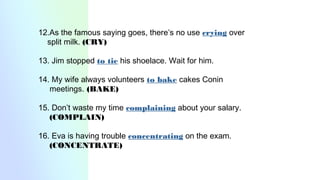
12.As the famous saying goes, there’s no use crying over
split milk. (CRY)
13. Jim stopped to tie his shoelace. Wait for him.
14. My wife always volunteers to bake cakes Conin
meetings. (BAKE)
15. Don’t waste my time complaining about your salary.
(COMPLAIN)
16. Eva is having trouble concentrating on the exam.
(CONCENTRATE)
Material created by 
Teacher Danitza Lazcano Flores 
Teacher of English 
Master in Education 
and 
Educational Counselor

Gerund and infinitive

  • 2.
    Gerunds and Infinitives can functionas nouns. The gerund is the name for the -ing form of a verb. Some verbs can be followed by each one of them:
  • 3.
    But there areothers that can be followed by both of them. For example: Begin Continue Hate Love Start
  • 5.
    We normally usethe Gerund: * After a preposition (in, at, on, for, without, of, about, etc) Eg: She is not interested in learning Kiswahili. *As the subject of a sentence. Eg: Cheating in a test is the worst. * After GO for a physical activity. Eg: I go swimming every weekend. *After certain verbs (See previous examples in slide nº 2) Eg: He avoids doing any hard work.
  • 6.
    We normally usethe infinitive: * To express reason or purpose. Eg: She went to New York to study acting. * After an adjective. Eg: It’s easy to see why you like him. * After question words: Eg: You didn’t tell me when to go. * After certain verbs (See previous examples in slide nº 2) Eg: We want to be famous.
  • 8.
    Exercise 1: Fillin the sentences with the correct form of the given verbs. 1. ___________ is very fun. (DANCE) 2. He enjoys ___________ with children. (WORK) 3. I will call you after __________ at the hotel. (ARRIVE) 4. We dislike __________ “Güatitas con patitas”. (EAT) 5. It’s better __________ love than money. (HAVE)
  • 9.
    Exercise 1: Fillin the sentences with the correct form of the given verbs. 1.Dancing is very fun. (DANCE) 2. He enjoys working with children. (WORK) 3. I will call you after arriving at the hotel. (ARRIVE) 4. We dislike eating “Güatitas con patitas”. (EAT) 5. It’s better to have love than money. (HAVE)
  • 10.
    6. I camehere in order ___________ English. (LEARN) 7. ___________ well English is something I have to improve. (NOT / SPEAK) 8. Alan can’t stand __________ on trains. (RIDE) 9. I decided __________ to the party. (NOT / GO) 10. Mr. Harris enjoys __________ people out to dinner. (INVITE) 11. In the old days, gentlemen challenged their rivals __________. (FIGHT)
  • 11.
    6. I camehere in order to learn English. (LEARN) 7. Not speaking well English is something I have to improve. (NOT / SPEAK) 8. Alan can’t stand riding on trains. (RIDE) 9. I decided not to go to the party. (NOT / GO) 10. Mr. Harris enjoys inviting people out to dinner. (INVITE) 11. In the old days, gentlemen challenged their rivals to fight. (FIGHT)
  • 12.
    12. As thefamous saying goes, there’s no use __________ over split milk. (CRY) 13. Jim stopped __________ his shoelace. Wait for him. (TIE) 14. My wife always volunteers __________ cakes CONIN meetings. (BAKE) 15. Don’t waste my time __________ about your salary. (COMPLAIN) 16. Eva is having trouble __________ on the exam. (CONCENTRATE)
  • 13.
    12.As the famoussaying goes, there’s no use crying over split milk. (CRY) 13. Jim stopped to tie his shoelace. Wait for him. 14. My wife always volunteers to bake cakes Conin meetings. (BAKE) 15. Don’t waste my time complaining about your salary. (COMPLAIN) 16. Eva is having trouble concentrating on the exam. (CONCENTRATE)
  • 14.