S 
WORK, REST, AND 
PLAY 
UNIT 2
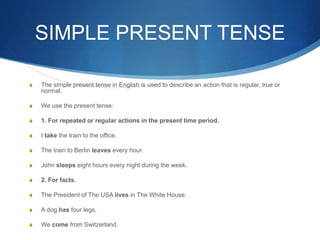
SIMPLE PRESENT TENSE 
S The simple present tense in English is used to describe an action that is regular, true or 
normal. 
S We use the present tense: 
S 1. For repeated or regular actions in the present time period. 
S I take the train to the office. 
S The train to Berlin leaves every hour. 
S John sleeps eight hours every night during the week. 
S 2. For facts. 
S The President of The USA lives in The White House. 
S A dog has four legs. 
S We come from Switzerland.
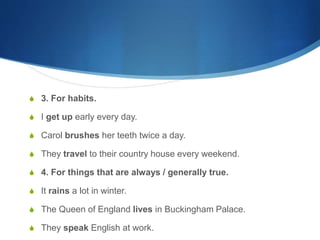
S 3. For habits. 
S I get up early every day. 
S Carol brushes her teeth twice a day. 
S They travel to their country house every weekend. 
S 4. For things that are always / generally true. 
S It rains a lot in winter. 
S The Queen of England lives in Buckingham Palace. 
S They speak English at work.
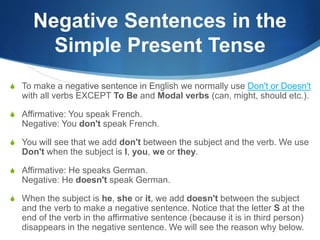
Negative Sentences in the 
Simple Present Tense 
S To make a negative sentence in English we normally use Don't or Doesn't 
with all verbs EXCEPT To Be and Modal verbs (can, might, should etc.). 
S Affirmative: You speak French. 
Negative: You don't speak French. 
S You will see that we add don't between the subject and the verb. We use 
Don't when the subject is I, you, we or they. 
S Affirmative: He speaks German. 
Negative: He doesn't speak German. 
S When the subject is he, she or it, we add doesn't between the subject 
and the verb to make a negative sentence. Notice that the letter S at the 
end of the verb in the affirmative sentence (because it is in third person) 
disappears in the negative sentence. We will see the reason why below.
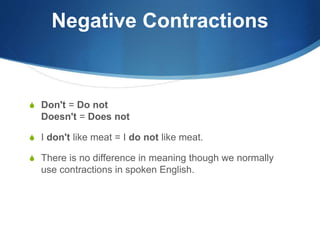
Negative Contractions 
S Don't = Do not 
Doesn't = Does not 
S I don't like meat = I do not like meat. 
S There is no difference in meaning though we normally 
use contractions in spoken English.
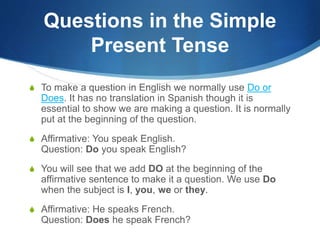
Questions in the Simple 
Present Tense 
S To make a question in English we normally use Do or 
Does. It has no translation in Spanish though it is 
essential to show we are making a question. It is normally 
put at the beginning of the question. 
S Affirmative: You speak English. 
Question: Do you speak English? 
S You will see that we add DO at the beginning of the 
affirmative sentence to make it a question. We use Do 
when the subject is I, you, we or they. 
S Affirmative: He speaks French. 
Question: Does he speak French?
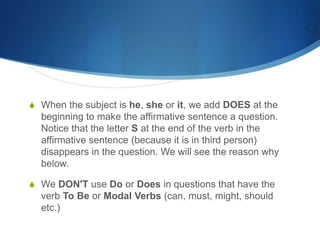
S When the subject is he, she or it, we add DOES at the 
beginning to make the affirmative sentence a question. 
Notice that the letter S at the end of the verb in the 
affirmative sentence (because it is in third person) 
disappears in the question. We will see the reason why 
below. 
S We DON'T use Do or Does in questions that have the 
verb To Be or Modal Verbs (can, must, might, should 
etc.)
SIMPLE PRESENT TENSE 
EXERCISES 
S http://www.ego4u.com/en/cram-up/tests/simple-present-1
ADVERB OF FREQUENCY 
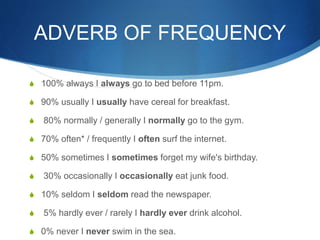
S 100% always I always go to bed before 11pm. 
S 90% usually I usually have cereal for breakfast. 
S 80% normally / generally I normally go to the gym. 
S 70% often* / frequently I often surf the internet. 
S 50% sometimes I sometimes forget my wife's birthday. 
S 30% occasionally I occasionally eat junk food. 
S 10% seldom I seldom read the newspaper. 
S 5% hardly ever / rarely I hardly ever drink alcohol. 
S 0% never I never swim in the sea.
The Position of the Adverb 
in a Sentence 
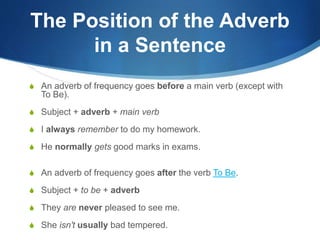
S An adverb of frequency goes before a main verb (except with 
To Be). 
S Subject + adverb + main verb 
S I always remember to do my homework. 
S He normally gets good marks in exams. 
S An adverb of frequency goes after the verb To Be. 
S Subject + to be + adverb 
S They are never pleased to see me. 
S She isn't usually bad tempered.
ADVERBS OF FREQUENCY 
EXERCISES 
S http://www.englisch-hilfen. 
de/en/exercises/adjectives_adverbs/adverbs_of_fre 
quency.htm
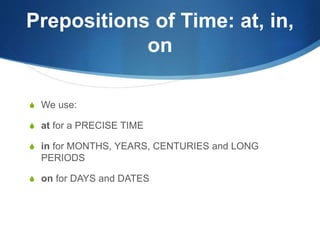
Prepositions of Time: at, in, 
on 
S We use: 
S at for a PRECISE TIME 
S in for MONTHS, YEARS, CENTURIES and LONG 
PERIODS 
S on for DAYS and DATES
REVIEW PREPOSISTIONS 
OF TIME 
S https://www.englishclub.com/grammar/prepositions-at-in-on- 
time.htm

Unit 2 sem2

  • 1.
    S WORK, REST,AND PLAY UNIT 2
  • 2.
    SIMPLE PRESENT TENSE S The simple present tense in English is used to describe an action that is regular, true or normal. S We use the present tense: S 1. For repeated or regular actions in the present time period. S I take the train to the office. S The train to Berlin leaves every hour. S John sleeps eight hours every night during the week. S 2. For facts. S The President of The USA lives in The White House. S A dog has four legs. S We come from Switzerland.
  • 3.
    S 3. Forhabits. S I get up early every day. S Carol brushes her teeth twice a day. S They travel to their country house every weekend. S 4. For things that are always / generally true. S It rains a lot in winter. S The Queen of England lives in Buckingham Palace. S They speak English at work.
  • 4.
    Negative Sentences inthe Simple Present Tense S To make a negative sentence in English we normally use Don't or Doesn't with all verbs EXCEPT To Be and Modal verbs (can, might, should etc.). S Affirmative: You speak French. Negative: You don't speak French. S You will see that we add don't between the subject and the verb. We use Don't when the subject is I, you, we or they. S Affirmative: He speaks German. Negative: He doesn't speak German. S When the subject is he, she or it, we add doesn't between the subject and the verb to make a negative sentence. Notice that the letter S at the end of the verb in the affirmative sentence (because it is in third person) disappears in the negative sentence. We will see the reason why below.
  • 5.
    Negative Contractions SDon't = Do not Doesn't = Does not S I don't like meat = I do not like meat. S There is no difference in meaning though we normally use contractions in spoken English.
  • 6.
    Questions in theSimple Present Tense S To make a question in English we normally use Do or Does. It has no translation in Spanish though it is essential to show we are making a question. It is normally put at the beginning of the question. S Affirmative: You speak English. Question: Do you speak English? S You will see that we add DO at the beginning of the affirmative sentence to make it a question. We use Do when the subject is I, you, we or they. S Affirmative: He speaks French. Question: Does he speak French?
  • 7.
    S When thesubject is he, she or it, we add DOES at the beginning to make the affirmative sentence a question. Notice that the letter S at the end of the verb in the affirmative sentence (because it is in third person) disappears in the question. We will see the reason why below. S We DON'T use Do or Does in questions that have the verb To Be or Modal Verbs (can, must, might, should etc.)
  • 8.
    SIMPLE PRESENT TENSE EXERCISES S http://www.ego4u.com/en/cram-up/tests/simple-present-1
  • 9.
    ADVERB OF FREQUENCY S 100% always I always go to bed before 11pm. S 90% usually I usually have cereal for breakfast. S 80% normally / generally I normally go to the gym. S 70% often* / frequently I often surf the internet. S 50% sometimes I sometimes forget my wife's birthday. S 30% occasionally I occasionally eat junk food. S 10% seldom I seldom read the newspaper. S 5% hardly ever / rarely I hardly ever drink alcohol. S 0% never I never swim in the sea.
  • 10.
    The Position ofthe Adverb in a Sentence S An adverb of frequency goes before a main verb (except with To Be). S Subject + adverb + main verb S I always remember to do my homework. S He normally gets good marks in exams. S An adverb of frequency goes after the verb To Be. S Subject + to be + adverb S They are never pleased to see me. S She isn't usually bad tempered.
  • 11.
    ADVERBS OF FREQUENCY EXERCISES S http://www.englisch-hilfen. de/en/exercises/adjectives_adverbs/adverbs_of_fre quency.htm
  • 12.
    Prepositions of Time:at, in, on S We use: S at for a PRECISE TIME S in for MONTHS, YEARS, CENTURIES and LONG PERIODS S on for DAYS and DATES
  • 13.
    REVIEW PREPOSISTIONS OFTIME S https://www.englishclub.com/grammar/prepositions-at-in-on- time.htm