GERIATRIC HEALTH PROBLEMS
& ITS PREVENTION &
MANAGEMENT & NATIONAL
PROGRAMS FOR ELDERLY
PERSONS
INTRODUCTION
Geriatrics = Geras Old Age + Latrike Medical Treatment
The world is witnessing increasing life expectancies at global level due to global
improvement in health care & living conditions thus geriatric health care is a global
focus area for all.
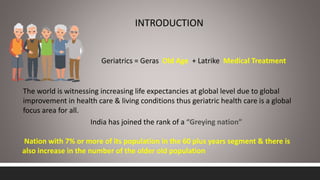
India has joined the rank of a “Greying nation”
Nation with 7% or more of its population in the 60 plus years segment & there is
also increase in the number of the older old population
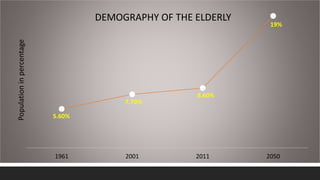
5.60%
7.70%
8.60%
19%
1961 2001 2011 2050
Population
in
percentage DEMOGRAPHY OF THE ELDERLY
DEFINITION
 Progressive process associated with declines in structure & function, impaired
maintenance & repair systems, increased susceptibility to disease & death ,and
reduced reproductive capacity
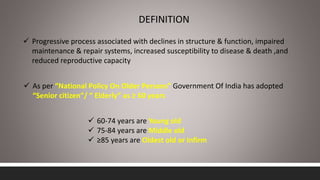
 As per “National Policy On Older Persons” Government Of India has adopted
“Senior citizen”/ “ Elderly” as ≥ 60 years
 60-74 years are Young old
 75-84 years are Middle old
 ≥85 years are Oldest old or Infirm
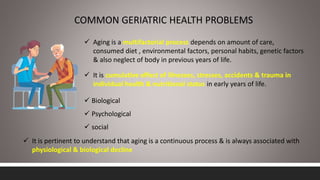
COMMON GERIATRIC HEALTH PROBLEMS
 Aging is a multifactorial process depends on amount of care,
consumed diet , environmental factors, personal habits, genetic factors
& also neglect of body in previous years of life.
 It is cumulative effect of illnesses, stresses, accidents & trauma in
individual health & nutritional status in early years of life.
 It is pertinent to understand that aging is a continuous process & is always associated with
physiological & biological decline
 Biological
 Psychological
 social
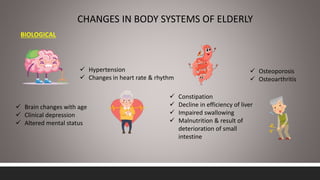
CHANGES IN BODY SYSTEMS OF ELDERLY
 Brain changes with age
 Clinical depression
 Altered mental status
 Hypertension
 Changes in heart rate & rhythm
 Constipation
 Decline in efficiency of liver
 Impaired swallowing
 Malnutrition & result of
deterioration of small
intestine
 Osteoporosis
 Osteoarthritis
BIOLOGICAL
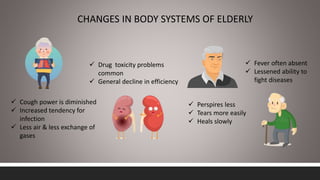
CHANGES IN BODY SYSTEMS OF ELDERLY
 Cough power is diminished
 Increased tendency for
infection
 Less air & less exchange of
gases
 Drug toxicity problems
common
 General decline in efficiency
 Perspires less
 Tears more easily
 Heals slowly
 Fever often absent
 Lessened ability to
fight diseases
PSYCHOLOGICAL
 Loneliness, boredom , depression, grief & worrying about the future which are common in this age
group alter the normal physiological processes.
 The prominent thrust areas resulting in sociopsychological frustration among the elderly are general
attitude towards old age, degradation of their status in community , problems of isolation, loneliness
& generation gap.
 Elder abuse is also quite common among elderly.
SOCIAL
 Many elderly people after retirement from their job feel reduction in income, social status, authority,
power, respect & importance.
 They are disregarded for employment, and are forced towards restricted social activity, thus it
marginalizes & excludes older people in their communities.
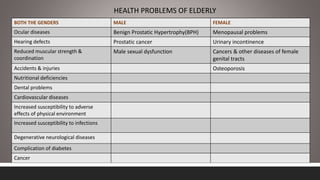
BOTH THE GENDERS MALE FEMALE
Ocular diseases Benign Prostatic Hypertrophy(BPH) Menopausal problems
Hearing defects Prostatic cancer Urinary incontinence
Reduced muscular strength &
coordination
Male sexual dysfunction Cancers & other diseases of female
genital tracts
Accidents & injuries Osteoporosis
Nutritional deficiencies
Dental problems
Cardiovascular diseases
Increased susceptibility to adverse
effects of physical environment
Increased susceptibility to infections
Degenerative neurological diseases
Complication of diabetes
Cancer
HEALTH PROBLEMS OF ELDERLY
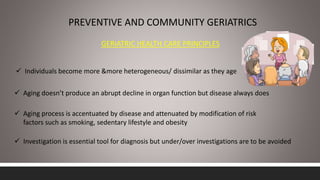
PREVENTIVE AND COMMUNITY GERIATRICS
GERIATRIC HEALTH CARE PRINCIPLES
 Individuals become more &more heterogeneous/ dissimilar as they age
 Aging doesn’t produce an abrupt decline in organ function but disease always does
 Aging process is accentuated by disease and attenuated by modification of risk
factors such as smoking, sedentary lifestyle and obesity
 Investigation is essential tool for diagnosis but under/over investigations are to be avoided
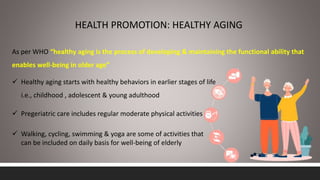
HEALTH PROMOTION: HEALTHY AGING
As per WHO “healthy aging is the process of developing & maintaining the functional ability that
enables well-being in older age”
 Healthy aging starts with healthy behaviors in earlier stages of life
i.e., childhood , adolescent & young adulthood
 Pregeriatric care includes regular moderate physical activities
 Walking, cycling, swimming & yoga are some of activities that
can be included on daily basis for well-being of elderly
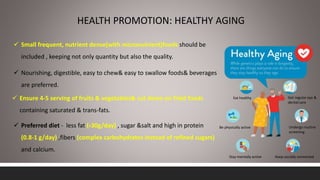
HEALTH PROMOTION: HEALTHY AGING
Eat healthy
Be physically active
Stay mentally active Keep socially connected
Undergo routine
screening
Get regular eye &
dental care
 Small frequent, nutrient dense(with micronutrient)foods should be
included , keeping not only quantity but also the quality.
 Nourishing, digestible, easy to chew& easy to swallow foods& beverages
are preferred.
 Ensure 4-5 serving of fruits & vegetables& cut down on fried foods
containing saturated & trans-fats.
 Preferred diet - less fat (‹30g/day) , sugar &salt and high in protein
(0.8-1 g/day) ,fibers (complex carbohydrates instead of refined sugars)
and calcium.
EARLY DIAGNOSIS AND TREATMENT
Screening
 Special health & screening camps should be organized for detection of hypertension, diabetes &
cancer
 Conducting health assessment on elderly people i.e., Collecting information related to vision, joints,
hearing, chest, blood pressure, blood sugar, etc. during health center visit & thereafter data can be
updated & maintained on subsequent visits.
Periodic health check-up
 Annual health check-up includes vision, hearing, & lab examination of blood test, stool for occult
blood & ECG .
 Advice on chronic morbidities like COPD, Arthritis, DM, HT etc.
REHABILITATION
 Rehabilitation in elderly is done by enabling person to acquire skills
that is needed to live independent life.
 Preventive geriatrics focuses on prevention & reduction of disability &
improvement of quality of life of old age people. Spectacles, dentures,
sun glasses & hearing aids are given free to the needy aged persons
 Rehabilitation is multidisciplinary effort by combination of medical, social, educational & vocational
training to achieve highest possible level of functional ability
 Day care centers provide excellent atmosphere where recreational activities can be organized.
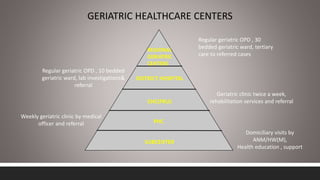
GERIATRIC HEALTHCARE CENTERS
Domiciliary visits by
ANM/HW(M),
Health education , support
SUBCENTER
Weekly geriatric clinic by medical
officer and referral PHC
Geriatric clinic twice a week,
rehabilitation services and referral
CHC(FRU)
Regular geriatric OPD , 10 bedded
geriatric ward, lab investigations&
referral
DISTRICT HOSPITAL
Regular geriatric OPD , 30
bedded geriatric ward, tertiary
care to referred cases
REGIONAL
GERIATRIC
CENTERS
CURRENT APPROACHES IN GERIATRIC HEALTHCARE SERVICES
International day
of
older persons
OCT -1
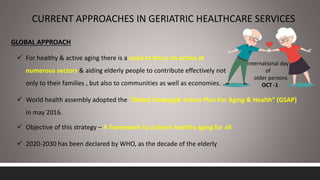
GLOBAL APPROACH
 For healthy & active aging there is a need to focus on action at
numerous sectors & aiding elderly people to contribute effectively not
only to their families , but also to communities as well as economies.
 World health assembly adopted the “Global Strategy& Action Plan For Aging & Health” (GSAP)
in may 2016.
 Objective of this strategy – A framework to achieve healthy aging for all
 2020-2030 has been declared by WHO, as the decade of the elderly
NATIONAL APPROACH
The Ministry Of Social Justice and Empowerment (MoSJE) deals with the social issues of elderly
while Ministry Of Health and Family Welfare (MoHFW) addresses the health concerns.
Major Government Of India Initiatives For Elderly Population
 National Policy on Older Persons (NPOP) – 1999, 2011
 Maintenance And Welfare Of Parents And Senior Citizens Act - 2007
 National Program For Health Care of Elderly (NPHCE) - 2010
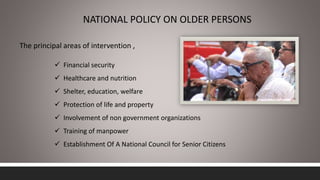
NATIONAL POLICY ON OLDER PERSONS
The principal areas of intervention ,
 Financial security
 Healthcare and nutrition
 Shelter, education, welfare
 Protection of life and property
 Involvement of non government organizations
 Training of manpower
 Establishment Of A National Council for Senior Citizens
MAINTENANCE OF SENIOR CITIZENS ACT, 2007
 As per this act, there is a legal compulsion for children & successors to offer maintenance
to senior citizens & parents, by monthly allowance
 This act also provides simple, immediate & economical instrument for the protection of life &
property of the older persons.
 A senior citizen, who is not capable to maintain himself from his own earning or out of the property
owned by him, is entitled to get relief under this act
 If children or relative is not maintaining his parents or senior citizen , then they can seek the
assistance of a Tribunal constituted under this act.
NATIONAL PROGRAM FOR HEALTH CARE OF ELDERLY (NPHCE) - 2010
 To provide an easy access to promotional, preventive, curative & rehabilitation services to
the elderly , through community based primary healthcare approach
 To identify health problems among the elderly & provide appropriate health interventions
in the community , with the strong referral backup support
 To build capacity of the medical & para medical professionals as well as caretakers within
the family , for providing healthcare to the elderly
 To provide referral services to the elderly patients through district hospitals & regional
medical institutions.
OBJECTIVES
THREE COMPONENTS OF NPHCE
 Dedicated primary care through district hospital, CHC, PHC, Subcenter.
 Secondary & tertiary care through RGCs at selected medical colleges
 Centers of excellence - National Center For Aging – AIIMS Delhi & Madras Medical
College - Chennai
MAIN STRATEGIES OF NPHCE
 Preventive & Promotive care
 Management of illness
 Health Manpower Development for Geriatric Services
 Medical rehabilitation & Therapeutic intervention
 Information, Education & Communication (IEC)
 Longitudinal Ageing Study of India (LASI)
OTHER INITIATIVES
 Integrated Program For Older Persons
Aim of the program is to improve the quality of life of elderly person by provision of elementary
facilities such as housing, food, medical or health care & recreation activities, etc. through local
bodies, non govt. organizations, etc.
 Rashtriya Vayoshri Yojana
Under this scheme, devices to assist in living with disability to elderly person of BPL category who
are facing age- related disabilities such as decreased vision, hearing impairment, loss of teeth &
locomotors disabilities.
OTHER INITIATIVES
 Indira Gandhi National Old Age Pension Scheme ( IGNOPS )
Under this scheme, financial assistance is provided to person of 60 years & above &
belonging to family living BPL.
Central assistance of Rupees 200/month for 60-79 years age group & Rupees 500 /month
for 80 years & above age group.
THANK YOU

Geriatric Health.pptx

  • 1.
    GERIATRIC HEALTH PROBLEMS &ITS PREVENTION & MANAGEMENT & NATIONAL PROGRAMS FOR ELDERLY PERSONS
  • 2.
    INTRODUCTION Geriatrics = GerasOld Age + Latrike Medical Treatment The world is witnessing increasing life expectancies at global level due to global improvement in health care & living conditions thus geriatric health care is a global focus area for all. India has joined the rank of a “Greying nation” Nation with 7% or more of its population in the 60 plus years segment & there is also increase in the number of the older old population
  • 3.
    5.60% 7.70% 8.60% 19% 1961 2001 20112050 Population in percentage DEMOGRAPHY OF THE ELDERLY
  • 4.
    DEFINITION  Progressive processassociated with declines in structure & function, impaired maintenance & repair systems, increased susceptibility to disease & death ,and reduced reproductive capacity  As per “National Policy On Older Persons” Government Of India has adopted “Senior citizen”/ “ Elderly” as ≥ 60 years  60-74 years are Young old  75-84 years are Middle old  ≥85 years are Oldest old or Infirm
  • 5.
    COMMON GERIATRIC HEALTHPROBLEMS  Aging is a multifactorial process depends on amount of care, consumed diet , environmental factors, personal habits, genetic factors & also neglect of body in previous years of life.  It is cumulative effect of illnesses, stresses, accidents & trauma in individual health & nutritional status in early years of life.  It is pertinent to understand that aging is a continuous process & is always associated with physiological & biological decline  Biological  Psychological  social
  • 6.
    CHANGES IN BODYSYSTEMS OF ELDERLY  Brain changes with age  Clinical depression  Altered mental status  Hypertension  Changes in heart rate & rhythm  Constipation  Decline in efficiency of liver  Impaired swallowing  Malnutrition & result of deterioration of small intestine  Osteoporosis  Osteoarthritis BIOLOGICAL
  • 7.
    CHANGES IN BODYSYSTEMS OF ELDERLY  Cough power is diminished  Increased tendency for infection  Less air & less exchange of gases  Drug toxicity problems common  General decline in efficiency  Perspires less  Tears more easily  Heals slowly  Fever often absent  Lessened ability to fight diseases
  • 8.
    PSYCHOLOGICAL  Loneliness, boredom, depression, grief & worrying about the future which are common in this age group alter the normal physiological processes.  The prominent thrust areas resulting in sociopsychological frustration among the elderly are general attitude towards old age, degradation of their status in community , problems of isolation, loneliness & generation gap.  Elder abuse is also quite common among elderly. SOCIAL  Many elderly people after retirement from their job feel reduction in income, social status, authority, power, respect & importance.  They are disregarded for employment, and are forced towards restricted social activity, thus it marginalizes & excludes older people in their communities.
  • 9.
    BOTH THE GENDERSMALE FEMALE Ocular diseases Benign Prostatic Hypertrophy(BPH) Menopausal problems Hearing defects Prostatic cancer Urinary incontinence Reduced muscular strength & coordination Male sexual dysfunction Cancers & other diseases of female genital tracts Accidents & injuries Osteoporosis Nutritional deficiencies Dental problems Cardiovascular diseases Increased susceptibility to adverse effects of physical environment Increased susceptibility to infections Degenerative neurological diseases Complication of diabetes Cancer HEALTH PROBLEMS OF ELDERLY
  • 10.
    PREVENTIVE AND COMMUNITYGERIATRICS GERIATRIC HEALTH CARE PRINCIPLES  Individuals become more &more heterogeneous/ dissimilar as they age  Aging doesn’t produce an abrupt decline in organ function but disease always does  Aging process is accentuated by disease and attenuated by modification of risk factors such as smoking, sedentary lifestyle and obesity  Investigation is essential tool for diagnosis but under/over investigations are to be avoided
  • 11.
    HEALTH PROMOTION: HEALTHYAGING As per WHO “healthy aging is the process of developing & maintaining the functional ability that enables well-being in older age”  Healthy aging starts with healthy behaviors in earlier stages of life i.e., childhood , adolescent & young adulthood  Pregeriatric care includes regular moderate physical activities  Walking, cycling, swimming & yoga are some of activities that can be included on daily basis for well-being of elderly
  • 12.
    HEALTH PROMOTION: HEALTHYAGING Eat healthy Be physically active Stay mentally active Keep socially connected Undergo routine screening Get regular eye & dental care  Small frequent, nutrient dense(with micronutrient)foods should be included , keeping not only quantity but also the quality.  Nourishing, digestible, easy to chew& easy to swallow foods& beverages are preferred.  Ensure 4-5 serving of fruits & vegetables& cut down on fried foods containing saturated & trans-fats.  Preferred diet - less fat (‹30g/day) , sugar &salt and high in protein (0.8-1 g/day) ,fibers (complex carbohydrates instead of refined sugars) and calcium.
  • 13.
    EARLY DIAGNOSIS ANDTREATMENT Screening  Special health & screening camps should be organized for detection of hypertension, diabetes & cancer  Conducting health assessment on elderly people i.e., Collecting information related to vision, joints, hearing, chest, blood pressure, blood sugar, etc. during health center visit & thereafter data can be updated & maintained on subsequent visits. Periodic health check-up  Annual health check-up includes vision, hearing, & lab examination of blood test, stool for occult blood & ECG .  Advice on chronic morbidities like COPD, Arthritis, DM, HT etc.
  • 14.
    REHABILITATION  Rehabilitation inelderly is done by enabling person to acquire skills that is needed to live independent life.  Preventive geriatrics focuses on prevention & reduction of disability & improvement of quality of life of old age people. Spectacles, dentures, sun glasses & hearing aids are given free to the needy aged persons  Rehabilitation is multidisciplinary effort by combination of medical, social, educational & vocational training to achieve highest possible level of functional ability  Day care centers provide excellent atmosphere where recreational activities can be organized.
  • 15.
    GERIATRIC HEALTHCARE CENTERS Domiciliaryvisits by ANM/HW(M), Health education , support SUBCENTER Weekly geriatric clinic by medical officer and referral PHC Geriatric clinic twice a week, rehabilitation services and referral CHC(FRU) Regular geriatric OPD , 10 bedded geriatric ward, lab investigations& referral DISTRICT HOSPITAL Regular geriatric OPD , 30 bedded geriatric ward, tertiary care to referred cases REGIONAL GERIATRIC CENTERS
  • 16.
    CURRENT APPROACHES INGERIATRIC HEALTHCARE SERVICES International day of older persons OCT -1 GLOBAL APPROACH  For healthy & active aging there is a need to focus on action at numerous sectors & aiding elderly people to contribute effectively not only to their families , but also to communities as well as economies.  World health assembly adopted the “Global Strategy& Action Plan For Aging & Health” (GSAP) in may 2016.  Objective of this strategy – A framework to achieve healthy aging for all  2020-2030 has been declared by WHO, as the decade of the elderly
  • 17.
    NATIONAL APPROACH The MinistryOf Social Justice and Empowerment (MoSJE) deals with the social issues of elderly while Ministry Of Health and Family Welfare (MoHFW) addresses the health concerns. Major Government Of India Initiatives For Elderly Population  National Policy on Older Persons (NPOP) – 1999, 2011  Maintenance And Welfare Of Parents And Senior Citizens Act - 2007  National Program For Health Care of Elderly (NPHCE) - 2010
  • 18.
    NATIONAL POLICY ONOLDER PERSONS The principal areas of intervention ,  Financial security  Healthcare and nutrition  Shelter, education, welfare  Protection of life and property  Involvement of non government organizations  Training of manpower  Establishment Of A National Council for Senior Citizens
  • 19.
    MAINTENANCE OF SENIORCITIZENS ACT, 2007  As per this act, there is a legal compulsion for children & successors to offer maintenance to senior citizens & parents, by monthly allowance  This act also provides simple, immediate & economical instrument for the protection of life & property of the older persons.  A senior citizen, who is not capable to maintain himself from his own earning or out of the property owned by him, is entitled to get relief under this act  If children or relative is not maintaining his parents or senior citizen , then they can seek the assistance of a Tribunal constituted under this act.
  • 20.
    NATIONAL PROGRAM FORHEALTH CARE OF ELDERLY (NPHCE) - 2010  To provide an easy access to promotional, preventive, curative & rehabilitation services to the elderly , through community based primary healthcare approach  To identify health problems among the elderly & provide appropriate health interventions in the community , with the strong referral backup support  To build capacity of the medical & para medical professionals as well as caretakers within the family , for providing healthcare to the elderly  To provide referral services to the elderly patients through district hospitals & regional medical institutions. OBJECTIVES
  • 21.
    THREE COMPONENTS OFNPHCE  Dedicated primary care through district hospital, CHC, PHC, Subcenter.  Secondary & tertiary care through RGCs at selected medical colleges  Centers of excellence - National Center For Aging – AIIMS Delhi & Madras Medical College - Chennai MAIN STRATEGIES OF NPHCE  Preventive & Promotive care  Management of illness  Health Manpower Development for Geriatric Services  Medical rehabilitation & Therapeutic intervention  Information, Education & Communication (IEC)  Longitudinal Ageing Study of India (LASI)
  • 22.
    OTHER INITIATIVES  IntegratedProgram For Older Persons Aim of the program is to improve the quality of life of elderly person by provision of elementary facilities such as housing, food, medical or health care & recreation activities, etc. through local bodies, non govt. organizations, etc.  Rashtriya Vayoshri Yojana Under this scheme, devices to assist in living with disability to elderly person of BPL category who are facing age- related disabilities such as decreased vision, hearing impairment, loss of teeth & locomotors disabilities.
  • 23.
    OTHER INITIATIVES  IndiraGandhi National Old Age Pension Scheme ( IGNOPS ) Under this scheme, financial assistance is provided to person of 60 years & above & belonging to family living BPL. Central assistance of Rupees 200/month for 60-79 years age group & Rupees 500 /month for 80 years & above age group.
  • 24.