Abhishek Achar, OMS-III
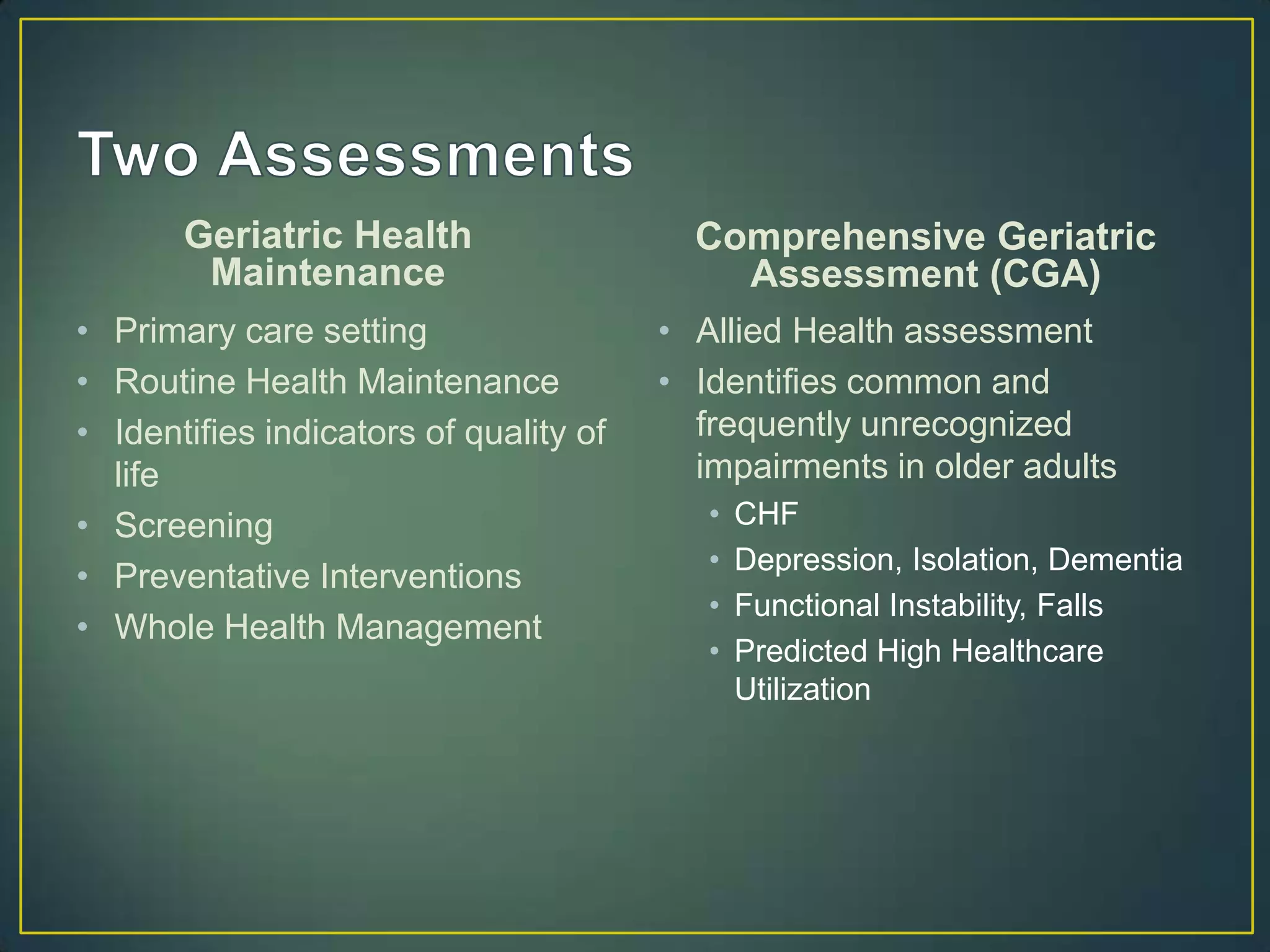
Geriatric Health
Maintenance
• Primary care setting
• Routine Health Maintenance
• Identifies indicators of quality of
life
• Screening
• Preventative Interventions
• Whole Health Management
Comprehensive Geriatric
Assessment (CGA)
• Allied Health assessment
• Identifies common and
frequently unrecognized
impairments in older adults
• CHF
• Depression, Isolation, Dementia
• Functional Instability, Falls
• Predicted High Healthcare
Utilization
• Patient centered complete and through History and
Physical
• Preventative Measures
• Primary Prevention
• Secondary Prevention
• Tertiary Prevention
• Whole Health Management
• Medications
• Driving
• Financial and Social Support
• Abuse
• Advance Care Directives
• Primary Prevention
To avert the development of disease
• Encourage Physical Activity and counsel against Alcohol and
Tobacco
• Discuss prophylactic Aspirin in CV Risk patients
• Immunizations
• Influenza – Annually
• Pneumococcal – >65y.o. (PPSV23)
• Herpes Zoster – >60y.o.
GERIATRIC HEATH
MAINTENANCE
• Secondary Prevention
Early detection and treatment of asymptomatic disease
• Cancer Screenings
• Prostate – Between 50-69y.o.
• Colorectal – Between 50-75y.o. (85y.o. for High Risk patients)
• Breast – Controversial Guidelines
• Typically every 1-2 years for females with ≥4 years life
expectancies.
• Cervical – Between 21-65y.o. with adequate recent screening.
• Three consecutive negative cytology test OR
• Two consecutive negative Pap in the last 10 years
• May start screening women under 21 who are sexually active
GERIATRIC HEATH
MAINTENANCE
• Secondary Prevention
Early detection and treatment of asymptomatic disease
• Blood Pressure Screening
• Lipid Screening
• Osteoporosis (DEXA)
• Routine Bone Density
(DEXA)
• Women ≥65y.o.
• High Risk Women ≥60y.o.
• Abdominal Aortic Aneurysms
• One-time Abdominal US
• Men ≥65y.o. who have
smoked or have AAA in PFHx
GERIATRIC HEATH
MAINTENANCE
• Tertiary Prevention
Identification of disease to prevent further morbidity or functional decline
• Functional
• Focused on activities of daily living
• Cognitive
• Targeted screening in patients with
• Memory complaints
• New functional impairment
• Vision
• Decreased visual acuity increases fall and mortality risk
• General Ophthalmologic Exam every 1-2 years
• Depression
• "Over the past two weeks have you felt down, depressed, or
hopeless?"
• "Over the past two weeks have you felt little interest or pleasure in
doing things?"
GERIATRIC HEATH
MAINTENANCE
• Tertiary Prevention
Identification of disease to prevent further morbidity or functional decline
• Hearing
• 3rd most common ailment (HTN, Arthritis)
• Associated with depression, social isolation, functional decline
• Whisper test almost as effective as formal studies
• Nutrition
• Routine Nutritional Assessments necessary
• Vit B12, Vit D, Calcium typically low
• Mobility/Falls
• ~30% of noninstitutionalized older adults fall every year.
• 5% of falls result in fracture/hospitalization
• Regular assessments necessary
• Circumstances of falls, orthostatic vitals, visual acuity, cognitive
testing, gait, balance, iatrogenic causes
• Incontinence
• Major psychosocial impact
• Routine targeted H/P with Urine/Blood testing indicated
GERIATRIC HEATH
MAINTENANCE
• Medications
• Multiple medication increase the risk of Drug-Drug interactions
• Maintain up-to-date medications (including OTC/herbal)
• Annual comprehensive reviews
• Assess for duplications, drug-drug
contraindications, affordability
• Altered pharmacokinetics/dynamics increase risk of ADR
• Assess specific classes associated with ADR
• Warfarin, Analgesics (NSAIDs), Antihypertensives (ACE-
I, Diuretics), Insulin, hypoglycemic agents
(Nitro), psychotropics
GERIATRIC HEATH
MAINTENANCE
• Driving
• Should be discussed in patients with
• Dementia
• Decline in visual, hearing, and psychomotor skills
• Reporting laws exist and vary state to state
• Abuse
• Reported in 3-8% of older population
• Suspicion raised if patient presents with contusions, burns, bite
marks, genital or rectal trauma, pressure ulcers, or a BMI <17.5
without clinical explanation
• Advance Care Directives
• Discussion is appropriate during Health Maintenance Exam
focusing on preventative planning
GERIATRIC HEATH
MAINTENANCE
• Intensive Multidisciplinary Diagnostic and Treatment
Program
• Differing from the Primary Care Clinician’s Geriatric Health
Maintenance
• Maximizes health with disease and aging
• Initiated through referral by PCP
• Indications for referral
• Age
• Major Comorbidities
• CHF, Cancer, DQs, Surgery, etc
• Psychosocial Disorders
• Depression, Social Isolation
• Unstable Geriatric Conditions
• Dementia, Falls, Functional
Disability
• Predicted high health care utilization
• Change in living situation
Comprehensive Geriatric
Assessment
• Major Components of the CGA
• Functional capacity
• Fall risk
• Cognition
• Mood
• Polypharmacy
• Social support
• Financial concerns
• Goals of care
• Advanced care preferences
Comprehensive Geriatric
Assessment
• Basic Activities of Daily Life
• Bathing
• Dressing
• Toileting
• Maintaining continence
• Grooming
• Feeding
• Transferring
• Instrumental Activities of Daily
Life
• Shopping for groceries
• Driving or using public
transportation
• Using the telephone
• Performing housework
• Doing home repair
• Preparing meals
• Doing laundry
• Taking medications
• Handling finances
Comprehensive Geriatric
Assessment
• Functional capacity
• Ability to perform activities necessary AND desirable in daily life
• In the context of living environment and social network
• Fall risk
• Assessment integrated into H/P of all geriatric patients
• Cognition
• Assessment integrated into H/P of all geriatric patients
• Mood
• Assessment integrated into H/P of all geriatric patients
• Polypharmacy
• Clinician review recommended on every visit
Comprehensive Geriatric
Assessment
• Social support and Financial concerns
• Brief screening of SoHx indicated
• Screen caregivers periodically for depression burnout
• Refer to counseling or support groups
• Goals of care
• Typical CGA patients have limited ability to return to fully
healthy/independent lifestyles
• Social and Functional goals typically assume priority over
healthcare.
• Advanced care preferences
• Assessment integrated into H/P of all geriatric patients
Comprehensive Geriatric
Assessment
• UpToDate
• Medscape
The geriatric assessment

The geriatric assessment

  • 1.
  • 2.
    Geriatric Health Maintenance • Primarycare setting • Routine Health Maintenance • Identifies indicators of quality of life • Screening • Preventative Interventions • Whole Health Management Comprehensive Geriatric Assessment (CGA) • Allied Health assessment • Identifies common and frequently unrecognized impairments in older adults • CHF • Depression, Isolation, Dementia • Functional Instability, Falls • Predicted High Healthcare Utilization
  • 3.
    • Patient centeredcomplete and through History and Physical • Preventative Measures • Primary Prevention • Secondary Prevention • Tertiary Prevention • Whole Health Management • Medications • Driving • Financial and Social Support • Abuse • Advance Care Directives
  • 4.
    • Primary Prevention Toavert the development of disease • Encourage Physical Activity and counsel against Alcohol and Tobacco • Discuss prophylactic Aspirin in CV Risk patients • Immunizations • Influenza – Annually • Pneumococcal – >65y.o. (PPSV23) • Herpes Zoster – >60y.o. GERIATRIC HEATH MAINTENANCE
  • 5.
    • Secondary Prevention Earlydetection and treatment of asymptomatic disease • Cancer Screenings • Prostate – Between 50-69y.o. • Colorectal – Between 50-75y.o. (85y.o. for High Risk patients) • Breast – Controversial Guidelines • Typically every 1-2 years for females with ≥4 years life expectancies. • Cervical – Between 21-65y.o. with adequate recent screening. • Three consecutive negative cytology test OR • Two consecutive negative Pap in the last 10 years • May start screening women under 21 who are sexually active GERIATRIC HEATH MAINTENANCE
  • 6.
    • Secondary Prevention Earlydetection and treatment of asymptomatic disease • Blood Pressure Screening • Lipid Screening • Osteoporosis (DEXA) • Routine Bone Density (DEXA) • Women ≥65y.o. • High Risk Women ≥60y.o. • Abdominal Aortic Aneurysms • One-time Abdominal US • Men ≥65y.o. who have smoked or have AAA in PFHx GERIATRIC HEATH MAINTENANCE
  • 7.
    • Tertiary Prevention Identificationof disease to prevent further morbidity or functional decline • Functional • Focused on activities of daily living • Cognitive • Targeted screening in patients with • Memory complaints • New functional impairment • Vision • Decreased visual acuity increases fall and mortality risk • General Ophthalmologic Exam every 1-2 years • Depression • "Over the past two weeks have you felt down, depressed, or hopeless?" • "Over the past two weeks have you felt little interest or pleasure in doing things?" GERIATRIC HEATH MAINTENANCE
  • 8.
    • Tertiary Prevention Identificationof disease to prevent further morbidity or functional decline • Hearing • 3rd most common ailment (HTN, Arthritis) • Associated with depression, social isolation, functional decline • Whisper test almost as effective as formal studies • Nutrition • Routine Nutritional Assessments necessary • Vit B12, Vit D, Calcium typically low • Mobility/Falls • ~30% of noninstitutionalized older adults fall every year. • 5% of falls result in fracture/hospitalization • Regular assessments necessary • Circumstances of falls, orthostatic vitals, visual acuity, cognitive testing, gait, balance, iatrogenic causes • Incontinence • Major psychosocial impact • Routine targeted H/P with Urine/Blood testing indicated GERIATRIC HEATH MAINTENANCE
  • 9.
    • Medications • Multiplemedication increase the risk of Drug-Drug interactions • Maintain up-to-date medications (including OTC/herbal) • Annual comprehensive reviews • Assess for duplications, drug-drug contraindications, affordability • Altered pharmacokinetics/dynamics increase risk of ADR • Assess specific classes associated with ADR • Warfarin, Analgesics (NSAIDs), Antihypertensives (ACE- I, Diuretics), Insulin, hypoglycemic agents (Nitro), psychotropics GERIATRIC HEATH MAINTENANCE
  • 10.
    • Driving • Shouldbe discussed in patients with • Dementia • Decline in visual, hearing, and psychomotor skills • Reporting laws exist and vary state to state • Abuse • Reported in 3-8% of older population • Suspicion raised if patient presents with contusions, burns, bite marks, genital or rectal trauma, pressure ulcers, or a BMI <17.5 without clinical explanation • Advance Care Directives • Discussion is appropriate during Health Maintenance Exam focusing on preventative planning GERIATRIC HEATH MAINTENANCE
  • 11.
    • Intensive MultidisciplinaryDiagnostic and Treatment Program • Differing from the Primary Care Clinician’s Geriatric Health Maintenance • Maximizes health with disease and aging • Initiated through referral by PCP
  • 12.
    • Indications forreferral • Age • Major Comorbidities • CHF, Cancer, DQs, Surgery, etc • Psychosocial Disorders • Depression, Social Isolation • Unstable Geriatric Conditions • Dementia, Falls, Functional Disability • Predicted high health care utilization • Change in living situation Comprehensive Geriatric Assessment
  • 13.
    • Major Componentsof the CGA • Functional capacity • Fall risk • Cognition • Mood • Polypharmacy • Social support • Financial concerns • Goals of care • Advanced care preferences Comprehensive Geriatric Assessment
  • 14.
    • Basic Activitiesof Daily Life • Bathing • Dressing • Toileting • Maintaining continence • Grooming • Feeding • Transferring • Instrumental Activities of Daily Life • Shopping for groceries • Driving or using public transportation • Using the telephone • Performing housework • Doing home repair • Preparing meals • Doing laundry • Taking medications • Handling finances Comprehensive Geriatric Assessment • Functional capacity • Ability to perform activities necessary AND desirable in daily life • In the context of living environment and social network
  • 15.
    • Fall risk •Assessment integrated into H/P of all geriatric patients • Cognition • Assessment integrated into H/P of all geriatric patients • Mood • Assessment integrated into H/P of all geriatric patients • Polypharmacy • Clinician review recommended on every visit Comprehensive Geriatric Assessment
  • 16.
    • Social supportand Financial concerns • Brief screening of SoHx indicated • Screen caregivers periodically for depression burnout • Refer to counseling or support groups • Goals of care • Typical CGA patients have limited ability to return to fully healthy/independent lifestyles • Social and Functional goals typically assume priority over healthcare. • Advanced care preferences • Assessment integrated into H/P of all geriatric patients Comprehensive Geriatric Assessment
  • 17.