SYED MOHAMMED RAHILSHERIN JOBY
SHAMEEM
REUBEN THOMAS
THAMEEM ANSAR
SYAM KUMAR.K
RASIM UL HAQE
THACHILATH MOHANDAS VISHNU
SARATH.K.S
SINTO C.J
SONU PAULSON
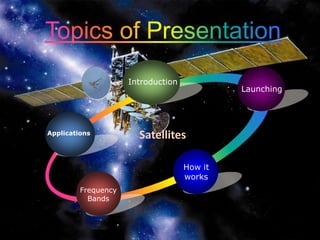
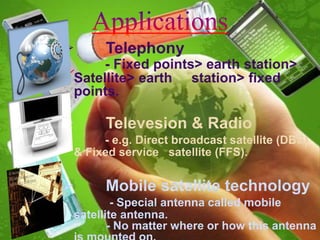
Applications
Introduction
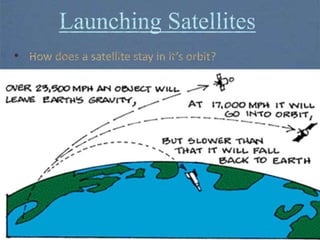
Launching
How it
works
Frequency
Bands
Satellites
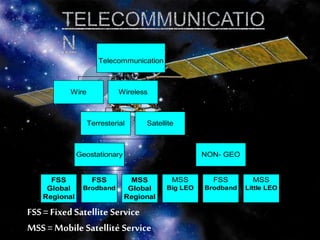
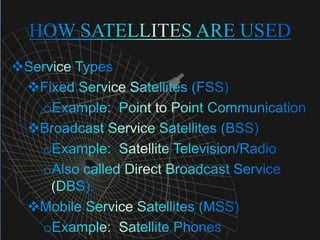
FSS = Fixed Satellite Service
MSS = Mobile Satellite Service
Wire
Terresterial
FSS
Global
Regional
FSS
Brodband
MSS
Global
Regional
Geostationary
MSS
Big LEO
FSS
Brodband
MSS
Little LEO
NON- GEO
Satellite
Wireless
Telecommunication
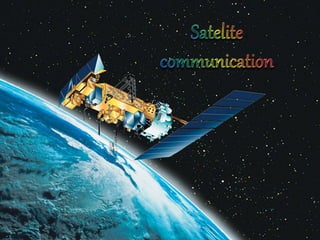
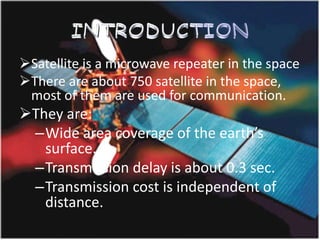
Satellite is a microwave repeater in the space
There are about 750 satellite in the space,
most of them are used for communication.
They are:
–Wide area coverage of the earth’s
surface.
–Transmission delay is about 0.3 sec.
–Transmission cost is independent of
distance.
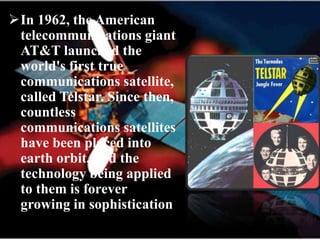
In 1962, the American
telecommunications giant
AT&T launched the
world's first true
communications satellite,
called Telstar. Since then,
countless
communications satellites
have been placed into
earth orbit, and the
technology being applied
to them is forever
growing in sophistication
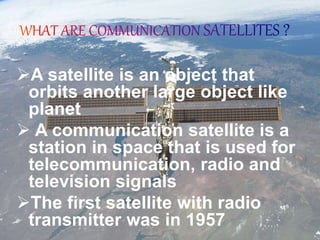
A satellite is an object that
orbits another large object like
planet
 A communication satellite is a
station in space that is used for
telecommunication, radio and
television signals
The first satellite with radio
transmitter was in 1957
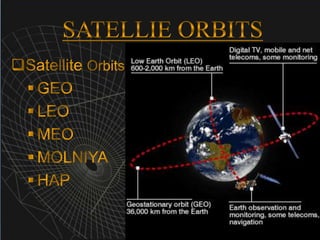
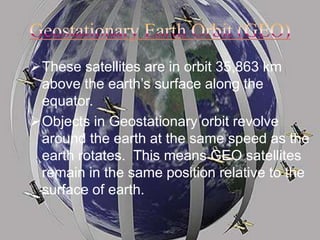
These satellites are in orbit 35,863 km
above the earth’s surface along the
equator.
Objects in Geostationary orbit revolve
around the earth at the same speed as the
earth rotates. This means GEO satellites
remain in the same position relative to the
surface of earth.
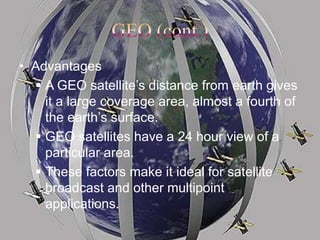
• Advantages
 A GEO satellite’s distance from earth gives
it a large coverage area, almost a fourth of
the earth’s surface.
 GEO satellites have a 24 hour view of a
particular area.
 These factors make it ideal for satellite
broadcast and other multipoint
applications.
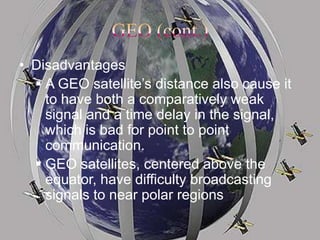
• Disadvantages
 A GEO satellite’s distance also cause it
to have both a comparatively weak
signal and a time delay in the signal,
which is bad for point to point
communication.
 GEO satellites, centered above the
equator, have difficulty broadcasting
signals to near polar regions
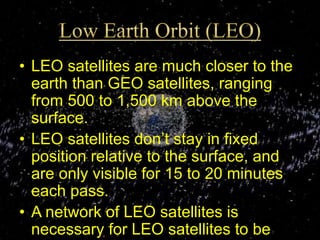
• LEO satellites are much closer to the
earth than GEO satellites, ranging
from 500 to 1,500 km above the
surface.
• LEO satellites don’t stay in fixed
position relative to the surface, and
are only visible for 15 to 20 minutes
each pass.
• A network of LEO satellites is
necessary for LEO satellites to be
• Advantages
 A LEO satellite’s proximity to earth
compared to a GEO satellite gives it a
better signal strength and less of a
time delay, which makes it better for
point to point communication.
 A LEO satellite’s smaller area of
coverage is less of a waste of
bandwidth.
• Disadvantages
 A network of LEO satellites is needed,
which can be costly
 LEO satellites have to compensate for
Doppler shifts cause by their relative
movement.
 Atmospheric drag effects LEO satellites,
causing gradual orbital deterioration.
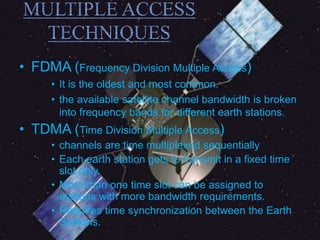
• FDMA (Frequency Division Multiple Access)
• It is the oldest and most common.
• the available satellite channel bandwidth is broken
into frequency bands for different earth stations.
• TDMA (Time Division Multiple Access)
• channels are time multiplexed sequentially
• Each earth station gets to transmit in a fixed time
slot only.
• More than one time slot can be assigned to
stations with more bandwidth requirements.
• Requires time synchronization between the Earth
Stations.
CDMA : (Code Division Multiple Access)
Combination of time/frequency
multiplexing
( a form of spread spectrum
modulation).
It provides a decentralized way of
providing separate channels without
timing synchronization. It is a relatively
new scheme but is expected to be more
common in future satellites.
•

Satelite (Msquare)
Satelite (Msquare)

Satelite (Msquare)

  • 2.
    SYED MOHAMMED RAHILSHERINJOBY SHAMEEM REUBEN THOMAS THAMEEM ANSAR SYAM KUMAR.K RASIM UL HAQE THACHILATH MOHANDAS VISHNU SARATH.K.S SINTO C.J SONU PAULSON
  • 3.
  • 4.
    FSS = FixedSatellite Service MSS = Mobile Satellite Service Wire Terresterial FSS Global Regional FSS Brodband MSS Global Regional Geostationary MSS Big LEO FSS Brodband MSS Little LEO NON- GEO Satellite Wireless Telecommunication
  • 5.
    Satellite is amicrowave repeater in the space There are about 750 satellite in the space, most of them are used for communication. They are: –Wide area coverage of the earth’s surface. –Transmission delay is about 0.3 sec. –Transmission cost is independent of distance.
  • 6.
    In 1962, theAmerican telecommunications giant AT&T launched the world's first true communications satellite, called Telstar. Since then, countless communications satellites have been placed into earth orbit, and the technology being applied to them is forever growing in sophistication
  • 7.
    A satellite isan object that orbits another large object like planet  A communication satellite is a station in space that is used for telecommunication, radio and television signals The first satellite with radio transmitter was in 1957
  • 13.
    These satellites arein orbit 35,863 km above the earth’s surface along the equator. Objects in Geostationary orbit revolve around the earth at the same speed as the earth rotates. This means GEO satellites remain in the same position relative to the surface of earth.
  • 14.
    • Advantages  AGEO satellite’s distance from earth gives it a large coverage area, almost a fourth of the earth’s surface.  GEO satellites have a 24 hour view of a particular area.  These factors make it ideal for satellite broadcast and other multipoint applications.
  • 15.
    • Disadvantages  AGEO satellite’s distance also cause it to have both a comparatively weak signal and a time delay in the signal, which is bad for point to point communication.  GEO satellites, centered above the equator, have difficulty broadcasting signals to near polar regions
  • 16.
    • LEO satellitesare much closer to the earth than GEO satellites, ranging from 500 to 1,500 km above the surface. • LEO satellites don’t stay in fixed position relative to the surface, and are only visible for 15 to 20 minutes each pass. • A network of LEO satellites is necessary for LEO satellites to be
  • 17.
    • Advantages  ALEO satellite’s proximity to earth compared to a GEO satellite gives it a better signal strength and less of a time delay, which makes it better for point to point communication.  A LEO satellite’s smaller area of coverage is less of a waste of bandwidth.
  • 18.
    • Disadvantages  Anetwork of LEO satellites is needed, which can be costly  LEO satellites have to compensate for Doppler shifts cause by their relative movement.  Atmospheric drag effects LEO satellites, causing gradual orbital deterioration.
  • 23.
    • FDMA (FrequencyDivision Multiple Access) • It is the oldest and most common. • the available satellite channel bandwidth is broken into frequency bands for different earth stations. • TDMA (Time Division Multiple Access) • channels are time multiplexed sequentially • Each earth station gets to transmit in a fixed time slot only. • More than one time slot can be assigned to stations with more bandwidth requirements. • Requires time synchronization between the Earth Stations.
  • 24.
    CDMA : (CodeDivision Multiple Access) Combination of time/frequency multiplexing ( a form of spread spectrum modulation). It provides a decentralized way of providing separate channels without timing synchronization. It is a relatively new scheme but is expected to be more common in future satellites.
  • 25.
  • 27.