
Dr. Ambedkar Institute of Technology
(An Autonomous Institution, Affiliated to V.T.U)
Bangalore-560056
SATELLITE NETWORKS
A Seminar by,
PRIYANKA P B
1TU17LDN04
1
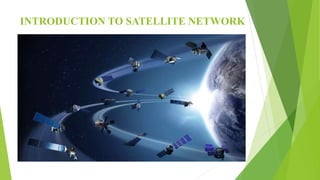
INTRODUCTION TO SATELLITE NETWORK
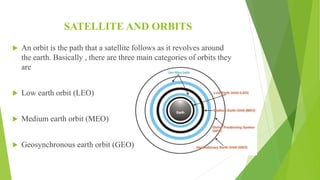
SATELLITE AND ORBITS
 An orbit is the path that a satellite follows as it revolves around
the earth. Basically , there are three main categories of orbits they
are
 Low earth orbit (LEO)
 Medium earth orbit (MEO)
 Geosynchronous earth orbit (GEO)
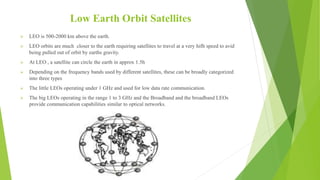
Low Earth Orbit Satellites
 LEO is 500-2000 km above the earth.
 LEO orbits are much closer to the earth requiring satellites to travel at a very hifh speed to avid
being pulled out of orbit by earths gravity.
 At LEO , a satellite can circle the earth in approx 1.5h
 Depending on the frequency bands used by different satellites, these can be broadly categorized
into three types
 The little LEOs operating under 1 GHz and used for low data rate communication.
 The big LEOs operating in the range 1 to 3 GHz and the Broadband and the broadband LEOs
provide communication capabilities similar to optical networks.
Medium Earth Orbit Satellites
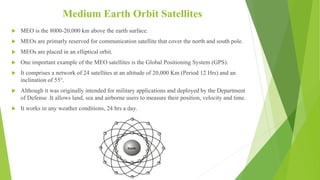
 MEO is the 8000-20,000 km above the earth surface.
 MEOs are primarly reserved for communication satellite that cover the north and south pole.
 MEOs are placed in an elliptical orbit.
 One important example of the MEO satellites is the Global Positioning System (GPS).
 It comprises a network of 24 satellites at an altitude of 20,000 Km (Period 12 Hrs) and an
inclination of 55°.
 Although it was originally intended for military applications and deployed by the Department
of Defense .It allows land, sea and airborne users to measure their position, velocity and time.
 It works in any weather conditions, 24 hrs a day.
Geosynchronous earth orbit Satellites
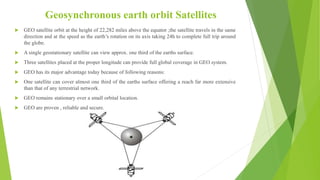
 GEO satellite orbit at the height of 22,282 miles above the equator ;the satellite travels in the same
direction and at the speed as the earth’s rotation on its axis taking 24h to complete full trip around
the globe.
 A single geostationary satellite can view approx. one third of the earths surface.
 Three satellites placed at the proper longitude can provide full global coverage in GEO system.
 GEO has its major advantage today because of following reasons:
 One satellite can cover almost one third of the earths surface offering a reach far more extensive
than that of any terrestrial network.
 GEO remains stationary over a small orbital location.
 GEO are proven , reliable and secure.
SALIENT FEATURES
 Communication from earth station to satellite is called uplink channel whereas
communication from satellite to earth station is called downlink channel. Some
of the features of satellite network are:
 Coverage
 Speed
 Security
 Service types
 Usage
 Repeater
 Packet switched
 Frequency band
SATELLITE ARCHITECTURE
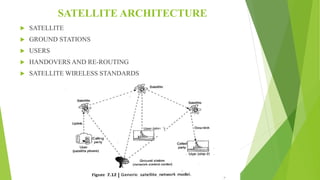
 SATELLITE
 GROUND STATIONS
 USERS
 HANDOVERS AND RE-ROUTING
 SATELLITE WIRELESS STANDARDS
APPLICATIONS
 Weather forecasting
 Navigation
 Astronomy
 Satellite phone
 Satellite television
 Satellite internet and many more
ADVANTAGES OF SATELLITE COMMUNICATION
 Provide global coverage to remote areas.
 Alternate mode of communication in military applications and
disaster recovery scenario.
 Support multipoint communication
 Ease of network expansion and flexibility of station organization
DISADVANTAGES
 Bursts error condition
 Higher bit rate
 Long delay and anormous cost associated with user terminal ,
earth station and satellite as a whole.
 Limited transmission power of both the ground terminals and the
satellite.
REFERENCES
 WIRELESS AND MOBILE NETWORKS BY
DR.SUNILKUMAR S MANVI.
 BROADCAST COMMUNICATION NETWORKS VERSION 2
CSE IIT , KHARAGPUR.
 SATELLITE SYSTEMS BY DR.DHARMA P AGARWAL.
THANK YOU

Satellite Network

  • 1.
    Dr. Ambedkar Instituteof Technology (An Autonomous Institution, Affiliated to V.T.U) Bangalore-560056 SATELLITE NETWORKS A Seminar by, PRIYANKA P B 1TU17LDN04 1
  • 2.
  • 3.
    SATELLITE AND ORBITS An orbit is the path that a satellite follows as it revolves around the earth. Basically , there are three main categories of orbits they are  Low earth orbit (LEO)  Medium earth orbit (MEO)  Geosynchronous earth orbit (GEO)
  • 4.
    Low Earth OrbitSatellites  LEO is 500-2000 km above the earth.  LEO orbits are much closer to the earth requiring satellites to travel at a very hifh speed to avid being pulled out of orbit by earths gravity.  At LEO , a satellite can circle the earth in approx 1.5h  Depending on the frequency bands used by different satellites, these can be broadly categorized into three types  The little LEOs operating under 1 GHz and used for low data rate communication.  The big LEOs operating in the range 1 to 3 GHz and the Broadband and the broadband LEOs provide communication capabilities similar to optical networks.
  • 5.
    Medium Earth OrbitSatellites  MEO is the 8000-20,000 km above the earth surface.  MEOs are primarly reserved for communication satellite that cover the north and south pole.  MEOs are placed in an elliptical orbit.  One important example of the MEO satellites is the Global Positioning System (GPS).  It comprises a network of 24 satellites at an altitude of 20,000 Km (Period 12 Hrs) and an inclination of 55°.  Although it was originally intended for military applications and deployed by the Department of Defense .It allows land, sea and airborne users to measure their position, velocity and time.  It works in any weather conditions, 24 hrs a day.
  • 6.
    Geosynchronous earth orbitSatellites  GEO satellite orbit at the height of 22,282 miles above the equator ;the satellite travels in the same direction and at the speed as the earth’s rotation on its axis taking 24h to complete full trip around the globe.  A single geostationary satellite can view approx. one third of the earths surface.  Three satellites placed at the proper longitude can provide full global coverage in GEO system.  GEO has its major advantage today because of following reasons:  One satellite can cover almost one third of the earths surface offering a reach far more extensive than that of any terrestrial network.  GEO remains stationary over a small orbital location.  GEO are proven , reliable and secure.
  • 7.
    SALIENT FEATURES  Communicationfrom earth station to satellite is called uplink channel whereas communication from satellite to earth station is called downlink channel. Some of the features of satellite network are:  Coverage  Speed  Security  Service types  Usage  Repeater  Packet switched  Frequency band
  • 8.
    SATELLITE ARCHITECTURE  SATELLITE GROUND STATIONS  USERS  HANDOVERS AND RE-ROUTING  SATELLITE WIRELESS STANDARDS
  • 9.
    APPLICATIONS  Weather forecasting Navigation  Astronomy  Satellite phone  Satellite television  Satellite internet and many more
  • 10.
    ADVANTAGES OF SATELLITECOMMUNICATION  Provide global coverage to remote areas.  Alternate mode of communication in military applications and disaster recovery scenario.  Support multipoint communication  Ease of network expansion and flexibility of station organization
  • 11.
    DISADVANTAGES  Bursts errorcondition  Higher bit rate  Long delay and anormous cost associated with user terminal , earth station and satellite as a whole.  Limited transmission power of both the ground terminals and the satellite.
  • 12.
    REFERENCES  WIRELESS ANDMOBILE NETWORKS BY DR.SUNILKUMAR S MANVI.  BROADCAST COMMUNICATION NETWORKS VERSION 2 CSE IIT , KHARAGPUR.  SATELLITE SYSTEMS BY DR.DHARMA P AGARWAL.
  • 13.